Car bombs appear to have been used as a distraction.
Armed men rammed vehicles into a Hidalgo prison and freed nine inmates early Wednesday, state authorities said.
Aided by the detonation of two apparent car bombs in nearby streets, the audacious jailbreak occurred at approximately 4:00 a.m. at a prison in Tula, located about 100 kilometers north of Mexico City.
Local media reports said the vehicle used to ram down the prison door was loaded with dynamite.
One of the freed inmates was the alleged head of a fuel theft gang called Pueblos Unidos. José Artemio Maldonado Mejía, known as “El Michoacano,” was arrested in México state last week on fuel theft, kidnapping, homicide and drug trafficking charges.
The Hidalgo Security Ministry said in a statement that there were clashes between the armed men and prison personnel, adding that two police officers were injured and were receiving medical care. It also said that municipal, state and federal security forces were engaged in an operation to detain the gang members and escaped inmates.
Hidalgo Interior Minister Simón Vargas said “an armed group burst into the prison aboard several vehicles,” adding that “it’s worth noting that near the prison, two vehicles were burned as part of the criminal group’s operation, as a distraction.”
The use of car bombs by Mexican criminal organizations is rare but one such attack in Ciudad Juárez, Chihuahua, in 2010, killed three people. In 2019, explosive devices were found in a vehicle left outside the Pemex refinery in Salamanca, Guanajuato.
While car bombs are rare, cartels frequently set vehicles alight to hinder police operations. So-called narco-blockades have been seen in several states, and Mexico City.
Day of the Dead display in Madrid was a popular attraction.
It is 500 years since the Spanish conquest of Mexico but a line winding around a Madrid block shows that the legacy of half a millennium is more than rancor.
The queue was for an exhibition last month at the Casa de México cultural institute — a display about the Day of the Dead that attracted 65,000 visitors, overwhelmingly locals. Families patiently waited to see traditional altars heaped with model skulls and ceramics, great green glass candelabras and other examples of popular Mexican art.
That level of interest, in a city where rival attractions include some of the world’s great museums and galleries, contrasted with a transatlantic slanging match between politicians.
Mexican President López Obrador stepped up his campaign for Spain to ask forgiveness for its conquest of his country. Isabel Díaz Ayuso, the leader of Madrid’s regional government, contested that Spain had given the Americas the Spanish language, Catholicism “and as a result, civilization and freedom.”
This was always set to be a turbulent year for relations between the old capital and the former colony: 2021 also marks the 200th anniversary of Mexico’s declaration of independence from Spain.
Perceptions of the colonial period differ drastically. Mexico is so marked by the experience that people say “mande” — “command me” — instead of “what”? As a former Mexico reporter now in Spain, I still do a double take when I walk past streets named after the likes of Hernán Cortés, the conquistador who remains many Mexicans’ public enemy No. 1. Cortés is a sinister, simpering presence in Diego Rivera’s great murals in the National Palace in Mexico City, where the viceroys ruled and López Obrador now holds court.
Yet even as politicians shout past each other to rally their bases, culture can be a meeting point. One reason my family went to the Day of the Dead exhibition was because my son, like many other primary-school kids in Madrid, is learning about Mexico.
Some Europeans appreciated Mexican art from the first. In 1520, the German artist Albrecht Dürer visited an exhibition of plundered Aztec treasures in Brussels and wrote: “All the days of my life I have seen nothing that rejoiced my heart so much as these things, for I saw among them wonderful works of art, and I marvelled at the subtle ingenuity of men in foreign lands.”
While those gold necklaces, scepters and mosaics have disappeared, melted down for their gold amid the despoliation of the Aztec empire, the much humbler exhibition at the Casa de México is an exercise in bridge building. “We are a window into Mexico in Spain,” says Ximena Caraza Campos, its director general.
As a Mexican cultural institution the Casa, which gets over 130,000 visitors a year, has government representatives on its board. But its day-to-day operations are privately financed and it was founded by Valentín Díez Morodo, a son of Spanish émigrés who has made millions with Grupo Modelo, Mexico’s biggest brewery (now part of AB InBev). The Casa is his bid to bring the two countries closer, by fostering cultural and also business ties.
Those ties run deep. Mexico has a place of pride, particularly among the Spanish left, for taking in republicans during and after the Spanish civil war. Among them was Luis Buñuel, the Aragón-born surrealist filmmaker, who made, among other Mexican masterpieces, Los Olvidados, about Mexico’s City’s street children.
When I lived in Mexico City, 25 years ago, I used to stroll in Parque España, where a statue of an open hand pays tribute to Mexico’s welcome to the exiles. After landing a freelance job with the Financial Times, I celebrated by taking a slow train to Veracruz, and traveled to La Antigua, the first Spanish town in Mexico, where tropical forest grows among the ruins of Cortés’ house.
By contrast, when the Spaniards built on the Aztec capital of Tenochtitlán, which became Mexico City, their works endured. Mexico remains the country of mestizaje, or mixing, its Spanish legacy an essential ingredient as the two countries’ cultures criss-cross the centuries. Places such as the Casa de México make the subtle ingenuity of people in faraway lands just that little bit closer.
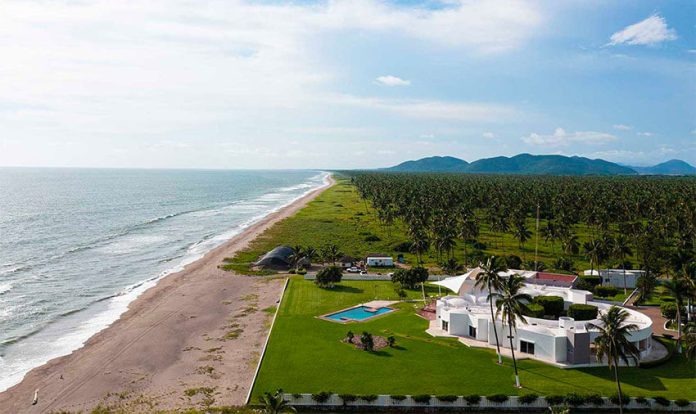
First prize in Sunday's raffle is this home at Playa Espíritu.
A beachfront property in Sinaloa will be the star prize in a lottery whose proceeds will help build a new hydroelectric plant in the state, President López Obrador said Tuesday.
The 12,000-square-meter property on Playa Espíritu, located on the Sinaloa-Nayarit border, has 11 bedrooms, a swimming pool and a terrace and is valued at 28.9 million pesos (US $1.36 million)
The government hopes to generate 5 billion pesos (almost $233 million) from the lottery to meet half the cost of the Santa María hydroelectric dam in El Rosario, 73 kilometers southeast of Mazatlán.
“Everything that is obtained by raffling this land goes to Sinaloa … [the dam] is a project of around 10 billion pesos,” the president said.
“Buy your ticket … to get yourself a safe property … It’s an Eden, a paradise.” A ticket costs 250 pesos and the draw will be held Sunday.
Second, third and fourth-place prizes of 5 million pesos each will be awarded, followed by 200 waterfront lots, each with a value of about 1.2 million pesos.
The total value of the prizes is 297 million pesos, said the head of the National Lottery, Margarita González Saravia.
The lottery’s first prize is a ranch that belonged to former Institutional Revolutionary Party (PRI) governor Antonio Toledo Corro. The land in the area was bought in 2008 by the National Tourism Promotion Fund (Fonatur), during the administration of president Felipe Calderón, to create a tourist destination.
However, the project failed because the property was bought at an elevated price, López Obrador said. He added that the cost of the upkeep posed a challenge. “Fonatur bought it for around 2.5 billion pesos ($22 million in 2008) and since then they had to continue spending on the land … they exceeded 4 billion pesos. It is difficult to maintain it. No one has wanted to invest … because it is not accessible,” he said.
Presidential raffles have been a frequent sideshow during the López Obrador administration. The presidential plane was advertised as a prize in a 2020 raffle, but symbolic cash prizes were awarded instead, and the plane is still in possession of the government. Box seats in the Azteca Stadium, which were a governmental asset, and the properties of drug traffickers were given away as prizes in September.
The lottery will be broadcast live on Sunday at 8:00 p.m.
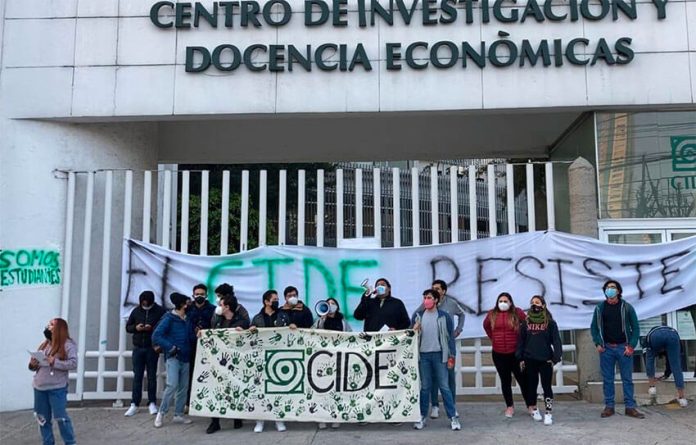
The protest against the appointment of a new director at CIDE.
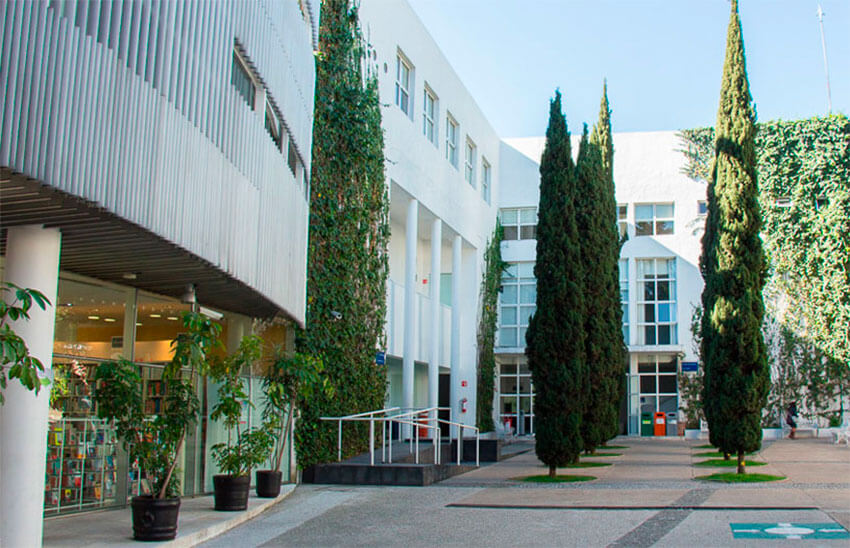
Against the wishes of students and a large group of academics, the interim director of a prestigious Mexico City-based public university and think tank has been appointed to the position on a permanent basis.
José Antonio Romero Tellaeche, an economist, was appointed director of the Center for Research and Teaching in Economics (CIDE) for five years after a unanimous vote to ratify his permanent tenure, announced María Elena Álvarez-Buylla, director of the National Council of Science and Technology.
The vote, in which seven external academics participated, took place Monday. Álvarez-Buylla’s claim that the vote was unanimous was disputed.
Romero has been rejected by students due to his dismissal of academics since taking the reins of the university as interim director in August and his declaration that CIDE has become a “neoliberal” institution. He was also criticized for describing students as “sponges” that only absorb what their professors want them to.
President López Obrador is a fierce critic of what he describes as Mexico’s “neoliberal period” – 1982 to 2018 – and claims his government is carrying out the “fourth transformation” of the country. He said Monday CIDE had “moved to the right” and that the government’s wish was for “chieftainships” in academia to come to an end.
CIDE is considered one of Mexico’s top think tanks, according to Wikipedia.
Álvarez-Buylla said Monday “CIDE is an institution of the Mexican state and must adhere to the new realities.”
After his appointment, Romero pledged to manage the university in a “democratic” way and committed to establishing an environment of “stability, freedom and plurality.”
“… It’s necessary to establish new lines of research … that propose … solutions to outstanding problems,” he said, indicating that he wanted to take the university in a more pragmatic direction.
While Romero said he was committed to democratic administration of the university, the voices of students and many academics were apparently not heard during the process to designate him as director.
Students have been protesting against his leadership since he became interim director, and occupied CIDE’s Mexico City campus and declared an indefinite strike after his permanent appointment on Monday. They also prepared a petition calling for his dismissal and launched legal action aimed at stopping his appointment as permanent director. They remain hopeful they will receive a court ruling in their favor.
“This person has a unique way of thinking and he wants to impose it [on the university]. What we’ve seen [so far] is just a taste of what he could do to the institution, that’s why we won’t let him,” Ramón, a student, told the newspaper El Universal.
“We’re fighting for a CIDE that conforms to the international and national vanguard, and to the needs of society.”
José Antonio Aguilar, a CIDE academic, suggested that Romero himself was not the problem but rather “the intervention of political power in universities.”
“That’s the central problem causing the CIDE crisis,” he said. If that’s the case, the interim and then permanent appointment of Romero added fuel to the fire.
A large number of CIDE academics and administrative staff expressed their preference for the appointment of Vidal Lleranas, a former federal deputy, over Romero. In an internal assessment process, the former achieved a score of 8.98 while the latter scored 7.29.
However, CIDE academics and staff, via the university’s permanent Academic Assembly, claimed their views weren’t taken into account. They also said there were other irregularities with the appointment process. One was the refusal to allow a CIDE academic council observer into the meeting on Monday at which the vote took place.
Academics also expressed support for the protesting students. “We call on the authorities to respect their right to peaceful protest,” they said in a statement.
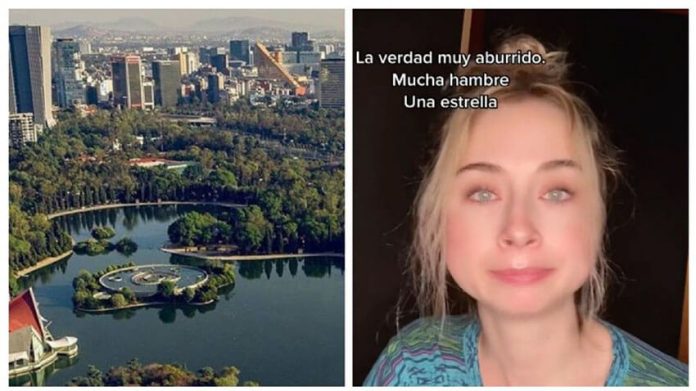
After seeing Chalpultepec, Central Park is nothing special, a TikToker reported.
New York’s world famous Central Park pales in comparison Mexico City’s Chapultepec Park, an Australian TikToker said, to the acclaim of Mexican viewers.
“For those that don’t believe me that Central Park is the lame version of Chapultepec, I’m going to show you my videos so you see,” user @itBends said, in a stylized video.
She then showed clips taken in Central Park and complained that the only food she found there were pretzels, which she said were “the driest thing in the world, more like cardboard than food.”
In a mocking tone, she added that the New York park had lots of grass, a bridge, people drinking and playing music, and skyscrapers which she said “the Reforma [avenue in Mexico City] has a lot of.”
The TikToker concluded that Central Park was worthy of one star, having left her hungry.
@itBends’s select public seemed to agree with her. “Most people don’t value it [Chapultepec], and TV and Hollywood hypnotizes them to think that all of the best things are in the USA, when the coolest things are here [in Mexico],” replied Gustavo Chavez.
Yaxum Cervantes Gali also attested to the Mexico City park’s superior offering: “Chapultepec: museums, fountains, lakes, giant heads, food, monuments, a castle, a zoo. Central Park: a bridge and some pretzels.”
Central Park opened its gates in 1858. Meanwhile, news website Animal Político reported that trees in Chapultepec date back to the 15th century.
Chapultepec is the biggest park in Latin America and at 686 hectares is more than double the size of Central Park.
Police officers sometimes face threats or forced recruitment into criminal gangs.
Police officers, at least one member of the National Guard and a prison guard have fled to Tijuana in recent months to escape the tentacles of organized crime.
The newspaper El Universal visited a migrants’ shelter in the northern border city where approximately 10 police officers, a guardsman and a female prison guard took refuge after fleeing notoriously violent states such as Guanajuato, Guerrero and Michoacán.
They left their homes to avoid death or forced recruitment by criminal groups, the newspaper said. Most if not all traveled to Tijuana to seek asylum in the United States.
The director of the shelter, who wasn’t identified for security reasons, said police and other internal migrants flee their homes because no one protects them in the face of threats from organized crime. He said that an auxiliary part of the shelter has been set aside for such people, some of whom travel to Tijuana with their families.
One such person is Alicia, a former prison guard, who left Michoacán almost a year ago with her children, a nephew and her mother. She gave up her job to save her life and that of her family, El Universal said, adding that she planned to seek asylum in the United States.
“I was very good at what I did, it was my vocation,” Alicia said. However, being a prison guard is “almost a death sentence,” she said.
“… We proudly wear a uniform that exposes us, it’s not fair,” Alicia said.
She explained that she had to quit her job because inmates were pressuring her to allow them to receive drugs, as other guards did. Because some of her colleagues allowed drugs to flow into the jail, Alicia said, the prisoners felt like they had the right to tell her what to do.
In the middle of last year, about six months after she left her job at the prison, Alicia and her brother were abducted from their home by members of a criminal group that operates in their town, El Universal said, without identifying the group or the town. The aim of the armed men was not to kill them but force them to work for them.
“We’re going to send you to train,” Alicia recalls the men telling her and her brother after they were taken to a hilltop they were beaten. They were released but armed men subsequently monitored their movements for weeks. Alicia began to plan her escape.
She told El Universal that she didn’t want to travel north by bus out of fear that criminals would stop it and set the passengers on fire. She waited until she was no longer being followed and traveled with her family to an airport – presumably that in the state capital Morelia – to take a flight to Tijuana.
While Alicia and some of her family members escaped the violence that plagued their town, her sister remained at home and was abducted earlier this year. She remains missing.
Alicia told El Universal she hopes she and her family can have a future without threats in the United States. The newspaper didn’t say whether they have filed an application for asylum.
“… I didn’t want to leave [Michoacán], I wanted to stay. My boss at the prison gave me a letter of recommendation in case I wanted to return one day but [with the way things are] how can I? [How can I go back] if they abducted my sister, my mom is almost dying of sadness and my brother and I were almost killed?”
Former beauty queen Emma Coronel, wife of Joaquín “El Chapo” Guzmán.
The wife of the convicted drug trafficker and former Sinaloa Cartel chief Joaquín “El Chapo” Guzmán was handed a three-year jail sentence in a United States court on Tuesday after she requested leniency from the judge.
California-born dual citizen Emma Coronel Aispuro, 32, was on trial on charges of drug trafficking and financial crimes, and faced the possibility of life imprisonment.
She pleaded guilty in June to three counts of conspiring to distribute illegal drugs, conspiring to launder money and of engaging in financial dealings with the Sinaloa Cartel. She also admitted to aiding her husband’s audacious escape from a maximum security prison in México state in 2015.
Federal prosecutors had asked for a lenient four-year prison term, considering that she would also be forfeiting US $1.5 million as part of her sentence.
The former beauty queen has nine-year-old twin daughters with Guzmán, who was sentenced to life in prison in the U.S. in July 2019 on charges of drug trafficking, conspiracy, kidnapping and murder.
Coronel pleaded for mercy from U.S. District Judge Rudolph Contreras at the hearing on Tuesday.
“With all due respect, I address you today to express my true regret for any and all harm that I may have done, and I ask that you and all the citizens of this country forgive me,” she said in Spanish through an interpreter.
She added she feared a harsh sentence due to her husband’s infamy.
“Perhaps for this reason you feel there is a need for you to be harder on me, but I pray that you do not do that,” she said.
Federal prosecutor Anthony Nardozzi said Coronel’s involvement in the organization was minor. “While the overall effect of the defendant’s conduct was significant, the defendant’s actual role was a minimal one. The defendant acted primarily in support of her husband,” he said.
Nardozzi added that after her arrest she “quickly accepted responsibility for her criminal conduct.”
Coronel’s lawyer, Jeffrey Lichtman, who also represented Guzmán in 2019, said she deserved leniency. “She met Joaquin Guzmán when she was a minor. She was 17 years old, and she married him on her 18th birthday … I’m not sure that she could ever go back home,” he said.
Judge Contreras said he took Coronel’s background into consideration, and weighed up the well-being of her daughters in the sentence, given their father’s imprisonment.
“Good luck to you,” Contreras told her as the hearing concluded. “I hope that you raise your twins in a different environment than you’ve experienced today.”
Coparmex said the base salary should gradually increase to 228.75 pesos (US $10.65) a day by 2024.
The national minimum wage should be increased by 8% in 2022, the Mexican Employers’ Federation (Coparmex) urged this week.
Coparmex proposed bumping minimum daily pay to 172.87 pesos (US $8.06), up from the current 141.70 pesos ($6.60).
The business group suggests reaching 228.75 pesos ($10.65) per day in 2024 through gradual increases, at which point two earners in a family of four could bring the family above an established standard for well-being.
More than 14 million Mexicans — 24.9% of the workforce — earned the minimum wage in October, according to figures from the National Statistics Institute (INEGI).
Coparmex claimed that if the 2024 target is reached, two people working in a family could “meet their food needs, but also cover essential needs for transportation, personal care, education, clothing and recreation.”
It added that the increases would have to be adjusted and kept in line with any rises in inflation.
The National Minimum Wage Commission is required to announce an increase to the daily minimum wage by December 31, which will take effect January 1. The minimum wage, one of the lowest in the Americas, was raised 15% from 123.2 pesos at the start of this year.
In the United States, the lowest legal pay is $7.25 per hour, more than the daily rate in Mexico. President López Obrador has complained that the minimum wages of Guatemala, Honduras and El Salvador are higher than that of Mexico.
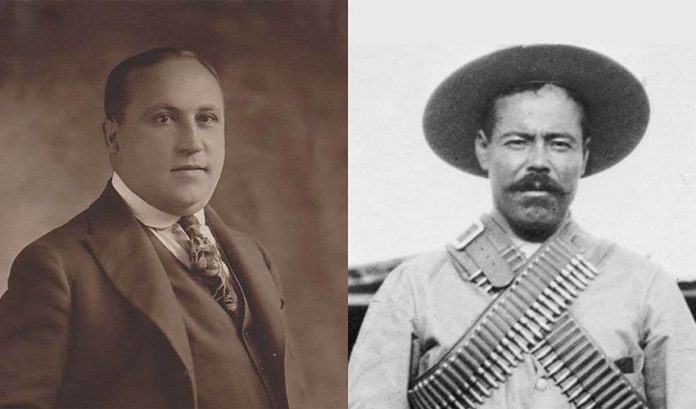
Stacey Ravel Abarbanel's family lore claimed that Pancho Villa invaded Columbus, New Mexico in 1916 to kill her grandfather, Sam Ravel, left.
From early on in life, filmmaker Stacey Ravel Abarbanel recalls learning about her family’s unique connection to Pancho Villa.
When the Mexican revolutionary raided the town of Columbus, New Mexico, on March 9, 1916 — the only time in the 20th century that the continental United States was attacked by a foreign army — family lore held that one of his motivations was to kill Abarbanel’s grandfather, Sam Ravel.
A Jewish immigrant from Lithuania, Ravel became a prominent merchant in Columbus. During the Mexican Revolution, some say, Villa was Ravel’s client for a weapons deal that misfired. Abarbanel grew up with chilling narratives about the resulting raid.
Although her grandfather was out of town that day, his brothers Arthur and Louis were both present. Arthur claimed he was injured, detained by the Villistas, then miraculously escaped with his life.
Abarbanel explores her family’s role in the narrative of Columbus in her new film UnRaveling.
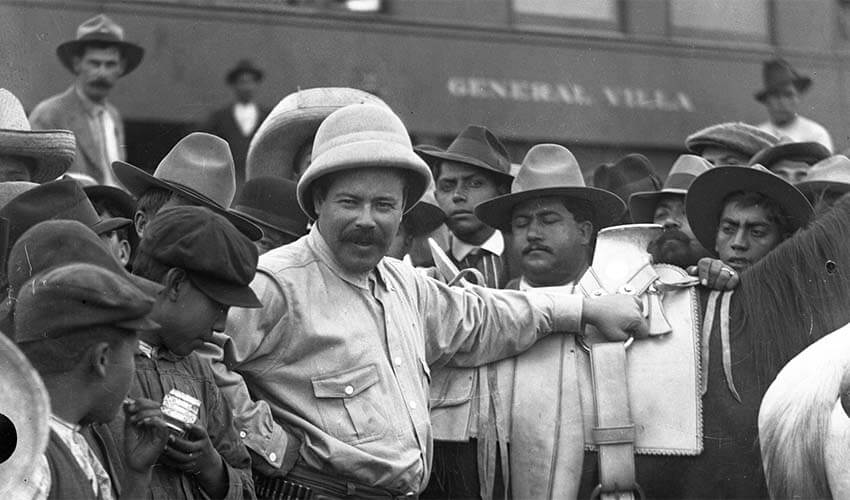
Pancho Villa circa 1910-1920. University of California, Riverside, Special Collections
“I think my family was incredibly lucky that day,” Abarbanel said. “My grandfather Sam was very fortunate he was not in town …”
Several weeks ago, it made its world premiere at the Doc LA film festival, where it won the best mid-length documentary award. It was most recently streamed at the Hanukkah Film Festival on November 28.
Villa himself appears in archival photos and footage, and Abarbanel travels to Columbus in 2020, during the annual commemoration in March, days before the first COVID-19 case in New Mexico and the state’s subsequent shutdown.
“The most interesting part of the narrative is how the people in the border region continue to tell, to this day, what happened in the raid,” she said. “They very much have their own way … they really keep this narrative alive for themselves.”
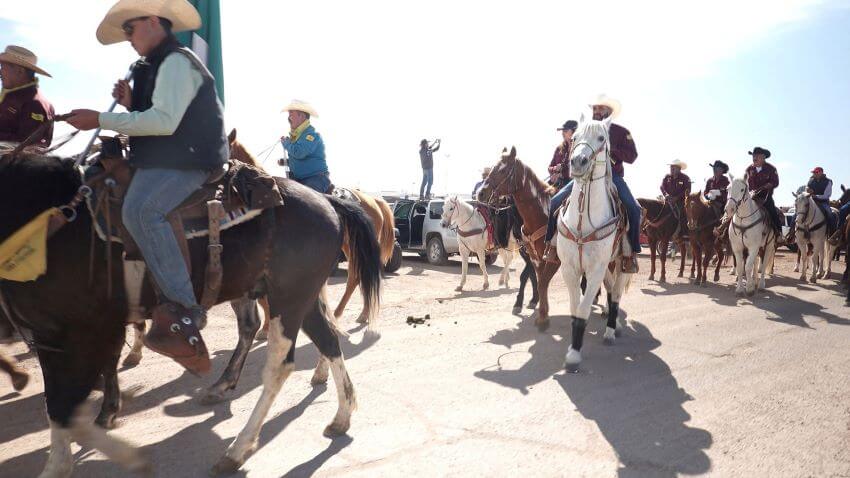
She filmed a unique group of equestrians who travel hundreds of miles from Mexico for the commemoration each year — the Cabalgata Binacional Villista. One member of the group — Ignacio Montoya, who was born in the U.S. and who has worked for American companies in Mexico — says in the film that the group “unite[s] all frontiers.”
“What a dramatic and beautiful moment that is,” Abarbanel said of the Cabalgata. “It runs contrary to a lot of people’s perceptions of the border.”
The Cabalgata Binacional Villista at the 2020 commemoration of the Villa raid into Columbus.
“So often,” she added, “you read really kind of negative news stories about conflict. In this case, you see the border in a really different light.”
Abarbanel originally chronicled her family story in a 2019 article for Tablet magazine entitled “Pancho Villa and My Grandfather.” She then decided to make it into a film.
She wrote the screenplay and produced it with Jeff Swimmer directing. A key step came when she encountered historian William McGaw’s archive of interviews with people from the American Southwest — including her late uncles Arthur and Louis.
“To me, it struck gold,” Abarbanel said. “It was pretty remarkable hearing them telling stories firsthand.”
That included Arthur saying that he was injured during the melee.
“Obviously, it’s something we all heard,” Abarbanel said. “He himself said a bullet whizzed by his ear … it speaks to how family lore gets passed down, accurate or not.”
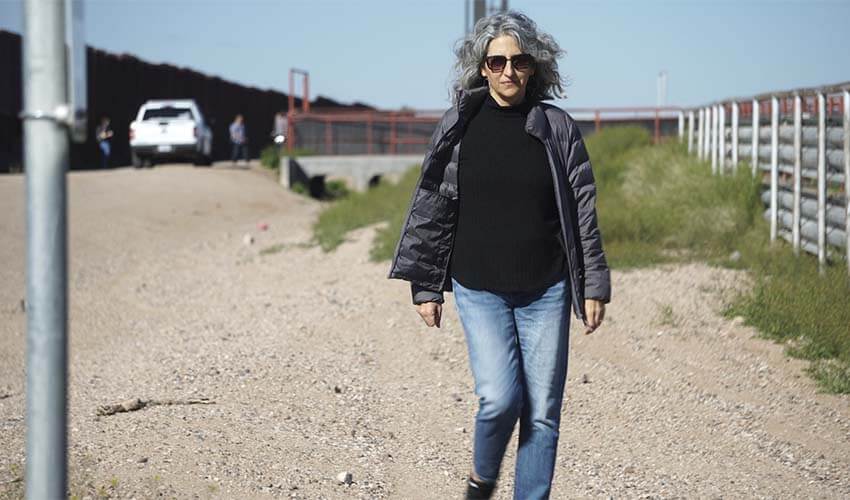
UnRaveling’s creator Stacey Ravel Abarbanel at the border wall in Columbus, New Mexico.
Throughout the project, Abarbanel had to unravel differing versions of the story — including about why Villa might have targeted her grandfather in the first place.
“Of the stories that get told about my grandfather Sam,” she said, “all are in the context of an arms deal that went wrong. There are various versions I can find … I have no way of knowing which version of the story is true.”
And, she said, “I always try to be very clear with everyone when I hear people repeating this story. A lot of people in reputable history books, serious historians, present many reasons [why] Villa raided the town.”
At that point, her grandfather had been in Columbus for nearly six years, and in the U.S. for over a decade.
Originally from eastern Europe, he had landed in America on September 11, 1905, on a ship that docked at Galveston. Abarbanel describes his narrative in the American Southwest as differing from perceptions that Jewish immigration to the U.S. was centered in New York.
“In the 19th and early 20th century, there were a small number of individuals, Jewish immigrants, who made their homes in the Southwest, including my grandfather,” she said. “They lived their lives very differently … In the case of my grandfather, he came here a Yiddish speaker, but he and his brothers had to learn English and Spanish.”
Arthur and Louis Ravel inside Sam Ravel & Brothers store.
In Columbus, Sam was soon running or helping to run several businesses — the Commercial Hotel, the town’s first movie theater and a general store. Eventually, he saved up enough money to bring both of his brothers there.
The general store became a family enterprise where a visitor could get everything from milk to bullets.
“[Sam Ravel] arrives in November 1910, right around when most historical perspectives [date] the start of the [Mexican] Revolution,” Abarbanel noted. “Columbus was a very small town. It had a border crossing with the international town of Puerto Palomas.
“What little I was able to glean from his business dealings is that a major part … was doing business in Mexico. In 1914, he delivered goods down there to revolutionaries … He was arrested. The U.S. government intervened to get him out.”
According to the film, the goods included firearms — a Colt pistol plus three rifles — as well as 180 rounds of ammunition. Another controversial arms deal allegedly took place two years later between Ravel and Villa in the lead-up to the raid on Columbus.
Regardless of why Villa attacked the town, the early morning hours of March 9, 1916, were terrifying for the population of Columbus — including the Ravel family.
UnRaveling - Teaser
The trailer for the documentary UnRaveling.
As Arthur relates in the oral history recording, his brother Louis hid under the bed while he himself was apprehended by the Villistas. They demanded that he take them to Sam.
But Sam was in El Paso for a medical appointment. They did not believe him.
Although the Villistas killed a total of 19 Americans, they spared Arthur’s life while hunting for his brother. Ultimately, U.S. forces drove out Villa’s men, killing 75 of them.
The government of President Woodrow Wilson subsequently ordered a military force led by General John Pershing into Mexico to find Villa. The influx of troops created a boomtown in Columbus and briefly made it the state’s largest city.
Yet Pershing returned months later after a failed pursuit.
Arthur says in the recording that while the family did business with other revolutionaries, it never did so with Villa.
“My uncle sort of disavowed that the Ravels had any dealings at all with the Villistas,” Abarbanel said. “It’s very, very likely they did do business with the Villistas.”
Even if the details remain hard to pin down, Abarbanel’s film fulfills its title goal of unraveling a family mystery.
“All I really want for the film is to reach as big and broad an audience as possible,” she said. “It’s just at the beginning of the screenings of the movie. I hope it continues for a long time.”
Rich Tenorio is a frequent contributor to Mexico News Daily.
President López Obrador at his Tuesday morning press conference. Presidencia de la República
Almost two-thirds of Mexicans support President López Obrador, a new poll indicates.
Conducted by the polling firm Mitofsky for the newspaper El Economista, the poll found 65% approval for the president, his highest rating since April 2019.
The only month since López Obrador took office in December 2018 when he had a higher approval rating was February 2019, when it hit 67%.
The president’s popularity has been trending upwards in recent months after reaching a 2021 low of 57% on the monthly El Economista poll in July.
His approval rating rose one point to 58% in August, jumped five points to 63% in September and increased another point to 64% last month before adding an additional point in November.
Among the six most recent presidents, López Obrador has the second highest approval rating after three years in office. Only Carlos Salinas, widely considered one of Mexico’s most corrupt presidents, had a higher approval rating – 77% – halfway through his six-year term.
The results of the poll, conducted over the internet with more than 34,000 respondents, showed that AMLO, as the president is best known, finds his strongest support among campesinos, or small-plot farmers. Almost 83% of campesinos said they approved of the president’s performance, while 72% of informal sector workers – such as street vendors – said the same.
Businesspeople and professionals expressed the lowest levels of approval at 47.6% and 50.3%, respectively.
Poll results also show that López Obrador has at least 60% support in 22 of Mexico’s 32 states. His approval rating is 50-59% in eight states and 40-49% in two – Jalisco and Querétaro.
The survey posited that a lot of the problems AMLO inherited from previous governments persist and asked respondents how much longer the president needs to solve them.
Those polled were given four options. The most popular was “he needs to finish his six years before he is judged,” with 43.7% of respondents choosing it, followed by “he will never achieve it” (26.8%); “he already managed to improve the country” (24.1%); and “he needs one more year before being judged” (2.1%).