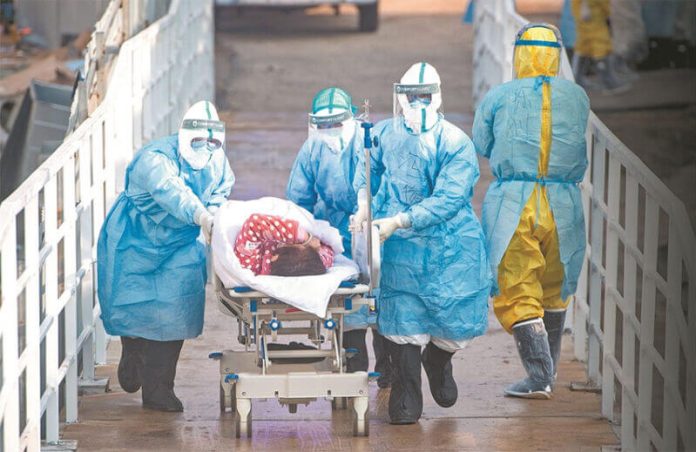
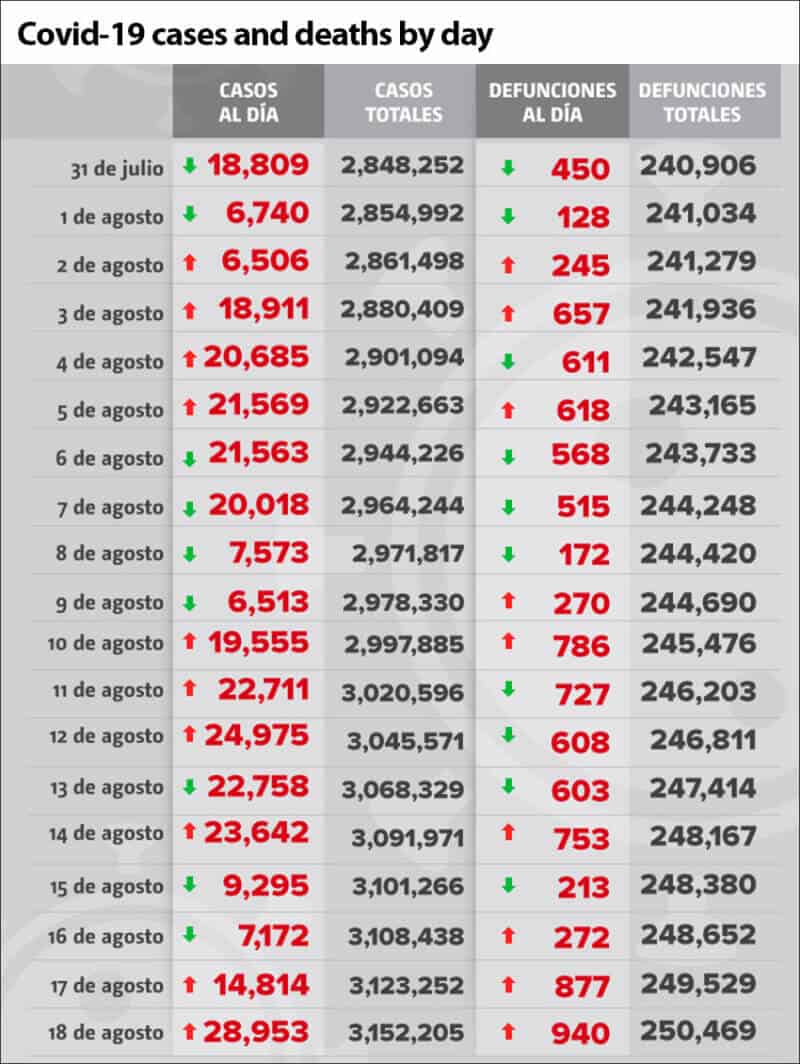
The number of new Covid cases set a record on Wednesday. The federal Ministry of Health reported 28,953 cases in the previous 24 hours, breaking the record set last week.
The number of estimated coronavirus cases shot up to 145,716 and there were 940 deaths.
Coronavirus cases and deaths in Mexico as reported by day. milenio
Ten states are experiencing the worst of the outbreak, and represent 66% of all cases in the country. They are Mexico City, México state, Nuevo León, Guanajuato, Jalisco, Tabasco, Puebla, Sonora, Veracruz and San Luis Potosí.
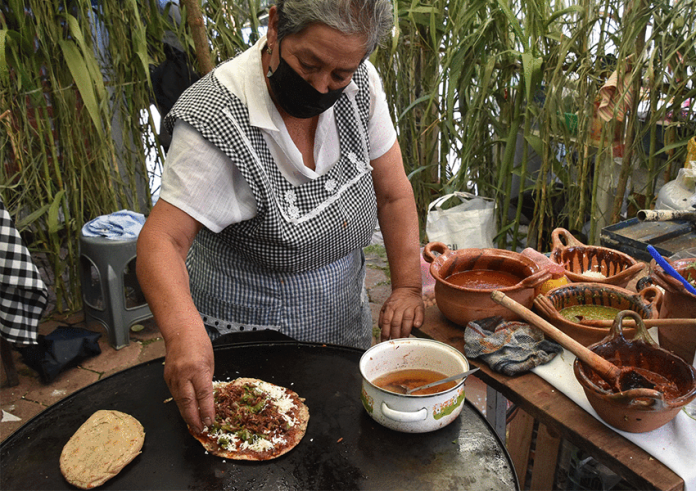
Adela González, one of the fair's vendors, makes Puebla's popular memelas (large corn tortillas) hot and fresh on the comal grill. photos by Joseph Sorrentino
The 12th Feria de la Nuez de Castilla in San Pedro Yancuitlalpan, Puebla — a fair celebrating traditional food found in and around San Pedro that opened this past weekend and runs for two more — is definitely not a place to go if you’re on a diet. But it’s a great place to eat some excellent cuisine from the state — and not just chile en nogada, one of the state’s signature dishes.
About 20 stands are set up on the grounds of the Church of the Immaculata Concepción (which was probably built atop a pre-Hispanic pyramid). The majority are found in the lower area of the church grounds and all of the stands located there are serving one of the dishes the region is famous for.
“Chile en nogada is the main dish served here, and the most popular,” said Ana Maria Sandie Trifundio, who organized this year’s fair and has her own stand. “It is because the people from San Pedro produce all the ingredients.”
Chile en nogada is a poblano chile stuffed with fruits, nuts and, typically, pork. It’s then covered with a delicious white sauce made with walnuts, queso fresco (farmer’s cheese) and queso Filadelfia (Philadelphia cream cheese) that’s thinned with a little milk and topped with a sprig of parsley and some pomegranate seeds, giving the dish the colors of the Mexican flag.
Although chile en nogada can now be found all across Mexico, it’s most closely associated with Puebla and with August and September, when the ingredients needed to make it are being harvested.
Local products and the traditional Puebla dishes made from them are the stars at the fair, in its 12th year.
But the vendors set up directly in front of the church go beyond chile en nogada.
Filomena Amozoqueño has been selling her food at the fair for 10 years, serving up bean tamales, nopal salad and rice as well as mole rojo and mole verde. Salsa de chito — a salsa she makes by hand using tomatoes, guajillo chile and garlic, to which she adds some dried goat meat — is one of her specialties, she said. “This fair is important because it preserves our tradition,” she said, “and also helps us economically.”
Across the plaza from Amozoqueño’s stand is Antojitos Doña Ade, where owner Adela González can be found presiding over a Mexican skillet called a comal. She’s a traditionalist when it comes to preparing food. “Everything is made by hand,” she said. “We are accustomed to making things by hand, and the food has a better flavor.”
She makes memelas, thick corn tortillas that she toasts on the comal and covers with beans and salsa. There’s also an interesting, and extremely tasty, tostada made with blue corn, which has requesón (a ricotta-like cheese), crema, avocado and pomegranate seeds — another nod to the Mexican flag. “We only use food that is produced here,” she added proudly. “Even the requesón is made here.”
For the more adventurous, her food can be topped with chapulines: roasted grasshoppers. According to a sign hanging above her stand, chapulin is a Náhuatl word meaning “insects that jump like a rubber ball.” Grasshoppers are rich in several vitamins and minerals and a good source of protein.
“I was sent an invitation,” said Maria de Socorro Tlapa of Cholula, who trained as a chef and is the owner of Yuyu Cupcakes there. She was enjoying González’s food with her brother, Alejandro Tlapa, including the grasshoppers. “I like that the food is continuing the tradition in the area,” she said. “Here, I like the tostada with chapulines. Chapulines are crunchy but soft, a little spicy and acidic because lime is added.”
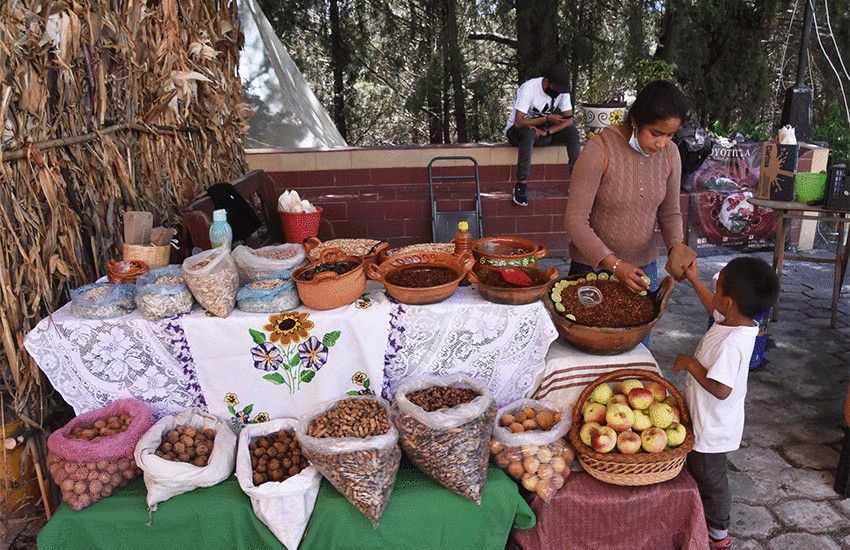
After enjoying some of the cuisine, strolling around the grounds a bit and perusing what non-edible items are available is a good way to make room for dessert. Marcelina Gómez Analco’s stand features jewelry she makes from beans, nuts, peach pits and acorns.
“I make these,” she said, “so people can buy something that will remind them of the pueblo.”
Nearby, Lidia Temich Cantero was selling objects made from a pine tree called Ocote Moctezuma, a tree whose needles are very long. “I collect the material that has fallen on the ground,” Temich explained. “[I] wash it and dry it well. I can then make things from it.”
The earrings and hair barrettes she sells take her about half an hour to make, while larger items like a small bag will take her about a week.
Yeni Popoca Fernández has an ice cream stand on one side of the church where she sells helado de nogada.
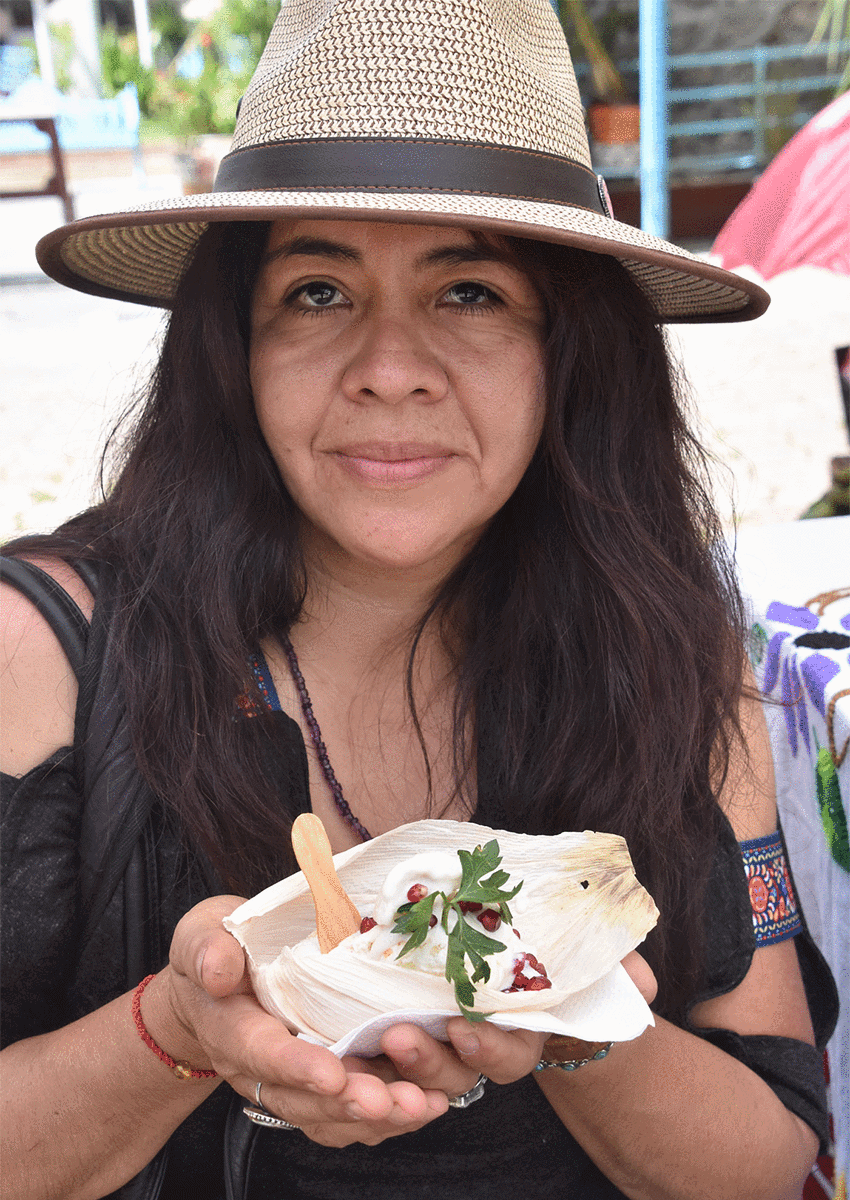
Martha Cabrera with her helado de nogada, an ice cream dish using some of chile en nogada’s elemental ingredients.
This dish is vanilla ice cream with walnuts, apples, peaches and pears. She tops it with crema de salsa nogada (a sauce made from walnuts), pomegranate seeds and a sprig of parsley — these seem to be required at the fair — and serves it in a corn husk.
Martha Cabrera sat nearby, greatly enjoying the dessert. “The helado en nogada has a good flavor, and I liked the concept of using corn husks instead of plastic plates,” she said. “I also like that it is decorated like chile en nogada.”
Another stand has buñuelos — large fried dough that can be topped with sugar or honey. Or both, if desired.
The annual fair, said Sandie, is an opportunity for the pueblo to highlight and share its traditional foods.
“We do this to rescue our roots and the origins of the pueblo, to rescue pre-Hispanic foods,” she said. “We have food like … cacamas [beans], yelo tlachchal [a tortilla made with corn and honey], tlapextumal [a flat tamale with mole verde] and salsa made by hand. This is food that is healthy and flavorful.”
San Pedro, like everywhere in the world, was affected by the virus. Popoca’s family all had Covid-19. “We were in quarantine for 40 days,” she said.
[wpgmza id=”343″]
Despite that, she’s at the fair. “I am nervous. Everybody is. But we have to work. We have to pay for everything. It is like I say, ‘If I stay home, I die from hunger. If I go out, I die from Covid.’”
She wore a mask, something that’s required to enter the grounds, and used sanitizing gel liberally, as did all of the fair’s participants. The fair is held outdoors to lessen any chance of transmission.
The event runs for two more weekends — on August 21–22 and on August 28–29. It opens around 11:00 and closes when, as participating cook Sandra Popoca Ochoa said, there are no more people to serve. Or, as Amozoqueño put it, “Hasta que el cuerpo aguante” (as long as the body allows).
A heads-up: one of the invitations sent out to this event — the one that de Socorro had — says that San Pedro is a 20-minute drive from Cholula. Unless you’re driving even faster than most people in Mexico, it’s actually about 45 minutes. But it’s worth a trip, however long it takes.
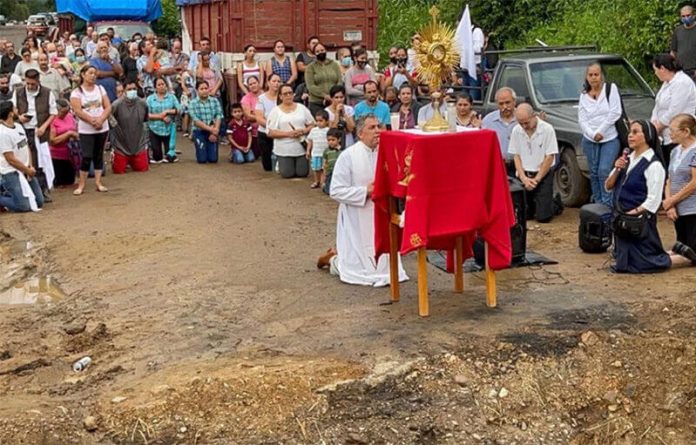
Rev. José Luis Martínez Chávez leads Mass next to the place where an armed group damaged the road, blocking access.
Residents of a city in the Tierra Caliente region, ravaged for months by a cartel turf war, prayed for peace alongside church leaders on Monday.
The group held a Mass next to a highway in Coalcomán, Michoacán, where a cartel has cut off access. The faithful numbered around 100 in a photo published by the newspaper El Universal.
Hundreds of families, at least 3,000 people, have fled Coalcomán in the last 11 days, forced out by violence and its related afflictions: shortages of electricity, food, water, and phone and internet services.
The city is only about 50 kilometers (126 kilometers by road) from Aguililla, the center of a violent turf war between the Jalisco New Generation Cartel (CJNG) and the Cárteles Unidos.
Residents, municipal authorities and church leaders have complained that although state and federal security barracks are present in the area, local people have not been afforded any protection.
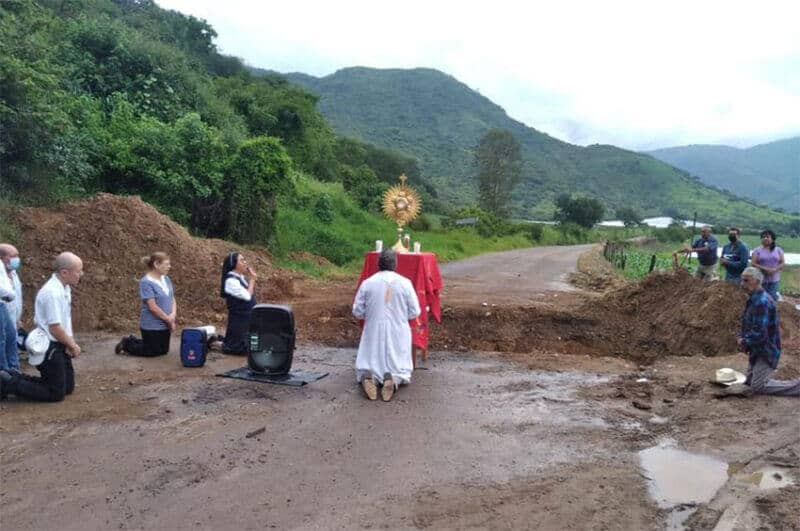
The priest prays in front of one of the ditches dug by armed groups to block access to Coalcomán.
Priest José Luis Martínez Chávez, who led the prayers, explained his motivation in video uploaded to Facebook: “We wanted these antagonistic groups, powerful groups … to know that we are praying for peace and that we are not afraid … we want to collapse the walls of hatred they have created, to create fraternity. Where they have opened ditches, we want to build bridges, where they have sown hatred we want to sow peace,” he said.
One resident revealed the undignified way residents had been treated. “We had to leave … by motorcycle because the roads were being cut off. [The criminals] took us and left us without any clothes,” she said.
She explained that 10 members of her family were forced to abandon their homes when armed men arrived, and had no time to gather important documents. She said they thought they would be killed and their houses burned.
A mother detailed her family’s rushed escape. “I was afraid we wouldn’t get out, as we were in the middle of the shootout … that was my worst fear, that we wouldn’t be able to get out of there alive … We took the risk to leave in the van. We had to leave everything. We got away in just what we were wearing and fast, because we were afraid that we’d get hit by a bullet,” she said.
Governor Silvano Aureoles downplayed the violence in the area: “There are exchanges of gunfire from one hill to another, but obviously, the people who live in the communities there are afraid,” he said.
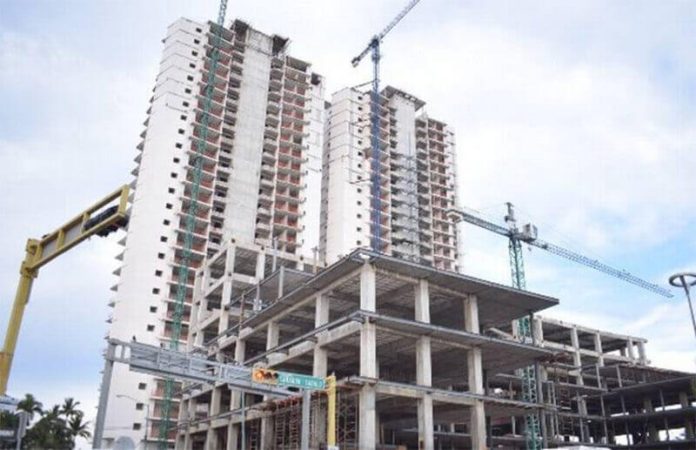
Forty new vertical developments are planned for Mazatlán in 2021.
A boom in real estate construction and speculation has kept the economy in Mazatlán, Sinaloa, afloat over the last 14 months and through the Covid-19 pandemic, with domestic buyers to thank.
Seventy percent of sales have come from customers in Durango, Chihuahua, Coahuila, Nuevo León and Jalisco as well as the U.S. Latin American market, according to state Chamber of Commerce representative Óscar Tirado Bernal.
In the last 32 months, 36 billion pesos (about US $1.8 billion) in private investment has arrived in Mazatlán, of which 63% went to tourism-real estate. Forty new vertical developments are planned for 2021 and the economic future looks bright for the next 10-15 years, according to the newspaper El Sol de Mazatlán. A new aerospace park for cargo plane construction and a new cruise ship pier are both in development.
Tirado said the recent success of the real estate market had gone against predictions. “Surprisingly, unlike what was expected, in the last 14 months a very good level of sales has been maintained for Mazatlán … so hopefully this will continue for a few more years,” he said.
He added that business was coming from domestic buyers. “The national investor has displaced the international. Mazatlán is becoming a total investment destination for Mexicans. As long as the momentum for beach destination real estate continues, it will generate great confidence.”
The Chamber of Commerce executive and real estate agent also mentioned price as a factor: for a beach destination, property in Mazatlán is much more affordable than rival destinations like Puerto Vallarta, Los Cabos and Cancún. In those highly international destinations, prices can be double what they are in the Sinaloa beach city.
The most sought after areas in Mazatlán are beach locations at Malecón, Zona Dorada and Cerritos, which cost around 7 million pesos (about $350,000).
However, more affordable properties, at 3.5 to 4.5 million pesos (about $175,000-$225,000), are available in the city center, Playa Sur, Olas Altas, Palos Prietos, Ferrocarrilera, Lomas de Mazatlán, Sábalo, Gaviotas and El Dorado, and parts of Cerritos.
In Tirado’s view, buying in the city is a prudent investment and lifestyle choice. “You can enjoy it, and above all that you can receive a return on investment by renting to people who are planning on buying here,” he said.
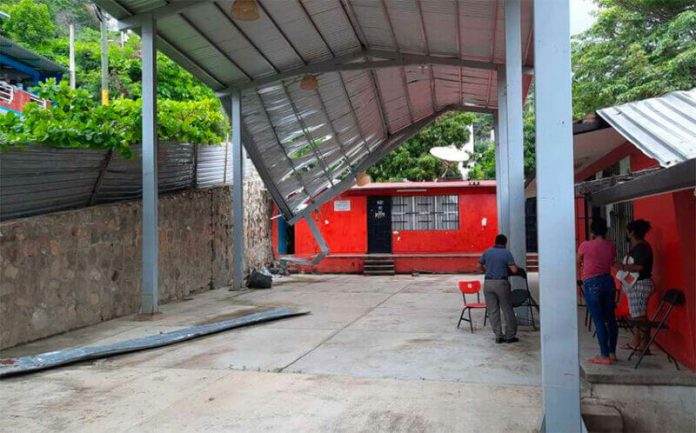
Many schools have been abandoned and are in rough shape.
Parents, teachers, states and schools were already divided over the federal government’s plan to reopen schools in 12 days, but now one element of the plan itself has been rejected by the president himself.
At Tuesday’s morning press conference, President López Obrador delivered what one newspaper called “a smack” at his education minister, after asking reporters if they believed he might have had something to do with the ministry’s Letter of Agreement for Corresponsibility.
“Well no, it was a decision made from below. If they had asked me I would have said no, we are free, [and it is] prohibited to prohibit.”
The letter was presented at the press conference last week, but Tuesday was the first time that the president has expressed his disagreement with its contents.
Parents would have been asked to sign off on six points, such as checking their children daily for symptoms of Covid, keeping them at home if they presented any and promoting good hygiene to prevent propagation of the virus.
On Wednesday, the minister of education confirmed that the letter was no longer a part of new protocols guiding a return to classes.
Meanwhile, the president will address opposition to the plan, which he claims is politically driven.
Earlier on Wednesday he told reporters that on Thursday officials will present the results of a study carried out by government officials with UNICEF “to demonstrate the danger being caused to children by not attending school.”
López Obrador said the study is based on “evidence, with arguments to show why [opposition to reopening schools] has no basis” and then proceeded to blame the opposition on a media conspiracy.
He urged the middle class to wake up to having been manipulated by the media with misinformation about the risks of sending children back to school.
“Our adversaries are very irrational, very irresponsible, lacking in ethics. How can they lie about a subject as delicate as health and education?”
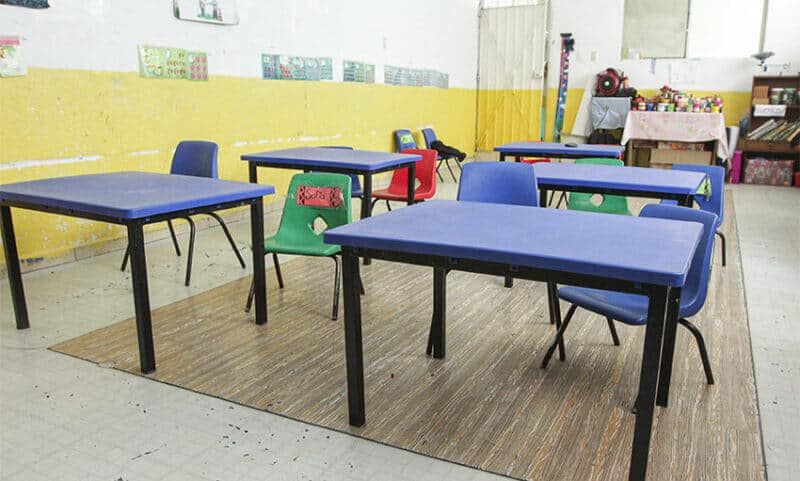
Many classrooms will likely remain empty beyond the August 30 reopening.
The president then declared, “There are no risks,” but offered the assurance that if there are problems, “we shall act.”
He made it clear on Tuesday that returning to school is not obligatory for the nation’s 25 million students but that probably wouldn’t make much difference for the majority of parents.
A survey by the newspaper El Financiero found that 58% are not in agreement with the plan.
At least three state governors feel the same way.
Nuevo León, Michoacán and Hidalgo have rejected a return to in-person classes. The governor of the latter state said it took two days for the delta strain of virus to reach the same infection rates that took the original virus 11 months.
Meanwhile, the governments of Baja California Sur, Colima, Nayarit, San Luis Potosí, Tamaulipas, Oaxaca, Puebla and Quintana Roo have not defined any strategy for reopening schools.
Teachers — or their unions, at least — are also divided. The dominant SNTE union is on side but the militant CNTE, with a strong base in Michoacán, Oaxaca, Guerrero and Chiapas, has said its members will not be in the classrooms on August 30.
A researcher at the National Autonomous University suggested that any reopening plan should be designed with individual schools and their needs in mind.
Gustavo Oláiz told the newspaper Reforma that each school needs specific measures depending on their location, size, ventilation, the number of students in each class and the possibility of complementing classes with distance learning.
The assessment might also consider the condition of the schools as a factor. At least 11,000 have been robbed or vandalized during the pandemic, according to the education advocacy group Mexicanos Primero, and many others have been reported in a state of abandonment.
Government and NGOs were present at Tuesday's announcement.
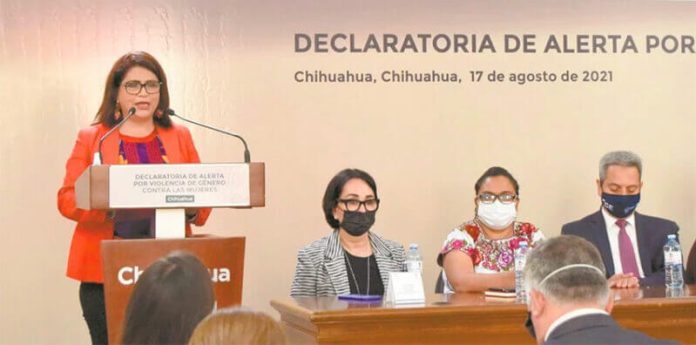
A gender violence alert has been activated for the five Chihuahua municipalities of Ciudad Juárez, Parral, Chihuahua, Cuauhtémoc and Guadalupe y Calvo, which have been identified as areas with a high level of violence against women.
“The government of Chihuahua recognizes that systematic violence against women has expanded in the state, given that every day a woman has been killed. Every day, a family suffers for the homicide of a mother, sister, or daughter,” said Alanís Sámano, head of the National Commission to Prevent and Eradicate Violence Against Women (Conavim).
Seven of 10 Chihuahua women have been victims of violence, primarily in the home, school, workplace or the streets. And in the past 10 years, the five municipalities have seen 2,400 murders of women. In the first six months of 2021, the state ranked third for homicides of women and had an elevated level of rape, Sámano said.
The alert is a useful legal tool for addressing violence, providing monitoring mechanisms and obliging the three levels of government to comply with certain recommendations, Governor Javier Corral said. He also confirmed that the alert was issued as a result of requests presented by nonprofits in the face of insecurity and mounting numbers of gender-motivated homicides.
Alejandro Encinas, deputy minister of human rights at the federal Interior Ministry, called the alert “an important step” in recognizing and moving toward solving the problem of violence against women. He said the alert came about as a result of cooperation between various levels of government, women’s collectives, academics and others.
Anabel Sanz Luque, representing UN Women, lauded the perseverance of the organizations that have made the alert a reality, which she said lays out “a path that requires political dialogue and a collective effort to make visible the violence against women and find solutions to eradicate it.”
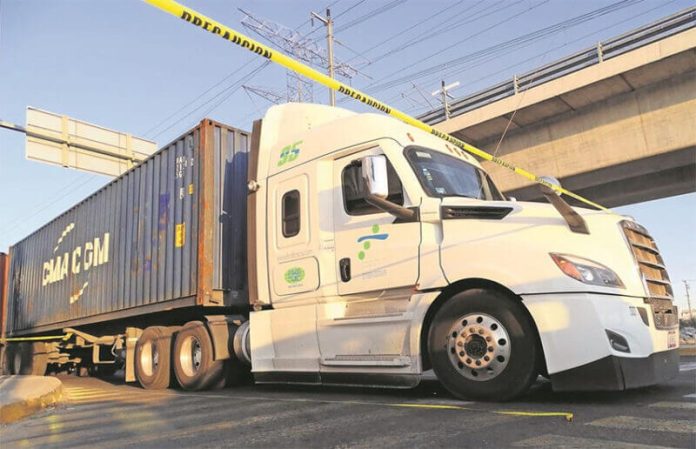
Federal highways in central Mexico were the most risky in the country for robberies in the first half of 2021, research by security consultancy DataInt showed.
The riskiest road in the country was the Querétaro-Irapuato highway, which recorded 54 robberies, and the Querétaro-San Luis Potosí highway was second with 46. Seven of the top 10 most crime-ridden roads were north of Mexico City and south of San Luis Potosí; four were going to Querétaro.
Six-hundred and twenty-five highway robberies were reported from January-July this year, with 62% of the vehicles targeted carrying cargo. Another 31% were private vehicles and 5% were passenger vehicles.
The report also detailed the time patterns of thefts. Wednesdays, Thursdays and Fridays from 6-10 a.m., 1-2 p.m. and 8-10 p.m. were points of high activity. The peak time for thefts was on Wednesdays from 6-10 a.m.
Meanwhile, roads south of Mexico City were no safe haven for drivers. Two sections of Highway 150D were third and fourth on list: Mexico City-Puebla and Puebla-Córdoba, which taken together recorded 58 robberies.
However, while the report points to central Mexico for high risk roads, it also conceded that it was the region for which data was most available.
Dataint’s global road risk indicator, which includes homicide statistics in the equation, adds parts of Sonora and Zacatecas to the most dangerous places to travel in the country.
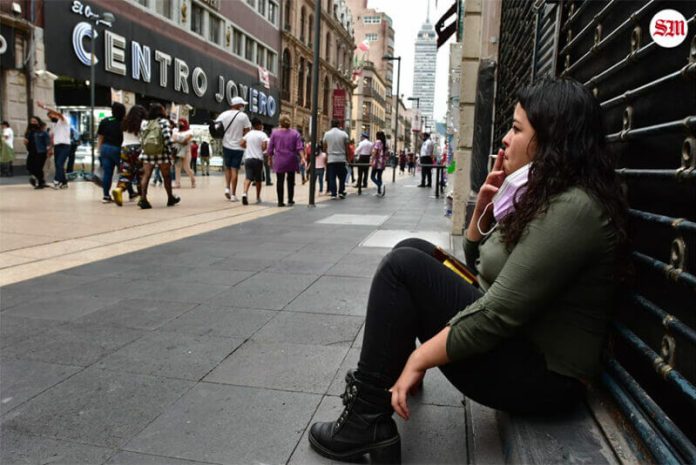
As part of an effort to clean up one of Mexico City’s most iconic streets, smoking has been prohibited on Madero Street in the historic center.
The city’s Historic Center Authority has installed no-smoking signage along the length of the street where, during the first month of implementation, smokers will be asked to put out their cigarettes and will not face fines if they comply. But starting in mid-September, smokers will face fines of 896 to 2688 pesos (US $45 to $134) or mandatory community service.
City authorities have also limited the number of flyer distributors allowed on the street to 51, down from over 200, in order to prevent unnecessary crowds, and installed sanitary checkpoints for the distribution of hand gel and face masks. They will also continue to promote the Open Air City program, which encourages outdoor dining and food sales.
The general coordinator of the Historic Center Authority, Dunia Ludlow, said the agency has been working to clean up the street since last year.
“When we started, we found some common urban problems, graffiti … Since last year we have been working with the auxiliary police and [government departments] to provide better order,” Ludlow said.
Ricardo Alemi, director of health and wellbeing for the nonprofit Refleacciona con Responsabilidad, said the goal of the smoking ban is to create a safe, healthy environment in one of the most heavily used pedestrian corridors in the country, through which up to 220,000 people pass daily.
A nurse was caught on video injecting a young woman with air rather than a Covid vaccine at a vaccination center in Morelia, Michoacán, on Tuesday.
The incident, which was reported to authorities after the video began to circulate on social media, occurred on Morelia’s second day of vaccination for the 18 to 28 age group.
State officials confirmed in a press release that there had been a case “in which an inadequate application of the vaccine occurred,” and added that it was “without a doubt an error that we cannot overlook. The necessary measures will be taken to strength control of the vaccination process and insure it does not happen again.”
The council also pointed out that healthcare workers have been “subject to intense work days, stress, and even putting their lives at risk.”
It is not the first mishap in the vaccination process. Various misapplied shots have been caught on camera, including one in Mexico City that President López Obrador suggested was a media set-up.
In recent days, Morelia vaccination centers have seen long lines as youths and parents arrive up to 15 hours ahead of time with folding chairs and tents, eager to secure their shot.
Mexico had administered 78 million doses as of Tuesday.
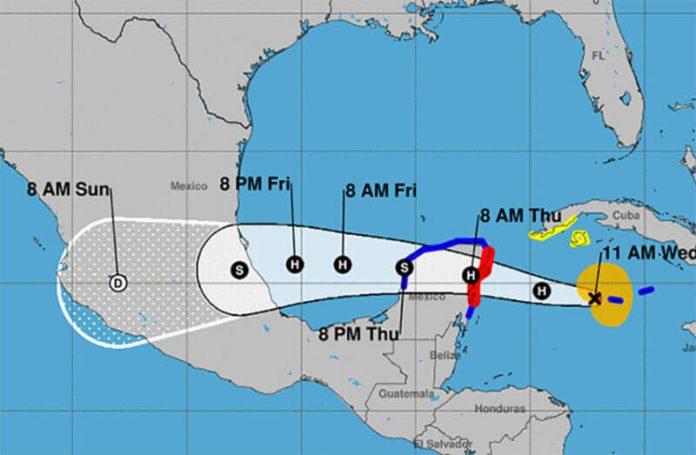
A hurricane warning is in effect for the areas indicated in red and a tropical storm warning has been issued for the areas marked in blue. us national hurricane center
Tropical Storm Grace was upgraded to a Category 1 hurricane by the U.S. National Hurricane Center (NHC) at 11:00 a.m. EDT.
Grace is predicted to hit the Quintana Roo coast Wednesday night or early Thursday morning near Tulum, Mexico’s National Water Commission said.
Torrential rainfall, strong winds and powerful waves are forecast for the peninsula starting Wednesday, before spreading to eastern Mexico on Friday.
The NHC reported a hurricane warning is in effect from Cancún, Quintana Roo, to 400 kilometers south at Punta Herrero, including Cozumel Island. It said a tropical storm warning is in effect from Punta Herrero to 80 kilometers south at Puerto Costa Maya and from Cancún to Campeche, 480 kilometers west.
The storm was located 105 kilometers west of Grand Cayman and 560 kilometers east of Tulum, Quintana Roo, with maximum sustained winds of 120 kilometers per hour (kph). It was moving west-northwest at close to 24 kmh.
It is expected to come within 115 kilometers of Punta Allen, about 54 km south of Tulum, on Thursday morning before crossing the peninsula overland as a tropical storm toward Progreso, Yucatán. It is forecast to continue west to Veracruz and come within 35 kilometers of Tocolutla as a Category 1 hurricane on Saturday morning before crossing inland Sunday, passing north of Mexico City as a tropical storm.
Conagua advised people to exercise precaution due to rain, wind and waves.
Several government departments and agencies released a joint statement Tuesday, warning of the need for preventative action to avoid a natural disaster.
It said two to three meter waves could be expected in Quintana Roo this evening and that the hurricane could affect Tulum, Playa del Carmen, Cozumel Island and Cancún tonight. It added that it could become a Category 2 hurricane near Veracruz late Friday or early Saturday.
The statement also added that torrential train should be expected in Puebla, San Luis Potosí, Veracruz and Hidalgo and intense rain in Guanajuato, Querétaro, Tamaulipas and Tlaxcala on Friday and Saturday.