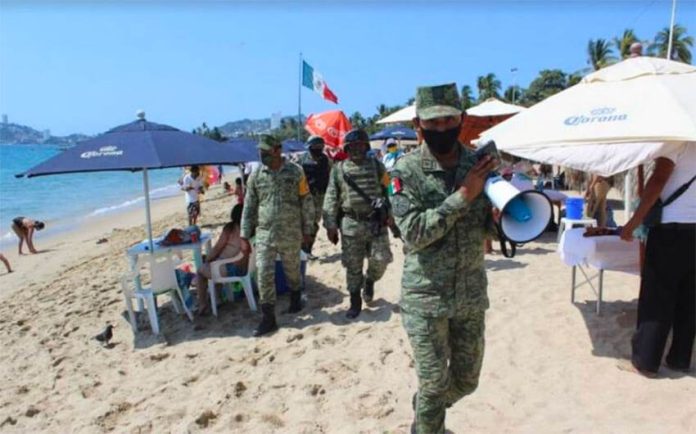
Soldiers patrol an Acapulco beach earlier this year to remind visitors to follow coronavirus precautions.
As of Monday bars and nightclubs are closed for business in Guerrero thanks to new measures that state authorities hope will stem the tide of new coronavirus cases.
In a virtual press conference, state officials announced that beaches will stay open but only from 7 a.m. to 6 p.m. with only 40% of the usual occupancy permitted. The authorities also asked that beach-goers use face masks.
Parties, camping and live music are suspended but hotels will be allowed to continue operating at 40% capacity. Restaurants will remain open at 50% capacity and alcohol sales will be prohibited after 7 p.m. Cemeteries will be closed and places of worship can only operate at 40% capacity.
“We are looking for the middle ground … we reiterate that the beaches will stay open, but with restrictions,” said Governor Héctor Astudillo. He added that the health measures aim to slow the rising numbers of Covid cases over the next two weeks.
“We are making an energetic call to all who would come to the tourist centers of Acapulco and Ixtapa-Zihuatanejo. They must know that we have a complicated situation here and they must follow the [health] guidelines,” Astudillo said. “We frequently find that the people ignoring [the guidelines] are the visitors.”
Mexico City is at red (high risk) on the coronavirus stoplight risk map, Astudillo said, meaning that visitors from the capital city could infect Guerrero citizens.
As of Monday, Guerrero is also red on the map. Despite that alert and the rise in cases, Acapulco registered 40% tourist occupancy on Sunday and beaches were brimming with vacationers.
A female vaquita identified as Ana with a calf in 2018. Oscar Ortiz
Three federal ministries announced a new agreement with NGOs Saturday to define cooperative efforts to save the endangered vaquita porpoise.
Although no NGOs were named and the announcement was thin on detail, the Ministries of Environment, Navy and Agriculture said in a joint statement that the accord would bring about improved collaboration in conservation efforts and avoid aggressive acts by people engaged in illegal fishing.
Last December, there was a clash between small fishboats and a vessel operated by the Sea Shepherd Conservation Society. A fisherman died after one boat collided with the vessel.
The agreement states that authorities will focus their efforts on inspection and monitoring in a so-called “zero tolerance” zone in the upper Gulf of California, where gillnet fishing had been declared illegal to protect the vaquita. The porpoise is a bycatch in the illegal totoaba fishery, made lucrative by strong demand for that fish’s swim bladder, a delicacy in China that has been referred to as the “cocaine of the sea.”
Like the drug, its trafficking has drawn drug cartels to participate.
While the government will attempt to control illegal fishing, a responsibility it has been unable to carry out successfully in the past, civil society organizations will remove abandoned nets and work to raise awareness about vaquita conservation among fishermen.
The accord comes three weeks after the Mexican government relaxed restrictions in the no-fishing zone, triggering a wave of accusations by conservationists that Mexico was abandoning the vaquita.
The most recent of those came from U.S. actor and environmentalist Leonardo DiCaprio, who criticized the government on his Twitter account last Thursday. “The vaquita porpoise is the most endangered marine mammal in the world. Yet, the Mexican government has lifted the ban on fishing in its habitat, effectively ensuring that the remaining 10 or so porpoises will die in gillnets.”
DiCaprio signed a memorandum of understanding in 2017 with then president Peña Nieto and businessman Carlos Slim to protect the vaquita, at which time there were still some 30 remaining. The intention was to make a temporary gillnet ban permanent in the Gulf of California.
But like most efforts at saving the mammal nothing was accomplished due to lack of enforcement, the growing involvement of cartels and protests by unhappy fishermen deprived of their ability to make a living.
Despite the fact there may be as few as 10 vaquita remaining, not all conservationists have written off the vaquita as a lost cause.
Environmental writer Andrew Revkin of the Climate School at Columbia University wrote last week he saw four reasons for hope after interviewing a marine scientist at the U.S. National Oceanic and Atmospheric Administration.
Barbara Taylor argued that the porpoise has a fighting chance:
The survivors are wily and elusive, she said, with their scars and behavior showing they are aware of the risk nets pose.
The estimated presence of three calves – all fat and healthy in 2019 – showed that the remaining females are prolific breeders.
Recent analysis of the vaquita genome shows they are unlikely to face a genetic bottleneck that sometimes threatens the recovery of deeply depleted species.
Finally, there are other examples of species, including marine mammals, reviving from tiny numbers after devastating slaughter. She cited the northern elephant seal, which was declared extinct in 1884. A tiny population was later discovered on an island off Mexico’s Pacific coast. Now there are 300,000.
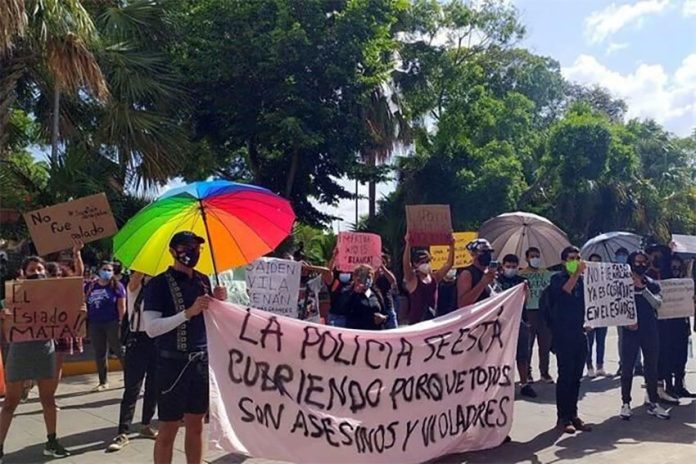
Yucatán residents protest the rape and murder of José Eduardo Ravelo in Mérida.
Four Mérida municipal police officers are now in custody for the rape and murder of a young man, according to an announcement by the Yucatán state governor on Saturday.
After police detained José Eduardo Ravelo, 23, on July 21 he was raped and badly beaten, leading to his death on August 3. Ravelo had recently arrived in Mérida from Veracruz, looking for a job.
The day after the attack, his mother said, Ravelo called her and told her what had happened. She traveled to be at his side as he was dying.
“In a video … the attorney general’s lawyer told me that when he was inside [the jail], you can hear screams and no one went to help him,” the victim’s mother told local media outlets.
“In our state there is no place for impunity … there will be justice,” Governor Mauricio Vila said, adding that the family had accepted help from the State Commission for Victim Services.
The murder has triggered protests by Yucatán residents and nonprofit organizations. The demonstrators rallied outside the municipal government building on Sunday.
“The police don’t protect us; they rape us, they kill us!” people chanted.
Some left flowers and candles by the building’s entrance in Ravelo’s memory.
Lawyer Adriana Quintal was one of the people who attended the protest. She said the crime was not an isolated incident.
“This is not an isolated case of violence by the police against citizens, what’s different is it’s the first case where a mother dared to rub it in their faces. In Progreso last year there were various [police murders],” Quintal said.
The federal Interior Ministry (Segob) has announced that the investigation will include an inquiry into whether discrimination based on physical appearance, age or personal identity factored into the attack on Ravelo.
The documentary Comala will compete in the Toronto International Film Festival.
It was only after his father’s death that Monterrey film director Gian Cassini, 34, learned what his father did for a living: he was a drug cartel sicario. The man had often been absent in Cassini’s youth, and now he knew why.
His father was killed during the violent drug-trafficking crackdown by the Felipe Calderón administration, Cassini said.
“At the time I remember it was like … I wanted to keep it in a box, as if it were separate from him. I thought, ‘I don’t need this in my life,’” Cassini said.
But talking with his father’s family and seeing their loss, Cassini became more interested in the dichotomy between the man his family knew and the violent business in which he had been involved and decided to make a documentary about his family’s experience. Now, after nine years of work, the film Comala is debuting at the Toronto International Film Festival.
“Initially, I thought I’d make a fictional film, but when I met with my family and saw everything, how the absence of a son, a brother and a father affected them, I was inspired [to make a documentary] … Little by little I convinced them to participate, which is admirable because we all have things we are ashamed of or things we don’t want to confront … in the end, they threw themselves in and were completely honest with me,” Cassini said.
Rather than focusing on sensationalist violence, the film looks at the toll his father’s line of work took on his immediate family. One of the film’s goals, Cassini said, was to spread awareness of the problem of violence, which is often normalized.
“It’s terrifying how we have arrived at the point of normalizing the violence of narco-trafficking. It is something that seems to no longer affect us, and is even celebrated [in popular culture] … It’s worth remembering that … in the midst of all of that, we are still human beings and what is happening affects us,” Cassini said.
The Toronto festival runs from September 9 through 18.
On Saturday night reports were heard of an armed man shooting in the tourist zone of Cabo San Lucas. It turned out to be none other than the head of the state Ministry of Public Security in Baja California Sur.
Germán Wong, allegedly drunk, drove through the area near Lázaro Cárdenas boulevard shooting off rounds around 11 p.m.
After receiving the reports local police mounted an operation to catch the shooters, who were traveling in a white Honda. When they found the vehicle and stopped it, they found Wong in the passenger seat. He was accompanied by three women and another man.
According to the newspaper Milenio, the officers did not believe Wong when he claimed to be the head of the state police and their superior officer. Instead, they handcuffed and interrogated him.
An hour later, municipal Police Chief oJuan José Zamorano arrived and ordered Wong be disarmed and taken home.
Baja California Sur Governor Carlos Mendoza later announced on Twitter that Wong would be fired. He has been the minister of public security since February 2018.
“The members of my cabinet must have irreproachable conduct,” he wrote.
Fewer Brits are expected among travelers at Mexico City airport.
The inclusion of Mexico on the U.K.’s travel red list means losses in the millions of dollars for the tourism industry, according to trade body the World Travel & Tourism Council (WTTC).
A third wave of Covid-19 infections in Mexico has seen around 20,000 new cases a day, which triggered the U.K. to change the country’s status from amber to red on its travel list. Many tourists from the U.K. rushed home before 4:00 a.m. Sunday to avoid a 10-day hotel quarantine which will cost arrivals about US $2,425. People without legal residence are banned from entering the U.K. from Mexico.
The WTTC estimates that the decision will affect about 6,000 U.K. tourists. Data from the Tourism Ministry (Sectur) shows the United Kingdom is the main source of tourists from Europe and the fourth biggest globally. Mexico was becoming a more popular destination for U.K. tourism, which grew by 16.8% from 2015-2018, from 505,954 to 590,954 visitors.
The announcement deals a fresh blow to the industry, which suffered badly due to travel restrictions in the pandemic. Data from federal statistics institute Inegi shows that the value of the industry dropped 55.1% in 2020 compared to 2019. However, it was still a significant foreign currency earner: according to the WTTC’s annual economic impact report it contributed 8.5% to Mexico’s GDP in 2020 and generated 5.8 million jobs.
The vice president of the WTTC, Virginia Messina, estimated the economic impact of the decision. “The longer [restrictions] are extended the greater the impact. We are talking about many millions of dollars for the Mexican economy,” she said.
She added that the restrictions could cost $2 million per day for the tourism industry, which would mean losses of $364 million over six months. Other European countries could also take action to restrict arrivals from Mexico, she said.
In the U.K. 70% of the population has received a first dose of Covid-19 vaccine, and officials hope to hit 100% in October. That has heightened fears of introducing new Covid-19 variants to the population, against which vaccines may not be effective. Meanwhile, in Mexico almost 40% of people have received a first dose, according to Health Ministry data released on August 7.
Sixty countries are on the U.K.’s red list including much of Latin America. The countries include Argentina, Brazil, Bolivia, the Dominican Republic, Colombia, Chile, Uruguay, Venezuela and Panama.
The U.K. government updates its list of countries every three weeks. Travelers can view updates and requirements on the official government website.
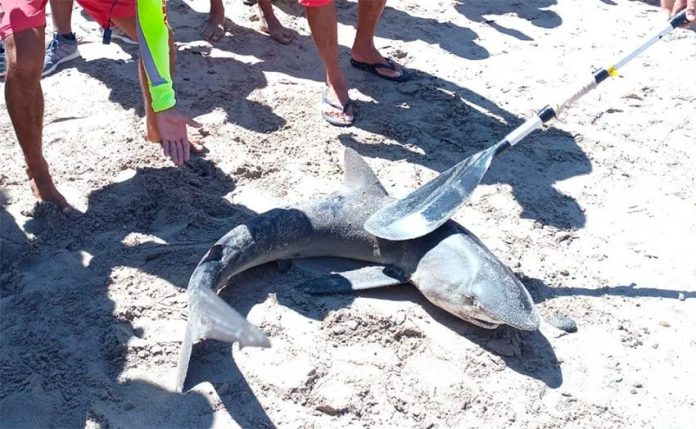
The basking shark on the beach in Puerto Vallarta.
An unusual sight gave beach-goers a scare on Saturday in Puerto Vallarta. After an ominous triangular fin was spotted circling near the shore, bathers exited the water and a crowd gathered to watch a small shark, just over a meter long, that was wandering through the shallows.
Fear quickly turned to concern for the animal’s well being after the shark came too close to the beach and a wave left it stranded on the sand. Civil Protection agents quickly arrived at the scene to help the shark, which had an injury on its tail. They decided that it was not serious enough to necessitate additional aid.
Then, with the help of local parachute tour operator José Manuel Castillón and his boat, the animal was taken half a kilometer out to sea and released, well away from the beach and its tourists.
It was identified as a small basking shark, a species that does not attack humans.
The longest cable car line in Latin America was opened by Mexico City Mayor Claudia Sheinbaum in the east of the capital on Sunday, less than a month since the first line of the system went into full operation.
Line 2 of the Cablebús improves connectivity in working class Iztapalapa – the most populous municipality in the country – through seven stops linking Metro stations Constitución de 1917 and Santa Marta by a 36-minute journey end-to-end. The 10.8-kilometer line will transport up to 108,000 passenger daily in 305 cabins, cutting the journey by almost 50 minutes, and cost 3.18 billion pesos (almost US $159 million) to build.
Line 1 went into full operation on June 11, connecting the Gustavo A. Madero borough to the Indios Verdes Metro and bus station. It has registered 56,000 users per day compared to the 48,000 predicted, which makes it the second most used cable car in Latin America, even by pre-pandemic numbers, according to city officials.
Cabins on both lines have capacity for 10 passengers, but only six are currently permitted due to coronavirus restrictions.
The inauguration of Line 2 saw a festive atmosphere with dancers and drummers and 100 murals by 35 urban artists revealed on the new line and its surroundings. Around 500 people attended. Some shouted “President! President!” to Sheinbaum who has long been touted as Morena’s next presidential candidate.
The mayor pointed to the social benefits of the new transport option. “The Cablebús project represents not only an investment in public transport – massive, modern, innovative and non-polluting – but one that reduces inequality, that gives dignity to a population that has been historically overlooked,” she said, adding that public investment was urgent in the municipality, one of the 15 most violent in the country.
While joking that the area would now be recognized for more than just cumbia band Los Ángeles Azules, she noted that the new airborne transport system was the fruit of an administration that is not corrupt.
Iztapalapa Mayor Clara Brugada said the area would be transformed entirely. “Today Iztapalapa ceases to be the backyard of Mexico City, the garbage dump of Mexico City. Today Iztapalapa takes flight,” she said.
Resident Óscar Méndez immediately saw benefits in safety and efficiency. “Before it took me an hour and a half or more to get to Santa Marta, but now they say it will be half an hour and it’s going to be safer. The truth is that taking a minibus is like flipping a coin: you don’t know what’s going to happen; whether you’re going to get assaulted or you’re going to get stuck in traffic. This [the cable car] looks great,” he said.
The first cable car to open in the Valley of México was the Mexicable in Ecatepec in October 2016. A new 8.2-kilometer line is under construction in the same municipality, and there have been discussions about a new cable car service in the west of Mexico City in Naucalpan, and another in the southwest of the city to connect the neighborhoods of Magdalena Contreras and Tlalpan.
Line 2 runs each day until 11:00 p.m. and starts Monday to Friday at 5:00 a.m, Saturday at 6:00 a.m. and Sundays and public holidays at 7:00 a.m. Trips cost 7 pesos and are free for adults over 60, people with disabilities and children under 5. Passengers can travel with a bicycle Monday-Friday.
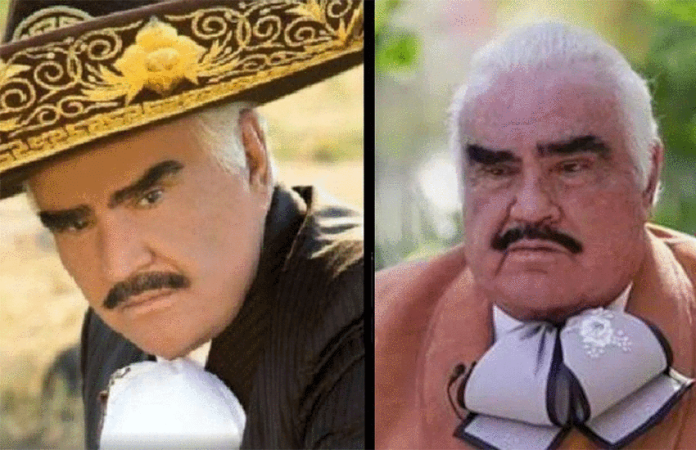
Promotional image of Vicente Fernandez, left, and a later one that was used in internet memes because he appeared in distress due to his bow tie.
If my discussions about this topic with friends, family, and other longtime foreign residents are any indication, this list might get me into some trouble.
So let me explain a little why I chose these five pop culture icons to highlight. They are not necessarily the most important, nor the only ones those of us who live here for any length of time should know. Mexico is a vast and multi-layered culture that takes more than one lifetime to explore.
Instead, take this list as a starting point. You might have seen these personajes (celebrities/characters) or heard of them, but you may not know exactly who they are. (I left out Diego Rivera and Frida Kahlo simply because they are already internationally famous.)
However, they are well-known to our Mexican friends and family, known multi-generationally. References to them appear in street murals, internet memes and other modern expressions, even if they have died some time ago. They are all from popular culture but demonstrate different aspects of it.
El Santo (The Saint)
Statue dedicated to El Santo in the wrestler’s hometown of Tulancingo, Hidalgo. Jay Galvin
No wrestler in the United States has achieved the iconic status that he of the silver mask did decades before The Rock or John Cena ever stepped into a ring. The Mexican term lucha libre (free fight) better describes the entertaining morality plays that are called wrestling in the U.S.
El Santo was just that, a “saint” fighting for justice in scenarios that the common man could identify with, even if they were often a bit corny. He was immensely popular in the ring, in comic books and in the 52 films he appeared in from the 1950s to the very early 1980s.
His real name was successfully kept secret, allowing audiences to see themselves in the character, until the retired Rodolfo Guzmán Huerta removed his mask on a television show in 1984.
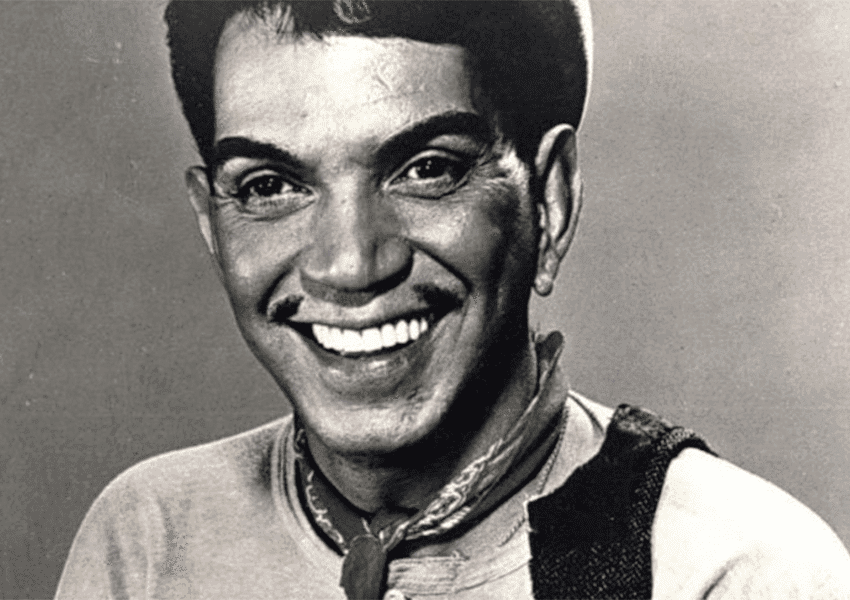
Cantinflas (Mario Moreno Reyes)
Where El Santo portrayed the innate good of the common man, Cantiflas (Mario Moreno Reyes) represented his mischievous side. He is the only pop culture character who has a verb named after him in Mexican Spanish, cantinflear, which roughly means to perform linguistic gymnastics to obfuscate a situation, especially when authorities are trying to take advantage of you.
Cantinflas is best known for his work in movies in the 1940s and 1950s, the height of Mexico’s Golden Age of Cinema, where he basically played the same character over and over in different dress.
In the early 1980s, Cantinflas was spontaneously named by several respondents to a political survey asking who would be a suitable presidential candidate in the 1982 elections.
He had a brief stint with international fame, appearing in the 1956 film Around the World in 80 Days, but could not get further in Hollywood because his humor was too rooted in the Spanish language.
El Chavo del Ocho (The Kid from Number 8)
This was the name of a television show and its main character the most popular creation of the comedian Chesperito (Roberto Gómez Bolaños). The chavo was an orphan who lived in a barrel inside a Mexican-style vecindad (tenement) on a television sitcom that ran from 1973 to 1980.
Wordplay, running gags and physical, even violent, humor defines much of the show. Many critics at the time considered it to be “trash,” but others recognized that El Chavo and his cohorts struck a chord with many Mexicans.
The idea of watching obvious grown-ups play children may seem strange, but El Chavo is one of two important little boy characters like this. The other is Chabelo, played by Xavier López Rodríguez until 2015, when he was 80.
El Chavo del Ocho remains highly profitable for Televisa. To this day, the show remains in syndication, along with an animated version created in 2006, and Televisa still sells merchandise for the franchise.
Roberto Gómez Bolaños, who played El Chavo, studied mechanical engineering at the National Autonomous University but left to pursue writing.
Vicente Fernández
There are several extremely important singers in charro (cowboy) outfits from the 20th century, including Pedro Infante and Jorge Negrete. Vicente Fernández was inspired to sing traditional Jalisco ranchera music by watching Pedro Infante’s movies in the mid-20th century. He followed his icon into recording contracts and movie appearances.
In fact, he is credited for breathing new life into ranchera when it was in danger of falling from popularity in the 1970s. Like El Santo, his fame was reinforced by regular appearances in movies, starting with the 1971 release, Tacos al Carbón.
At age 81, he still records music, stepping back from live performances only a few years ago. Today, his son Alejandro Fernández continues the family legacy of singing ranchera in the charro outfit.
La India María
This choice is likely to get me in the most trouble (though not as much as Memín Pingüin would!). There are few female pop icons in Mexico, but it is important to have one in this list.
Chalk drawing of La India María.
There is an indirect link between this character, played by María Elena Velasco, and the smiley-faced dolls sold all over Mexico. The clothing and hairstyle for both are based on one typically worn by Mazahua women who migrated to Mexico City in the latter part of the 20th century.
Collectively known as “Marías,” the women were distinctive in the capital because of their use of traditional dress and making a living selling in the street; unfortunately, this invited abuse and ridicule. La India María suffers many of these problems in the movies and television shows in which she appears, almost always diffusing the situation using acts of morality and humor.
Cantinflas "Por mis Pistolas" [English Subtitles]
A short clip from a movie by Cantinflas.
Certainly, there are many more people and characters that those of us who live in Mexico, especially long term, should be familiar with. Those who almost made the cut here include actress María Félix and singer Juan Gabriel.
Given Mexico’s obsession with clowns, I even briefly considered the comedian and talk show host Platanito despite his rather coarse humor.
What pop culture icon would you have included on this list?
Leigh Thelmadatter arrived in Mexico 18 years ago and fell in love with the land and the culture in particular its handcrafts and art. She is the author of Mexican Cartonería: Paper, Paste and Fiesta (Schiffer 2019). Her culture column appears regularly on Mexico News Daily.
One year when I was living in Querétaro, my bike was stolen. So was my digital camera (this was before the era of great camera phones) and two very full piggy banks. The owner of the house knew who had probably done it because he’d left his copy of my keys unattended with some of his workers and there had been no break-in.
If you’ve ever had property stolen from you — especially when you worked hard and sacrificed to get it — then you know the specific type of impotent rage it can make you feel.
If you’ve had something stolen from you in Mexico, that rage comes in two parts: first, when you realize that someone has committed a crime against you and second, when you realize that there will very likely be zero justice.
In my own case, the owner of the house replaced my camera, at least; I would not have gotten it back otherwise. But I still had to go file a police report, something that took upward of three hours.
In the case of another friend whose vehicle was stolen, the part about filing a report is what made him (and what makes most others) ultimately give up.
Before they would even start looking for the vehicle, he needed a variety of signatures from a variety of institutions — all of them across town from one another, of course, making him spend days running around as if neither telephones nor the internet existed.
By the time he had gotten most of the ones he needed, he was out quite a bit of money in taxis and a full week had passed.
If you happen to be the victim of a crime, the message is loud and clear: you’re on your own.
Sure, the bureaucratic machine will go through the motions for you … as well as demand a lot of work from you. Will justice be done? Though it might be once in a while — even a blind squirrel finds a nut once in a while, as my high school calculus teacher used to say — you’re probably better off making peace with what’s happened and moving on.
Having property stolen is frustrating and sad, and it’s thankfully the only crime I’ve been a victim of so far here (unless you count the occasional unwelcome butt grab). But when crimes are essentially those of terror — like kidnapping, torture and murder — patience with a dysfunctional and ineffective justice system can downright disappear.
Just ask the people of Fresnillo, where a full 96% of people feel unsafe, or any of the other numerous communities that have been completely overtaken by narcos. As offended and dismissive as the president was about the United States claiming that one-third of Mexican territory is controlled by narcos, I’d like to see him live in one of those places and then talk about how “peaceful and tranquil” the country is.
Underpaid and uncertified police officers, narcos who have essentially taken over entire communities and bureaucratic policies that actively discourage crime victims from seeking justice; we ignore our clunky, ineffective system at our own peril. Because when there’s not a functioning system, something comes up and takes its place; it doesn’t just stay a vacuum.
When a security and justice system is ineffective, a new one will be built by someone. This is what happened with the “El Machete” defense force in Chiapas most recently and what’s happened in various other parts of Mexico such as in the Tierra Caliente region of Michoacán (spoiler: the results are not typically what they hope to achieve).
And while the recent news of armed citizen groups in Chiapas running security forces out of town and taking matters of justice into their own hands is either alarming or inspiring (depending on how you look at it), what it’s not is surprising.
It’s simply what happens when people know for a fact that justice will not be served. It’s what happens when they know they are not safe. It’s what happens when they know that the system is not meant to work for them.
According to locals, known violent criminals were living among them and the authorities were doing nothing about it, so the group decided to handle it themselves. What’s disturbing is the way they did so, raiding the homes of some and taking one suspected motorcycle thief and literally setting him on fire (he survived).
There’s a certain portion of the population who I think would be perfectly happy to see criminals face this kind of punishment. But if we want human rights to be respected, we can’t simply torture people who are accused of crimes, even if they’re certainly guilty. Preventing that kind of mob justice is why the institution of criminal justice exists.
I understand anger. I’ve been so angry before that I’ve literally wished for certain people to get hit by a bus. I get it. But do Kill Bill-like fantasies have a place in real life? Probably not.
I also worry about the absence of a system for truly proving someone’s guilt or innocence when citizens take the law into their own hands. What’s to stop someone with a personal vendetta from accusing someone of a crime and having communal rage wrongly brought down upon them?
On the other hand, seeing justice done in a place where there’s precious little of it can be so, so, satisfying; I understand people who say, “Well, it’s better than nothing.”
I don’t have a solution. I’m just spinning the most anxious of my wheels. Making sure all security forces are well-trained and well-paid enough to resist bribes is one step; a cutting-down of the tasks that a crime victim must complete to even begin to try to find justice is another.
The president said, “There is governability, there are no risks of instability. We’re fighting the scourge of violence every day, and peace and tranquility can be spoken about throughout the country.”
I know virtually no one who would agree with this statement. It’s time for a real overhaul.












![Cantinflas "Por mis Pistolas" [English Subtitles]](https://i.ytimg.com/vi/y3XwUY3GxT0/0.jpg)