Home Blog Page 1225

Morena ally rejects AMLO’s proposal to incorporate National Guard into army

0
National Guardsmen
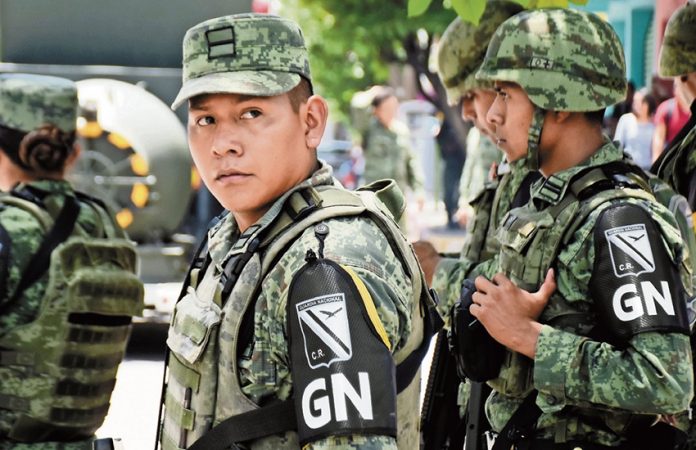
Guardsmen are the responsibility of the Public Security Ministry, but in its first five years the civilian security force is being overseen by the army and navy. File photo

A proposal by President López Obrador that the National Guard be incorporated into the Ministry of National Defense (Sedena) appears doomed after the Labor Party (PT), an ally of the ruling Morena party, indicated that it doesn’t support the plan.

López Obrador said Tuesday that he intends to propose a constitutional amendment in 2023 so that the National Guard, a two-year-old civilian security force, can become a branch of the army.

Such a reform would require two-thirds support of Congress. But Morena and its allies don’t have a two-thirds majority in the Senate and are set to lose their supermajority in the lower house as a result of the June 6 elections, although the president raised the possibility that the government could seek the support of some Institutional Revolutionary Party (PRI) lawmakers.

López Obrador justified his plan by saying that he doesn’t want the National Guard to suffer the same fate as the Federal Police force, which he charged was left to rot after it was established during former president Felipe Calderón’s 2006–2012 government.

“It was spoiled to such an extent that he who was public security minister in the government of Felipe Calderón is in prison,” he said, referring to Genaro García Luna, who was arrested in the United States in 2019 on charges that he colluded with the Sinaloa Cartel in a drug trafficking conspiracy.

President Lopez with secretaries of defense and navy
The president said he will propose a constitutional amendment in 2023 to allow the Guard to become part of the army. File photo

“In addition, that police [force] didn’t do its duty and didn’t act with professionalism,” López Obrador said.

The president wanted the National Guard to be part of Sedena and to have a military commander from the beginning but changed tack amid pressure from a range of non-government organizations, which argued that incorporating the new security force into the military would perpetuate the failed militarized public security model introduced by Calderón in 2006.

The National Guard is officially the responsibility of the civilian Public Security Ministry, but during the first five years of its existence, its operation is overseen by the army and navy in order to instill military-style discipline in the new force and ensure that it meets the same standards as those required of the armed forces.

López Obrador said Tuesday that his administration doesn’t want responsibility for the National Guard to be transferred to “the Interior Ministry or another institution” and for it to be “spoiled” six years after it was established.

He added that he doesn’t want to leave office without having proposed “the things I believe the country needs.”

However, getting the Congress to approve a constitutional reform that incorporates the National Guard into the army will require the support not only of lawmakers affiliated with Morena but also many of those from opposition parties, especially if the ruling party’s allies — the Green Party and the PT — don’t vote in favor of the initiative.

Labor Party (PT) Party lawmaker Gerardo Fernández Noroña.
Labor Party (PT) lawmaker Gerardo Fernández Noroña.

PT lawmakers indicated Wednesday that they don’t support the president’s plan, although they reaffirmed their commitment to continue backing López Obrador in a general sense until the final day of his presidency.

Speaking after a meeting with his fellow deputies, Gerardo Fernández Noroña said the government has a commitment to withdraw the army from the streets in March 2024 and López Obrador’s proposal would contravene that promise.

“We share the concern about [the need] to combat insecurity and to keep the National Guard out of corruption but I believe that there is a way to achieve that without incorporating it in the Ministry of Defense,” he said.

The coalition made up of the National Action Party (PAN), the PRI and the Democratic Revolution Party also rejected the president’s proposal.

PAN Senator Julen Rementería described the plan as “madness,” asserting that the president is attempting to “completely militarize” public security.

López Obrador has also indicated that he intends to propose constitutional amendments to reform the energy sector and to get rid of the election of lawmakers via proportional representation.
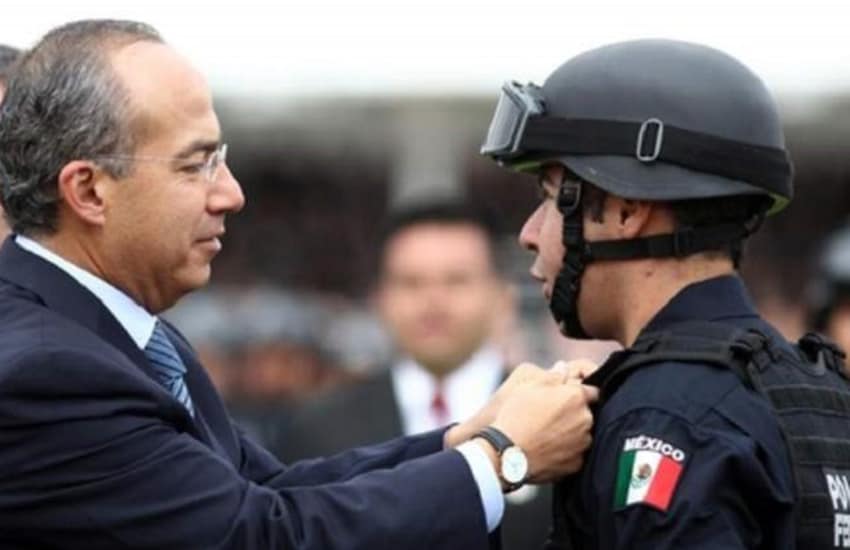
Felipe Calderon with Federal Police officer
Federal police officer with former president Felipe Calderón during his administration.

The PT said that it would support an energy sector overhaul – the president is aiming to wind back the previous government’s reform that allowed private and foreign companies into the Mexican oil and electricity market – but was not enthusiastic about the latter proposal.

With reports from El Universal and Milenio 

Baja California, Sinaloa approve same-sex marriage

0
Supporters of the same-sex marriage bill outside the Baja California state Congress.

Same-sex marriage was approved in Baja California and Sinaloa this week after being rejected previously in both states.

The Supreme Court ruled in 2015 that bans on same-sex marriage are unconstitutional, and the same year the National Commission of Human Rights advised that laws should be adapted at the state level to widen the definition of marriage.

In Sinaloa, where a proposal was rejected in 2019, supporters celebrated outside the state Congress as the law passed with 18 votes in favor and 17 abstentions.

Solidary Encounter Party (PES) Deputy Karla de Lourdes Montero Alatorre addressed legislators who opposed the bill, and chastised comments they had made: “No rights are being taken away from you,” she said.

“I have heard comments like: ‘My religion does not allow me,’ ‘I am not homophobic, but that doesn’t sit with me,’ ‘After a while they will want to marry a dog,’ and the stupidest of all: ‘God created Adam and Eve; not Adam and Steve,’” she added.

Party of Sinaloa (PAS) Deputy Angélica Díaz Quiñonez said that although she believes in a traditional definition of marriage, she voted in favor of the law out of respect for the constitution.

In Baja California the law passed with 18 votes in favor, four against and one abstention, and now requires approval in three of the state’s five local governments.

The adjustment eliminates the specification of marriage as “… aimed at guaranteeing and safeguarding the perpetuation of the species () through the union of a man with a woman.”

There have been previous attempts to change the law in Baja California: a bishop led a protest outside of the State Congress when a deputy tried to present a proposal in 2019, and proposals were twice rejected in 2020.

Morena Deputy Juan Manuel Molina said he was convinced that the move had public support. “There were positions against and for, but the citizens had been informed by several deputies and on June 6 they overwhelmingly voted for us … that for me was a clear sign that citizens are not against the issue,” he said.

“Human rights are not up for discussion,” he added.

With reports from Reforma

When dealing with crocodiles, expect the unexpected

0
crocodile in Mazatlan
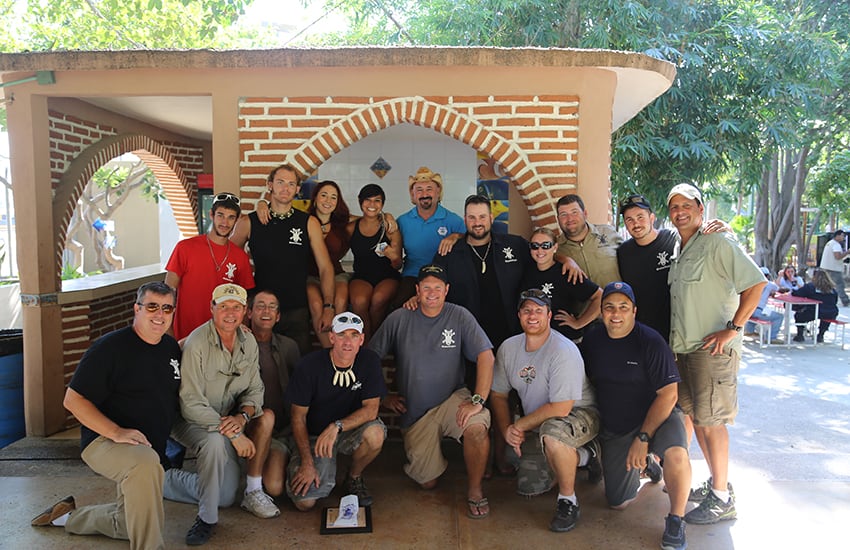
Reality TV meets Mexico. From left, Gator Boy Jimmy Riffle, aquarium director Jorge del Rincón Jarero and Gator Boy Paul Bedard with a 12-foot croc.

In Part 4 of “The Crocodile Chronicles,” the cast and crew of The Gator Boys reality TV show had arrived in Mazatlán for their first day of on-camera croc wrangling in Mexico, and the writer learned the art of wrangling local officials who craved their moment in the spotlight. Now, in the final installment, it’s finally time for the cast and crew to film “captures” of the reptiles they’d rented to make on-screen debuts in various amenable Mazatlán urban locations.

The days were long during our first week of production of The Gator Boys episodes in Mexico. The crocodile captures were going smoothly enough that confidence levels were high as we rolled into the very upmarket Estrella Del Mar golf resort.

We had previously scouted a couple of water features there (or water traps if you are a golfer) and had Gator Boys Jimmy Riffle and Paul Bedard pick the one they preferred. Since the temperature was hovering in the low 90s, there were no golfers to contend with.

The croc box was unloaded, and the 10-foot snapper went for the water with lightning speed.

After a long silence, several members of the group said in close unison, “Wow, where did it go?”

crocodile in Mazatlan
The Captured Tourist Woman and a probably sleeping specimen.

The chosen water feature was about 700 square meters, about chest-deep in the center, and not very clear. The program’s two stars had several hundred or more gator captures under their belt, so when they looked a bit nervous, we all took notice.

Given the size of this croc, neither Paul nor Jimmy really wanted to wade through the water while poking around with the capture pole.  They muttered accordingly. But there was a job to be done, and the wading and poking method would be the only way to locate the now well-hidden animal.

It was a tense time. The cameras were ready when the angry crocodile broke the surface with jaws open wide. After 20 minutes of thrashing and snapping, the beast was subdued and the golf course was once again safe.

In between the captures, the cast was being followed around by the cameras while enjoying Mazatlán’s many amenities. Eric the director let us know that he wanted to shoot a romantic dinner scene with Jimmy and his partner Ashley, also a sometime-gator catcher.

The scenario they planned was to have Jimmy surprise Ashley with a special and romantic dinner at an outdoor venue in the Plazuela Machado, the cultural center of the historic district.

Although expressly instructed not to let the secret out, my partner, The Captured Tourist Woman (TCTW), however, felt it would be only fair to inform Ashley of the plan because she should be able to properly dress for the special occasion and have the chance to make sure her hair looked good, plus other reasons that TCTW said made her unwilling to play a part in potentially embarrassing the woman.

Ashley’s job was appearing on TV, so she could act as surprised as she needed to surely? Both the TCTW and myself deemed this a minor contravention to the edict of secrecy assumed by the term “surprise.”

After all, TCTW and I discussed, if Ashley was not informed of the romantic dinner at the very nice outdoor eatery with a liveried waitstaff, a wine list with selections costing several thousand pesos, a menu containing excellent examples of several regional specialties highlighting the great culinary art of Mexico, live but not loud background music, linen napkins and tablecloths, she might show up in a sweatshirt and sweatpants. How embarrassing would that be for her? And it would all be on camera.

So TCTW had a quiet chat with Ashley during lunch break and let her know that the evening would be spent at one of Mazatlán’s better restaurants.

The crew had spent about an hour there to set up the scene. They provided attractive ambient soft lighting cast upon the 160-year-old adobe wall with arched windows. The camera angle was slightly above the plane of the table to showcase the two gourmet meals soon to grace the linen tablecloth.

When the romantic couple arrived, Jimmy looked like he was wearing the same clothes he had worn during the day’s two captures. I learned later that Jimmy’s wardrobe consisted of numerous changes of the same clothing so that he was never out of character. And, of course, Ashley was in a sweatshirt.

They were both drinking Pacíficos while perusing the multi-page menu. When the waiter came to take their order, they each ordered hamburgers. These folks were fearless when it came to facing several hundred pounds of dangerous reptile, but the culinary adventure of something new and different was significantly outside their box. When I glanced at TCTW’s horrified face and wide eyes, she gave me the hand sign that meant do not say anything.

Cast and crew of The Gator Boys episodes in Mazatlán.
The cast and crew of The Gator Boys episodes in Mazatlán.

The days whizzed along. We were fast coming up on the scheduled encounter with the humongous crocodile out at the estuary. Two days in advance, I contacted the shrimp farmers there to reconfirm our date with Godzilla the giant crocodile, now known as El Diablo, that they had promised me existed.

They were very excited! They were ready and would fire up the old Ford V8, which ran the lights and pump, to see if the giant croc would show up for a test run. Apparently, the crocodile sensed the vibrations of the running engine, which signaled chow time.

I was still concerned about any direct contact with a 16-foot, 800-pound predator that had lost its fear of people. Although I made no mention of it, I was glad that most of the show was already in the can prior to this confrontation.

On the scheduled day for the estuary, I called the shrimp farmers again and was told the Ford had developed a serious rod knock. One of the shrimp farmers had been dispatched to Culiacán for parts. The El Diablo encounter would need to be rescheduled.

I gave Eric the bad news. He said depending on a few shrimp farmers to reassemble a 50-year-old engine in a timely manner was too great of a risk. We needed another El Diablo — fast.

Jorge, our always helpful and supportive Mazatlán aquarium contact, suggested using one of his crocodiles for the El Diablo scene. Since he had a croc over 12 feet long and 600 pounds, it would not be as dramatic as Godzilla, but then again, no one would be facing certain death or disfigurement.

So we took the 12-footer and staged the scene at the edge of an estuary abutting the aquarium site. The camera angles had to be perfect so that no condo towers or hotels would show in the finished product. The croc was so docile, it needed to be poked with a stick several times just to animate the lethargic reptile. I don’t think anyone in the cast realized how serious a bullet they had dodged.

When the two-part Mazatlán episode was aired, we were told the ratings had been unprecedented. Myself and all the locals involved with the making of the two episodes had a great time with no severe injuries except for a stinky crocodile transport van.

The writer describes himself as a very middle-aged man who lives full-time in Mazatlán with a captured tourist woman and the ghost of a half-wild dog. He can be reached at buscardero@yahoo.com.

Coronavirus emptied the classrooms then thieves emptied the schools

0
Robbed Guanajuato school
Schools such as this one in Guanajuato have lost US $29.3 million to robberies during the pandemic, says Mexicanos Primero.

More than 6,000 schools have been targets of robbery during the coronavirus pandemic, according to an education advocacy organization.

Mexicanos Primero said in a new report that 6,008 schools have been burglarized since schools shut in March last year.

Their combined losses total 600 million pesos (US $29.3 million), the group said, explaining that items such as computers, musical instruments, speakers, laboratory equipment, air conditioners, chairs, desks, water pumps, copper pipes and security cameras have been stolen.

Jalisco has recorded the highest number of such robberies with a total of 643 cases followed by Guanajuato with 581 and Aguascalientes with 514. Coahuila and Sonora round out the top five with 500 and 446 cases, respectively.

Mexicanos Primero research director Fernando Ruiz told the newspaper Reforma that the figures were compiled from media reports and from information provided by state governments and schools.

Tlajomulco, Jalisco school robbed during pandemic
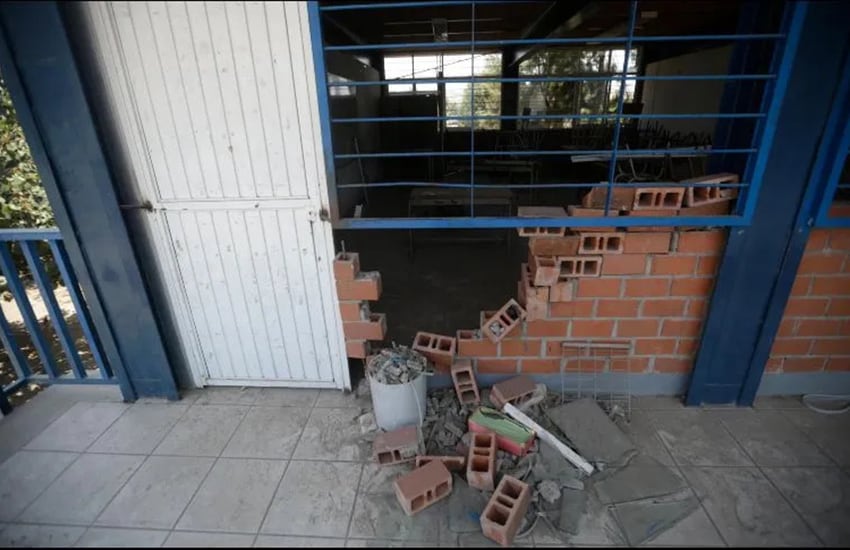
Despite it being located 300 meters from a National Guard base in Tlajomulco, Jalisco, thieves stole this school’s doors, pipes, electrical equipment and even flags.

He said the high number of robberies is one factor that explains low attendance at schools since many of them reopened at the beginning of last week.

“What we’re seeing is that the reopening [of schools] is a failure, at least in the terms that the federal government sought,” Ruiz said.

The facilities at many schools are in poor condition due to being abandoned during the pandemic, he added, citing those in Mexico City as an example. Nine out of 10 schools in the capital didn’t open because of the condition they were in.

He said that a lack of resources and bureaucratic obstacles will make replacing stolen items and carrying out repairs difficult.

In Aguascalientes, for example, some 30% of schools have sustained robberies or vandalism during the pandemic but state education authorities don’t have the money to remedy the situation at all of them, Ruiz said.

He said the federal Ministry of Public Education (SEP) needs to outline what it will do to help schools that don’t have the resources to carry out repairs and replace stolen items.

With the aim of preventing additional robberies and acts of vandalism, Morena party Senator Cecilia Sánchez tabled a document this week that calls on the SEP and the federal Security Ministry to work with their state counterparts to implement or strengthen operations against such crimes.

“With school activities suspended, various media outlets reported a range of illegal acts at educational facilities in all states, proof of that is the report by the organization Mexicanos Primero,” Sánchez said.

“… In the same vein, SNTE [teachers union] secretary-general  Alfonso Cepeda Salas announced that 40% to 50% of schools have been vandalized or have recorded thefts during the current health emergency. … [Those figures] represent between 86,000 and 108,000 public schools,” the senator said.

With reports from Reforma and El Universal 

Woman seeks to document female entrepreneurship in her Puebla town

0
Zuri Merlo
Zuri Merlo is documenting the lives of women business owners in her town of Chipilo, Puebla.

There are probably 50 to 60 female business owners in Chipilo, Puebla, the majority of whom go unnoticed. Resident Zuri Merlo is hoping her project to document the lives and work of these women will change that.

“There is not a lot of information about female business owners in Chipilo,” she said. “The project is to record a little of the history and the legacy that these women have made. The idea is to take photographs and to interview women.

“I will put the information on Facebook, maybe have an exhibit, maybe publish some of their photos and stories as part of a book about Chipilo. My hope is that the government will decide to help women with their businesses or to help them start businesses.”

There’s also a more personal reason for her wanting to do this project. “I have two daughters, and I want to show them that it is possible to be a woman and to have a business.”

Merlo’s desire to undertake this project is, in part, due to her rebelling against the traditional household in which she grew up.

Carolina Zamora, Academia de Baile Blue Dance.
Carolina Zamora, owner of Academia de Baile Blue Dance.

“I am the oldest in my family, and I have three brothers,” she explained, “and my mother, for example, if I was going to ride a bike with my brothers, she would say, ‘You cannot go because you have to stay in the house and help me because you are a girl. You have to do women’s work.’ Or my father, if he was patching a tire, would tell me I could not do it. So there were clear differences between a man and a woman.”

During meals, if her brothers wanted food, she had to serve them, even if she were eating at the time.

“My father would say, ‘Get up and heat the tortillas for your brother’ and I would say, ‘Why me?’ And they would say it is because it is normal that the daughter serves her brothers. When they told me this, I said, ‘I am not going to do it because he can do it himself.’ I understood that a woman was supposed to serve others and I did not like that.”

Her father also didn’t think that a woman should work outside the home. “He still believes a woman is weaker than a man,” she added. “But I do not think there are limits to what a woman can do.”

Merlo doesn’t like to be limited and has certainly shown that she can be successful at a number of things. She has her own business, selling artisanal foods made in Chipilo; she’s raising two daughters and is the director of Chipilo Nostro, an October festival celebrating the pueblo’s founding in 1882.

She came up with the idea for the festival in 2015 and, until the pandemic shut it down, had been a yearly event since 2017. And now she’s taken on the project Mujeres Emprendedoras Chipileñas (Female Business Owners of Chipilo).

Irene Solari de Zeron, owner of Quesería Don Giovanni.

She learned, as might be expected, that women often face challenges that men don’t.

Many of the women she’s interviewed talked about not being taken seriously by men when they first opened their business.

“They do not believe you can do the work,” she said, “but when they see you in your job, your performance, they start to trust you and begin to help you … I believe that this is something that we women have to fight for and win, unfortunately.”

But, she found, once a business owned by a woman was established, men accepted them as equals. “There was no longer discrimination,” she said, adding, “The majority of women were eventually backed by a man, a father, husband, sons or brothers.”

It’s no surprise that most women told her about the challenge of having to work essentially two jobs: at home and at their businesses.

“The biggest challenge for women I interviewed was time,” Merlo said, “because we do not stop doing what we, as women, have to do, like taking care of our husbands and our children, keeping a clean house, all those things … This takes a lot of time, basically dividing our attention between what we put into those things and the attention we want to put into our work. Many times we are not able to focus on growing our businesses.”

Merlo’s upbringing has given her the desire and the drive to prove that she — and other women — can do whatever a man can do and be successful. “Now we have activities like men do,” she said, “and this makes me feel a little excited.”

Joseph Sorrentino, a writer, photographer and author of the book San Gregorio Atlapulco: Cosmvisiones and of Stinky Island Tales: Some Stories from an Italian-American Childhood, is a regular contributor to Mexico News Daily. More examples of his photographs and links to other articles may be found at www.sorrentinophotography.com  He currently lives in Chipilo, Puebla.

Remains of another Ayotzinapa student identified

0
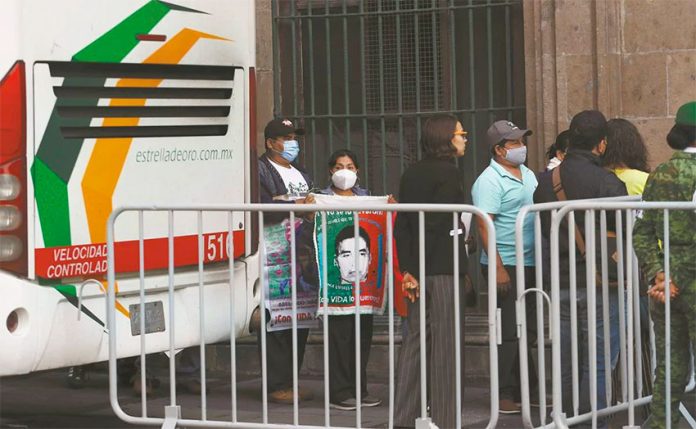
Families of the missing students outside the National Palace on Tuesday.

The federal Attorney General’s Office (FGR) announced Tuesday that the remains of one of 43 students who disappeared in Guerrero in 2014 has been conclusively identified.

Omar Gómez Trejo, the special prosecutor in charge of the reexamination of the disappearance and presumed murder of the 43 Ayotzinapa rural teachers college students, said that a bone fragment of Jhosivani Guerrero de la Cruz was identified via nuclear DNA testing at the University of Innsbruck in Austria.

“Today we can report … that the identification of Jhosivani Guerrero de la Cruz is certain and absolute,” he said.

The University of Innsbruck identified a bone fragment as matching the DNA of Guerrero de la Cruz’s mother in 2015 but that finding wasn’t considered conclusive.

Gómez said the bone fragment analyzed was found in a ravine in the municipality of Cocula, Guerrero. Authorities found the remains of another Ayotzinapa student, Christian Alfonso Rodríguez Telumbre, in the same ravine last year. DNA analysis at the University of Innsbruck identified the remains as those of Rodríguez.

The remains of three of the 43 students have now been formally identified. Those of Alexander Mora were identified in December 2014.

The previous federal government claimed that the students were intercepted by corrupt municipal police in Iguala on September 26, 2014, after they commandeered a bus to travel to a protest in Mexico City. According to its “historical truth,” the police handed the students over to a local crime gang, the Guerreros Unidos, whose members killed them, burned their bodies in the Cocula dump and scattered their ashes in the nearby San Juan River.

However, the remains of Guerrero de la Cruz and Rodríguez showed no evidence of fire damage.

The parents of the former were notified of the positive identification of their son last weekend. They met with President López Obrador on Tuesday along with other parents of the disappeared students.

A lawyer for the parents, Vidulfo Rosales, said the president told them that the United States had advised Mexico of the arrest of a person allegedly involved in the case. However, it is unclear whether that person will be extradited to Mexico and when that might occur.

Scores of suspects have been arrested in connection with the students’ disappearance but many were later released because they were found to have been tortured while being questioned about their alleged crimes.

President López Obrador established a super commission to conduct a new investigation into the Ayotzinapa case shortly after he took office in late 2018. His administration has dismissed the previous government’s “historical truth” but hasn’t established its own definitive version of events.

The army has long been suspected of involvement in the students’ disappearance, and leaked testimony obtained by the newspaper Reforma earlier this year supported that theory.

With reports from El Universal and AP

In Mexico’s cities, daily life is marked by a plethora of charming noise

0
Garbage bell CDMX
In Mexico City, one noise you might hear in your neighborhood is the trashman ringing these 'bells' to alert residents to impending trash pickup.

As I’ve written before, Mexico is a very noisy country. And at least in urban settings, it’s not conducive to that loveliest of institutions, the siesta.

But no matter! All that noise is just something to be expected down here, and since I’ve been feeling charmingly perplexed — a state of mind I don’t always manage to find — by what seems like even more noise lately, I’d like to dedicate this week’s piece to examining what exactly some of those noises are.

What might be the source of these noises, you may ask? For the sake of efficiency, I’ve decided to divvy them up into categories (yes, there are enough to make categories).

Services

For the entire first year that I lived in Xalapa, I was completely bewildered by the frequency with which I heard a certain song blaring through the neighborhood on a vehicle as it raced by. “What the hell is that?” I’d ask my compatriots (to be fair, those were the wrong people to ask). The answer was finally revealed to me one day when I heard it and then saw my host-mom run to the front window to wave down the source of the music.

If I’d been able to decipher the lyrics with my fledgling understanding of Spanish, I’d have figured it out earlier: “¡Ya llegó Gas Express!/¡Gas Expess ya está aqui!” (“Gas Express arrived!/Gas Express is here!”). Gas delivery!

In my defense, it doesn’t occur to most North American foreigners that LP gas is something that must be delivered by a company rather than pumped through pipes or wires magically like water or electricity. But by far, it was the greatest mystery to me for the better part of a year.

Another sound that you might hear, at least where I live in Xalapa, is a cowbell. That’s right, a cowbell!

The role of the cowbell, which is rung by a person literally running up and down the street, is to let people know that it’s time to take their trash out to the designated area for pick-up roughly 10 minutes later.

If you miss the cowbell and trash pickup only happens once or twice a week (as it does in my neighborhood), then you might be able to catch a few independent trash collectors who walk through the neighborhood shouting “Quiere basuraaaaaa” (literally, “want traaaaaash”). Walk out of your house and wave them down! You can give them your trash bags for a few pesos.

Finally, there’s a high-pitched whistle used by the person who rides around offering to sharpen your knives. It’s almost like a train whistle but much airier and higher. So, if you hear it and have some dull edges, wave him down and take your knives out!

Things for sale

This is also a big category, and the biggest part of it by far is food. The way to tell what exactly is for sale is, of course, to sharpen your listening skills or take a peek outside as they’re passing. Most people can understand tamales, but camotes (sweet potatoes), elotes (corn with mayo, cheese, and chile pepper), verduras (vegetables) and pan (bread) might get past some people if they’re not used to it.

Sometimes there’s a recording that blares out of speakers affixed to the top of a car, but often the vendors have simply sharpened and perfected their loud calls to announce their presence in your neighborhood.

Agua (water) is another word that gets announced on my street a couple times a week. They’re not talking about water from the faucet, but rather garrafones of water, those five-gallon clear containers of purified drinking water. This is what most people drink from in their homes, as the water from the tap is officially suspect for regular consumption. (I once asked a chemist friend who worked at a water plant about that, and she explained to me that the water wasn’t so much the problem, but rather the outdated pipes that it ran through).

Another frequent noise that I think is more about buying than selling is for fierro viejo (old iron literally, but mostly they mean any kind of old large appliances that don’t work anymore and that you’d like taken off of your hands). They’ll “buy” it from you, though I’m not quite sure for how much.

Miscellaneous

The first thing to go under this category is animals, of course: barking dogs, of which there are sometimes many, top the list. After that — at least in cities like mine whose pueblo’s past isn’t too far removed from the present day — are … roosters!

In the farm animal children’s books of my youth, roosters only crowed at sunrise. Not so in my neighborhood! Roosters (apparently) crow to establish dominance and territory, the habit more closely resembling dog barks than a once-daily sunrise ritual.

There are roosters on my street that crow at me every time I walk by … perhaps my gait looks like a threatening strut? They are not persuaded of my intentions by my repeated “Relax, dudes,” so it’s just something I’ve come to expect. I think I’ll start telling myself that they’re just saying hi.

This is not a complete list by any means: there are rockets and fireworks on pretty much any saint’s day, and when we hear them, we pray that they actually are rockets and not bullets. Partying neighbors (complete with old songs sung in unison by 20 very drunk people at 2 a.m.) are also a common occurrence.

The general attitude seems to be that noise is simply something everyone makes and therefore something everyone has to live with. You can always tune out the sounds with a good pair of headphones, but why try?

Sarah DeVries is a writer and translator based in Xalapa, Veracruz. She can be reached through her website, sdevrieswritingandtranslating.com and her Patreon page.

Former mayor gets 8 years in murder of Chihuahua journalist

0
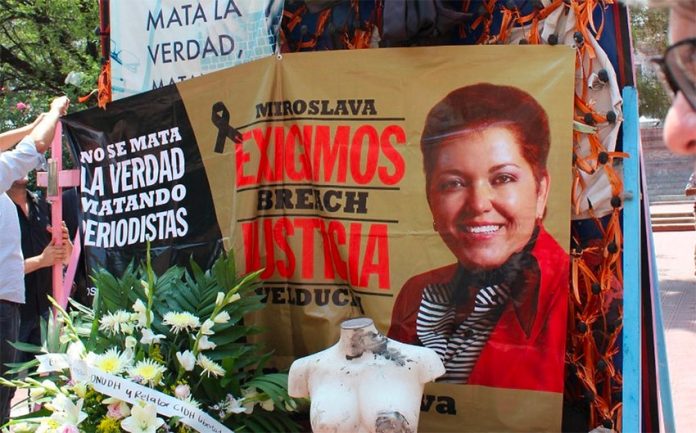
A photo of Miroslava Breach at a memorial.

A former mayor has been handed an eight-year sentence in the killing of journalist Miroslava Breach in Chihuahua city in 2017.

Hugo Amed Schultz Alcaraz, the former mayor of Chínipas, Chihuahua, admitted to his role as an accessory to the murder. The sentence bars him from future political activity and the right to appeal, and obliges him to provide monetary compensation and a public apology. By accepting the terms, Schultz received a shorter jail term.

Breach was shot eight times in the head on March 23, 2017, after she wrote a series of reports on drug trafficking networks in the state. Former state leader of the National Action Party, José Luévano Rodríguez, and his former spokesman Alfredo Piñera, are still at liberty, despite allegedly directing cartel members to her.

It is thought that Luévano ordered Piñera to record the journalist as she was interrogated about her research. The audio recordings were then given to Schultz, who passed them onto the intellectual author Juan Carlos Moreno, who was sentenced to 50 years in prison last year.

Human rights organization Propuesta Cívica, which accompanied Breach’s family during the trail, said she was murdered for investigating narco-political and corruption networks and exposing the human rights violations of populations in the Sierra Tarahumara. “More than four years after her murder, we have achieved a second conviction against another person responsible,” it added.

In Schultz’s public apology, he stated the importance of Breach’s work as a journalist. “… I am very sorry that actions on my part contributed to her regrettable murder. I want to convey a message to Miroslava’s family in which I acknowledge that my contribution affected Miroslava’s rights and I regret the consequences that they resulted in. The absence of Miroslava Breach as a critical journalistic voice has undoubtedly affected the right of society to public information,” he said.

More than four years after the homicide there is still an arrest warrant pending for driver Jaciel “N” and at least one other suspected intellectual author of the murder. 

Mexico is the deadliest country in the world to be a journalist, according to Reporters Without Borders.

With reports from Milenio, El País and El Universal

Quintana Roo, Yucatán lead increase in Covid cases, Health Ministry warns

0
Deputy Health Minister López-Gatell
Deputy Health Minister López-Gatell at Tuesday's press conference in the National Palace.

The intensity of the coronavirus pandemic has declined in much of Mexico but Quintana Roo and Yucatán are among a small group of states that have seen a recent increase in new case numbers.

Deputy Health Minister Hugo López-Gatell said Tuesday that new infections had spiked 8% nationally after weeks of declines, attributing the increase to higher case numbers in Quintana Roo, Yucatán, Baja California Sur, Campeche, Sinaloa and Veracruz.

“It’s Quintana Roo and Yucatán where there is a significant increase in cases. We’ve called for a reduction of certain activities where people congregate,” the coronavirus point man told reporters at President López Obrador’s regular news conference.

There are currently 1,212 active cases in Quintana Roo and 1,729 in Yucatán, according to federal Health Ministry estimates.

Only Mexico City (5,871) and Tabasco (1,989) have more active cases than the Yucatán peninsula states, which are currently high risk orange on the federal government’s coronavirus stoplight map. Ranking fourth for active cases – one spot below Yucatán and one above Quintana Roo – is Baja California Sur, which an estimated 1,544 people currently have Covid-19 symptoms.

The common denominator for three of the top five states for active cases – Quintana Roo, Yucatán and Baja California Sur – is that they are home to popular tourist destinations.

“This increase has to do with tourism, … something that must be highlighted is that Mexico doesn’t ask for a PCR [or antigen] test to enter the country,” said Andreu Comas, a health academic at the Autonomous University of San Luis Potosí.

“… We’re having a signifiant increase [in case numbers] in the Baja California peninsula and in the Yucatán peninsula because of tourism,” he said.

In Mérida, the capital of Yucatán, brigades of people employed by the state Health Ministry have returned to the streets to distribute hand gel and remind citizens to follow measures to mitigate the spread of the virus, such as the use of face masks.

In Quintana Roo, where more than 100 new cases per day have been recorded in recent weeks and more than 250 Covid patients are currently hospitalized, Governor Carlos Joaquín took to Twitter to remind citizens to continue following the health protocols.

Mexico City, which switched to low risk green at the start of last week, has also seen a slight increase in new cases since easing restrictions. The capital easily leads the country for confirmed cases and Covid-19 deaths with more than 669,000 of the former and 44,100 of the latter.

The national case tally is 2.46 million while the official death toll is 230,428, a figure considered a vast undercount.

López-Gatell advised people with Covid-like symptoms to seek timely medical attention, saying that there is plenty of capacity to treat patients.

“At this time we don’t have saturation problems, … we have ample space in the Covid units,” he said.

Meanwhile, Mexico’s Covid-19 vaccination program continues to roll out across the country with first doses being given to people aged 40 to 49 and second doses already reaching some people in the 50-59 age bracket.

About 37.5 million vaccine doses had been administered in Mexico by Tuesday for a rate of 29 shots per 100 people, according to The New York Times vaccinations tracker.

With reports from El País and Milenio 

Chef and restaurateur Alam Méndez is Oaxaca’s culinary messenger

0
Chef Alam Méndez at Pasillo de Humo, Mexico City
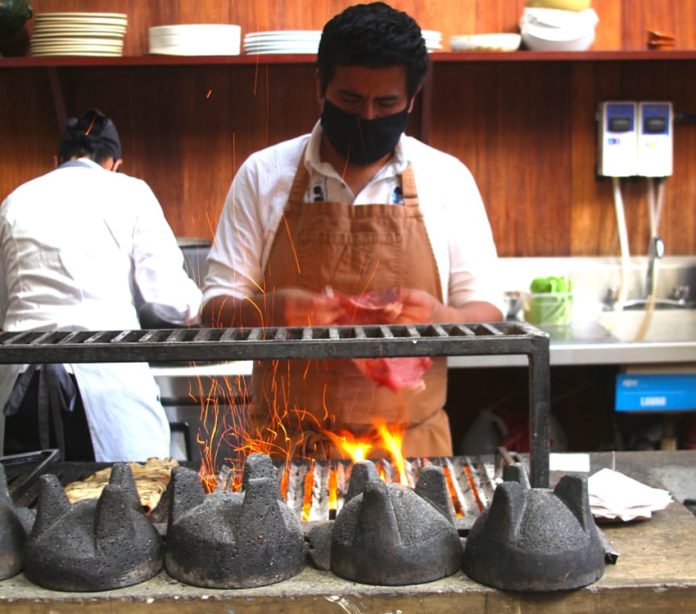
Alam Méndez working in the kitchen at Pasillo de Humo, his Mexico City restaurant.

“As chefs, we are the ‘messengers of our mothers and grandmothers who cooked for centuries. We are tasked with conserving the cooking traditions of our communities,” says Oaxaca chef Alam Méndez. “Our role is particularly important for those people who did not have the pleasure of being born in Oaxaca.”

Méndez had the pleasure of being born in Oaxaca in 1990, one of three children of another renowned Oaxacan chef and food expert, Celia Florían. This probably “sealed his fate.”

He practically grew up in his parents’ Oaxaca city restaurant, Las Quince Letras, living in the same building until he was 16. He accompanied his father to the market to buy supplies and was given a portion thereof to “play with.”

In middle school, he decided to follow in his mother’s footsteps and began doing some work in the kitchen when he was 14.

“As long as I can remember, the kitchen has been a part of my life — open the door of my house and you are in Las Quince Letras. It wasn’t obligatory; [it was] … something I enjoyed immensely,” says the chef.

Alam Méndez, owner of Mexico City's Pasillo de Humo
Méndez is the son of renowned Oaxacan chef and food expert, Celia Florían.

His parents started the restaurant with no formal training in the business, just a passion for the cooking of their childhoods. Méndez, however, decided to take this passion out into the culinary world of Mexico and beyond.

First, he studied at the Culinary Institute of Mexico in the city of Puebla, then he worked in various restaurants in Mexico, Europe, Guatemala and Chile. One thing his international experience taught him is that it is possible to recreate authentic flavors of Oaxacan cooking outside of the state.

He returned to Mexico from Europe in 2016 to start the Pasillo de Humo (Smoke Hall) restaurant in Mexico City, a small place located in an upscale “food market” called Parían in the international neighborhood of Condesa. Pasillo de Humo refers to the section of Oaxacan markets where grills cooking sausage, marinated beef (tasajo) and more line up and wait for hungry patrons.

Initially, the restaurant’s purpose was to bring authentic Oaxacan flavor to the capital. It still offers 100% authentic dishes such as tlayudas and chicken in red mole sauce.

His efforts here have not gone unnoticed. Food writer and editor James Oseland included Méndez in his cookbook on Mexico City, stating “Pasillo de Humo is a well-appointed restaurant for certain kinds of upscale diner, but the food really does conjure Oaxacan authentically. The flavors and textures of the state come through even in a world so different from his own.”

Méndez was one of seven Mexican chefs selected to compete in the semifinals of the S. Pellegrino Young Chef 2018 competition.

His family’s Oaxacan cooking forms the basis of his work, but his professional training and experiences in Mexico and abroad have broadened his horizons.

“I love Oaxacan cuisine, and I love using herbs, vegetables and other products of the fields,” he says.

But he has also learned to appreciate the cooking in other parts of Mexico and the demands of a sophisticated urban market. For example, he will never change his mother’s mole negro sauce (her pride and joy), but he has experimented with putting it over duck instead of the traditional turkey and cooking the meat in a manner more sophisticated than simply boiling it.

One dish that shows his respect for the other cuisines of Mexico is oregano chicken with mole rojo. (Oregano is a Mediterranean herb that is used in various parts of Mexico but not so much in Oaxaca.) His experimentation has received approval from his traditional mother.

“His ability to combine tradition with the contemporary, making dishes his own, is something that fills me with pride,” she says.

Oaxaca is one of Mexico’s most traditional states, and it might seem unusual for a man from here to become a chef. Méndez disagrees. It may have been that way in the past, he says, but certainly not now. In addition, certain dishes in the state have always been cooked by men, especially for major gatherings, he explains.

Ensalada de la milpa (Cornfield salad).

One example is caldo de piedra (literally “stone soup”), where the broth is boiled by adding a heated rock. Another is barbacoa, traditionally made in a pit dug into the earth.

Méndez’s international experience and a chance meeting with restaurateur Chad Sparrow has taken him to the United States, more specifically to Washington, D.C. Sparrow visited Pasillo de Humo and, highly impressed with what he saw and tasted, offered Méndez the head chef spot and the chance to be the inspiration behind Urbano 116, a restaurant with the aim of recreating authentic flavors of Mexico City.

Unfortunately, this did not pan out. The high-end restaurant business is an unforgiving one, and the owners switched gears to, of all things, Tex-Mex cuisine. Méndez understandably decided to leave the venture. But he still believes that there is a market for authentic Mexican regional food, especially in D.C. He has started a new joint venture called Maíz 64. The 64 refers to the number of varieties of native corn in Mexico.

Méndez hopes to open the restaurant by the end of the month and reproduce traditional Oaxacan fare. Oseland shares Méndez’s optimism about promoting the cuisine in the United States, noting that tastes for Mexican food have become more sophisticated in the past decades.

“What is so special about what Alam can offer a diner in Washington, D.C. is a chance to taste the true flavors of Oaxaca,” he says, “because who better to channel them than Alam, who ‘literally’ has Oaxacan food flowing through his veins.”

Leigh Thelmadatter arrived in Mexico 18 years ago and fell in love with the land and the culture in particular its handcrafts and art. She is the author of Mexican Cartonería: Paper, Paste and Fiesta (Schiffer 2019). Her culture column appears regularly on Mexico News Daily.