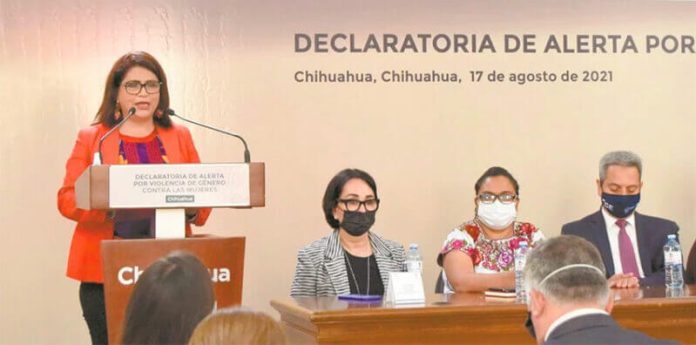
Government and NGOs were present at Tuesday's announcement.
A gender violence alert has been activated for the five Chihuahua municipalities of Ciudad Juárez, Parral, Chihuahua, Cuauhtémoc and Guadalupe y Calvo, which have been identified as areas with a high level of violence against women.
“The government of Chihuahua recognizes that systematic violence against women has expanded in the state, given that every day a woman has been killed. Every day, a family suffers for the homicide of a mother, sister, or daughter,” said Alanís Sámano, head of the National Commission to Prevent and Eradicate Violence Against Women (Conavim).
Seven of 10 Chihuahua women have been victims of violence, primarily in the home, school, workplace or the streets. And in the past 10 years, the five municipalities have seen 2,400 murders of women. In the first six months of 2021, the state ranked third for homicides of women and had an elevated level of rape, Sámano said.
The alert is a useful legal tool for addressing violence, providing monitoring mechanisms and obliging the three levels of government to comply with certain recommendations, Governor Javier Corral said. He also confirmed that the alert was issued as a result of requests presented by nonprofits in the face of insecurity and mounting numbers of gender-motivated homicides.
Alejandro Encinas, deputy minister of human rights at the federal Interior Ministry, called the alert “an important step” in recognizing and moving toward solving the problem of violence against women. He said the alert came about as a result of cooperation between various levels of government, women’s collectives, academics and others.
Anabel Sanz Luque, representing UN Women, lauded the perseverance of the organizations that have made the alert a reality, which she said lays out “a path that requires political dialogue and a collective effort to make visible the violence against women and find solutions to eradicate it.”
Federal highways in central Mexico were the most risky in the country for robberies in the first half of 2021, research by security consultancy DataInt showed.
The riskiest road in the country was the Querétaro-Irapuato highway, which recorded 54 robberies, and the Querétaro-San Luis Potosí highway was second with 46. Seven of the top 10 most crime-ridden roads were north of Mexico City and south of San Luis Potosí; four were going to Querétaro.
Six-hundred and twenty-five highway robberies were reported from January-July this year, with 62% of the vehicles targeted carrying cargo. Another 31% were private vehicles and 5% were passenger vehicles.
The report also detailed the time patterns of thefts. Wednesdays, Thursdays and Fridays from 6-10 a.m., 1-2 p.m. and 8-10 p.m. were points of high activity. The peak time for thefts was on Wednesdays from 6-10 a.m.
Meanwhile, roads south of Mexico City were no safe haven for drivers. Two sections of Highway 150D were third and fourth on list: Mexico City-Puebla and Puebla-Córdoba, which taken together recorded 58 robberies.
However, while the report points to central Mexico for high risk roads, it also conceded that it was the region for which data was most available.
Dataint’s global road risk indicator, which includes homicide statistics in the equation, adds parts of Sonora and Zacatecas to the most dangerous places to travel in the country.
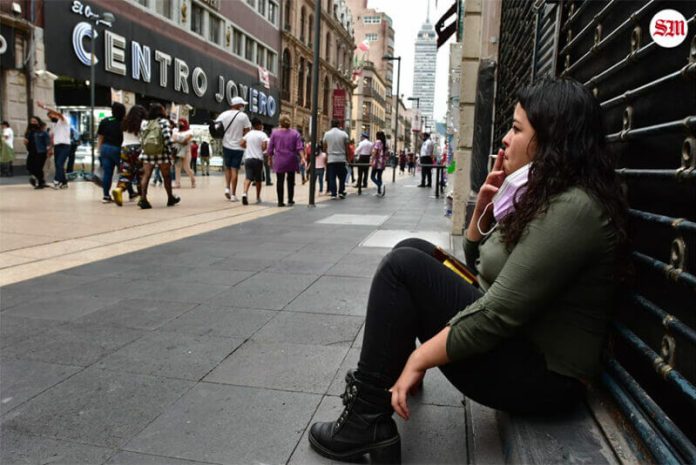
As part of an effort to clean up one of Mexico City’s most iconic streets, smoking has been prohibited on Madero Street in the historic center.
The city’s Historic Center Authority has installed no-smoking signage along the length of the street where, during the first month of implementation, smokers will be asked to put out their cigarettes and will not face fines if they comply. But starting in mid-September, smokers will face fines of 896 to 2688 pesos (US $45 to $134) or mandatory community service.
City authorities have also limited the number of flyer distributors allowed on the street to 51, down from over 200, in order to prevent unnecessary crowds, and installed sanitary checkpoints for the distribution of hand gel and face masks. They will also continue to promote the Open Air City program, which encourages outdoor dining and food sales.
The general coordinator of the Historic Center Authority, Dunia Ludlow, said the agency has been working to clean up the street since last year.
“When we started, we found some common urban problems, graffiti … Since last year we have been working with the auxiliary police and [government departments] to provide better order,” Ludlow said.
Ricardo Alemi, director of health and wellbeing for the nonprofit Refleacciona con Responsabilidad, said the goal of the smoking ban is to create a safe, healthy environment in one of the most heavily used pedestrian corridors in the country, through which up to 220,000 people pass daily.
A nurse was caught on video injecting a young woman with air rather than a Covid vaccine at a vaccination center in Morelia, Michoacán, on Tuesday.
The incident, which was reported to authorities after the video began to circulate on social media, occurred on Morelia’s second day of vaccination for the 18 to 28 age group.
State officials confirmed in a press release that there had been a case “in which an inadequate application of the vaccine occurred,” and added that it was “without a doubt an error that we cannot overlook. The necessary measures will be taken to strength control of the vaccination process and insure it does not happen again.”
The council also pointed out that healthcare workers have been “subject to intense work days, stress, and even putting their lives at risk.”
It is not the first mishap in the vaccination process. Various misapplied shots have been caught on camera, including one in Mexico City that President López Obrador suggested was a media set-up.
In recent days, Morelia vaccination centers have seen long lines as youths and parents arrive up to 15 hours ahead of time with folding chairs and tents, eager to secure their shot.
Mexico had administered 78 million doses as of Tuesday.
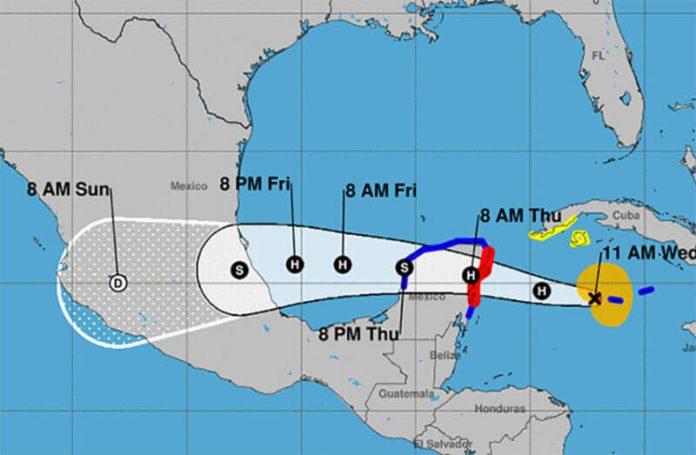
A hurricane warning is in effect for the areas indicated in red and a tropical storm warning has been issued for the areas marked in blue. us national hurricane center
Tropical Storm Grace was upgraded to a Category 1 hurricane by the U.S. National Hurricane Center (NHC) at 11:00 a.m. EDT.
Grace is predicted to hit the Quintana Roo coast Wednesday night or early Thursday morning near Tulum, Mexico’s National Water Commission said.
Torrential rainfall, strong winds and powerful waves are forecast for the peninsula starting Wednesday, before spreading to eastern Mexico on Friday.
The NHC reported a hurricane warning is in effect from Cancún, Quintana Roo, to 400 kilometers south at Punta Herrero, including Cozumel Island. It said a tropical storm warning is in effect from Punta Herrero to 80 kilometers south at Puerto Costa Maya and from Cancún to Campeche, 480 kilometers west.
The storm was located 105 kilometers west of Grand Cayman and 560 kilometers east of Tulum, Quintana Roo, with maximum sustained winds of 120 kilometers per hour (kph). It was moving west-northwest at close to 24 kmh.
It is expected to come within 115 kilometers of Punta Allen, about 54 km south of Tulum, on Thursday morning before crossing the peninsula overland as a tropical storm toward Progreso, Yucatán. It is forecast to continue west to Veracruz and come within 35 kilometers of Tocolutla as a Category 1 hurricane on Saturday morning before crossing inland Sunday, passing north of Mexico City as a tropical storm.
Conagua advised people to exercise precaution due to rain, wind and waves.
Several government departments and agencies released a joint statement Tuesday, warning of the need for preventative action to avoid a natural disaster.
It said two to three meter waves could be expected in Quintana Roo this evening and that the hurricane could affect Tulum, Playa del Carmen, Cozumel Island and Cancún tonight. It added that it could become a Category 2 hurricane near Veracruz late Friday or early Saturday.
The statement also added that torrential train should be expected in Puebla, San Luis Potosí, Veracruz and Hidalgo and intense rain in Guanajuato, Querétaro, Tamaulipas and Tlaxcala on Friday and Saturday.
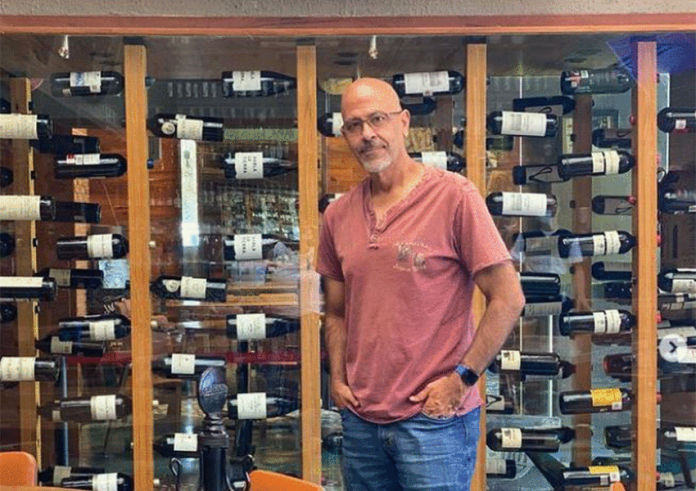
The owner of the YouTube channel "Retired Life in Mexico No Bull," who goes online by the pseudonym Sirdragonx, says Mexican healthcare saved him from cancer. Instagram
A U.S. man who suffered from cancer has lauded his experiences with private Mexican healthcare providers and said that they saved his life. Better still, he said his U.S. insurance provider covered the entire cost.
He has also turned his experience into an opportunity to explain to other expats how healthcare operates in Mexico in a series of three videos, two of which are available on YouTube.
On the YouTube channel Retired Life in Mexico NO BULL, the presenter, who says he formerly worked as a U.S. diplomat in Brazil, explained that he found a lump on his neck in May 2019 while he was planning a move to San Miguel de Allende, Guanajuato, but was still living in the United States.
After four weeks of medical appointments and billing insurance companies US $3,000, the all-important MRI scan was still proving evasive.
He felt unsatisfied with the care he was receiving in the U.S. and so traveled to the Hospital Zambrano Hellion in Monterrey to visit an ear, nose and throat doctor. He was sent straight to an imaging lab for an MRI which cost US $270 rather than the thousands of dollars it would have cost in the U.S.
On review, the doctor said it was a cyst rather than a cancer. However, during extensive surgery, lymph nodes were discovered which turned out to be cancerous. The doctor sent him to an oncologist, who recommended radiotherapy and chemotherapy.
The patient considered returning to Houston for treatment but was informed that a hospital in Monterrey had exactly the same equipment.
He underwent the treatment, which he describes tearfully in the video. His U.S. insurance company, Aetna, paid for all of the costs accrued in the whole course of investigation and treatment: $25,000 in addition to $2,500 out-of-pocket expenses.
“I have a newfound respect for those that have gone through cancer treatment. All I can say is that it was seven weeks of hell and a year of recovery … I am cancer free. It was brutal, but I survived,” he said.
He added a word of advice for anyone going through treatment: “Never give up, no matter how hard it may get.”
However, he admitted that insurance providers will differ on whether they would pay out for overseas medical care.
In the second video, he invited a licensed insurance representative from Seguros Monterrey New York Life, Anna Caballero, to offer technical information. She advised anyone looking for insurance in Mexico to look to insurance regulator Condusef for information on which provider to choose.
She added that policies are defined by whether they are purely domestic or offer international coverage; what proportion of hospitals they cover; and what deductibles they offer.
How Mexico saved my life! Healthcare in Mexico Series Part 1. My personal battle with Cancer!
Private Healthcare in Mexico part 2 of 3. Private healthcare and insurance explained.
Puebla will be the fourth state where Jüsto has a presence, along with Mexico City, Guadalajara and Querétaro.
A Mexico City-based delivery-only grocery store chain has announced a 400-million peso (about US $20 million) investment in Puebla.
Jüsto plans to source agricultural products in the state before selling them domestically and through export.
Puebla will be the fourth state where Jüsto has a presence, along with Mexico City, Guadalajara and Querétaro. The investment is expected to generate 500 jobs and more than 2,000 in the next two years, according to the newspaper El Universal.
Jüsto founder and CEO Ricardo Weder explained that the company offers 5,000 products online, including fruits, vegetables, meat, fish, dairy products, bread, beverages, liquor, frozen foods and medicines.
Weder, who is the former CEO of the ride-hailing service Cabify, added that the company has a monthly growth rate of 20–30%. Last year, he said that the e-commerce adoption curve was “dramatically accelerating” as a result of the pandemic, yet the market penetration rate of e-grocers is still less than 1% in Latin America.
“That means there’s an enormous opportunity — and all the right conditions — to disrupt the grocery industry …” he said.
Governor Miguel Barbosa Huerta said investment in the primary sector — the exploitation of natural resources, such as farming, fishing and forestry — was a key economic driver. “The economic growth of any state and any country is crystallized by capital investment, but also by the development of agriculture,” he said.
The head of the state Economics Ministry, Olivia Salomón, welcomed the company to the state due to its ethical business practices. “Jüsto is committed to fair trade, with a platform of more than 5,000 products, through a mobile application at competitive prices,” she said.
Ana Laura Altamirano Pérez, head of the state Rural Development Ministry, said that Puebla’s agricultural land is of sufficient quality to grow fresh produce throughout the whole year.
Manolo Fernández, a spokesman for Jüsto and member of the company’s founding team, said last year that the grocery chain has the capacity to supply fresher products to consumers than those found at brick-and-mortar supermarkets.
“At traditional supermarkets, the fill rates are lower and the product is less fresh. One of our core tenets is to reduce waste. We don’t have fruits and vegetables sitting outside in the store,” he said.
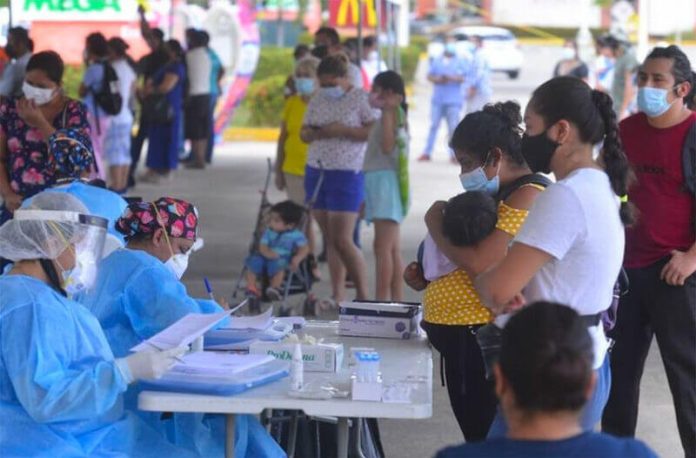
Covid testing stations were busy in Villahermosa, Tabasco, on Monday.
The deputy health minister responsible for managing the coronavirus pandemic is predicting a decline in case numbers toward the end of the month.
Hugo López-Gatell, who has been the government’s coronavirus point man since early last year, said preliminary signs in half of Mexico’s states show a decline in the speed with which Covid has been spreading. He also said that this week is the second in a row in which there had been a reduction in cases.
“When the [downward] tendency becomes established, which will surely happen in the next 15 days, we shall be seeing a decline in the third wave, likely moving toward stabilization,” he told Thursday morning’s government press conference.
He cited Sinaloa as “the most clear example” of how the growth in new case numbers has dropped. “… we now have three weeks in which the pandemic has seen a reduction.”
López-Gatell said vaccination is the most important contributor to the improvement.
He said 78 million doses have been administered, providing 54.9 million people with at least one dose, or 61% of the adult population. An average of 750,000 shots are being given daily, a pace that ought to allow the government to reach its goal of giving at least one dose to every adult by the end of October.
Meanwhile, the positive news doesn’t apply to Tabasco, where new daily case numbers have broken a record: more than 4,000 were recorded over the four-day period ending Sunday, health authorities said Monday. With 6,731 new cases, the past week was the worst since the pandemic began.
One factor in the rising case numbers is likely due to the fact that Covid testing by the Ministry of Health has been tripled, though not enough to keep up with the demand in Villahermosa, the state capital, on Monday.
Nationwide, there were 14,814 new cases registered as of Tuesday afternoon, the federal Health Ministry said, bringing the total to 3.12 million. Total deaths rose to 249,529 with 877 additional fatalities registered today.
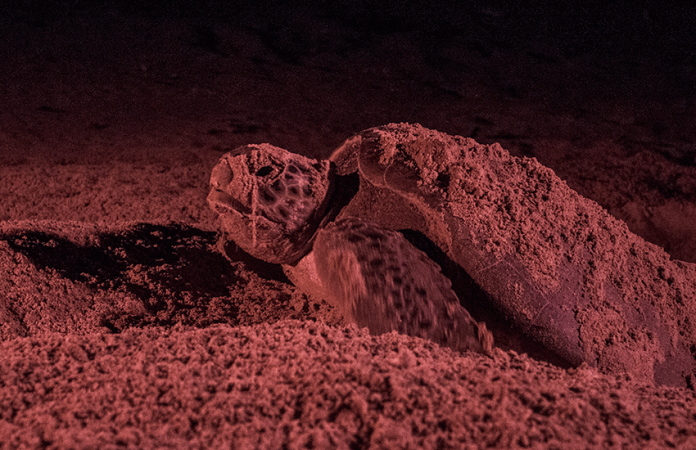
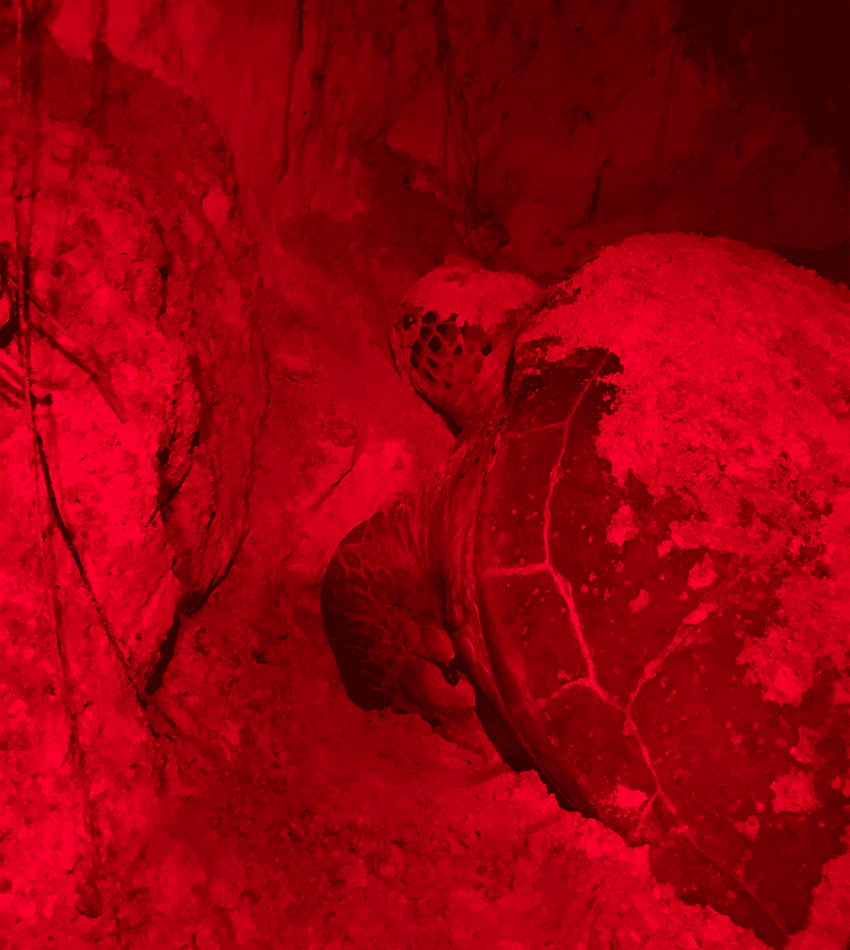
Green turtle on El Cuyo beach in Yucatán, seen at night by red light to avoid bothering the nesting reptiles. Marigel Campos
“My day begins with the night,” Fabiola — a weather-beaten veteran researcher of sea turtle nesting sites — tells me before we depart on her ATV to patrol the beaches of El Cuyo, Yucatán. El Cuyo: where endangered green and hawksbill sea turtles have come to lay their eggs year after year since the dawn of time.
We putt-putt over two kilometers down the beach on a night with no stars, moon, breeze or people. It smells of the sea, and the only sound to be heard (other than our ATV) is the echo of the Caribbean waves on a humid June night. We move forward until the high tide stops us and, to my joy, we are forced to leave to its dark fate the horrendous, noisy, four-wheeled vehicle that doesn’t permit one to contemplate the night or listen to the sea in peace.
I told myself that I would rather walk the full five kilometers that night, patrolling the beach and feeling the wet sand under my feet. These are the times when I need to feel the Earth directly, without intermediaries. I’m now convinced that the only valid reason ATVs exist is to help biologists look for sea turtle nests, and for that reason only, we humans must put up with those dreadful machines.
Fabiola carries in her backpack a small GPS device, a notebook and a few test tubes in which she will preserve samples from the turtles’ skin — upon which genetic studies will be performed. She also carries measuring tape, tags for turtle fins, alcohol to sterilize and who knows what other trinkets. Both of us have red-light lamps on our forehead that, she told me, don’t bother the turtles.
Then, there is me, Fabiola’s accidental field assistant, the one who on his back carries 37 of the thousands of bamboo stakes that she has patiently painted bright red; tonight, she has chosen stakes that number 583 to 620. We will bury them in the sand to mark the turtle nests we find.
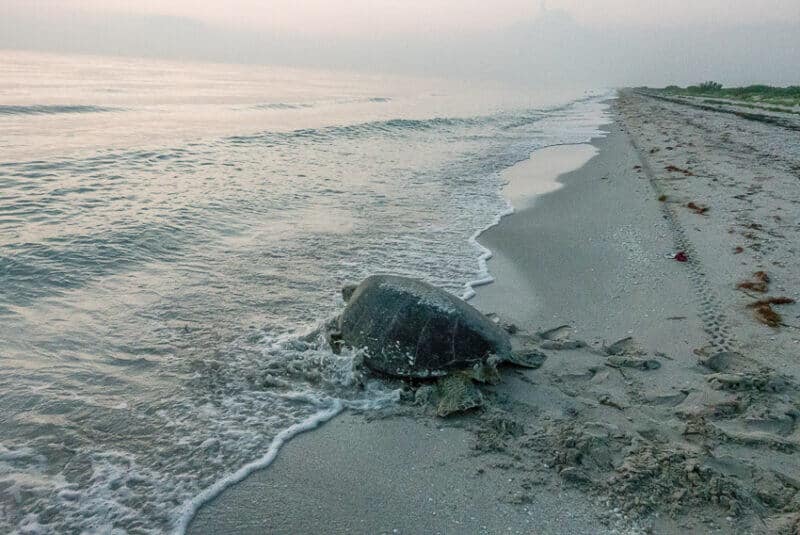
An adult green turtle at the shore, confronting the tide. Marigel Campos
Fabiola recycles those stakes from the leftover wood of the jimba de caña brava, one of Mexico’s five native species of bamboo, the same bamboo that fishermen use to catch octopuses along the coast of the states of Campeche and Yucatán. The jimba technique is a diurnal, drifting artisanal fishing method that, I’m told, is environmentally sustainable but is disappearing because the new generation of fishermen don’t want to use it anymore.
I had heard of this bamboo fishing gear’s existence for the first time just the day before while chatting on the beach with Tatiana and Gerardo, two cheerful young fishermen in love who came to El Cuyo from the states of Chiapas and Tabasco years ago. I listened to them while Tatiana’s dad was fishing on a small skiff, accompanied by his old mixed-breed dog, in a nearby area where pelicans and herons feasted on fish and frigate birds soared in slow motion.
At a distance, gluttonous pink flamingos filtered lagoon water with their bills, removing the brine shrimp, Artemia salina, those 15-millimeter-long crustaceans equipped with three eyes and 11 pairs of legs to live in hypersaline water.
These shrimp are stuffed with carotenoids, the pigment responsible for the pink feathers of the flamingos. Brine shrimps are primitive invertebrates that, like us vertebrates, contain hemoglobin in their blood, but they’ve hardly changed over 100 million years of existence — just like sea turtles.
I frequently dreamed of seeing sea turtles laying their eggs on a starry night. Maybe that is because the first time I ever saw Vincent van Gogh’s Starry Night I was deeply touched by the subtle dark night colors of browns, grays and pale blues in that sublime painting. Vincent was, of course, hallucinating (for himself and for us) at the asylum of Saint-Paul-de-Mausole near Saint-Rémy-de-Provence.
Sadly, my second night in El Cuyo was another non-starry night, a night when, after wandering across several kilometers of beaches, my voiceless frustration had built after seeing, once and again, only the tracks that the turtles left on the sand. No live turtles; only the traces of their zigzagging forward and backward movements from the sea and toward the sea, as if they were undecided where to make their nests.
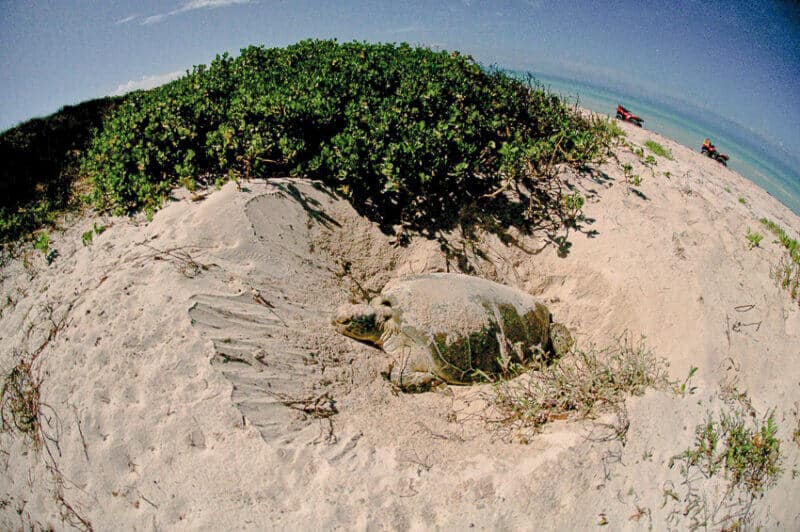
The green turtles that arrive at El Cuyo crawl to the beach’s highest ground to safely make their nests. Iván Gabaldón
But just hours ago, Dr. Melania López, an experienced Mexican scientist who leads the sea turtle program of Pronatura Península Yucatán — one of Mexico’s leading non-governmental environmental organizations — told me that El Cuyo is one of the two most important nesting beaches for green and hawksbill sea turtles in the entire Mexican Caribbean, the other one being Holbox Island in the state of Quintana Roo. So I continue walking, looking down in hopes of finding one of those turtles.
I ask myself: maybe they are not coming today, or it just isn’t the right time? Or perhaps they sense our presence and choose to nest elsewhere? Or, even worse, the monstrous and noisy ATV that we abandoned has frightened them away?
Suddenly, noiselessly, in the starless dark where the waves break on the beach, a ghostly turtle-like silhouette unveils itself. Crouching on the sand, just a few meters from the sea, my mouth opens in wonder and I stare at a moving sketch of a sea turtle emerging from the water slowly, almost as if in pain.
Magnificent Chelonia drags herself onto the beach with an unbreakable millenary evolutionary resolve to reproduce. It is a female green sea turtle that relentlessly swam who knows how many thousands of miles or from which far ocean, but she came to El Cuyo, probably the same beach where she was born decades before.
I stop breathing, motionless, sharpening my sight, hearing and sense of smell in the darkness and in the monotonous wash of the waves, trying to discern how this immense ancient marine reptile crawls slowly but meticulously up onto the beach. Unexpectedly, a flip-flop sound gets my attention and makes me look in the other direction.
Then I realize — first thinking for a moment that I’m hallucinating — that another turtle is crawling up the beach, its fins making the sound as it pads its way up the wet sand. I’m in the middle of the track that those two sea turtles must follow to reach the highest part of the beach and dig their nests.
El Cuyo is one of the two most important nesting beaches for green and hawksbill sea turtles in the entire Mexican Caribbean. Omar Vidal
And I have no idea what to do. I’m no more than 10 meters from the two giant turtles. What to do to avoid being bulldozed by them?
The only thing I can come up with is to try and hide motionlessly on the sand as I was instructed to do when in danger as a Boy Scout: hide and allow your eyes to stealthily scan the area.
As if she were smelling my terror (sea turtles have bad sight but a very good sense of smell), the turtle on my right turned to begin moving directly toward me. Instinctively, I turned my head down, placing it against the sand, signaling submission, gazing at that huge armored reptile, begging her not to crush my fragile human kindness.
In retrospect, I honestly don’t know why I behaved like that; it now seems an embarrassing reaction for a field biologist who has spent most of his life roaming the wilderness with wildlife.
I will never know if the turtle recognized my submissiveness ritual, but she stared at me with her big eyes, and when she was barely two meters from my head, she decided to change course and continue on her own path.
Surely, she had more important things to do than going after a frightened human — make her nest, lay her 100-or-so eggs, cover the nest with sand and return to the sea for what Dr. López calls the “lost years” of sea turtles. This is because sea turtles spend only 1% of their lives on land and the remaining 99% on the sea.
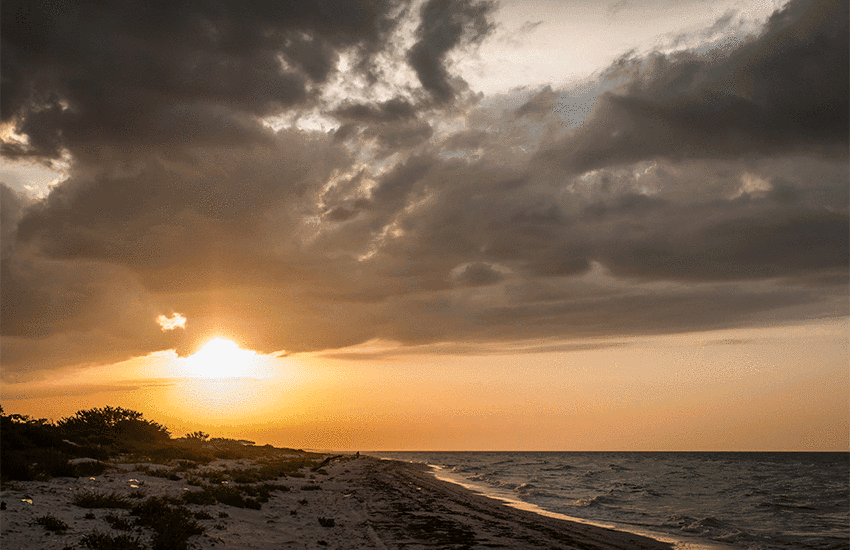
Dawn on the beach. Marigel Campos
Once I recovered from my crushed pride, I joined Fabiola to study the other turtle. I saw how she dug and shaped her nest using her backward fins, a perfect nest as only chelonians know how to create.
I witnessed her slowly lay her eggs as she rolled back her eyes and entered a kind of trance. She then returned to the sea after carefully burying her eggs in the sand. She left with the same determination with which she arrived because she came to El Cuyo with a singular purpose.
[wpgmza id=”340″]
And I don’t know why, but this big, slow-moving, single-minded female green turtle left me with a strange emptiness as I have never felt before.
I raised my eyes. The sky was still moonless, but the night was no longer dark. I gazed at shooting stars twinkling against a setting of palm trees that lull themselves to sleep with the breezes, and I had just one wish: to be able to see, one more time, a sea turtle laying her eggs.
But, to my surprise and amusement, those shooting stars proved not to be meteors but the sparkling of dancing fireflies over El Cuyo, that magic place in Yucatán where the days begin at night.
Omar Vidal, a scientist, was a university professor in Mexico, is a former senior officer at the UN Environment Program and former director-general of the World Wildlife Fund-Mexico.
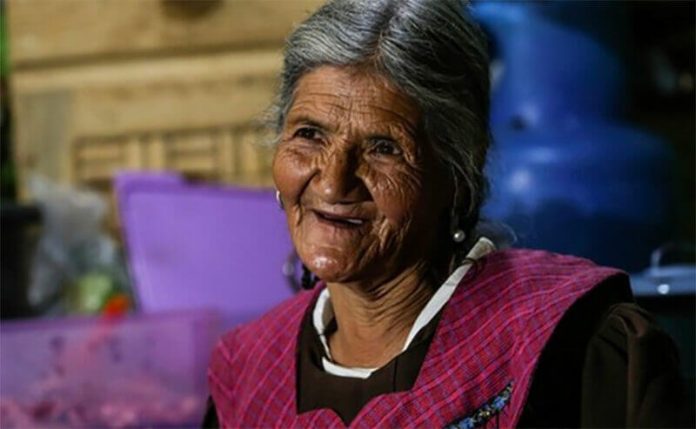
Doña Victoria was introduced to Amazon's virtual assistant.
A senior citizen in Veracruz was thrilled this week when she discovered that Amazon’s virtual assistant Alexa could recite the rosary, a set of Catholic prayers.
Victoria González, 75, lives in Xometla, La Perla, near the Pico de Orizaba, where there is no internet service.
So a device such as Alexa is foreign to some people, including González: “I went to my granddaughter’s house … And she said, ‘Do you want to say a few words to Alexa?’ Then I said, ‘Who is Alexa? Is she the daughter of my friend Rosa?’”
After an explanation, González decided to put the assistant to the test and requested that it recite the rosary. She was delighted when it did.
Meanwhile, her granddaughter Dalia took a video and uploaded it to social media platform TikTok, where it attracted more than five million views.
Una adorable abuelita, le pidió muy amablemente a #Alexa que le rezara el “Santo Rosario” y su reacción se ha vuelto viral… 🥰🥰 pic.twitter.com/9tHlVoVUEH
“As my grandmother is very spontaneous, I decided to upload the video … We never imagined the impact it would have,” Dalia said.
González explained that although she was impressed with Alexa, she wouldn’t be able to use it at home. “I would like to have one, but I don’t have internet. Here the only thing I entertain myself with is my TV and the music I play from my radio. I start dancing … to avoid loneliness,” she said.
Whenever she is visited by her granddaughters, she takes full advantage to chat, watch TV or drink a tequila and dance. “God made me like this and I want my granddaughters to be like me in the future, joyful and happy,” she added.
González also thanked all the people who have taken the time to send kind words through her granddaughter’s TikTok account.