The Jalisco New Generation Cartel (CJNG) clashed with self-defense forces on two separate occasions in Michoacán on Wednesday, but there were no reports of casualties.
According to a report by the newspaper El Universal, the CJNG went on the offensive in the neighboring municipalities of Tocumbo, Tingüidín and Los Reyes.
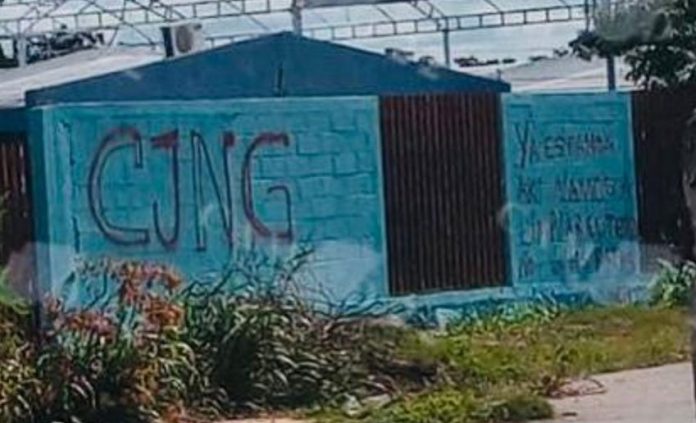
Residents reported the presence of armed men in a convoy of at least 20 vehicles emblazoned with the CJNG initials.
In Santa Inés, a community in Tocumbo, the cartel members forced motorists out of their vehicles and stole them. At least two people took to social media to warn others to avoid the town.
After stealing several vehicles, the CJNG members were intercepted by self-defense force groups and a confrontation ensued.
The gangsters subsequently directed their convoy to Tingüidín, located about 15 kilometers east. There, the CJNG clashed with more self-defense force members and federal forces, El Universal said.
“We’re screwed. These assholes are well-armed, … let’s get out of here,” said one Tingüidín resident. The man fled his home with his family in his pickup truck and a short time later they began to hear gunfire. Fearful that they would get caught in the crossfire, the family took shelter in a warehouse.
The gunfight lasted for almost an hour but authorities said there were no injuries or deaths, only material damage. Michoacán police, accompanied by municipal officers from Los Reyes and Peribán, deployed to Tingüidín but there were no reports of any arrests. The cartel members reportedly fled to Cotija, a Michoacán municipality that borders Jalisco.
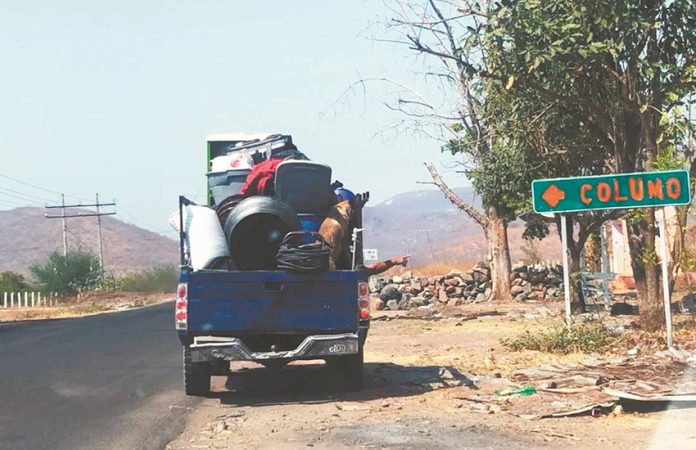
The Jalisco cartel, generally considered Mexico’s most powerful and violent criminal organization, is seeking to increase its influence in many states, including Michoacán. It is engaged in a bloody turf war with the Cárteles Unidos in Aguililla, Michoacán, which has forced many residents to flee the Tierra Caliente municipality.
Eliseo Fernández's campaign for governor billboard. The buzzword in all Campeche's political campaigns this year is "cambio" (change).
“Total Change,” reads one campaign billboard.
A nearby competitor riffs along: “More Change.”
Then, across the road, a differently colored poster calls for “True Change.”
Finally, just when you think you couldn’t be surprised by infinitesimal jazz-like variations on declarations of change, here comes yet another party, this time advertising “Better Change.”
Welcome to Campeche’s 2021 electoral cycle, in which, to steal Edward Murrow’s line about the Vietnam War: “anyone who isn’t confused really doesn’t understand the situation.”
The PRI, PAN, and PRD coalition candidate Christian Castro Bello is aiming to maintain PRI power in Campeche.
On sale in Campeche this 2021 electoral season is wall-to-wall change, in which the main prize is the governorship of the state, held by the Institutional Revolutionary Party (PRI) since time immemorial.
PRI hegemony notwithstanding, new political waves are sweeping through this quiet political backwater, waves which also represent broader national tendencies and might give some clues into Mexico’s political future.
Contextually, it is important to note that when President López Obrador, or AMLO, was elected three years ago, Campeche was not one of the state seats in contention and, as such, did not fall to the vast Morena wave which swept all before it in 2018.
As such, the 2021 electoral cycle will serve a twofold purpose: first, as a watermark for gauging whether the Morena project has retained its overwhelming grassroots support and can therefore continue its strong trajectory. Second, it’s a test case for understanding whether the traditional parties of the PRI, the National Action Party (PAN) and the Democratic Revolution Party (PRD) have experienced a recent temporary setback or whether they are in fact faced with a crisis that imperils their very existence.
In fact, the traditional parties from across the political spectrum have, in an unprecedented move, joined together in an alliance for the current electoral cycle and are the only coalition not running on a platform of change.
Instead, their campaign is fueled by oblique talk of “defending Campeche,” intimating that Morena and its gubernatorial candidate, Layda Sansores, are outsiders intent on ransacking the state for their own political ends. Indeed, though Sansores is demonstrably from Campeche, she has had an opportunistic political career in which 30 years with the PRI later led to her flitting between almost all other parties at different junctures.
Sansores’ campaign notwithstanding, the unspoken message behind the coalition’s nebulous slogan of defense is that Campeche is and always has been a PRI state. Morena’s increasing influence brings with it the kind of seismic change that threatens all traditional power structures in the state, and for the PRI and its traditional supporters, there is much at stake to be lost.
These strange anti-Morena political bedfellows are in fact not unique to Campeche; they are fielding candidates across the country.
In Campeche, Christian Castro Bello is the figurehead for the coalition, although as the nephew of previous governor Rafael Alejandro Moreno Cárdenas, who is now president of the PRI, Bello faces unsurprising charges of nepotism.
Of course, the raison d’être of the PRI and its almost entire political platform tends to be regarded by independent political commentators as that of maintaining its established hegemony — nothing further. Accordingly, many see the alliance as a desperate political move by all three parties in an attempt to reestablish political purchase, traditional enemies banding together in the face of a common nemesis: the new Morena kid on the block.
Viewed from a national perspective, it thus comes as little surprise that the battleground seems set between AMLO’s Morena and the traditional parties.
Yet, there is a third contender, who — whatever your opinion of him — has altered the language of the political rulebook. Enter, stage left, the curious figure of Eliseo Fernández Montufar.
Morena candidate Layda Sansores hopes to continue the national Morena electoral wave.
Of the three contenders, Fernández is perhaps the most renegade. He has established his own political playbook, breaking with all received opinions on how to run campaigns in Mexico.
Take a stroll and you may see him pasted on a billboard holding an eagle, or you may have seen him boxing his way through a video, to name two of his more heavy-handed campaign choices. Moreover, where Morena and the coalition have poured money into traditional campaign methods, Fernández has focused primarily on boosting his image through social media as an appeal to modernization. He’s also used Everyman strategies, going from community to community, personally filling and fixing roads by hand — something old school political apparatchiks would consider well beneath them.
But therein is the point.
A quick scroll down Fernández’s Twitter page will reveal a plethora of photographs of an affable man of the people, grinning alongside the residents of locales all over Campeche. The man definitively and defiantly does not lack for energy or footfall.
But, above all, what makes Eliseo — and he is largely known by his first name — unique is how he has eschewed party political structures and, with support and funding from the Movimiento Cuidando, is undertaking his campaign for governor largely by himself.
A defector from the political party structure would rarely be a threat to the hegemony of the traditional parties at the best of times, but Fernández’s term as the mayor of the city of Campeche (albeit on a PAN platform) means that he already has at least a social media-proven track record of hard work and delivery for the people.
Current polls suggest that Morena and Eliseo Fernández are the real heavyweight contenders facing off for the governorship. This begs the question of whether the midterm elections in states across Mexico will see the beginning of a broad political sweep for Morena or the seeds of pushback against government populism.
Whatever the way of it, the upcoming June elections in this quiet backwater of Mexico’s tropical south are likely to be a much bigger indicator of the country’s political future.
Shannon Collins is an environment correspondent at Ninth Wave Global, an environmental organization and think tank. She writes from Campeche.
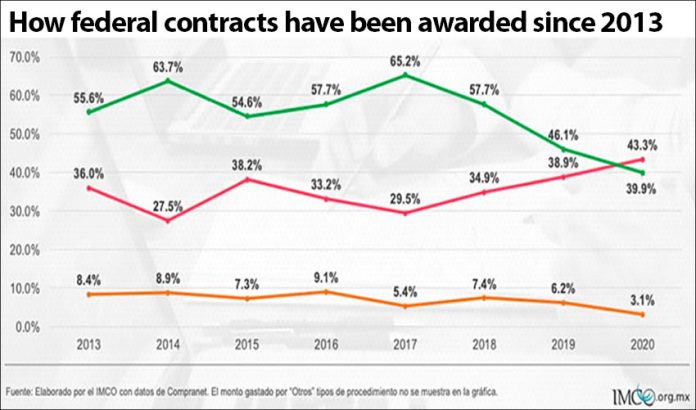
Contracts awarded without tender are indicated in red, those with public tender in green and by invitation in orange. imco
Federal government spending on contracts awarded without a competitive tendering process hit a record high in 2020, according to a public policy think tank.
The Mexican Institute for Competitiveness (Imco) said in a new report that the government spent almost 205.2 billion pesos (US $10.2 billion) on directly awarded contracts last year.
“The constitution and purchasing laws establish that public purchases must be carried out through public tendering except in exceptional cases. Despite this, almost one of every two pesos spent by the federal government in 2020 was contracted through direct adjudication or restricted invitations. The processes established as the exception have become the rule in federal government contracting,” the think tank said.
Imco, which analyzed data on the government’s online transparency platform CompraNet, said the amount represents 43.3% of all money spent on government contracts in 2020. The figure is up from 29.5% in 2017, 34.9% in 2018 and 38.9% in 2019.
“In the second year of this administration, this figure [43.3%] broke a historical record, exceeding any other type of contracting,” Imco said.
The outlay on contracts that were awarded following a public tendering process accounted for 39.9% of total spending in 2020, the think tank said, while the percentage of resources allocated to contracts awarded following an invitation-only tendering process was 3.1%. The other 13.7% of the total outlay was spent on contracts awarded via other processes not specified by the report.
“This is the first time that the resources allocated to contracts directly awarded by the federal government are higher than [the amount allocated] to contracts [awarded] through public tendering,” Imco said.
The percentage of government resources spent on contracts awarded via an open, competitive tendering process has been on the wane since 2018, the final year of the administration led by former president Enrique Peña Nieto.
The figure declined from 65.2% in 2017 to 57.7% in 2018 and 46.1% in 2019 before falling to 39.9% last year.
Public tendering is the contract awarding process that “most promotes competition,” because it allows a higher number of participants and favors lower prices through competitive bidding, Imco said.
The growing number of directly awarded contracts — 80.9% of all government contracts were awarded that way last year, according to Imco — is a “red light for competition” and “represents a corruption risk,” the think tank said.
The corruption risk comes about because “the absence of objective criteria to select contractors opens spaces in which the decision [to award a contract] could be influenced by unlawful agreements,” Imco said.
Residents are fleeing cartel violence and crime, including death threats, extortion and being forced to serve as human shields.
The Catholic Church is issuing letters of recommendation to residents of Aguililla, Michoacán, to support their future claims for asylum in the United States as they flee violence and crime in the embattled municipality.
Parish priest Gilberto Vergara said the Church of Our Lady of Guadalupe in Aguililla — where the Jalisco New Generation Cartel (CJNG) and the Cárteles Unidos are engaged in a bloody turf war that has intensified in recent months — has issued 85 such letters this week, which serve as proof that residents’ lives are in danger due to the violence.
The Diocese of Apatzingán issued 50 to 60 letters of recommendation to Aguililla residents last week, he told the newspaper Milenio.
Residents can present the letters directly to United States immigration authorities, Vergara said. “It’s a kind of guarantee that they’re from here [Aguililla] and that their lives and those of their families are in danger.”
An exodus from Aguililla, located in the notoriously violent Tierra Caliente region, is underway, he said.
Some 200 families have fled the area in the last three weeks, El Universal reported, to escape violence, extortion and death threats. Some people are staying with family, some are in church-run shelters and others have already headed to the United States, said priest and activist Gregorio López Gerónimo.
Aguililla has become a ghost town, he said. He claimed that the authorities are in cahoots with the criminals, who he described as “beasts” and “soulless beings.”
One person who asked the Catholic Church for a letter for him and his family was an elderly farmer identified only as Luis. He said the CJNG had forced him to join a human shield outside the army’s Aguililla base to stop it from carrying out operations and threatened to kill his wife and other members of his family if he didn’t obey.
The rancher and lime producer took advantage of the visit of the Vatican’s ambassador to Mexico to Aguililla last week to get his family out of the municipality. Archbishop Franco Coppola, papal nuncio to Mexico, was able to travel to Aguililla by road from a neighboring municipality because security forces set up several checkpoints on the 84-kilometer Apatzingán-Aguililla highway, which was reopened early last week after being blocked by organized crime for months.
According to Vergara, criminals continue to set up blockades on the highway at night.
Fleeing Aguililla was the only way to avoid being murdered, said Luis, who had cattle and a lime orchard in El Aguaje and used to export his products. He fled with just 200 pesos and a few essentials.
He and other members of his family will seek work as jornaleros, or day laborers, in other parts of Michoacán to raise the money they need to travel to the northern border to seek asylum, he said.
“We’ve left our home, our land and an entire life of work to look for a calmer life because it seems that our luck has run out,” he said. “… We can no longer put up with this violence that screws us over every day. … I managed to take a few things to survive and [received] God’s blessing that the Vatican’s envoy gave us.
“… The CJNG took everything from us, even courage.”
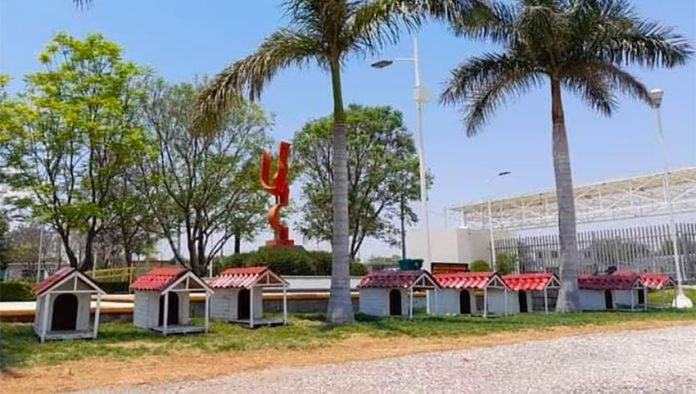
A university in Puebla has created a colonia for homeless dogs, providing them with food, a small house, water, shade and medical care.
Students, professors and administrative staff at the Technological University of Tehuacán (UTT) created the colonia “Dogtores,” a play on Mexico City’s Colonia Doctores, to improve animal welfare, create awareness around animal abuse and prevent formation of gangs of street dogs.
The idea came about in 2020 before the Covid-19 pandemic, and is being promoted by around 20 volunteers, who have been in charge of looking after the animals and providing them with food.
The dogs also receive attention from vets who monitor their health, and supply them with vaccines.
At the moment Dogtores houses seven canines that also help to protect the nearly empty campus, where in-person classes are yet to be reinitiated.
Teacher training students have ended their protest at the airport.
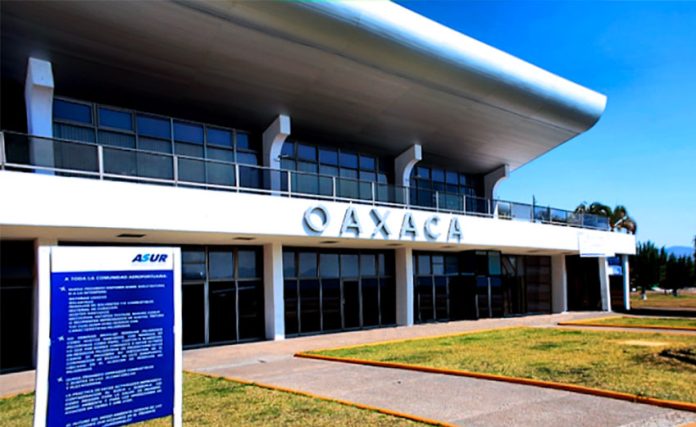
The Oaxaca city airport reopened Thursday morning after teacher training students ended their four-day blockade.
The protesters restored access after coming to an agreement with the state government.
Ninety-one domestic and international flights were canceled and more than 6,000 passengers were affected during the closure.
The blockade was lifted after the director of the state Institute of Public Education (IEEPO), Francisco Ángel Villarreal, promised to respond to the students’ demands, acting on the orders of Governor Alejandro Murat.
The key demand, to guarantee graduates automatic job placements, was agreed in principal through the IEEPO’s commitment to “guarantee the hiring and job stability of graduates.”
“The agreements recognize and respect the autonomy of teacher training colleges … and avoid the imposition of curricula,” Villarreal said.
State education representatives and students met Tuesday night for nine hours, wrapping up at 7:00 a.m. Wednesday with high expectations for an end to the impasse.
That morning National Guardsmen were prevented from accessing Covid-19 vaccines destined for 117,000 state education workers, before an agreement was negotiated with the protesters to allow access to the medication.
During the last two weeks the teachers in training have set fire to the offices of the state education authority, hijacked transit buses and blockaded roads and highways.
Governor Murat, who resolved another blockade in Puerto Escondido on Tuesday, maintained that disputes can only be ended by peaceful means. “With social issues, and especially with young people, we are never going to use public force … In my government dialogue is the only way,” he said.
Mexico's recent history involves protectionist disputing of foreign contracts in the petroleum industry. How will the government react to the Kansas City Southern merger further consolidating foreign concessions in Mexico's railroad system?Cluster Industrial
The haunting, fading Doppler effect of a receding train whistle on a hot summer night is romantic, even though it is saying goodbye.
Mexico’s train whistles are tooting hello these days as a good old-fashioned donnybrook is breaking out, now that there are two highly qualified foreign bidders for Kansas City Southern (which holds Mexico’s foreign route concessions).
The first bid, for US $25 billion, came from a Vancouver company, the second US $33.7 billion from a Montreal enterprise. Both bids are tangible support that at some time in the future Canada, Mexico and the United States will be a dominant economic, if not political, entity.
First Coca-Cola and beer — now Dutch, then aviation — now American. And railroads next?
I’m a train buff and have ridden the rails in China and the United Kingdom, as well as Romania, Ecuador, Peru, Czechoslovakia, Canada and, of course, Mexico and Guatemala.
In Mexico, on a trip from California to Mexico City and Guatemala, I even toasted a cheese sandwich on the locomotive’s boiler of the president’s train as I shared the engineer’s cabin with an oilcan-bearing, pinstriped-overalled veteran.
I showed the trackside ragamuffins how to turn Guatemala’s outsized one-Quetzal coin into a mini-Frisbee before we derailed.
Mexico’s President López Obrador is a train buff too, having already pledged that he will retire to his family farm in Palenque, Chiapas, the new loading point for the Refugee Special known unaffectionately as The Beast, which passes north close enough to the United States border to tempt fate.
Enough of nostalgia, except to hope that future train buffs may have the opportunities that I’ve had. On to investment dynamics.
Turning to my eight years as an analyst for investment in Latin America, I’d dismiss the economic risk of investing in railroads in Mexico. Developing nations need railroads.
But this does leave political risk, which is high, not just for Mexico, but for the United States as well. As a recent Reuters article points out, the most recent permitted railroad merger of size in the U.S. was in 1994.
This leaves Mexico, whose distant train history includes a 1930s nationalization of foreign-owned railroads and whose more recent history involves disputing foreign contracts in the petroleum industry.
So, how far does AMLO’S railroad buff-ness go?
Carlisle Johnson writes from his home in Guatemala.
The national transparency and data protection body Inai is challenging a new law that requires telecoms companies to gather users’ biometric data, and will argue before the Supreme Court that it violates privacy rights and is unconstitutional.
The law, which passed on April 13, aims to reduce crimes like extortion and kidnapping by making it more difficult for criminals to remain anonymous when purchasing new mobile phones.
Telecoms companies are now required to collect customers’ fingerprints or eye data for a national database, which would then be available for use in criminal investigations.
Last week, a judge stopped part of the law from taking effect, saying it would put customers at risk if they refuse to share personal data because their cellphone connection would be cut. The parts of the law stipulating the creation of the registry remain in effect.
The Mexico Internet Association has said the registry would violate human rights and cost the industry hundreds of millions of dollars to implement.
“The prosecution of crimes is an issue that should concern us all and the state is responsible for ensuring the safety of the inhabitants, but this cannot and should not be a sufficient reason to restrict freedoms and human rights,” said Adrián Alcalá Méndez, an Inai commissioner.
President López Obrador, no admirer of autonomous bodies such as Inai, criticized the action, framing it as a move by telecoms companies against regulation in their industry rather than a defense of individual rights.
“These telecoms companies that are very powerful … are bringing a campaign before autonomous agencies and judges. We have to review this because if not the state is going to keep serving a rapacious minority,” he said.
“They are also very hypocritical because for a phone contract they ask for the same data,” he added.
Contrary to what the president said, biometric data has not been required in the past.
While 155 countries around the world maintain cellphone user registries, only about 8% require biometric data, mainly for prepaid SIM card users, according to global telecoms industry lobby GSMA.
According to the think tank México Evalúa, the federal Attorney General's Office's poor results are due to 'deficiencies and omissions in its institutional design.'
Impunity in Mexico remains rampant, according to a new study by a public policy think tank.
Two years after the federal government created a new, supposedly more autonomous federal Attorney General’s office (FGR), 95.1% of federal cases still go unpunished, México Evalúa said in its report entitled “Observatorio de la transición 2020” (2020 Transition Observatory).
Only 4.9% of cases investigated by the FGR are resolved with a prison sentence or other punishment, the think tank said.
Other studies have detected similarly high levels of impunity and just last month the United States Department of State cited impunity as a major problem in Mexico in a human rights report.
México Evalúa found that more than 70% of FGR investigations are running behind schedule. It also determined that the FGR, headed by Attorney General Alejandro Gertz Manero – a veteran lawman and ally of President López Obrador, has gone backward in five of six “transformation” areas in which it was assessed.
In its 2019 report, the think tank said the FGR’s progress toward autonomy was 27.7% complete. However, the new report said progress was now only 20.1% complete. The FGR also went backward in the areas of institutional development, normative development, pace of transformation and resolution effectiveness.
The only area in which it improved was “citizens’ confidence,” with 25% of people now trusting the FGR, according to the study, up from 21.4% a year ago.
México Evalúa also said that the FGR’s coordination and collaboration with other government institutions are declining.
“The Attorney General’s Office and its head have interpreted the autonomy of the institution as an open invitation to operate without transparency, in an isolated way, … turning its back on other institutions, citizens and especially victims,” said México Evalúa director Edna Jaime during the presentation of the study on Wednesday.
The think tank said the poor results are due to “deficiencies and omissions in its institutional design,” problems that also plagued its predecessor, known as the PGR.
México Evalúa noted that the FGR has not yet established a citizens’ participation committee, although it should have done so two years ago. Input from citizens is “almost nonexistent,” it said.
In addition, it doesn’t have budgetary or administrative autonomy nor a “criminal prosecution plan built hand in hand with citizens,” the think tank said. Such a plan, it added, would allow the FGR to know which crimes to prioritize for investigation.
México Evalúa also evaluated the progress made in the “institutional transformation” of the new Mexico City Attorney General’s Office (FGJ) and gave it a comparatively glowing assessment, even though impunity levels are also extremely high in the capital — 97.7% in 2019.
The think tank praised the FGJ’s “effective incorporation of citizens’ participation in the drawing up of a criminal prosecution plan” and its “effective supervision and control mechanisms.”
The process of the transformation of the FJG, headed by Attorney General Ernestina Godoy, offers a “clear example” for the transformation of other state-based Attorney General’s offices, México Evalúa said.
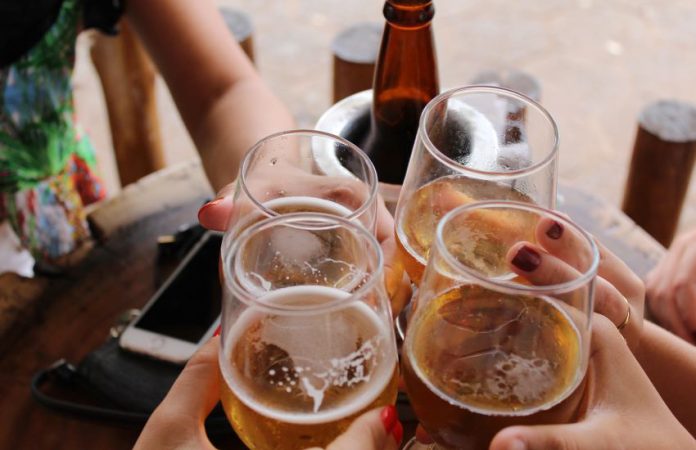
Upon coming to Mexico, the writer learned for the first time to appreciate the social perks of sharing an alcoholic beverage with others. Giovanna Gomes unsplash.com
I was 20, a month away from 21, when I first came to Mexico on an exchange program.
Living in a college dorm room for the previous three years over 1,000 miles from my family had already given me a taste of quite a few new freedoms. But attending college on a small “dry” campus in a town with only one bar, drinking was not one of them.
Not that the desire was on my radar in any kind of serious way. I grew up in a family where pretty much nobody drank, ever. It’s not that they were alcoholics and working to abstain. Alcohol just was never a part of the picture, those kinds of vices being something for far more troubled types — the kinds of people who screamed at their kids in front of everybody in grocery stores or obnoxiously kept the neighbors awake with whoops and hollers at 2 a.m.
The implication of this understanding was that where alcohol was involved, any manner of terrible things could and did happen. Nobody would be safe if there were drunk people around.
Imagine my surprise and low-grade degree of alarm (that I tried very hard to hide), then, when I arrived in Mexico and saw both my teachers and classmates order beer to drink with their regular meals — and often — like it was nothing.
Oh no.
Fortunately, the scary, maniacal behavior that I was somehow prepared to expect never materialized. Eventually, I thought to myself, Well, when in Rome … and started ordering alcoholic drinks myself every once in a while. I found that I enjoyed the pleasant buzz and suddenly easier conversation, a boon for someone who was naturally reserved and easily prone to embarrassment like me.
It took me a while to like beer, though. Granted, at the time, I didn’t know any better and drank a lot of Sol and Corona. They are what they are, and many people like and appreciate them.
Since that year of learning to enjoy as well as moderate alcohol (after a bit of trial and error, of course), both my puritanical assumptions and my palate have changed quite a bit.
One thing that I don’t think most Mexicans realize about the United States is that it’s actually a much more socially conservative place, on average, than entertainment or Spring Break exports would have them believe. After all, I wasn’t part of a commune or super-religious community. I can’t have been the only kid that grew up with those assumptions about alcohol.
And while I don’t have the numbers to back me up on this, my own observations from living in Mexico for the past 19 years have made it clear to me that moderate, social, casual alcohol consumption is not considered the deviant behavior that it was where I come from. Kids are sent to the store to fetch more caguamas (liter bottles of beer) during family gatherings; drinks seem to be present at every party, something special to be shared.
And while I don’t encourage people to get totally wasted, it’s refreshing not to see worried glances across the room when alcohol is served.
The value put on alcohol here was made especially clear to me when, during quarantine, owners of small businesses argued that beer was actually an essential product. The later sometimes-dry laws and limits on consumption were frustrating, and black market sales reached fairly ridiculous heights during those first few months of the pandemic.
Thankfully, after a while of limiting the purchase of any kind of alcohol to certain days and times — which felt like a halfway prohibition on top of everything else — it’s back on the collective table.
And now that it is, I’m not taking it for granted. Over the past year, I’ve especially come to love and appreciate rather high-end artisanal beer, and it’s become quite an innovative industry that is growing just as much in my city of Xalapa as in other more established brewing areas of Mexico. We’ve got several delicious homegrown brews now, and it seems that more are frequently being added.
Heartening too is the growth of women-owned breweries across the country. I’ve thought about them a lot lately as I myself have recently turned from beer fan to beer fan and beer brewer (involving a blackberry English porter that is just lovely and that I am very proud of). Might I one day join their ranks?
As my partner likes to say, beer is noble. It gives back to you what you put in. And when something is truly special, a deepening understanding of its complexity will inevitably lead to a deepening love and appreciation as well.
Granted, it might also lead to increased levels of snobbish attitudes — it certainly has in my own case — but it’s to be expected: once you’ve read Isabel Allende, after all, it’s hard to look at the Twilight series in the same light.
For now, I’m just glad I have so many delicious, local and innovative choices, as well as the possibility of creating brand-new recipes. Because even when the world is falling apart, we’re called to appreciate beauty and be creative.
So, this week, let’s take a break from politics, the economy, the coronavirus. The problems we have matter, but I’d be willing to bet that even Angela Merkel kicks back with a celebrity magazine and something bubbly once in a while.
Let’s not forget to do the same; it’s been a rough year, and we’ve earned the right to let ourselves experience a little magic once in a while.
Salud, my friends.
Sarah DeVries is a writer and translator based in Xalapa, Veracruz. She can be reached through her website, sdevrieswritingandtranslating.com.