Seven of eight officers on the Acatic police force in Jalisco have been detained in connection with the disappearance of five family members who were traveling home to Zapopan last month after vacationing in Mexico City.
Attorney General Gerardo Octavio Solís explained that eight arrest warrants had been ordered for the crime of forced disappearance.
“Early data which was obtained in the course of the investigations suggests the very probable participation of some of the Acatic police force in the disappearance of these people,” he said.
A police report was filed March 25 for the disappearance of Julio Alberto Villaseñor Cabrera, 35, Jimena Romo Jiménez, 24, their 1-year-old daughter Julia Isabella, Alberto’s sister Virginia Villaseñor Cabrera, and their nine-year-old son.
After the family got lost somewhere in the Altos Sur region, a search operation was initiated in the municipalities of Tepatitlán, Jalostotitlán, San Miguel El Alto and Acatic. Officials are confident that it was in the last municipality that the family disappeared.
“In some localities like Jalostotitlán, Tepatitlán and some others where they had been traveling, they will have only been somewhere they were passing through and it’s very probable that here is where it happened. It’s documented in some early data and for that reason there’s a great many [investigators] working here in this area,” the Attorney General said.
A total of 200 officers have been deployed to find the family.
The motive for the disappearance has not been determined, but there could be a connection to an armed attack which took place days earlier in Guadalajara.
“That person who was assaulted with a gun in the city of Guadalajara, four days earlier in a direct attack, has a very close relationship with two of the disappeared people. So it is very probable that the events were related, but we are still not totally sure,” the Attorney General’s Office added.
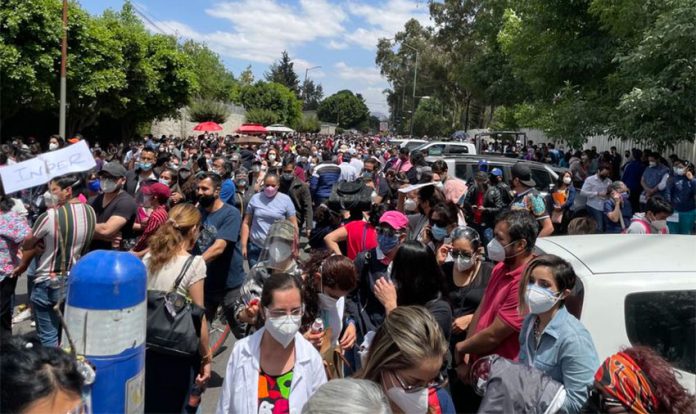
Private healthcare workers protest Thursday in Mexico City.
More than 630,000 Mexican health workers have been fully vaccinated against Covid-19 but some private sector medical personnel say they have been forgotten by the federal government.
Health workers employed in private hospitals and clinics protested in Mexico City last Thursday to demand that they too be given access to the vaccine and protected against the disease which has sickened and killed countless patients they have treated over the past year.
The protest occurred near the Naval Medical School in Coyoacán after word spread on social media that public sector health workers were receiving vaccine shots at the facility on Thursday.
More than 1,000 private sector health workers arrived at the school with the hope that they too would be able to get a shot. Some were inoculated but many more were still in line when an official announced that the supply had run out.
Instead of quietly leaving, the private-sector doctors and nurses staged an impromptu protest on the Eje 3 East thoroughfare, blocking traffic including city buses running along route 5 of the Metrobús system.
The disgruntled medical workers questioned why they have been ignored by the government when they attend directly to Covid-19 patients and are exposed to the risk of infection on a daily basis.
“We’re private [sector] doctors who are demanding the vaccine,” Karla Dam told the broadcaster Televisa.
She explained that she and other private sector health workers arrived at the Naval Medical School after they heard on social media that vaccines were being administered there.
“We arrived here and they gave us hope that we would be vaccinated but in the end they said no,” Dam said.
“They told us there were no vaccines … [and] that seniors are the priority,” said Lourdes Castillo, a private sector anesthetist.
Leobardo Castro, manager of a private clinic in México state, questioned the priorities of the government, which said in January that its vaccination plan considered private sector health workers but failed to explain clearly when they would get their shots.
“We’re risking our lives when we could be protected,” he told the EFE news agency.
“It’s very sad that there are retirees, seniors, teachers and [health] professionals who are not on the front line who are already vaccinated against Covid and that people who work in the private [health] sector and are at risk [of exposure from infected patients] are not,” Castro said.
In light of the protest, Mexico City government official Juan Gutiérrez said that the protesting workers had a “legitimate demand” but noted there were only 500 vaccine doses available at the Naval Medical School event and they were used to inoculate public sector medical personnel.
The Mexico City Health Ministry subsequently said that frontline private sector health workers who went to the facility did receive a vaccine shot later in the day after additional doses arrived.
Xavier Tello, a Mexico City-based health policy analyst, raised concerns about the vaccination of private sector health workers almost three months ago.
In a January 10 article published on the business and careers website LinkedIn, Tello wrote that many private sector doctors and nurses – some of whom lost colleagues to Covid-19 – had asked him the same question: “When will we be vaccinated?”
After noting that the question was valid, the analyst asserted that the government hadn’t provided a clear answer. Almost three months later, some private sector medical personnel continue to ask the same question, and haven’t yet received an unambiguous response.
“… It’s not difficult to understand that private hospital personnel who are exposed to Covid patients have exactly the same risk of infection as staff who work in government institutions. It’s the same virus, with the same danger,” Tello wrote before questioning why all frontline health workers – both private and public – weren’t being prioritized for simultaneous vaccination.
Although there are still health workers who aren’t protected against Covid-19, Mexico’s five-stage vaccination program, which began December 24, is accelerating after virtually stalling in February due to a lack of supply.
Just over 9 million vaccine doses had been administered by Sunday night, according to Health Ministry data which indicates that the lion’s share has gone to seniors. About 14.67 million vaccine doses made by five different companies including Pfizer, AstraZeneca and SinoVac have arrived in the country, meaning that just over 60% of those received have been used.
Right now is arguably the best part of the asparagus season in Mexico.
Asparagus seems to be everywhere right now; there’s another month of the growing season in Mexico, and the market is flooded with beautiful young asparagus at more-than-reasonable prices. Here in Mazatlán, I paid 18 pesos for a bunch of a dozen lovely, bright-green young stalks. (I don’t remember the weight.)
Look for stalks that are fresh and not dried out; if your grocery store displays them standing upright in a little water, that’s the best. After washing and disinfecting, snap the stalks wherever they naturally break, discard the bottom part and then proceed with your recipe.
Thinking I’d make a chilled asparagus salad, I roasted the asparagus in the toaster oven with a drizzle of good olive oil and a little salt and pepper. After about eight minutes, I tested a stalk — and almost ate them all!
Roasting or grilling asparagus gets rid of the characteristic bitterness and is as easy (or easier) than steaming them. I like to use asparagus in quiche and frittata, omelets, salads and, of course, as a side dish with just about anything. It’s also great in stir-fries and pairs particularly well with mushrooms.
Asparagus is a big money-making export crop for Mexico because of its consistent high quality and because it’s harvested when not much is available from elsewhere. Most of it is grown in the Sonora municipality of Caborca, on the uppermost eastern side of the Sea of Cortés near the Arizona border.
Roasting asparagus is a quick and easy way to get your veggies.
The season is from December to April, so we’re right at the peak. Take advantage of this abundance by freezing several (or many!) bunches now — directions below.
How to freeze asparagus:
Wash stalks and snap off root ends.
Bring a large pot of water to a boil, and blanch asparagus for 2-4 minutes, depending on thickness of stalks, until tender-crisp.
Immediately drain asparagus and plunge in an ice water bath for 2-3 minutes to stop cooking. Drain.
Flash-freeze stalks by spreading them in a single layer on cookie sheets and freezing for 1-2 hours. (Using parchment or wax paper will make them easier to remove.) Transfer to freezer bags or containers.
Simple Roasted Asparagus
Serve this as a side dish or use as the base for your other asparagus recipes.
Place asparagus in a single layer on baking sheet or pan. Drizzle with olive oil, sprinkle with salt and pepper and Parmesan or garlic, if using. Bake about 8-10 minutes till tender-crisp.
If desired, drizzle with fresh lemon or lime juice just before serving.
A creamy dipping sauce takes this battered treat to a whole new level.
“Country Fair” Deep-Fried Asparagus
Perfect with a cold beer for Happy Hour or lunch!
Vegetable or peanut oil (as needed)
1/3 cup beer (cold and flat)
1 egg white
6 Tbsp. flour
¼ cup cornstarch
½ tsp. baking powder
½ tsp. black pepper
½ tsp. salt
½ tsp. baking soda
1 ½ lbs. asparagus (cleaned and trimmed)
Heat 1 inch of oil in a skillet over medium-high heat.
Whisk together beer, egg white, flour, cornstarch, baking powder, baking soda, salt and pepper in a flat dish or pan big enough for asparagus spears to fit in.
Dip spears in batter one at a time; fry for about 2 minutes or until golden brown. Sprinkle with salt, and serve with mayo or a creamy dipping sauce.
Spaghetti al Limone with Asparagus
1 lb. spaghetti
⅔ cup extra-virgin olive oil
1 bunch asparagus, trimmed, sliced diagonally
4 garlic cloves, minced
Four 3-inch-long strips lemon zest
½ tsp. crushed red pepper flakes
8 fresh basil leaves, chopped or whole
2 lemons, halved
1 cup grated Parmesan, plus more for serving
Cook pasta al dente. Drain, reserving 1½ cups pasta cooking liquid. Heat oil in a large heavy pot over medium-high heat. Add asparagus and cook, stirring, about 1 minute. Add garlic, zest, and red pepper flakes; cook, stirring, about 30 seconds. Remove from heat.
Add pasta and basil to pot with asparagus mixture and return to medium heat. Squeeze juice from both lemons into pot, add 1 cup pasta cooking liquid and Parmesan.
Cook, mixing well; add more pasta liquid if needed, until sauce is creamy and emulsified, about 1 minute. Season with salt.
Divide pasta among bowls, place a lemon strip in each. Top with more Parmesan.
The light crisp of asparagus adds a perfect contrast to spaghetti.
Chilled Asparagus with Sesame-Ginger Vinaigrette
1 lb. asparagus, trimmed
Dressing:
1 Tbsp. toasted sesame seeds
1 clove garlic
1 tsp. grated fresh ginger
2 Tbsp. rice vinegar
2 Tbsp. orange juice
2 tsp. soy sauce
2 Tbsp. vegetable oil
1 tsp. sugar
¼ tsp. red chile flakes
¼ tsp. sesame oil
Roast or steam asparagus till tender-crisp; immerse in ice water to stop cooking. Pat dry.
Arrange on platter and chill in refrigerator. Just before serving, mix together dressing ingredients and pour over asparagus.
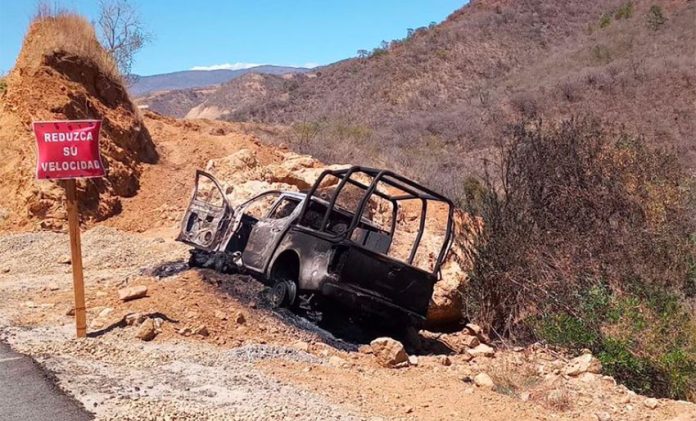
Two municipal police officers and the police chief of San Pablo Coatlán, Oaxaca, were ambushed and killed Saturday by armed men who burned their bodies and the vehicle in which they were traveling, according to the state Attorney General’s Office.
At the site of the ambush state police and forensic investigators identified bullet shells from an R-15 rifle.
The region, located in the Sierra Sur, is known for drug cultivation and the presence of armed criminal groups. However, agrarian disputes over the borders between municipalities are also common, such as that between and San Pedro Coatlán and San Vicente Coatlán.
In November 2019 in the same jurisdiction a state police patrol was also gunned down, killing five police officers. Four people with links to criminal groups were later arrested.
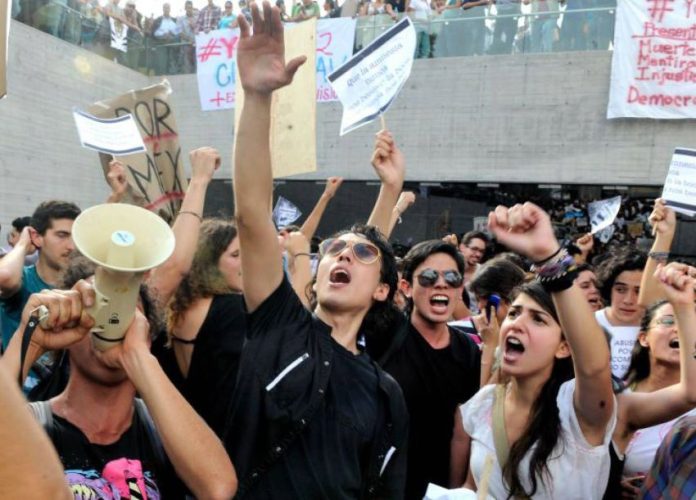
The results of municipal, state and federal elections in June could depend heavily on the political preferences of young people, some of whom will be voting for the first time this year.
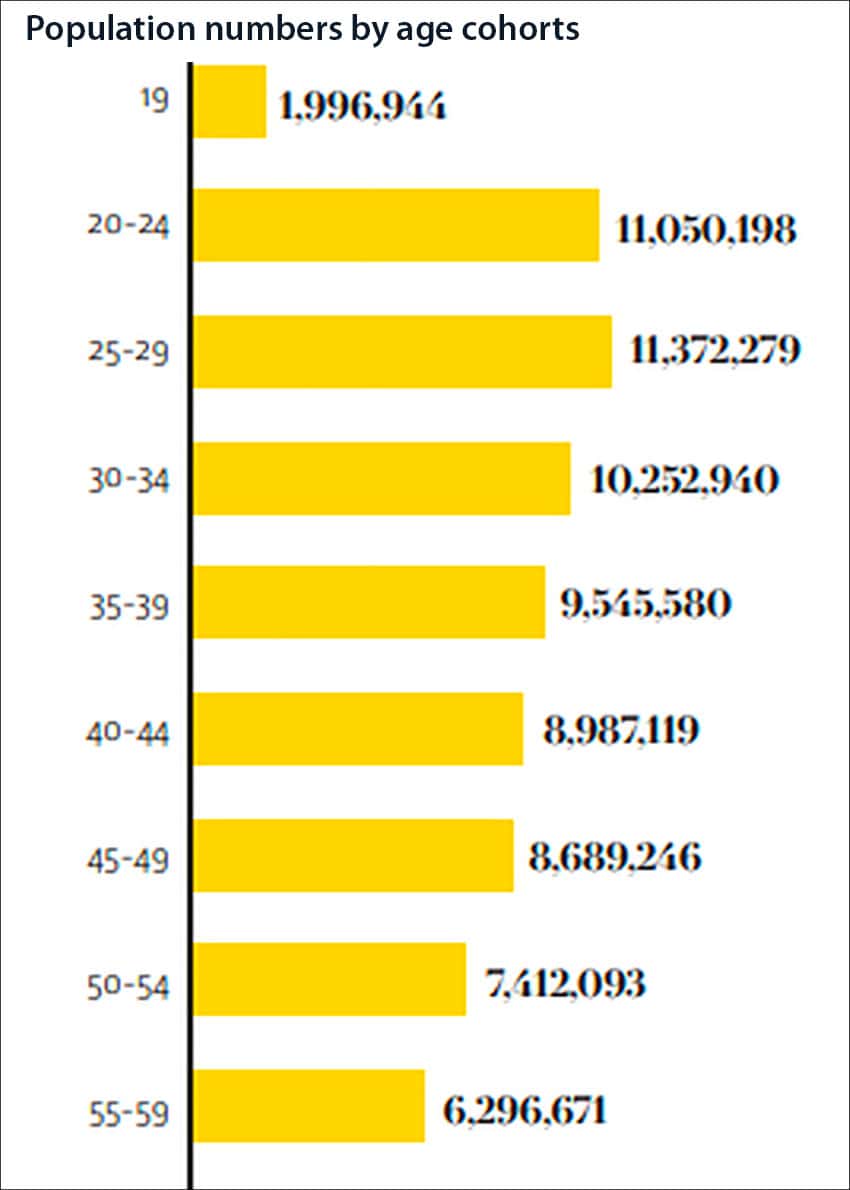
According to the National Electoral Institute (INE), there are more than 14.68 million people aged 18 to 24 who currently have a voter ID card and are therefore eligible to vote in the June 6 elections, at which Mexicans will renew the entire lower house of federal Congress and elect municipal and state representatives, including 15 governors.
The cohort — made up of Generation Z members who are also known as digital natives and centennials — is the largest of any age bracket, according to INE data, meaning that if they go to the polls in large numbers, they could have a significant say in deciding who will govern in the coming years.
More than 3.6 million of those in the 18–24 bracket are 18 or 19 and therefore will have their first-ever opportunity to vote.
The second-largest cohort of eligible voters is those aged 25–29, numbering more than 11.37 million.
milenio
Consequently, there are just over 26 million eligible voters aged 18 to 29, a figure that accounts for about 28% of the almost 94 million voters.
Given their large numbers, young people are an important and attractive segment for candidates, said Rubén Darío Vázquez, an academic at the National Autonomous University.
He told the newspaper Milenio that many young people don’t have clear political allegiances so their votes are up for grabs by the various political parties that will contest the elections. Parties’ success or otherwise will depend on their capacity to persuade undecided voters to cast their ballot for them, Vázquez added.
“The parties should be very interested in convincing these first-time voters,” he said. “… But the political actors haven’t found the way to approach them.”
Vázquez predicted that parties will have a hard time winning the support of young voters, many of whom spend a lot of time online, because they must struggle to keep up with the different ways young people communicate.
“The political class is only just understanding, and [still] with certain tentativeness, how to communicate on Facebook. … They haven’t realized that Instagram now dominates in the millennial community and that there is a new generation of voters on TikTok,” he said, referring to the video-sharing social networking service.
The academic nevertheless predicted that political advertising will flood social media during the campaign period, which officially began on Sunday. The bombardment of information will test young people’s analytical skills, he added.
“They’re digital natives, but they don’t necessarily have the skills to … distinguish between correct and incorrect information. One example of this was Pizzagate … in the 2016 presidential election in the United States, in which a rumor about a supposed people-trafficking and child pornography ring [operated by] the Democratic Party was believed by a large number of social media users,” Vázquez said.
This year’s elections will be the largest ever in Mexico. The ruling Morena party is seeking to maintain its majority in the lower house of Congress while opposition parties, three of which have banded together, are determined to wrest control and thus scuttle President López Obrador’s legislative agenda.
Among the 15 states where voters will elect new governors are Baja California, Chihuahua, Guerrero, Michoacán and Zacatecas.
Two environmental activists with political ties have been brutally murdered during the past week in Guerrero and Oaxaca.
Jaime Jiménez Ruiz, a former municipal agent in the town of Paso de la Reina known for his activism defending the Río Verde river, was shot and killed March 28 while en route to the town from nearby Santiago Jamiltepec.
The murder was the fifth this year in Paso de la Reina, a community of approximately 500 inhabitants 120 kilometers from the tourist destination of Puerto Escondido.
The environmental organization Educa Oaxaca, which has fought large scale hydroelectric and mining projects, said that neither state nor federal authorities have taken preventative measures despite the killings of two citizens on March 14 and 15.
“[Paso de la Reina] suffers under despotic authoritarianism and impunity, which are the structural causes of the violent deaths of five of its citizens this year,” the organization said in a statement.
In Guerrero, meanwhile, Carlos Marqués Oyorzábal, municipal commissioner of the Las Conchitas community in San Miguel Totolapan, was killed by armed men Saturday while traveling on an ATV to the nearby community of Ciénaga de Puerto Alegre. He was tortured, killed and dismembered.
Marqués belonged to the communal Pueblos Unidos organization, dedicated to protecting forest land. It has previously obstructed trucks from entering the region to extract timber.
Another local citizens group said that despite threats, residents will continue to obstruct access by logging trucks.
Cancún will be the most popular destination, with direct flights arriving from 40 US airports.
The pandemic may not be over but air travel between Mexico and the United States is nevertheless set to rebound strongly in 2021.
In the seven-month period between the end of March and the end of October – the International Air Transport Association’s summer season – a total of 151,900 flights are scheduled between the two countries.
That’s a 6% increase compared to the same period in 2019. (Yes, you read correctly.)
According to aviation data company Cirium, 13 airlines will fly regular routes between Mexico and the United States this summer season. They are American Airlines, Aeroméxico, Alaska Airlines, JetBlue Airways, Delta, Frontier, Spirit, Sun Country, United, Viva Aerobus, Aeromar, Southwest and Volaris.
Collectively they’ll offer almost 23 million seats on flights between the North American neighbors.
René Armas Maes, commercial vice-president and associate at Midas Aviation, a consultancy, told aviation news website Simple Flying that the Mexico-United States market is currently the largest binational air travel market in the world.
“Currently, the Mexico-U.S. cross-border market remains the largest country pair, representing 2.5 times the amount of capacity of the next biggest country pair,” he said, adding that he expects the status quo to continue throughout 2021.
Simple Flying reported that the strong rebound of the Mexico-United States market is directly linked with leisure and VFR (visiting friends and relatives) travel. International travel to Mexico has been encouraged by the absence of restrictions for arriving visitors, who don’t have to provide evidence of a negative Covid-19 test result or go into mandatory quarantine.
Armas noted that many U.S. travelers – a significant number of whom have likely already been vaccinated against Covid-19 given that more than 165 million doses have been administered in that country – are planning Mexican beach vacations to destinations such as Cancún, Los Cabos and Puerto Vallarta.
Cancún will be the most popular destination this summer, according to data that also shows that 11 of the 13 airlines that fly between Mexico and the United States will provide services to and from the airport in the Caribbean coast city. All told, there will be direct services between Cancún and 40 airports in the United States, among which Los Angeles International Airport and Dallas-Fort Worth International will have the most connections.
Among the other popular Mexican destinations this summer will be Los Cabos, Mexico City and Guadalajara, according to Cirium data. Several airlines, including Viva Aerobus and Spirit, have recently announced new Mexico-U.S. services.
Although the number of flights scheduled between the two countries over the coming months is good news for the tourism sector, which had its worst year in living memory in 2020, Armas warned that things could change.
He explained that many airlines file flight schedules well in advance and subsequently adjust them according to demand and the profitability of their different routes. The vaccination programs in the United States and Mexico, where more than 9 million doses had been administered by Sunday night, will help to increase demand for air travel but new outbreaks of the coronavirus will have the opposite effect, Armas said.
A redesign of flight patterns into Mexico City's airport means new daily headaches for some city neighborhoods that had never dealt with noisy jets flying overhead.
The noise of landing airplanes approaching the Mexico City airport’s two runways is no longer exclusive to the neighborhoods of Moctezuma and Jardín Balbuena.
Residents of neighborhoods in the south of the city, near the beltway, say they are newly being exposed to the decibels resounding from jet turbines overhead.
That’s due to a redesign of routes used by Mexico’s air navigation service, in which a new approach has been added in the south of the capital to accompany those in the city’s north, above Ciudad Satélite, Lomas de Chapultepec and Nápoles.
The change went into effect on March 25, when the Ministry of Communications and Transportation announced the first phase of an overhaul of air traffic routes to and from the international airports in Mexico City and Toluca, México state. The changes won’t likely be perceptible to travelers, but officials predict they will help reduce by 16% the flight time of aircraft operating in the city’s airspace, as well as reduce operational delays, optimize takeoffs and landings and reduce plane fuel use.
The second phase will go into effect in March 2022 with the expected opening of Mexico City’s new Santa Lucía airport.
The redesign will also allow the use of performance-based navigation, which will permit the three airports to operate simultaneously without getting in each other’s way and increase route efficiency.
But the change means more noise for residents unaccustomed to hearing aircraft.
Live air traffic radars show the new movements through Xochimilco, Tlalpan, Coyoacán and Álvaro Obregón.
“Residents of Jardines de Pedregal and Tepepan had told me of the noise that just a few weeks ago wasn’t there,” said Jimena de Gortari, an academic who specializes in urban noise pollution at Universidad Iberoamericana, “and now I know for a fact that in Villa Olímpica, airplanes are passing frequently during the day and at night.”
Jardines del Pedregal’s neighborhood representative Roberto Bustamente explained that for residents there, the noise was a new phenomenon.
“For us, this is significant because we were accustomed to silence — that’s to say it was a characteristic of Jardines del Pedregal, but now we have the sound of planes above us,” he said.
San Ángel resident Úrsula Camba said that while she was already aware of the movement of airplanes above the neighborhoods of Nápoles and Narvarte when they circle as they queue to land, now it is a daily occurrence.
“From early morning, they start to fly over. They wake me up, and I can’t get back to sleep,” she said.
De Gortari said that a lot of people are used to the noise of airplanes and road traffic, and to an extent, the noise is a normal part of the city.
“Now I have a lot of complaints from people whose peace has been disrupted because they are not adapted, but in reality, there is no adaptation, only stress, discomfort and a series of symptoms caused by the noise,” she said.
Evelin Flores, a resident of Tepepan, located between Tlalpan and Xochimilco, said that in addition to the jet noise, the planes interfere momentarily with the telephone and television when they pass over.
“The passing of planes started two weeks ago. Before then, one could hear the sound of the birds in the morning or in the afternoon, but now that we have the noise, we can’t hear them anymore,” she said.
Hordes of tourists arrived at Mexico's beaches on the weekend for the Holy Week vacation period.
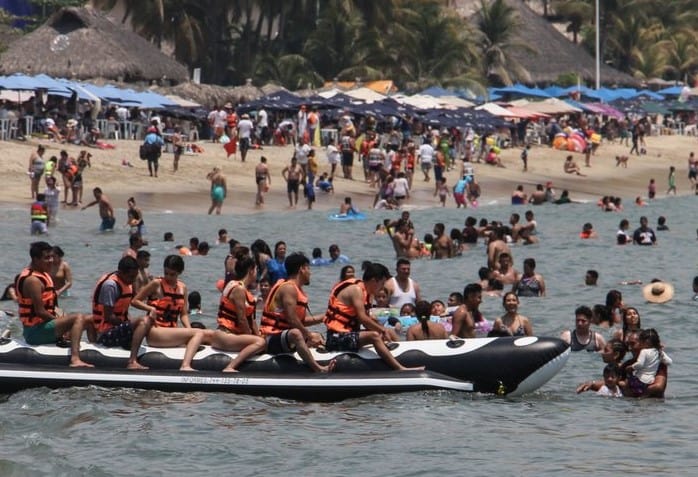
The pandemic didn’t stop hordes of tourists from flocking to some of Mexico’s most popular beach destinations over the weekend, raising concerns that the Easter vacation period could fuel a third wave of new coronavirus infections.
Cancún, Acapulco, Puerto Escondido and Huatulco were among the destinations that saw large numbers of vacationers, many of whom failed to follow basic virus mitigation rules such as wearing a face mask and keeping a safe distance from others.
In Cancún, where hotel occupancy exceeded 65% during the Holy Week holiday period and more than 240 flights touched down on Saturday alone, both Mexican and foreign tourists packed the Caribbean coast beaches to soak up the sun, swim or wade in the water and perhaps forget about the pandemic for a while.
One especially popular beach was Playa Gaviota Azul, where the resistance to complying with coronavirus mitigation measures was palpable, according to a report by the newspaper El Universal.
Alcohol on sale at a kiosk at the entrance to the beach may have been a factor in some people’s carefree attitude, while pandemic fatigue and the outdoor environment also likely contributed to beachgoers’ reluctance to mask up and follow other health recommendations.
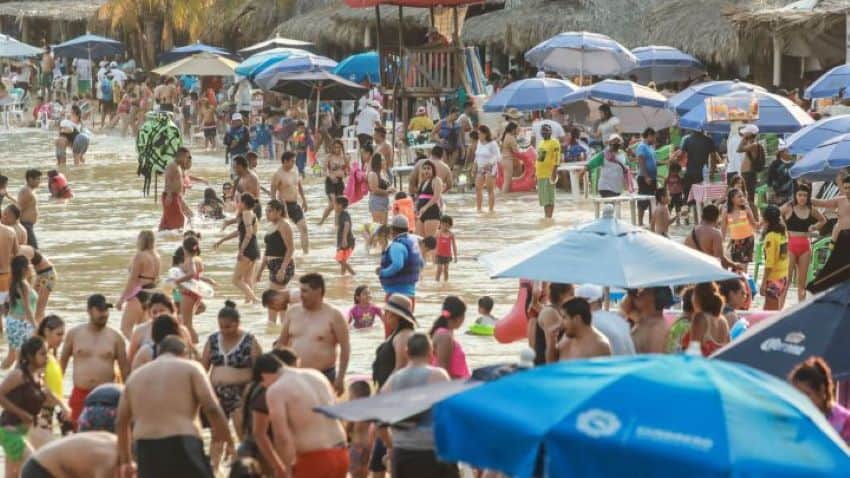
Social distancing was not the watchword at many of Mexico’s beaches this weekend.
Hotels in Acapulco, Guerrero’s premier resort city, and the Oaxaca coastal destinations of Puerto Escondido and Huatulco were also busy, although occupancy levels weren’t quite as high as those in Cancún.
A party atmosphere prevailed in Puerto Escondido, especially on and around Playa Zicatela, the resort town’s famous surfing beach. Young revelers packed bars and other venues that line the beachfront to drink, shout and dance, El Universal said.
“All this without social distancing or face masks as if they were immersed in a world where Covid-19 doesn’t exist,” the newspaper said.
Most visitors to the 10 beaches across Puerto Escondido’s two municipalities also failed to follow basic health rules, and authorities in most cases did nothing to enforce them, a shift in attitude compared to last October when more than 200 people were arrested in a span of just five days for not wearing face masks in public.
So-called health modules, where people have their temperature checked and are given hand sanitizer, were only in operation at a couple of beaches over the weekend, one of which was Playa Carrizalillo. El Universal also reported that a maximum of 300 people — 60% of normal capacity — were permitted onto the beach. But despite authorities’ efforts to reduce the risks, beachgoers appeared to forget about the virus threat once they were on the sand.
Authorities didn’t attempt to limit capacity at most other beaches in Puerto Escondido, where the majority of the tourists were domestic rather than international travelers.
In Cancún, easy access to alcohol at beach entrances may have played a role in beachgoers’ laissez-faire attitudes towards Covid safety.
Another state where beaches were busy over the holiday period was Baja California Sur, home to destinations such as Los Cabos, Loreto and La Paz. However, authorities there limited capacity to 50% of normal levels to reduce coronavirus risks.
State Civil Protection official Carlos Alfredo Godínez León said that a lot of Baja California Sur residents couldn’t resist going to the beach over the weekend because of the good weather.
“They allowed themselves to go to the different beaches in the state, but as was expected, not all managed to enter,” he said, noting that the capacity control measures enforced by all three levels of government were effective.
Some families were “annoyed” at being denied beach access, Godínez said, adding that “it was worse for those who lined up for a long time and were told there was no space [on the beach] when they got to the checkpoint.”
In the lead-up to Easter, health authorities urged people to continue following virus mitigation measures and not gather in large numbers over the holiday period. They also warned that Mexico is not immune from the possibility of a third wave of the coronavirus, as has occurred or is occurring in many countries around the world.
But more than a year after the virus was first detected in Mexico, and with the second wave — which peaked in January — having receded, many Mexicans are no longer as worried about becoming ill with Covid-19.
Tourists largely ignored warnings that Mexico could see a third wave of the coronavirus, with most eschewing masks and other Covid safety measures.
“Covid can get screwed! [The pandemic] hasn’t come to an end, but neither have we, so let’s have fun,” a group of young vacationers from Mexico City said in late March as they strolled down 5th Avenue, Playa del Carmen’s main tourist strip, while passing around a bottle of tequila.
Many foreign tourists in Mexico — among which are large numbers of United States citizens who may have already been vaccinated against Covid — also appear unconcerned about the ongoing virus risk, with many largely eschewing face masks during visits to popular destinations such as Cancún and Tulum.
According to Guadalupe Soto Estrada, a public health academic at the National Autonomous University, there is a risk that the pandemic in Mexico will worsen as a result of the relaxation of virus mitigation measures over the Easter break.
“Everyone wants to come out of lockdown but … the epidemic is still active, and we must continue looking after ourselves,” she told the news website Animal Político.
Although Mexico’s vaccination program has been underway for more than three months and has recently gathered pace, Soto asserted that virus mitigation measures must still be observed.
“The health measures can’t be relaxed during all of 2021 at least,” she said.
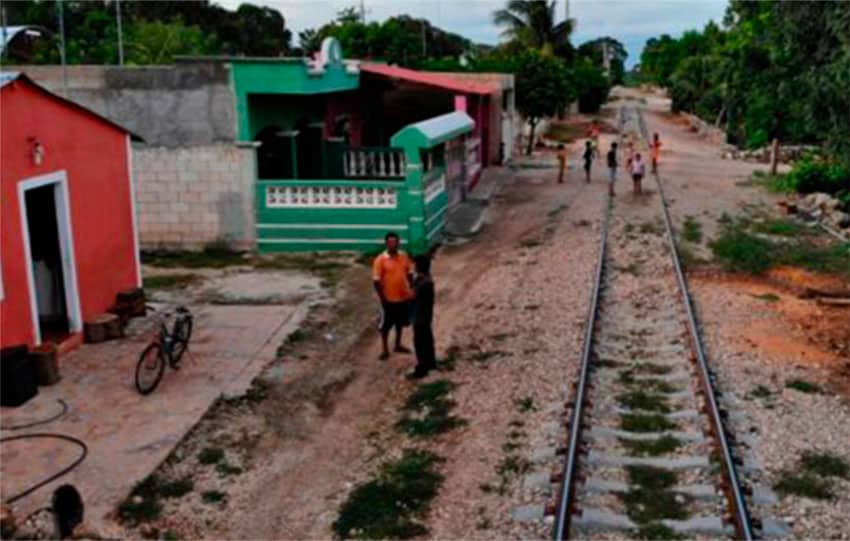
Old tracks are ripped up in preparation for laying new ones.
A dilapidated shed on a potholed road in the heart of Mexico’s Unesco-protected Calakmul biosphere is an unlikely war room.
But it is from here that the Regional Indigenous and Popular Council of Xpujil (Cripx), a local NGO, has launched a legal battle to stop President López Obrador’s $7.8-billion Maya Train project in its tracks.
Cripx and local farmers are worried about the environmental impact of running diesel engines through the habitat of endangered jaguars in a landscape studded with archaeological treasures. They are facing off against a powerful adversary: the military.
The government has awarded construction contracts for several stretches of the 1,500-kilometer route — including the one through the lush Calakmul biosphere, which is home to the majestic ruins of the same name — to the defence ministry. This month it announced that once complete, the entire Maya Train would belong to the army.
“They know that if they’d awarded the stretch here to a private company it would be easy to organize resistance,” said Jesús López Zapata, one of Cripx’s founders, speaking in the shade of a tree behind the tiny office.
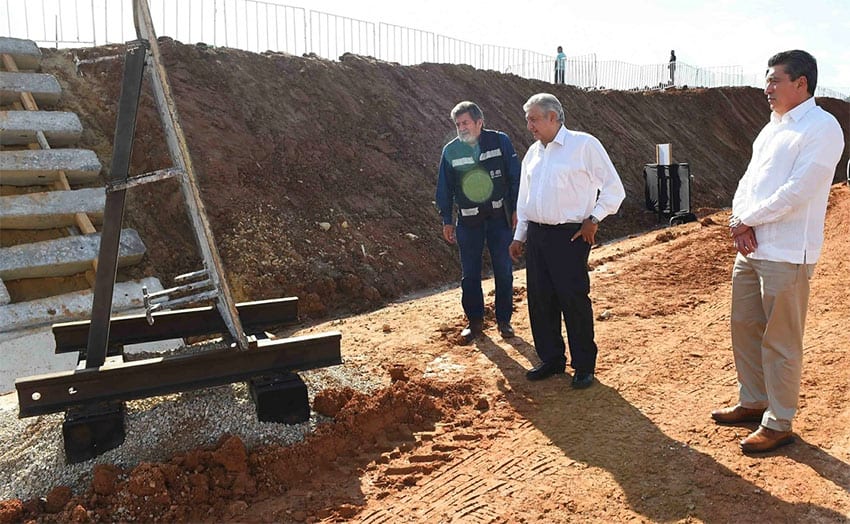
President López Obrador inspects construction progress on one of his favorite infrastructure projects.
“But not when it’s the army. We are talking about a confrontation. We don’t want things to get to that point, but if push comes to shove, we’ll have no choice.”
More than a dozen injunctions against the train are making their way through the courts but López Obrador is not easily derailed. He has pledged to visit the project every fortnight if needed to ensure the flagship development and infrastructure project will be finished before he leaves office in 2024, and refuses to believe legal challenges could thwart his plans.
But with court rulings pending, work so far has been confined to tearing up the tracks of an old railway that exist on part of the planned route. New rails will be laid capable of carrying trains running at up to 160 kph to connect some of the country’s best-known tourist resorts and Maya ruins.
López Obrador says the project will offer tourist, local and cargo services and bring development to the poor southeast where he grew up — a region historically overlooked by Mexican leaders.
But the project is divisive. “I’m a life-long railway man and I would like nothing more than to see passenger railways reborn in Mexico… However, from the start, I’ve never thought the Maya Train was a good idea,” Francisco Javier Gorostiza Pérez, a former train boss and ex-government official, told Mexico’s College of Civil Engineers recently.
He said the Maya Train’s expectations of reaching 50,000 passengers a day and 18 million a year were pie in the sky — such a figure would be almost as much as China’s Beijing-Shanghai high-speed railway, which attracts 20 million passengers annually, and nearly double the Eurostar’s 10.4 million, he said.
Compared with other tourist trains, the projected passenger figure would be 12 times that of Peru’s Cusco-Machu Picchu service and would far outstrip the 250,000 a year who ride the Swiss Glacier Express, or the 200,000 people traveling on El Chepe through Mexico’s Copper Canyons, the country’s sole surviving passenger service, he added.
Gorostiza said the plans needed to be revised and warned that the cost was likely to balloon by 50%.
As for the Maya Train’s impact on some of the world’s most biodiverse regions, he said: “Running high speed trains through biosphere and jungle zones would be a true ecological crime.”
Mexico’s state auditor’s office has also warned about cost overruns, dubious profitability, insufficient consultations with local communities and environmental damage.
But many locals are behind the project. “It was hard for us to take the legal action because lots of people see López Obrador as a savior and this project as manna from heaven,” acknowledged López at Cripx.
For Isaías Vásquez Sánchez, employed for 43 years on Mexican railways, “the train will bring back glory.” He has been squatting in the abandoned station at Escárcega, a scruffy traditional rail hub where three Maya Train routes will intersect, since losing his job last August when cargo services stopped so that work on the project could start.
Some communities are concerned they will lose homes and businesses that are on the train’s right of way.
“I hope they’ll give me a job,” he said, leaning on the barbed wire fencing off the future construction site. His wife, Clemencia de la Cruz, is proud to work as a cleaner with the train project. “I’ve never been on a passenger train,” she said. “There are lots of poor people here who will be helped.”
Many shopkeepers in Escárcega also like the prospect. What they object to is the route.
Yosulia Gamboa, whose father was a train worker and mayor of Escárcega, faces a double whammy. The proposed 20-meter right of way on each side of the track will require buildings to be knocked down and “I’m affected on both sides — on one side is my house and on the other, my clothes shop,” she said.
Maya Train officials say they are in negotiations with residents and that expropriation of land for the train is a last resort they hope to avoid.
Meanwhile, Alejandro Varela, head of legal affairs at Fonatur, the state agency in charge of the Maya Train, said injunctions could not stop them from modernizing the lines and despite multiplying legal challenges to the project “we are sure we will win.”
Around Calakmul, however, some local farmers feel their compliance has been bought. Almost everyone is a beneficiary of López Obrador’s tree planting program, Sowing Life, because it pays an attractive 4,500 pesos ($220) a month.
Like many locals, Germán Bartolo Barrios chopped down the mature, existing trees on the land that he and his wife rent inside the biosphere and replanted it with the scheme’s saplings. “I think AMLO thinks Sowing Life is in exchange for support for the Maya Train,” said his wife, Jerónima López Hernández.
An indigenous Tzeltal beekeeper, she is in the process of securing organic certification for the honey she produces in the middle of the jungle and fears “the train will cause a lot of pollution — a lot.”
Even some tourists were unconvinced. “I wouldn’t take it. It’ll be a natural disaster, I don’t think it’s necessary,” said Iván Paredes, a 43-year-old survival instructor from Barcelona, as he ate his lunch amid the peaceful Xpuhil ruins.
Many fear the train will end up a white elephant. “It’s such a waste of money,” complained one businessman who lives in a state where the train will pass. “I can’t believe we can’t stop it.”