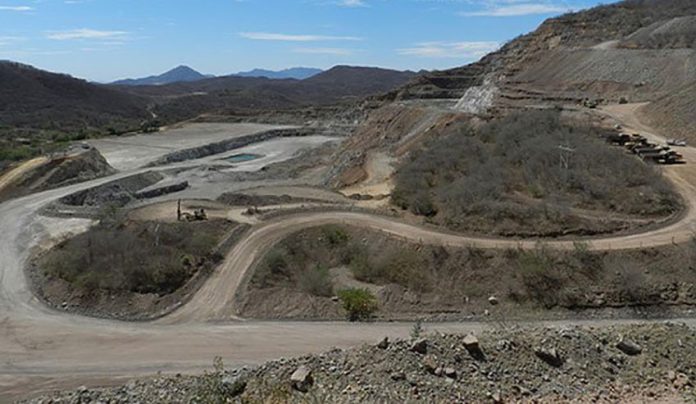
Thieves stole US $8.5 million worth of gold from the Gallo mine in Sinaloa in 2015.
Mexico has a new security force to protect the nation’s mines from drug cartels, the government announced Monday.
The first 118 mine guards, who will be equipped with assault rifles, graduated from a special training course and will be tasked with “solving the attacks by organized crime in this economic sector,” Security Minister Security Alfonso Durazo said.
“Today concludes a pioneering and highly relevant course in the increasingly broad profile in the training of the members of the federal protection service,” Durazo said at the officers’ graduation ceremony. “We know that the security of these facilities is delicate and requires high specialization. In coordination with the Ministry of the Economy and the industrial chambers, specialized strategies have been created for the mining regions.”
Foreign-run gold and silver mines have long been subject to extortion by drug cartels, and in recent years criminal organizations have also stolen minerals or semi-refined metals from the mines.
In 2015, a drug cartel stole around 4.5 kilograms of gold and silver from a mine in northern Mexico. The British-owned Fresnillo mining company, which operates three mines in Mexico including the largest silver mine in the world, reported that the theft occurred near its Herradura mine in Sonora when armed men carrying high-caliber weapons stopped a company vehicle and stole the ore.
That same year, thieves stole 7,000 ounces of gold worth US $8.5 million from the Canadian-owned El Gallo 1 mine in Mocorito, Sinaloa.
In 2018, the Canadian company Pan American Silver temporarily reduced some operations at its mine in northern Mexico due to safety concerns.
The company noted that its employees had experienced safety problems on the roads leading to the mine in a remote part of Chihuahua, a region plagued by criminal groups. At one point, employees hid in the mine, fearful to leave due to threats from armed groups, and some employees were evacuated in private planes.
And in April 2020, Minas de Oro Nacional, a subsidiary of the Canadian firm Alamos Gold, was the victim of a daring theft of 1,000 ounces of silver and gold when five armed men subdued security guards and loaded their booty into a waiting small plane in an attack that took less than 10 minutes.
The decision to form a special squad of mine police was made at a summit on mining security held in May.
Some 2.6 million Mexicans are employed in the mining industry. In 2019, Mexican mines produced 244 billion pesos (US $11.25 billion) worth of ore.
Informal sector jobs regained in the table at left; formal sector jobs at right. The first column in each indicates total jobs lost. In green are jobs recovered by month. Numbers represent millions of jobs. el economista
Mexico’s jobs recovery continued in August but fewer people returned to work than in previous months, data shows.
According to a survey conducted by the national statistics agency Inegi, 653,000 people returned to work last month. Many of those who re-entered the workforce had been laid off due to the coronavirus pandemic.
The number of people who re-entered the workforce in August is less than half the number who went back to work in July and just over one-tenth the number who regained employment in June.
Of those who went back to work last month, 71% had informal sector jobs without access to benefits and 29% were in the formal sector.
According to Inegi, a total of 14.1 million people lost their jobs in the formal and informal sectors between March and May due to the suspension of nonessential business activities and the government’s advice for people to stay at home.
About 10.4 million of those jobs were in the informal sector and 3.7 million were formal.
Approximately 7.2 million informal sector workers have returned to their jobs since June, a figure that accounts for about 69% of those who found themselves unemployed due to the pandemic.
The jobs recovery has been slower in the formal sector. About 1.6 million of those workers have returned to their jobs since June, 43.5% of those who were laid off.
Counting both informal and formal sector workers, 8.8 million people – 62% of those who lost their positions earlier this year – are now back at work.
The unemployment rate, according to Inegi, is 5.2%, slightly lower than the 5.4% rate in July but 1.9% above the March level.
Employment in the agricultural and industrial sectors increased by 2.3% and 1.4%, respectively, in August but commercial sector jobs including retail declined by 3.9%.
Overall, the labor market is improving albeit slowly, said Jonathan Heath, deputy governor of the Bank of México.
David Kaplan, a senior labor market specialist at the Inter-American Development Bank, said the recent job numbers – despite the improvement – “have been disappointing.”
According to Gabriela Siller, head of economic and financial research at Banco Base, there is a risk of a second round of job losses even though most sectors of the economy have now reopened.
Another concern is that many of the jobs that have been recovered pay low salaries, which doesn’t bode well for the increase in consumer spending the economy needs to bounce back from a near 20% decline in the second quarter of the year.
The prevalence of low salaries together with an employment rate still below pre-pandemic levels “represent a significant challenge for a recovery in private consumption,” said Juan Carlos Alderete, director of economic analysis at Banorte.
“It seems that the recovered jobs have been [those] with lower remuneration, which might be explained by companies’ necessity to control costs,” he said.
The Abortion Day march turned violent when protesters were denied access to the zócalo.
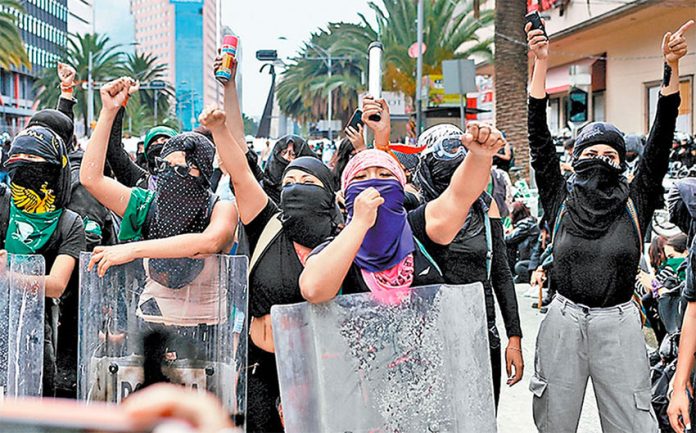
An estimated 1,000 women took to the streets of Mexico City Monday to mark International Safe Abortion Day and lobby for reproductive rights, some clashing with police as they attempted to march to the zócalo, the capital city’s central square.
Abortion rights activists began assembling around 2 p.m., chanting slogans such as “Abortion yes or abortion no, that’s for me to decide,” as they marched along Avenida de la República accompanied by Grupo Atenea, a women’s police brigade charged with keeping order during protests, marches and other public events.
But when the protesters reached Alameda Central park, police blocked their access to the zócalo.
The protesters responded by shoving at police shields, hitting them with hammers and metal pipes and throwing fireworks as they demanded to be allowed to proceed.
Police reportedly launched tear gas in order to retain order, triggering claims of police violence.
Mexico City Mayor Claudia Sheinbaum defended the police’s actions, observing that the protesters were invited to continue their march peacefully if they handed over objects that could be used as weapons, but they refused to do so.
One of the reasons they were not permitted to proceed to the zócalo and protest in front of the National Palace, she explained, was that another group of protesters — supporters of Frenaaa, an organization calling for President López Obrador’s resignation — has been camping out there since last week.
The mayor also denounced yesterday’s violence. “The feminist movement deserves all our respect and sympathy, what we do not agree with is violence. We cannot accept violence of any kind. It is the obligation of every government to protect people, regardless of their beliefs,” Sheinbaum said, noting that 44 people were injured during the protest.
Less volatile demonstrations also occurred yesterday in at least 23 states.
In Pachuca, Hidalgo, pro-choice activists held informational sessions, staged a performance and broadcast the events live from the Plaza Independencia before setting off on a march.
Women in Zihuatanejo, Guerrero, held a rally on the beach and placed a purple bandana on a statue of former president Lázaro Cárdenas.
In San José del Cabo, Baja California Sur, women decorated statues of the city’s founding fathers in the town square with green sashes and signs reading “Only I decide for my body” and “Take your rosaries out of our ovaries.”
More than 200,000 abortions have been performed in Mexico City since it became legal in 2007. Since September 2019, when abortion up to the 12th week of pregnancy was legalized in Oaxaca, the states of Puebla, Hidalgo, San Luis Potosí and Guanajuato have tried and failed to pass bills decriminalizing abortion.
Around 47,000 women die annually after undergoing unsafe abortions, Amnesty International says.
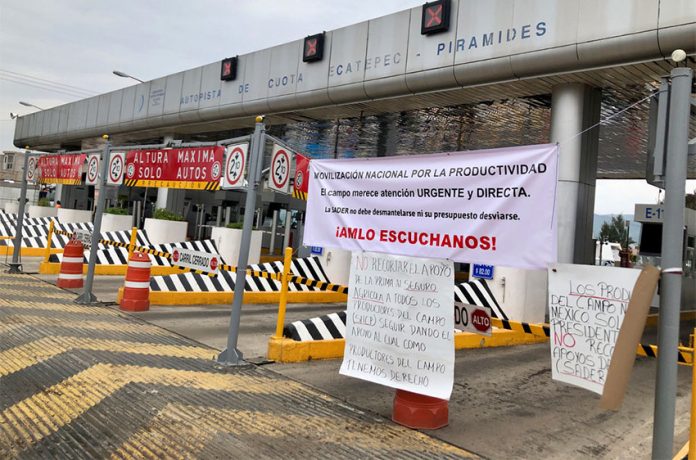
Farmers took over this toll plaza in the state of México.
Hijacking highway toll plazas continues to be a lucrative activity in many parts of Mexico even as the federal government takes action to address the problem.
Plazas in Mexico City, Morelos, Baja California, Guerrero, México state, Oaxaca, Querétaro, Guanajuato, Sonora, Puebla and Hidalgo were occupied, according to a report by the newspaper Reforma.
In Mexico City, protesters took over toll plazas at the entrance to the highways to Querétaro; Texcoco, México state; and Cuernavaca, Morelos.
Those occupying the toll plaza on the route to the Morelos capital have set up camp, seemingly indicating that they plan to settle in for the long haul and collect “voluntary contributions” from motorists around the clock.
In México state, many of the people occupying toll plazas are unemployed and looking for a way to get by at a time when jobs are scarce due to the coronavirus pandemic.
According to the newspaper El Universal, the toll plaza on the Mexico City-Querétaro highway at Tepotzotlán and that on the Circuito Exterior Mexiquense (México State Outer Loop Road) at Tultitlán are regularly occupied by groups of unemployed people who ask motorists for contributions lower than the regular toll.
A toll booth worker at Tultitlán said that groups of unemployed people take over one, two or all of the lanes at the toll plaza every day of the week. She said that they justify their actions by saying that they lost their jobs due to the coronavirus.
Out of work ride operators, waiters and drivers who work in the tourism sector are among those who regularly show up at the toll plaza in Tultitlán, located about 70 kilometers north of Mexico City.
A violent group known as “Revolutionary Movement of Ecatepec” and another called “Pacific Civil Disobedience” have also taken over the toll plaza, El Universal said, explaining that up to 70 people arrive there in pickup trucks before getting to work collecting tolls. Groups normally only stay for 20 to 30 minutes and flee when they catch wind that the National Guard is on its way.
Jobless people have also occupied toll plazas in Morelos. Unemployed people and students took over a toll plaza on the Mexico City-Acapulco highway, the Autopista del Sol, over the weekend and charged motorists a “voluntary contribution” of 50 pesos.
Oaxaca mayors commandeered the plaza at Huitzo, outside Oaxaca city.
According to the newspaper El Sol de Cuernavaca, the occupiers of the Ahuehuetzingo toll plaza didn’t hold up any signs to explain the motivation for their actions. When one motorist refused to pay, the toll plaza hijackers surrounded his car and aggressively demanded that he cooperate.
One motorist told El Sol that the toll plaza occupiers are sent there by a group intent on cashing in on prevailing lawlessness.
Community landowners in Morelos have occupied another toll plaza on the Autopista del Sol in recent days to demand that the federal government and a highway concessionaire comply with commitments to clean up a waterway near the highway and complete the construction of a community building on their property.
Toll plazas in other parts of the country, including Nayarit, have been occupied by farmers who say that they and/or their land have been adversely affected by the construction and operation of highways.
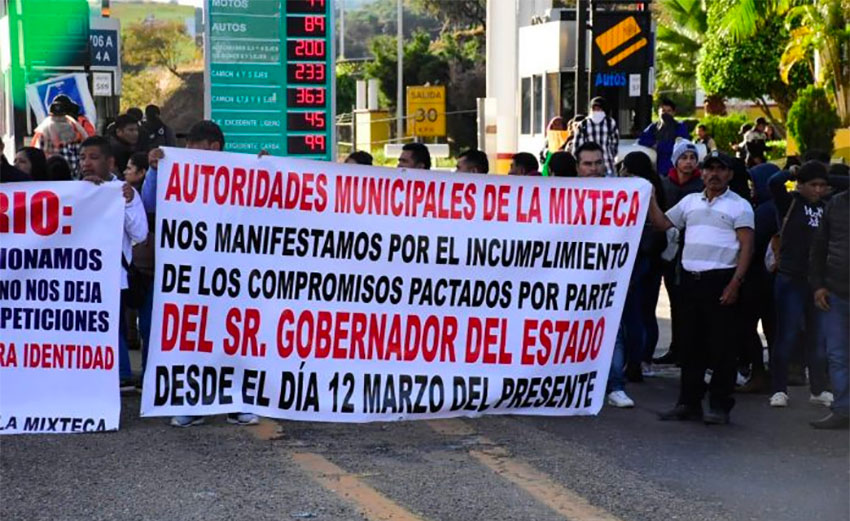
In Oaxaca on Monday, officials from municipalities in the state’s Mixteca region decided that taking over a toll plaza would be a good strategy to pressure the state government to deliver resources to them.
Led by mayors, Mixteca region officials occupied a plaza on the Oaxaca-Puebla highway in the municipality of San Pueblo Huitzo, located about 40 kilometers north of Oaxaca city. The officials demanded that the state government release resources earmarked for spending on security, including the purchase of police vehicles.
They held up a large sign demanding that the Oaxaca Ministry of Finance comply with its funding commitments and treat the Mixteca region people fairly. Unlike other toll plaza occupiers, the officials weren’t collecting contributions from motorists before letting them pass.
Instead they simply blocked the toll plaza, causing long lines of traffic to accumulate. Motorists were eventually able to pass when the mayors and other officials took their protest to government offices in the state capital.
In addition to the takeover of at least 18 toll plazas on Monday, protesters blocked highways in Sonora, México state, Guerrero and Oaxaca for a range of reasons.
Enrique González, president of the National Chamber of Trucking, said that highway blockades and toll plaza takeovers cause significant losses for the industry.
He explained that truck drivers are charged twice at occupied toll plazas because they are forced to pay tolls to the hijackers after which their electronic toll tags are detected.
If the drivers refuse to pay the occupiers, their trucks are scratched or otherwise damaged, González said.
The occupation of toll plazas has caused the loss of more than 3 billion pesos (US $134.1 million) in toll revenue this year, according to Marco Antonio Frías Galván, head of the Association of Road Infrastructure Concessionaires.
He said last week that the association he leads is working with the federal Security Ministry to develop a plan to prevent the takeover of plazas. President López Obrador has claimed that the federal government is putting an end to the practice and that it has avoided losses of up to 7 billion pesos.
But Frías contended that impunity remains a significant incentive for would-be occupiers, who can reportedly collect up to 1 million pesos (about US $45,000) per day at a single toll plaza.
“While there’s no punishment for those who take over toll booths, … the incentive will remain. It’s also clear that this very impunity has led to the creation of groups that exclusively dedicate themselves to blocking [toll plazas]. They’ve found a significant source of illegal revenue,” he said.
An easy win for Renata Zarazúa on Monday made her the first female tennis player from Mexico to advance to the second round at the Roland Garros French Open in 20 years.
The 22-year-old from Mexico City beat French wildcard player Elsa Jacquemot 6-1 and 6-2 in the first round of the tournament, claiming victory in just 64 minutes.
“It means a lot, I think it’s not only a win, I think it means more than that,” Zarazúa told reporters after the match. “I’m living a dream here in Paris and I just want to enjoy every match and every opportunity of being here this week.”
On Wednesday, Zarazúa’s 23rd birthday, she will take on 26-year-old Ukrainian Elina Svitolina, the No. 3 seed in the tournament. She moved to the second round after beating Russian Varvara Gracheva. Svitolina has made it into the final eight in Paris twice before.
Zarazúa is the first Mexican tennis player, male or female, to advance to the final draw of a Grand Slam tournament since Bruno Echegaray played at the United States Open in 2007, and only the fourth Mexican woman to do so, following in the historic footprints of Elena Subirats, Patricia Montaño and Angélica Gavaldón.
Zarazúa: happy to be part of history.
“I feel very happy to be part of history. I play to improve myself, not to make history, but this comes as a plus,” she said. “I love Mexico and I love that the people of Mexico support me. … Soccer is very big and I hope that tennis is also big now,” she said.
Zarazúa hopes her success will motivate young Mexican tennis players to train hard as she has over the years. She began competing at the age of 13. The following year she was the highest-ranked Mexican youth tennis player in the International Tennis Federation and among the 30 best in the world.
She now lives in Tampa, Florida, and has trained with France’s Patrick Mouratoglou, who has been recognized for his work with Serena Williams, one of the biggest stars in women’s tennis.
The young tennis player is coming into her own as she prepares for one of the biggest matches of her career thus far. Zarazúa came close to winning the Mexican Open in Acapulco earlier this year when she beat favorite and first seed Sloane Stephens but ended up losing to Canadian Leylah Fernández in the semi-finals.
With a record of 201 wins and 150 losses in singles matches, Zarazúa is currently ranked 178th in the world.
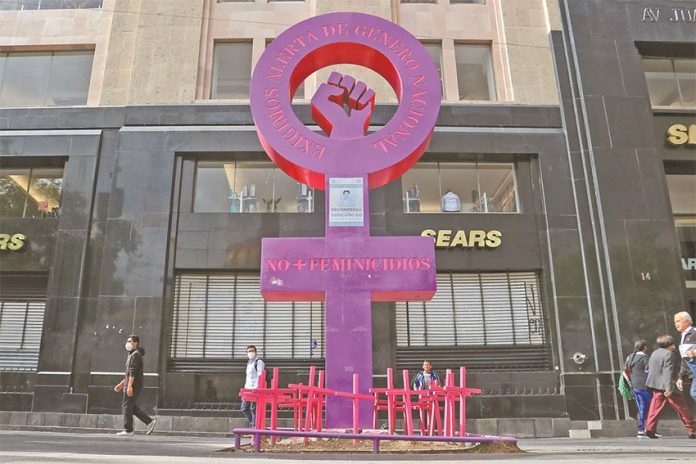
No more femicides is the message of the anti-monument opposite the Palace of Fine Arts.
Mexico City is filled with famous monuments – the Angel of Independence, the Monument to the Revolution and the Benito Júarez Hemicycle to name just a few.
Less known is that there are also seven recently erected “anti-monuments” in the capital that serve as a reminder of a range of injustices that have occurred in Mexico.
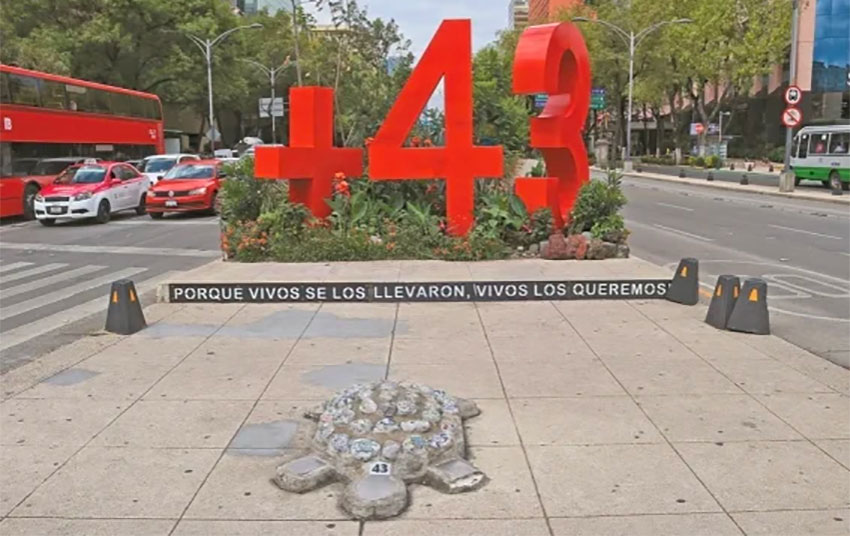
The purpose of the first “anti-monument” that appeared in Mexico City was to call for justice for the 43 Ayotzinapa teachers college students who were abducted and presumably killed in Guerrero in 2014.
Erected on Reforma Avenue in 2015 by the missing students’ parents, the anti-monument consists of a large plus sign in red next to the numerals 43 in the same color.
Beneath the “+43” monument is a message that reads, “Because they were taken alive, we want them back alive,” a slogan that has been chanted at countless protests across the country.
The Ayotzinapa anti-monument on Reforma.
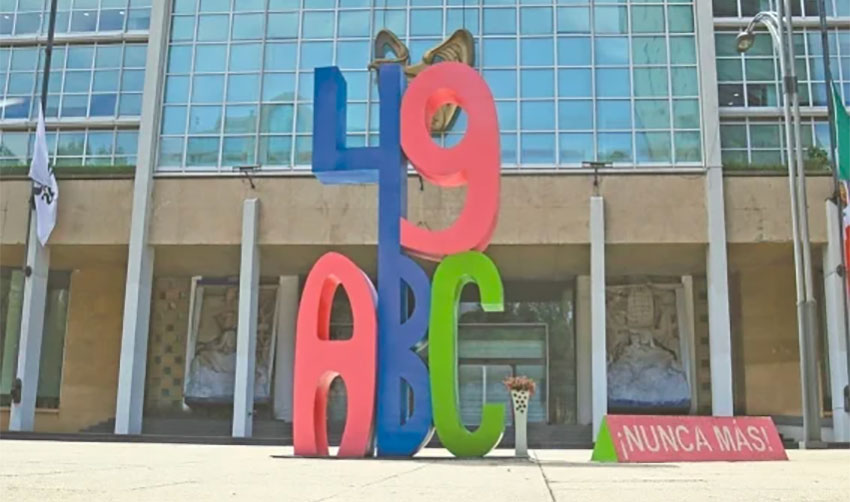
In June 2017, parents of 49 children that died in a fire at an ABC Daycare center in Hermosillo, Sonora, in 2009 followed suit and erected an anti-monument outside the Mexican Social Security Institute offices on Reforma.
It consists of the number 49 above the letters ABC, a sign that reads, “Never again!” and bronzed children’s shoes, some of which were stolen last year.
Another anti-monument popped up at the junction of Reforma and Bucareli Avenue in January 2018. The pale and dark blue structure, whose two halves together look like a person, was erected to denounce the disappearance of two young men who were kidnapped in Guerrero as they traveled to the coast for a holiday.
It also serves as a monument to the thousands of other people who have disappeared in Mexico.
In February 2018, a fourth anti-monument appeared on Reforma Avenue outside the Mexican Stock Exchange. The “+65” structure calls for the immediate rescue of the bodies of 63 of 65 miners who died in a methane explosion at the Pasta de Conchos coal mine in Coahuila in 2009.
The anti-monument was erected on the 12th anniversary of the miners’ deaths. More than two years later, the bodies of the 63 miners remain underground but the government has announced plans to recover them.
Anti-monument in front of the IMSS offices on Reforma remembers the 49 children who died in a daycare center fire in Sonora.
The three most-recently erected anti-monuments recognize injustices against women, migrants and students.
On Juárez Avenue opposite the Palace of Fine Arts in downtown Mexico City is a pink and purple anti-monument that demands a national gender alert due to the high levels of violence against women.
Featuring a raised fist and ringed by pink crosses, a message on the structure reads, “NO + FEMINICIDIOS,” or no more femicides.
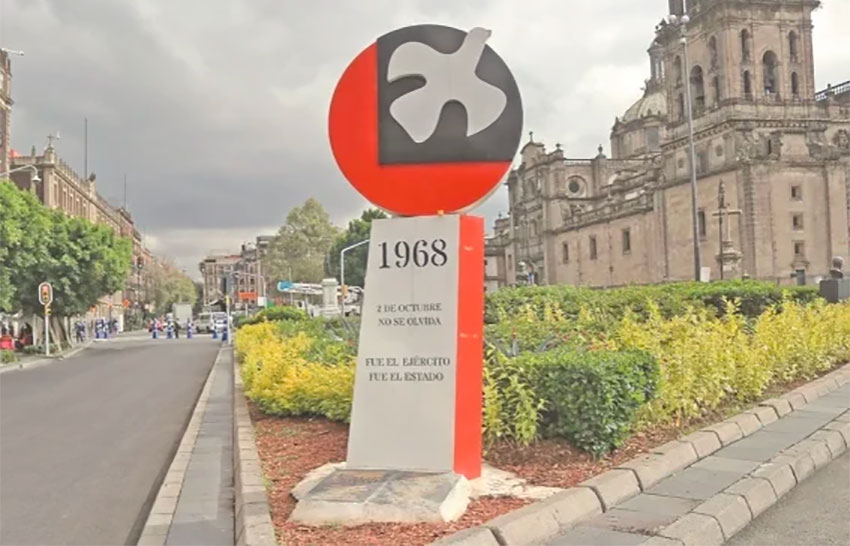
Just over a kilometer away in a small garden next to the zócalo, Mexico City’s central square, is an anti-monument to commemorate the students who were killed by government forces while protesting in Tlatelolco in 1968.
The memorial features a dove and a message that reads, “October 2 is not forgotten. It was the army, it was the state.”
The seventh Mexico City anti-monument, like five others, is on Reforma, the capital’s most emblematic boulevard.
A memorial to the students killed by government forces in Tlatelolco in 1968.
The “+72” memorial remembers the 72 undocumented migrants who were killed in a massacre in Tamaulipas in 2010 that was allegedly perpetrated by the the Zetas drug cartel.
Erected last month, the anti-monument includes the message,“To migrate is a human right.”
A Mexican student has taken a gold medal in this year’s 61st International Mathematical Olympiad under unusual pandemic-related conditions that required participants to compete virtually in socially distanced conditions.
Tomás Cantú, a high school student from Mexico City, learned he had won the gold at 5 a.m. Monday morning, when this year’s Olympiad hosts in St. Petersburg made the announcement virtually.
In an overall impressive showing, four of the five other Mexican competitors on this year’s team won bronze medals: Pablo Valeriano of Nuevo Leon, Omar Astudillo of Guerrero, Ana Paula Jiménez of Mexico City, and Emilio Ramos of Sinaloa. The final member of Mexico’s team of six, Daniel Ochoa, won an honorable mention.
The competition was to have taken place this year in St. Petersburg in July, but Covid-19 restrictions put the brakes on the anticipated trip to Russia. Olympiad organizers had delayed the event until September in hopes that the pandemic would have abated by then, but in June they announced that all competing students — from 113 countries — would have to participate from specially-installed competition centers in their home countries, supervised by a designated Olympiad representative, with cameras broadcasting to St. Petersburg as they completed the competition’s math exams.
The Mexican team participated from a center installed in Cuernavaca.
In order to mimic normal competition conditions, the tournament’s organizers required all participants to complete their exams simultaneously in a coordinated four hour and 30 minute window in Coordinated Universal Time (GMT), meaning that students in New Zealand finished their exams at midnight and Mexico’s students started their exams at 7 a.m.
The medals put Mexico’s team at 45th place worldwide.
Winners participated today in a virtual closing ceremony from Russia.
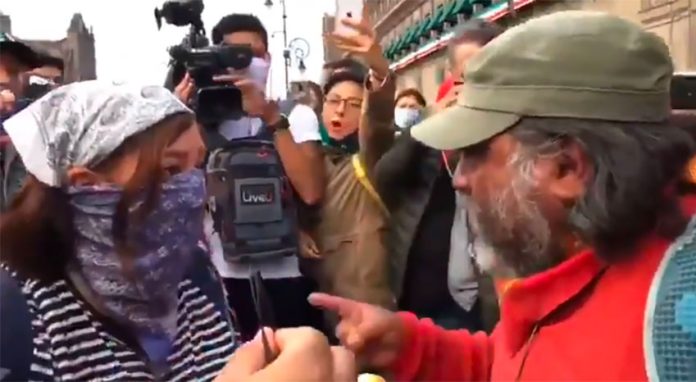
The father of a murder victim and a woman, both protesters in a Mexico City march, engaged in a heated argument on Saturday over defacing public property during a protest.
The facade of the National Palace was painted with messages and slogans at the conclusion of a march to mark the sixth anniversary of the disappearance of the 43 students in Guerrero.
A man who said his son was murdered in Acapulco, Guerrero, confronted a woman who had contributed to the painting and told her in no uncertain terms that she and other activists had no right to graffiti the palace, the seat of executive power.
“You can’t scribble on it because it doesn’t belong to you,” he shouted.
The woman retorted that she could indeed deface the building before asking the man whether he cared more about a wall than a life.
“I came to fight for my brothers, for the 43 [students] from Ayotzinapa. … It’s not possible that you do this, … my son was killed. I care about Mexico, I care about my son, I care about the 43 [students] and the thousands of missing people. This [defacing the National Palace] is not the way to fight,” the man said angrily.
“They won’t listen to us this way.”
The female protester said she didn’t care that the National Palace was a historic place, as the man pointed out, and took umbrage at his declaration that he couldn’t respect the women responsible for the graffiti.
“Are you going to disrespect me?” she yelled at him.
Prior to the confrontation, the facade of the National Palace was defaced with messages including “it was the state” – an assertion that the federal government was involved in the students’ abduction and presumed murder – “justice” and “Ayotzinapa lives on.”
The building’s main wooden door was adorned with a large “+43” in red paint.
Earlier on Saturday, close to 1,000 people led by parents of the 43 missing students marched to the zócalo, Mexico City’s central square, to demand justice.
Moncada with the 56-kilo sailfish he caught last week.
A young Oaxaca fisherman proved last week that age is no barrier to skill, catching three enormous sailfish, each weighing more than 49 kilograms.
According to Field and Stream magazine, the world record for the largest sailfish ever caught is 100 kilograms. It was landed in Ecuador in 1947.
David Moncada, a 22-year-old from Puerto Escondido, caught the three sailfish last Wednesday and Thursday. The three fish weighed 49, 50 and 56 kilos each, the last fish being a personal sailfish record for Moncada.
Moncada, who comes from a family of commercial fishermen, is as comfortable with using the rod and reel as with simply using bare fishing line in his hand.
While his fishing trophies include impressive marlin — his own personal best marlin catch was a blue marlin that weighed just over 208 kilos — he also loves fishing for sailfish and dorado, which he seeks out for their size and coloring.
The Oaxaca fisherman with a dorado, or mahi-mahi.
After spending his youth on his father’s fishing boat, Moncada now boasts his own boat, the Cristal, which provides him with a living.
“I like just as much to go out looking for tuna,” he said. “This year it went very well for me, and I caught a total of a half-tonne of tuna just fishing by myself.”
On another occasion, Moncada said he caught 523 skipjack tuna in one go, catching them one after another using four fishing lines tied to his boat and two rod-and-reel setups.
Nevertheless, he is also an assiduous competitor in Puerto Escondido’s sportfishing tournaments, which is perhaps not surprising given that Moncada’s father, José Luis Moncada Sánchez, is also a recognized fisherman and frequent judge at various sportfishing tournaments in Oaxaca. David soon followed in his footsteps.
One event that probably clinched Moncada’s decision to become a fisherman like his father came when he was just 11 years old: he and his father fought a memorable battle on his father’s fishing boat to land a 305-kilo marlin.
A photo of him and his father showing off the catch at the time shows David proudly holding onto the fish that probably equaled father and son’s combined weights three times over.
Masquerading as a simple dried bean, garbanzos are actually a powerhouse of protein eaten all over the world. Its subtle flavor belies its role as the key ingredient in Arabic hummus, Indian chana dal, and a panoply of soups, stews and curries.
Dried and ground into flour, we find Middle Eastern falafel, the Sicilian fritters panelle and the East Indian sweet laddu. The simplest recipe consists of chickpeas soaked overnight, spiced and roasted or sautéed, eaten as a snack called leblebi in Arabic and delicious in any language. In some parts of Mexico, the green pods, guasanas, are steamed, salted and eaten like the more common edamame made from soybeans.
It was difficult to choose recipes as there are just so many. (And we won’t even talk about aquafaba — the liquid left after cooking chickpeas or in a can of garbanzos — that can be whipped like egg whites to make meringue.)
You’ll find dried chickpeas in bulk in almost every grocery store, in the produce section, bagged ones in the bean aisle and canned ones with the other canned frijoles. Chickpea flour is harder to find, depending on where you live; try a health food store or the “gourmet” aisle in a big grocery store. Called garbanzos in Spanish, they’re inexpensive and a good staple to keep on hand.
Try adding chickpeas to any simple soup or stew or sprinkling them in a salad.
If you haven’t cooked with chickpeas, try adding them to any simple soup or stew, like chicken noodle or minestrone, or sprinkling them in a salad. If you’re a toast or hors d’oeuvre aficionado, hummus is surprisingly easy to make. And the first recipe, for sautéed chickpeas, is an all-round winner.
While you can substitute canned chickpeas for cooked dried ones, for some dishes the results won’t taste quite the same. Garbanzos don’t need as much cooking as other dried beans, though (generally about two hours), and if you soak them overnight or for eight hours the cooking time will be shortened even more.
Crispy Sautéed Chickpeas
I love these for breakfast, but they’re good for a side dish with any meal. Using dried chickpeas soaked overnight will give you a crispier result than if you use canned ones.
1 (15.5-oz.) can chickpeas, rinsed, patted dry, or 2 cups soaked chickpeas
Pour oil into a large skillet; add garlic, chickpeas and turmeric and ginger if using.; Cook over medium heat, stirring occasionally, until chickpeas are crisped and some have split open, 10–15 minutes. Season with salt and pepper. Remove from heat; stir in herbs, if using.
Fried Chickpeas with Chorizo & Spinach
¼ cup olive oil, plus more for drizzling
2 cups cooked or canned chickpeas, as dry as possible
Salt & pepper
4 oz. chorizo, diced
½ lb. spinach, roughly chopped
¼ cup sherry
1- 2 cups breadcrumbs
Crema for serving
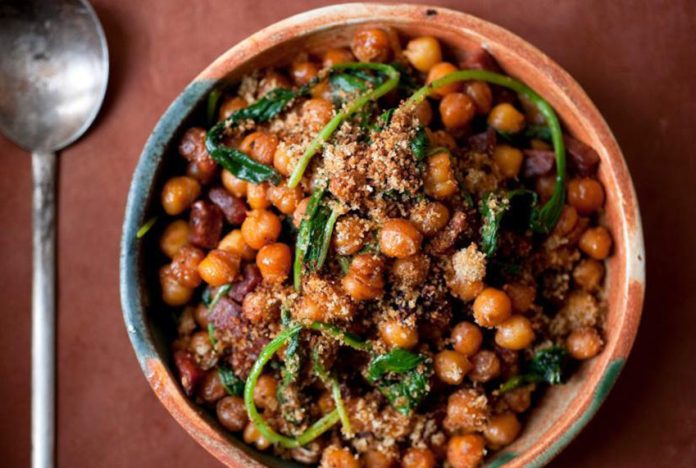
Heat broiler. Heat 3 Tbsp. olive oil in large skillet over medium-high heat. Once it’s hot, add chickpeas in a single layer and sprinkle with salt and pepper. Reduce heat to medium-low and cook, shaking pan occasionally, until chickpeas begin to brown, about 10 minutes. Add chorizo. Continue cooking for 5-8 minutes until chickpeas are crisp. Using a slotted spoon, remove chickpeas and chorizo from pan; set aside.
Add remaining 1 Tbsp. oil to pan. Add spinach and sherry, sprinkle with salt and pepper and cook over medium-low heat until very soft and liquid has evaporated. Add chickpeas and chorizo; toss quickly to combine. Top with breadcrumbs, drizzle with a bit more oil and run pan under broiler to lightly brown the top. Serve hot, topped with crema.
Classic Hummus
1 (15½-oz.) can chickpeas
1-2 lemons
1-2 cloves garlic
½ cup tahini (sesame seed paste), well mixed
¾ tsp. salt
Black pepper
Optional: ¼ tsp. ground cumin
3 Tbsp. olive oil, plus more for drizzling
Sesame seeds (for serving)
Optional: red bell pepper, fresh cilantro or parsley, chopped jalapeños
Classic hummus is surprisingly easy to make.
Drain chickpeas and rinse well. Juice lemons and set aside. Mix tahini, chickpeas, lemon juice, salt and pepper in food processor. Drizzle in olive oil. Process till creamy. Stir in any optional ingredients.
Carol’s Fantastic Chickpea Fritters
These are made with chickpea flour, also called besan flour. I’ve had them several times and they’re truly delicious!
1 cup sifted chickpea flour
Salt & pepper
3½ cups water
Vegetable oil for deep-frying
Put chickpea flour in large saucepan with a pinch of salt and beat in the water gradually. Bring to a boil and cook, stirring continually, for 5-10 minutes until mixture is thick and smooth. Stir vigorously to avoid lumps, covering your hand with a cloth if mixture spatters.
Pour mixture into a shallow baking tray or cookie sheet. Let cool to a slightly rubbery mass.
(Mixture should not stick.) Turn out onto a board and cut into strips 3-inch long by ¾ inch wide. Deep fry in hot oil until golden. Lift out with slotted spoon and allow to drain on paper towels. Serve hot sprinkled with salt and pepper.
Chickpea Fritters #2
These are made with canned chickpeas; a little easier with a slightly different flavor.
1 can (15.5 oz.) chickpeas, rinsed and drained
½ cup sliced scallions
1/3 cup chopped cilantro
½ cup flour
1 egg
1 tsp. salt
Olive oil
In a food processor, pulse together chickpeas, scallions and cilantro until a coarse paste forms. Mix in flour, egg, and salt. Heat ¼ inch olive oil in a large skillet over medium high. Add dollops of chickpea mixture to skillet,about 3 Tbsp. each, pressing to form patties. Cook until golden brown on both sides, turning once, about 5 minutes total.
Chickpea Salad
1/8 cup plain regular yogurt
1 Tbsp. mayonnaise
1 Tbsp. fresh lemon juice
½ tsp. Dijon mustard
Salt & pepper
1 Tbsp. EACH minced fresh dill, parsley and cilantro, plus more for serving
1 (15-oz.) can chickpeas, rinsed
1/3 cup finely diced celery
¼ cup thinly sliced scallions, white and green parts
Combine yogurt, mayonnaise, lemon juice, mustard, salt and pepper in small bowl. Whisk until smooth, add herbs, stir to combine. Set aside.
Place chickpeas in large bowl. Use a fork to lightly mash about 1/3 of them. Add celery and scallions. Pour dressing over salad, toss well. Let sit at room temperature at least 30 minutes before serving.
Janet Blaser has been a writer, editor and storyteller her entire life and feels fortunate to be able to write about great food, amazing places, fascinating people and unique events. Her first book, Why We Left: An Anthology of American Women Expats, is available on Amazon. Contact Janet or read her blog at whyweleftamerica.com.