With the Covid-19 pandemic still afflicting large parts of Mexico, most schools and universities are starting the new academic year with online learning in lieu of face-to-face classes.
While the transition to virtual learning is not a problem for some, for students without their own computer and without the means to acquire one the online shift has left them in a difficult situation.
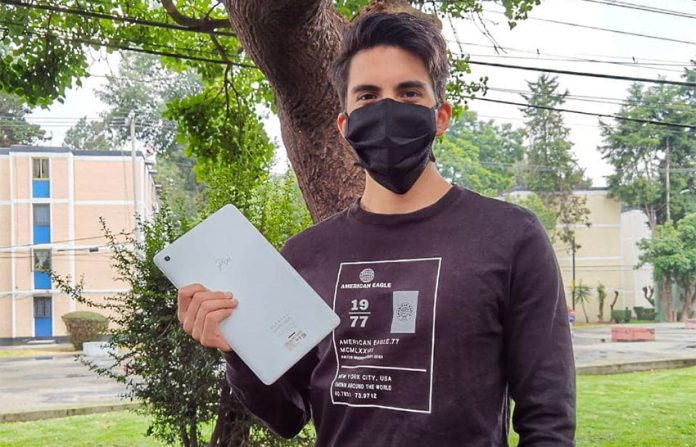
Enter an initiative called “Laptops Con Causa” or “Laptops With A Cause,” which seeks to distribute donated computers to students who don’t have one.
The brainchild of Mexico City university student Montserrat Rodríguez, the scheme has begun delivering computers to school students and undergraduates in the capital and has aspirations to expand to other parts of the country.
Rodríguez told the newspaper Milenio that the aim is to prevent students dropping out of high school or university.
“We’re university students and we know that there is tremendous social inequality in our country [with regard to] education,” she said.
The shift to online learning precipitated by the coronavirus pandemic has only widened the gap, Rodríguez said, adding “for that reason we decided to take action on the matter.”
She said that she and six other students involved in the project were surprised at the response they received after launching on August 13: 4,700 young people have applied for computers and 300 people have donated laptop, desktop and tablet computers.
A Tabasco restaurant specializing in traditional pre-Hispanic cuisine has made it onto the list of the 20 Best Restaurants in the World, compiled by Travel + Leisure and Food and Wine.
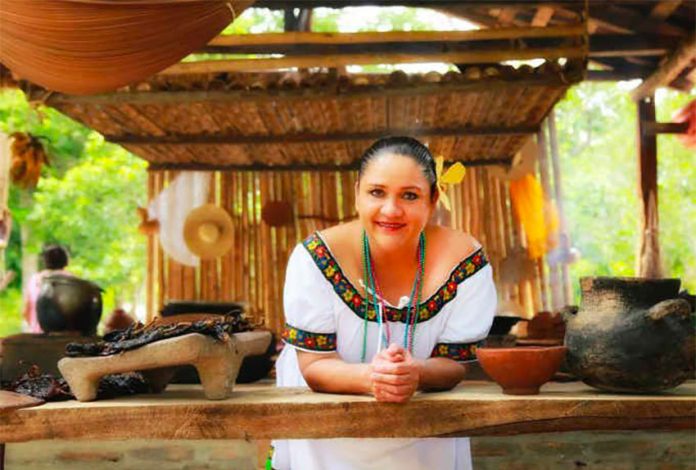
Cocina Chontal — a small house with brick floors and wooden tables where dishes are cooked on an outdoor comal anddogs hang out waiting for scraps — might seem an unlikely place to find one of the world’s best foodie haunts.
But the restaurant, located near the ancient Mayan archaeological zone in the jungle of San Isidro de Comalcalco, has won accolades with international tourists and locals alike due to its commitment to preserving knowledge of pre-Hispanic Tabasco cuisine, knowledge on the verge of being lost.
Nevertheless, chef Nelly Córdova Murillo said ending up on the travel magazine’s list was a total surprise.
“Truly it’s incredible,” she said. “I was calmly baking some cinnamon rolls with my daughter, and suddenly it occurred to me to get my telephone. I found all these people congratulating me, and I didn’t know for what.”
Córdova is among restaurants in major world cities like Rio de Janeiro, Sydney, Bogotá, and Santiago, Chile. But she hasn’t let it go to her head. The award, she said, goes to all tabasqueños.
“It’s their culture, their traditions, their customs, their men and women, their products, and their artisans,” she said. “Cocina Chontal is that. It’s Tabasco in a small place.”
In her Travel + Leisure article discussing the winning restaurants, culinary criticBesha Rodell praised not only Cocina Chontal’s cuisine, citing in particular the mole poblano with turkey, the scarlet shrimp, and the tortilla Chontal, but also its golden, sunlight-bathed ambience.
“I spent multiple days and flights and car rides getting to this one meal, and I’d do it all again in a heartbeat,” she wrote.
Ironically, the restaurant has been closed for the last four months due to Covid-19 restrictions. “… like many, we are practically at a dead stop,” Córdova recently wrote on Cocina Chontal’s Facebook page. However, she is working to reopen with sanitary precautions in place by the first or second week of September and taking advantage in the meantime to renovate her home, in which the restaurant is located.
“We’re working on giving the house a touch-up,” she added in her post. “It’s a restored house, so we have to do some artisan work.”
These baked jalapeños are stuffed with hard and cream cheese.
Small, unassuming and commonplace, jalapeños are actually anything but. They’ve been included as food on the U.S. space shuttle, they’re the “state pepper” of Texas and are the “secret” ingredient in the internationally popular Sriracha sauce.
Even the Sinaloa Cartel found them appealing: turns out “El Chapo” Guzmán once operated a jalapeño cannery as a front for shipping drugs to the U.S.
Trivia aside, the secret to the popularity of jalapeños may lie in their hot but tolerable (and often irresistible) chile pepper kick. That heat is also easy to manipulate in recipes: since almost all of the capsaicin and pungency-causing compounds are in the white “veins” and seeds, all you have to do is remove those and you’re good to go.
The green skin does have a bit of a bite, and as they ripen that develops more, but in general jalapeños are on the low end in terms of Scoville heat units — unless they’ve been stressed while growing.
How would you know this? If a jalapeño has been stressed while growing – by erratic watering, too-high temperatures, incorrect soil nutrition, insects, illness — their pungency increases. You can tell that’s been the case because there’ll be small brown lines
on the skin, called “corking.” Those Jalapeños will be hotter than most. The more scars, the hotter the pepper.
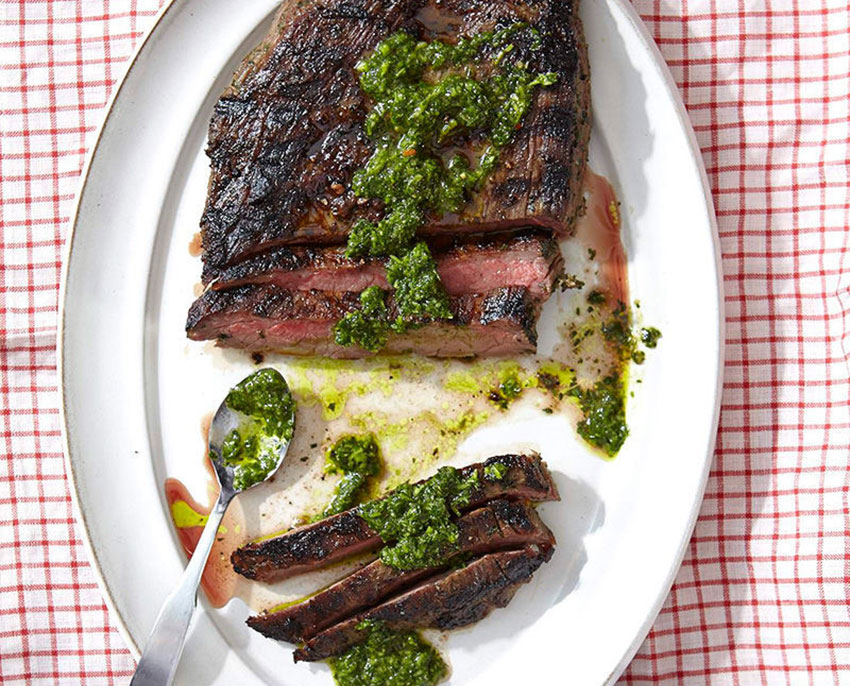
A steak topped with Argentinian chimichurri sauce.
Jalapeño plants are easy to grow and one healthy plant can produce 25-35 peppers. picked over the course of a season. If left to ripen, jalapeños turn red and are hotter than their younger green counterparts. Smoked, they’re called chipotles. Not surprisingly, jalapeño juice is used as a remedy for allergies and clearing sinuses.
Fresh or canned, jalapeños can be added to a smorgasbord of dishes: pizza, mac and cheese, tuna salad, scrambled eggs, quiche, frittata,casseroles of every type, shrimp cocktail, chili, and of course they’re a mainstay in Mexican classics like every kind of salsa, guacamole, nachos and even the simple quesadilla sencilla.
As with all hot peppers, keep jalapeños (and hands that have touched them!) away from skin, eyes, lips or other membranes, as the oils are irritating. If you forget and do something like rub your eyes, rinse with hot water. If your skin is irritated, wear rubber gloves next time or wash with hot soapy water and rub vegetable oil on the area.
One more bit of trivia: the unbeaten Guinness World Record for the most jalapeños eaten in a minute was set by Alfredo Hernandes in 2006, who consumed 16. And the most jalapeños eaten? That would be 275 pickled jalapeños, eaten in eight minutes by Patrick Bertoletti in 2011.
Nancy’s Famous Jalapeño Jelly
Folks in Mazatlán have been buying and loving this for 11 years. Nancy says it’s great on crackers with cream cheese.
In a large pan, bring jalapeños, water and vinegar to a boil, simmer for 15 minutes. Strain out pepper pieces; from this liquid, measure out 3 cups, adding more water if needed, and bring to a boil again. Mix in pectin. Add 3 cups of sugar, stir and bring to a boil for 3 minutes. Add a few drops of food coloring if desired. Pour into four ½-pint jars or two pint jars. Cool upside down until lids ping and seal, about 10 minutes; no canning necessary.
Jalapeño-Cilantro Dipping Sauce
Think of this as Green Goddess with a kick. Use as a salad dressing, on fish or chicken entrees or tacos, or over a pork roast.
1 jalapeño, seeds removed, chopped
1 cup plain whole-milk Greek yogurt
½ cup cilantro leaves with tender stems
2 Tbsp. mint leaves
1 Tbsp. (or more) fresh lime juice
¼ tsp. ground cumin
Kosher salt
Purée everything in a blender until very smooth. Taste and season with salt and more lime juice, if desired.
Baked Stuffed Jalapeños
4 oz. cream cheese, room temperature
½ cup grated sharp cheddar or chihuahua cheese
6 large jalapeños, halved, seeded, veins removed
3 Tbsp. minced fresh cilantro
Salt and pepper
Bread crumbs
Preheat oven to 450 F. In small bowl, mix cream cheese, cilantro and cheese. Season with salt and pepper. With a small spoon, fill each jalapeño half with about 1 Tbsp. of cream cheese mixture. Sprinkle with bread crumbs. Place peppers on a parchment- or foil-lined baking sheet and bake until cheese is browned and bubbling, about 10-12 minutes
Option #2: Add ¼ cup crumbled cooked bacon into cream cheese mixture.
Chimichurri
This classic Argentinian sauce can be used as a marinade and served with all cuts of beef, fish, shrimp, poultry, and as a dip or on a torta.
1 shallot, finely chopped
1 large jalapeño, finely chopped
3–4 garlic cloves, minced
½ cup red wine vinegar
1 tsp. salt, plus more
½ cup finely chopped cilantro
¼ cup finely chopped flat-leaf parsley
2 Tbsp. minced fresh oregano
¾ cup extra-virgin olive oil
The classic Argentinian chimichurri sauce.
Combine shallot, jalapeño, garlic, vinegar and 1 tsp. salt in a medium bowl. Let sit 10 minutes. Stir in cilantro, parsley and oregano. Whisk in oil. If using as marinade, reserve ½ cup to a small bowl for sauce. Toss meat (or chicken wings or whatever) with remaining sauce in a glass or ceramic dish, cover and let sit in refrigerator for 3 hours or overnight. When ready to cook, remove meat from marinade, pat dry and grill. Use reserved chimichurri as a sauce. –bonappetit.com
Jalapeño Popper Dip
1 cup shredded cheddar cheese
1 (8 oz.) package cream cheese, softened
8-10 jalapeños, seeded & minced
5 slices cooked bacon, crumbled (optional)
½ cup sweet corn
¼ cup mayonnaise
Preheat oven to 400 F. Mix all ingredients together in a small casserole dish. Bake 15-20 minutes until warm and bubbly.
Janet Blaser has been a writer, editor and storyteller her entire life and feels fortunate to be able to write about great food, amazing places, fascinating people and unique events. Her first book, Why We Left: An Anthology of American Women Expats, is available on Amazon. Contact Janet or read her blog at whyweleftamerica.com.
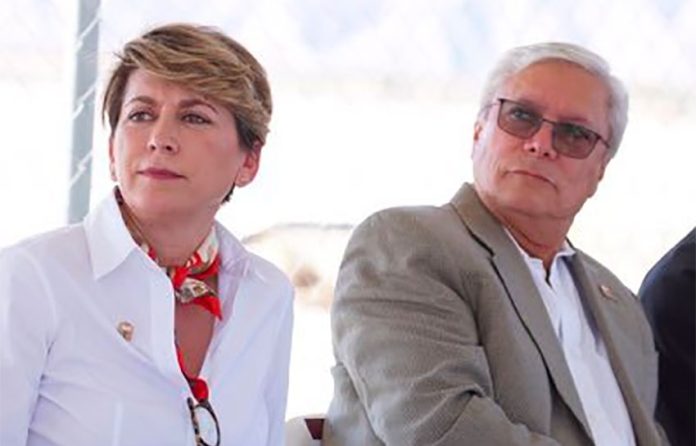
Minister Postlethwaite and Governor Bonilla: state has been 'abandoned.'
Baja California Governor Jaime Bonilla has accused the Federal Electricity Commission (CFE) of abandoning the state as it seeks a solution to its energy crisis.
The governor made the claim as the northern border state faces a growing deficit of electricity, prompting his government to open a bidding process last Thursday for the construction of a private solar energy plant that is expected to cost US $200 million.
Speaking at a press conference in Mexicali, Bonilla said he spoke to federal Energy Minister Rocio Nahle for the first time in two years after his administration launched the seven-week-long tendering process.
The governor said he told the minister that he was pleased that the federal government was finally taking an interest in Baja California’s energy problems.
“Now it turns out that they’re worried because Baja California wants to generate” its own energy, Bonilla said.
The governor, who represents Mexico’s ruling Morena party, added that he told Nahle that she should speak to CFE director Manuel Bartlett about his government’s decision to take it upon itself to solve the state’s energy problems.
(Baja California is not even connected to Mexico’s national power grid, and buys surplus power from the U.S. state of California to supplement locally-generated electricity).
“I think you should speak with Mr. Bartlett with whom we’ve had many discussions,” Bonilla said he told Nahle.
“We’ve asked him to support us and he said there were no resources. So if they [the CFE] cut us adrift, we’re going to seek alternatives; I have an obligation to Baja California regardless of who the president is, that has nothing to do with it.”
The governor said the decision to look for a private company to build a solar energy plant doesn’t amount to a “confrontation” with the federal government but is simply a “position” of the state government.
Bonilla said last week that the company awarded the contract will sell the electricity it generates to the state government at “a better price than what we are currently paying.”
The winning bid will be chosen in October and construction is expected to take one year.
Bonilla had urged state lawmakers to approve the tender process, arguing that the government needed to be able to buy cheaper electricity to power the Rio Colorado-Tijuana aqueduct, the state’s largest consumer of power.
Water supply to 60 neighborhoods in Tijuana has been recently affected by the power deficit problem and some companies in the border region have been told to operate at a reduced capacity in summer months.
Baja California Infrastructure Minister Karen Postlethwaite Montijo said last week that recent high temperatures have created a shortage of power, and residents are being asked to reduce consumption between noon and 10 p.m., unplug appliances, turn off lights and set their air conditioners no lower than 25 C.
She also said the new solar plant will need to generate at least triple the amount of energy the Rio Colorado-Tijuana aqueduct uses to ensure that energy needs are met.
“We’re talking about 270 solar megawatt [hours], the aqueduct consumption is 80 megawatts; to generate it in solar, you have to generate more or less triple … because energy isn’t generated at night. Energy is stored in batteries to use at night,” Postlethwaite said.
The Baja California government said Saturday that three companies have already expressed interest in submitting bids.
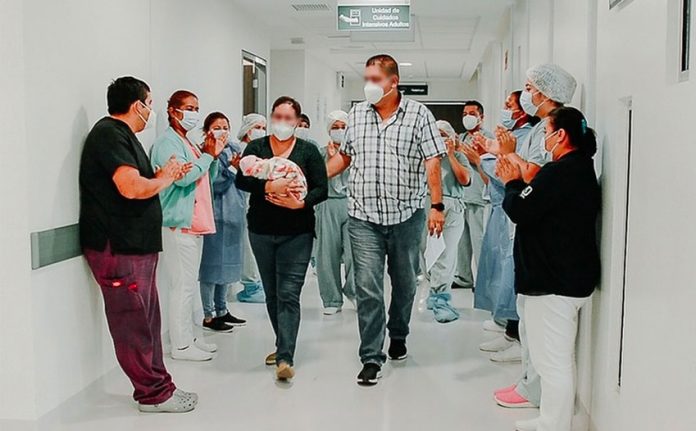
Sofía gets a send-off from Chiapas hospital staff.
A baby girl born in Chiapas with Covid-19 transmitted by her mother is safe and sound at home after a 47-day battle for her life.
As soon as the infant, identified only as Sofía, was born premature in a private hospital, doctors attending her birth noticed that she was having serious problems breathing. She was transferred that day to a public hospital in Tapachula, operated by the Mexican Social Security Institute (IMSS), where she was isolated in a special Covid-19 ward.
“From her birth, she couldn’t breathe. The doctors didn’t have time to take her measurements. They connected her immediately to oxygen,” said the child’s mother, identified only as Doris. “Everything was stacked against my daughter, but now she has come home, and we are very excited to get to know her.”
Doctors suspected Covid infection in Sofía when she displayed symptoms because her mother had recently been diagnosed with the disease.
“She had tested positive for the SARS-CoV-2 infection a month before giving birth,” said Roger Alexis Liévano Cruz, a pediatric cardiologist at the hospital, “and so they gave tests to [Sofía], which came up positive.”
According to an IMSS spokesperson, Sofia’s treatment required intubation, high-support mechanical ventilation, and “a complex surgery for her age and size,” but she has recovered thanks to a combination of medications and respiratory therapy.
In Mexico City meanwhile, a mother with Covid-19 had a much luckier outcome after doctors ordered an immediate Caesarian section when she showed up for her 36-week wellness check with Covid symptoms.
Doctors at the IMSS clinic sounded the alarm when the mother displayed a fever and low oxygen levels.
The mother, who was eventually diagnosed with Covid-19, had no idea she was sick. She was transported to hospital where doctors treated her respiratory symptoms. The newborn, who was pronounced in good health, is now safe at home with its mother.
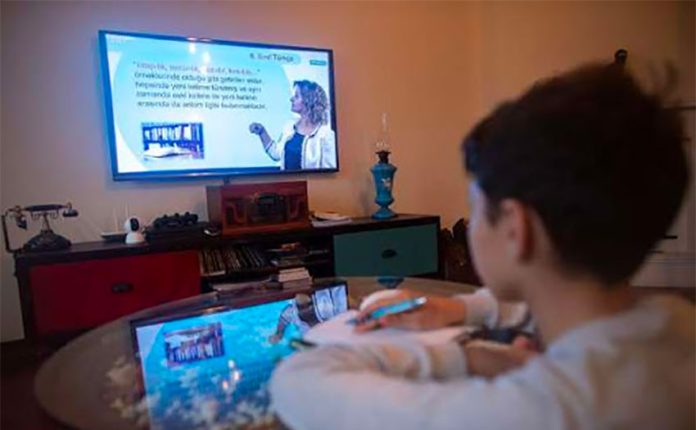
Many households don't have this kind of technology.
More than 30 million students across Mexico were scheduled to return to school by attending virtual classes on Monday but not all of them have access to the technology they need to study remotely amid the coronavirus pandemic.
The federal government announced in early August that four broadcasters had agreed to screen virtual classes and other educational content but learning via television is not an option for students in many indigenous communities, including hundreds if not thousands in the southern states of Chiapas, Oaxaca and Guerrero.
In Chiapas, the free-to-air television signal reaches only three in 10 homes, according to the Federal Telecommunications Institute. Some communities don’t even have electricity or supply is unreliable, creating an additional barrier for students to learn remotely using technology.
Herminia Hernández, an educational consultant in San Cristóbal de las Casas, said the federal government’s virtual education model, which also includes online content, is not feasible for 1.5 million students in Chiapas.
“In the majority of homes, even those that are near cities, the television signal doesn’t even arrive,” she said.
In Oaxaca, one in four homes doesn’t have a television, according to state government statistics cited by the newspaper El Financiero. Electricity supply is also a problem in the state, not just in remote communities but even for some homes near Oaxaca city, the state capital.
El Financiero reported that some homes in impoverished neighborhoods in the municipality of Zaachila, located just south of Oaxaca city, don’t have electricity.
A woman only identified as Antonia who lives with her family in the Guillermo González neighborhood – where many residents scavenge in the local dump to get by – acknowledged that the absence of electricity in her home will make it impossible for her children to watch televised classes or study online.
Some students in Guerrero face the same situation, with electricity supply unreliable or non-existent in more than 600 rural, mostly indigenous communities.
About 65% of the population of the southern state doesn’t have access to the internet in their homes, El Financiero reported, while the figure is close to 90% in rural areas.
Teachers and parents said that the government’s pandemic learning model will only increase educational inequality in Guerrero, which includes coastal cities such as Acapulco and Zihuatanejo and small, isolated towns in mountainous regions.
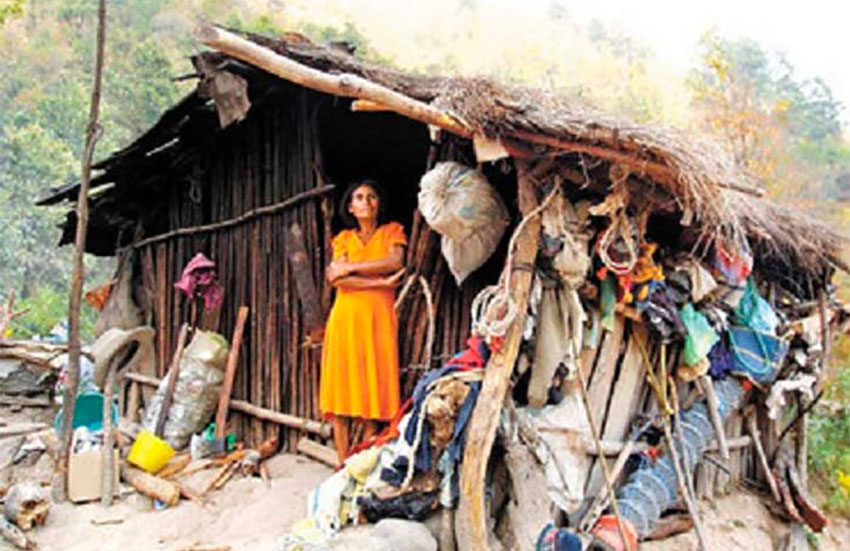
Electrical service is unlikely and internet less so in many rural communities.
Manuel Venancio, a local education union leader, said that access to television, computers and the internet is “not part of the reality for many students in Guerrero.”
“If there is a high percentage of students in the state’s main cities who don’t have their own computer, imagine … [the situation] in other places like the Sierra and Montaña [regions],” he said.
The Organization for Economic Cooperation and Development (OECD), the United Nations and the World Economic Forum agree that the coronavirus pandemic and the consequent shift to virtual education will widen inequality between technology haves and have-nots.
The OECD said that fewer than 5% of Mexican students classified as “poor” have a computer and internet connection in their home whereas the vast majority of “rich” households have both.
The education of students from poor socio-economic backgrounds will suffer more as a result of the shift to virtual learning and they will face long-term negative consequences as a result, the OECD said.
The UN Development Program said “the reality in Mexico” is that many students, especially those who live in rural locations and/or are indigenous, don’t have the technology they require to keep up with their classes and deliver their schoolwork to their teachers virtually.
The World Economic Forum said that the transition to virtual classes “has disproportionately affected the most vulnerable communities” and widened the inequality gap.
Karen Lizette Matias López of a Mexican NGO called Women United for Education said much the same.
“The inequality gaps were already very wide before this pandemic but they will be more evident than ever after it,” she said.
“Those who don’t have access to a television, computer or internet will miss out on the opportunity to access a more solid form of education.”
David Calderón of Mexicanos Primero, an education advocacy group, said that one of the most serious consequences of the situation will be that many students without access to technology will drop out of school, thus limiting their future educational and employment opportunities.
A supplier of the Swedish furniture retailer IKEA will build its first North American factory in Coahuila.
The 100,000-square-meter plant, to be built by Ikano Industry on a 78-hectare parcel of land behind the Chuy María Coahuila Industrial Park in Ramos Arizpe, near Saltillo, will eventually expand to 200,000 square meters, company officials said. Upon completion in the second quarter of 2021, the factory is expected to provide 2,000 new jobs in the region.
The plant will manufacture foam “comfort products” such as mattresses and sofas sold in IKEA stores in North America. Its other production facilities are in Poland.
“Starting up a factory in a fast-growing country like Mexico, and becoming part of the dynamic environment in Ramos Arizpe, is a fantastic opportunity for us,” said Mats Håkansson, chairman of parent company Ikano Group.
The complex will have LEED gold certification from the United States Green Building Council and utilize solar power and other renewable energy technologies and the reutilization of production waste.
“Here in Ramos Arizpe, we aim to establish a great workplace for employees in an innovative environment that uses the latest technology, optimized processes, and high-quality materials,” Ikano Industry’s Sebastian Łuczyński said.
The manufacturing complex will be financed by HSBC México with special sustainable financing.
“The fact that the financing has conditions to make it ‘green’ permits us as a banking institution not only to support the arrival of Ikano Industry in Mexico but also accompany them in the development of infrastructure that, from the beginning of its construction and until its future operation, takes into account the efficient use of resources, cleaner technologies, and more sustainable processes,” the bank said.
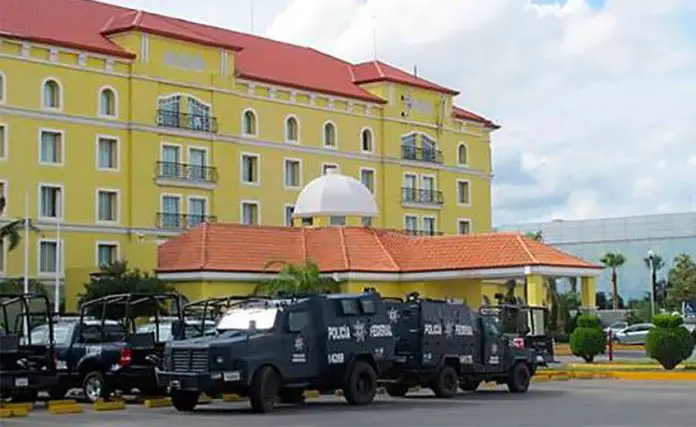
This hotel in Tamaulipas was a temporary home to Federal Police, posted to conduct operations against organized crime.
More than 24 billion pesos was embezzled from Federal Police (PF) coffers in four years during the previous government’s six-year term, according to federal authorities.
The Federal Auditor’s Office (ASF) detected anomalies in the use of PF funds between 2013 and 2017 that amount to 24.26 billion pesos (US $1.1 billion at today’s exchange rate).
According to a report by the newspaper Reforma, former PF commanders diverted money that should have been used to pay for officers’ travel expenses and bonuses among other operational costs.
Just over 8.1 billion pesos earmarked for spending on officers’ accommodation and meals while they were deployed on operations in different parts of the country was allegedly embezzled as was more than 6.1 billion pesos allocated for transportation services.
Two of those sought are Jesús Orta Martínez, a former Mexico City police chief, and Frida Martínez Zamora. Both served as secretaries general of the Federal Police at the time of the alleged embezzlement. However, the embezzlement of which they are accused only amounts to 2.5 billion pesos, or just over 10% of the amount that allegedly disappeared between 2013 and 2017.
Reforma reported that the embezzlement of some of the funds Orta and Martínez allegedly stole occurred via 246 checks issued to the other 17 officials sought by authorities.
According to the ASF, the funds were supposed to have been used to pay for gasoline for police vehicles as well as meals, accommodation, other travel expenses and risk bonuses while PF officers were deployed on operations.
Reforma said that during the previous government, it was told by officers that their superiors personally profited from money that should have been spent on expenses associated with operations that were carried out against organized crime.
Some officers were even kicked out of their hotel accommodation because the Federal Police failed to pay for it, the newspaper said.
The CEO of a hotel chain in Michoacán wrote to a company contracted by the PF to settle travel expenses late in 2017.
Former federal cop Jesús Orta is among those for whom arrest warrants have been issued.
Jaime Vega, head of the Vista Hermosa chain, told the firm KolTov that it was eight months in arrears and that 500 officers would be evicted if the payment wasn’t made. Despite the warning, the payment never arrived.
Officers alleged that KolTov received the money to make the payment but that it was split between the company and Federal Police commanders.
According to a report in 2017 there were 201 hotels in 22 states on the brink of collapse because they were owed more than 653 million pesos by the police force for accommodation and food.
Most of the hotels awaiting payment are in the states of México, Guerrero and Michoacán, where police have been sent to combat the violence created by criminal organizations fighting over territory.
“There was always swindling,” one former PF officer who is now a member of the National Guard told Reforma.
He also said that commanders “invented” misdeeds supposedly committed by officers in order to justify not paying them their bonuses. The commanders allegedly pocketed the money themselves.
The ASF has also found irregularities related to more than 83 million pesos allocated to the PF between 2010 and 2017 to purchase 40 police vehicles.
Among other alleged PF corruption, federal investigators discovered that a 2.5 billion-peso, no-bid contract in which the Federal Police purchased technology from the Israeli firm Rafael Advanced Defense Systems was issued at four times market value and only half that amount was actually paid.
The Federal Police, restructured in 2009 by the government of former president Felipe Calderón, was officially disbanded at the end of last year, with many officers moving into the newly created National Guard.
Testing strategy means it is uncertain that new case numbers are in fact going down.
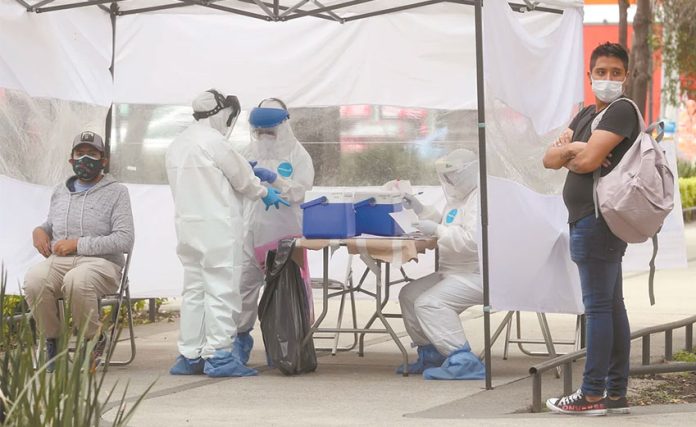
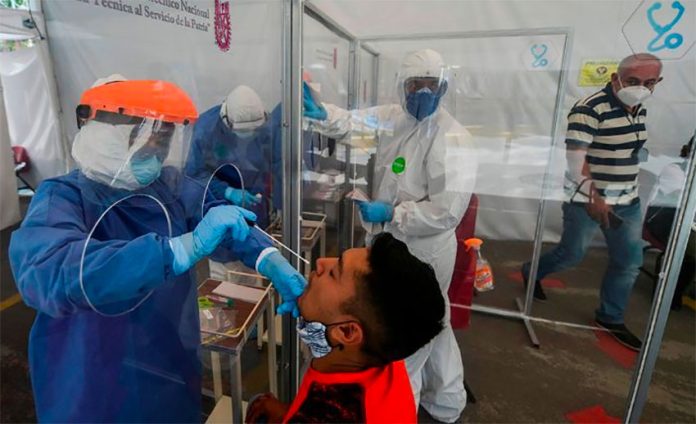
New coronavirus case numbers have declined in recent weeks but the situation might not have improved as much as health officials claim: Mexico’s already low Covid-19 testing rate has also recently fallen, meaning that that an even higher number of cases could be going undetected.
Officials including Deputy Health Minister Hugo López-Gatell and Director of Epidemiology José Luis Alomía have asserted in recent days that the pandemic is on the wane in Mexico.
The former, the federal government’s coronavirus czar, said last week that the situation was “very positive” because data from recent weeks show the pandemic is in “a clear phase of descent.”
But data from the University of Oxford shows that the number of Covid-19 tests being performed each day in Mexico has consistently trended downwards in the same period.
On July 21, 0.1 tests per 1,000 people were carried out, according to the Oxford University project Our World in Data, but by August 19 the rate had fallen to 0.07.
Based on those figures, the daily testing rate per 100,000 people fell from 10 to seven in a four-week period but the World Health Organization (WHO) said last week that the rate in Mexico had dropped to as low as three.
López-Gatell attributed the drop-off in testing to a decrease in the number of people with coronavirus-like symptoms, rejecting any suggestion that the government is deliberately testing fewer citizens to create a misleading impression that the pandemic is on the wane.
“It is believed that it was decided to reduce the number of tests in order to reduce the number of cases; it’s not true, the [testing] policy is the same. If there are symptoms, a test is done,” he said.
But experts who spoke with the El Universal newspaper agreed that the recent decline in case numbers could be linked to decreased testing.
Malaquías López Cervantes, a public health professor at the National Autonomous University (UNAM) and spokesperson for the university’s Covid-19 commission, was highly critical of the drop-off in testing from an already low rate.
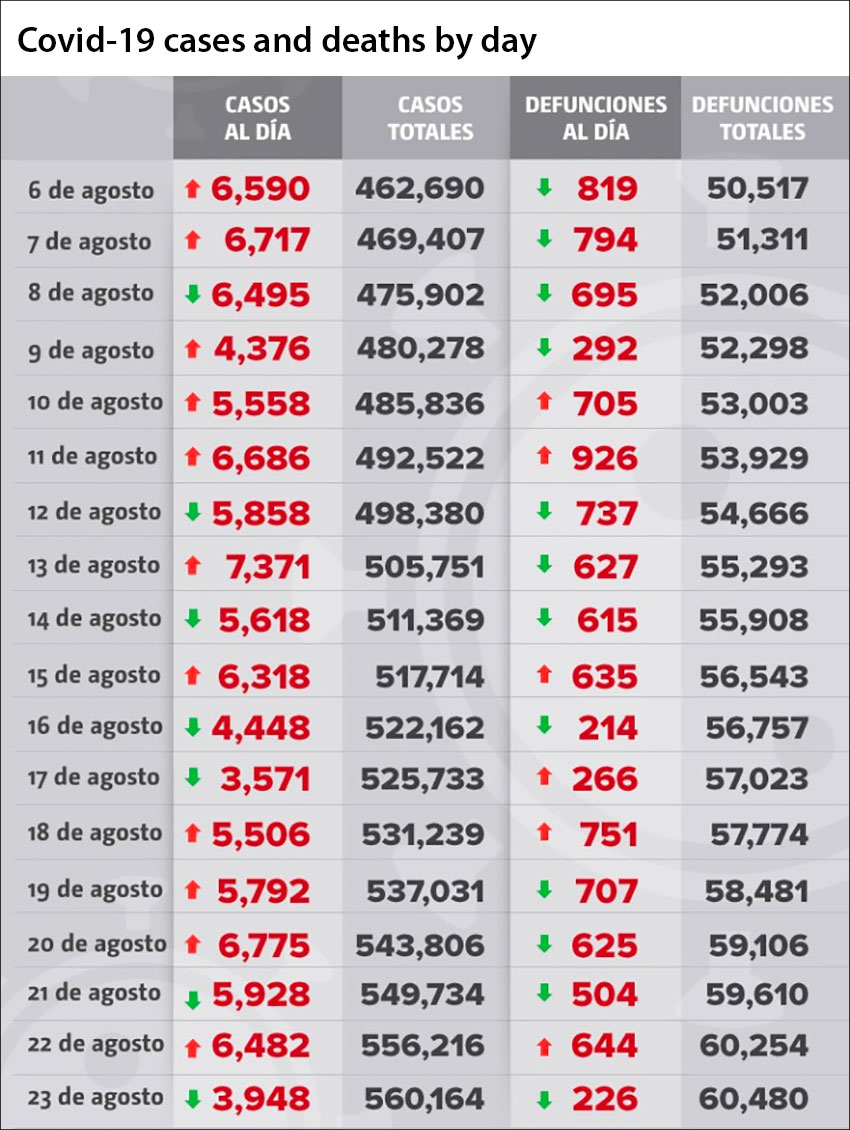
Coronavirus cases and deaths reported by day. milenio
“The worst thing is that in a country where … enough tests have never been done, it’s now being said that we need less [testing],” he said.
The UNAM academic said that it’s regrettable that testing has been mainly targeted at people with severe coronavirus symptoms such as breathing difficulties and therefore people with less serious symptoms have not been tested and included in official data.
Rodolfo de la Torre, director of social development at the Espinosa Yglesias think tank, was also critical of Mexico’s strategy. As a result of the approach, it cannot be certain that new case numbers are in fact going down, he asserted.
“The WHO has established fundamental elements to combat the pandemic, one of them is the number of tests that are carried out. The entire population doesn’t have to be tested but [testing] shouldn’t be limited to serious cases,” de la Torre said.
Widespread testing can play an important role in managing the pandemic because it allows mild and asymptomatic cases to be detected and isolated to stop the spread of the coronavirus, he said. However, “that’s not happening in Mexico,” he added.
Alejandro Macías, a member of UNAM’s coronavirus commission and the federal government’s point man during the swine flu pandemic in 2009, said that more widespread testing would be beneficial because it would provide a clearer picture of how the pandemic is evolving.
Admitting that it sounds “paradoxical,” Macías said that more tests can result in fewer cases in the long term.
“While you’re doing more tests, you’ll have a better chance of finding the sick and being able to isolate them in the immediate term,” he said, adding that community transmission will decrease as a result and the infection rate will fall.
“The ideal would be that contacts [of positive cases] went into isolation and that there was capacity to test them,” Macías said.
However, the reality is that contact tracing has not been carried out widely in Mexico, although some state authorities, such as those in Campeche, have made efforts to do so.
At Sunday night’s coronavirus press briefing, the government’s health promotion chief said that just under 1.26 million Covid-19 tests have been carried out since coronavirus was first detected in Mexico at the end of February.
Confirmed cases rose to 560,164 on Sunday with 3,948 new cases registered. The positivity rate in Mexico is 44.5%, meaning that almost one in two tests performed comes back positive.
The extremely high positivity rate – the rate in the United States is 9%, according to authorities in that country – is widely regarded as a clear indication that Mexico is not testing anywhere near as widely as it should be.
Meanwhile, Mexico’s official Covid-19 death rose to 60,480 on Sunday with 226 additional fatalities reported.
On Saturday, health officials reported 6,482 new cases and 644 deaths.
The lack of testing is widely believed to be hiding not only the real size of the coronavirus outbreak but also the number of deaths caused by Covid-19.
Nevertheless, Mexico has the third highest death toll in the world behind only the United States and Brazil.
According to Johns Hopkins University, Mexico has the fifth highest number of Covid-19 fatalities per 100,000 inhabitants among the countries most affected by the pandemic.
There have been just under 48 deaths per 100,000 residents here as of Sunday, data shows. The countries that currently have higher mortality rates than Mexico are Peru, Chile, Brazil and the United States.
The magnitude of the Covid-19 epidemic in Mexico is being underestimated, warns the World Health Organization (WHO), and one of the main reasons is the lack of testing.
Limited testing and a disproportionate impact on indigenous and impoverished populations have made for a complex situation in Mexico where “the scale of the epidemic is clearly under-recognized,” said Michael Ryan of the WHO’s Health Emergencies Program said on Friday.
Mexico is testing just three of every 100,000 people a day, Ryan said, whereas in the United States the figure is 150 per day.
Tests are also not being done quickly enough to save people, Ryan said. Positivity rates in Mexico hover around 50%, “which means that many people are not well diagnosed or are diagnosed late.”
The WHO has been strongly urging widespread testing since March, but health authorities in Mexico have resisted, claiming that it would be “useless and costly.”
Ryan also said that wealth and class are factors in the spread and mortality of the disease.
“There’s a sharp difference in mortality among the wealthier districts and the poor municipalities,” Ryan said. “People living in impoverished areas are more than twice as likely to die from Covid-19 than those in more affluent areas.”
He also noted a different impact on indigenous populations in Mexico where the fatality rate is one in four to one in five.
Ryan said that Mexico must make efforts to increase access to tests in order to be able to conduct a realistic assessment of the country’s situation.
The WHO said on Friday that it expects the Covid-19 pandemic won’t last as long as the Spanish flu of 1918, which killed an estimated 50 million people by 1920.
“We hope to end this pandemic in less than two years. Above all, if we manage to unite our efforts … and use the available resources to the maximum and hope that we can have supplementary tools such as vaccines, I think we can end it with a shorter timeframe than the 1918 flu,” WHO director general Tedros Adhanom Ghebreyesus told a news conference.
Mexico is the seventh most affected country in the world by the Covid-19 pandemic, with 549,734 reported cases, although the actual number is estimated to be exponentially higher.