Nexos magazine: a legitimate fine or an attack against freedom of the press?
The federal government has fined a critical newsmagazine for submitting false documentation to obtain advertising but the magazine itself and several critics see it as an attempt at intimidation and an attack on press freedom.
The Inter American Press Association (IAPA) warned Friday that the sanction against Nexos sets a “terrible precedent” for freedom of the press in Mexico while its publisher sees it as “another sign of official intolerance to criticism.”
On Thursday, the Ministry of Public Administration (SFP) announced a fine of nearly 1 million pesos (around US $45,000) related to a two-year-old advertising matter. The government also banned federal agencies from advertising in Nexos for two years.
The magazine provided false information to achieve an advertising contract, the SFP said, by altering data to show it was up to date with IMSS employer contributions.
Although the advertising in question was valued at 74,000 pesos (about US $3,300) the SFP calculated the fine based on the fact that Nexos was awarded more than 85 million pesos in government advertising between 2012 and 2018.
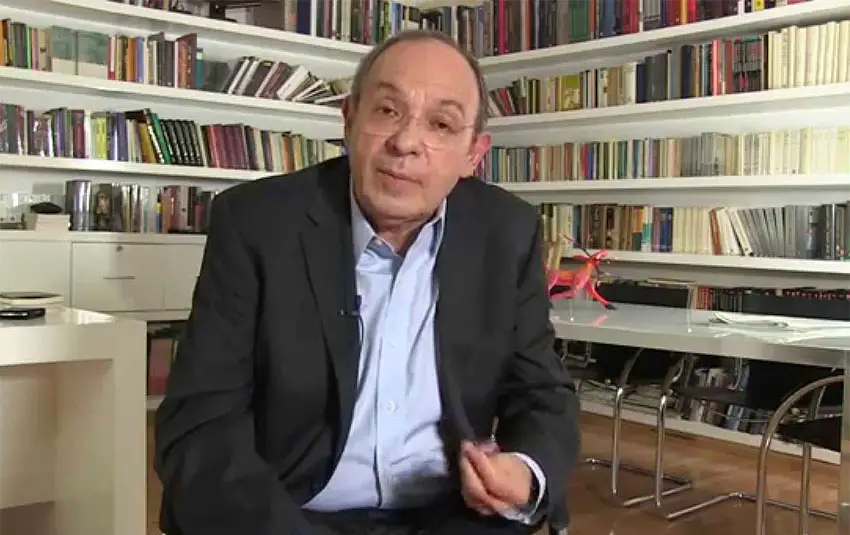
Nexos publisher Aguilar: ‘We are witnessing a symptom of the authoritarian drift of this government against media it does not like, opinions it does not like and even facts it does not like.’
In response to the criticism generated by the sanction, the SFP defended its investigation and decision and stated that “it respects absolutely freedom of expression and journalistic work.”
“After so many [directly awarded advertising contracts] it is obvious that they can and should pay the imposed fine,” Public Administration Minister Irma Eréndira Sandoval observed on social media, adding that Nexos should take the two-year ban on government advertising in stride.
“Nexos editors have been one of the strongest promoters and defenders of the minimal state,” Sandoval wrote. “Today they can continue to publish freely their ideas without depending on state funding.”
The magazine says the government has taken a unilateral decision to impose the sanction despite the fact that the 2018 contract was fulfilled to the satisfaction of all parties. Everything was in order, said publisher Héctor Aguilar Camín of the paperwork regarding its contributions.
The magazine also said it has received no government advertising since 2018 when López Obrador took office.
Joining the press association in its condemnation of the punishment were freedom of expression advocates Article 19, the Fundar Center for Analysis and Research and the Mexican Commission for the Defense and Promotion of Human Rights. They called the fine “disproportionate and excessive” and a form of indirect censorship.
Aguilar called the sanction “symptomatic of the atmosphere of hostility against critical media that prevails in the government. It is not an isolated event, it is another sign of official intolerance to criticism, to different thinking, to the diversity of opinions, ultimately, to freedom of expression.”
“We are witnessing a symptom of the authoritarian drift of this government against media it does not like, opinions it does not like and even facts it does not like.”
Press association president Christopher Barnes and Robert Rock of the association’s press freedom committee said it was “striking that the measure was taken two years later with a magazine critical of the president, which opens a compass of suspicion as to whether it is an indirect retaliation.”
Rock, who is publisher of the news portal La Silla Rota, called the government’s actions an “act of intimidation or prior censorship, a terrible precedent for freedom of the press in the country.”
Mayor Sheinbaum takes a selfie with another Metro passenger.
Mexico City will remain at the orange, high-risk level for the coronavirus for the ninth straight week, Mayor Claudia Sheinbaum announced Friday. But conditions in the capital city are holding steady and some restrictions will be eased.
Next Thursday, after going dark for five months, theaters around the city will be allowed to reopen at 30% capacity. Outdoor theaters will be permitted to hold performances at 40% capacity, and sanitary protocols must be in place.
The use of face masks will be mandatory for audiences throughout the performances, which can last no longer than 90 minutes.
Orchestras and live bands that use wind instruments will not be allowed.
Staging must also be configured to allow a three-meter distance between the cast and audience, and cast members cannot come within 1.5 meters of one another.
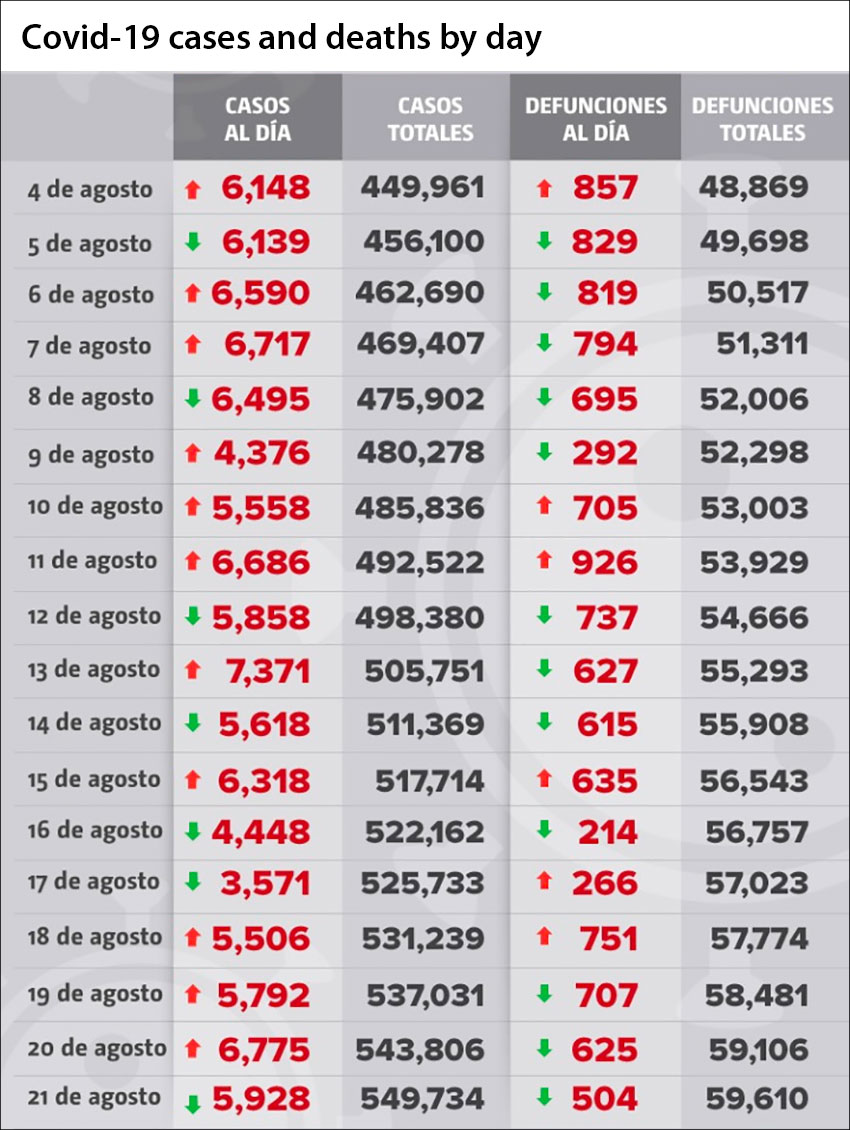
The daily tally of coronavirus cases and deaths. Deaths are numbers reported and not necessarily those that occurred each day. milenio
The first two rows of seats in the theater must be removed, and every other seat must be blocked off to allow the audience maintain a safe distance.
No printed programs or flyers are permitted, and online ticketing is encouraged.
Movie theaters in Mexico City were allowed to reopen on August 12 at a reduced capacity.
Parties, meetings and social gatherings are still not permitted, Sheinbaum said, noting that now is not the time for festivities.
“We should not relax because we have had a certain stability in hospitalizations, and we want to have a downward trend. In recent days we had an increase, but yesterday there was a decrease,” Sheinbaum said. Hospitals in the capital are currently treating 2,816 patients.
She also announced that Mexico City will also undergo a coronavirus testing and detection program in 158 neighborhoods, focusing on neighborhoods that are adjacent to those that have 10 or more active cases. The neighborhoods selected will be announced on Sunday.
More than 10,000 people have died from the coronavirus in Mexico City which has seen 89,421 total cases.
The Ministry of Health reported Friday there were 5,928 new cases for an accumulated total of 549,734. Another 504 deaths were reported, for a total of 59,610.
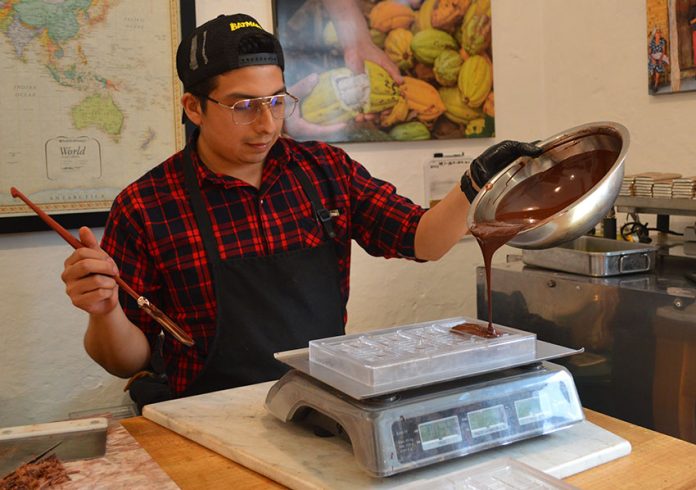
Chef Eduardo Yair of Alkymia Ethical Foods in San Cristóbal pours chocolate into molds. leigh thelmadatter
As if avocados, tequila, and tomatoes weren’t enough, Mexico is also the land that gave the world chocolate.
But not as a candy. That’s a European invention.
The cacao tree, which the Aztecs believed was stolen from paradise by the deity Quetzalcóatl to give to man, has been grown for at least 4,000 years in much of what was the tropical territory of the Mayan empire and which today is most of southern Mexico.
Use of the beans spread into other parts of Mesoamerica through trade. For the Aztecs, the cacao beverage was reserved only for the emperor and certain persons of high social rank. They drank it bitter, even adding chile pepper, but depending on time and place the cacao could be mixed with honey, allspice, achiote, Mexican pepperleaf or pinole (a type of ground corn), but never sugar or milk. After the Conquest, the Spanish began drinking it, but they added the sugar.
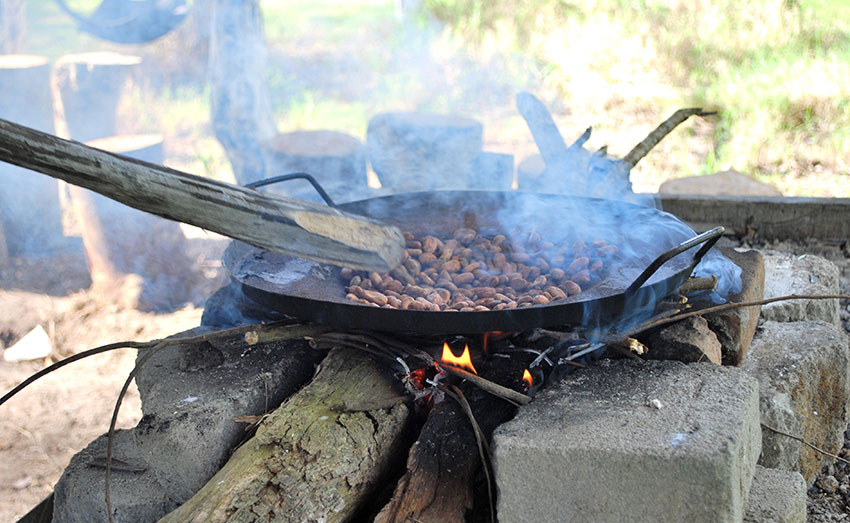
Then and now, the most traditional way to prepare cacao is to toast the beans on a comal (griddle), then grind them by hand. The rough paste is mixed with sugar and sometimes other flavorings, then pressed into hard tablets or bars. This chocolate de mesa can be eaten but does not have the taste and texture of a candy bar. A portion of the chocolate is broken off and added to simmering water or milk until is it dissolved. The last step is to make a froth by stirring rapidly, spinning a tool called a molino for this purpose, or pouring it into a cup from a height.
Cacao pods in Tabasco. Alejandro Linares García
Chocolate as the world knows it is the result of European tinkering. In 1528, Spanish conqueror Hernán Cortés took cacao to Spain. Its consumption spread and different European chocolatiers innovated both forms and processes to make the highly refined hot cocoa, chocolate bars and other treats preferred today.
Mexico never lost its taste for cacao-based drinks, especially in the center and south of the country. The three states that drink the most are also the main producers: Tabasco, Chiapas, and Oaxaca. The Oaxacan version is best known because of that state’s tourism industry and tends to contain higher percentages of sugar. This is especially true for major brands such as Mayordomo and La Soledad.
In Tabasco and Chiapas, chocolate is generally sold with the percentage of cacao indicated. It is possible to get 100% cacao beverage, with no sugar at all. Chocolate is popular in the center of the country, but without local production and the infamous Chocolate Abuelita by Nestlé is nearly ubiquitous. (This and other inexpensive “chocolates de mesa” can have as little as 3% cacao, along with soy lecithin and artificial flavors.)
Cacao is also used to prepare cold drinks, which go by various names, including pozol, tascalate, tejate and popo, depending on the region. The cacao is mixed with fermented corn and other flavorings and the drinks are a lot more refreshing than they sound.
Cacao that is prepared traditionally is a real food, maintaining its nutritional benefits such as antioxidants, protein, fiber, vitamins A, B2 and others, phosphorus, iron and potassium, according to biologist Julio Salazar of Alkymia Ethical Food in San Cristóbal de las Casas, Chiapas. Cacao is very similar to wine, loaded with flavor compounds. Processes, locations, and years affect the flavor. To preserve these qualities, beans need to be fermented, roasted, ground, and even poured into molds with great care.
The concerns about cacao go beyond just taste. Two-thirds of the world’s production is in east Africa, often using child labor. Mass production with questionable ethics means highly abundant, cheap, low-quality chocolate for the world’s sweet tooth, unfortunately, including Mexico’s.
Roasting cacao at Hacienda La Chonita on Tabasco’s Cocolate Route. Alejandro Linares García
According to a national association of chocolate and candy manufacturers, Mexico grows 27,000 tonnes of cacao each year, representing only 0.5% of the world’s production. There are about 37,000 producers, but growers are almost always indigenous families producing small quantities. Although they earn the least from the chocolate market, their cacao still costs three to four times the international price. To make things worse, cacao production in Mexico fell about 50% over the past decade or so because of disease and non-profitability.
Mexico produces three types of cacao: criollo, forastero and trinitario. Criollo produces the finest chocolate, but accounts for only 10% because it is susceptible to disease and infestations. Forastero is the most common (70%) because it is hardy. Trinitario is a hybrid of the first two.
Tabasco grows 66% of Mexico’s cacao, followed by Chiapas at 33% and smaller quantities are grown in other states in areas that border these two. Tabasco may be the best place to visit and see how cacao is grown and processed. It has a well-marked Chocolate Route (Ruta de Chocolate) connecting traditional haciendas that open their doors to visitors.
One of these is Wolter Chocolates, founded at Hacienda La Luz in 1958. The operation has cacao fields and processes harvests into both drinking and eating chocolates, welcoming over 14,000 tourists each year. For the past 10 years or so, a fine chocolate culture has been growing in San Cristóbal, started in part with the opening of Otoch Chukwá by a Tabasco chocolate family.
There is no internationally known Mexican chocolatier, not even for drinking chocolate. One reason is that the Europeans have taught the world to expect a highly refined product, much the way it expects white sugar and flour. Mexican chocolate has a courser texture because of its fiber content.
Almost all of Mexico’s production is for domestic consumption, and what little is exported is for niche markets. Salazar says this represents an opportunity with the right kind of consumer education. In just three years San Cristóbal’s Alkymia has built a small but international and very loyal client base.
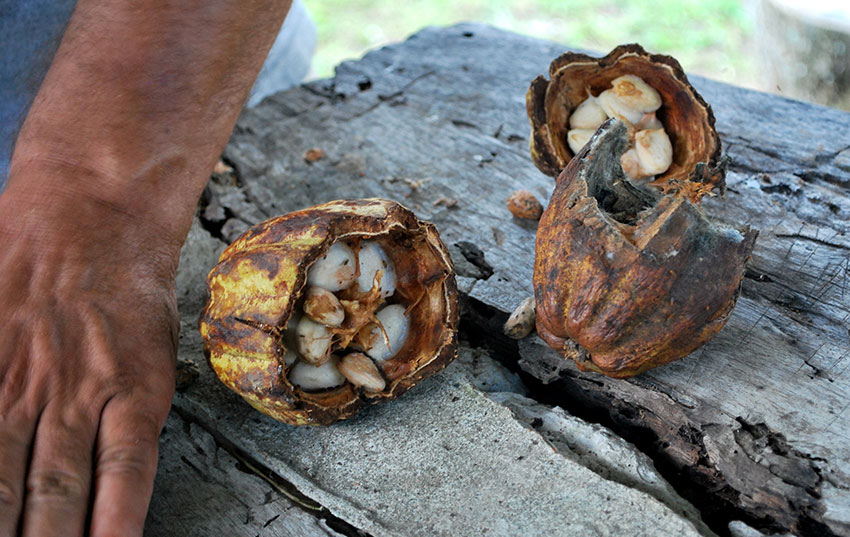
A split cacao pod at Hacienda La Chonita reveals the beans inside. Alejandro Linares García
Mexico has some relatively large chocolate makers including Chocolatera Moctezuma and Chocolate Rey Amargo, whose products can be found in supermarkets and specialty stores in Mexico. But better quality is generally had with small, local producers.
Both large and small chocolatiers can be found on the internet, often simply by googling “chocolate” and the name of the company or state you are interested in getting cacao from.
Leigh Thelmadatter arrived in Mexico 17 years ago and fell in love with the land and the culture. She publishes a blog called Creative Hands of Mexicoand her first book, Mexican Cartonería: Paper, Paste and Fiesta, was published last year. Her culture blog appears weekly on Mexico News Daily.
Governor Bonilla: solar plant will provide electricity at a lower price than the state currently pays.
A growing deficit of electricity in Baja California is affecting the water supply to 60 neighborhoods in Tijuana and requiring 15 companies, including Honeywell, Toyota and Cemex, to operate at reduced capacity during the summer months.
State Infrastructure Minister Karen Postlethwaite Montijo explained that recent high temperatures have created a shortage of power and residents are asked to reduce consumption between noon and 10 p.m., unplug appliances, turn off lights and set their air conditioners no lower than 25 C. The use of appliances that require large amounts of energy, such as irons, washing machines and dryers, is discouraged during those hours.
In addition, she said the National Energy Control Center (Cenace) has asked that industries with the highest energy consumption to stop production at peak hours.
Power to the Rio Colorado-Tijuana aqueduct, the state’s largest consumer of electricity, is also being limited, hence the water shortages.
“When we lack energy, (Cenace) turns around and says to large consumers ‘I need you to reduce energy consumption because I have no energy,’ and one of the major consumers is the aqueduct,” state Water Minister Salomón Faz Apodaca said in a Facebook press conference with the governor. “What we are doing is balancing,” Faz explained.
One of the main issues in Baja California is lack of infrastructure. The state requires 3,040 megawatts per year, Postlethwaite explained, yet it only has access to 85.5% of that amount, which it manages to collect by buying California’s excess power. Also, Baja California is not connected to Mexico’s national power grid but to California’s, making it “an energy island,” Postlethwaite said.
And with California in the grips of a brutal heatwave and facing rolling blackouts of its own, there’s not a lot of surplus energy to sell to Mexico.
Every year during the summer months, when temperatures in Mexicali soar to around 50 C and coastal temperatures are also on the rise, Baja California has a deficit that ranges between 400 and 550 megawatts. It’s a recurring situation Governor Jaime Bonilla Valdez says he is determined to fix.
On Thursday, the state opened the bidding process for the construction of a private solar energy plant which would resolve the deficit.
“A project of this magnitude involves an investment of US $200 million, which will not be made by the state but by the business consortium that is the winner of the tender, and which will sell the electricity to the state government at a better price than what we are currently paying,” the governor announced.
The winning bid will be chosen in October and construction is expected to take one year. The plant will supply energy directly to the water system for a contractual period of 30 years.
Currently, Baja California spends around 1 billion pesos (US $45.5 million) on electricity each year just to pump water to Tijuana and Tecate.
A rendering of a villa at a new hotel planned in Todos Santos.
Baja California Sur successfully rode out Hurricane Genevieve, which skimmed the Baja Peninsula earlier this week as a category 1 storm and did not make landfall.
Damage from the storm was mostly limited to landslides and flooding as 305 millimeters of rain fell in some places. The Marina and beaches in Cabo San Lucas were left riddled with garbage as flooding in the streets swept trash into the sea. Beaches in Los Cabos remain closed.
Some 80,000 homes were without power in the aftermath of the storm, and many neighborhoods are still without power and water.
New cemetery for Loreto
Officials in Loreto have agreed to start work on an urgently needed new cemetery, El Sudcaliforniano reports.
“We have always been aware that having a new cemetery is a priority for our municipality, being one of the actions most demanded by citizens,” said Mayor Arely Arce Peralta. “For this reason, today I feel happy to be able to start with this long-awaited project that will solve the enormous problem we have lived with for years.”
Work has begun on clearing the property which will have 1,747 burial plots, a crematorium, administrative offices, a chapel and restrooms.
New hotel for Todos Santos
Todos Santos is getting a new hotel. The luxury chain Habitas announced plans to build an 80-room hotel on 24 coastal acres on the Pacific Ocean, Forbes reports.
The hotel will be built using parts created in a factory on a 3D printer, which are then assembled onsite as in Lego. Once the parts arrive in Todos Santos, construction should take just four months. The hotel will offer a spa, organic garden and farm to table restaurant, and guests can indulge in activities such as diving, hiking, mountain biking, fishing, surfing and sound meditation.
Hear no evil
A man in La Paz had part of his ear cut off last night, but says he was so drunk he can’t remember who did it, BCS Noticias reports.
The man told police he remembers drinking alcohol in the Miramar neighborhood with someone from work, but he is unable to recall who that person was. He does remember being struck in the head and seeing the resulting blood. Paramedics transported the 55-year-old to the hospital to receive stitches.
Film festival goes virtual
The Los Cabos International Film Festival will be a virtual event this year, organizers say.
The festival, in its ninth year, will be featured online from November 11 through 15, Proceso reports.
Executive director Alejandra Paulín says “we are going to move forward, we are proposing all possible schemes” as the festival looks to reinvent itself in difficult times.
“We already saw it as complicated at the budget level, but obviously the whole situation of the pandemic worries us. We found ourselves chatting with other types of sponsors, different from the ones we were used to working with,” Paulín says.
The Los Cabos Tourism Trust, which traditionally provides a large chunk of the festival’s budget and had pledged to do the same this year back n November, withdrew funding in May.
Organizers are working to make the festival as inspiring as possible but on a fraction of their normal budget.
Last year, director Martin Scorcese’s film The Irishmen premiered at the festival and its star, Robert DeNiro, was in attendance.
Organizers say they hope “to return to the majestic sea and desert landscape of Los Cabos in 2021.”
Bar none
Authorities warn that bars and nightclubs that attempt to skirt coronavirus restrictions by pretending to be restaurants will face serious sanctions.
Bars and clubs are prohibited from opening at this stage of the pandemic, but restaurants may operate at 30% capacity.
Authorities say bars in La Paz, Comondú and Los Cabos have opened, but ask customers to order some kind of food or snack with their drinks in an attempt to disguise their operations as family businesses, Metropolimx reports.
Health Minister Víctor George Flores says their disregard for coronavirus restrictions can cause massive concentrations of people which could endanger public health.
According to data provided by the State Commission for the Protection of Sanitary Risks (COEPRIS), 158 bars and nightclubs have had their licenses suspended since March 23 for feigning to be restaurants.
A screenshot from the La Paz priest’s TikTok page.
TikTok priest
A young priest from La Paz has taken the scriptures to TikTok, recording a series of short videos that show a lighter side of Catholicism.
Often clad in jeans and bright orange tennis shoes for his appearances, Father Javi’s videos have reached nearly 40,000 followers and have been liked 320,000 times worldwide.
Father Javi dances and jokes in his videos: in one, he poses to rap music, in another he lip-syncs a monologue from the film Titanic. But he also tells short stories related to his faith, and how to respond to different situations in a godly manner.
One of his most viewed videos shows Father Javi entering a church and lurching up the aisle like a zombie after not confessing or taking communion for five months due to the coronavirus. Michael Jackson’s song Thriller plays in the background.
The electrical workers union has struck a deal with the Federal Electricity Commission (CFE) that lowers the general retirement age for the state company’s workers from 65 to 55.
Under the new 2020-22 collective agreement between Suterm and the CFE, male workers can retire at 55 if they have completed 25 years of service. They can retire at an even younger age provided they have been with the company for 30 years.
Female workers can retire after 25 years of service regardless of their age.
Under the previous agreement men retired at 65 after 30 years of service or at a younger age provided they had put in 40 years. Women previously retired at 60 after 30 years of work or at a younger age if they had been with the CFE for 35 years.
Some pension experts were critical of the move, arguing that it will hurt the national budget and increase inequality.
Bernardo González, president of the Amafore pension funds association, said the agreement will “cost the country a lot” because the government will be paying pensions earlier and for longer. He also said the new scheme was unfair because it favors high-wage earners over low-wage ones.
When the previous scheme was introduced in 2016, it was estimated that it would save more than 161 billion pesos (US $7.3 billion) because it increased retirement ages by five to 10 years.
Alejandra Macías, a director at the Center of Economic and Budget Research, a think tank, said the deal will increase the inequality between Mexico’s different pension schemes.
Speaking during a virtual panel discussion on “the pensions tsunami,” she said that pensions for retired CFE workers currently average just over 803,000 pesos (US $36,500) per person per year whereas retirees on Mexican Social Security Institute pensions only get an average of just under 81,000 pesos, or about 10% of that amount.
Macías said that if it isn’t revised, the new CFE scheme will contribute to government spending on pensions increasing from 4.2% of GDP currently to 6% by 2030.
During the same discussion, Pedro Vásquez Colmenares, an economist and author of a book entitled Pensions in Mexico: the next crisis, said that reducing the retirement age goes against what is happening in the rest of the world.
To keep pension systems sustainable as life expectancy increases people are generally being required to work longer, he said.
Vásquez said that life expectancy in Mexico is increasing by one year every decade or so and therefore “we have to extend the productive stage” of people’s lives. “Suterm is doing the opposite,” he said.
Severo López Mestre, a partner at the consultancy firm Galo Energy, charged that the reduction in the pension age is politically motivated, designed to win votes for the ruling Morena party at next year’s midterm elections.
He told the newspaper Reforma that the state-owned firm is already struggling to find money to build new power plants. Now it will see increased costs by having to pay pensions to younger retirees as well as salaries to their replacements.
“How is it possible for them to make this change? It’s a double whammy for the CFE because if you retire someone at 55 you lose someone at their most important productive age,” López said, explaining that such workers are valuable because of the knowledge and training they can pass on to the next generation.
At age 55, workers are capable of giving 10 years more service, he argued.
An unnamed CFE source told Reforma that the pension change will cost the company 100 billion pesos in the short term, leaving the company in the red as soon as next year.
Snowballing pension payments have been regarded for some time as a time bomb for the federal government. But President López Obrador presented a plan last month that seeks to address the issue while obliging employers to increase their pension contributions in the coming years.
Some experts have questioned whether it does enough to reduce the government’s pension obligations while ensuring a dignified retirement for all workers.
Vásquez likened the pension system in its current state to a car that needs four new tires. But all López Obrador’s proposed pension reform does is put air in one of them, he said.
“I wouldn’t call it a reform,” Vásquez said, asserting that the plan only makes a few “parametric changes” to the current pension system.
A nurse in León, Guanajuato, claims she and her family were beaten by neighbors who feared she would infect them with the coronavirus but the alleged assailants say the virus had nothing to do with it.
Nurse Carolina Lira filed a complaint alleging that she, her elderly mother and aunt were physically and verbally attacked on August 15 by a man and a woman outside her mother’s food stand.
Lira says she suffered a cervical sprain from the beating, which began when the woman allegedly grabbed her mother and began choking her, threatening to kill her before shoving her into a post and knocking her to the ground.
Then, a woman identified as Laura grabbed Carolina Lira’s hair and knocked her to the ground. Next, she claims, Laura punched her in the back, chest and abdomen while hurling insults. Lira says they called her a piece of “garbage” who would infect the entire neighborhood with the virus.
“I felt that they were going to kill me. They were hitting me with so much anger and fury that I really did think I would die,” said Lira, who is also a teacher at a private university.
The neighbors began harassing Lira in May, she says, when one of them approached her and threatened to kill her because she was was going to infect everyone with the coronavirus, a phrase that was allegedly repeated in Saturday’s attack.
Lira said that since then she and her family had been afraid to go outside, but they never thought the situation would escalate to physical violence.
Lira was assessed by health personnel who determined that she should wear a neck brace but did not require hospitalization. The hospital in Guanajuato where Lira works condemned the attack and any physical or emotional abuse against health workers.
But the alleged attackers tell a different story. “It is a street issue. It was never aggression due to Covid,” Laura claimed, saying the clash was the result of longstanding neighborhood quarrels.
Laura said the Lira family disparaged her brother due to his sexual preference, calling him names, and that is how the melee began.
“… there was never a Covid issue like she’s saying,” Laura said, noting that her family has received threats as a result of the heavy media attention that has been given the case.
Her family said they have several videos of the incident which prove that coronavirus and the nursing profession were never mentioned.
Yesterday afternoon, Laura’s family filed a counterclaim for physical damage and plan to file another complaint for moral damages in the coming days.
The family says it considers nursing an honorable profession and that healthcare workers have their full appreciation and support.
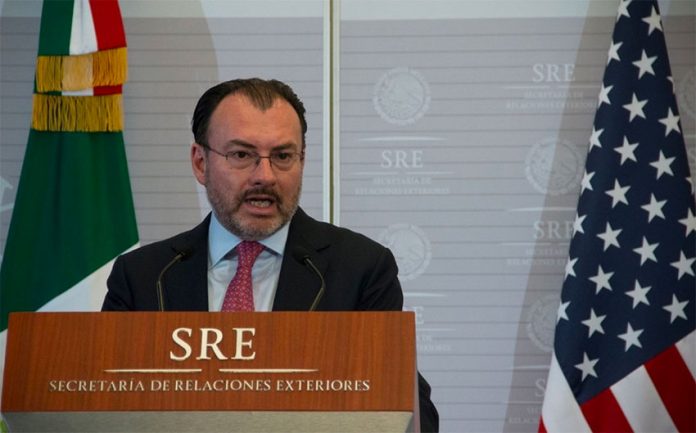
Videgaray called the accusations false, 'absurd, inconsistent and reckless.'
Luis Videgaray, a former cabinet minister who served in the government of ex-president Enrique Peña Nieto, has rejected accusations made against him by former Pemex CEO Emilio Lozoya.
His denial Thursday came after the leaking this week of a document submitted to the federal Attorney General’s Office (FGR) in which Lozoya accuses the former finance and foreign affairs minister of leading a bribery scheme that paid off National Action Party (PAN) lawmakers for their support of the previous government’s structural reforms.
In a statement posted to Twitter, Videgaray described the accusations against him as “false, absurd, inconsistent and reckless.”
“Lozoya’s accusations are invented lies to try to get out of the consequences of his own actions,” he wrote.
“The only person responsible for the serious legal situation that he, his mother, his sister and his wife face is Emilio Lozoya.”
The former state oil chief, extradited from Spain last month, is awaiting trial on corruption charges related to bribes paid by the Brazilian company Odebrecht in exchange for lucrative contracts and Pemex’s 2015 purchase of a run-down fertilizer plant at an allegedly inflated price.
Lozoya has agreed to cooperate with authorities in the hope that he will receive a more lenient sentence if convicted and has been afforded protected witness status by federal authorities.
Videgaray, now a lecturer at the Massachusetts Institute of Technology, said it was unsurprising that he is now blaming others to try to protect himself.
“It’s an attitude that’s fitting for his personality,” he wrote, adding that it’s also unsurprising that he is one of Lozoya’s targets.
“It’s widely known that we had a bad personal relationship due to his poor financial management of Pemex, what he sought to do with the energy reform and his conduct as a public servant,” Videgaray said.
“I’m always ready to respond to the call of the relevant authorities and contribute in that way to the clarification of the truth. … I will not allow myself to be defamed out of political revenge. For that reason, I will have to resolve these issues and I will defend my honor through the relevant legal authorities.”
Meade: goal should be finding the truth, not letting Lozoya make accusations without proof.
José Antonio Meade, another former cabinet minister accused of corruption by Lozoya, responded to the claim against him – that he received a 4-million-peso kickback – on Twitter.
“I dedicated my public life to building a better country, always with absolute honor and legality,” he wrote.
The former minister, who served in a range of portfolios in the previous two governments and was the Institutional Revolutionary Party candidate in the 2018 presidential election, also said that the opportunity Lozoya has been given to cooperate with authorities should be aimed at establishing the truth, not giving the former Pemex chief the chance to “accuse without proof those of us who denounce illicit acts.”
Meade added that he will be respectful of the investigations and that he has notified authorities of his whereabouts.
José Antonio González Anaya, who succeeded Lozoya as Pemex chief before becoming finance minister, also rejected corruption accusations leveled at him.
The corruption scandal has kept the coronavirus crisis off the front pages of newspapers in recent days and given President López Obrador new fodder for one of his favorite pastimes – attacking past presidents and “their corrupt, neoliberal” governments.
Senator Julen Rementería del Puerto, the PAN’s deputy leader in the upper house, charged Thursday that the ruling Morena party is using Lozoya as a “battering ram” against its conservative opponent with the aim of damaging it electorally before the 2021 midterm elections.
“Lozoya [is] a battering ram of the government to hit who? The PAN, clearly,” he told a virtual press conference.
“He has shown a perverse intention of a political nature to hurt the main adversary of the [party] which poorly governs our country today.”
The head of the anti-corruption commission at the business lobby Coparmex said much the same. “This trial is being played out in the media,” said Max Kaiser. “It appears to be designed to be able to talk about [the president’s] political enemies.”
The head of México Evalúa, a think tank, said López Obrador was using the case to distract from the worst recession in Mexico’s history and the world’s third-highest death toll.
“The moment López Obrador used this in his morning rant, it turned into a political issue,” Luis Rubio said. “He will not advance the cause of justice, he will only prosecute his enemies — it’s the traditional Mexican game of playing politics with the law.”
Hospital admissions rose this week in Mexico City.
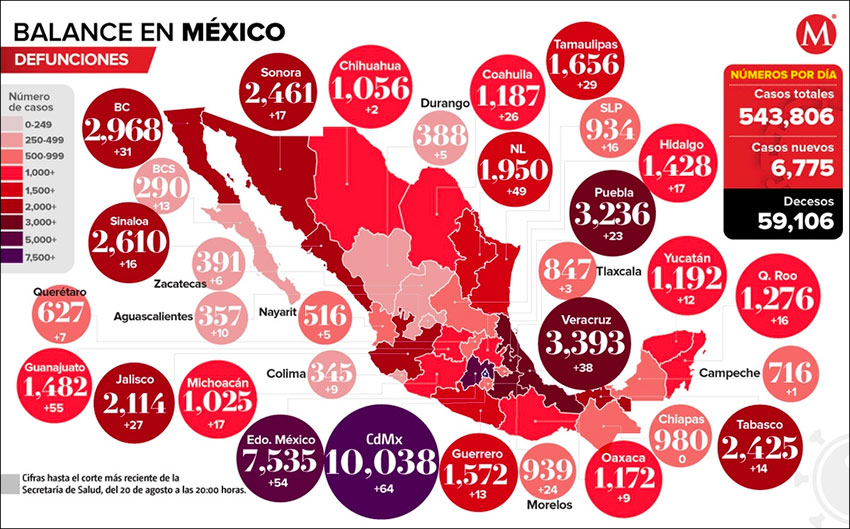
Mexico’s official Covid-19 death toll is on the cusp of reaching a figure that the country’s coronavirus czar once said could only be reached in a “catastrophic scenario.”
The federal Health Ministry reported 625 additional Covid-19 deaths on Thursday, increasing the accumulated tally to 59,106.
At the time, Mexico’s pandemic death toll was just over 12,500 and López-Gatell predicted that it would likely increase to between 30,000 and 35,000.
While the official toll is now nearing 60,000, several independent studies suggest that Mexico is grossly underestimating deaths from the virus that claimed its first victim here in mid-March.
Coronavirus deaths are set to hit a ‘catastrophic’ level. milenio
The Health Ministry also reported Thursday that the accumulated case tally had increased to 543,806 with 6,775 new cases registered. There are 29,143 active cases while the results of 82,786 tests are not yet known.
More than 1.2 million people have been tested for coronavirus in Mexico since the beginning of the pandemic for a positivity rate of 45%. The rate is extremely high because testing is mainly targeted at people with serious coronavirus-like symptoms.
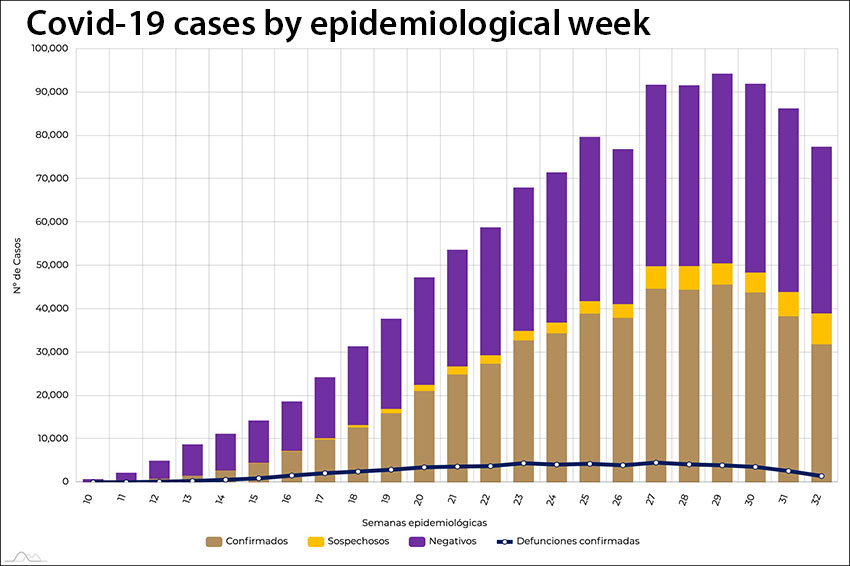
At Thursday night’s coronavirus press briefing, Director of Epidemiology José Luis Alomía reiterated that new case numbers have declined in recent weeks. But data shows that testing has also declined during the period, which could explain the reduction in new case numbers.
Alomía also said that Covid-19 deaths are on the wane although more than 600 were reported on 15 of the first 20 days of August.
He said 38% of general care hospital beds set aside for coronavirus patients are currently occupied while 33% of those with ventilators are in use.
Nayarit and Nuevo León are the only states with more than 60% of general care hospitals in use while Colima and Nuevo León have the highest occupancy rates for critical care beds, at 56% and 53%, respectively.
Confirmed cases are brown, suspected are orange and negative test results are purple. Deaths are shown in black at the base of the chart. The final week shown—No. 32— is August 2-8.ministry of health
Alomía said that the number of coronavirus patients hospitalized across the country has decreased in recent weeks.
However, hospitalizations have increased in Mexico City, Mayor Claudia Sheinbaum said Thursday.
The Mexico City government’s latest Covid-19 report shows that there are currently just under 2,900 coronavirus patients in the capital’s hospitals.
Mexico City has been the country’s coronavirus epicenter since the beginning of the pandemic with almost 90,000 cases detected over the past six months. The capital’s official Covid-19 death toll passed 10,000 on Thursday with 64 additional fatalities reported.
Despite the increase in hospitalizations, Sheinbaum announced Friday that the “orange light” high risk level will remain in place in Mexico City for a ninth consecutive week between August 24 and 30.
When orders to “stay at home as much as possible” reached my community, I noticed an immediate result, which could be considered peculiar. Suddenly, there were many more people walking up and down our rustic, cobblestone streets than I had ever seen before.
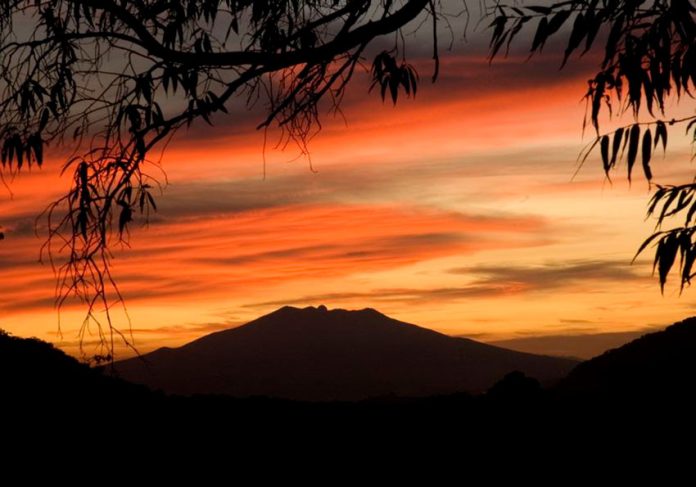
They were out there early in the morning walking their dogs and back again in the evening to catch the often splendid view of sunset over the nearby Tequila Volcano. Self-quarantining seemed to have given all of them a new appreciation for the pine and oak forest in which we live and for the great outdoors in general.
I also noticed that, after weeks of “staying at home,” many people began to send me emails with questions like: “Do you know if the Primavera Forest is now open to visitors?” and “Can you recommend someplace I can go to commune with nature without running into anybody?”
In response to people like these, I offer a short list of outdoor sites in western Mexico which meet three criteria: first, they are, for the most part, places where you are unlikely to bump into a single soul. Second, they are all unfenced and open to the public. And finally, they are places where I’ve never heard tales of unsavory characters lurking about.
So, if you live in western Mexico and have been cooped up for too long, here are a few options for getting away from it all without getting infected.
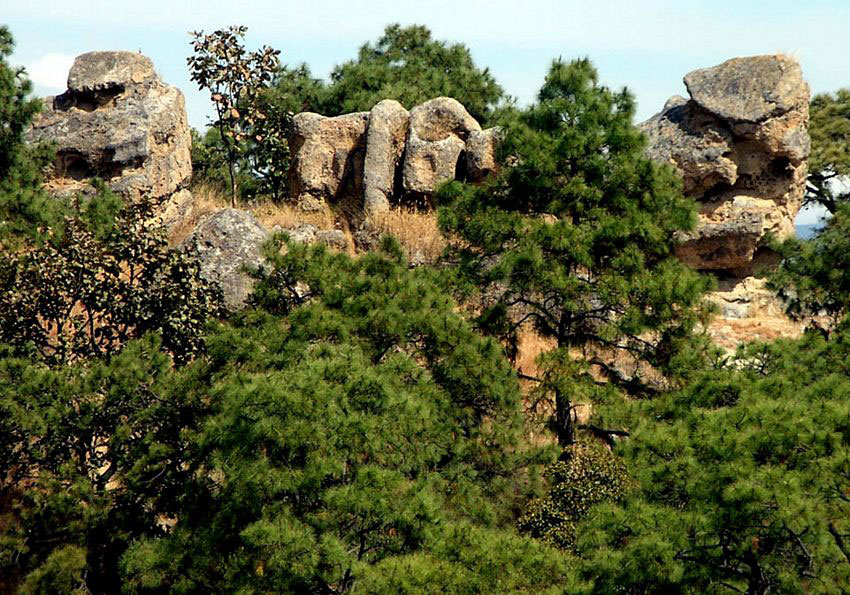
Bizarre rock shapes are found everywhere at Villa Felicidad.
Villa Felicidad
This is a sprawling, uninhabited area just east of Tala, Jalisco, filled with big rocks of amazing shapes which may resemble walls, bathtubs, armchairs, tree trunks and much more, depending entirely upon your imagination. It’s also home to the utterly unpolluted Río de las Ánimas where you can find cool, clean pools to splash in. It’s a perfect place for a picnic! Look for “Villa Felicidad” on Google Maps.Driving time from Guadalajara: one hour and 11 minutes.
Hacienda La Cofradía
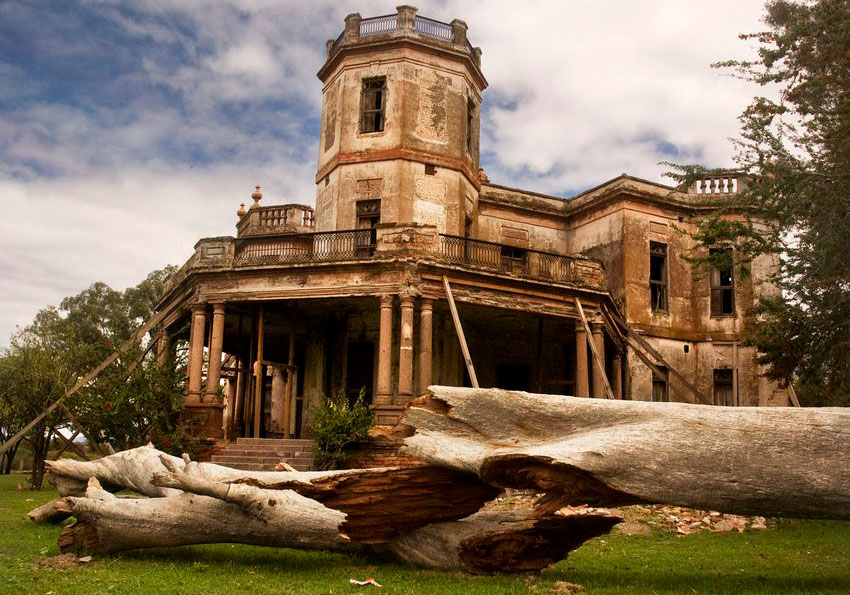
How about going for a stroll through the ruins of a 19th-century neoclassical hacienda? Rancho de la Cofradía del Puente lies alongside the Arenal River, not far off the old highway linking Guadalajara to Tequila. A plaque there says the building had “a double corridor with three apartments that were connected by an arcade made up of nine arches held up by Tuscan pillars that today lack a roof.”
The property was once in the middle of extensive agave field and they were producing tequila here as early as 1800. This hacienda is one of several old tequila distilleries or tabernas located near the town of Amatitán.
To visit the hacienda, ask Google Maps to take you to “R8P8+7Q La Villa de Cuerambaro.” Driving time from Guadalajara: 57 minutes.
“Psychedelic shapes” atop La Campana.
La Campana
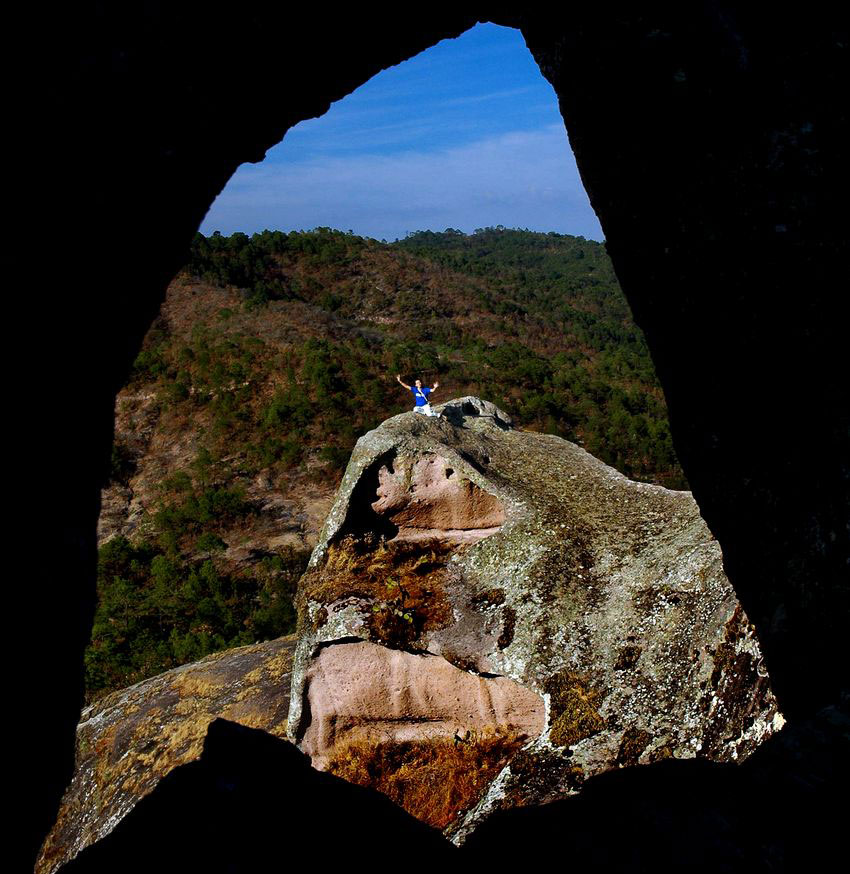
Here is a small, beautiful and very curious mountain not far from Mascota, Jalisco, where you’ll see exotic rock formations shaped like giant waves. The walk to the top takes less than half an hour, but you’ll feel like you’ve stepped onto another planet. For more details, see La Campana, Jalisco’s Psychedelic Bell. Ask Google Maps to take you to “9CC4+67 Los Volcanes, Jalisco” and you’ll find yourself at the trail head. Driving time from Guadalajara is about two hours.
The Teuchitlán Andador
This is a three-kilometer-long hiking and bicycling path which follows the short but scenic Teuchitlán River from its source to the point where it enters La Vega Dam. At its south end it turns into a path on a narrow strip of land, with a marsh on one side and the lake on the other: a great place to spot waterbirds.
You might expect to see white egrets, tiger herons, lily trotters, ibises, anhingas, cormorants, puffins and more.
As for human beings, I’ve never seen one here, even though the trail is quite near a string of fine restaurants along the lakeshore. To reach this spot, ask Google Maps to take you to “M5G5+64 Teuchitlan.” Park and walk south to see the waterbirds. Driving time from Guadalajara: one hour.
“Natural” rock-outcrop trail takes you up Cerro Viejo.
Cerro Viejo
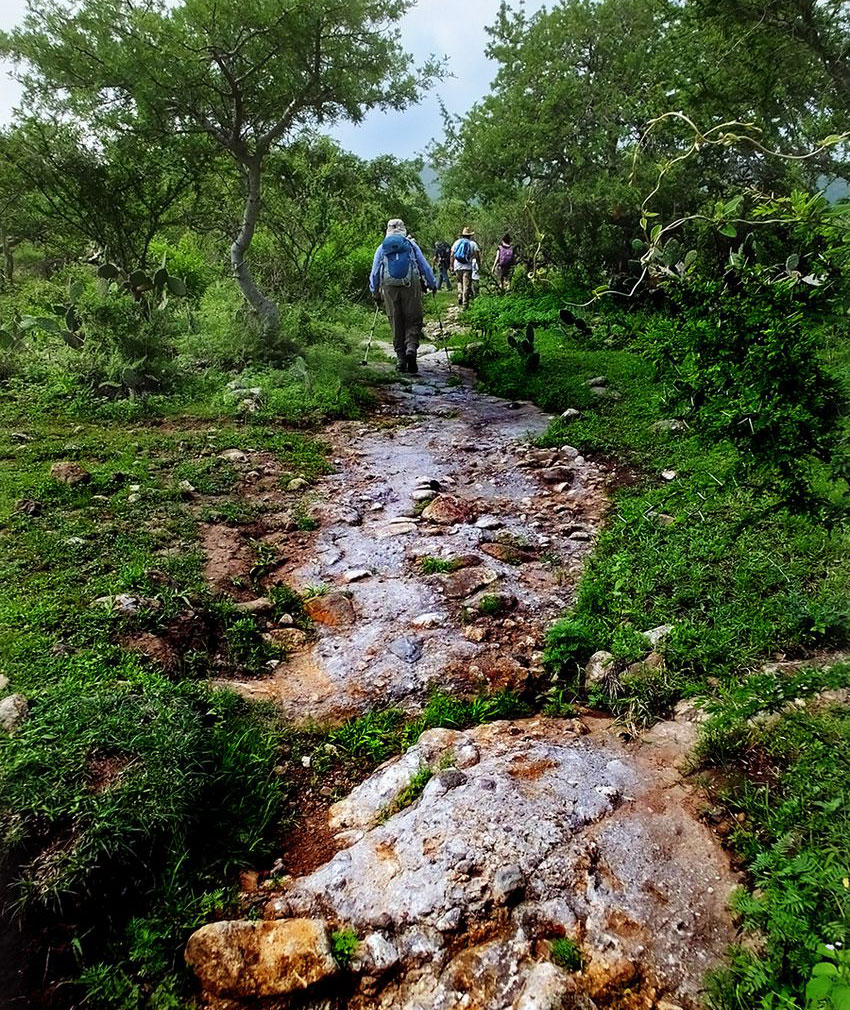
“The Old Hill” is a picturesque mountain that fills the skyline overlooking Lake Chapala. Its peak is 2,960 meters above sea level and reaching the top would take you many hours of hard hiking. I am not sending you all the way up there, but just inviting you to enjoy one of the mountain’s lovely foothills, which is easy to reach from the little town of San Juan Evangelista, home to some of Jalisco’s most talented potters.
Let Google Maps take you to “9MRM+4Q San Juan Evangelista, Jalisco,” on the shores of Lake Cajititlán. You’ll find yourself at a bridge over the Macrolibramiento expressway. Walk across the bridge, and you are on your way into the beautiful foothills of Cerro Viejo. Driving time from Guadalajara is about 50 minutes.
La Maltaraña Mansion
This strikingly beautiful casona, with 365 doors and windows, was built in the early 1900s by Manuel Cuesta Gallardo, one-time governor of Jalisco and the man responsible for reducing the size of Lake Chapala by 33%. La Maltaraña was also known as La Bella Cristina in honor of Cuesta’s daughter.
For more information, see Some Chapala spots well worth a visit. On Google Maps this elegant old house is identified as “68G8+R7 Jamay, Jalisco.” Driving time from Guadalajara: two hours.
Propped up by poles, La Maltaraña is still elegant.
The Ghost Town of El Amparo
Apart from the ghosts, you’ll find the ruins of one of Mexico’s most successful gold and silver mining operations, one of the very few companies that kept operating right through the Mexican revolution. For the full story see Amparo: the rise and fall of one of Mexico’s most controversial mines.
To visit some of the most intriguing of the old buildings, ask Google Maps to take you first to Etzatlán, Jalisco. Once you are there, tell Google Maps to direct you to “PW29+6R Etzatlán.”
This subterfuge is to make sure you approach Amparo from the north, on a far better road than the awful one coming from the south. Driving time from Guadalajara: two hours.
El Diente
This is the only one of these eight sites where I would expect you to find a few people — almost certainly rock climbers — whom you may see high above you dangling from a handhold in one of the huge monoliths standing tall on the hillside.
[soliloquy id="120623"]
You may enjoy watching Jalisco’s best bouldering enthusiasts do their stuff (with little danger of contagion) or you may prefer to wander off on your own to discover other rocks which, instead of resembling a tooth, may remind you of a turtle or a teapot.
One advantage of El Diente is that it’s located only five kilometers from Guadalajara’s Ring Road, but nevertheless bestows solitude, peace and beauty upon its visitors. For more info see El Diente, a forest of rocks. To get there, look for “QJR3+CF Rio Blanco, Jalisco” on Google Maps. Driving time from the center of Guadalajara: 50 minutes.
Enjoy your escape to the great outdoors where — as Burt Lancaster put it in The Kentuckian — the air “has got a clean taste like nobody ever used it before.”
The writer has lived near Guadalajara, Jalisco, for more than 30 years and is the author of A Guide to West Mexico’s Guachimontones and Surrounding Area and co-author of Outdoors in Western Mexico. More of his writing can be found on his website.