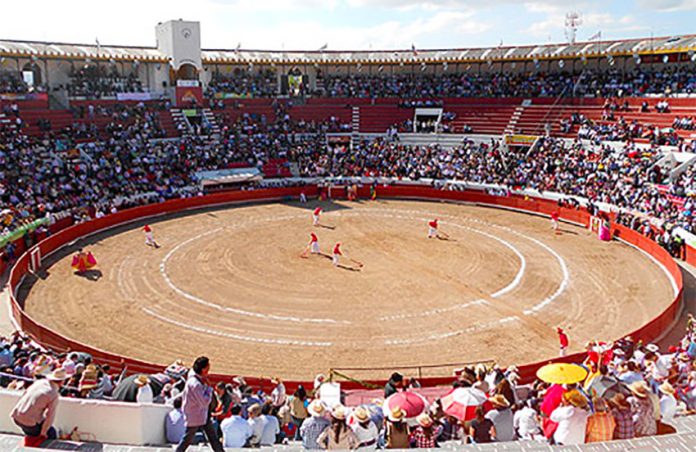
Children in Pachuca, Hidalgo, are free to attend bullfights and cockfights, municipal council members decided Thursday.
An initiative to bar minors from the fights due to the violent nature of the events was rejected by a vote of 11 to 5.
Biofutura, a non-profit devoted to biodiversity and animal rights, had lobbied in favor of the bill, which was based on an international recommendation by the United Nations Committee on the Rights of the Child.
For years the committee has advocated for banning children from participating in or attending bullfights as it exposes them to extreme violence which, it says, affects their mental and emotional well-being.
Councilor Isabel Vite argued against the motion, saying there was no scientific evidence that exposure to bull or cockfights affects children.
The Mexican Bullfighting Association applauded the proposal’s defeat. “This preserves fundamental rights enjoyed by girls, boys and adolescents such as access to culture, the free development of the personality and freedom of expression,” it said in a statement. “Neither empirically nor much less scientifically is there evidence that proves that witnessing or participating in bullfights generates violent behavior or some other personality disorder.”
According to the federal Ministry of Agriculture, bullfighting generated 6.9 billion pesos, more than US $313 million, in 2019.
In Hidalgo alone there are 30 breeders of fighting bulls and bullfights are held in 60 towns. The state also has two bullfighting schools attended by over 50 children.
A law banning bullfighting, cockfighting and other acts that cause suffering or harm to animals took effect in Quintana Roo in November, making it the fourth state to outlaw bullfighting, after Coahuila, Sonora and Guerrero.
Spain, France, Portugal, Mexico, Colombia, Venezuela, Peru, and Ecuador are the only countries that still allow bullfighting.
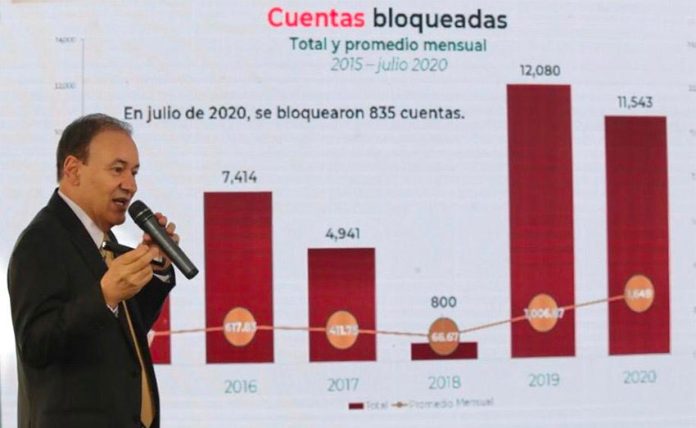
Security Minister Durazo presents crime statistics at Thursday's press conference.
Homicides increased 3.9% in July compared to June, according to official data that also shows that Mexico is on track to record its most violent year on record.
There were 2,980 homicide victims last month, according to the National Public Security System, an increase of 113 compared to June.
There were 20,494 murder victims in the first seven months of the year, up 1.6% from the same period of 2019, which was the most violent year since national records were first kept in 1997.
Presenting the July data at Thursday’s presidential press conference, Security Minister Alfonso Durazo said that homicide numbers are on the wane in 22 states.
Although homicides are up compared to the first seven months of last year, the minister claimed that the government has managed to establish a “containment line” against the crime.
Durazo said that July was a “hectic” month in terms of violence due to the capture of José Antonio Yépez Ortiz, leader of the Santa Rosa de Lima Cartel (CSRL), a Guanajuato-based crime gang. However, Yépez, better known as “El Marro,” was in fact taken into custody on August 2.
Guanajuato, where the CSRL is engaged in a vicious turf war with the Jalisco New Generation Cartel, was the most violent state in the country in July with more than 400 homicides but Durazo noted that murders have decreased since the crime leader’s arrest.
“We can’t sing victory but the incidence of … homicides in Guanajuato is fortunately on the wane today … and we hope to consolidate this trend,” he said.
Durango and Querétaro recorded the biggest increases in homicides between June and July, the newspaper Milenio reported.
There were 22 homicide victims in the former state last month, a 214% increase compared to June when seven people were murdered. In Querétaro, homicide victims increased 100% in July to 16 from eight the previous month.
Aguascalientes recorded a 50% increase between June and July, with numbers increasing from eight to 12, while murders spiked 53% in Quintana Roo from 34 to 52.
In Baja California Sur, Mexico’s second least violent state this year, homicide victims increased 80% to nine in July from five in June.
During the first seven months of the year, Guanajuato was the most violent state in the country with a total of 2,695 homicide victims. The figure accounts for 13.1% of all homicides in Mexico so far this year, meaning that one of every eight murders was committed in the Bajío region state.
México state ranked second with 1,678 homicide victims.
Four other states have recorded more than 1,000 murders this year. They are, in order, Chihuahua, Baja California, Jalisco and Michoacán.
At the other end of the scale, seven states have recorded fewer than 100 homicides this year. They are Yucatán with 28; Baja California Sur, 36; Campeche, 44; Aguascalientes, 59; Tlaxcala, 68; Durango, 97; and Nayarit, 98.
In per capita terms, Colima was the most violent state between January and July with 51.2 homicide victims per 100,000 residents.
Along with homicides, extortion, drug dealing and robberies increased in July compared to June while there was no change in the incidence of kidnapping, with 62 cases in both months.
Femicides – the killing of women and girls on account of their gender – declined 27% from 101 in June to 74 in July.
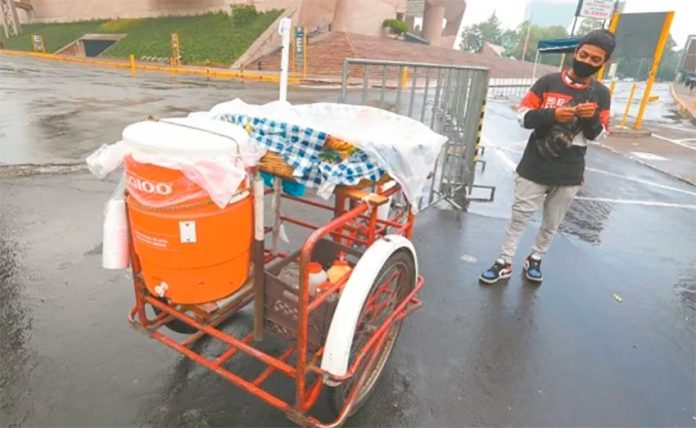
Tricycle vendors in Mexico City’s Miguel Hidalgo municipality say they have to pay three different bribes totaling 700 pesos (about US $32) a week to peddle their wares. Sometimes the total represents more than half their income.
Before the coronavirus pandemic, tricycle vendors say, they earned up to 1,500 pesos a week. Now they are lucky to take in 1,000 and the bribes have further crippled their incomes.
Coffee sellers Omar and Federico say that each week they have to pay municipal authorities 100 to 200 pesos in order to operate on the municipality’s streets, and the amount fluctuates depending on the products the sellers offer.
“You must give people from the [mayor’s office] a fee to let you sell,” Omar told the newspaper El Universal while attending to customers near the Metro Auditorio subway station. “That fee is mandatory. If it’s not paid, they won’t let you work.”
Those who sell in the tony Polanco area also pay police 50 pesos a day for the privilege of setting up shop there.
Hegel Cortés Miranda of the Miguel Hidalgo mayor’s office said the government is aware of the allegations of such payments but no one has made a formal complaint.
But there’s another fee that speaks to the growing rumors of nefarious forces controlling wheeled trade in the city.
Vendors say they are also being charged 500 pesos a week by unidentified individuals in exchange for protection from government inspectors. They refuse to name those involved for fear of reprisals.
On August 15, Miguel Hidalgo officials announced that they had confiscated 140 tricycles, for which several reasons were given. One was the coronavirus, another was that the city had received more than 3,000 complaints, and still another was that the seizure represented an attempt to break up a tricycle mafia on the city’s streets.
“These are not ordinary people who dedicate themselves to this, but there is a whole tricycle industry,” Miguel Hidalgo Mayor Victor Hugo Romo said. “I can say that in some cases it is a mafia, there are honorable exceptions, but the ones that we have removed are in a union, like an industry, (under the command) of two people who hoard their tricycles and invade public space without permission,” he explained in an interview on Monday.
Those individuals, who Romo says have been identified, control tricycles across the municipality and reap huge profits. “For 500 carts they take in 2 million pesos (US $90,578) a day,” the mayor said in a recent interview.
Although Romo’s office first said it would destroy the tricycles, it later recanted and said they would be returned to their owners provided they have a receipt, and those that are not claimed would be donated to charities such as Bicitekas, which provides healthcare personnel with bicycles.
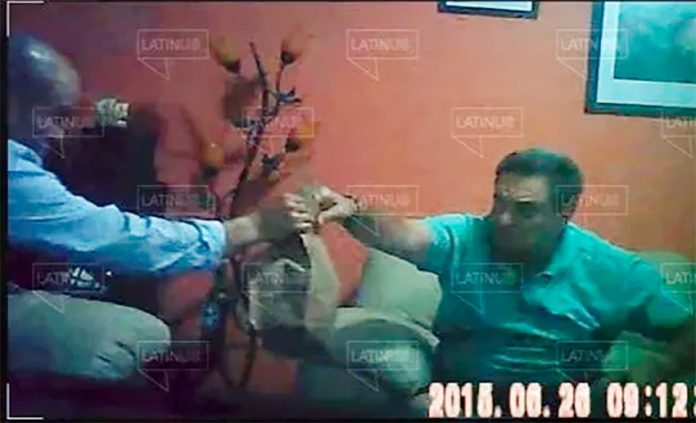
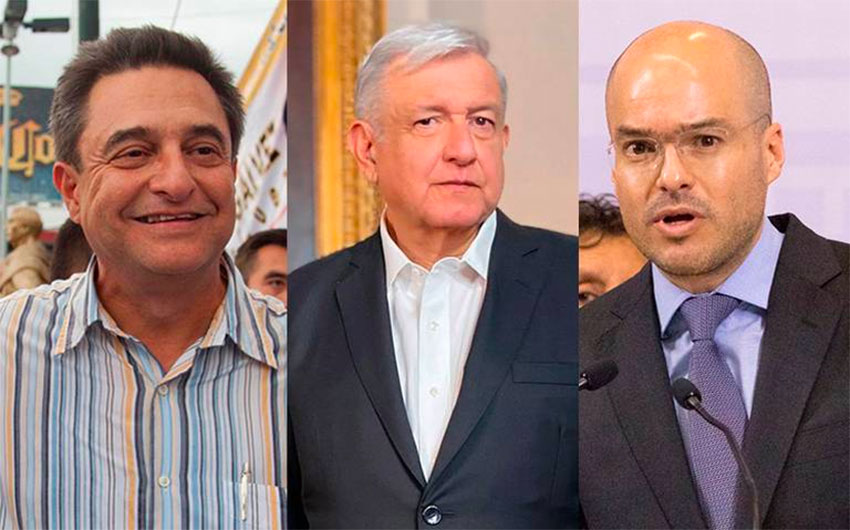
A bag of cash changes hands between León, left, and Pío López Obrador.
More videos have surfaced in which large amounts of cash change hands, but this time it’s the Morena party that’s involved.
Two videos show President López Obrador’s brother receiving large amounts of cash from David León, a former Civil Protection chief who was recently named to run a state company that will distribute medical supplies.
In one video, Pío López Obrador receives a paper bag which, according to León, contains 1 million pesos (US $45,300 at today’s exchange rate). The transaction reportedly took place in 2015 in Pío López Obrador’s home in Chiapas.
León tells López Obrador that the cash is to support the “movement” – presumably the now-ruling Morena political party – in Chiapas.
The president’s brother was a political operator for Morena in the state at the time while León was a private consultant and an advisor to the state government.
Léon also tells Pío López Obrador to let his brother know that “we’re supporting” his campaign for the 2018 presidential election.
The two men also spoke about arrangements for the delivery of an additional 1 million pesos.
In a second video, León gives Pío López Obrador a large stuffed envelope during a meeting in a restaurant that also reportedly took place in 2015.
“Here I’m bringing you 400,” León says, presumably referring to a quantity of 400,000 pesos.
The appearance of the videos, presented Thursday by journalist Carlos Loret de Mola on his program on the news portal Latinus, comes just days after a video was posted to YouTube in which two former Senate officials linked to the National Action Party (PAN) are seen receiving 2.4 million pesos. The money is believed to have been used to pay bribes to lawmakers in exchange for their support of the previous federal government’s 2013-14 structural reforms.
The damning video could be presented as evidence in the corruption case against former Pemex CEO Emilio Lozoya, who claims that several PAN lawmakers were paid bribes by the previous government and that former president Enrique Peña Nieto and two of his predecessors, Felipe Calderón and Carlos Salinas, were involved in corruption related to deals with the Brazilian conglomerate Odebrecht.
The López Obrador brothers and David León.
President López Obrador has described the Lozoya case as important because it will help shed light on the corruption committed by past government officials. However, the story also provides a welcome distraction for the president amid the coronavirus crisis and the accompanying economic downturn.
But a video of his brother receiving large sums of cash doesn’t look good for the corruption-fighting López Obrador.
Speaking at his morning news conference on Friday, he denied that the payments his brother received were corrupt but said the Attorney General’s Office should investigate them nevertheless.
López Obrador said the payments were “contributions to strengthen the [Morena] movement” and came from ordinary people who supported the party, which he founded in 2014. He said the funds were used for 2015 elections in Chiapas but when asked whether the campaign money was registered with authorities, the president said he didn’t know.
López Obrador rejected any suggestion that the money his brother received was in any way comparable to the Lozoya scandal currently embroiling a who’s who of Mexico’s political elite.
“Our adversaries seek to compare things, … this is quite normal … when a transformation is being carried out. … In this case of the video of my brother with David León there are obvious differences with relation to the other matters. … It’s not just the amount of money, which can’t be compared,” he said.
“In just one illicit operation that Mr. Lozoya is denouncing, they [Pemex under the former government] paid 200 million pesos for a junk [fertilizer] plant. In that case, … which has our adversaries very annoyed, it’s extortion without a doubt, it’s bribery, … it’s corruption,” López Obrador said.
“The aim [of the publication of the videos] is to damage the image of the government but they will not achieve it,” he added.
León, whom the president described as “one of the government’s best public servants” when announcing last month that he would be the director of a new state-run medical distribution company, responded on Twitter to the publication of the videos.
“From November 2013 to November 2018, I was a consultant not a public servant. My way of supporting the [Morena] movement was to collect resources among acquaintances for holding meetings and other activities,” he wrote.
León said he will not accept the nomination to head the new company until the matter of the videos has been clarified.
As of Friday morning, Pío López Obrador had not made any public comment about the videos.
It all started when a farmer in the Central Valleys region of Oaxaca tried to offload his surplus corn crop to a company CEO to whom he was already selling castor beans.
From that humble entrepreneurialism on the part of the farmer – and a gamble by the head of a castor oil company – an “ancestral” corn whiskey made out of native, Oaxaca-grown corn was born.
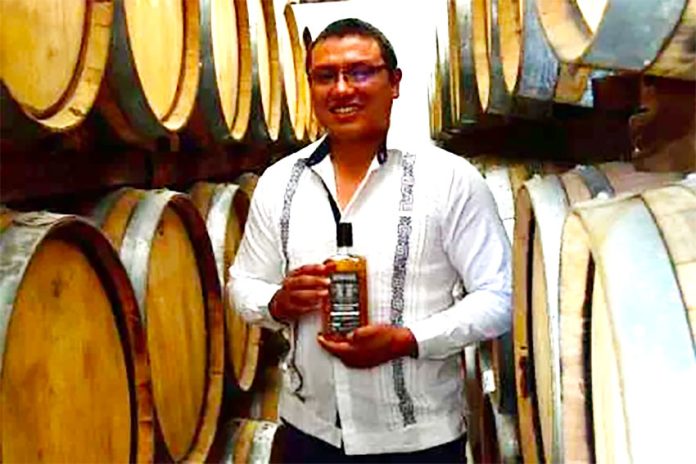
According to a report by the newspaper El Universal, when the farmer first tried to sell his excess corn along with his castor beans to Jonatan Hernández Díaz, CEO of RicinoMex, he got a negative response.
Undeterred, the same farmer tried his luck a year later. “Buy it! Do something with it, make mezcal,” the farmer reportedly urged Hernández in a jocular way.
The RicinoMex chief agreed to the purchase even though he had no idea at the time what he would do with the corn.
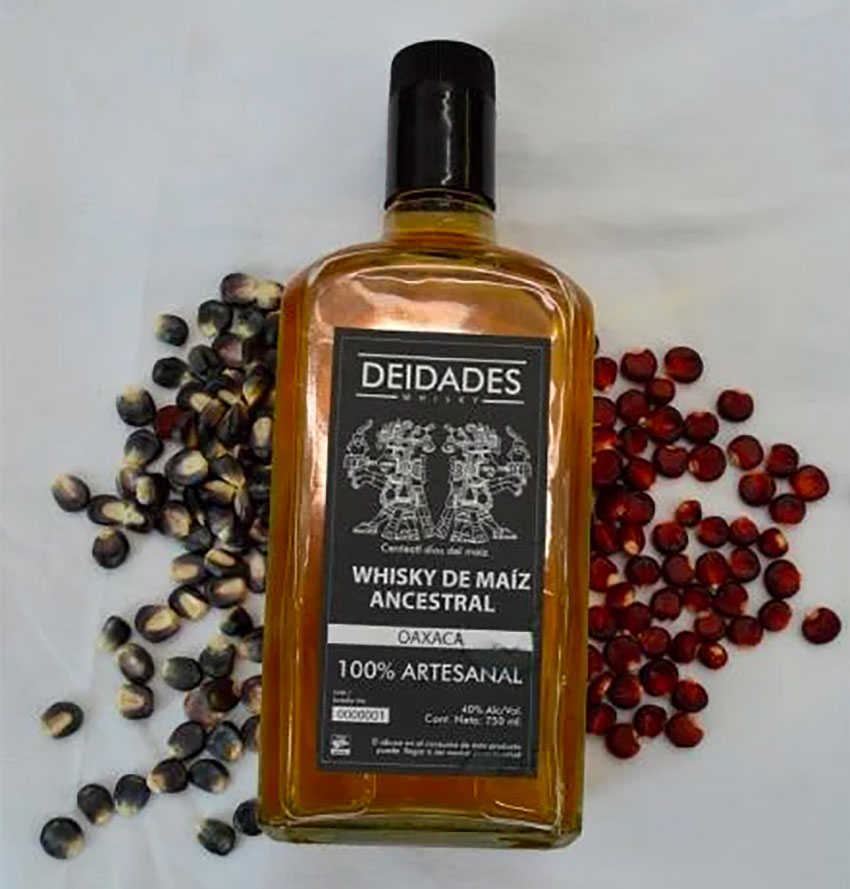
Deidades whiskey will go on sale in December.
First he thought of grinding it into flour but that idea was discarded because of an already crowded market and the investment in infrastructure that was required. What about corn chips? Again the investment required was deemed to be too high.
Hernández’s third idea was the one that stuck – he would move into the distilling business and make a 100% handcrafted corn whiskey.
Thus a new company – Deidades (Deities) – was formed. Hernández and his team began making whiskey 3 1/2 years ago with native corn purchased from about 80 indigenous small-plot farmers in the Central Valleys.
The first batch of 50,000 bottles will go on sale in December, possibly in international markets as well as in Mexico.
Hernández told El Universal that the vast majority of the farmers from whom RicinoMex buys castor beans also grow corn and therefore finding maize for the whiskey wasn’t difficult.
“Their corn is for their own consumption but sometimes they have a surplus,” he said, adding that most found it difficult to sell it at a fair price.
Now that Deidades is making whiskey, Deidades pays the farmers 8 pesos a kilo for their white, yellow, red, blue and black corn, double the price they can get from other buyers.
Hernández said he wants the price he pays to reflect the “value of the work carried out in the communities” where the corn is grown. He described the native corn species grown in Oaxaca as “something magnificent” and a treasure that must be shared with the rest of the world.
Making whiskey with it is an innovative way to do just that.
After malting and mashing the corn and completing the fermenting and distilling process, the end result – the native corn whiskey – is placed in French oak barrels for aging. Hernández explained that he is working with specialists to determine the optimal amount of time his product should be aged.
He said the aim is to have a product that proudly tells the story of native Mexican corn on imbibers’ taste buds and which they truly savor.
Oaxaca is already famous for its mezcal. Could Deidades’ “Whisky de maíz ancestral” be the next big thing?
Mexico is locked in combat with an invisible enemy, whose menace is sweeping the globe. Spiderman, Superman, Batman and the Avengers are nowhere to be found. But one homegrown hero has stepped out of the shadows to fight: SuperSlim.
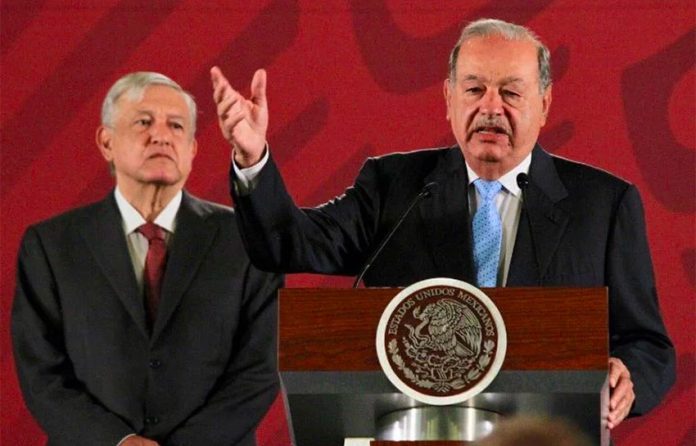
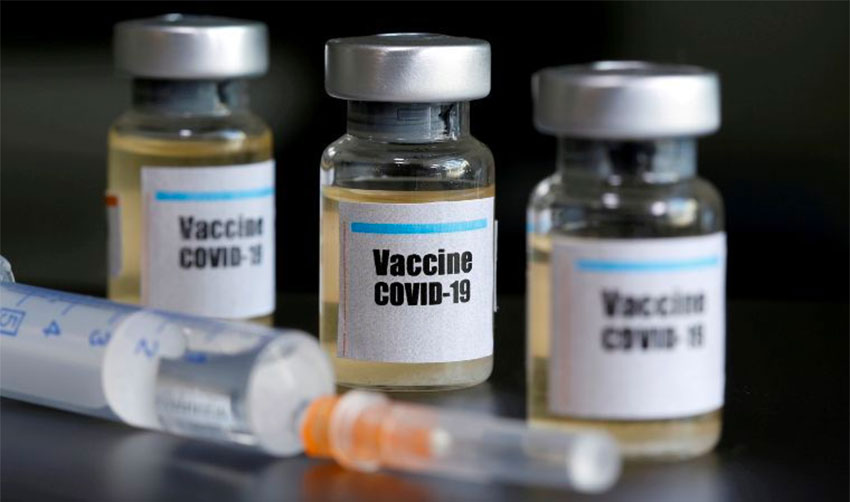
Carlos Slim, the famously unassuming telecoms mogul, has been hailed as a savior since his charitable foundation announced last week it would fund production of a promising AstraZeneca and University of Oxford Covid-19 vaccine as Mexico grapples with the world’s third-highest coronavirus death toll. Little wonder that a cartoonist in the national newspaper El Economista portrayed the 80-year-old magnate pulling open his shirt to reveal a Superman “S.”
For Mexico’s (and once the world’s) richest man, who prefers to think of charity as “social investment,” the move was in character. As he told his biographer, Diego Osorno: “Our concept focuses on achieving and resolving things, rather than giving. We don’t go around like Santa Claus.”
But for the cash-strapped government of leftist nationalist President López Obrador, the deal was a godsend as it struggles to tame a pandemic that has killed nearly 60,000 people.
The foundation, which Slim set up nearly 35 years ago, will stump up an unspecified sum to help produce 150 million to 250 million doses of the vaccine in Argentina and Mexico. López Obrador says that means a free, universal Covid-19 vaccine will be available in the first quarter next year — and volunteered to be the first to be inoculated.
It is not the first time Slim has ridden to López Obrador’s rescue. But a populist president who rails against Mexico’s neoliberal past, and a billionaire who made his fortune because of it, nonetheless make an unlikely duo. In fact the man-of-the-people president and the billionaire América Móvil boss go back a long way: López Obrador tapped Slim to help him spruce up the capital’s grungy historic center when he was mayor from 2000-05.
But as López Obrador barrelled towards his landslide presidential victory in 2018, Slim admitted to feeling queasy about the investment climate if he won and went ahead with a pledge to scrap the US $13-billion Norman Foster-designed Mexico City airport, which the magnate backed.
López Obrador did just that, straining the relationship between them, and only in the past year has there been a rapprochement. Last August, López Obrador fulsomely praised Slim for helping engineer a deal to settle a row over gas pipeline contracts he considered exorbitant.
The love-in continued, with Slim throwing his weight “100% behind” the president’s goals, including combating corruption and developing Mexico’s poor southeast through mega-projects. Indeed, a consortium led by Slim’s companies in May won a tender to build a section of the government’s flagship Maya train project and Slim has promised to invest $5 billion in infrastructure.
In February, when López Obrador summoned the business elite for a fundraising dinner at the National Palace, Slim was seated at his side. When López Obrador visited U.S. president Donald Trump at the White House in July, Slim joined the two leaders on the top table at a dinner with businesspeople.
Slim has graciously allowed López Obrador to bask in the credit for the vaccine program. But the president sometimes has a funny way of saying thanks: within days of the announcement, he called for an ethylene plant contract between loss-making state energy company Pemex and a consortium of Brazil’s Braskem and Mexico’s Idesa to be scrapped, or at least revised. Slim’s Inbursa bank is a major Idesa creditor.
The $5.2-billion plant was a landmark investment because of its size, but Pemex no longer has a glut of ethane — the raw material used in the plant — and is struggling to meet the terms of a contract the president considers unfavourable to the state company.
But he appears to be overlooking the fact that if Pemex fails to fulfil its contract, Braskem Idesa has an option to force it to repay all the investment plus return on capital. Pemex already has debts of $107 billion. Averting that disaster could be the next test for SuperSlim’s negotiating skills.
Mexico’s official Covid-19 death toll could exceed 100,000 by the end of the year and confirmed cases could total more than 1 million, according to a National Autonomous University (UNAM) mathematician.
Arturo Erdely told the newspaper Milenio that fatalities could go past six figures by the end of 2020 and case numbers could exceed seven figures if the pandemic wanes only slowly, as is currently occurring. If face masks are not made mandatory in the entire country, the numbers could be even higher, he said.
As of Wednesday, the official Covid-19 death toll was 58,841, an increase of 707 compared to Tuesday, and the accumulated case tally stood at 537,031, up 5,792.
Noting that some states have not yet reached the peak of their local epidemics, Erdely predicted that there will be 65,000 confirmed Covid-19 deaths by the beginning of September and 79,000 at the beginning of October. Fatalities will reach 88,000 at the start of November and 95,000 by December 1, he said.
“We could close the year with more than 100,000 deaths due to Covid-19,” Erdely said.
As a result, there will be sufficient time this year for “many more cases” to accumulate, he said. “At this pace, we could go past a million cases by the end of the year.”
As Mexico’s testing rate is low – only just over 9,000 people per 1 million inhabitants have been tested to date – and targeted at people with serious symptoms, the real number of citizens who have been infected has almost certainly already passed 1 million.
Estimating a fatality rate of 0.6 per 100 cases (Mexico’s rate is currently 10.9), one infectious disease specialist said in late July that Mexico’s real coronavirus case tally could be more than 7 million. Independent studies have also found that Covid-19 deaths have been grossly underreported in Mexico.
The UNAM mathematician stressed that his end-of-year predictions are for the government’s official numbers. With regard to face masks, Erdely said it was unfortunate that the federal government hasn’t “forcefully”promoted their use.
The government’s coronavirus point man, Deputy Health Minister Hugo López-Gatell, did wear a face mask at Wednesday night’s coronavirus press briefing and for the first time in almost six months of nightly appearances left it on for the entire hour-long conference.
He reiterated that new case numbers in Mexico are on the wane and thanked citizens for continuing to follow coronavirus mitigation measures and maintaining a “healthy distance” from each other.
The deputy minister called on people to remember that the coronavirus outbreak is still active despite the decrease in case numbers and urged them to not drop their guard.
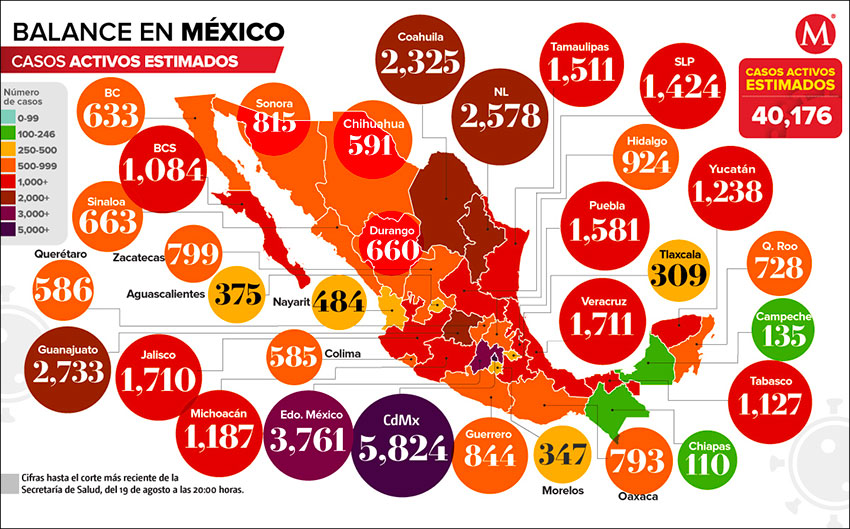
The Health Ministry estimates that there are currently just over 40,000 active cases across Mexico with the largest current outbreaks in Mexico City, México state, Guanajuato, Nuevo León and Coahuila.
The country could use a few more judges, report suggests.
Mexico’s deficiencies in security and justice coupled with high levels of corruption have landed the country in 60th place on the 2020 Global Impunity Index (GII).
The index measures systems of security, justice, the protection of human rights and structural capacity to come up with its ranking.
Authored by researchers at Puebla’s University of the Americas, the index rates 69 countries with the highest impunity worldwide. The only countries with higher impunity rates than Mexico are Kyrgyzstan, Nepal, Guyana, Paraguay, Azerbaijan, Algeria, Morocco, Honduras and Thailand.
In the last report, compiled in 2017, Mexico ranked 66th out of 69 countries, while in the 2015 report it ranked 58th out of 59. But that doesn’t mean that Mexico is getting better, it actually means that the rest of the world is getting worse, researchers say. The improvement in position this year is “the result of changes in the position of other countries, rather than the implementation of effective actions to strengthen the rule of law and guarantee access to justice or protect human rights,” the report says.
One concrete step that Mexico needs to take is to increase the number of judges, the report concludes, which would help improve justice administration capacity. The IGI found that of the countries surveyed, the global average is 17.83 judges per 100,000 people. Mexico has just 2.17 judges per 100,000. The country with the least impunity, Slovenia, has 42.77 judges per 100,000.
And although Mexico has a high number of police officers compared to other countries with 347.76 police officers per 100,000 inhabitants, more officers does not translate into effective policing.
Police and justice system budgets need to be dramatically increased in order to improve both infrastructure and professionalism, the IGI found.
Presidents López Obrador inherited high levels of crime and corruption, the report says, and penal reforms have depressurized Mexican prisons, but they lose effectiveness when not coupled with a solid justice and public safety system.
On the positive side, the report praises Mexico’s Financial Intelligence Unit, which investigates financial crimes.
The countries with the lowest rates of impunity are Slovenia, Croatia, Greece, Bosnia and Herzegovina and Sweden.
Data used in the study was compiled in 2018 and 2019.
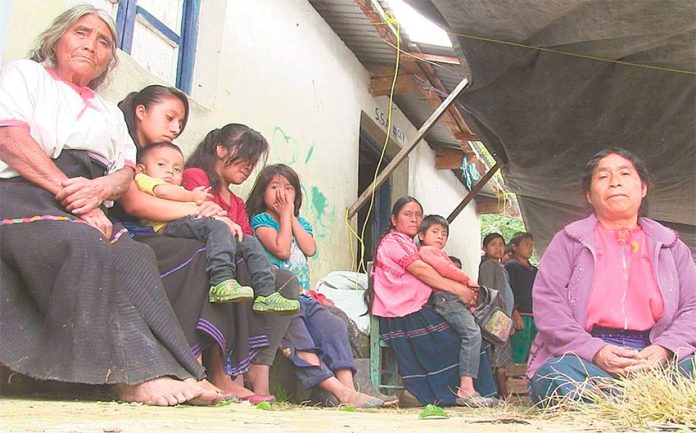
More than 1,000 indigenous Tzotzil people have been forced to flee their homes due to violent attacks in Aldama and Chenalhó, Chiapas.
Men, women, children and the elderly have sought shelter this week due to renewed violence over a long-disputed, 60-hectare plot of land. Some have set up camps in the mountains to escape the gunfire while others are sheltering in sports stadiums or in private homes.
Adama’s conflict is with an armed group from Chenalhó that has continued for more than four decades. In October 2017, more than 5,000 Tzotzil people took refuge in 11 different camps without access to toilets or running water while the government did nothing to intervene, according to the National Human Rights Commission.
Yesterday, a contingent of 200 National Guard and state police officers were dispatched to the area to prevent violence after one man was killed and another injured in the exchange of gunfire, with each side of the conflict accusing the other of armed attacks.
Gunfire drove 80-year-old Adama resident María Méndez Ruiz to flee with other families to a house in the mountain town of Chivic, but her husband, Mariano Jiménez, 81, could not join her as his health is too frail. She fears he may die as he has nothing to eat.
More than 15 families, mostly women nursing infants, have taken refuge in a 20-square-meter house where they lack food and clothing. Some are also sick with colds.
Rosa Jiménez, who lives near the border with Chenalhó, fled to protect her five children: “Almost all night there are shots and the children are scared. I had to flee to find a safe area. In the mountains we are cold, there is a lot of suffering,” she said.
High-caliber gunfire forced Doña Julia López, her husband, daughter and her two grandchildren to leave their home, and they can still hear shots ring out from where they are sheltered. “We cannot spend the night quietly with our children, we are quite scared,” she told El Universal through tears.
Mariana, another of the displaced women, called on President López Obrador to intervene on behalf of the Tzotzil people, especially for the children who are suffering and have nothing to eat.
On July 30, Chenalhó and Aldama officials ratified a non-aggression pact but have chosen not to respect its terms. Fighting between the two communities resumed last week and is intensifying.
On Wednesday morning residents of Chenalhó took the body of the man who was killed to the state government building in Tuxtla Gutiérrez. They placed his coffin mounted on a stretcher alongside banners calling for justice for the 20 people they claim Aldama residents have murdered since the conflict between the communities began.
State Government Secretary Ismael Brito Mazariegos asserts that the government continues to maintain “a serious and responsible dialogue with both parties” as it searches for a peaceful resolution to the conflict.
Yesterday, a group of armed men wearing masks and dressed in military fatigues and carrying assault rifles released a video demanding the release of two Chenalhó leaders who were detained last year. “The state government wants to pass our legitimate territorial right from Santa Martha to Aldama, and through political means it wants to fix this problem,” a man told the camera. “We know well that it won’t be solved through political means but through legal means, justice and equity.”
Calderón: president not interested in justice; 'he wants a lynching.'
Former president Felipe Calderón has accused President López Obrador of using ex-Pemex CEO Emilio Lozoya as an “instrument of revenge and political persecution” after the erstwhile state oil company chief accused him of acting corruptly while in office.
His claim came after the leaking to media outlets on Wednesday of a document submitted to the federal Attorney General’s Office in which Lozoya – currently awaiting trial on corruption charges – accused him, former presidents Enrique Peña Nieto and Carlos Salinas Gortari and several other former officials of illicit conduct related to government dealings with the Brazilian conglomerate Odebrecht.
Calderón, who Lozoya accused of approving the sale of ethane to an Odebrecht subsidiary at a heavily discounted price, wrote on Twittter:
“The illegal and showy management of the [Lozoya] case confirms that Lozoya (with the blackmail of having his mother imprisoned) is used by López Obrador as an instrument of revenge and political persecution. He’s not interested in justice but rather lynching [by] making ridiculous accusations” against me.
The president said last Friday that he had forgiven Calderón for “stealing” the presidency at the 2006 election but the long-standing acrimonious relationship between the two men doesn’t appear likely to warm any time soon.
Ricardo Anaya, a former National Action Party (PAN) lawmaker who was the party’s candidate in the 2018 presidential election, also spoke out after it came to light that Lozoya had accused him of receiving a 6.8-million-peso (US $306,500 at today’s exchange rate) bribe in exchange for supporting the former government’s 2013-14 structural reforms, including the controversial energy reform that ended a 75-year state monopoly in the sector.
In a video message, Anaya described the accusation against him as “completely false” and “truly absurd.”
He noted that Lozoya accused him of receiving the bribe money in the carpark of the Chamber of Deputies in August 2014 but highlighted that he wasn’t even a deputy at that time.
“In addition to being corrupt, Lozoya is very bad at lying,” Anaya said.
The former PAN lawmaker, who also served as the party’s national president between 2015 and 2017, said he would initiate legal action against Lozoya for “moral damage.”
“I’ll do it because I am certain that there is no support at all for the vile lie that Lozoya has invented against me,” he said. “I don’t care how long it takes me; I will defend my honor and continue fighting to change Mexico.”
Querátaro Governor Francisco Domínguez and his Tamaulipas counterpart Francisco García Cabeza de Vaca, both former PAN senators, also rejected Lozoya’s claim that they received bribes in exchange for supporting the previous government’s reforms.
Domínguez described Lozoya’s accusation as an “unprecedented vile deed” and “libel,” and asserted that the words of a “confessed criminal” cannot be trusted.
Speaking alongside López Obrador at a press conference Wednesday, the governor distanced himself from the actions of his personal secretary, whom he fired on Monday after a video surfaced showing him accepting 2.4 million pesos in cash when he was a Senate official.
“I removed him from his position, … for my part, I don’t have anything to fear, nothing to be ashamed of and nothing to hide. In my life I have always faced up [to accusations against me], today won’t be an exception,” Domínguez said, pointing out that he was a supporter of energy reform long before the previous government’s presented its initiative.
“Mr. Emilio Lozoya has sought to involve me … in acts of corruption. He has only provided words which are worth as much as his standing – nothing.”
García Cabeza de Vaca of Tamaulipas wrote on Twitter: “I will not allow them to use me for electoral purposes nor to hide the country’s serious problems. I will respond with resolve to the lies of the confessed criminal Lozoya.”