Home Blog Page 1512

Petroleum thieves turn to tunnels to move stolen fuel

0
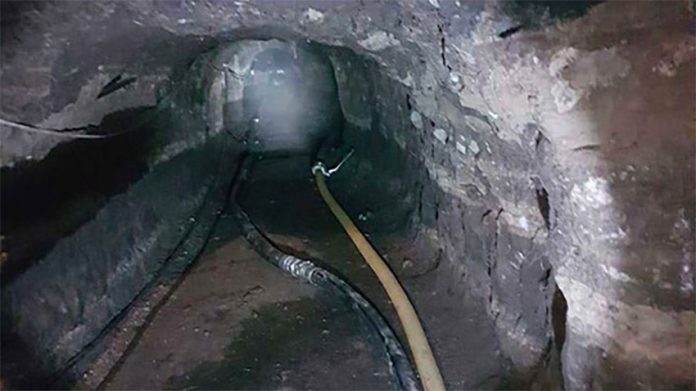
Hoses transport fuel in a petroleum thieves' tunnel.

Amid an ongoing crackdown on fuel theft, Mexico’s petroleum plunderers are going underground – literally: they have built tunnels in at least three states to transport stolen fuel.

According to a report by the newspaper Milenio, huachicoleros, as fuel thieves are known colloquially, have had to rethink their modus operandi in order to sustain their illicit business while the army, navy and National Guard carry out air and land operations against them.

Tunnels, infrastructure that drug cartels have used extensively to move their product across the northern border into the United States, are one part of their new strategy.

Federal security authorities in conjunction with the state oil company Pemex have uncovered fuel transportation tunnels in San Martín Texmelucan, Puebla – part of the so-called Red Triangle, a region notorious for the tapping of petroleum pipelines, Cadereyta, Nuevo León, and the Guanajuato municipalities of Apaseo el Grande and Apaseo el Alto.

Fuel thieves use hoses that run through the tunnels to transport petroleum extracted illegally from tapped pipelines.

The tunnels, located just under the ground’s surface, have exit points at locations away from the Pemex pipelines where thieves can more easily avoid the prying eyes of authorities and safely make off with their stolen fuel – at least until the tunnels are discovered.

Now that the authorities have become aware of the huachicoleros‘ subterranean strategy, the security forces tasked with combating the lucrative fuel theft racket have a new mission: ferret out more tunnels.

A Pemex security director told Milenio that finding the tunnels is not as hard as it might seem.

“The smell of fuel is very strong, very acute, and that’s one of the main signs that allows us to detect … an illegal extraction,” Netzahualcóyotl Albarrán Mendoza said. He said the tunnels that have already been found were located not long after they were built.

Fuel thieves have not only relied on their own purpose-built tunnels to move stolen petroleum in secret: they’ve also used infrastructure built for licit purposes.

Authorities told Milenio that fuel thieves have made use of a 3.7-kilometer section of an incomplete, non-operational natural gas pipeline built by TC Energy (formerly TransCanada Corporation) in Hidalgo.
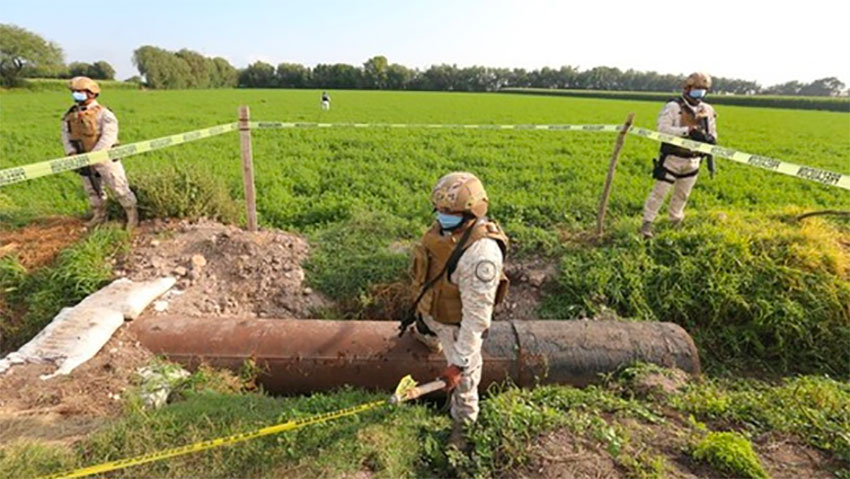
National Guardsmen at a pipeline in Hidalgo.

Located just two kilometers from the state-owned refinery in Tula, the section of pipeline used by thieves to transport fuel runs parallel to a Pemex duct.

The army not only detected that huachicoleros were opportunistically using the TC Energy pipeline but is also in the process of recovering some 2 million liters of stolen fuel still in it. Once recovered, the fuel will be decontaminated and returned to Pemex storage facilities.

Col. Humberto Bautista said Monday that the recovery of the stolen fuel will be the largest since the federal government implemented a new strategy against fuel theft 18 months ago.

He said that air and land-based security operations have been successful in “considerably” reducing fuel theft, a crime that formerly cost Pemex 30 billion pesos (US $1.3 billion at today’s exchange rate) a year, according to former CEO Carlos Treviño.

President López Obrador and current Pemex CEO Octavio Romero have asserted that fuel theft has declined significantly on their watch, although it remains a problem for the heavily-indebted state oil company.

López Obrador said earlier this month that theft had been reduced from 80,000 barrels a day when he took office to just 3,000 barrels a day, a 96% decline.

He claimed that fuel theft will soon end because there is no longer collusion between Pemex and fuel thieves, who like their drug trafficking cousins have inspired a genre of outlaw music.

Considering the authorities’ recent discoveries, it might not be too long before a new huachicorrido – a ballad that tell the stories of fuel thieves  – celebrating their tunnel digging prowess makes an appearance online.

Source: Milenio (sp), Excélsior (sp) 

Former Pemex chief drops extradition fight in corruption case

0
Peña Nieto, left, and Lozoya
Peña Nieto, left, and Lozoya: will the latter testify against his old friend?

The former head of Pemex, Mexico’s state oil company, has dropped his extradition fight and will be flown home from Spain to face charges in the biggest corruption prosecution yet under President López Obrador.

Attorney General Alejandro Gertz Manero said Emilio Lozoya had “offered his collaboration to establish and clarify the matters of which he has been accused.”

The former Pemex chief, who had been a key figure in the election campaign of former president Enrique Peña Nieto, was arrested at a luxury residential complex on the Costa del Sol in February, after an eight-month search.

Lozoya has denied receiving US $10 million in bribes from the Brazilian construction company Odebrecht, which admitted paying billions of dollars in kickbacks across Latin America in exchange for political favours that have landed scores of former officials across the region in jail.

He faces charges of money laundering and corruption over Pemex’s purchase of a fertilizer factory.

Shortly after news of his imminent extradition was made public, Coello Trello y Asociados, the law firm that represents Lozoya, said it would no longer do so.

In a statement, it said it had taken the decision a month ago, in agreement with Lozoya, but gave no reason.

Mexico was conducting final paperwork before sending an aircraft to fly him home. Once back in Mexico, legal proceedings would begin “immediately,” the attorney general said.

“The relevance of this issue mandates an absolutely transparent investigation and fairness that is beyond doubt,” he said.

That scandal, as well as the unsolved killing of 43 students almost six years ago, has tainted Peña Nieto’s reputation. Some analysts believed that Lozoya could testify against his former boss.

“He surely didn’t act alone,” said Marco Fernández, anti-corruption investigator at México Evalúa, a think tank, and a professor at the Tec de Monterrey. No other former officials have yet been accused.

Former Ayotzinapa investigator Zerón
Former Ayotzinapa investigator Zerón is sought by Interpol.

“The big elephant in the room is the lack of results” in López Obrador’s anti-graft drive, he added.

Gertz Manero also said an Interpol red notice had been issued against Tomás Zerón, the fugitive former head of the Criminal Investigation Agency that was part of the attorney general’s office, seeking his extradition to face charges in connection with the investigation of the student killings.

Zerón had been a defender of what the previous government described as the “historic truth” — that the students had been kidnapped by corrupt police, handed to a local cartel, killed and burned.

“The historic truth is over,” Gertz Manero said.

© 2020 The Financial Times Ltd. All rights reserved. Please do not copy and paste FT articles and redistribute by email or post to the web.

Visitors welcome in Puerto Peñasco, Sonora, as reopening advances

0
Puerto Peñasco is easing coronavirus restrictions.

Puerto Peñasco, Sonora, also known as Rocky Point or “Arizona’s Beach” due to its proximity to the Grand Canyon State, has reopened for tourism and is welcoming visitors to its sunny shores. 

With the safety of residents and tourists a priority, the resort destination, which has only seen a handful of coronavirus cases, has implemented a series of protocols corresponding to phase three of its reopening plan, Mayor Kiko Munro in a press release issued Monday.

“Now that we know our efforts to lock down and stay at home have limited the spread of coronavirus in Rocky Point, we have been happy to welcome tourists back in our town,” said Keith Allen of the Peñasco Business Coalition.

Healthy visitors are encouraged to return to Puerto Peñasco, but are required to wear a face mask in public areas and businesses. 

Travelers will have their body temperature checked upon arrival at health checkpoints, and anyone registering a temperature higher than 37.5 C will be asked to leave their vehicle and take a second temperature test. If the reading is the same, the passenger will be offered a free, rapid coronavirus test. 

A positive result means travelers will be asked to return to their point of origin. If the test is negative, visitors will be allowed to continue but advised to consult with a doctor. 

Visitors will also be asked to show proof of a lodging reservation at an approved hotel, resort or rental property. 

All residents and visitors are encouraged to maintain a healthy distance from others of approximately two meters. 

Beaches remain closed, but some hotels may allow access to pools or the small beaches directly in front of their property, although swimming in the ocean is not permitted.

Sportsfishing has been reopened, as have other marine tourism businesses. The boardwalk area of the Malecón is open until 9 p.m. for those who would like to take a stroll along the sea, but they must do so with masks in place. 

“We hope visitors understand that these precautions will keep everyone safe and healthy as we look to welcome people back to Rocky Point while still preventing the spread of Covid-19,” said Mayor Munro.

Mexico News Daily

Tourism reopens in Sinaloa Wednesday, with restrictions

0
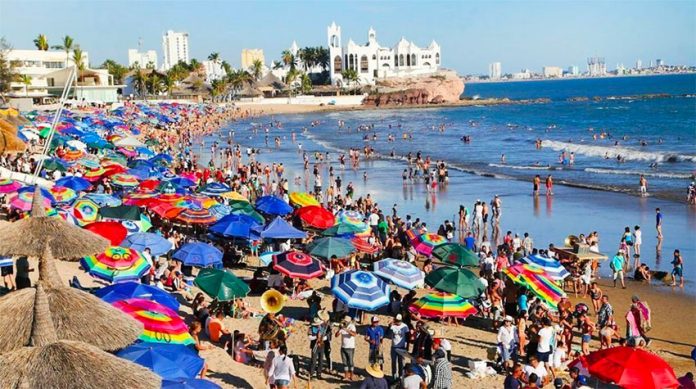
Mazatlán will be open for business on Wednesday.

The lockdown that began April 1 in Sinaloa is being lifted and tourists will once again be welcome in the state as of Wednesday.

Governor Quirino Ordaz Coppel, accompanied by Durango Governor José Rosas Aispuro at an event in Mazatlán, announced the opening of hotels, spas, beaches, golf courses, restaurants and other tourism businesses which will be permitted to operate at 40% of their capacity.

“This reopening is quite a challenge but life goes on, and we have to know how to travel in this new normality given the lack of a vaccine for the coronavirus,” Governor Ordaz said. “The important thing is to follow these health protocols and monitor compliance, thereby strengthening the areas of surveillance and supervision.” 

According to the federal coronavirus risk “stoplight” Sinaloa is one of 14 states across Mexico that are still marked as red, and at maximum risk level.

The governments of Sinaloa and Durango announced they will convene an interstate working group where they will discuss follow-up issues for the revival of tourism during the coronavirus pandemic. This will allow those who visit their neighboring state to do so knowing that they can expect the same protective measures that are in place at home.

Sinaloa Tourism Minister Oscar Pérez Barros stated that 76% of the state’s 623 hotels have already earned a coronavirus safety certification, and that number is expected to rise to 100% over the next few days.  

The Durango governor said reactivating the economy is essential to financial solvency, and that thousands of people have lost or suffered a reduction in their income. 

Mazatlán Mayor Luis Guillermo Benítez Torres expressed cautious approval of the move at the meeting with the governors. “We will be very aware so that this tourist reopening does not increase the spread of the coronavirus. For this reason, we will have weekly meetings to prevent it from slipping out of our hands because it would be a serious consequence for this tourist destination.”

Sinaloa’s health minister said protocols will be of the utmost priority, and stressed that both Sinaloa and Mazatlán are showing signs of stability with a downward trend in cases of infection.

As of June Monday, Sinaloa had recorded 8,111 confirmed cases of the coronavirus and had seen 1,257 deaths.

Source: Milenio (sp), El Heraldo (sp), El Sol de Mazatlán (sp)

8 gray wolf pups born at Coahuila’s Desert Museum

0
Two of the wolf pups born at the museum in Saltillo.

The Desert Museum in Saltillo, Coahuila, has announced the birth of eight healthy Mexican gray wolf pups this spring, the fifth litter born at the facility and an important step for a species that is in danger of extinction. 

Since 2009, the museum has been part of the Binational Committee for the Recovery of the Mexican Gray Wolf, made up of more than 50 institutions from Mexico and the United States. 

The gray wolf, one of the most endangered mammals in North America, once roamed southeastern Arizona, southwestern New Mexico, western Texas and Mexico’s Sierra Madre Occidental before being driven to the brink of extinction in the 1970s due to hunting and habitat encroachment. 

“After the massacres that occurred in the ‘60s and ‘70s, a total of seven Mexican wolves were recovered; they were wild and were captured to restart the breeding program,” explained Miguel Ángel Armella Villalpando, a biology professor at the Autonomous Metropolitan University in Mexico City. 

Currently, most gray wolves exist in captivity as zoos and wildlife parks hope to increase their numbers. Mexico has released 30 captive wolves into the wild, and the United States has more than 100 living outside of captivity.

The Desert Museum has been successful in its breeding program, with litters born in 2015, 2016 and 2017. After no pups were born in 2018, the museum switched out the breeding pair and welcomed three pups in 2019, and the most recent litter of eight — four males and three females — in April. The museum currently has 18 gray wolves in its care.

Also this year, a sanctuary in New Mexico saw the birth of seven healthy pups, bringing the total number of Mexican gray wolves in existence in the world to 204.

All the Coahuila pups are part of preventive medicine, nutrition and enrichment programs established for the species and supported by the University of Coahuila and Carlos Slim’s wildlife foundation.

Source: Heraldo de Mexico (sp), El Universal (sp), Milenio (sp)

Boy, 6, lost in Mexico City market 30 years ago reunited with his family

0
Tolentino receives a warm embrace from family members.

Thirty years after Adán Tolentino went missing from a Mexico City market he has been reunited with his family.

In 1990 the six-year-old Tolentino accompanied his father to work at the Central de Abasto, a food warehouse and distribution center that is the largest of its kind in the world and sees some 300,000 customers each day.

As father and son walked through the aisles of the market, Tolentino let go of his father’s hand and quickly became lost among the crowds. 

For a while, the boy survived by selling chewing gum on the streets of the capital city but was soon taken in by a family from Poza Rica, Veracruz, who fed and clothed him and made sure he finished school. Eventually, Tolentino married and moved to Lolotla, Hidalgo, where his wife encouraged him to search for the family he had lost all those years ago.

“For several years, my wife told me to go find them,” Tolentino says, so he reached out to the state of México’s Missing Persons Commission on June 10 and sent in the required paperwork in order to allow the government organization to aid him in his search, following up with a phone call to provide further details. 

Tolentino, left, meets his family after 30 years.

The commission combed through an extensive database containing more than 10,000 possible matches, cross-referencing entries with information Tolentino had provided, and within a few days they called Tolentino to tell him that they had found his original family. 

“I started crying, I was very grateful. I felt … that I was born again. It is a great joy. I really felt that something was missing,” Tolentino said. “I think joy came back.”

The sentiment was shared by Tolentino’s family, who could scarcely believe that after 30 years they would be reunited.

“They sent a message to one of my sisters, and they said they found my brother and asked if we could identify the photo they had sent …” said Lucia, one of Tolentino’s sisters, who recognized him in the photo and immediately began crying tears of gratitude. 

Tolentino and his family met at the offices of the Missing Persons Commission in Toluca and shared warm embraces. 

“We are very grateful to everyone because, thanks to you, we found the person we were missing, and the truth is we missed him a lot. Now that he is with us, we say thank you to all of you for helping my brother find us,” Lucia said.

Source: Nación 321 (sp)

Supreme Court suspends energy policy for restricting competition

0
The Supreme Court upheld an argument by the antitrust regulator.

The Supreme Court has suspended a new Energy Ministry (Sener) policy that imposed restrictive measures on the renewable energy sector.

Justice Luis María Aguilar Morales made the ruling in response to a complaint filed by Mexico’s antitrust regulator, the Federal Economic Competition Commission (Cofece).

The competition watchdog argued that the Sener policy published on May 15 violated the constitutionally enshrined principles of free competition.

The policy placed limits on the number of permits that can be issued for new wind and solar projects and prohibited their construction in parts of the country where there are already a large number of renewable plants, among other restrictive measures.

Aguilar accepted Cofece’s argument and suspended the policy, which ostensibly sought to guarantee the reliability, security, continuity and quality of Mexico’s national electricity system.

Critics say the aim of the policy is to prevent the expansion of the renewable energy sector and consolidate control of electrical power in the state-owned Federal Electricity Commission (CFE).

Pending a final ruling by the court, Sener’s 2017 reliability policy will re-enter into force as a result of Aguilar’s decision.

His ruling, published Monday, came two weeks after a federal judge issued a suspension order against the same policy.

Energy Minister Rocío Nahle responded to the decisions in a Twitter post.

“The executive has the obligation to provide security and custodianship for the energy system in Mexico. The government is respectful of the decisions of the judicial power; we will fight any disputes in court with solid arguments to maintain the reliability of the national electricity system,” she wrote.

According to the Business Coordinating Council, an influential business lobby, some 578 lawsuits have been filed against Sener’s suspended policy.

The Mexican Employers Federation (Coparmex) said the Supreme Court ruling “returns confidence to private sector investments, especially in the renewable energy sector.”

It also “constrains the federal government’s intentions to return a monopoly to the Federal Electricity Commission,” Coparmex said. “The court is an asset for legal certainty.”

Alain Duthoy of the oil sector consultancy LexOil told the newspaper Milenio that if the Supreme Court upholds Aguilar’s decision in a final ruling, the federal government will have no further recourse.

The Energy Ministry would therefore have to keep the 2017 reliability policy in place or publish a new, more flexible one that respects competition rules.

Meanwhile, President López Obrador this morning renewed his attack on private energy companies and past governments.

Speaking at his regular news conference, López Obrador claimed that private companies and the CFE under previous governments committed fraud.

He charged that the CFE signed contracts with private companies that established the rate the former would pay the latter for supplying electricity to the national grid.

However, “immediately after a contract was signed,” a new one stipulating higher rates was put in place, López Obrador said.

As a result of the “illegal procedure,” the CFE has to pay “extremely high” rates to private companies, he said, adding that the government will launch legal action against those who participated in the scheme.

“It’s fraud, … and it caused damage to public finances,” López Obrador said.

“We’ve estimated the [financial] damage and at the [right] time we’ll report it. … [But first] we want to speak to the companies, one by one. … I’ve given the instruction to start drawing up the corresponding complaints, that’s the substance of the matter.”

The president’s accusation comes a month after CFE director Manuel Bartlett accused renewable energy firms of committing “simulation and fraud” at the expense of the state-owned utility.

He accused renewable firms of passing off other private companies as their business partners rather than their customers in order to avoid paying transmission costs to the CFE.

Source: Milenio (sp), El Financiero (sp) 

An hour south of Mexico City is Mexico’s cheese factory

0
Leticia Herrera at her cheese store in San Cristóbal Poxtla.

San Cristóbal Poxtla is a small pueblo with a population of a little under 1,000 but despite its size it is known throughout Mexico as as one of the best producers of artisanal cheeses.

In fact, it’s called “La Gran Fábrica de Quesos” — the Great Cheese Factory — and the majority of its residents are employed in dairies or in cheese shops.

Poxtla, as it’s commonly called, is located in the state of México, about an hour south of Mexico City, and is surrounded by fields of corn and, of course, cows. Although it’s a bit of a trek from the city, it’s worth the effort to get there and sample its cheeses.

Cattle were first brought to Mexico by the Spanish, specifically by Gregorio de Billalobos in 1521, about six months before the fall of Tenochtitlán, the Aztec capital. For many years, cattle were considered a source of meat, not milk or cheese.

That began to change in the late 1800s as new breeds of cows were introduced, ones that increased milk production. But dairies still tended to be small scale operations. It wasn’t until the 1990s that the dairy industry expanded and large scale production began. Mexico now ranks 10th in the world for cheese production and around 40% of that production is from small-scale dairies and cheesemakers, like the kinds found in Poxtla.

A selection of Mexican-made manchego cheeses.

Leticia Herrera Guerrero, the owner of Lacteos Artesanales Lety, stands behind the counter in her shop and places a selection of cheeses in front of her. “Queso Oaxaca and panela, which are fresh cheeses, are the most popular,” she said as she pointed out the cheeses.

“This is partly because they are less expensive than other cheeses and also because they are both used daily in cooking and in foods like quesadillas.”

Another product is manchego, a matured cheese that is popular because of its flavor.

Manchego originated in the Spanish area of La Mancha and was brought to Mexico by the Spanish. Although both countries call this cheese manchego, in Spain the cheese is made from sheep’s milk but in Mexico cow’s milk is used. This led to a disagreement a few years ago between Spanish and Mexican cheesemakers which dragged on for over two years. Because of the differences, the Spanish wanted Mexico to stop calling their cheese manchego. The dispute was finally settled in 2018 with an agreement that stipulates that Mexican manchego must be labeled as a domestic cheese.

Clearly, cheesemakers take their products seriously but, personally, I’m glad that Mexico’s cheesemakers still make manchego.

A simple, plain manchego has a mild, somewhat nutty taste and, in my experience, is also good for making quesadillas. But cheese shops in Poxtla aren’t happy with only offering a plain manchego. Herrera’s store carries 16 varieties of the cheese.

Smoked provolone at 'Mexico's Cheese Factory.'
Smoked provolone at ‘Mexico’s Cheese Factory.’

“We have manchego made with tequila, red wine, several with different types of chiles, others with herbs, and even walnuts when they are in season,” said Juan Cruz, who works at Lacteos Lety. There’s even one known as Por Salud (For Health) that’s higher in protein and often eaten when a person’s feeling sick.

Herrera is happy to give customers a taste of any number of the different cheeses and manchegos and it’s simply not possible to walk out of the shop without several varieties. I left with a half kilo of Queso Oaxaca, some smoked provolone, two types of manchego (herb and wine) and tortillas made with chipotle chiles. There are tables and benches at the side of the store where you can relax and enjoy a snack before driving home.

In addition to offering samples, Herrera also offers advice about how to eat her cheeses.

“Manchego,” she said, “is best eaten with a little red wine.” I took her advice when I got home.

Joseph Sorrentino is a frequent contributor to Mexico News Daily and lives in San Gregorio, Xochimilco.

3 cops murdered after police attempt to check gangster’s mom’s car

0
In a video, El Marro told police not to get in the way.

Three municipal police officers were shot and killed in Silao, Guanajuato, early Monday just hours after police allegedly attempted to detain the mother of Santa Rosa de Lima Cartel leader José Antonio “El Marro” Yépez following her release from prison.

The officers were gunned down in the La Joya neighborhood at about 1:20 a.m. while responding to a report of a shootout. A fourth officer survived the attack but was wounded and is in serious condition.

The attack occurred just two weeks after three other Silao police officers were murdered.

In a video posted to social media on Monday, Yépez claimed responsibility for the most recent police murders.

He accused the Silao municipal police of following orders from the Jalisco New Generation Cartel (CJNG) – the Santa Rosa gang’s arch-enemy – to stop the vehicle in which his mother was traveling with lawyers after a judge ordered her release from prison due to a lack of evidence on charges of involvement with her son’s criminal organization.

However, Yépez said that his mother had changed cars and managed to pass freely through a police checkpoint.

El Marro, a fuel theft “king” and one of Mexico’s most wanted men, accused the officers of being “assholes” for following the orders of the CJNG, which is engaged in a vicious turf war in Guanajuato with the Santa Rosa de Lima Cartel.

He said that other police who cooperate with the Jalisco-based cartel will meet the same fate as the officers slain Monday.

Yépez ordered police to be “neutral” in the dispute between his criminal organization and that led by Nemesio “El Mencho” Oseguera Cervantes and “not get in the way of” his cartel’s activities. He also accused the Silao police of killing one of his lawyers.

In the same expletive-laden video, Yépez denied he was responsible for a failed bomb attack on the Pemex refinery in Salamanca, Guanajuato, last week.

“If I had something to do with the [bomb] scare at the refinery, I’d let you know with my own voice; I don’t have to make calls or hang [narco] signs,” he said.

A federal and state police operation has been attempting to capture El Marro for more than a year but the criminal leader has remained elusive even as members of his cartel – and family – were taken in to custody.

His wife, mother, father, sister, cousin and niece, among other relatives, have all been arrested only to be later set free.

Source: Infobae (sp), El Universal (sp), La Silla Rota (sp)

Mexico hasn’t seen coronavirus peak yet, say Johns Hopkins researchers

0
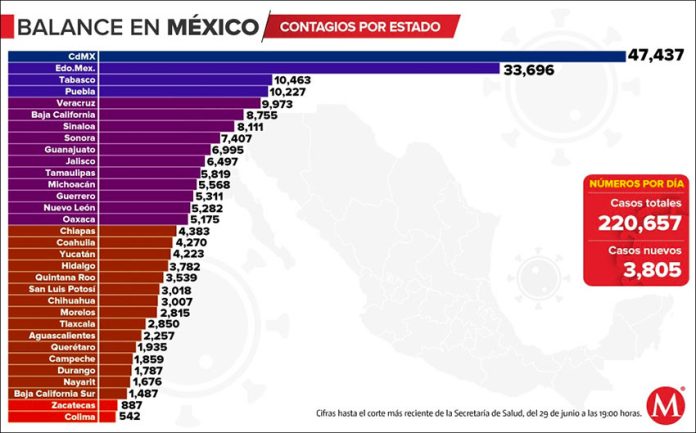
Accumulated coronavirus cases as of Monday evening.
Accumulated coronavirus cases as of Monday evening. milenio

The number of new coronavirus cases reported by the Health Ministry has trended downwards in recent days but Mexico does not appear to have reached the peak of its pandemic, according to Johns Hopkins University.

In a Covid-19 situation report published Monday, the Johns Hopkins Center for Health Security noted that Mexico had reported a decreasing daily incidence for three consecutive days. (Daily case numbers have now declined for four consecutive days.)

“However, Mexico does not yet appear to have reached its peak,” the report said.

“Based on recent trends, we expect Mexico to report increasing daily incidence over the coming days. Mexico is currently No. 6 globally in terms of daily incidence,” it added.

Indeed, data shows that the Health Ministry has generally reported fewer cases on Saturdays, Sundays and Mondays compared to preceding days, seemingly indicating that there is a delay in registering cases over the weekend.

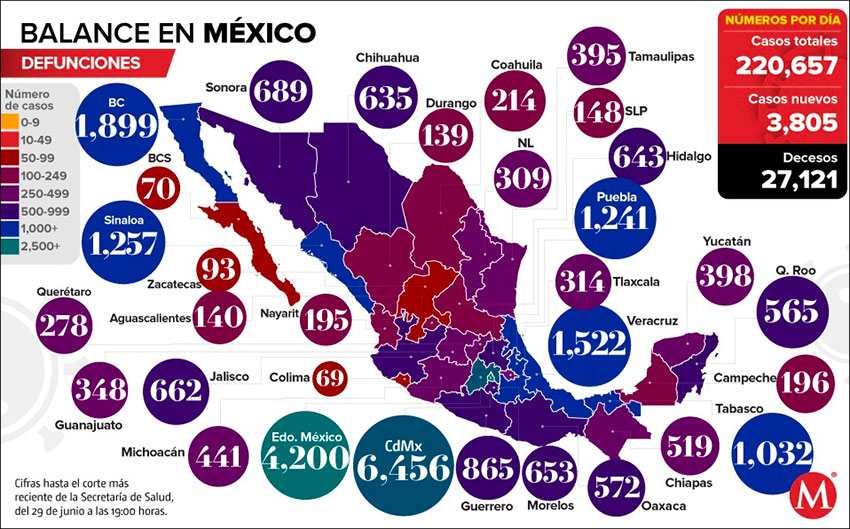
The coronavirus death toll as of Monday.
The coronavirus death toll as of Monday. milenio

However, Deputy Health Minister Hugo López-Gatell, the government’s coronavirus point man, asserted on Sunday that the speed at which Mexico’s coronavirus pandemic is growing has slowed.

At Monday night’s coronavirus press briefing, the Health Ministry reported 3,805 additional Covid-19 cases, increasing Mexico’s accumulated case tally to 220,657. It was the first time that fewer than 4,000 cases were reported since June 15.

The ministry also reported 473 additional Covid-19 fatalities, lifting the death toll to 27,121.

Almost two-thirds of all confirmed Covid-19 deaths were reported this month, although health officials have stressed that some of the fatalities reported on any given day occurred days, weeks or even months prior.

Based on confirmed coronavirus cases and deaths, Mexico’s fatality rate is currently 12.3, well above the global rate of 4.9.

In addition to Mexico’s confirmed Covid-19 fatalities, 2,055 deaths are suspected of having been caused by the disease.

Health Ministry Director of Epidemiology José Luis Alomía said that 23,389 of the confirmed cases are considered active, a decrease of 2,169 cases compared to Sunday. He also said that there are 66,910 suspected cases and that 566,602 people have been tested for Covid-19.

Mexico City, which switched from “red light” to “orange light” coronavirus restrictions this week, continues to lead the country for accumulated cases, active cases and deaths.

The capital has recorded a total of 47,437 cases, of which 3,431 are currently active. It has also recorded 6,456 confirmed Covid-19 fatalities.

México state ranks second for accumulated and active cases, with 33,696 of the former and 2,039 of the latter. It also has the second highest coronavirus death toll in the country, with 4,200 confirmed fatalities as of Monday.

Tabasco and Puebla are the only other states to have recorded more than 10,000 confirmed cases since the start of the pandemic.

Apart from Mexico City and México state, six states currently have more than 1,000 active cases. They are Puebla, Guanajuato, Tabasco, Tamaulipas, Veracruz and Yucatán.

Five states excluding the capital and México state have Covid-19 death tolls above 1,000. They are Baja California, Veracruz, Sinaloa, Puebla and Tabasco.

The Health Ministry presented data Monday night that showed that the average age of those who have died was 61 and 66% of deceased coronavirus patients were men.

Hypertension was the most common existing health problem among those who died followed by diabetes, obesity, tobacco addiction, chronic kidney disease, chronic obstructive pulmonary disease, cardiovascular disease, immunodeficiency disorders and asthma.

About seven in 10 patients who died from Covid-19 in Mexico had at least one existing identified health problem while three in 10 did not.

National data showed that 44% of general care hospital beds set aside for coronavirus patients are currently occupied while 39% of those with ventilators are in use. Every state in the country has at least 35% availability of both general care and critical care beds.

Source: Reforma (sp), Milenio (sp)