Home Blog Page 1594

Police arrest main suspect in case of Oaxaca acid attack

0
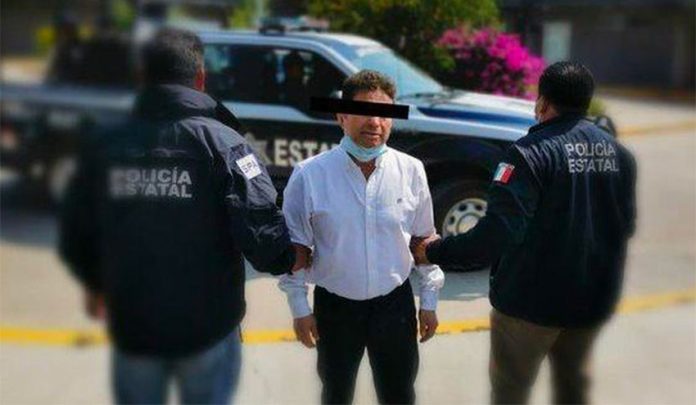
Juan Antonio Vera is accused of ordering the attack on musician María Elena Ríos.

Oaxaca state police have arrested former lawmaker Juan Antonio Vera Carrizal, the main suspect in the case of an acid attack on saxophone player María Elena Ríos Ortiz in September of last year.

Ríos was attacked with acid by a man pretending to be a travel agency customer on September 9 in Huajuapan de León, Oaxaca, leaving her disfigured and wondering if she would ever be able to play her instrument again.

The arrest was confirmed by Governor Alejandro Murat, who said that the ex-deputy “would now face justice for the terrible act of violence [he] committed.”

Vera was arrested about five weeks after the Oaxaca Attorney General’s Office (FGE) placed a 1-million-peso reward (US $53,000 at the time) on his head in February.

Interpol had also issued a Red Notice for Vera, initiating an international search, and the Financial Intelligence Unit had frozen his bank accounts.

On Friday the FGE arrested another man related to the crime who was responsible for paying the men to carry out the attack and is now facing charges of femicide.

Although recovery has been a long process that will continue for years, Ríos was able to regain the use of her hands well enough to once again play her saxophone for a TV audience in early March.

Sources: Milenio (sp), Expansión Política (sp)

Sayulita, Nayarit, shuts the door on vacationers

0
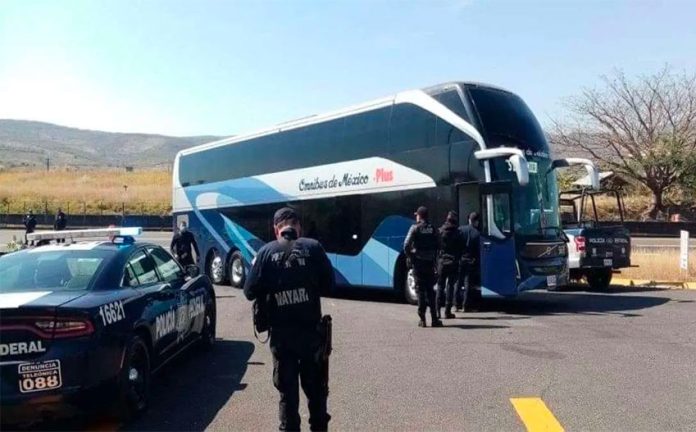
Police check traffic arriving in Nayarit.

Residents in Bahías de Banderas, Nayarit, the municipal home of the popular beach destination Sayulita, blocked access to the town over the weekend in order to prevent out-of-state tourists from visiting during the emergency period called in response to the Covid-19 pandemic.

The residents criticized the out-of-towners for ignoring the government’s recommendations to help mitigate the spread of Covid-19. Deputy Health Minister Hugo López-Gatell reminded the public on Friday that they should not be making plans to hit the road for the Easter vacation period.

Local media reports said that around 20 residents set up checkpoints at the entrances to the town. In a video shared on social media one can be heard telling the tourists attempting to enter that if they want to go on vacation they should pick somewhere else.

Later in the video an argument can be heard between residents and tourists, the latter complaining that there were no hotels in which to stay and the former reminding them that the announcement of the beach closures came many days prior to their arrival.

Nayarit Governor Antonio Echevarría posted a video to social media in which he expressed his anger over citizens traveling from Jalisco for vacation and urged Nayarit citizens not to provide services to them.

“We have made the decision to close all the [beach clubs], all the public pools. And I’m asking the people of Bahía de Banderas not to provide services to these people in your homes,” he said.

Echevarría said that an official in Jalisco had been in communication with him to let him know that many Jalisco residents were going to Nayarit for vacation.

“We are not going to allow them to come and infect our people,” he said. “Please stay in your homes in Guadalajara.”

The weekend’s events were not the only examples of communities closing themselves off to outsiders. Indigenous residents in Baja California Sur, Oaxaca, Chiapas and Chihuahua closed off access to their towns in response to the virus.

Source: Eje Central (sp)

For cooks in quarantine, try these video cooking classes and shows

0
Watching Jamie Oliver can be both inspiring and disheartening.

If you like to cook and quarantine is giving you more time to do so, there is a world of cooking shows out there and YouTube is the place to find most of them.

While there are still some traditional shows hosted by well-known chefs, many have been replaced by millennial personalities, who cook in a much more casual (and entertaining) way.

Navigating streaming and subscription options can be bewildering and even overwhelming but I hope my research will be useful.

I avoided any channels or sites that require registration or a subscription, like the Food Network.

This list is by no means complete. There are tons of video cooking classes and shows to choose from.

Martha Stewart and Snoop Dogg make brownies.

Let’s start with the award-winning Kin Community. With more than 8 million followers on YouTube, each themed episode feels like you’re in the kitchen with a friend. On the main site is a big menu of episodes with different hosts. All are free and the recipes are varied and interesting, from honey-glazed ham to shepherd’s pie (hosted by actress Tori Spelling) to praline French toast.

Regular hosts also have their own channels, and you can scroll through them on either the home or videos sections.

Another big name is Genius Kitchen, an app from Food.com with thousands of recipes and cooking videos. Stream it though Apple TV or other streaming players. Some videos are free, and subscriptions (annually or monthly) give access to more features. Search the YouTube channel or download the app (link above).

There are also thousands of printed recipes. The screen will ask you what you want to make: simply type in an ingredient or the name of a dish, and up pops any number of recipes, with gorgeous pix and clear instructions.

The beautifully done videos have no narration; ingredient lists and instructions appear on the screen as the recipe is being made. Background music is soft and pleasant. Recipes include lots of international dishes, like Tandoori chicken, toffee pudding and fish masala.

Twenty-four years on the on the Food Network and more than a million subscribers can’t be wrong. Chef Tyler Florence and his newest channel, Wolf It Down Live, offer up-close-and-personal cooking lessons with menus you’ll want to make. There are two dishes per episode, like roasted root salad with balsamic, citrus and arugula, and mushroom chicken marsala with parmesan polenta.

With hundreds of videos of varying lengths made by chefs, farmers, producers, restaurateurs, food activists, and culinary personalities, the focus of MAD: A Global Cooking Community is more on food education than cooking, but its wide-ranging international scope is fascinating. From a soba master to a fermentation expert, how to make a crab omelet or clean an artichoke in 20 seconds, this channel can be addicting.

Google Arts & Culture has a wealth of information that includes in-depth video and interactive explorations of the cuisine of different countries. Spanish Gastronomy includes a wine map, online “exhibits” of the ingredients and foods from all the different regions and charming subtitled cooking videos for classic dishes like paella and tortilla de patatas.

It also examines iconic dishes like tapas and Iberian ham; in short, the series is an immersion into a country’s cooking, ingredients and culinary traditions. So far, Spain, Nigeria and Japan are profiled. Start at the main page and see where you end up.

Outside of Hell’s Kitchen, Chef Gordon Ramsey is actually kind of a sweetheart in the kitchen. Thirteen million followers can’t be wrong, right? A consummate professional, Ramsey guides viewers through basic and complex dishes, explaining technique and ingredients as he goes along.

His accent and his expressions – calling a ricer “posh” – are charming, and he knows how to work the camera. Episodes include showing an NFL star how to make the perfect rib-eye, mastering five basic cooking skills and making salmon scrambled eggs. You have to pay for the master class series, but Ramsey’s basic cooking show is free on his YouTube channel.

PBS has been presenting Martha Stewart’s Cooking School on YouTube for more than five years, with four themed recipes per episode. She shares cooking tips and techniques, explanations of ingredients and cooking techniques in her trademark calm, confident voice.

Tori Spelling and her shepherd's pie.
Tori Spelling and her shepherd’s pie.

For the past few years, Stewart has teamed with rapper Snoop Dogg — with dark glasses and an X-rated vocabulary — and their cooking classes are entertaining as well as informative.

Watch “Making Mashed Potatoes” as they discuss white vs. black pepper, and why adding cognac to mashed potatoes is a good idea. For a huge laugh, watch them make brownies —minus the “greens,” to Snoop’s dismay.

Watching an accomplished chef like Jamie Oliver can be both inspiring and disheartening as he cooks everything so easily, from a make-at-home pizza from scratch to the perfect steak and tiramisu. He’s also able to adapt many recipes to be vegan or vegetarian as he’s cooking, plus you’ll find specialty recipes, like a veggie sausage roll. (“A proper mouthful of heaven.”)

Also on Oliver’s channel are classes from his mentor, popular Italian chef Gennaro Contaldo, like an easy tuna pasta that he somehow makes seem elegant, or his chicken with chile, garlic and rosemary, filmed on the Amalfi coast in an outdoor kitchen high up on the cliffs.

Contaldo is also known for the BBC television series Two Greedy Italians which ran for many years.

And then there’s outrageous, lovable Kalen Allen, with almost a million followers on his YouTube channel and a regular stint on The Ellen Show too. What Kalen does, with his own unique style, is “review” strange, weird, sometimes scary food videos. His reactions are — well, you just have to watch yourself.

Among my favorites are “Kalen Reacts To Seltzer Chicken,” where a can of orange soda is roasted inside a whole chicken (oh my), “Kalen Reacts to a Hot Dog Waffle,” and “Kalen Reacts to Day of the Dead Tamales.” () These are less instructional than entertaining, but hey, you never know.

Enjoy!

The writer is Mexico News Daily’s food columnist. Her recipe column, The Tropical Table, appears every Monday.

Forecasters predict 4 major hurricanes in Atlantic this season

0
The Atlantic hurricane season begins June 1.

This year’s Atlantic hurricane season is shaping up to be “above average” as climate experts from Colorado State University (CSU) forecast four major hurricanes and a total of 16 tropical storms for 2020.

CSU meteorologists said that this year will be “very active for tropical storms and hurricanes in the Atlantic basin.”

Its historical data reveal that on average the region sees around 12 tropical storms each year, including six hurricanes and three Category 3 storms or higher.

Forecasters expect about eight hurricanes, four of which will be Category 3, 4 or 5.

One factor influencing the hurricane season is the current wane of the El Niño phenomenon, leading to higher ocean surface temperatures, which in turn feeds and intensifies tropical storms and hurricanes.

Although CSU’s data goes back four decades, it still cannot clearly predict how specific areas will be affected. Statistics suggest that areas like the Bahamas and parts of the southeastern United States hit hard by hurricanes Joaquín, Mateo, Irma, Florence, Michael and Dorian might see a break from the bad weather this year.

As with any natural disaster, vigilance and preparedness are key, said the CSU scientists, hoping places devastated by the powerful storms that have ravaged the reason since 2015 aren’t hit hard again.

The Atlantic hurricane season begins June 1 and ends November 30.

Source: El Financiero (sp)

Public investment, social spending at heart of president’s economic plan

0
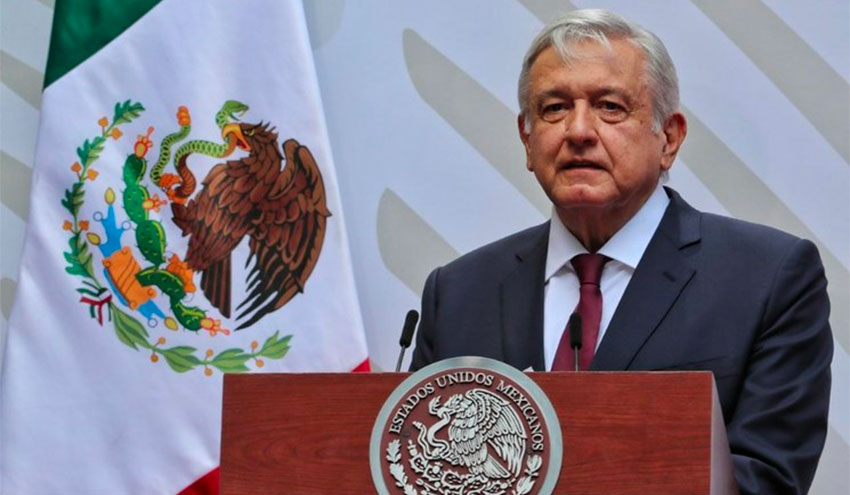
AMLO delivers his address in Mexico City on Sunday.

President López Obrador said Sunday that the federal government will increase public investment and social spending, create 2 million jobs, provide loans to small businesses and individuals and adopt additional austerity measures in response to the coronavirus-induced economic crisis.

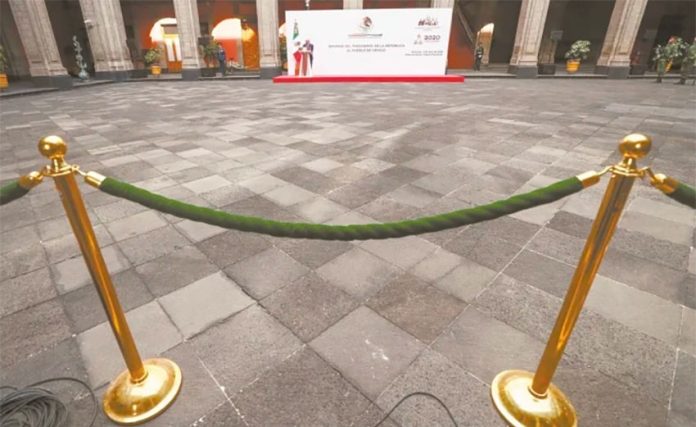
In a televised address from the near empty patio of the National Palace in Mexico City, López Obrador stressed that his administration will not bail out large companies, cut their taxes or increase public debt to support the economy as Mexico braces for a recession seen as inevitable due to the Covid-19 pandemic and the measures implemented to contain the spread of the disease.

Instead, it will strengthen actions in support of the poorest and most vulnerable, he said.

“In the face of recurrent crises, [past] leaders said that we had to take out more loans, bail out large companies and banks, convert the private debt of a few into public debt, establish tax privileges, put the prices of fuel and public services up, reduce salaries, dismiss workers and cut social security. Now this is not going to be done, it’s not the way. … The wellbeing of the people comes first. … Privileges, corruption, looting [of public coffers] and impunity – never again,” he said.

“The [economic] plan does not conform to the neoliberal model. Nothing will make us go back to the past,” the president declared.

López Obrador stressed that all of the government’s major infrastructure projects, including the Santa Lucía airport and the Maya Train, will continue, adding that his administration will invest an additional 25 billion pesos this year (US $1 billion) on water and drainage projects and to pave roads.

He also said that the government will build 50,000 new homes in marginalized areas, creating 228,000 jobs, and that the Federal Electricity Commission will build thermal power stations on the Yucatán Peninsula.

Pemex, the heavily-indebted state oil company, will get a 65-billion-peso tax break, the president said, while a 339-billion-peso (US $13.6 billion) public/private program for investment in the energy sector will be announced next week.

The State Workers Social Security Institute will provide personal loans of between 20,000 and 56,000 pesos (US $800-$2,250) to 670,000 workers and two government housing funds will issue housing loans worth 177 billion pesos to more than 440,000 workers, López Obrador said.

Small businesses and people who work in the informal economy will also have access to loans, he said, without specifying how much money they will be able to borrow. All told, 2.1 million government loans will be on offer, Lopez Obrador said, pledging that the government will not abandon the nation’s neediest.

The president also said that 190,000 fishermen will receive direct financial assistance from the government and that parents’ associations will be allocated additional funding for the maintenance of 31,000 schools.

Although large business will not receive any tax concessions or other financial support to help them weather the coronavirus storm, the government will “promptly” return tax refunds they are owed, López Obrador said.

The president asserted that the government will create 2 million jobs over the next nine months, highlighting that 80,000 of them will come from construction of the Maya Train in the country’s southeast.

López Obrador also said that an additional 200,000 jobs will be made available via the government’s tree planting program and that the modernization of the railroad across the Isthmus of Tehuantepec will create more than 7,000 jobs.

Funding for the economic response to the coronavirus pandemic – officially called the Emerging Program for Well-being and Employment – will come from a government stabilization fund, a range of trusts and the state development bank, he said.

Despite the depreciation of the peso and the impact of the coronavirus pandemic on the global economy, “we are doing everything possible to maintain the commitment not to increase public debt,” he declared.

To save public money, López Obrador said that he and all government ministers will take pay cuts and that high-ranking officials won’t receive end-of-year bonuses. He added that the government will reduce its advertising and operational costs as well as spending on travel, and seek to make additional savings in its purchases.

The president said that no government employees will lose their jobs but he called on them to work more efficiently and with greater commitment and “spirit of service” while maintaining “complete honesty.”

He thanked banks that have given their customers the option of freezing their loan and interest repayments for six months and expressed gratitude to businesses that have followed the government’s order to cease non-essential activities while maintaining their workforces and continuing to pay employees their full salaries.

“They’re showing their humanism, their social dimension,” López Obrador said.

He also reiterated his message that the coronavirus crisis is a temporary one that the country will overcome soon.

“Despite the adversities the transformation of Mexico will not stop, our strengths are greater than our weaknesses. … This crisis is passing, transitory,” López Obrador said.

“Soon normality will return. We will overcome the coronavirus. We will reactivate the economy and Mexico will remain standing, showing the world its glory and greatness.”

Source: El Universal (sp), La Jornada (sp), El Economista (sp), El Financiero (sp) 

Transmission of coronavirus accelerates; 2,143 cases as of Sunday

0
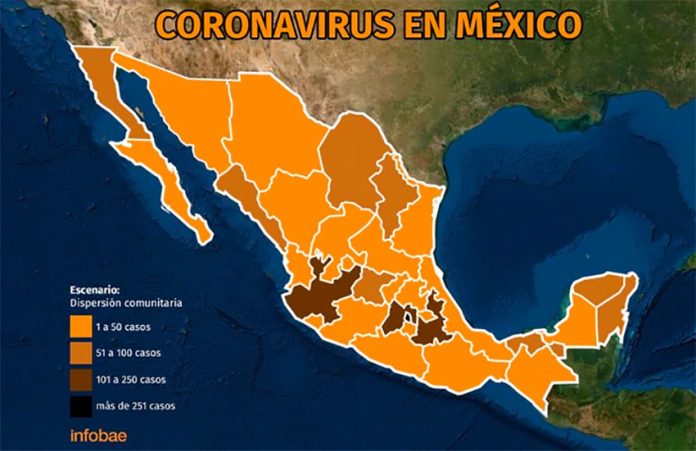
Coronavirus cases in Mexico: the darker the color the more cases.

The number of confirmed coronavirus cases in Mexico had risen to 2,143 and deaths totaled 94, Deputy Health Minister Hugo López-Gatell told a press conference on Sunday evening.

He said that Mexico remains in Phase 2 of the outbreak and is slowly approaching the plateau of infections in which the number of new daily cases either remains the same or falls.

However, that is no reason to let up on the preventative measures recommended and implemented by the federal government for its emergency declaration, López-Gatell said.

The number of cases on Sunday increased by 253, after health officials reported on Saturday that confirmed cases totaled 1,890, deaths were at 79 and possible cases numbered more than 5,000.

President López Obrador said yesterday there is still a long way to go before the economy and society can see a return to normal life, and reiterated his call for people to remain at home as much as physically possible.

Coronavirus by state
State Deaths Cases Suspected Tested negative
Mexico City 19 560 697 1382
Sinaloa 12 90 248 242
Jalisco 6 123 774 1036
Baja California 6 69 201 360
Hidalgo 5 34 73 227
Coahuila 4 82 222 439
State of México 3 204 434 745
Tabasco 4 97 342 313
Veracruz 3 40 404 280
Morelos 3 15 45 126
Quintana Roo 4 86 110 214
Querétaro 2 38 37 247
San Luis Potosí 2 37 111 407
Baja California Sur 2 28 92 180
Durango 3 12 48 99
Zacatecas 2 10 45 164
Puebla 1 147 199 346
Nuevo León 2 91 203 819
Michoacán 3 30 49 222
Sonora 1 28 114 227
Guerrero 2 30 112 160
Oaxaca 1 25 30 198
Tamaulipas 1 26 67 156
Nayarit 1 9 18 84
Yucatán 2 67 68 262
Guanajuato 53 162 924
Aguascalientes 49 122 378
Chiapas 25 52 128
Chihuahua 15 29 85
Tlaxcala 11 72 153
Campeche 8 10 39
Colima 4 19 40
Deaths Cases Suspected Tested negative
Total 94 2143 5209 10682


López-Gatell said that Phase 3 of local transmission, in which community transmission of the disease is widespread and cases number in the thousands, will begin in around two to three weeks.

The area of Mexico hit hardest by the virus so far is the Valley of México, which includes Mexico City and México state with 560 and 204 cases, respectively.

Source: El Universal (sp)

The María doll: from street vendor to international icon

0
Lele, a giant-sized María doll that has traveled the world to promote Mexican tourism.

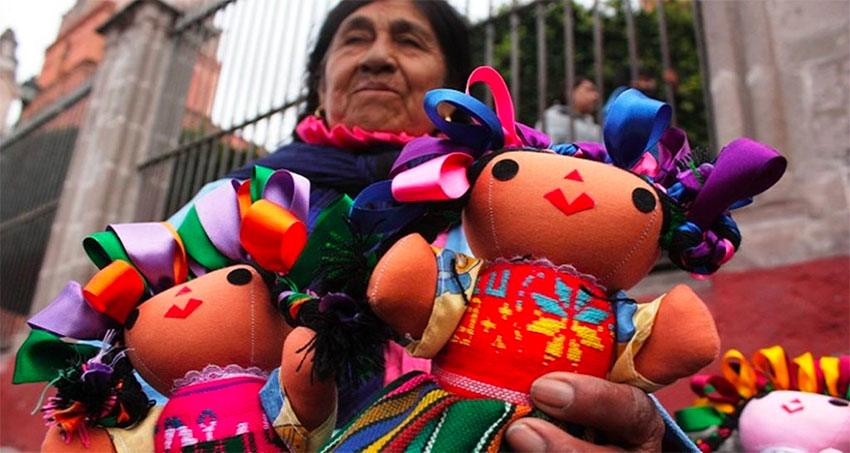
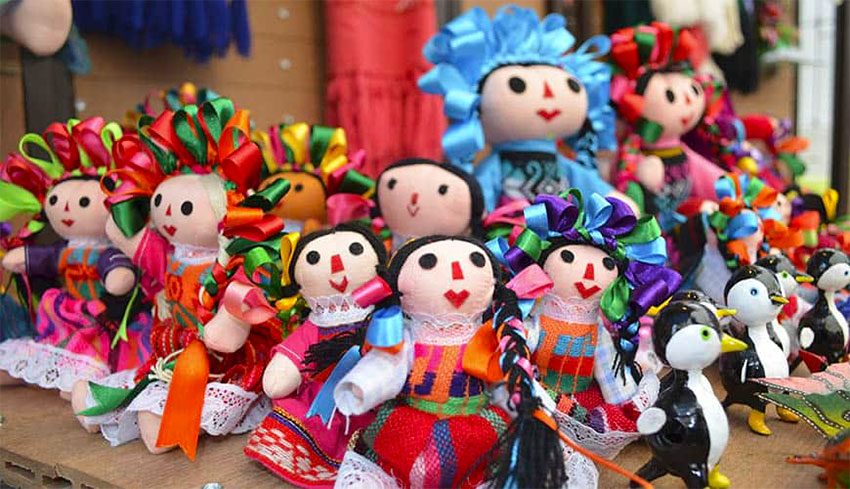
Smiling along with her sisters in markets and on street vendors’ stands is the “María” doll. She is readily identified by her wide face, hair braided with multicolored ribbons, and a vaguely indigenous dress.

Now a symbol of Mexico found in tourist promotions all over the world, she has a surprising but unknown backstory.

The doll is strongly tied to the Otomí people of Amealco municipality in southern Querétaro, a few hours northwest of Mexico City. She is big business, with over 500 workshops employing about 70% of the people here. The Otomí, the municipality and the state have promoted the dolls, leading most to believe that she originated here.

But that is not the case.

Her origins, believe it or not, are in Mexico City in the 1970s.

A street vendor and her María dolls.

In the mid-20th century, there was a wave of Otomí and Mazahua migration into the capital. These migrants eked out a living working on the streets of Mexico City.

Their presence was not exactly welcomed by established businesses, and the indigenous women were readily identified by their use of traditional clothing. They became stereotyped with the name “María,” the basis of the famous comic figure La India María from Mexican movies and television at that time.

Even more problematic was that these women were subject to harassment from both merchants and local authorities. The city decided to intervene by establishing the Programación y Estudios Económicos (PYEE, Programming and Economic Studies) to provide these women with an alternative.

The program had these women make their traditional handcrafts, mostly embroidery, in two centers based in La Merced and Coyoacán. The city would buy their handcrafts to resell, and provide the women with childcare, nutrition and basic education.

The program was initially successful, attracting over 800 women within a short time.

The María doll, made to represent the Marías who worked on the street, was the idea of the PYEE’s manager, Guadalupe Rivera Marín, daughter of the famous Mexican painter Diego Rivera.

The María dolls originated in Mexico City in the 1970s.

Experts were hired to design the doll and the production method and to train the women how to use industrial sewing machines. The doll’s dress is roughly based on that of the more colorful Mazahua dress but simplified to make it easier and quicker to sew.

By far, the dolls are the most successful thing to come out of the program, but not in the way that was intended.

Over time, the PYEE waned due to continued opposition to the indigenous by merchants, fallout from the 1985 earthquake and administrative/financial problems that were never resolved. Today, all that is left of the original program is a small non-profit called the Sociedad Cooperativa Flor de Mazahua, which is basically one family headed by Antonia Mondragon working out of a home next to the Mexico City airport.

The women who learned how to make these dolls did not keep this knowledge to themselves. The doll and its production “went home” to the Mazahua/Otomí areas in México state, Michoacán, Querétaro and Guanajuato.

The success of the dolls here is likely because of economics. Making a living with handcrafts is not easy anywhere, but far more possible in areas with lower costs of living and fewer alternatives for work.

The dolls are made in all four states but it is the Otomí of Amealco who have capitalized on them the most. Artisans here often tell stories about someone in dire economic straits who used the dolls to overcome the difficulty, and mostly likely believe the tales.

The truth is that Amealco’s legitimate claim to the doll comes from its impressive efforts in both the production and promotion of the Marías, allowing them to have national, and now international recognition.

The artisans here have also taken the next steps in creating newer versions, such as those representing La Catrina, brides, other indigenous groups and even characters from Disney movies. This means that the doll’s identifying characteristic is shifting from the ribbons and dress to the wide, multipaneled head, found on no other doll handcrafted in Mexico.

This lack of awareness about Marias’ origin does have one problem. There has been a campaign in the Amealco area recently claiming that the “María” name is racist. The alternative suggested for the doll is Lele (“baby” in Otomí). The claim is accurate in associating “María” with the negative stereotype, but it forgets that the doll was originally created to represent the street vendors.

The story of the Marías is important in another sense. They are the spark behind a growing trend to make cloth dolls that represent Mexico’s various indigenous groups. Although cloth dolls were made before the Marías, the dolls developed since then have all been for commercial purposes.

They have become an important item for textile artisans, in particular because they are relatively easy to sell.

Mexico News Daily

19 killed in clash between crime gangs in Chihuahua

0
A vehicle at the scene of Chihuahua ambush.

At least 19 men died Friday evening in a clash between two criminal gangs in Madera, Chihuahua.

A survivor told police that about 20 members of the Gente Nueva del Jaguar were traveling in a convoy between the communities of Chuhuichupa and La Norteña when they were ambushed by 40 members of La Línea.

The Gente Nueva are linked to the Sinaloa Cartel and La Línea to the Juárez Cartel. The two are fighting for control of drug trafficking routes in the mountainous region near the Sonora border.

Military personnel and state police found two vehicles peppered with bullet holes, 18 firearms and two hand grenades at the scene.

Source: El Financiero (sp)

No visitors: many communities restrict access to combat coronavirus

0
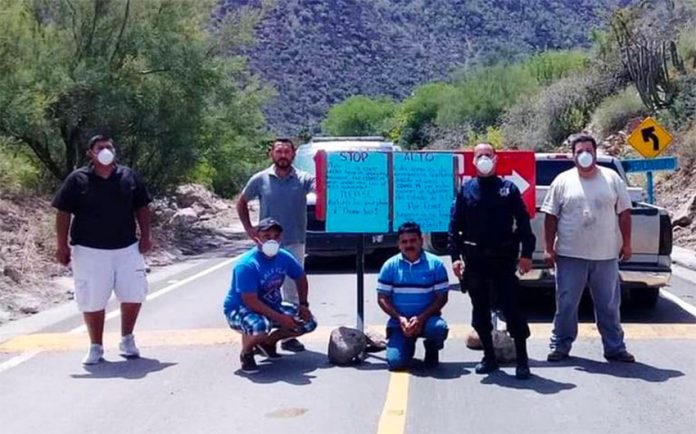
San Javier residents block the road into their community in light of the coronavirus emergency.

Residents of indigenous communities across the country are starting to say no to visitors, closing off access to their towns in order to avoid Covid-19 outbreaks in areas with high concentrations of vulnerable people and few medical resources.

Residents of San Javier in the Baja California Sur municipality of Loreto came to a consensus to close off the town on Thursday, citing the high percentage of elderly people and a lack of medical supplies.

Local authorities said there were currently no confirmed cases of Covid-19 in Loreto, and the citizens of San Javier are hoping their isolationist tactics will keep it that way.

In the south of the country, residents of San Juan Bautista Valle Nacional in northern Oaxaca voted by 80% to close the municipality off to outsiders to avoid contagion.

Mayor Rey Magaña García said that the vast majority of the municipality’s 53 communities voted to block access roads to all who are not residents, including relatives from other areas.

He also cited the risk to the municipality’s vulnerable population as a reason for taking the action, noting that Valle Nacional receives a lot of traffic moving between the state’s Cuenca del Papaloapan and Valles Centrales regions.

Restaurants in the municipality remain open, but only for take-out orders, tourist centers like the Monte Flor and El Zuzul swimming holes are closed and police are patrolling the river to ensure people aren’t gathering to swim.

Several communities in the Chiapas municipality of Ocozocuautla took similar measures to avoid Covid-19, blocking highways, closing tourist services and publicly requesting that people not visit.

In the north, authorities in two Chihuahua municipalities have been told by the state government that their decisions to close their towns were illegal.

Residents of Samalayuca formed brigades that began to stop and try to “persuade” visitors not to enter the municipality on March 26. Four days later, Mayor Javier Meléndez Cardona announced the all-out closure of access to anyone not from the 1,500-population town.

“Please don’t come,” he said on social media, adding that parks, tourism and other attractions were all shut down anyway. Samalayuca is known for its white sand dunes, waterparks, cave paintings and agricultural festivals.

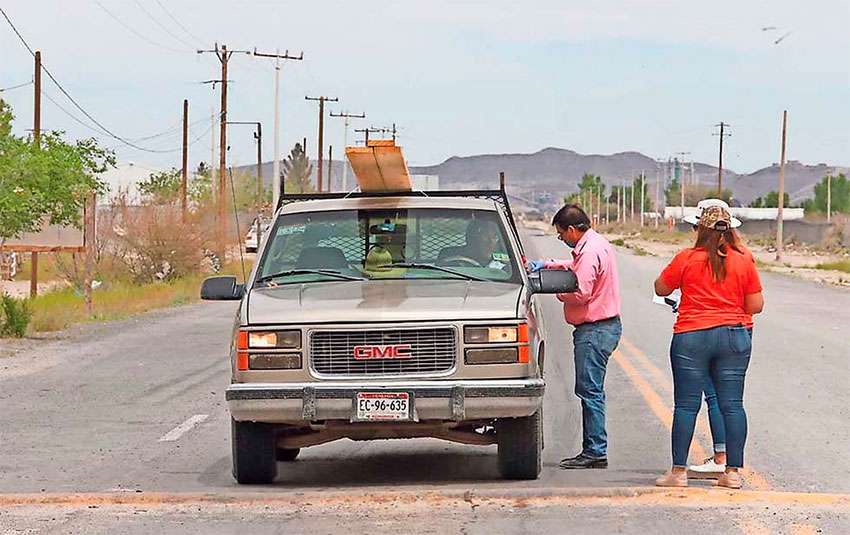
A vehicle is checked on a highway in Samalayuca, Chihuahua.

The restriction applies only on weekends and will remain for the duration of the month-long emergency period.

Over 600 kilometers away, the municipal government of Urique, located in the famous Copper Canyon region, has prohibited outsiders from both entering and leaving the town.

Municipal representative Angélica Torres said that the decision aims to protect the town’s indigenous residents, who make up around 70% of its population.

“[Indigenous residents] are a bit more rooted in their customs and they don’t pay attention to whatever normal preventative measure we might tell them, like washing their hands, keeping their distance, sneezing into the arm,” she said of the threat the virus poses to them.

“They definitely don’t comply with these types of measures and the truth was that this was one of the situations we thought about most … that if there is contagion in the municipality, they’ll be the main ones affected,” she said.

Speaking to both the local community and tourists from across the globe, Torres pleaded with people not to visit the popular tourist destination during the Covid-19 pandemic crisis.

“We’re issuing this request to the community and to tourists in general not to come to our municipality for the wellbeing of our Rarámuri people, who are our most vulnerable population … [and] for the wellbeing of everyone,” said the local government in a statement.

“Please pardon the inconvenience. We’ll get through this crisis together,” it said, adding that the closure will be lifted on April 20.

A spokesperson for the state Ministry of the Interior, Alejandro Solís, said that both municipalities were alerted that their closures were illegal by state Interior Minister Luis Fernando Mesta Soulé on March 30.

“In the end it’s a crime to impede the transit of other people,” said Solís.

“We understand perfectly that the authorities are worried about their citizens, but … in this case they’re violating a [constitutional] right,” he said.

There is currently no effort at the state level to open up the communities, he said, as they are hoping the communication will be sufficient for the municipalities to make the decision to do so themselves.

Chihuahua had 11 confirmed cases of Covid-19 as of Friday, and the number of suspicious cases had dropped to 20. Oaxaca had 22 confirmed and 73 suspicious cases. Chiapas had 18 confirmed cases and Baja California Sur had 21.

Sources: El Sudcaliforniano (sp), NVI Noticias (sp), Cuarto Poder (sp), Pie de Página (sp)

More communities implement restrictions on alcohol sales due to coronavirus

0
Ley seca, or a 'dry law,' is being introduced in various states.

“Dry laws” that put restrictions on alcohol sales, commonly enacted during elections, are popping up in communities across the country, triggered by the month-long coronavirus emergency.

The laws range from restrictions on hours of sale to all-out prohibitions on the sale and consumption of alcohol.

State and local authorities in Tabasco, Baja California Sur, Sonora, Campeche and Quintana Roo are the most recent to announce that they will restrict or prohibit alcohol sales, following a trend that began on Thursday in Nuevo León.

The strictest regulations in the country have been applied in Tabasco, where even consuming alcoholic beverages has been prohibited for the duration of the emergency period. The governor announced the restrictions in a taped recording on Wednesday, but did not explain what the benefits of the measure might be.

Municipal authorities in Los Cabos, Baja California Sur, announced the prohibition of alcohol sales beginning on Monday, threatening any businesses that fail to comply with fines ranging from 8,600-16,800 pesos (US $345-$673).

Also in Baja California Sur, the municipality of Comondú announced on Friday the immediate prohibition of alcohol sales for the remainder of the month-long emergency declaration, with sanctions running from fines to shutting down businesses.

Less restrictive actions were announced in Sonora, Campeche and Quintana Roo, which will take lighter measures such as restricting the hours in which alcohol can be sold.

Authorities in Sonora said the temporarily adjusted sales schedules would be based on population sizes in the municipalities.

Alcohol sales in Campeche will be prohibited from noon to 6:00 p.m., making beer, wine and spirits available in the evening.

In a move contrary to its very raison d’être, Quintana Roo, the home of such popular tourist and party destinations as Cancún, Tulúm and Cozumel, will also restrict alcohol sales, but only slightly.

The prohibition will only restrict the sale of alcoholic beverages from 10:00 p.m. to midnight from Monday to Saturday in certain municipalities, including those in which the state’s popular tourist destinations are located.

Alcohol sales will continue to end at 5:00 p.m. on Sunday in the state and normal sales hours will resume on April 10.

The only reason that has been given for the dry laws was offered by Nuevo León Governor Jaime Rodríguez, who predicted physical conflicts arising among people imbibing while cooped up in their homes due to the coronavirus quarantine.

President López Obrador weighed in on the subject at his press conference on Friday, indicating that health officials would have to decide whether alcohol consumption should be restricted during the coronavirus emergency.

But he suggested the value of doing so appeared doubtful.

Beer drinkers in areas that have not enacted dry laws may still have reason to worry about the availability of the beverage as major beer makers have announced they will halt production after the government deemed the industry “nonessential.”

Sources: Milenio (sp), Infobae (sp)