The 'doctors' had opened one ATM when an alarm sounded.
Eight men dressed as doctors attempted to rob the ATM machines at a hospital in the Mexico City borough of Tlalpan, but were forced to flee when their actions set off the security alarm.
The men were wearing fake coats and ID badges from the Ignacio Chávez National Cardiology Institute when they entered the ATM area of the hospital’s emergency room lobby at around 3:00 a.m. on Wednesday.
After entering without causing suspicion, they began to try to open the bank machines. They managed to open one but it immediately activated the security alarm.
Hospital security officers arrived on the scene upon hearing the alarm and saw the men flee the ATM area and escape in the vehicle in which they had arrived.
Authorities received a 911 call regarding the attempted robbery and police officers were sent to the hospital to secure the area.
Mexico City police said in a statement that the hospital’s head of security told them that he and his partner observed the men enter the facility dressed and identified as doctors.
Investigators are using the city’s C5 security camera system to ascertain the robbers’ getaway route. They established a virtual perimeter to create a model of their possible trajectory.
Authorities had yet to determine the identities of the disguised men as of Wednesday night, but it was confirmed that they had been unable to get away with any of the cash in the bank machines.
The Maya Train was to run from Valladolid to Tulum through Cobá, as shown. Now it will revert to the original plan, with track running between Valladolid and Cancún.
A judge has granted a definitive suspension order against the Maya Train project to a group of Maya and Ch’ol people in Campeche but it only applies to one community in the municipality of Calakmul.
Campeche-based Judge Grissel Rodríguez Febles ruled on Wednesday that the National Tourism Promotion Fund (Fonatur), which is managing construction of the US $7-billion Yucatán Peninsula railroad, cannot carry out any new work within the limits of the community of Xpujil.
The decision came five days after a court in Campeche upheld a provisional suspension order granted to the Maya and Ch’ol people that prevented Fonatur from commencing new construction work anywhere in the five states – Quintana Roo, Yucatán, Campeche, Tabasco and Chiapas – through which the railroad will run.
The indigenous people applied for an injunction against the Maya Train on the grounds that the government consultation process, held prior to a December vote on the project that found over 92% support, was not conducted in accordance with their rights.
After Wednesday’s ruling, Fonatur noted in a statement that the definitive suspension order does not prevent it from calling for tenders or carrying out work on more than 99% of the 1,500-kilometer project.
The federal agency added that it will continue dialogue with the 19 people who filed the injunction against the project “with the aim of safeguarding the rights of all residents” in Calakmul. Fonatur also said that it was confident that there is sufficient evidence to have the suspension order overturned.
However, if the prediction of a lawyer who advised the people that filed the legal action comes true, Fonatur will face many other legal battles to proceed with the railroad, which is scheduled to begin operations in 2023. Elisa Cruz Rueda said in January that it is likely that other communities in the five southeastern states through which the rail project is slated to run will also be granted injunctions.
Meanwhile, Fonatur chief Rogelio Jiménez Pons told the newspaper Milenio that the project will not include a section of track between Valladolid, Yucatán, and Tulum, Quintana Roo, as announced last June.
Fonatur said in June that the railroad would not directly link Valladolid to Cancún and that there would instead be a line between the former city and Tulum, where travelers would be able to take another line north to Cancún. The agency said at the time that the route change would knock 5.5 billion pesos (US $278 million) off the total cost of the project and 55 kilometers off its length.
However, Jiménez said that the change will not go ahead because of the large number of archaeological sites around Cobá, Quintana Roo, and problems with the subsoil in the area.
“We’re going to make a change, we have to return to the original route from Valladolid to Cancún,” he said, explaining that the decision was taken a few days ago.
Jiménez said that Fonatur will look for savings in other areas of the project to ensure that it doesn’t exceed the planned budget of 139 billion pesos.
Police search for animal that killed a 50-year-old man.
The México state Ministry of Education suspended classes indefinitely in 13 schools in Valle de Bravo after a resident of the municipality was killed by what is believed to have been a big cat.
A man of around 50 years of age was found dead on Sunday in the community of Cerro Gordo. The nature of the wounds found on his body have led authorities to believe that the attack was carried out by a species of large cat.
México state Governor Alfredo del Mazo Maza issued an alert for the communities of Cerro Gordo and El Pinal del Marquesado and urged residents not to go to the area where the attack occurred.
The Ministry of Education took the extreme measure of cancelling classes on Wednesday, announcing that the suspension is indefinite while authorities from the state Commission of National Parks and Forests (Cepanaf) search for the animal.
The suspension includes seven primary and six secondary schools.
State and municipal authorities are carrying out surveillance operations in the municipality.
“The municipal environmental department has already been in contact with specialized personnel from Cepanaf … and [the federal environmental agency] Profepa with the aim of searching the area, finding the cat and taking it to a zoo,” said Valle de Bravo Mayor Mauricio Osorio on his Facebook page.
Authorities took DNA samples of the animal found on the body to ascertain what type of feline might have carried out the attack. They also set up camera traps that will help obtain specific data in order to confirm the species.
In addition to agents from Cepanaf, Profepa and the Ministry of the Environment, there are also personnel from the National Protected Areas Commission, the México state Attorney General’s Office and state and municipal Civil Protection in the area.
Marines and state police have also been deployed to the municipality to aid local police in security operations.
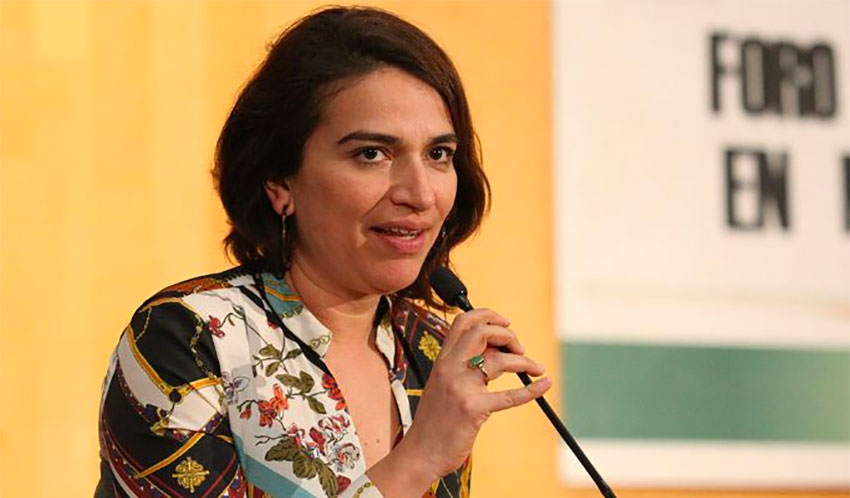
Guevara: alleging corruption is far from the truth.
The director of the National Commission for Physical Culture and Sport (Conade) lashed out at the Ministry of Public Administration (SFP) on Tuesday over its questioning of the use of almost 31 million pesos (US $1.6 million).
Speaking to reporters after attending a meeting at the National Palace on Tuesday morning, Ana Gabriela Guevara accused the SFP of getting ahead of itself by publicly questioning the use of the funds before the audit process is finished.
Guevara’s remarks came two weeks after Public Administration Minister Irma Sandoval told a press conference at the National Palace that the SFP had detected that Conade had presented “false invoices” to justify the high costs it incurred for expenses such as travel.
“This case is serious due to the immorality … it implies,” Sandoval said. “The possible damage [to public coffers] … is almost 31 million pesos.”
Guevara asserted that Conade has done nothing wrong, charging that the SFP is only assuming that there were irregularities in the use of public money by the commission. The former Olympic 400-meter runner accused the ministry of being “treacherous” by saying that irregularities had been found before the audit process is completed.
Sandoval claimed there were false invoices.
“All the departments have irregularities, all the ministries have irregularities but … saying that there are serious crimes of corruption is a long way off” the truth, Guevara said.
“We have the right to defend ourself; the most serious thing of all was the violation of the right of reply and of the constitutional guarantee of the presumption of innocence,” she said.
Later on Tuesday, the SFP rejected that claim, saying that it has always respected the right of reply and presumption of innocence and that Sandoval’s remarks didn’t amount to an accusation against Guevara.
“The Ministry of Public Administration always conducts itself in accordance with the law and with strict respect to due process and fundamental rights,” the SFP said in a statement.
For those reasons, the ministry never makes accusations against public officials before the conclusion of an investigation, the statement said.
The SFP said that the remarks made by Sandoval at last month’s press conference consisted of “public information” and that the minister provided it after being instructed to do so by President López Obrador.
The ministry and Sandoval have made it clear that an SFP audit in itself cannot lead to the imposition of a penalty on any person found to have acted corruptly. Only separate investigations into irregularities that have been detected by audits can result in sanctions, the SFP said.
Guevara, a silver medal winner at the 2004 Athens Olympics who was appointed Conade director at the start of the López Obrador administration, has also faced pressure due to the SFP’s detection of irregularities in the use of 50.8 million pesos allocated to the government’s high-performance sports fund known as Fodepar, which is used to provide grants to elite athletes.
National Action Party Deputy Miguel Alonso Riggs last month accused the Conade chief of embezzling resources from Fodepar and called for her dismissal.
“This is an issue that has been hurting athletes, sport in Mexico. I think that speaking about the dismissal of Ana Gabriela Guevara from Conade is appropriate [although] probably a little late,” he said.
The big-box home improvement store The Home Depot announced that it will invest nearly 2.4 billion pesos (US $122.8 million) in Mexico this year, which will include the opening of four new stores.
The company said that it aims to continue consolidating its presence in Mexico by improving customers’ experiences, maintaining productivity and increasing efficiency. It invested 1.95 billion pesos in its Mexico operations in 2019, 0.25 billion more than in each of the previous two years.
One of the retailer’s goals is to improve distribution, for which it will open two logistics nodes to supply stores with the lowest inventories on their sales floors. It will also augment two distribution centers to increase its warehousing capacity.
The company said that it will “strengthen its PRO strategy, directed at construction professionals, both in stores and online, through the renovation of modules and personalized service in the store,” among other changes.
It said that it plans to link brick-and-mortar stores with online commerce to be able to serve customers at any moment and in any part of the country. It will reinforce its customer service at both points of sale to achieve this, the company said.
The company closed 2019 with 125 stores in all of Mexico’s states, including Mexico City.
Rescuers break through a wall to retrieve abandoned baby.
Rescue workers in Mexico City freed a newborn baby who was found trapped between the walls of two buildings in the borough of Iztacalco on Tuesday.
Members of the Rescue and Medical Emergency Squadron responded to 911 calls in which neighbors reported hearing a baby crying somewhere in the walls of a building on Plutarco Elías Calles street in the neighborhood of Santiago Norte.
They spotted the baby girl from the roof of the building. She was trapped three meters down in the space between the walls of the buildings. They also saw blood stains on the bricks.
Rescue workers broke through the wall of a residence in order to get the baby out, after which she was treated by paramedics and diagnosed with bradycardia, or a low heartrate. Firefighters arrived on the scene to take her to a pediatric hospital in the borough.
Although the infant was found alive, her presumed grandfather told the news outlet Telediario that his daughter had had an abortion on Monday, adding that she later ran away. It is believed that she threw the baby into the space between the buildings from the roof before fleeing.
The infant was reported to be in critical condition.
According to the United Nations Children’s Fund, there were 1.6 million orphaned minors in Mexico in 2017.
However, the lack of an official database for orphaned children has led to a number of different estimates. The organization Aldeas Infantiles SOS México estimates that there are 412,456 orphaned children in the country.
The federal Social Assistance Accommodations Census reports that there are 879 orphanages in Mexico, which look after a total of 30,000 children and teenagers.
Among the principal causes of orphaned children are abandonment, migration and organized crime.
Mexican soprano Denis Vélez is one of five candidates selected in a competition for the chance to audition for the Metropolitan Opera, held by the Metropolitan Opera National Council (MONC) in New York on March 1.
She is the first Mexican to win a shot at an audition, which comes with a US $25,000 prize.
“I do not have the words to express my excitement and the profound gratitude to my family and my teachers that have accompanied me throughout my education to make it to this point. As a Mexican, I feel profoundly honored to be the first finalist … to represent the young talent of Mexico at one of the world’s top-tier competitions. It is a dream come true.”
Despite her triumph, Vélez admits that she didn’t grow up with opera or classical music. Born in Puebla in 1992, she heard Mexican popular music, her initial contact with classical music being through Disney movies. That changed when she was 17 and entered the Conservatory of Puebla. She fell in love with opera though she hasn’t entirely left her musical roots behind.
“Yes, (Mexican) popular music influences me, and I feel that much of the musical ability I have comes from it. For me, there is no clear line between popular and classical music, although it can certainly be difficult for people to appreciate it as opera is not Mexican.”
Denis Velez, soprano
Vélez performs in San Miguel de Allende last year.
Vélez continued her studies at the National School of Music in Mexico City and soon became part of the Opera Chorus at the Palace of Fine Arts. For two years, she was part of an intensive program for new talent at the Ryan Opera Center, part of the Lyric Opera of Chicago.
She has won regional competitions in the past, her major national triumph being with the Carlo Morelli National Singing Competition at the Palace of Fine Arts in 2018.
Last year she was fourth-place winner at the 11th Concurso San Miguel held in San Miguel Allende for promising young opera singers.
Her current repertoire includes Le nozze di Figaro (Contessa and Susanna), Bastián y Bastiana (Bastiana) and Così fan Tutte (Fiordiligi) by W. A. Mozart, along with L’elisir d’amore (Adina) by Gaetano Donizetti, and La Bohème by Puccini.
Vélez was also chosen to join the Patrick G. and Shirley W. Ryan Opera Center of the Lyric Opera in Chicago for the 2020-2021 season.
She is returning to Mexico to sing on March 7 at the 90th anniversary of the Isauro Martínez Theatre in Torreón with Mario Rojas and the Chamber Orchestra of Coahuila.
MONC was founded in 1954 with the express purpose of finding new talent and giving them the chance to work with the Met. It holds the most important competition of its type in the United States and one of the most prestigious in the world. This year, Mexico became a permanent site for Met Opera auditions.
Members of Mexico’s largest teachers union, the SNTE, took a leaf out of the playbook of its more dissident counterpart on Tuesday by blocking train tracks to pressure the government to meet its demands.
The militant CNTE teachers union has been successful in obtaining more than 800 million pesos (US $40.9 million) in unpaid bonuses in Michoacán by blocking tracks, the newspaper Reforma reported, noting also that it has won promises from the government related to the allocation of teaching positions in states such as Oaxaca and Chiapas.
In that context, some members of the SNTE teachers union “copied” the railroad blockade strategy in Veracruz, Puebla and Tlaxcala on Tuesday to demand that President López Obrador and Labor Minister Luisa María Alcalde ensure that new labor laws guaranteeing them the right to elect their union leaders in free and secret ballots are adhered to.
Reforma reported that there were blockades on tracks in the Veracruz municipalities of Coatzacoalcos, Fortín, Córdoba and Orizaba as well as in the Puebla municipality of Rafael Lara Grajales and in Huamantla, Tlaxcala. Members of a group called Maestros por México (Teachers for Mexico) – linked to former, long-serving SNTE boss Elba Esther Gordillo, who was absolved of corruption charges in 2018 – led the blockades at several points.
Freight trains transporting products including steel, fertilizers, auto parts and foodstuffs, among other goods, were held up by the blockades.
Protesting teachers warned that rail blockades in states such as Hidalgo, México state, Nuevo León, Jalisco and Michoacán, will follow if the Labor Ministry doesn’t ensure that their demand for union democratization is met. They also called for teachers who were dismissed during the administration of the previous government to be reinstated and for more funds to be allocated to education.
Rail blockades by members of the CNTE union in Michoacán lasted 18 days in early 2019, costing the economy at least 18.5 billion pesos.
Tijuana residents received US $476 million in remittances.
Residents of Tijuana, Baja California, received more money in remittances sent home by Mexicans living abroad in 2019 that those of any other municipality, according to a report by the bank BBVA.
Completed by the bank’s research division, the report shows that US $476.2 million in family remittances was sent to the northern border city last year.
Puebla city ranked second, with residents receiving $458.7 million, followed by Morelia, Michoacán, $440.8 million; Guadalajara, Jalisco, $432.9 million; Culiacán, Sinaloa, $373.8 million; Álvaro Obregón, Mexico City, $360.1 million; León, Guanajuato, $330.9 million; Juárez, Chihuahua, $328.9 million; Oaxaca city, $321.6 million; and Zapopan, Jalisco, $313.6 million.
The top 50 municipalities in terms of remittances received – among which were also large cities such as Monterrey, Acapulco and Hermosillo as well as municipalities with much lower populations – accounted for 30.7% of the total of just over $36 billion that was sent to Mexico from abroad in 2019.
Just under 95% of remittances came from the United States, BBVA said, noting that the monetary transfers exceeded their historical peak for the fourth consecutive year.
The 50 municipalities that received the most remittances from the US in 2019.
Michoacán, Jalisco and Guanajuato were the biggest beneficiaries among Mexico’s 32 federal entities, receiving $3.58 billion, $3.5 billion and $3.29 billion respectively.
“In general, the states that receive most remittances are those that have seen the most migrants depart over the last 50 years,” BBVA said. “For at least 15 years, Michoacán, Jalisco and Guanajuato have been the country’s top three recipients of remittances.”
Residents of México state and Oaxaca received $2 billion and $1.8 billion in remittances, respectively, to rank fourth and fifth. Rounding out the top 10 were Puebla, Guerrero, Mexico City, Veracruz and San Luis Potosí.
The five states that received the lowest amounts in remittances were, in order, Baja California Sur, Campeche, Quintana Roo, Yucatán and Tabasco. The states with the highest growth in remittances received in 2019 were Chiapas (21.4%), Tabasco (19.6%), Mexico City (18.6%), Chihuahua (13.2%) and Sinaloa (13.1%).
BBVA also reported that California was easily the largest state of origin for remittances. Just over $10.5 billion was sent from the Golden State, a figure that accounts for almost a third of the $34.11 billion in remittances from the United States.
Texas ranked second with remittances of $5.56 billion followed by Illinois, Florida, New York and Georgia, with amounts of between $1.2 billion and $1.5 billion each.
BBVA said that total remittances to Mexico could grow 6% this year to $38.2 billion, which would ensure that a new record is set for a fifth consecutive year.
While more money is flowing into the country in the form of remittances, less is leaving, the BBVA reported.
The bank said that remittance outflows, or remittances sent from Mexico to another country, decreased by 1.9% to $981.2 million in 2019.
The United States is the main destination for remittances from Mexico, receiving 40% of the total last year, followed by Colombia, China, Peru, Honduras and Guatemala.
Fishboats attack the Sharpie in the Gulf of California on Tuesday.
Conservationists and federal inspectors were assailed by fishermen who hurled Molotov cocktails and fishing net weights at them Tuesday as they carried out surveillance operations in a protected area of the Gulf of California.
The federal environmental agency Profepa said in a press release that fishermen in two skiffs known as pangas attacked the crew aboard the Sea Shepherd Conservation Society vessel M/V Sharpie while in the Upper Gulf of California Biosphere Reserve.
“Over 20 smaller boats gathered around the two skiffs, attacking and provoking [the authorities], first verbally, then physically, aiming to stop [their] efforts to curtail illegal fishing,” said Profepa.
“At first, the fishermen threw fishing net weights at the inspectors; later, Molotov cocktails. … after an initial pursuit, [the conservationists] decided to avoid confrontation but not before notifying the navy, which arrived aboard [a patrol boat] to provide security,” it added.
The inspectors and conservationists used anti-piracy tactics such as high-speed maneuvering and defensive water cannons to repel the attacks. The use of Molotov cocktails caused military on board to fire a warning shot, which convinced the fishermen to stop their attack and disband.
Profepa said that a second boat called the M/V Farley Mowat was also attacked. It was carrying 15 Sea Shepherd conservationists, two Marine infantrymen, two National Guard troops, one member of the National Aquaculture and Fisheries Commission and one Profepa inspector.
The conservationists reported seeing a minor among the attacking fishermen.
“Today on World Wildlife Day, I watched a young child throw lead weights at our ship during an attack,” said Sea Shepherd Captain Jacqueline Le Duc.
“Witnessing this firsthand was extremely sad. Sea Shepherd is here to save a species on the brink of extinction so that future generations can continue to enjoy the biodiversity this area has to offer. We should be teaching younger generations the importance of the conservation of nature, not the exploitation of it.”
The Upper Gulf of California Biosphere Reserve is a protected conservation area for the vaquita, a critically endangered marine mammal. The Autonomous University of Baja California Sur reported last year that only 22 vaquitas remained in the Gulf of California.