Home Blog Page 1619

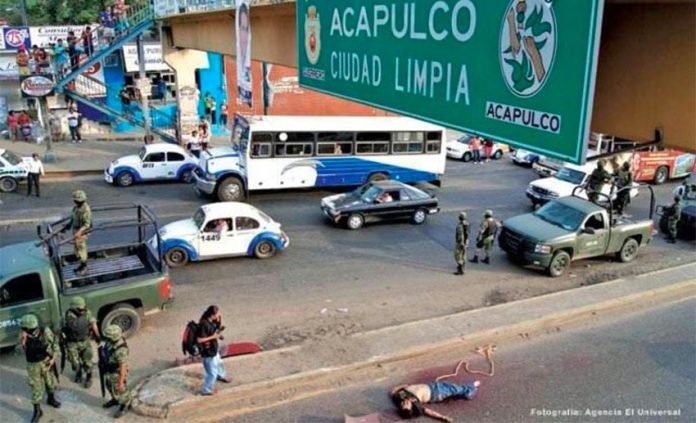
Violence so commonplace that an unknown disease is a serious worry

0
A murder scene in Acapulco: people are numb to it.

Our interview with the lifeguard had come to an end. A spate of robberies along the beach had the locals concerned, and his testimony had told us just that.

The entire town depends on tourists, particularly the ones bringing dollars, and a surge in crime is poisonous. Being told to turn out your pockets at knifepoint tends to overshadow even the nicest of beach getaways.

The local consensus was that the cops were to blame. They laugh in the faces of tourists who come to report robberies, and the lifeguard says there’s no security after dark. For the bad guys, there’s free reign to target anyone they think might be vulnerable, and ultimately the victims are seen as the ones to blame. They know they shouldn’t be around here after dark, so what were they thinking? Of course, something like this was bound to happen.

With murders on the increase to boot, our interviewee didn’t hold out much hope for the future.

“But what about that coronavirus?” he enquired. “That’s terrifying.”

“Really?” I replied incredulously. “Thirty-five thousand murders in Mexico last year, and you’re worried about coronavirus?”

Ah sí.” Hi didn’t miss a beat. “Pero la violencia ya se conoce” – “Yeah, but we’re acquainted with the violence.”

And he was right.

Thirty-five thousand murders in 2019 didn’t spring out of nowhere.

The year 2018 saw 31,000 killings, and that was a record year when it occurred. Ad nauseam.

All across Mexico, the violence has become so commonplace that of course an unknown disease, of unknown tendencies, is more terrifying to this man than the disappearances and violence occurring in his own locale.

Three years ago I drove down to Acapulco from Mexico City early on a Friday morning to cover the town’s worsening violence. A local nota roja (crime and disaster stories) reporter friend had advised me that for best results, it was best to come around the weekends, and on a quincena (the fortnightly payday).

We saw seven bodies that day. Four discovered in a clandestine grave, two kids shot as they hung around on the wrong corner, and a man sitting in his car in a neighborhood close to the beach, shot through his window, his head slumped on the interior glass.

Seven a day was about the average, my local reporter friend told me.

In mid-2019 I returned to Acapulco to do a similar story, and that same friend, who says he’s seen more than 6,000 murders in nearly a decade of covering the violence, says the daily murder rate is better.

“Now it’s two, or one,” he told the camera. “Sometimes even none.”

But the city has become so numb to the bloodshed that locals barely bat an eyelid. Our interview was at the site of that day’s only murder (it was a Tuesday), and where the body had been, a large pool of congealed blood sat curdling in the afternoon sun.

“That’ll be cleaned up when the streets sweepers come through. People come by to have a quick look, and then get on with their business,” he said. “They just don’t care.”

Just how much does this apathy and stoic acceptance that violence is a fact of life in Mexico contribute to the issue?

My question was answered during the reporting of that same story.

The friend of a murdered student told us of her experience, and the self-loathing she experienced during the mourning process.

“Did I do anything to protest the death of my friend?” she demanded of herself. “No, because I was scared of something happening to me.”

“It’s so easy to criticize people who do nothing until you live through it. Until someone you love …” She didn’t finish her sentence; she didn’t need to.

I come to no judgement on the people, nor offer any broad conclusions about the nature of Mexican society. Perhaps the violence has always been here, perhaps not. But it seems we can’t see the bodies for the trees.

Alasdair Baverstock is a freelance foreign correspondent and reporter for CGTN who has covered Mexico and Latin America for nearly a decade. You can follow him across social media at @alibaverstock.
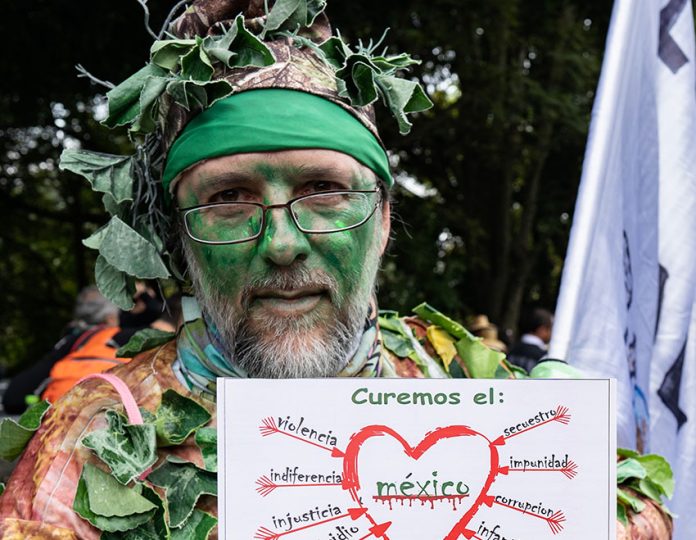
Arturo ‘The Tree Man’ has marched all over the continent

0
Environmental and anti-violence campaigner Arturo Malvido Conway.

Arturo Malvido Conway has become something of a celebrity by attending marches in his tree outfit all over North America for the past 40 years. His initial campaigns focussed on environmental matters but since the murder of his brother, Rafael, 23 years ago, he has also been campaigning to end violence, corruption and impunity. 

“The Tree,” as he is called, talks to me as he walks the 12-kilometer stretch of road from Cuernavaca to Mexico City on the first leg of a march for peace in January. His efforts include petitioning United States President Trump to stop selling arms to Mexico and distributing cards to raise awareness for gun violence. 

Arturo’s description of violence verges on poetic. “Each one of us is a leaf,” he says, “nobody can come and pull us out. We should only die when God says we will die.”  He goes on to say that “violence is chopping the head off liberty.” 

When asked about progress, the Tree shakes his head and says how hard it has been.  He believes that the real crime is in the way that the Mexican government applies the law. “In the United States, if you commit a crime you go to jail, even if you were the son of the president. Here they do anything they can to protect the criminals. That is not fair.”

Arturo’s two-pronged solution for change is clear and simple. “Firstly, we must educate our people in the school of peace; secondly, the state should be tougher to protect us from criminals — while respecting their human rights.” 

Mexico News Daily

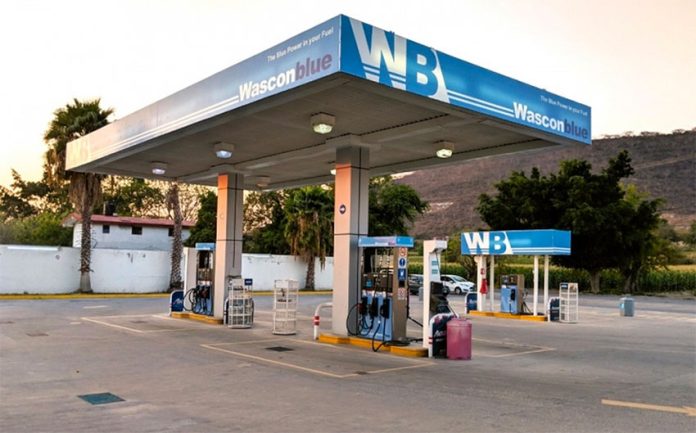
Gasoline vendor Wascon Blue plans to build 4 ‘green’ biorefineries

0
The first of Wascon's 'biorefineries' will produce 30,000 barrels of gasoline daily.

The gasoline company Wascon Blue has announced that it will invest US $720 million in four new “green” biorefineries, which will produce gasoline from byproducts of the process of refining crude oil and natural gas.

“They are biorefineries, not petroleum refineries. It’s a refinery that is going to allow us to produce the kinds of hydrocarbon bases we want to, not the type that are currently in the market, and be able to mix the components,” said Wascon Blue CEO Enrique Olivera.

The company will acquire the raw material from the state oil company Pemex, which currently exports the byproducts and later imports them after they’ve been converted to gasoline.

“They are byproducts of the production of gas and oil. Since it’s not crude oil, it doesn’t have added value for Pemex,” said Olivera.

The company’s biorefineries will produce a gasoline with a lower concentration of aromatics, which are base components of gasoline that are a main source of octane and also one of the leading pollutants in the fuel.

Conventional gasoline contains around 30% aromatics, but the goal of Wascon Blue is to reduce that to 20%.

“That other 10% of aromatics we don’t put in we’ll replace with ethanol, which is a biodegradable material that is sustainably produced from sugar cane and products like sorghum,” said Olivera.

Each refinery will have an ethanol processing partner plant to supply the key material.

The first complex will be located in Veracruz. It will have a refinery with a daily capacity of 30,000 barrels and an ethanol production plant with a daily capacity of 120,000 liters. Both facilities will be in production by 2021, according to the company’s business plan.

“If we’re successful with [the first plant], the next will be in the north of the country, where the raw material is also available and is currently being exported,” said Olivera.

The second refinery will be in Nuevo León and its accompanying ethanol plant is planned for Torreón, Coahuila.

The company plans to be supplying the country with 100,000 barrels of “green” gasoline per day by 2025.

By comparison, the government’s conventional refinery now under construction in Dos Bocas, Tabasco, is expected to produce 340,000 barrels of petroleum products a day.

Wascon Blue currently sells 10 million liters of gasoline to Pemex each week.

Source: El Financiero (sp)

Man gets 83 years for raping, killing 11-year-old girl

0
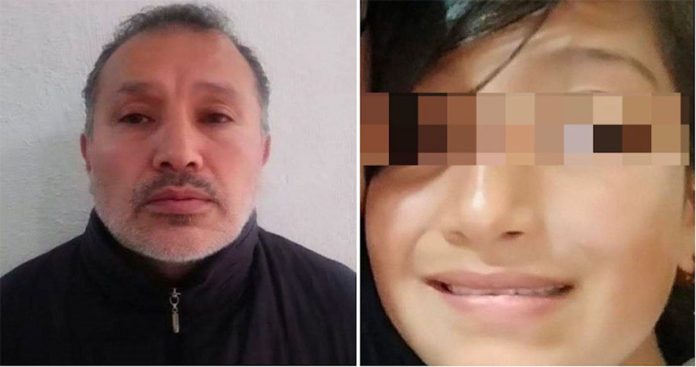
Roberto Buendía was sentenced for the rape and murder of Giselle.

A man from México state was sentenced to 83 years in prison for the rape and murder of an 11-year-old girl in the municipality of Chimalhuacán.

Roberto Buendía Díaz, 51, was found guilty of murder of the girl identified as Giselle who was reported missing on January 19 of this year. Her body was found in a vacant lot in the neighboring municipality of Ixtapaluca five days later.

Police determined that the girl had gone to a cyber café in Chimalhuacán where Buendía invited her to enter his house, which was connected to the business. He proceeded to rape and beat her, producing injuries that would ultimately lead to her death.

After killing her, he took her body to an area in Ixtapaluca called El Cerrito (The Little Hill), where it was found a few days later.

The femicide provoked protests in a state with one of the highest rates of violence against women in the country.

The state Attorney General’s Office said that its investigations clearly pointed to Buendía as the perpetrator of the crime, which led to his arrest on January 29.

Buendía was also ordered to pay a fine of 1.55 million pesos (US $77,500).

Source: El Financiero (sp), Sin Embargo (sp)

Police locate kidnapping victims in Jalisco clash; 9 people killed

0
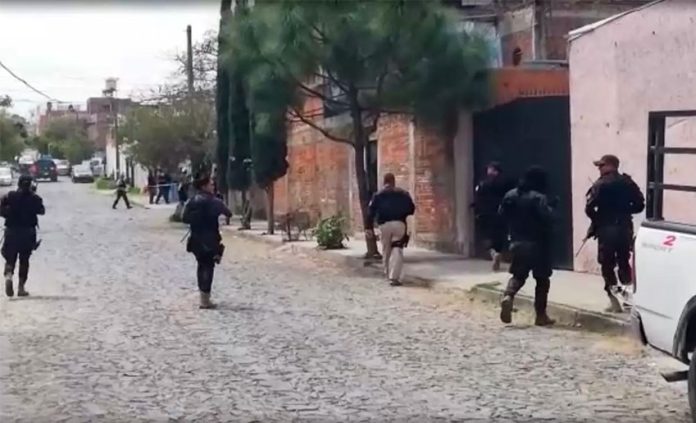
Police at the scene of Tlaquepaque shooting.

A confrontation between security forces and armed civilians in Tlaquepaque, Jalisco, on Friday left nine people dead, including two police officers.

The confrontation occurred as officers from the state Attorney General’s Office carried out an operation related to stolen vehicles. Officers Jorge Omar Valdez Hermosillo and Miguel Medrano were among those who lost their lives in the gunfight.

Police discovered that the house where the fighting occurred was used to hold kidnapping victims, several of whom were on the property at the time. Six people were found dead after the fighting.

Another woman who was in the neighborhood to visit her daughter died in the crossfire.

Four civilians, presumably kidnapping victims, and a police officer were reported wounded.

Municipal police officers secured a broad perimeter around the house where the events occurred.

Teachers at a nearby daycare said that they told the children to get on the floor when they heard the gunshots. They helped maintain calm by telling the children that the noises were just fireworks for a religious ceremony.

Source: El Financiero (sp)

Young entrepreneurs find market in China for their unique face masks

0
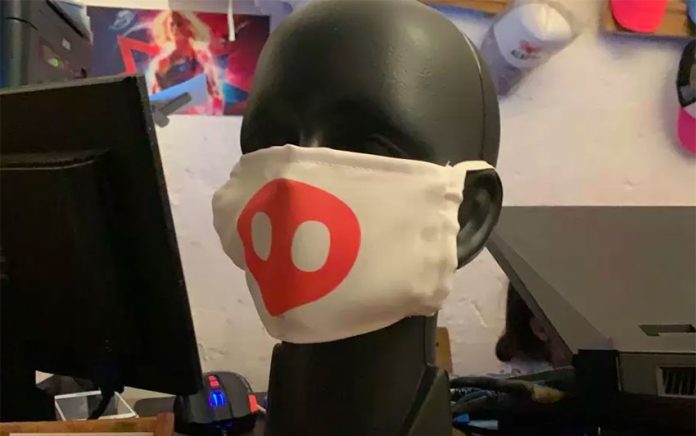
A face mask produced by Changuitos in Morelos.

A group of young people in Morelos have found a market in China for the decorated face masks they invented to help mothers and children in their hometown stay healthy.

The demand for face masks has skyrocketed in China as the country attempts to contain the spread of the coronavirus known as Covid-19.

The four entrepreneurs behind Changuitos (Little Monkeys) were contacted by the company E-FX to make a big order of their fun face masks, which they decorate with smiley faces, cartoon characters, pig noses and other designs.

They said that although it may appear they are being opportunistic, they have been making the masks since before the spread of the coronavirus made the masks a hot commodity.

“They called us opportunists, said that we were taking advantage of the scarcity of face masks … to make and sell these designs, but what they don’t know is that we created these face masks so that children would leave them on when they are sick,” Changuitos’ Eduardo Salas told the newspaper El Financiero.

Children like the masks for their unique designs.

They saw that mothers in their town had trouble getting their children to leave the face masks on when they were sick, so they founded Changuitos in a little workshop located at the city limits between Cuernavaca and Tepoztlán.

“The moment we put smiley faces on the face masks, they became more striking and the kids even wanted to show them off, because now they were part of their personalities,” said cofounder Susana Itzel.

But it’s not just human health that the company is worried about. The Changuitos founders are looking out for the environment as well. Made of cloth and cotton, the face masks can be washed and reused to avoid generating waste.

A mother herself, cofounder Diana Karen said that the increased demand has led them to open other Changuitos branches in Juitepec, Temixco, Cuernavaca and elsewhere in the state.

The company also personalizes mugs, pens, T-shirts, hats, aprons and coffee thermoses, and their work can be seen in a number of local restaurants, hotels, cafés and other businesses.

Source: El Financiero (sp)

Gender Unit finds that, even among police, sexual harassment is a problem

0
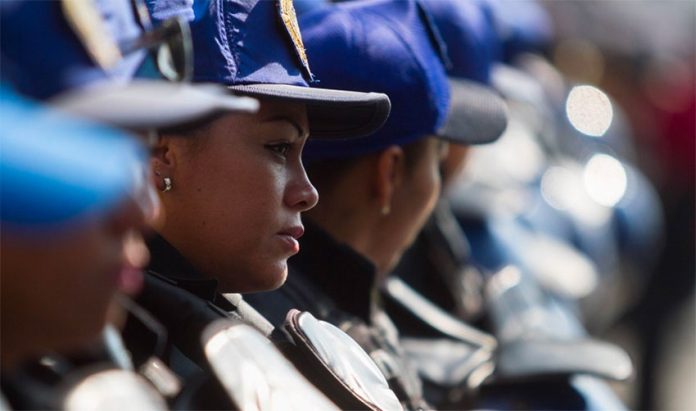
Female police are also targets of sexual harassment.

The response to the recently created Mexico City police Gender Unit has revealed that sexual harassment and assault are problems even among those meant to protect the public from such crimes.

The office already has 205 open cases looking into internal reports of assault or machista violence. There were 130 such reports in 2019.

Gender Unit director Sahara Sánchez Nieto told the news website Animal Político that the force has always investigated internal reports of gender violence, but having a specific office for such complaints has encouraged more victims to speak out.

“Now with this unit that was created, women feel safer when filing reports,” she said.

Government watchdog group Causa en Común, or Common Cause, reported on Tuesday that 68% of female police officers have been the victims of lascivious comments or worse forms of sexual harassment or assault.

Its data also revealed that 21% said that they had not reported the incidents because they either didn’t know they could or where to do so.

The Gender Unit was created to address the problem in November of last year in honor of that month’s International Day for the Elimination of Violence Against Women.

The Mexico City Attorney General’s Office reported that month that it had received 117 complaints of sexual aggression by police.

The new unit is specially designed to deal with reports of gender violence, both from civilian women who are assaulted by police and female police officers who have been victimized by their peers or ranking officers, both on and off duty.

In the first months of 2020, 13 such cases have been sent to the city’s Council of Honor and Justice, which analyzes the evidence and determines sanctions, and disciplinary actions have been taken against several officers.

Sánchez said that the strength of the sanctions has not changed since the creation of the unit. They can be anything from a written reprimand to 24-36 hours in jail to a department transfer, and serious cases can lead to dismissal.

“It depends on the gravity of the conduct. For example, for rape, it’s dismissal. Sexual assault, the same, dismissal when there are ways to prove it. That’s why we work with the Attorney General’s sexual crimes unit,” she said.

She said that her office aims not only to remove guilty officers from their posts, but also to bring criminal charges against those whose crimes call for it.

The Gender Unit has the ability to open investigations even when there is no report of a crime.

“There are several ways that complaints come to us,” said agent Judith Escobar. “They come to us directly or we go out for them, we go to different sectors, we do field work.”

She and her colleagues perform random interviews and review the city’s security cameras to detect any irregular behavior.

Aside from officers specifically trained to deal with gender violence, the unit also has two lawyers, three psychologists, two human rights specialists and two gender violence educators.

The office is also conducting a public relations campaign to show women that they shouldn’t be afraid to file reports against their aggressors.

Source: Animal Político (sp)

The world of indigenous women observed in Mexico City gallery

0
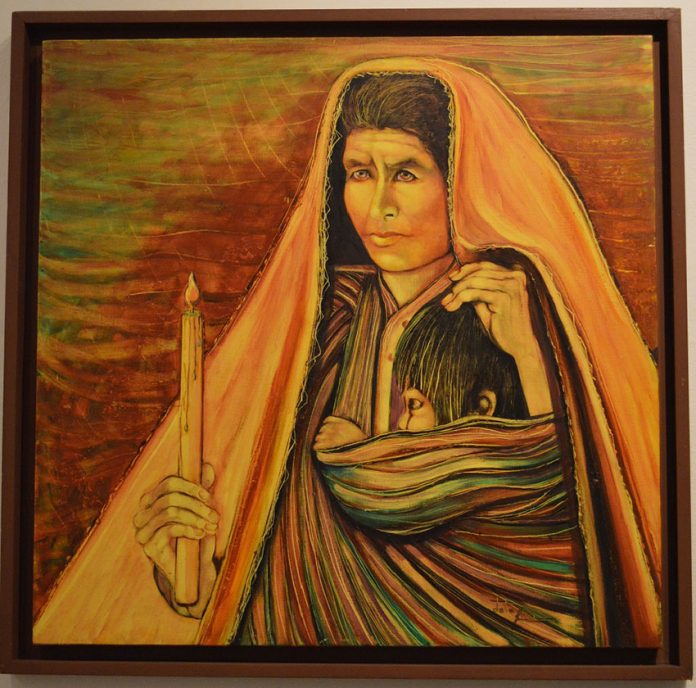
María Tzeltzal by Myriam de la Riva.
María Tzeltzal by Myriam de la Riva. Alejandro Linares Garcia

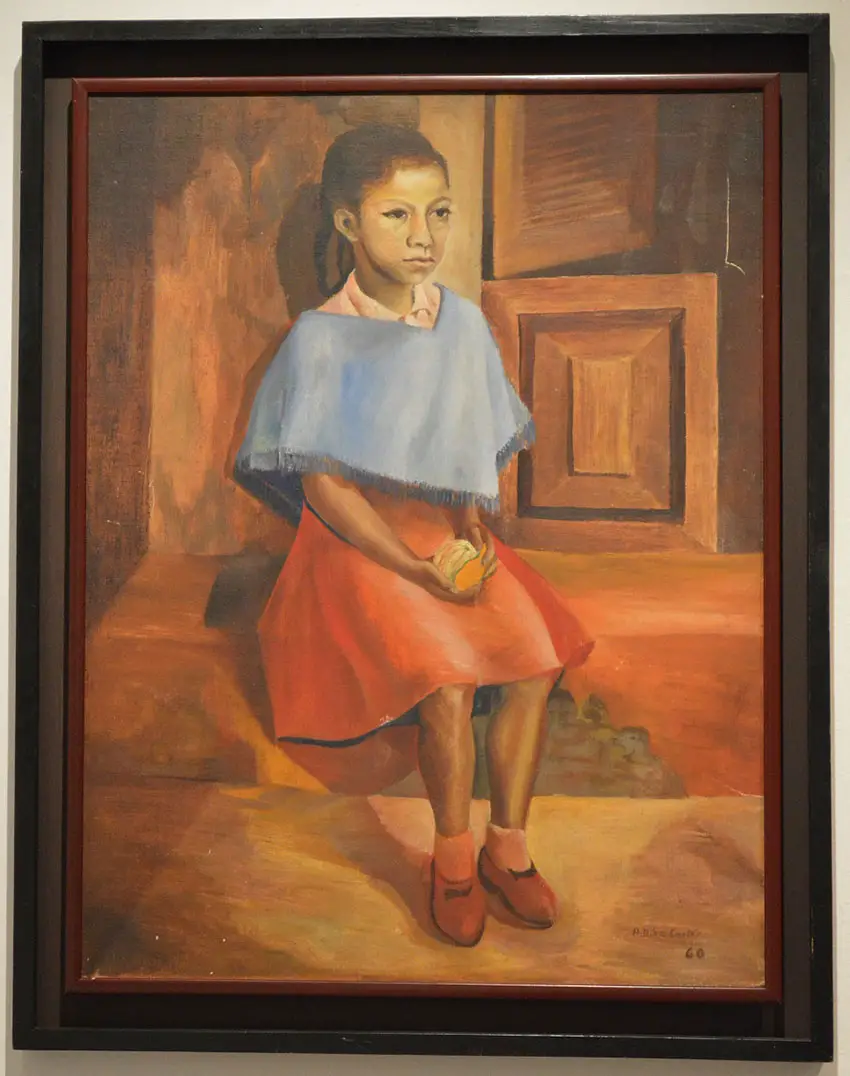
Indigenous Mexican women are the focus of a new exhibition at the Salon of Mexican Fine Art (Salón de la Plástica Mexicana) in Mexico City, this year’s edition of an annual program in honor of International Women’s Day, celebrated next Sunday.

An exhibition honoring women — Mexican women in particular — has been held at the institution each year since 2005. According to board member Helen Bickham, “… even though it is much, much better, this society is still not entirely favorable to women or to their achievements. So, we are trying again to break the barriers that still exist to what women do.”

The focus of the show varies slightly from year to year. This time, it is on women in rural and traditional communities, mostly of indigenous origin, but not necessarily limited to them.

Mujeres de los pueblos originarios” (Women of Indigenous/Traditional Communities) comprises 36 pieces, including drawings, graphic works, sculpture, painting and photography.

Dating from the mid-20th century to the present, the works correspond to dominant art styles in Mexico over the past 70 years.

Niña Jarocha by Antonio Díaz Cortes.
Niña Jarocha by Antonio Díaz Cortes. Alejandro Linares Garcia

There are rarely seen preliminary mural sketches as well as photographs of artists working with women. Both male and female artists are represented but the focus is on the reality of traditional life, both good and bad.

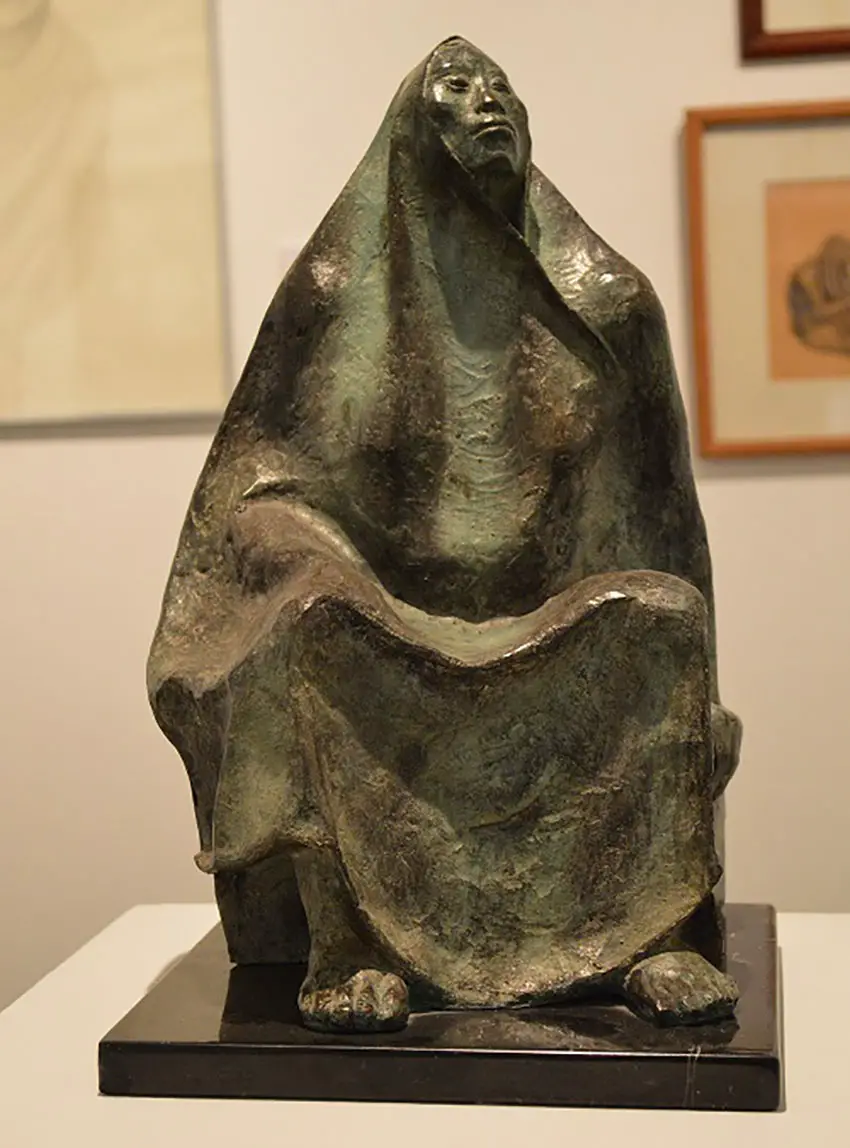
Featured works include Mujer con tocado (Woman with headdress) by Raúl Anguiano, Mujer con rebozo negro (Woman in black shawl) by Concepción Báez, Tres generaciones (Three generations) by Federico Cantú and Bronce (Bronze) by Francisco Zúñiga.

The collection represents women from Chiapas, Hidalgo, Veracruz and other states, embracing such ethnicities as the Tzetzals, Tehuanas and Jarochas (Veracruz mestizo).

Women are depicted as mothers, protectors, workers, fighters and sufferers, with elements from traditional societies, particularly dress.

The show “… is a tribute to our identity through the features that define the women of the different regions of our country,” stated gallery director Cecilia Santacruz at the inauguration.

This year’s exhibit is part of the Equitativa program, dedicated to promoting gender equality and denouncing gender-specific violence and sponsored by the federal Secretariat of Culture. Launched in November 2019, it is the brainchild of artist and cultural activist Lorena Wolffer.

Bronce by Francisco Zúñiga.
Bronce by Francisco Zúñiga. Alejandro Linares Garcia

The Salon took the opportunity of International Women’s Day to reopen another exhibition that was interrupted three years ago by the Puebla earthquake. Umbral, by photojournalist and Salon member Blanca Charolet, features a series of 15 black-and-white photographs that explore the “… space between the need to make a decision and the making of it.”

Charolet was the first woman photojournalist to work for a Mexican daily newspaper as well as the official photographer for the office of the president from 1977 to 1982.

Mexico News Daily

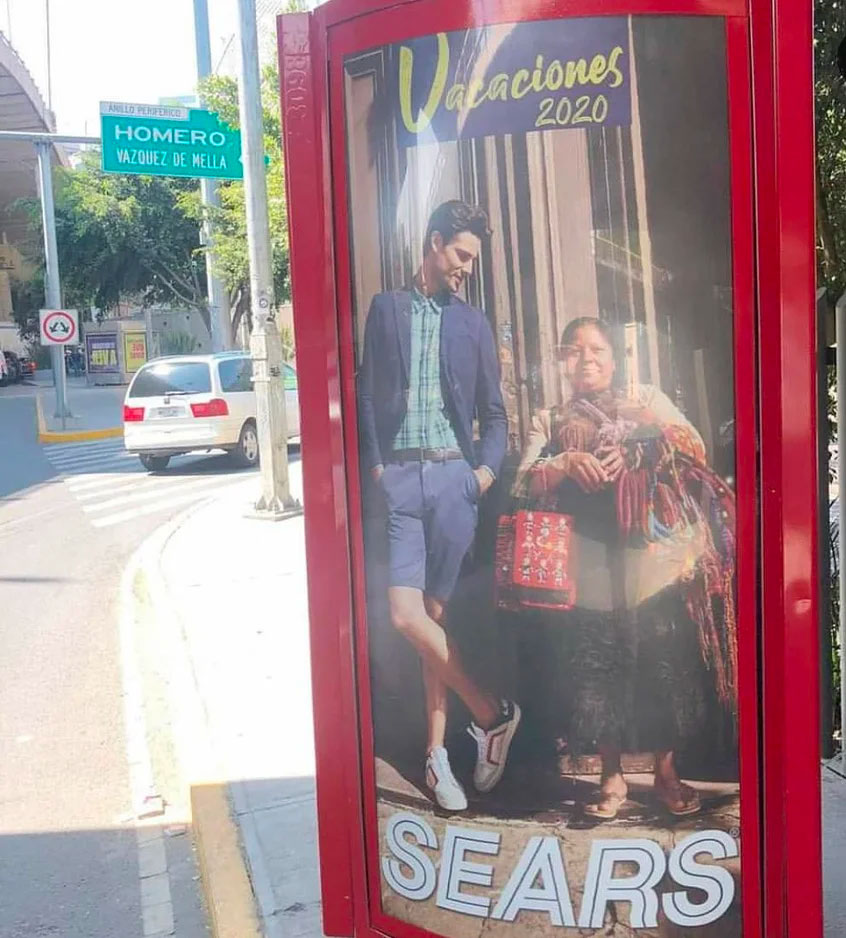
Sears pulls ads following complaints of racist imagery

0
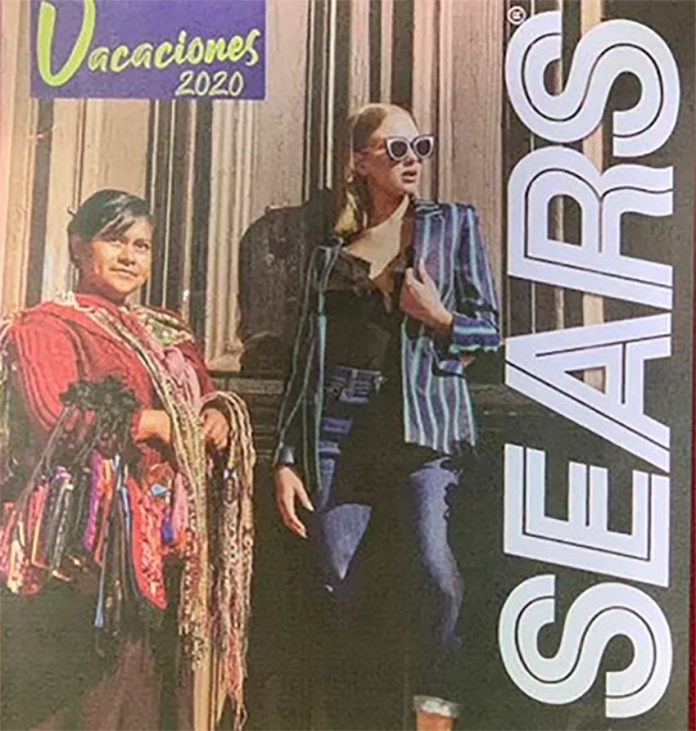
One of the two ads that was the target of criticism.

The department store chain Sears has withdrawn two photographs from an advertising campaign amid a barrage of online complaints that they are racist.

Sears México, owned by billionaire businessman Carlos Slim, used two images featuring indigenous women to promote its “Vacations 2020” clothing collection.

One of the photographs shows an indigenous woman in traditional dress standing next to a much taller fair-skinned woman dressed in clothes available for sale at Sears. The other image shows an indigenous woman holding bags and textiles beside a man dressed in a Sears outfit who looks down at her while smiling.

Social media users accused Sears of objectifying the indigenous women who appear in the photos, and the hashtag #SearsNoEntiende (Sears doesn’t understand) – an adaptation of the chain’s slogan “Sears Me Entiende” (Sears Understands Me) – trended on Twitter.

Twitter user @Santiralph speculated satirically about how the images might have come about.

The ads were described as 'classist and discriminatory'
The ads were described as ‘classist and discriminatory’

“Marketing creative: Imagine a tall white man looking at an indigenous woman beneath his shoulder and a blonde woman showing disinterest towards another indigenous woman. SEARS: You’re a genius, advertising approved. #SearsNoEntiende.”

Above images of the offending advertisements, Twitter user @Magdalenachulis wrote: “Come and see the stigmatization, objectification and racism that this store promotes. Can someone explain it to me?”

Another Twitter user appealed to the National Council to Prevent Discrimination (Conapred) for advice about how to have the advertisements removed from the streets of Polanco, an affluent Mexico City neighborhood where Sears has a store.

“Hey @CONAPRED how can we remove these @searsmexico billboards that I think are classist and discriminatory. What procedure should be followed?” wrote @mara_glz.

Conapred responded with a graphic that outlines the various ways in which a complaint can be filed – in person, in a letter, by e-mail and phone or on the council’s website.

As the criticism continued, Sears México announced on Twitter late Thursday that it would withdraw the two images from its advertising campaign.

“At Sears we value your opinion about our new campaign that seeks to highlight the cultural richness of Mexico. We understand that for some people the message was inappropriate so we offer a sincere apology and … we’re withdrawing both photos from the campaign,” the company said.

Sears México also felt the wrath of social media users recently after it advertised domestic appliances such as washing machines and blenders beneath a banner that wished women a happy International Women’s Day for March 8.

“Celebrating [International] Women’s Day promoting washing machine and domestic appliances is extremely sexist,” said Twitter user @BBBLGUMDJ.

Source: El Universal (sp), Yahoo Noticias (sp) 

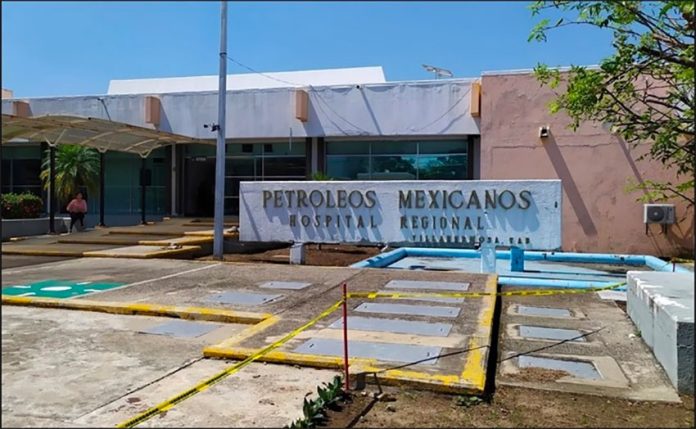
3rd patient perishes from tainted medication at Pemex hospital

0
pemex regional hospital
Medication reportedly came out of dusty, old boxes.

A third dialysis patient at the Pemex Regional Hospital in Villahermosa, Tabasco, has died from contaminated medication.

Feliciano Sánchez Osorio, 65, died on Friday after being treated with a contaminated dose of the life-saving blood-thinning drug sodium heparin.

Two others have died and as many as 25 have required hospitalization since the patients were administered the contaminated drug last weekend.

Sánchez’s body was taken to the state Attorney General’s Office for an autopsy. The victim’s family will decide whether or not to sue the hospital once they see the results.

His wife Elodia Hernández Félix said that he had told hospital staff that the medicine was a strange yellow color and that he had seen them take it out of dusty, old boxes.

“He, with his own money, bought the heparin, but they didn’t use it here. They gave him something else, and he himself told the nurse that they were going to kill him. He began to feel bad that very same day [February 27],” she said.

Hernández called for justice and demanded that President López Obrador intervene to see that other dialysis patients don’t die in the same way.

Several patients at the hospital’s dialysis clinic have complained about the quality of the medicine they receive.

Gutemberg López Hidalgo said that he hadn’t been administered the correct medication in weeks and that he was forced to buy it out of pocket, despite not being able to work.

María Araceli García, whose husband is in intensive therapy, complained that the dialysis department is always closed and that it lacks basic medications and supplies.

Others said that although the state oil company had reported it would move six critical patients to Mexico City for specialized care, none has left Tabasco and they are still being treated at the hospital in Villahermosa.

This was not the week’s only news of harmful practices in Pemex medical facilities. Results from a study published last December by doctors at Mexico City’s Central Norte Pemex Hospital revealed that over 13% of patients at the facility have been victims of “medication errors.”

Source: El Financiero (sp)