Home Blog Page 1620

An evening’s stroll through Guadalajara’s Palace of the Cows

0
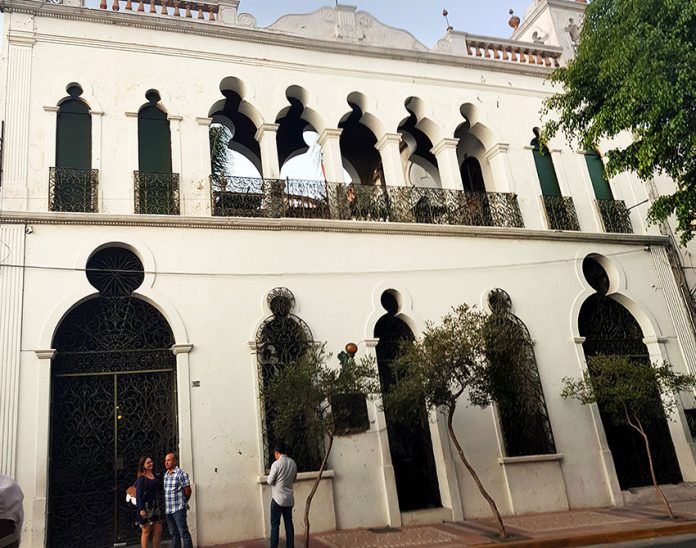
The entrance to the Palacio de las Vacas in the historic district of Guadalajara.

The city of Guadalajara was founded 478 years ago and many of its dusty old buildings have extraordinary tales to tell. One of these is El Palacio de las Vacas, an urban legend that few local people have heard of and even fewer have visited. This venerable old mansion was closed to the public for some time but visits are now permitted — only on Sunday nights.

The entrance, at Calle San Felipe 630, immediately grabbed my attention. The windows and doors have a Moroccan design that cried out, “Within these walls something exotic awaits you.”

At 7:00 p.m., Raul Nava, the custodian of the place, opened the doors and led us into a huge, elaborately decorated room with a ceiling three stories high. Here we enjoyed a glass of wine and snacks as Señor Nava recounted the history of the place.

“This mansion was built by President Porfirio Díaz for his cousin Segundo Díaz, because Porfirio wanted Segundo to marry a tapatía, a woman from Guadalajara who was famed for her beauty. Construction was begun in 1850 and completed in 1910. Sixty years it took to build the place, which is not surprising if you consider that this house has 24 rooms, 10 baths, two dining halls, four patios and a chapel.

“Well, Segundo never married that woman, but he did live in the house for a short while, after which he passed the place on to his brother Miguel. Miguel then moved in, but he didn’t like it much and soon moved back out … and it was Miguel who came up with the idea of keeping his cows here overnight, as if the house were a big barn.
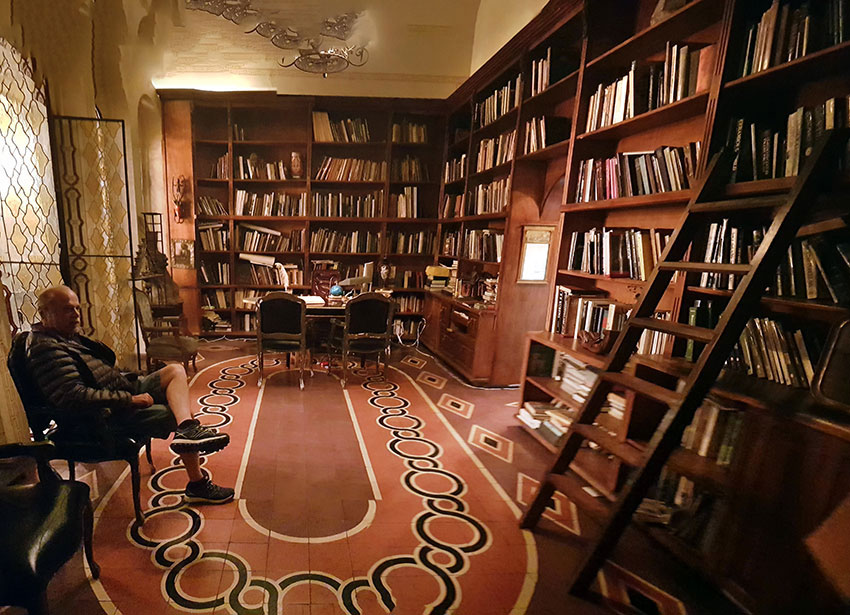
A visitor enjoys a quiet moment in the library, which is filled with books on art.

“Yes, he actually turned the place into a dairy farm! Well, everybody in Guadalajara was soon talking about Miguel Díaz’s cows ruminating among exquisite murals and from then on it has always been known as the Palace of the Cows.”

The murals Señor Nava referred to have a history all their own. They were painted — over a period of 11 years — by Xavier Guerrero who, together with Diego Rivera, José Clemente Orozco and David Alfaro Siqueiros, founded Mexico’s great muralist tradition.

Guerrero, who had been born in Coahuila, was only 16 years old when he came to Guadalajara and — who knows how — got himself the gig of all gigs: a chance to paint whatever he wanted on 400 meters of walls and ceilings and get paid for it. The youthful artist painted 80 murals in that mansion: pastoral scenes here and biblical scenes there, spiced up a bit with an occasional erotic image. He also added a curious frieze displaying stylized foliage interspersed with nude women whose bodies ended in fish tails, “an anomaly which greatly surprised the owner.”

Over the years, El Palacio de Las Vacas was used for just about every purpose under the sun. “It was a dairy, a grade school, a secondary school, a school of homeopathic medicine, a tapestry workshop, a carpentry workshop and even a brothel. Maybe even a hospital and a kindergarten,” says Julia Escher in a University of Guadalajara publication.

Some say the palace also housed Guadalajara’s first college for women, but historians have found it very difficult to document this or much else of the building’s history.

It is said that one of the building’s owners, a Mexican woman, wanted to tear the palace down and replace it with a parking lot. The city fathers told her she couldn’t do that … which prompted the woman to plug all the downspouts with cement, hoping that the weight of all the water on the flat roof would cause the building to collapse. This did not occur, but the nefarious plan resulted in great damage to many of Xavier Guerrero’s murals.
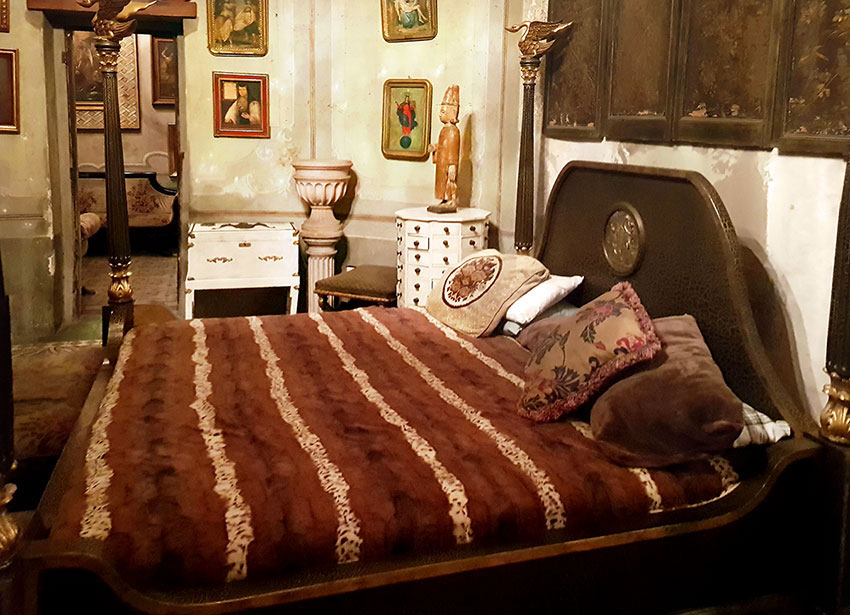
It is said that Porfirio Díaz slept here when visiting Guadalajara.

According to Julia Escher, in 1998 an American named John A. Davis, a retired jeweler from Atlanta, Georgia, bought the place from Alexandra Muir, a member of the famous Muir family of California.

“Davis had fallen in love with El Palacio three years before,” she says, “and he sold everything he had to buy it.”

Davis then moved right into the old house “even though it was falling to pieces and filled with lice and fleas.”

“When I bought the house there was no furniture, no bathrooms, no electricity, no water, no plants,” he told the Guadalajara Reporter, and he spent the next 20 years filling it with antiques and trying to restore it.

However, he was assaulted by armed robbers “on more than one occasion,” and in the end was left penniless. “I worked 40 years to buy this house. It was my life’s work and now I’ve lost everything,” he reportedly lamented.

Davis never stopped trying to find support for the restoration of El Palacio de las Vacas, but in time he fell ill and passed away. Today the place has a new owner who prefers to remain anonymous … or so goes the rumor.

[soliloquy id="103353"]

In fact, while this palace once housed cows, today it seems to house rumors: “Porfirio Díaz once lived here; so did Diego and Frida; the paintings hanging on the walls were done by the most famous artists you can imagine; the house makes strange noises at night and is full of ghosts; President López Obrador’s wife says she is going to restore the old place.”

Not a rumor is the fact that it is now possible to visit the Palace of the Cows on Sunday nights at 7:00 p.m. Better take advantage before the situation changes! For more information check out their Facebook page or call 331 129 5389.

The writer has lived near Guadalajara, Jalisco, for more than 30 years and is the author of A Guide to West Mexico’s Guachimontones and Surrounding Area and co-author of Outdoors in Western Mexico. More of his writing can be found on his website.

Coronavirus could hurt exports to the tune of US $1.3 billion: UN

0

Mexico’s exports could decline by US $1.37 billion due to the outbreak of the novel coronavirus known as Covid-19, according to the United Nations Conference on Trade and Development (UNCTAD).

The intergovernmental body said in a report that the slowdown of manufacturing in China due to the outbreak of Covid-19 is disrupting world trade and could result in a $50-billion decrease in exports across global value chains.

“Because China has become the central manufacturing hub of many global business operations, a slowdown in Chinese production has repercussions for any given country depending on how reliant its industries are on Chinese suppliers,” UNCTAD said.

According to UNCTAD estimates, Mexico will be the eighth most affected economy after the European Union, the United States, Japan, South Korea, Vietnam, Singapore and the United Kingdom.

“In addition to grave threats to human life, the coronavirus outbreak carries serious risks for the global economy,” said UNCTAD Secretary-General Mukhisa Kituyi.

“Any slowdown in manufacturing in one part of the world will have a ripple effect in economic activity across the globe because of regional and global value chains.”

UNCTAD said its estimates showed that the most affected sectors would include precision instruments, machinery, automotive and communications equipment.

In Mexico’s case, UNCTAD is predicting that the automotive sector will take the biggest hit, with exports forecast to fall by $493 million.

The next most affected sectors are predicted to be electrical machinery, with a forecast export decline of $341 million; “various” machinery, $228 million; communications equipment, $71 million; office machinery, $58 million; precision instruments, $57 million; wood products and furniture, $52 million; rubber and plastics, $26 million; and metals and metal products, $23 million.

UNCTAD noted that the estimated effects of Covid-19 are subject to change depending on the containment of the virus and/or changes in sources of supply. As of Friday morning, there were five confirmed cases of Covid-19 in Mexico and 35 possible cases.

Source: Milenio (sp) 

Costs mounting as teachers’ rail blockade halts service from Gulf ports

0
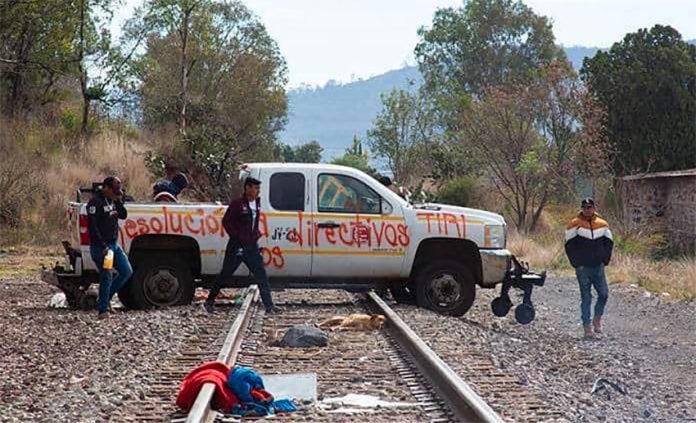
Students block the tracks in Michoacán.

Rail blockades in Puebla and Michoacán are costing the private sector millions of pesos.

Members of the SNTE teachers union have blocked tracks in the Puebla municipality of Rafael Lara Grajales for the past nine days to demand the intervention of the federal government to ensure that new labor laws guaranteeing them the right to elect their union leaders in free and secret ballots are adhered to.

Their blockade has forced the rail firm Ferrosur to suspend service between Veracruz and the Valley of México. As a result, the company was unable to transport 440,000 tonnes of steel, foodstuffs (including perishables such as fruit), chemicals and auto parts on Thursday, the newspaper Reforma reported.

Ferrosur estimates that it has lost 12.5 million pesos (US $620,000) per day due to the blockade in Puebla.

“In nine days, we haven’t been able to move 144 trains and we haven’t been receiving goods from our customers for four days,” Lourdes Aranda, a spokesperson for Ferrosur’s parent company Grupo México, told Reforma.

“The warehouses of our clients in the port of Veracruz are saturated: there are more than 73,000 tonnes of goods stored there. The same thing is happening at Tierra Blanca and Coatzacoalcos, where we have 120,000 tonnes in both ports. There are also ships that haven’t been able to unload,” she said.

In light of the circumstances, Ferrosur has called on Puebla Governor Miguel Barbosa to intervene and immediately order the clearing of the tracks.

Meanwhile in Michoacán, teacher training college students blocked tracks at two different points on the Lázaro Cárdenas-Morelia line during the past two days. The normalistas, as the students are known, say that they are protesting to demand the payment of scholarships they are owed and to pressure authorities to make more teaching positions available for graduates.

The Michoacán Industry Association said that 17 trains were stranded due to the students’ blockades on Wednesday and Thursday and estimated economic losses of 100 million pesos (US $5 million). The steel, automotive, agro-industrial and petroleum industries are among the worst affected.

The industry association urged authorities to immediately clear the tracks but the students continued their blockade on Friday morning before voluntarily withdrawing, according to a report by the news outlet Imagen Noticias.

Disgruntled normalistas also blocked train tracks in Michoacán for two days last October, causing economic losses of around 500 million pesos.

Source: Reforma (sp), Milenio (sp) 

Izapa, a city of clay in Chiapas, is being restored by archaeologists

0
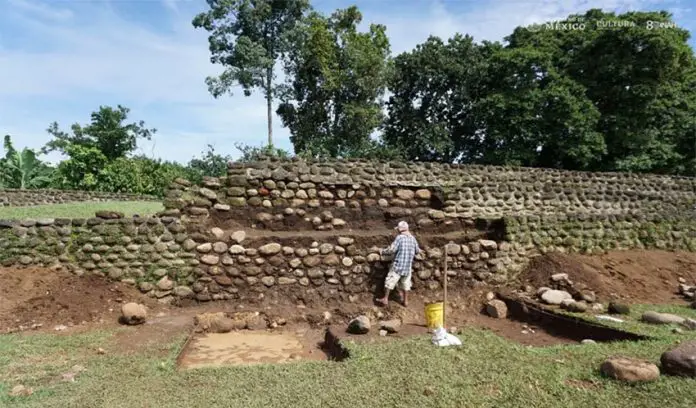
Restoration work underway at Izapa. Alejandro Uriarte Torres/INAH

Archaeologists with the National Institute of Anthropology and History (INAH) are carrying out a project to study and restore Izapa, a pre-Hispanic city in Chiapas built with clay.

Located on the Izapa River near Tapachula and the Tacaná Volcano, which straddles the Mexico-Guatemala border, the Mayan city features more than 30 stone monuments engraved with mythical scenes associated with the exercise of power by ancient rulers. The carvings haven’t been studied for more than 50 years.

Led by the archaeologist Alejandro Uriarte Torres, the Izapa Research and Conservation Project (PICI) is restoring the splendor of the monuments and the site in general, INAH said in a statement.

Uriarte said that the work is being carried out to repair damage to the site’s structures caused by their proximity to Tacaná, an active volcano that last erupted in 1986.

He explained that when the PICI team first examined Izapa in 2015, they found that parts of the clay structures were displaced, crumbling or cracked due to seismic activity linked to rumblings and eruptions at the volcano.

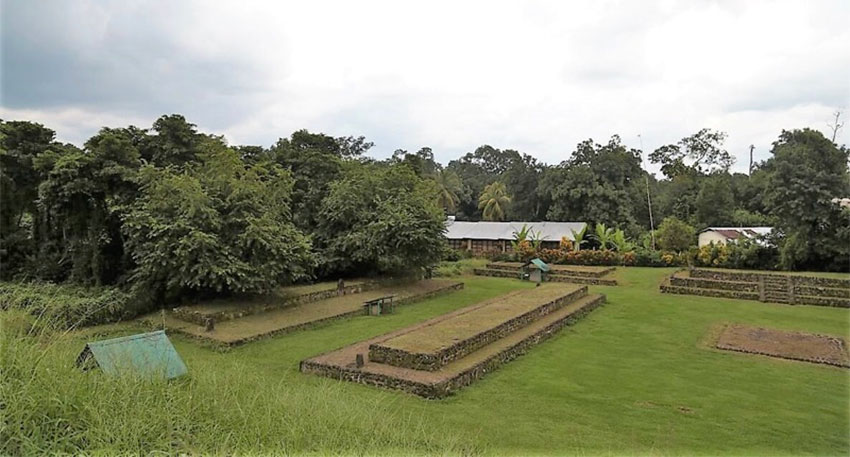
A ballcourt at the Izapa site.
A ballcourt at the Izapa site. Alejandro Uriarte Torres/INAH

While carrying out the restoration work, archaeologists were able to identify the construction systems and materials used at Izapa, Uriarte said, adding that a study will be carried out to determine where the materials came from.

All of the structures are made out of clay, the archaeologist said, explaining that after they were built, their exterior walls were covered with river stones measuring 50-60 centimeters in diameter. All of the restoration work has been carried out with respect for the original construction techniques, Uriarte said.

“We learned to value the earthen architecture in Mesoamerica, which is much more common that we think. … There are a great quantity of sites like Izapa, where only the walls are made with stone … The whole interior is clay,” he said.

“This is something that we have to study more deeply because we generally have the idea that all the Mesoamerican buildings are stone.”

The archaeologist explained that the stone monuments, or steles, are being cleaned of lichen and other types of fungi that thrive in the year-round humid climate at Izapa, one of the most important archaeological sites in the Soconusco region of Chiapas.

After cleaning, archaeologists are photographing the monuments with the aim of establishing a visual registry of their iconography before further deterioration occurs.

Some steles were removed from the site before the current project began and are on display at the National Museum of Anthropology in Mexico City and the Soconusco Museum in Tapachula.

INAH said that the microorganisms growing on the steles are also being studied to determine how they can be removed in the future without harming them. Alejandro Medina, an INAH biologist, is leading the work.

Izapa reached its peak between 850 B.C. and 100 B.C. but was abandoned completely sometime around 1200, a year which corresponds to the early post-classic period of pre-Hispanic Mesoamerica.

Mexico News Daily 

Father of Guanajuato cartel boss detained; ‘El Marro’ still at large

0
The truck in which El Marro's father was traveling.

Yet another family member of José Antonio “El Marro” Yépez Ortiz, head of the Santa Rosa de Lima Cartel, has been arrested in Guanajuato. The father of the notorious gang leader was arrested in Celaya on Thursday night.

“We have confirmed the arrest of [the father of El Marro]. An investigation is underway, but the arrest was made due to a report of a stolen vehicle,” said federal Security Minister Alfonso Durazo, who added that there is a “possibility of incorporating other crimes into the investigation.”

Speaking of the possible repercussions the arrest may have, Durazo said that “it is a notable arrest and if there is eventually a [violent] reaction, federal security forces will be ready for any incident.”

The gang leader’s father was arrested after a confrontation with municipal police acting on a report of a stolen vehicle. Attempting to stop a GMC Sierra pickup truck, the police were fired upon by the passengers.

The police activated a code red and began pursuit. The driver of the pickup reportedly lost control of the vehicle during the chase and slammed into a light post. El Marro’s father was arrested on the scene.

Three officers were seriously injured in the gunfight and were taken to hospital to be treated.

The detention brings the number of arrests of people close to El Marro to eight. His wife, Karina Mora, was arrested in a safe house in January, but was later released after a judge ruled that police had entered the house without a search warrant.

Three other presumed members of the cartel were also arrested in the operation, and subsequently released.

El Marro’s niece, Denise Yépez Pérez was arrested on weapons charges in Apaseo el Alto, Guanajuato, in February. That arrest was also made as a result of a stolen vehicle report.

Security forces also arrested Fabián N., alias “La Vieja” (The Old Lady), El Marro’s alleged right-hand man, in Baja California on the weekend.

Although he continues to evade capture, authorities say they see the walls closing in on El Marro, considering these arrests and the murder of his sister on her wedding day in January.

Source: Infobae (sp)

Human remains from Guerrero sent to Austria for analysis in Ayotzinapa case

0
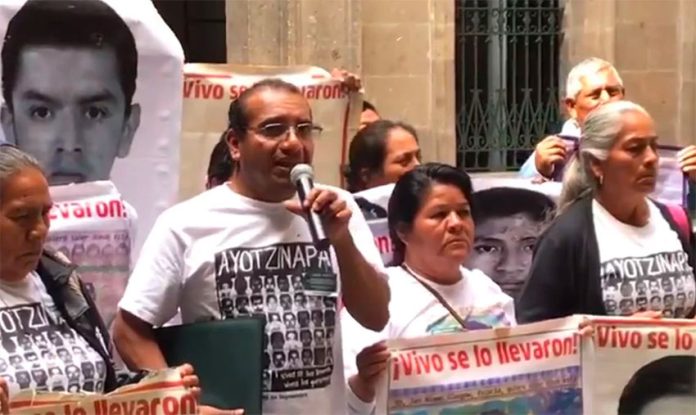
Vidulfo Rosales speaks Thursday at the National Palace in Mexico City.

The remains of six bodies found in Guerrero have been sent to Austria for analysis to determine if they belong to any of the 43 male students who disappeared in September 2014.

Speaking to reporters outside the National Palace in Mexico City after meeting with relatives of the missing students from the Ayotzinapa Rural Teachers College on Thursday, Deputy Interior Minister for Human Rights Alejandro Encinas said that the remains were delivered to forensic investigators at the University of Innsbruck on Monday.

The remains of three of the bodies were found in a ravine located on community-owned land in the municipality of Cocula, while the other remains were found near the city of Iguala in an area known as Jesús de Nazaret, he said.

The students disappeared in Iguala on September 26, 2014, after buses they had commandeered to travel to a protest in Mexico City came under fire by municipal police.

According to the former federal government’s official version of events – the so-called “historical truth” – the students were killed by members of the Guerreros Unidos gang after they were handed over to them by corrupt municipal police.

After killing the students, who they allegedly mistook as members of a rival gang, the Guerreros Unidos gangsters burned the bodies in the Cocula municipal dump and scattered the ashes in a nearby river, the previous government said.

Encinas said on Thursday that the so-called “historical truth” is collapsing as a result of new investigations conducted by the Federal Attorney General’s Office (FGR). The previous government’s version of events was built on “torture and simulation,” he said.

Approximately 80 suspects have been released from prison due to a lack of evidence or because courts found they were tortured during the interrogation process.

In addition to the remains sent to the University of Innsbruck – whose researchers previously identified two of the missing students by conducting DNA testing on bone fragments – Encinas said that “other discoveries” were made in a cave contaminated by bat feces. The findings will also be subject to analysis, he said.

The deputy minister said that authorities in Mexico did not know when the results of the testing in Austria would be available but stressed that the government will announce the findings as soon as it has them.

For their part, parents of the 43 presumably dead young men said that they asked Attorney General Alejandro Gertz Manero and Supreme Court Chief Justice Arturo Zaldívar to do all they can to speed up the investigations in order to find out what happened to their sons and where they ended up.

The two officials’ meeting with the parents came after President López Obrador personally asked them to work together to seek justice in the case.

The parents told Zaldívar that only one court should be tasked with working on the case because many are currently doing so and the investigation is progressing slowly as a result.

Vidulfo Rosales, a lawyer for the students’ families, said that criminal cases related to the students’ disappearance are currently being heard by several courts, each of which applies its own criteria.

“All it does is delay access to justice for the mothers and fathers,” he said.

The parents asked Gertz to launch investigations into Federal Police and municipal police from Huitzuco, Guerrero, which borders Iguala, for the crimes of forced disappearance and torture. They also urged him to initiate new criminal proceedings against suspects who have been released.

López Obrador signed a decree to create a super commission to conduct a new investigation into the Ayotzinapa case just two days after he was sworn in as president in December 2018 and has pledged that his government will not rest until it knows the whereabouts of the missing students.

While the government has rejected the version of events set out by the administration led by former president Enrique Peña Nieto, after 15 months in office it has not offered its own alternative conclusion.

Source: El Universal (sp) 

Women Artists of Zihuatanejo: empowerment in the gallery

0
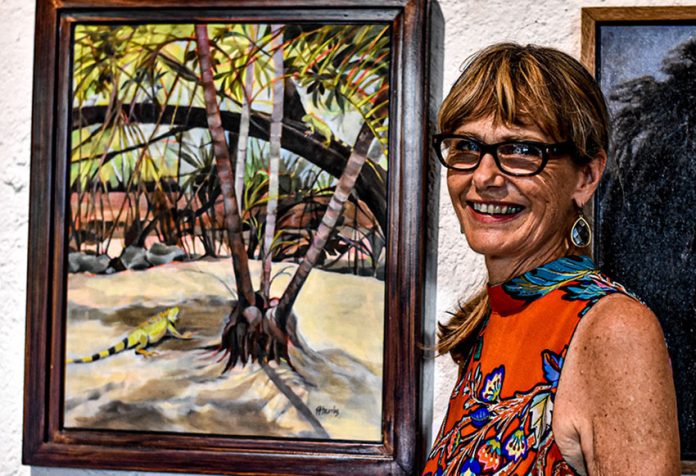
Art show organizer Peg Harris.

It’s appropriate that the premier art show in Zihuatanejo, Women Artists of Zihuatanejo (Mujeres Artistas de Zihuatanejo), happened this year on February 29, also known as “Sadie Hawkins Day.” An Irish-based tradition, it’s the day when a woman can propose to a man.

Today, however, the day celebrates, among other things, female empowerment. And since the name Zihuatanejo can be literally translated as “A Place Of Women,” it is appropriate to do a show of this type on this day, one that occurs only once every four years.

It all started when artists James Crespinel and Monica Gutiérrez decided they needed a creative space to work. It wasn’t too long before other artists were invited to share the workspace and exhibit at what is now known as Mezgaleria.

Says the duo, “It became a place where artists who previously could only show in restaurants, retail stores, or in some cases, their own gallery, could now have a professional venue to showcase their works.”

Speaking with them I could feel the passion they had about the gallery, a true labor of love as they’ve given the community a space for creative expression. Adds Crespinel, “The purpose was to bring women together as a collective group rather than with an individual show.”

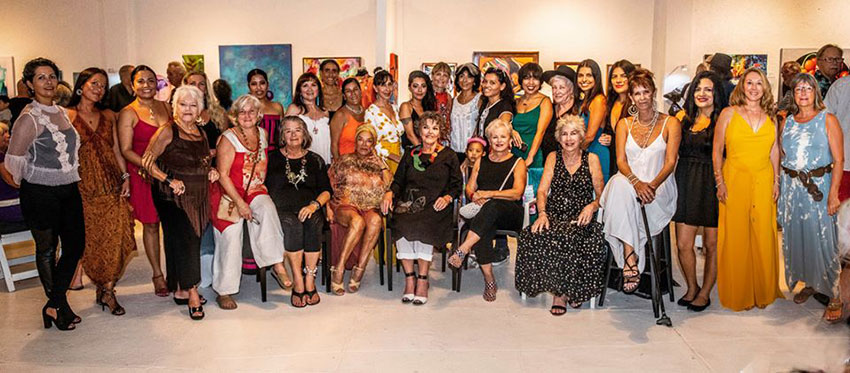
The artists represented at the Zihuatanejo show.

I walked into the gallery on opening night to find the place buzzing with excitement. It seemed that the elite of Zihua society were in attendance and, as Gutiérrez remarked, women (and perhaps men too) were as concerned as much about the clothes they wore as the show itself. Judging from the looks of so many beautiful people in one room, I can only agree.

But as to the show itself … 30 talented women from the region exhibited their works in a variety of styles and genres that ranged from sculpture to paintings to paper maché, along with textiles in the form of purses, jewelry and silk scarves. The intent, of course, was to sell their work and five of the artists did just that. 

Organizer Peg Harris, an artist and exhibitor herself, explained how women were chosen for the show. “Some of the women were gathered by their involvement at previous shows, this one being the fourth after a one-year hiatus.” She also sent letters out to artists inviting them to exhibit, while Gutiérrez searched the area, spreading the word and visiting artists in their home studios.

“It’s a wonderful event and it’s all about bringing communities together,” Harris said.

As far as how the show might evolve in the future, “There are a lot of directions that we could do in the future but right now we know it’s a show that people look forward to and we’d like it to continue.”

Interesting to me was that of 30 exhibitors, 17 were Mexican while the other 13 were either American or Canadian with one artist from Sweden. “And all of them have a strong connection to Zihuatanejo in one form or another, whether they live here full-time or are people who spend a few months a year here,” said Gutierrez.

For those who missed the show, the gallery will be open 10:00 a.m – 6:00 p.m. Monday to Friday, 10:00 a.m. – 3:00 p.m. Saturday for one more week.

The artists are Agatha Fast, Ana López Doddoli, Barbara Bridges, Carla Juarez, Carla López, Carmen Rivas, Ciria Velázquez, Edita Kon, Gabriela Trejo, Gloria Hernández, Grace Relfe, Gwyn Barre, Guadalupe Gaytan, Lauri Copeman, Lisa Bissonnette, Martina Croghan, Mishel Espinal, Mónica Gutiérrez, Monserrat Baños, Nina Turkin, Peg Harris, Perla Arana, Rubí Quintana, Sonya Yahyaoui, Suzanne Viechnicki, Tamara Zapata, Tina Andreasson, Viridiana De la O, Yoba Gould, Zahira de Anda.

Mexico News Daily

Ex-governor of Nayarit, barred from US, denies knowing any narcos

0
Sandoval distanced himself from activities of his former attorney general.

The former governor of Nayarit, Roberto Sandoval, expressed his surprise over being barred entry into the United States and claimed not to be connected to any drug traffickers or other criminals in an interview with the news outlet Milenio.

The United States government denied Sandoval and his immediate family members visas to enter the country in February due to his “significant involvement in corruption” during his time as governor.

“For me it was a surprise that the U.S. Secretary of State made that announcement when I have been in communication with the government, [and] we’ve conducted a joint investigation,” said Sandoval.

The former state attorney general during Sandoval’s governorship, Édgar Veytia, pleaded guilty to drug trafficking charges in the United States in January, and Sandoval claims to have been caught up in a smear campaign in the wake of that trial.

But Sandoval said that he was “not [Veytia’s] boss” and distanced himself from the former attorney general’s criminal actions.

“I don’t know any criminals, any drug traffickers,” he said before stating that he did not appoint Veytia to the position, but rather proposed him for confirmation by the state chamber of deputies, who elected him to the position.

Sandoval has defended his record since the U.S. Treasury Department imposed sanctions on him in May of last year. He told Milenio that the investigation into his presumed illicit enrichment came out of confusion over a sale of purebred horses and the purchase of a ranch and house.

“I raise livestock. I don’t buy horses, I sell horses. … I’m not ashamed of coming from the country and going back to the country after being in politics. There is some confusion about the purchase of purebred horses, a ranch and a residence,” he said.

Sandoval added that he currently has access to the properties in question, but that his bank accounts and those of his immediate family have been frozen.

He claimed that the accusations are part of a smear campaign led by Democratic Revolution Party (PRD) national president Guadalupe Acosta Naranjo.

“Guadalupe Acosta Naranjo has set out to revile me, to play politics with me. As he was my rival in 2011 and I beat him, he’s taking advantage of the fall of [Veytia] to burn me too,” said Sandoval.

He added that the federal auditing office has conducted numerous audits on him and never found any irregularities. He reiterated that he never misused government funds and asked that his family be left out of the controversy.

He also emphasized that there are no criminal charges filed against him, merely administrative proceedings.

Source: Milenio (sp)

Kindergarten director suspended for exorcism in Querétaro

0
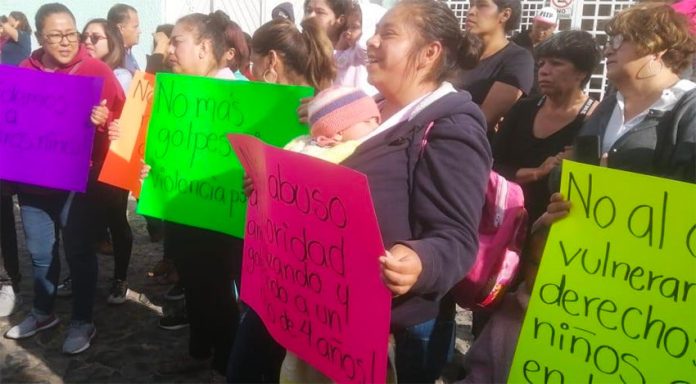
Parents protest abuse at Querétaro school.

A director of a kindergarten in Querétaro has been temporarily suspended after parents carried out an undercover investigation that revealed she was conducting exorcisms on their son.

A student of the Juan Caballero y Osio kindergarten had told his parents that the director of the school was mistreating him, so the concerned parents hid a microphone in his clothes to find out what was going on.

When the student returned home, his parents listened to the recording and heard the director attempting to exorcise their son.

“The blood of Christ has power,” the director can be heard saying as the boy cries. She tells the boy to take his jacket off, but he refuses to do so between sobs.

The school director also tells him that the exorcism is meant for children who misbehave, and when the boy continues to disobey her, she threatens him: “Do you want me to hit you? This hits hard.”

Local administrator Enrique de Echávarry announced the director’s suspension.

“As a precautionary measure we are going to remove the educator from the service of the school while we carry out the administrative process,” he said.

The parents of the child said that their son’s exorcism was not the only case of abuse in the school. They claimed there are other reports of physical and emotional abuse of students by teachers and administrators on its premises.

Source: Milenio (sp)

Elections agency ‘loses’ computers, furniture and 116 vehicles

0
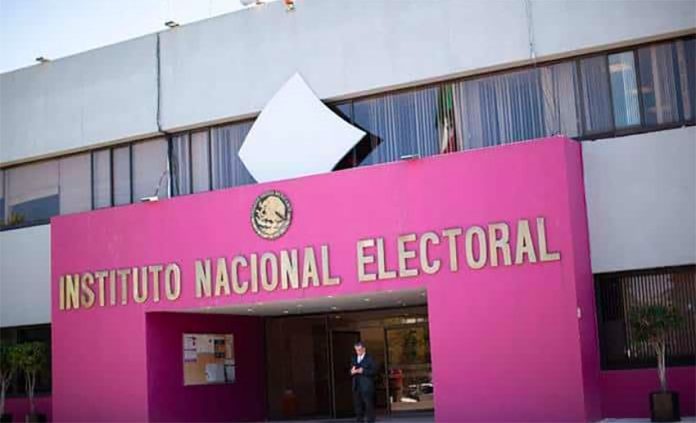
electoral institute

Federal electoral authorities have lost or lost track of thousands of their assets including 116 vehicles but say that there is no concrete evidence that public officials are to blame.

The internal auditing body at the National Electoral Institute (INE) reported to Congress that 17,355 items of movable property – including computer and medical equipment, office furniture, electric generators and cameras – cannot be located.

According to an INE inventory, the items have a combined value of 126.1 million pesos (US $6.2 million).

In a 2019 annual report sent to the Transparency and Anti-Corruption committee of the Chamber of Deputies, the INE Internal Control Body (OIC) also reported that 116 vehicles worth 6.2 million pesos are unaccounted for.

Questioned by the newspaper El Universal about the missing assets, the INE itself presented a different, and more detailed, version of events.

“The 17,355 goods to which the OIC refers are identified, albeit misclassified. The information has now been updated,” the INE said.

The institute told El Universal that 3,123 of the items in question are no longer in its possession although it didn’t explain what happened to them.

The INE said that it was bequeathed a list of 7,719 missing goods by the Federal Electoral Institute, or IFE, which it superseded in 2014, and that 5,479 of the lost items were reported by state-based INE branches rather than institute headquarters.

It also said that 271 items were located in storage, 471 were found in INE’s central offices and 291 were disposed of or sold but have not yet been removed from the institute’s inventory and hence appear in the OIC report.

With regard to the missing vehicles, the INE said the institute’s executive management had reported 117 missing vehicles, one more than the number cited by the OIC.

Of that number, 82 were removed from the institute’s “administrative resources computer system,” or SIAR, in 2013 because they were no longer in the institute’s possession, the INE said. However, when information from that system was migrated to the new “comprehensive administrative management system,” or SIGA, the record of the missing vehicles was also transferred.

The INE said that it doesn’t currently have the supporting documentation to remove the record of the 82 lost vehicles from the SIGA.

Thirty-one vehicles that were classified as stolen in the SIAR are also classified as such in the SIGA. INE said that it doesn’t currently have any documentation about those vehicles or their theft. Another four vehicles that weren’t listed as stolen in the SIAR appear as such in the SIGA.

The INE said that 18 audits conducted by the OIC that are referred to in the report submitted to Congress have not yet been completed. Therefore, the observations are preliminary and “in no way signify clear or proven” irregularities or show that public officials are responsible, the institute said.

The OIC said in its report that 15 investigations conducted in 2019 found that there was no evidence to suggest that INE officials had stolen goods. However, it added that at the end of last year there were 72 pending investigations related to the disappearance of goods from the National Electoral Institute.

Source: El Universal (sp)