Home Blog Page 1621

Every CDMX home to be visited in campaign to counter gender abuse

0
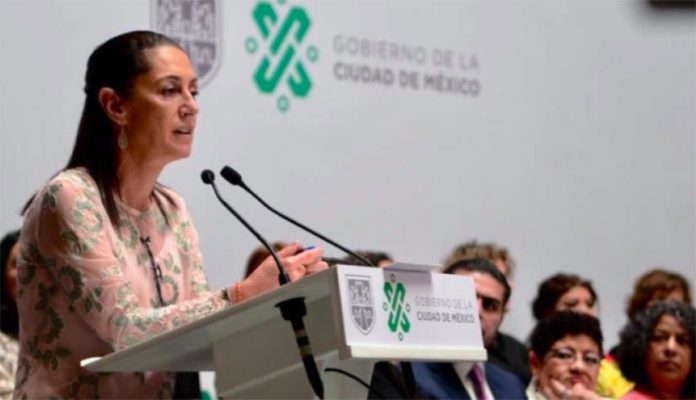
Mexico City Mayor Sheinbaum.

Mexico City Mayor Claudia Sheinbaum has announced her administration’s latest initiative to take on the problem of gender violence: visiting every home in the nation’s capital to inform women of the institutions available to victims in need of support.

The S.O.S. Mujeres (S.O.S. Women) program will be added to 11 other initiatives launched by the city government in November of last year, when Mayor Sheinbaum activated the gender violence alert.

“ [S.O.S. Mujeres] … focuses on what we’ve been doing to locate and work with cases of femicide that have occurred in Mexico City,” Sheinbaum told a press conference on Thursday.

“These cases stem from a circle of violence linked fundamentally to the home and the people closest to the victims,” she added.

She said that many victims feel they have nowhere to turn and are unaware of the various institutions and support programs available to them.

The S.O.S. Mujeres program aims to send representatives to people’s doors to inform them of government programs.

“They’re going to go house by house. They have been trained and informed to tell each family, and in particular each woman, that if you’re a victim of violence, these are the institutions that can help and protect you,” said Sheinbaum.

Head of the city’s Ministry of Women Ingrid Gómez Saracíba said that the most reported crime against women is family violence. Of the 22,000 current open cases of gender violence, 98% of the women reported experiencing it in their homes.

The majority of the violence reported — 57% — is psychological and emotional, while the second most reported type is physical.

“There are many women who for various reasons are not coming [to report violence] and we’re going to come to them, give information, accompany them, protect them,” said Sheinbaum.

The recent murders of Ingrid Escamilla and a 7-year-old girl named Fátima sparked outrage among those calling for gender justice and equality.

Women across the country have planned a national strike for Monday, March 9, to call attention to the problem and demand the government take action.

Federal Interior Minister Olga Sánchez Cordero admitted in February that the federal government had “arrived late” in its actions to combat gender violence, but said that it was now committed to dealing with the problem directly.

Source: 24 Horas (sp)
Business group urges government to renew investor confidence

0
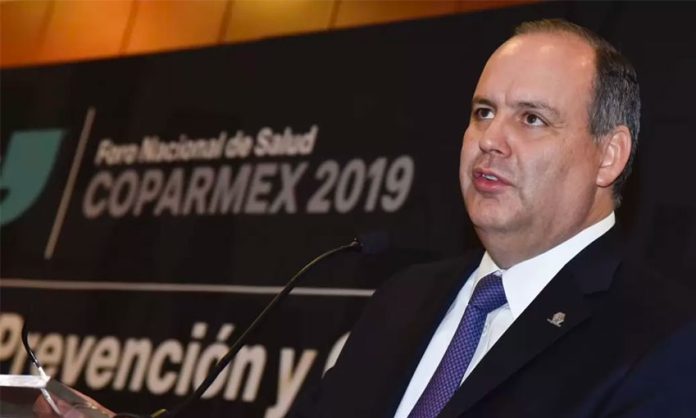
De Hoyos of Coparmex.

The head of the Mexican Employers Federation (Coparmex) has urged the federal government to put an end to the climate of anxiety and uncertainty that is scaring away investors.

Gustavo de Hoyos charged that the López Obrador administration is “highly destructive” to investment and said that it must make the “restoration of confidence” an “absolute priority.”

The warning from United States company Constellation Brands that it could terminate construction of its new brewery in Mexicali, Baja California, and transfer production to another country should serve as a wake-up call for the government, he said.

Speaking at a press conference after signing the United Nations Global Compact, a pact that seeks to encourage businesses to adopt sustainable and socially responsible policies, de Hoyos said that if the government succeeds in restoring confidence, the investment of Constellation and other companies can help Mexico to rekindle growth after the economy contracted last year.

His remarks came after President López Obrador said that a public consultation will be held to decide whether Constellation will be allowed to open its new brewery, which local farmers say poses a threat to the state’s water supply. López Obrador already canceled the previous government’s US $13 billion Mexico City airport project after a legally questionable public consultation, a move that was particularly damaging to investor confidence.

The departure of Constellation, de Hoyos said, would send a negative message to investors around the world. There is “nothing more damaging for the country’s future growth than a sign of uncertainty,” he said.

“Uncertainty could be destructive to the capacity to attract millions of dollars. … The continual reductions to growth outlooks for the Mexican economy in 2020 and 2021 are categorical evidence that there is not a climate of confidence … [nor] the willingness to take action in the short term to reestablish it,” said the chief of Coparmex, which represents some 36,000 businesses across Mexico.

The absence of growth is the fault of the government, he added, asserting that it has undermined investor confidence since it took office in December 2018. The decisions to disband the National Institute for Entrepreneurs, the investment promotion agency ProMéxico and the Tourism Promotion Council have especially hurt small and medium-sized businesses, de Hoyos said.

One positive is that Mexico, the United States and Canada signed a modified version of a new North American trade agreement late last year. The USMCA (only Canada’s legislature has not yet ratified the pact) will help attract greater foreign investment to Mexico, some experts say, because it guarantees tariff-free access to the North American market for the companies that operate here.

Source: El Financiero (sp) 

Cannabis entrepreneurs find much to like in Senate’s legalization bill

0
Entrepreneurs welcome new legislation.

Entrepreneurs hoping to cash in on the legalization of marijuana are happy with the draft bill approved by three Senate committees on Wednesday that seeks to regulate the plant for medicinal, recreational and industrial use.

“We see it as a way to provide security and certainty to both national and international investors,” said Erick Ponce, president of the Cannabis Industry Promotion Group, which has 25 Mexican and foreign members.

The bill, which seeks to regulate cannabis for medicinal, recreational and industrial use, proposes legalizing the possession by adults of 28 grams of marijuana for personal use.

Ponce highlighted that the bill approved on Wednesday does not prohibit local entrepreneurs from receiving more than 20% foreign investment for cannabis-related business ventures in Mexico, as an earlier version of the proposed law did. The elimination of the 20% investment ceiling will allow Mexican businesses to receive greater support from people who already have experience in the legal marijuana industry, he said.

The recreational use of marijuana was legalized in Canada in 2018 and the plant is also legal in some U.S. states such as Colorado and California.

Ponce noted that the bill proposes granting two different cultivation licenses, one for marijuana destined for the recreational market and one for hemp to be used by industry.

“The two types of cultivation will be allowed under a licensing model that will be defined by the cannabis regulatory institute; there aren’t very specific details. It appears that [the regulatory institute] will be a specialized independent body. It’s not yet known if it will be part of the Interior Ministry or the Health Ministry,” he said.

Slated to begin operations on January 1, 2021, the institute will also have responsibility for granting permits to sell marijuana and products that contain its psychoactive ingredients.

In accordance with a directive from the Supreme Court – which has established that prohibiting marijuana is unconstitutional – the Congress must legalize the plant for recreational and medicinal use by April 30.

Source: El Financiero (sp) 

1 vaquita less: video reveals endangered porpoise in fisherman’s net

0
The endangered vaquita marina.

A video taken by a fisherman reveals that there is one less vaquita porpoise in the upper Gulf of California.

Footage sent to the newspaper Reforma shows a lifeless vaquita in a fishing net. The sender said that the marine mammal became trapped in the net on Sunday or Monday, days when fishermen are active in the region.

It was the first time the fatal impact of fishing nets has been caught on camera. Once trapped, the vaquitas are unable to return to the surface for air and drown if not freed in time.

The fishing net in the video appears to be a No. 8, a type of net used illegally to fish for totoaba, which is prized in China for its swim bladder’s alleged medicinal and aphrodisiacal qualities.

With prices so high that the fish has been nicknamed “the cocaine of the sea,” totaba fishing has been responsible for decimating vaquita populations. Scientists from the Sea Shepherd Conservation Society reported last March that only 10 members of the species were estimated to remain in the wild.

Graban muerte de una de las últimas vaquitas marinas

Federal Environment Minister Víctor M. Toledo met with fishermen from the area on January 17 to discuss the problem.

Since then, fishermen have attacked conservationists and federal agents working to protect the species. On Tuesday they used net weights and Molotov cocktails to attack a Sea Shepherd boat, the second such instance of violence by area fishermen in a month.

Toledo said that the illegal fishing that prevails in the area will require intervention by various departments at all three levels of government, as well as by the fishing sector and society in general.

The situation has grown worse as criminal organizations have entered the market to cash in on the high prices fetched by the totoaba swim bladders. The problem is the worst between the towns of San Felipe, Baja California, and Golfo de Santa Clara, Sonora.

Mexico barely avoided sanctions from the Convention on International Trade in Endangered Species in August by pledging to take stronger action against illegal fishing in the vaquita’s natural habitat, but conflict between conservation efforts and local fishermen still endangers the dwindling species.

Sources: Reforma (sp), Tribuna (sp)

Xibalbá, a new theme park in Yucatán, will feature 8 cenotes

0
Xcaret's Xplor Park, located on the Riviera Maya in Quintana Roo.

Theme park operator Grupo Xcaret is set to open its latest attraction in Yucatán: a circuit of eight of the natural sinkholes called cenotes, which are unique to the region.

Called Xibalbá, the new attraction is being developed with an investment of 1 billion pesos (US $50.3 million). The 250-hectare park will open its doors on December 12 of this year.

Grupo Xcaret president and general director Miguel Quintana Pali presided over a presentation ceremony on a nearby hacienda.

“This is the biggest project that Grupo Xcaret has developed until now. It’s the most lavish, grandiose, the most beautiful,” he said.

He said that the project has encountered some difficulty due to the site’s distance from major tourist centers in the region. It is 189 kilometers from Mérida, 140 kilometers from Cancún, 120 kilometers from Playa del Carmen and 39 kilometers from Valladolid.

The five-to-six-hour tour will consist of a trip through the eight cenotes on the property, which are of several types: closed, open and semi-open.

It will begin in a cenote called Zopilotes (Vultures), with a gift shop, ticket booths, bathrooms and changing rooms nearby. From there, visitors will be able to reach the other cenotes via a canal aboard a kayak.

One of the cenotes is different from all others in the Yucatán peninsula.

“Normally a cenote with really nice water has little light, because light is what turns the water green or cloudy, but this one has a very crystalline color … and it has a lot of light. It’s a very pretty cenote, with many rock formations, and it has a kind of beach, which, from what we know, is the only cenote with a beach that exists,” said David Quintana Morones, the company’s director of development.

Another cenote will be given over to quiet meditation. It is open to the air above and has lots of lush vegetation hanging down its rock walls.

One cenote will be a venue for a show of traditional Mayan dancers and musicians.

Visitors will be able to move through the park via ziplines, kayaks or on foot. Snorkeling equipment may be used to view the interesting rock formations under the water.

There will also be a Mayan town with vendors selling souvenirs of hand-carved stone and wood, hammocks and leather goods, as well as a traditional Mayan medicine workshop.

“The idea is to steep visitors in the culture of Yucatán,” said Quintana.

Other features of the park include a food court, an area constructed in the style of a small colonial town and the largest aviary in the Xcaret park system.

The developers did not announce how much the park would cost, but they said they expect to see 1,500-2,000 visitors per day. It will generate 150 direct jobs once in operation, and residents of the state of Yucatán will receive a 50% discount on admission.

Yucatán Tourism Minister Michelle Fridman Hirsch said at the ceremony that the park is the state tourism board’s flagship project in its push to create more products that will attract more visitors and revenues to the state.

Source: Diario de Yucatán (sp)

Most senators say yes to cannabis legalization framework

0
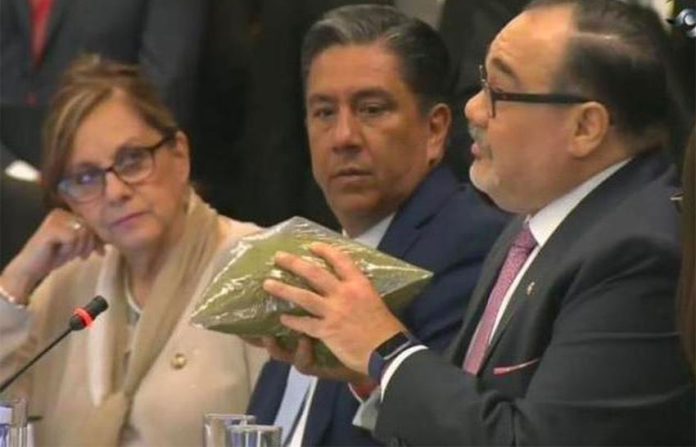
A senator uses baggies of oregano to demonstrate pot quantities.

The legalization of marijuana is one step closer after three Senate committees broadly approved a draft bill that seeks to regulate the plant for medicinal, recreational and industrial use.

At a joint meeting of the Justice, Health and Legislative Studies committees, 26 senators voted in favor of the bill, seven voted against it and eight abstained. The proposed law was approved “en lo general,” or in a general sense, meaning that the individual articles within it remain up for debate and are subject to modification.

The bill, which seeks to make changes to the Federal Health Law and federal criminal code, proposes legalizing the possession by adults of 28 grams of marijuana for personal use. Legal possession of the plant is currently limited to five grams.

The bill also proposes allowing people who require marijuana for medicinal purposes to grow up to 20 plants with the permission of the Mexican Cannabis Institute, a new government department that is not yet operational.

In addition, it stipulates that marijuana possession will not be punished as a drug trafficking offense until a person is carrying more than 200 grams. Prison sentences of up to 10 years can be imposed on people in possession of between 200 grams and 56 kilograms of marijuana, according to the draft bill.

The Cannabis Regulation Law would establish a controlled legal market for the plant that avoids monopolies. In the first five years after legalization, 40% of production licenses would go to people who live in communities affected by drug trafficking.

Lawmakers with the conservative National Action Party (PAN), who opposed the bill, and the Institutional Revolutionary Party, who abstained from the vote, stressed that the committees’ approval of the draft law doesn’t mean that all of its different parts have been supported.

The specifics of the bill will be debated in another meeting of the three Senate committees and in a plenary session of the upper house, where a vote could be held as soon as next week. If approved, the legislation would have to be ratified by the lower house and promulgated by President López Obrador in order to become law.

PAN Senator Damián Zepeda said that his party rejected the bill because it would make it easier for young people to obtain drugs. He also charged that the regulation of marijuana would not lead to a reduction in violence.

Antares Vázquez, a senator with the ruling Morena party who voted in favor of the bill despite President López Obrador’s opposition to the legalization of marijuana for recreational use, stressed that the law would regulate the plant but not promote it.

When the president’s opposition to recreational marijuana was raised during the meeting of the three Senate committees, Morena senators stressed that the legislative branch of government is separate from the executive.

The Supreme Court has set an April 30 deadline for Congress to legalize marijuana, granting a six-month extension to the Senate after it suspended debate on the issue in October.

The court published eight precedents on the recreational use of the plant in February 2019 that determined that its prohibition is unconstitutional.

Judges ruled that the complete prohibition of marijuana is not a proportional measure to protect people’s health and public order and that criminalization of the drug violates the right to free development of personality.

Source: El Universal (sp), Milenio (sp) 

Overcoming Starbucks shame with the progressive set

0
starbucks

I’ve been carrying around a Starbucks cup for the past few weeks. It’s terribly convenient for whenever I want my coffee or tea “to go,” but I’m feeling a little self-conscious about it.

I bought it on a whim during an infrequent trip to Starbucks one morning. It was 25 pesos, and I figured I’d get good use out of it, which I have. But I keep meaning to cover up the telltale emblem with a sticker or something.

The crowd I tend to hang around with here can probably best be described as “bougie-hippie” — social and environmental progressives who have the means to be particular about where they shop and what kinds of things they buy (and where they absolutely will not as a matter of principle).

In this crowd, Starbucks is not cool, but rather another symbol of vapid American capitalism coming down to push out the very fine Mexican coffee shops and vendors that are already here.

This kind of attitude is familiar to me. Growing up, my mom loved Walmart. Like, really loved it. It was her favorite place ever to go. I was a little embarrassed by it, especially being lower-middle-class in an upper-middle-class environment. If you shopped at Walmart with your family, you didn’t talk about it.

Once I got to college, I found that many of my classmates openly disparaged it. This was for a variety of fair reasons: its tendency to push out smaller stores from a community, its use of sweatshops to make its products and keep the prices low, the dismal pay it gave its employees.

Any underlying class snobbery was masked by a concern for social and economic justice. I’m not saying they weren’t concerned at all; but there was no consideration for people who might not have another choice than shopping where products were cheapest.

Here, that dynamic is turned on its head; some of the same places that many dislike in the United States — like Walmart (which happens to be Mexicos largest employer) — are solidly middle-class stores rather than simply “the cheapest place to get stuff.”

For a specific crowd here in my artsy, intellectual, coffee-growing city, shopping and consuming coffee at Starbucks may as well amount to betrayal. Really, though, I don’t feel sorry for these other places, and here’s why:

  1. Starbucks consistently has excellent service. I often wonder what their training program looks like, as baristas are always so predictably cheery and attentive. As a very sensitive person whose feelings are easily hurt, I like knowing someone will at least pretend to be friendly to me. When customer service here is good, it’s really good. But when it’s bad … yikes.
  2. No one at Starbucks ever says “hííííííjole, es que ya se nos terminó” (“Oh man, we’re out of that”). If you’ve got a business, be consistent; make sure you actually have all of the things on the menu, every day.
  3. Starbucks actually treats their employees well. Those who work there get benefits, vacation days and help with college. While people like to point out that not all American firms pay well, their Mexican counterparts certainly don’t either.
  4. They make an effort to be transparent about where their coffee is from and support local coffee growers. They’ve also got good sustainability initiatives.

Other coffee shop chains in Mexico seem to be following suit, coming up with novel plans for reaching more of the market, too. The Italian Coffee Company (which inexplicably has a name in English and is called “Italian” even though it’s a Mexican chain) has found its place on the highways of the Bajío region.

Café Punto del Cielo has gotten creative by offering its products on airlines. Café Don Justo, after starting out with a very mediocre cup of coffee, has greatly improved in quality, and Bola de Oro has done an excellent job at creating calm, beautiful spaces for people to meet and sip its award-winning coffee.

In the meantime, there are plenty of small, independent places to grab an excellent cup or bag of ground coffee to make at home. Ninety-five percent of the time, my Starbucks cup is filled to the brim with coffee from my favorite local place in neighboring Coatepec, La Onza.

I’m still thinking of putting a sticker over that siren.

Sarah DeVries writes from her home in Xalapa, Veracruz.

Over 13% of Mexico City Pemex hospital patients were given wrong meds

0
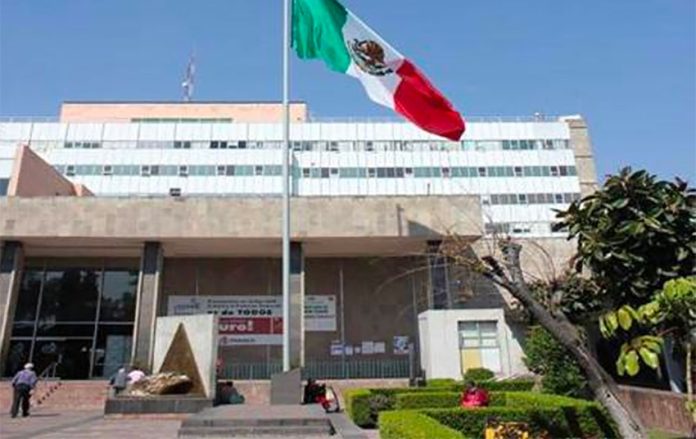
Pemex hospital in Mexico City were 342 patients were affected by medication errors.

A recent study by doctors at a hospital run by state oil company Pemex reveals that more than one in 10 workers and their family members treated at the company’s health facilities were affected by “medication errors.”

Doctors of internal medicine at Mexico City’s Central Norte Pemex Hospital have been speaking out about the problem since mid-2018.

They published a study in the December 2019 issue of the Pemex health system magazine. Of the 2,600 patients observed in the study, they found that 342 — or 13.15% — had experienced errors in medication at some point in the administration process.

The study found that the majority of errors were committed during the early morning shifts at the Central Norte Hospital.

When considered by medical specialty, the internal medicine department was found to have the most medication errors with a rate of 39.5%, followed by general surgery with 12.3%, orthopedics with 11.4%, cardiology with 5%, oncology with 4.4% and ophthalmology with 3.2%.

Errors were mostly committed during the preparation and prescription stages in the administration process.

Led by Dr. José Óscar Terán González, the research team determined that there was a need to pay better attention during these, the most crucial stages in the process, when doctors have direct contact with patients.

The team confirmed that the Pemex health system urgently needed to improve the service it provides employees and their families.

The study cited the U.S. National Coordinating Council for Medication Error Reporting and Prevention, which defines a medication error as any preventable incident that can bring harm to a patient through the inappropriate use of medications when under the care of health professionals.

The incidents can be related to professional practice, procedures or systems at any stage in the medication process, such as selection and acquisition, prescription, dispensation, preparation and administration.

“Medication errors … must be analyzed as errors in the system, and can occur at any stage in the process,” read the study’s findings.

“The majority [of errors] occur because of deficiencies in the process, although there are many possible ways to prevent them.”

Pemex currently serves around 700,000 oil workers and their families in its system of two central, six regional and 13 general hospitals, as well as its three hospital clinics, 11 community clinics, 24 general practitioner’s offices and one central medical administrative facility.

Two people died and 67 became ill last week at the Pemex Regional Hospital in Villahermosa, Tabasco, after they were given contaminated medication.

However, unofficial reports based on interviews with family members claim as many as 14 people have died at the hospital since February 17.

Source: El Universal (sp)

Gang disguised as doctors attempts to rob hospital ATMs

0
The 'doctors' had opened one ATM when an alarm sounded.

Eight men dressed as doctors attempted to rob the ATM machines at a hospital in the Mexico City borough of Tlalpan, but were forced to flee when their actions set off the security alarm.

The men were wearing fake coats and ID badges from the Ignacio Chávez National Cardiology Institute when they entered the ATM area of the hospital’s emergency room lobby at around 3:00 a.m. on Wednesday.

After entering without causing suspicion, they began to try to open the bank machines. They managed to open one but it immediately activated the security alarm.

Hospital security officers arrived on the scene upon hearing the alarm and saw the men flee the ATM area and escape in the vehicle in which they had arrived.

Authorities received a 911 call regarding the attempted robbery and police officers were sent to the hospital to secure the area.

Mexico City police said in a statement that the hospital’s head of security told them that he and his partner observed the men enter the facility dressed and identified as doctors.

Investigators are using the city’s C5 security camera system to ascertain the robbers’ getaway route. They established a virtual perimeter to create a model of their possible trajectory.

Authorities had yet to determine the identities of the disguised men as of Wednesday night, but it was confirmed that they had been unable to get away with any of the cash in the bank machines.

Source: El Universal (sp)

Judge orders definitive halt to Maya Train in Calakmul but other work can continue

0
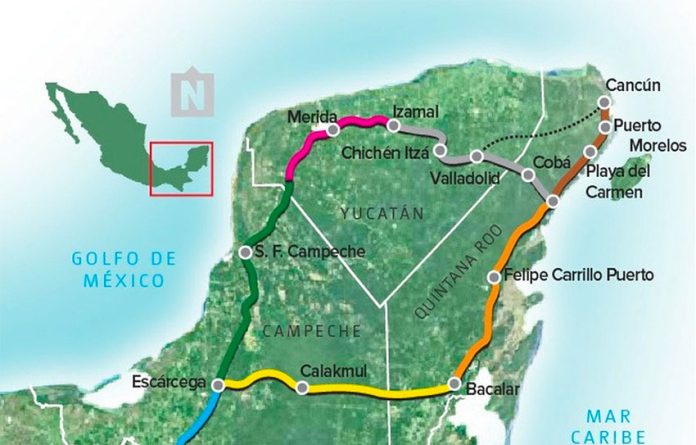
The Maya Train was to run from Valladolid to Tulum through Cobá, as shown.
The Maya Train was to run from Valladolid to Tulum through Cobá, as shown. Now it will revert to the original plan, with track running between Valladolid and Cancún.

A judge has granted a definitive suspension order against the Maya Train project to a group of Maya and Ch’ol people in Campeche but it only applies to one community in the municipality of Calakmul.

Campeche-based Judge Grissel Rodríguez Febles ruled on Wednesday that the National Tourism Promotion Fund (Fonatur), which is managing construction of the US $7-billion Yucatán Peninsula railroad, cannot carry out any new work within the limits of the community of Xpujil.

The decision came five days after a court in Campeche upheld a provisional suspension order granted to the Maya and Ch’ol people that prevented Fonatur from commencing new construction work anywhere in the five states – Quintana Roo, Yucatán, Campeche, Tabasco and Chiapas – through which the railroad will run.

The indigenous people applied for an injunction against the Maya Train on the grounds that the government consultation process, held prior to a December vote on the project that found over 92% support, was not conducted in accordance with their rights.

Their view was supported by the Mexico office of the United Nations High Commissioner for Human Rights, which found that the consultation failed to meet all international human rights standards.

After Wednesday’s ruling, Fonatur noted in a statement that the definitive suspension order does not prevent it from calling for tenders or carrying out work on more than 99% of the 1,500-kilometer project.

The federal agency added that it will continue dialogue with the 19 people who filed the injunction against the project “with the aim of safeguarding the rights of all residents” in Calakmul. Fonatur also said that it was confident that there is sufficient evidence to have the suspension order overturned.

However, if the prediction of a lawyer who advised the people that filed the legal action comes true, Fonatur will face many other legal battles to proceed with the railroad, which is scheduled to begin operations in 2023. Elisa Cruz Rueda said in January that it is likely that other communities in the five southeastern states through which the rail project is slated to run will also be granted injunctions.

Meanwhile, Fonatur chief Rogelio Jiménez Pons told the newspaper Milenio that the project will not include a section of track between Valladolid, Yucatán, and Tulum, Quintana Roo, as announced last June.

Fonatur said in June that the railroad would not directly link Valladolid to Cancún and that there would instead be a line between the former city and Tulum, where travelers would be able to take another line north to Cancún. The agency said at the time that the route change would knock 5.5 billion pesos (US $278 million) off the total cost of the project and 55 kilometers off its length.

However, Jiménez said that the change will not go ahead because of the large number of archaeological sites around Cobá, Quintana Roo, and problems with the subsoil in the area.

“We’re going to make a change, we have to return to the original route from Valladolid to Cancún,” he said, explaining that the decision was taken a few days ago.

Jiménez said that Fonatur will look for savings in other areas of the project to ensure that it doesn’t exceed the planned budget of 139 billion pesos.

Source: Milenio (sp)