Home Blog Page 1641

Veracruz primed for eye-popping parades at Carnival No. 96

0
The carnival in Veracruz will feature five different parades.

Veracruz is ready to kick off its 96th annual carnival with dances, concerts, giant robotic floats and even a parade at sea in the coastal city February 19-25.

Parades are the heart of the modern version of this festival of excess leading up to Ash Wednesday, which begins the six-week penitence Catholics observe before Easter.

With dance troupes, baton twirlers, drum groups, floats and squads of costumed characters, the Veracruz carnival is fun for the whole family.

The 30 floats and 50 dance troupes registered for this year’s parades will feature everything from traditional dances to colorful plumed headdresses to characters from Star Wars.

Between February 22 and 25 five parades will cavort to and from Veracruz and Boca del Río along the Manuel Ávila Camacho coastal boulevard. The five-kilometer parade will last about 3.5 hours.

This year’s theme for the parades is iconic cities and destinations around the world. The float for the queen of the carnival is inspired by Cairo, Egypt, and the king’s float is based on Dubai, United Arab Emirates.

The floats all feature robotic elements, lights, elevators and other special effects. Even more spectacular will be the four monumental animatronic figures so large that they must be transported with heavy equipment.

A giant robotic samurai warrior and a three-meter-tall King Kong are among the gargantuan figures unique to this festival.

Bleachers along the parade route will provide space for 120,000 revelers, including spaces for people with disabilities. Tickets for the bleachers cost 90 pesos (US $5) on Saturday and Sunday, February 22 and 23. There is no charge on Monday, February 24, and on the 25th they’ll cost just 10 pesos.

The Veracruz carnival has stood out in recent years for its nautical parade. A total of 500 people, both residents and tourists alike, will board five boats to sail around the bay entertained by salsa dancers and the festival’s king and queen.

The nautical parade is free of charge, but places on the boats are given on a first-come-first-served basis, so hopeful attendees will have to arrive early to get a spot. It is scheduled for 9:00 a.m. on February 22.

The carnival will also feature such traditional events as the coronations of the king and queen, as well as the quema del mal humor (burning of the bad mood), a ritualistic torching of a giant likeness of a derided figure or theme in the community.

It will also feature concerts by such renowned artists as Banda El Recodo, Emmanuel y Mijares, Gloria Trevi and Mario Bautista, and there will be a joke battle as well.

The concerts will be held on the Macro Plaza, on the malecón (coastal boulevard), and all are free of charge.

Although the Veracruz Carnival is now a family affair, it wasn’t always so. Carnival in the city actually dates back to the 18th century, when raucous troupes of dancers tore through the streets to the rhythm of Cuban music.

They displayed mojigangas, figures that satirized the dominant classes, and often behaved in manners deemed too licentious for the public sphere. It sometimes got so out of hand that, for example, during the reign of Emperor Maximilian, the festival was ordered to take place inside dance halls.

The celebration in its current form began in 1925, when the first organizing committee and the parade-style festival as it is now known were created.

Source: El Universal (sp)
In exchange for demands, community police agree to disarm children in Guerrero

0
children with guns
The kids will stand down.

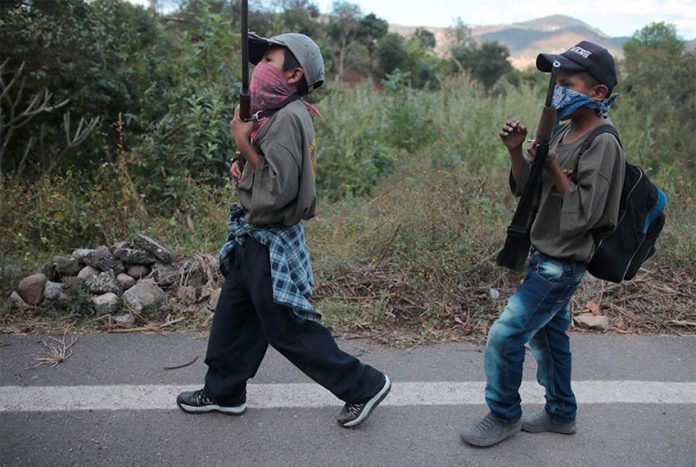
Nineteen children who were presented in the mountains of Guerrero in January as vigilantes-in-waiting have laid down their weapons after the community police force that was training them reached an agreement with the state government.

The coordinator of the CRAC-PF force said that a deal was struck with officials from the DIF family services agency at a meeting last Thursday.

“We were asked not to continue preparing the children [as community police],” Bernardino Sánchez said.

He added that the CRAC-PF, which operates in the municipalities of Chilapa and José Joaquín de Herrera, made a commitment to stop the children’s training as long as the 29 demands it put forth are met.

Directed to both the Guerrero and federal government, the demands include a visit from President López Obrador to formally endorse the community police force, the cancellation of 66 warrants issued for the arrest of CRAC-PF members, the release of imprisoned colleagues and a guarantee for the education of children who live in Chilapa and José Joaquín.

David Sánchez, another CRAC-PF coordinator, said that the community police force has given state authorities a week to show that they are prepared to meet the demands.

A meeting with DIF Guerrero president Mercedes Calvo, wife of Governor Héctor Astudillo, is scheduled for this Thursday to review the progress made, the newspaper Milenio reported.

David Sánchez said that the CRAC-PF has shown its willingness to keep its side of the bargain and that it’s up to authorities to do the same.

He stressed that the children who were in training to become community police – some of whom are as young as six – were not being prepared to become sicarios, or criminal hitmen.

“They’re being prepared to defend their family, their mother, their little brother and the town,” Sánchez said.

“For us, as indigenous people, in accordance with our traditions and customs, teaching our children so that they know how to defend themselves is a right because if we don’t teach them, later they [crime gangs] will kill us.  … Will the government defend them? We’ve already seen that it won’t,” he said.

Ten indigenous musicians were killed in Chilapa last month, allegedly at the hands of members of the Los Ardillos crime gang, which has attacked communities in the region on numerous occasions in recent years.

Eleven days after the ambush and murder of the musicians, a joint state and federal security operation was launched in Chilapa, while a walk for “Peace, Justice and Truth” was held in the municipality on Saturday to remember those who had been murdered or abducted in the Guerrero community in recent years.

Source: Milenio (sp) 

Kites of many colors to soar over Querétaro next 2 weekends

0
Go fly a kite in Tequisquiapan this week and next.

The skies of Tequisquiapan, Querétaro, will be filled with colorful kites both big and small over the next two weekends during the town’s fifth annual kite festival.

Designated a Magical Town by tourism authorities and just a few hours north of Mexico City, Tequisquiapan is a popular weekend getaway for residents of the country’s capital, many of whom make the trek to sample the region’s renowned wines and cheeses.

But the next two weekends will be dedicated to reviving the inner child whose heart soars along with the kite held aloft by the breeze.

There will be workshops at which festivalgoers can make their own kites, as well as many pre-made kites of all colors, shapes and sizes for sale. Festival organizers will also fly super-sized kites to wow attendees of all ages.

Aside from the entertainment overhead, children will have fun on the ground, too, with the puppet shows, bouncy castles, face painting, clowns and other activities planned for the weekends.

But don’t worry, grown-ups. The festival is to be held at the Cava Bocanegra cheese cellar, site of the Festival Viva El Queso cheese and wine festival, so there will be lots of food and alcoholic beverages as well.

Live music is also featured, and the festival is pet friendly so the whole family can go.

The festival will be held from 11:00 a.m. to 6:00 p.m. on February 15 and 16 and the following weekend, on the 22nd and 23rd. Tickets cost 75 pesos (US $4) and can be bought upon entering the festival (cash only). Kids under 1.2 meters enter free.

Source: El Universal (sp)

Chiapas migrants’ station ‘a prison in disguise,’ says Morena deputy

0
Deputy Muñoz (in wheelchair) with migrants in Tapachula.

A senior lawmaker with the ruling Morena party has described a migrants’ station in Tapachula, Chiapas, as “a prison in disguise.”

Porfirio Muñoz Ledo made the remark after visiting the federally run Siglo XXI migrants’ station on Monday as part of a delegation of federal deputies.

The lawmaker, an outspoken critic of the government’s increased enforcement against mainly Central American migrants who enter Mexico via the southern border, also asserted that the facility – used to house (and detain) migrants as they await either deportation or permission to remain in or travel through Mexico – was spruced up in preparation for the deputies’ visit.

“When we went in, it smelled of paint; they painted it a few hours before. … It’s a farce,” he said.

Drawn from several parties, the nine deputies who visited the migrants’ station agreed that an urgent law change is needed to ensure that neither child migrants nor their parents are held in migrants’ centers after being detained by authorities.

National Action Party (PAN) Deputy Laura Angélica Rojas Hernández said that migrant families should be housed at facilities operated by the family services agency, known as the DIF. More funding should be allocated to the agency to allow it to improve its infrastructure, she said.

Rojas said that the aim of the federal delegation, whose members met with representatives of the UN Refugee Agency, the Mexican Commission for Refugee Assistance (Comar) and non-governmental migrant advocacy organizations, was to learn more about the migration phenomenon firsthand.

She said that Comar statistics showed that asylum requests in Mexico had increased from just 1,200 in 2013 to 70,000 last year.

“That places very significant pressure on institutions,” the lawmaker said.

Rojas added that National Immigration Institute (INM) data shows that the number of undocumented migrants who crossed into Mexico in Chiapas last year increased to 170,000 from just under 94,000 in 2017 and just over 130,000 in 2018.

The number of migrants who have entered Chiapas from Guatemala so far this year is 50% higher than in the same period of 2019, she said.

The PAN deputy said that authorities need to reduce the time it takes to process applications for legal admission, pointing out that some migrants have to wait between six and eight months.

Rojas also said that the INM and Comar need to work together more closely and that infrastructure at migrants’ stations needs to be improved. They were built to house men but now also accommodate children and teenagers, some of whom are unaccompanied, she said.

Citizens’ Movement Deputy Jacob David Cheja said that responding to the migration phenomenon on the southern border is a priority because it’s a humanitarian, rather than a partisan, issue.

Verónica Juárez Piña of the Democratic Revolution Party said that the General Migration Law must be brought into line with the General Children’s Law because minors’ interests must be respected and that includes not detaining them in migrants’ centers.

The federal government agreed to ramp up enforcement against migrants in the middle of last year to avert a threat from United States President Donald Trump to impose blanket tariffs on Mexican goods.

Source: El Universal (sp) 

Abuse by government contractors no longer tolerated: AMLO

0
Private firms have misbehaved: AMLO.

President López Obrador has had enough of construction businesses “that have behaved badly,” taking advantage of the government contracts they are awarded.

“The companies had more lawyers than engineers; they specialized in arguing. The government was their piggy bank and that is now over,” he said at his morning press conference on Tuesday.

“We have a problem in how badly national and foreign companies have behaved,” he said. “They don’t follow through and they keep the advances.”

Nevertheless, he cited two experiences that he considered worthy of praise.

“One good example is the military engineers in the construction of the Santa Lucía airport, who are doing a quality job on time,” he said.

“The other experience is [with] a Dutch company that is [working on] the new Dos Bocas refinery [in Tabasco]. I can’t say the same for other cases.”

AMLO, as he is commonly known, said that now that the government is calling for tenders for the restoration of the railway on the Isthmus of Tehuantepec, he’ll make sure the bidders know that this aspect of business culture in Mexico has changed.

“Companies that come through will have the full recognition of the government, but those that run afoul will be derided, I can assure you … We cannot go on with more of the same,” he said.

Source: El Universal (sp)

Official overspent US $3.2M on ex-attorney general’s jet, court charges

0
Jesús Murillo's private jet.

The ex-senior officer of former Attorney General Jesús Murillo Karam has been charged with improper exercise of power for the purchase of a nearly US $20-million private plane for Murillo’s own use.

The current Attorney General’s Office (FGR) claims that Judith Aracely Gómez Molano ordered the purchase of a Bombardier Challenger CL-600 in 2013 with a leasing agreement through the state development bank Banobras.

Also implicated is Víctor Rodrigo Curioca Ramírez, former deputy director of material resources for Banobras and current undersecretary of administration in México state.

During a 10-hour hearing on Monday, prosecutor Carlos Palafox said that the plane had been valued at $16.4 million, but Murillo’s office paid the company Aviation Enterprise $19.6 million. He added that an expert with the FGR valued the plane at $14 million.

Palafox claimed that the purchase of the aircraft was unjustified, as the attorney general, who served in the administration of former President Enrique Peña Nieto, did not need a plane capable of transatlantic flights to carry out his duties of prosecuting federal crimes within Mexico’s borders.

“You don’t need an airplane with that type of luxury and comfort in order to prosecute crime. It was only used to fly the former head of the Attorney General’s Office, as well as his close collaborators,” said Palafox in court.

Both former officials could face up to 12 years in prison for the offense.

Federal Judge Beatriz Moguel Ancheyta rejected the FGR’s petition to put Gómez and Curioca in preventative custody, releasing the two on 100,000-peso (US-$5,350) bail bonds and restricting them from traveling outside the country.

Moguel said in her judgment that the decision to buy the plane failed to consider the cost-benefit impact of such a purchase, and that the lease agreement compromised the office’s funds for five years.

“They said the plane has 11 seats. I wonder if buying 11 tickets on commercial flights wouldn’t have been cheaper than paying over 344 million pesos,” she said.

The defense for Gómez and Curioca said that the two merely signed the contracts, but the purchase was endorsed by other departments, such as Finance. But Moguel didn’t seem to buy it.

“It would be illogical to think that a person in the post of senior officer could blindly sign the contracts and compel an undersecretary [of Banobras] to sign a contract without looking through it,” said Moguel.

Current Attorney General Alejandro Gertz accused Murillo last May of out-of-control spending and leaving the office in anarchy.

Source: Reforma (sp)

Once prestigious UNAM auditorium in the hands of ‘anarchists and punks’

0
The UNAM auditorium has been 'occupied' for 20 years.

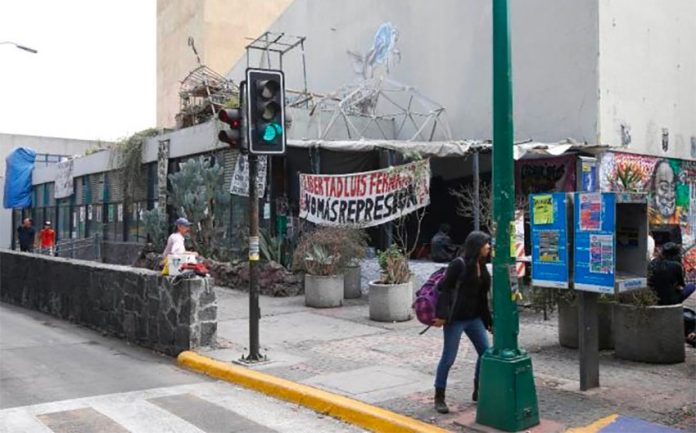
An auditorium at the National Autonomous University (UNAM) that once hosted luminaries such as French statesman Charles de Gaulle and Italian philosopher and novelist Umberto Eco has fallen into disrepair after being in the hands of self-styled “anarchists and punks” for almost 20 years.

According to a report by the newspaper El Universal, the Justo Sierra auditorium at Mexico City’s University City was first occupied by rebel students in September 2000 just months after the end of the longest strike in the university’s history.

Today it serves as the home and workplace of members of four collectives that are continuing its near 20-year history as a bastion of anti-authoritarianism. A vegetarian fonda, or small restaurant, a tattoo parlor and a screen printing workshop all operate in the auditorium but access to bona fide members of the university community is limited at best.

Students can’t freely use the auditorium – now dubbed the Che Guevara in homage to the Argentine-Cuban revolutionary – are prohibited from taking photos or videos of its interior and are met with stern responses if they ask too many questions of its occupants.

It’s not surprising that not all students are happy about the situation.

“I believe that the [university] community should take [back] … the space. … I agree with there being self-managed spaces but why in a university … ? At the start, the takeover was important but those there today don’t have very democratic attitudes. They’re closed off and don’t lend themselves to dialogue,” said literature student Andrey Palma Márquez.

El Universal reported that the auditorium, named after UNAM founder Justo Sierra, had its glory days, hosting events featuring not only de Gaulle and Eco but also other influential figures of the 20th century including Argentine novelist Julio Cortazar, Uruguayan writer Mario Benedetti, Chilean poet and diplomat Pablo Neruda and Mexico’s own literary superstar Octavio Paz. It was also once a rehearsal and performance space for the university’s philharmonic orchestra.

The seats have not been removed from the auditorium but the ceilings are cracked as a result of the twin earthquakes of September 2017. The bathrooms are in a state of disrepair, stink of urine and feces, and both vulgar and revolutionary graffiti is scrawled on the walls, El Universal said.

Other walls in the auditorium are plastered with anarchism-related images and messages in support of a range of social movements and leaders. Punk or ska music blares incessantly from two speakers, making it difficult for students anywhere in the vicinity to study.

One unidentified student told El Universal that the auditorium is now home to a “kind of very strange polygamous, communist commune,” adding “even children have been born here.”

El Universal noted that the occupants are aware that they could be evicted at any time and have stockpiled fire extinguishers, cudgels and shields similar to those used by riot police to stave off any attempt to kick them out.

If a confrontation over the auditorium were to ensue, the scenes would likely be similar to those seen at the UNAM campus in recent months, where thousands of students have been striking and protesting against gender violence and sexual assault by professors.

Source: El Universal (sp) 

Stretched to the limit: no new flights or increased frequency at Mexico City

0
Travelers at Mexico City airport.

No new flights will be authorized for the Mexico City International Airport (AICM) nor will airlines be allowed to increase the frequency of existing routes due to saturation of the facility, says the general director of the Federal Civil Aviation Agency (AFAC).

“If international operators come that want to fly in [already] saturated schedules, they won’t be able to. If they want to increase the frequency of a domestic flight, they won’t be able to,” said Rodrigo Vásquez Colmenares.

“The AICM is finished for all of us,” he added.

A record 50.3 million international and domestic passengers used the Mexico City airport last year, a figure that Vásquez said is evidence that the facility has well and truly reached its limit. The airport was designed to handle just 34 million passengers annually.

However, the AFAC chief explained that the main reason why no new flights will be added is that there is insufficient airspace to accommodate them in an already crowded flight schedule.

To reduce the pressure that the airport currently faces, there will be a “rationalization” of take-off and landing spots, Vásquez said.

“The implication that has will be different for each airline. Each will have to take their own decisions,” he said.

Airlines will have to decide where they want to concentrate their growth efforts, Vásquez said, citing the Toluca and Guadalajara airports, both of which are slated for upgrades, as possibilities.

He explained that airlines are forced to use up to 16% more fuel because they frequently face delays when taking off from the Mexico City airport. Transferring some flights to alternative airports would allow airlines to avoid such additional costs and improve their bottom line, Vásquez said.

The AFAC chief said that the federal government has the authority to reduce the number of slots an airline has at any given airport and as a result can effectively force carriers to shift part of their operations.

“The temptation to impose a decision is big,” Vásquez said before predicting that “it won’t happen.”

For his part, federal Communications and Transportation Secretary Javier Jiménez Espriú has said that the aim is to reduce the number of passengers using the AICM on an annual basis to 45 million even though a third terminal is in the works.

The Santa Lucía airport, currently under construction at a México state air force base north of the capital, will relieve pressure on the AICM but is not expected to be completed until 2022.

The operator of the Guadalajara airport hopes to double capacity there to almost 30 million with the construction of a new runway and terminal building but the new infrastructure is part of a five-year plan and it is unclear exactly when it will be finished.

Raúl Revuelta, CEO of the Pacific Airport Group, told the newspaper El Financiero that the aim is to “absorb” passengers who are currently using the Mexico City airport but didn’t specify when the Guadalajara facility would be in a position to allow that to happen.

Source: El Financiero (sp) 

Though no fan of sculpture, critic denies smashing it to pieces

0
Remains of the exhibit at the OMR Gallery in Mexico City.

An avant-garde work exhibited at one of the Mexico City’s most important annual art shows may or may not have been intentionally destroyed by a disapproving critic last weekend, though a number of observers believe it was her intention to do so.

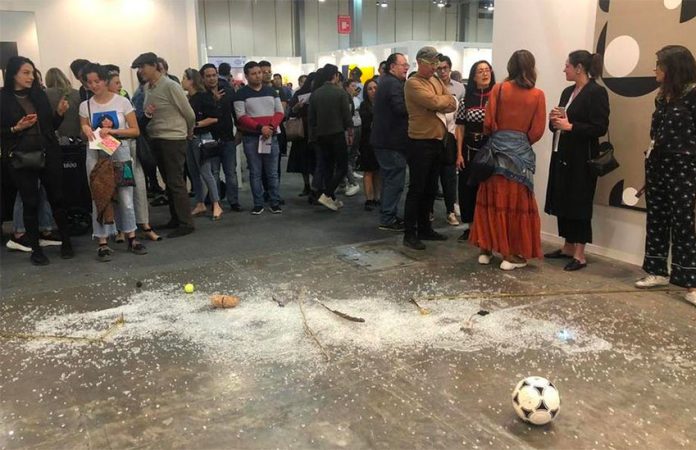
Gabriel Rico’s sculpture entitled Nimble and Sinister Tricks (To be Preserved with Out Scandal and Corruption) broke into innumerable pieces at the Zona Maco Fair in Mexico City on Saturday. Controversial art critic Avelina Lésper was very close to the piece when it shattered, and she is not a fan of the sculpture.

The newspaper Milenio reported Lésper denied breaking the sculpture and trying to run off afterward. She claimed a glass sheet that was part of the piece shattered when she placed an empty Coke can atop one of the stone elements that stands upon the glass.

“I had an empty can of soda. I tried to put it on one of the stones but the work exploded. It was as if the work heard my comment and felt what I thought of it.”

Artist Pavel Égüez, who was with Lésper at the time, stated “… the glass the objects supported exploded. Avelina did not touch it. The glass was too thin.”

The art exhibit before Saturday's incident and Lésper.
The art exhibit before Saturday’s incident and Lésper. Did she or didn’t she?

On Sunday, La Jornada reported that Lésper admitted to breaking the artwork by accident and putting a Coke can on one of the stones to show her rejection of the piece’s premise.

According to artnet.com one day later, the glass shattered when the critic put a can of Coke on it.

The OMR Gallery, where the piece was exhibited, issued a statement expressing its dismay, stating “We don’t understand how an alleged professional art critic could destroy a work.”

“Despite the fact that it appears to have been accidental … Lésper’s getting too close to the work to put a can on top of it and take a photo … which undoubtedly caused the damage, [demonstrates] an enormous lack of professionalism and respect.”

Lésper has been denounced by museum directors, galleries and others over the incident. Alfonso Miranda Márquez, director of the Soumaya Museum, accused her of trying to escape the scene, calling the incident a “tragedy” and calling Lésper a “pseudo and self-proclaimed art critic.”

The sculpture has been valued at US $20,000. It consists of a sheet of glass supporting a soccer ball, a tennis ball, stones and other objects. Its creator, Gabriel Rico, is an avant-garde artist whose work appeared in the 2019 Venice Biennale. The sculpture was the centerpiece of the OMR Gallery’s exhibit at the fair.

Lésper suggested that the work should be exhibited and sold as it was left, making reference to Marcel Duchamp’s The Bride Stripped Bare by Her Bachelors, Even (The Large Glass), which the artist declared complete after it had broken in transit.

Lésper said she did not have the resources to pay the asking price, but she offered to “repair it,” buying the exact same materials and rearranging them as Rico had done.

Lésper is a controversial art critic who is noted for her aversion to contemporary art. The incident quickly trended on social media with some defending the critic and sparked memes based on her fierce reputation.

It remains unclear if Rico will recreate the work or who will pay for it.

Sources: Milenio (sp), Artnet (en), El Universal (sp)

Young harpist wins classical music award, will perform in New York

0
Harpist Morales is off to Carnegie Hall.

Young harp player Erédira Yaretzi Morales Flores of the state of México will have a solo at Carnegie Hall in New York, thanks to her win at the 2020 Golden Classical Music Awards.

Morales won first place in the intermediate category (13 to 15-year-olds) in the competition held last month.

The Golden Classical is a musical competition open to people of all nationalities and ages, with competitions in strings, piano, wind and vocal. The objective is to discover new talent and offer opportunities to launch international careers.

Morales earned the chance to compete by submitting a video of herself playing. An international jury selected her from among contestants from 12 other countries for the intermediate strings category.

She began studying music when she was 6 years old. Today, she is a student at the Escuela de Iniciación de la Música y Danza, part of the Ollin Yoliztli Cultural Center, which is the concert hall in the south of the city for the Philharmonic Orchestra of Mexico City.

Here, she has studied various types of harp music, along with traditional instruments and dance of Mexico. One of her teachers is Baltazar Juárez, the principal harpist of the National Symphony Orchestra of Mexico.

Morales stated that she decided to study the harp because she likes its sound, its wide range and the ease in which she can touch people’s emotions. She stated that she is not sure if she plans to make music a career, but believes that it is important that every child in Mexico has musical training because “… it is sad to see that people are so busy with careers they do not like and become depressed.”

Morales’ win earns her the right to a solo performance at part of the award ceremony concert. This will be held March 9 and 10 at the Weil Recital Hall, part of Carnegie Hall. For this event, she is currently working with French harpist and composer Marcel Tournier.

Mexico News Daily