Home Blog Page 1675

Tzotzil weaver wins Mexico’s highest cultural award for her life’s work

0
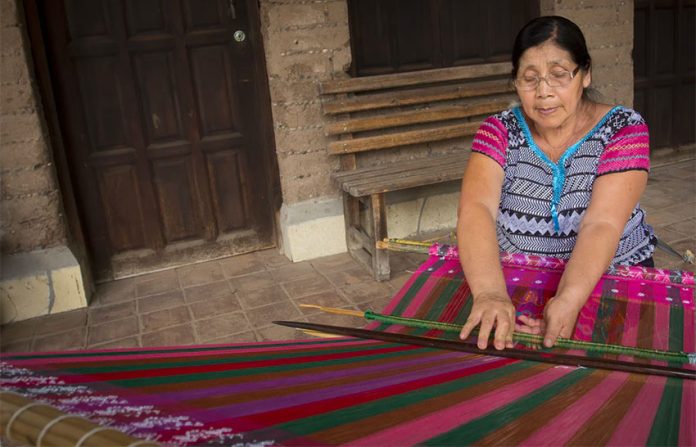
Chiapas weaver Carmen Vázquez keeps the tradition alive.

A weaver from a rural town in Chiapas has a new award in her collection after being named winner of the National Prize in Arts and Literature, presented to recognize those who have contributed to Mexico’s cultural heritage.

Carmen Vázquez, a Tzotzil Mayan woman from Venustiano Carranza, won the award in the folk arts category for her work in preserving and promoting traditional textile designs and techniques.

Vázquez was born in 1958 in the state’s Tierra Caliente region, several hours from the cities of San Cristóbal de las Casas or Tuxtla Gutiérrez. Villages are surrounded by sugar cane fields and in many ways, life here has not changed much in the 20th century.

The youngest of five children, her upbringing was traditional for the time, speaking only Tzotzil and not permitted to attend school. Instead, she was prepared for chores associated with rural domestic life, which included the making of textiles, in particular weaving on a backstrap loom.

For the most part Vázquez conformed to her community’s expectations, but not entirely. She studied secretly as a child and eventually convinced her family to allow her to attend school. Unlike her sisters, she can speak, read and write Spanish. But much of her time was spent working with her mother, who taught her how to weave on the traditional loom.
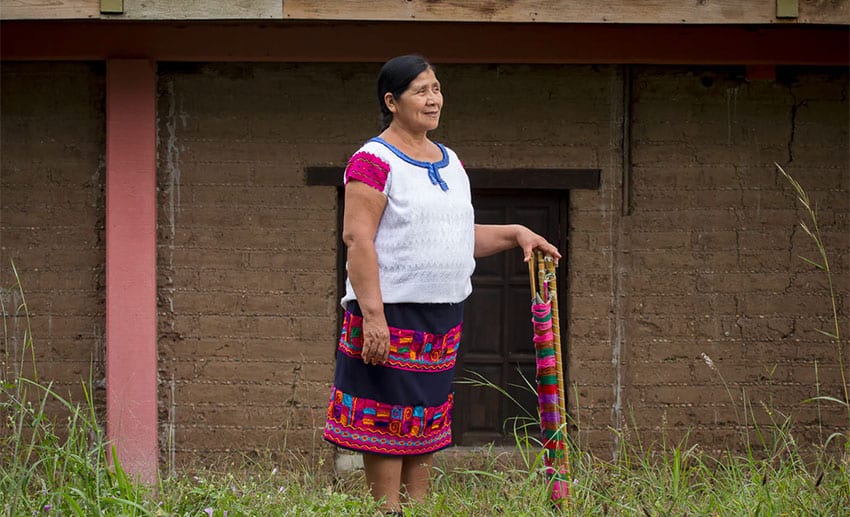
The winner of the National Prize in Arts and Literature at her home in Venustiano Carranza, Chiapas.

At first Vázquez watched then played with the thread and fabric scraps from her mother’s projects. At age 10, she began to learn in earnest. “My mother began teaching me to weave starting with napkins. I began playing with the threads I saw that were not being used, and I watched my mother weave so I could do it.” Much of her work was sold to support the family’s economic needs.

She married early, at 15, becoming the mother of five and eventually the grandmother of six. Over the following decades, Vázquez continued weaving, preserving a number of designs and techniques that others would leave behind.

Her proficiency is such that her pieces are works of art,with intricate weaving and embroidery, and designs reflect the Chismacal, the cosmology of the Tzotzil people. Like many indigenous communities, traditional dress for women has indications that tell where the woman is from. For example, Vázquez explains, women’s blouses in Venustiano Carranza are lighter than those in other communities because the weather is warmer. While some Chiapan communities weave with wool, those in Venustiano Carranza weave exclusively with cotton.

Over the years, she has perfected the making of linens, along with blouses, rebozos (a kind of shawl) and men’s shirts and pants. Some of these garments require working with very fine threads and most take months to make.

Vázquez won her first award the year she married and it was followed by many others at both the state and national level. The most important of these was the National Grand Prize in Handcrafts, sponsored by one of Mexico’s most important collections of folk art, the Fomento Cultural Banamex. It has brought the work of her Tzotzil community to national attention.

About 14 years ago, Vázquez began actively promoting and teaching traditional weaving to the younger generations in Venustiano Carranza. She is also one of the founders and the current president of the Cooperativa Jolobiletik Jun Ya’el, which makes and sells the work of 10 women in the community. In addition to all this, she still weaves with her sisters.

Despite their cultural and historic importance, handwoven garments are in danger of disappearing. They are time and labor-intensive and have to compete with the importation of copies. Many weavers in the area have stopped working or have abandoned more difficult techniques such as brocade, which Vázquez and her sisters are working to keep alive.

Says Juana Solano Espinosa, another weaver from Venustiano Carranza: “We plan to keep teaching . . . We hope to keep teaching the children so that they continue to keep our work alive; continue to make a living from handcrafts since this work is unique. Outside of Carranza no one does it anymore.”

Source: EFE (sp)
16 mountain communities in Oaxaca band together to get phone service

0
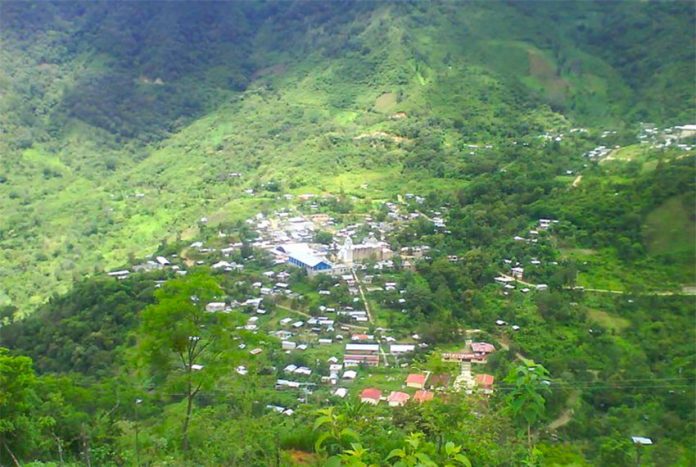
Santiago Nuyoó, where 1,700 residents are now enjoying mobile phone service.

An association made up of 16 mountain communities in Oaxaca has achieved what no private company was willing or able to do: it has taken low-cost mobile telephone service to the state’s Juárez, Mixe-Alto and Mixteca Sierra regions.

Called Indigenous Community Telecommunications (TIC), the association was supported in its endeavor by Rhizomatica, an international organization whose mission is to support communities to build and maintain self-governed and owned communication infrastructure.

Sixty percent of the revenue generated by the new mobile network will be reinvested in the communities that built it.

One of the main beneficiaries is Santiago Nuyoó, a municipality in Oaxaca’s Mixteca region, where 1,700 of the 4,000 users of the new network live.

“Our ancestors didn’t know telephone communication. Their communication was based on the ringing of bells, whistles and shouting. The people of our town never dreamt of having this technological advance,” Timoteo García, a local chronicler, told the newspaper Milenio.

Although just 100 kilometers from Oaxaca city as the crow flies, the journey to Santiago Nuyoó from the state capital takes six hours due to a roundabout highway route.

The difficult access to the municipality and other parts of Oaxaca’s sierra regions is one of the reasons why no company has shown interest in providing mobile coverage there, Milenio said.

Anastasio Vázquez, a Santiago Nuyoó councilor, said the community-built network is “very important” for the municipality, explaining that it has helped authorities overcome difficult communication problems.

“For example, when we need to communicate quickly with the seven communities [of Santiago Nuyoó] we have the radio but sometimes it’s difficult because of the mountains. We solve that with the telephone,” he said, adding that if the service was taken away, it would be akin to losing a hand.

Another Santiago Nuyoó resident said that having telephone service was no longer a luxury but a necessity.

“To take a message to some communities in this municipality, you have to walk three hours. I have family in [the community of] Plan de Zaragoza and when my mom got sick, the news didn’t reach there until the next day,” Hermelinda Pacheco told Milenio before making a call on her mobile phone.

“I can’t hear you,” said the person on the other end of the line, proving that while the construction of the mobile network is a big step forward, it hasn’t made communication foolproof.

To improve reliability, TIC is now working to upgrade the network from 2G to 4G, which would give residents of Santiago Nuyoó and other Oaxaca mountain communities the same service as that provided to residents of Mexico’s largest cities.

Source: Milenio (sp) 

Mexico-Bolivia tiff heats up: AMLO a ‘cowardly thug,’ says ex-president

0
Quiroga, left, accused President López Obrador of 'kneeling before' Donald Trump.

A dispute between Mexico and Bolivia intensified on Thursday after the federal government said it was initiating legal action against the South American nation and a former Bolivian president called President López Obrador a “cowardly thug.”

Foreign Affairs Secretary Marcelo Ebrard said the government would file a complaint against Bolivia in the International Court of Justice in The Hague, Netherlands, against a “siege” on the Mexican embassy in the Bolivian capital, La Paz.

“We will present a complaint before the International Court of Justice so that the police and military siege on the headquarters of the embassy of Mexico in Bolivia is suspended. We demand respect for the Vienna Convention [on the Law of Treaties] . . .” he wrote on Twitter.

The government says the embassy in La Paz has been encircled by Bolivian forces since it gave refuge to nine former officials from the government of ex-president Evo Morales, who resigned in November amid accusations of electoral fraud and took up an offer of political asylum in Mexico only to leave the country for Argentina less than a month later.

The Mexican government says that drones have been flown over the embassy, more than 50 security force members have been deployed there and that its diplomatic staff, including the ambassador, have been intimidated and harassed.

The Secretariat of Foreign Affairs (SRE) acknowledged in a statement that it made a request to its Bolivian counterpart for the provision of security due to the unrest in the country that followed the disputed October 20 election, but asserted that the police response has been excessive.

“. . . The police operation that Bolivian authorities have assembled is not only out of proportion but generates exactly the opposite of what the embassy requested: support to guarantee the security of the Mexican buildings, diplomatic personnel and the people under Mexican protection in La Paz,” the SRE said.

The department charged that Bolivia has violated the Vienna Convention by constantly filming its embassy and searching its diplomats’ vehicles.

Speaking at the president’s regular news conference on Thursday, Ebrard said he hoped that the International Court of Justice would uphold Mexico’s right to grant asylum and have its embassy respected.

The “consensus of the international community” is on Mexico’s side, he said.

The foreign secretary said Mexico asked for safe conduct passes for the nine people in the embassy, among whom is Morales’ former chief of staff, but Bolivian authorities refused the request.

Mexico's embassy in Bolivia is 'under siege.'
Mexico’s embassy in Bolivia is ‘under siege.’

The government of the landlocked nation, led now by interim President Jeanine Áñez, has issued warrants for the arrest of four of the former officials, he said.

Standing alongside Ebrard, President López Obrador said he hoped that no attempt would be made to force entry into the embassy, adding “not even [former Chilean dictator Augusto] Pinochet did that.”

A minister for the Bolivian presidency responded that the intention of his government was in fact to protect the Mexican embassy, stating that there are “supposedly groups who want to come down and take it.”

However, Yerko Nuñez added that the Bolivian government also wants “everyone who committed acts of terrorism and sedition and sought to organize conflict to face justice.”

He asserted that the ex-officials in the embassy won’t be given safe passage.

In turn, Bolivian Foreign Minister Karen Longaric told reporters in La Paz that Mexico’s appeal to the International Court of Justice was a “mistake” and a “legal fallacy” and should be withdrawn.

She rejected the claims that Mexican diplomatic personnel have been intimidated and that the police presence outside the embassy has been bolstered.

“No one can file a lawsuit for unproven facts, no one can be sued for acts they have not committed,” Longaric said.

“The government of [interim President Jeanine] Áñez is respectful of international treaties, of the Vienna Convention on diplomatic relations and, so national security forces would never enter a diplomatic building without prior authorization,” she added.

Also on Thursday, former Bolivian president Jorge Quiroga – now an international delegate for the government of the interim president – launched a scathing attack on López Obrador.

“Mr. López Obrador, it’s time to speak clearly. You have clearly decided to be the godfather of the Latin American tyrants. You’re a cowardly thug . . . we’ve seen you kneeling down ashamed before [United States President Donald] Trump, who places demands on you, who forces you to deport Central Americans, who’s putting labor inspectors even in the bathroom of your apartment,” he told a press conference.

“You kneel down before Trump and you shamefully kneel down before Castro of Cuba and [President Nicolás] Maduro of Venezuela,” Quiroga added.

In granting asylum to Morales, López Obrador “gave shelter” to a person who committed electoral fraud and is a “cocaine producer,” the ex-president said.

Quiroga also asserted that the Mexican president violated asylum conventions by allowing Morales to make political declarations while in Mexico that instigated violence in Bolivia.

“You have become a rogue with Bolivia. You confused our respect, our deference, with cowardice . . . Don’t come and bully the second female president of Bolivia . . .” he said.

In response, López Obrador told reporters at his Friday news conference that he wouldn’t take Quiroga’s bait and “fall into provocation.”

“We’re going to wait for this diplomatic matter to be resolved. We’re not going to get hooked on tittle-tattle, it’s not up to our level,” he said.

“. . . We’re going to continue demanding that they [the Bolivian government] respect the sovereignty of our country that is represented in the precinct of our embassy [in La Paz].”

Source: El Universal (sp), Animal Político (sp), Reuters (en), The Washington Post (en) 

Femicide cases have doubled in 4 years; 890 recorded in first 11 months

0
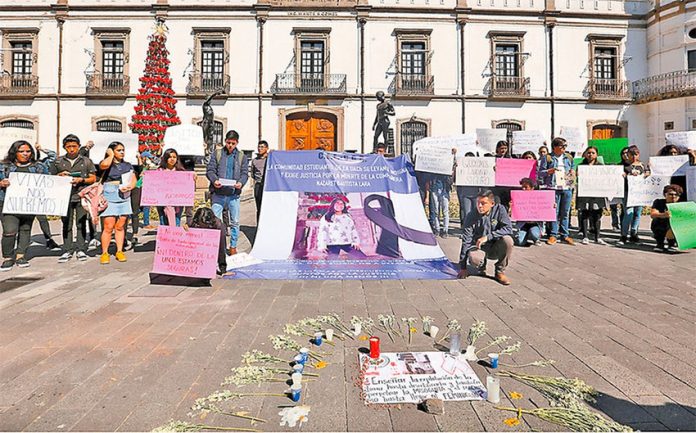
Protesters mourn one of the latest femicides in México state, that of student Nazaret Bautista in Texcoco.

The number of women killed on account of their gender has more than doubled in four years, statistics show.

There were 890 femicides in the first 11 months of 2019, according to the National Public Security System (SNSP), a 116.5% increase over the 411 cases recorded in all of 2015.

The figure is 17% higher than the 760 femicides recorded between January and November last year and almost 7% above the 834 cases reported in all of 2018.

With 152 cases, Veracruz recorded the highest number followed by México state, where 108 women were killed on account of their gender. Almost 30% of femicides across Mexico to the end of November occurred in the two states.

At a municipal level, Monterrey, Nuevo León, recorded the highest number of femicides between January and November with 17 cases, followed by Culiacán, Sinaloa, and Iztapalapa, Mexico City, where 14 and 13 women were killed respectively.

Several México state municipalities, including Toluca, Chimalhuacán, Ixtapaluca, Ecatepec, Naucalpan and Nezahualcóyotl, were among the 100 worst for femicide in the first 11 months of the year.

Murders of women also increased in 2019 compared to four years earlier although the spike was not as large as that for femicides.

SNSP statistics show that 2,564 women were murdered in the first 11 months of the year, an increase of almost 48% compared to the 1,735 cases in all of 2015. The figure is 4% higher than that recorded for the same period of 2018, when there were 2,466 female murder victims.

With 294 cases, México state recorded the highest number of murders of women between January and November. Although Veracruz led the country in femicides, the state didn’t record a single intentional homicide of a woman in the first 11 months of the year.

The total number of femicide and female murder victims was 3,454, meaning that more than 10 women were killed on average every day between January 1 and November 30. The figure is 61% higher than the number of women killed in all of 2015.

The high levels of violence against women triggered protests in many Mexican cities this year including the capital, where several marches were held including one in November to mark the International Day for the Elimination of Violence Against Women.

Source: Milenio (sp) 

Come for the music, stay for the beach is theme of rock and blues fest

0
ixtapa zihuatanejo blues fest

You can begin 2020 with a blast at the third annual Tequila Blues and Rock Explosion in Ixtapa and Zihuatanejo, Guerrero, in January.

Now expanded to two weekends, the music festival will rock Ixtapa on January 10-12 and Zihuatanejo on the 17th to the 19th.

In a shift from previous festivals, this year’s lineup includes a broader offering of musical styles, with rock, jazz, country and reggae mixed in with the traditional blues and blues rock.

Festival creator Bob Rempel is hoping the event’s marketing theme — “Come for the music, stay for the beaches” — will attract more people than ever before.

“We’ve tried to tell everyone connected and interested in growth for Ixtapa-Zihuatanejo . . . that these kinds of events are tourism magnets that many tourism-focused communities in Mexico are hoping to develop or acquire to give them an edge to attract visitors,” said Rempel.

The two-weekend lineup features a total of 20 performers from Canada, Mexico and the United States, including two hometown acts from Zihuatanejo: teenage guitar prodigy Vicente Contreras and reggae group Zihuatlan Vibration.

Among the stand-out tributes on the lineup are the ZZ Top Experience Show presented by Canadians Geoff and Chris Dahl. They will also present their Blues Brothers Experience, which they have performed all over the world.

Music legends Johnny Cash and Stevie Ray Vaughn will be revived in the tribute by Canadian Charlie Jacobson, and classic tunes by Led Zeppelin, Janis Joplin and AC-DC will be presented by the award-winning band Tangerine from Mexico City.

But the festival will also feature lots of original music as well. Melodi Ryan of Toronto, Ontario, will play songs from her first album of folk-rock originals, and vocalist and saxophonist Evelyn Rubio of Houston, Texas, will play her original blues and jazz.

Other notable Mexican acts include the blues four-piece band Fonzeca CPP Group from Monterrey and blues harmonica master Isidoro Negrete Reynoso of Mexico City with his band Máquina de Blues.

Proceeds from the festival go to local charities that support children and the rescue of street animals. Rempel has raised over 120,000 pesos for charity since 2018 by organizing this and other music events.

He said his events can generate so much money for charity because they attract “the kind of visitors with higher levels of spending that will really benefit a community in the highly competitive and somewhat stagnant tourism environment that currently exists in Mexico.”

Tickets can be bought on the festival website.

Mexico News Daily

Torreón, Coahuila, cracks down on noise infractions with fines for residents

0
Bars often contribute to high noise levels.

Noisy neighbors are under the eye of authorities in northern and central Mexico.

Officials in Torreón, Coahuila, have begun enforcing noise regulations, fining two residents last week as part of the Noisy Neighbor program.

“We give warnings beginning at 10:00 at night, but after 1:00am we apply fines,” said the head of the city’s environmental department, Felipe Vallejo López.

He said that each of the residents cited were fined 20 UMAs amounting to 1,689 pesos (US $89). (The UMA is a reference unit used to set fines.)

“If they reoffend, the fine can go up to as much as 40 UMAs,” he said, adding that the number of noise reports soared from 80 to 200 in the last week.

The two who were fined were on a list of 50 homes marked as reoffenders in the five months since the program was initiated.

Vallejo said his office is looking into expanding the operation during the holiday season as the number of complaints has significantly grown since the beginning of the festivities.

Elsewhere in the country, Mexico City is also looking to strengthen regulations to crack down on noisy neighbors.

According to city lawmaker Lilia Rossbach Suárez, noise complaints are on the rise in the capital, and she urged authorities to review the regulations.

She said previous attempts to regulate noise in the city have not yielded positive results, and there are more noise complaints being made by residents.

The regulations call for fines for exceeding established noise levels, but the infractions are rarely punished with fines and usually end in a request to lower the volume.

To make her case, she referred to Mexico City’s ranking of No. 8 on the World Health Organization’s list of the 50 noisiest cities.

Sources: Milenio (sp), Excélsior (sp)

Chihuahua police chief arrested in connection with LeBarón massacre

0
Janos Police Chief Villegas.

The chief of police of Janos, Chihuahua, has been arrested in connection with the massacre of members of the LeBarón family in November.

Janos Mayor Sebastián Efraín Pineda confirmed the arrest of Fidel Alejandro Villegas Villegas, stating that he was taken to Mexico City after his detention. “It took us by surprise,” he said.

As of Thursday night, Mexican authorities had released no further details.

Villegas is the fourth person arrested in relation to the massacre that left three women and six children dead in the municipality of Bavispe, Sonora, on November 4. Preliminary investigations have linked Villegas with the La Línea criminal gang in Janos, authorities said.

Chihuahua Attorney General César Peniche announced the first arrest in the case on November 6 and federal Security Secretary Alfonzo Durazo announced two more on December 1 — brothers Héctor Mario and Luis Manuel Hernández.

Claiming the brothers’ innocence, residents of Janos have conducted protests in response to their arrests and accused the Mexican government of using them as scapegoats.

Authorities have said the attack was a result of a dispute between La Línea, linked to the Juárez Cartel, and Los Salazar, linked to the Sinaloa Cartel. The LeBarón family has rejected the claim.

Source: Univisión (sp)

Guadalajara’s Cold Dunk Cave is home to thousands of tequila bats

0
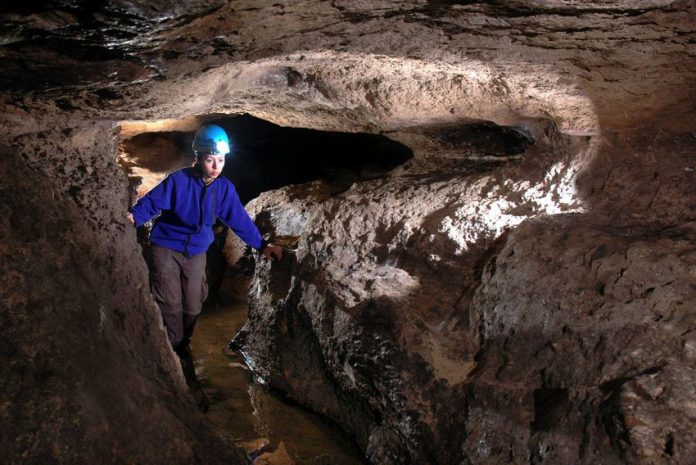
Cold Dunk Cave was formed in volcanic rock by water dissolving soluble material.

Anyone in the city of Guadalajara with a hummingbird feeder, has probably noticed that any nectar left over at the end of the day inevitably vanishes in the course of the night. This is due to the nocturnal visits of thousands of tequila bats, so named by none other than Sir David Attenborough himself.

These are the bats that normally pollinate the blue agave and if it weren’t for them, the town of Tequila would probably be far more famous for its majestic volcano than for its liquor.

As cave explorers, my friends and I naturally asked ourselves where all those bats must sleep during the daytime and that question led us — years ago — to a very curious river cave located only 22 kilometers from the edge of the city.

It all began in the plaza of a charming pueblito. It was the middle of May, the hottest month of the year in these parts, and the square was already shimmering with heat, although it couldn’t have been earlier than 10:00am. We approached the stooped form of a man relaxing on the only shaded bench around. Tired eyes watched us from a face that sported a harvest of wrinkles, perhaps from years of toil in the burning sun.

“Good morning, caballero, we´ve come here looking for caves in this area. Could you help us?” This was my favorite technique — not very scientific, I’m afraid — for finding caves in Mexico.

Seven species of bats inhabit the cave, including a small number of vampire bats.

The ancient eyes grew puzzled. “¡Ay! If it’s caves you’re looking for, you shouldn’t come to me. Why don’t you ask one of the old men around here?”

Though we were unable to find anyone older than our venerable informant, our question had been overheard by a gentleman — young and friendly — who claimed there was a cave on the ranch that he managed. He was even kind enough to draw us a map to the place, which resulted in our standing knee deep in a muddy swamp about 45 minutes later, trying to find a river, which would lead us to a waterfall which was close to the cave.

While slogging through the muck, little did we suspect that our caving club, Grupo Zotz, was about to encounter one of its greatest challenges.

Eventually we reached the end of the swamp and what did we find but the very river our informant had told us about. So we began following it downstream and after a while came to the top of a quite good-looking waterfall. Impressed by the accuracy of the friendly rancher’s information, all we had to do was find the cave.

Well, that problem was resolved, in a sense, the moment we reached the very edge of the cascade, a strikingly beautiful one at that, with a special plus for cavers. Standing at this spot, vapors rising from the canyon some 20 meters below us reached our noses and we gasped because, in spite of the sunshine and open air, we couldn’t miss the unmistakable, pungent odor of bat guano!

“There really is a cave here,” we said. “All we have to do is find a way down to the base of the waterfall.”

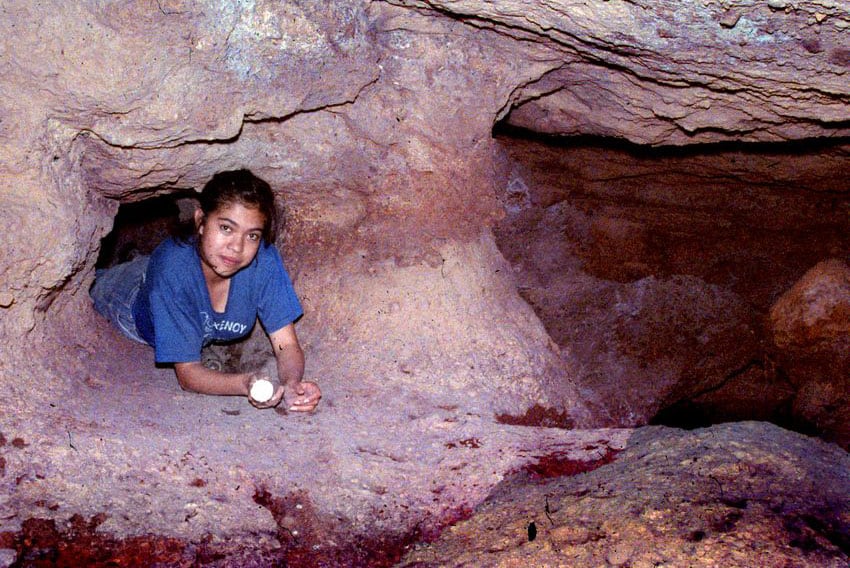
A typical crawlway in Cold Dunk Cave.

As we had brought no rope, that job took several hours, following a circular route which brought us to the river at a point downstream. Then we had to wend our way through a bamboo jungle to get back to the waterfall. When we finally reached it, we could see a big black hole to the right of the falls and we discovered that our cave entrance was completely flooded. Naturally we made an attempt to “chimney” above the water level and naturally we fell into the drink and this is how Cold Dunk Cave (El Chapuzón) got its name.

This is the closest cave to Guadalajara and one of the most interesting — as well as unusual — caves I have ever been in. It took us a full year to discover that the cave has 623 meters of passages on two different levels, with a small underground river running through most of it. We also learned that Chapuzón Cave has seven entrances, most of them much easier — and drier — than the waterfall entrance.

In the course of mapping the cave, we followed the river to the edge of a small drop. Just below us was a kind of pit filled to the brim with a disgusting mixture of bat guano, bat urine and cave water, with a dead rat floating on top for good measure. Hugging the walls on either side of what we soon christened La Pila de la Pestilencia, we tried our very best to bypass this unsavory soup, but we could find no way to do it. “We’re just going to have to jump in and swim across,” we decided, “but we’ll come back with clothes fit for the occasion.”

The following week we returned wearing what would best be described as rags. We jumped into the murky black liquid and after a few seconds climbed out of the pool into a long narrow passage whose ceiling and walls were covered by thousands of Leptonycteris bats. Naturally, a population like that was producing great amounts of guano which had resulted in a gooey layer of muck on the floor, at least a foot thick, which sucked at our boots as we tried to walk through it.

To make matters worse, flitting around our head were little bugs we immediately nicknamed “eyeball biters.” These seemed dedicated to making it as difficult as possible to read the compass or take notes for our survey. But we now had a pretty good idea where Guadalajara’s tequila bats were hanging out.

The murciélagos in Cold Dunk Cave seemed to be doing very well for themselves, unlike many Mexican bats which which are literally under attack from all sides.

[soliloquy id="97155"]

Amazingly, the war against bats in this country is based on a case of mistaken identity. Rancheros watch their horses and cattle die a horrible death from paralytic rabies and swear revenge on the vampire bats responsible. When they eventually come upon a cave, they automatically assume that all those bats inside are vampires. Often — as is the case with La Cueva del Chapuzón — the cave is mainly populated by thousands of harmless bats which eat tons of mosquitoes or pollinate many plants whose flowers only open at night.

Among all these friendly bats there may be only a handful of blood-drinking vampires, but the local people typically start fires inside the cave, dynamite it, or seal the entrances with chicken wire, effectively killing off or driving away thousands of innocent and very beneficial creatures.

Fortunately, many people who feed hummingbirds are happy to let bats finish off the daily supply of nectar. If you are among them, be sure to remove the “anti-bee” inserts at night so the bats can reach the nectar during their split-second visits to one of the feeder’s “flowers.”

The writer has lived near Guadalajara, Jalisco, for more than 30 years and is the author of A Guide to West Mexico’s Guachimontones and Surrounding Area and co-author of Outdoors in Western Mexico. More of his writing can be found on his website.

Renewable energy producers will be hurt most by strengthening CFE

0
Electricity commission wants to raise transmission costs to private sector.

The Federal Electricity Commission (CFE) has developed plans to curb private participation in the Mexican electricity market as part of an effort by the government of President López Obrador to consolidate power generation in state hands.

The CFE has created a “pliego petitorio,” a document that speaks of many ways in which the government is seeking to improve the conditions of the national electricity provider.

The document was prepared by the Federal Electricity Commission (CFE) and addressed to the Secretariat of Energy (Sener) and the Energy Regulatory Commission (CRE), identifying 80 specific issues, as well as 14 strategic issues for immediate attention, for strengthening the CFE.

The language in the document pleaded for the support of Sener, the CRE and the National Center for Energy Control (Cenace) to modify the regulation of manuals, resolutions and agreements as first implemented during the energy reform.

The most obvious adaptation is to increase transmission costs, which are the basis of investment projects of private companies, making a lot of private projects, above all in renewables, become economically unfeasible.

Transmission lines are key assets in the supply chain, taking the electricity from an area of production — potentially in rural areas where space is more freely available — to populated areas of high electricity demand.

In a similar fashion to what was discussed last week with fuels, the creation of more power is fruitless if the demand centers cannot access it. This could have even further ramifications for the development of the energy sector since across power, gas and fuels, the country is desperately short of production, a void that foreign investors are willing to fill. With such changes being implemented, contracts structured with private companies will also have to be reviewed given both the public and private arena must attain reciprocal value.

If approved, the legislation would have severely detrimental effects on the deregulated power markets, since the measures proposed by the CFE would harm companies that contribute around 12% of the country’s electricity supply, and above all to renewable energy generators. Mexico has made commitments to international climate change regulators and these changes will signify a regressive move for the country.

Secondly, the National Center for Energy Control (Cenace) has formally cancelled the medium-term electric auction.

In an official notice published last Friday, Cenace finally cancelled the already suspended auction from late March. Cenace should convene a medium-term auction every year to meet the basic electricity supply in the country, but since March 28 the Secretariat of Energy has warned of its intention not to continue with the auctions.

While this may not be a surprise to consumers or the wholesale electricity market, the failure to commit to auctions and the governing Morena party’s pessimistic approach to bid pricing provides another dent to the power sector and its desire to see a previously promised competitive market.

In response to claims from opposition parties and pro-energy reformists, López Obrador denied claims that he is trying to monopolize the power sector and return it to its former self. Instead, he claimed he was seeking to bring about changes as a strategic move to protect the people of Mexico and the nation itself. He continued in a similar tone to his dialogue on Pemex, indicating that it would indeed be possible for the CFE to restructure its debt and be profitable in economic terms for the benefit of the country.

He also assured the public that he is committed to the idea that the price of electricity does not increase in real terms during his sexennial, a task at which he has failed with aplomb in relation to fuel prices since his presidency began.

AMLO made it clear that he wants to assure the Federal Electricity Commission will continue to be the major distributor of electricity in the country and that the ratio of 56% public to 44% private will be maintained for the duration of his presidency, protecting the CFE from losing market share.

But he also indicated that the CFE will compete with the private market on “equal terms,” which implies that outwardly he still wants to show the private sector that he is a believer in an open market where a variety of options are still available to the end consumer.

The writer is the founder of Indimex Group, a Mexico City company focused on the procurement, marketing, trading and optimizing of refined petroleum products as well as investing in and operating physical assets for the movement of fuels in Mexico and the United States. His bulletin about developments in the Mexican energy industry appears weekly on Mexico News Daily.

Fair pay the best place to start in building professional police forces

0
police officers
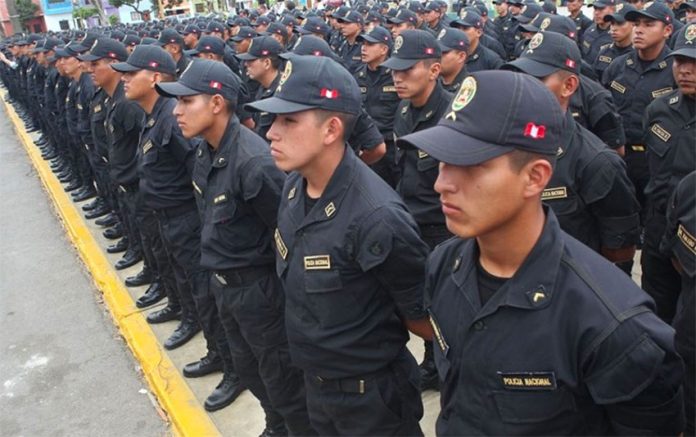
Is the pay worth risking one's life?

I have a friend whose daughter is in an abusive relationship. The daughter, a mother of three young children, is cloistered in her cramped home with little permission to go out without her partner — almost every aspect of her life is controlled, partially by him, partially by her lack of a job and time to work.

Her partner is currently in training to become a police officer.

Another friend of mine used to work as a psychological evaluator for potential police recruits. He was constantly surprised to hear confessions of (and sometimes bragging about) rape and abuse, only to see them hired as police officers anyway against his recommendations.

To be fair, abusers can be in any profession, and I don’t have the data to claim that they’re predominantly concentrated in certain jobs. I want to give them the benefit of the doubt; I want to believe that all those who become police officers are good people, interested in justice and fairness, who take their duty to protect citizens seriously.

With homicides at an all time high in Mexico, we need them more than ever. And as imperfect as our institutions are, they’re still a preferable buffer between citizens simply trying to live their lives and total lawlessness — and yet.

In a recent Mexico News Daily article about police pay and certification, it was revealed that large swaths of police forces around the country are poorly paid (no surprise there) and that “only 12 of Mexico’s 32 federal entities had police forces in which more than half of the officers were certified.

Certification is conferred on officers who have passed confidence tests, completed initial training and are performing to their expected level.”

I’m sorry, what?

Who, exactly, is pinning badges on people who are not prepared for doing the job?

Police are tricky. We need them, especially now, but how can we make sure they’re not themselves infiltrated with “bad guys,” especially when we’re desperate to beef up our thinned-out forces?

When probable impunity is part of the fabric of society itself, how can we ensure that they’re on the side of law-abiding citizens, and willing to stay there despite unprecedented danger and lukewarm pay?

In the absence of well-trained, well-paid police forces throughout the country, several groups, including this one in Veracruz, have taken it upon themselves to form their own security forces.

Well, it’s better than nothing. But their presence shows a shocking loss of faith and confidence in government to protect its citizens at a profound level. After all, who decides on the standards, rules and regulations for these defense forces? Is there any uniform set of laws or standards (or — yikes — morals?) that they’ll decide to enforce?

Is there anything that could convince these ordinary citizens to become legitimate, badge-carrying police officers?

With every state police force in the country severely lacking in numbers and many municipal forces dwindling as well, it’s important for us to ask what we can do to recruit good, qualified officers. What can we offer people in order to become professionals who, in some areas, might as well have targets pinned to their uniforms?

With such a tall order, it’s hard to be picky, yet we must be. And one way to do that is through pay. Pay is not everything, of course. But pay directly correlates to how important we feel peoples jobs are to society. So what does it say when were asking people to protect citizens with their lives, if necessary, for 10,000 pesos a month?

Most police officers make between 10,000 and 20,000 pesos a month, with salaries for municipal police set by the municipality itself. Currently Guanajuato state police are set to be the highest-paid in the country, with a monthly take-home pay of just over 20,000 pesos.

They’re not terrible salaries for many places in Mexico, but it’s certainly not a high enough amount for which most people I know would accept risking their lives.

Asking people to protect citizens in a country uncomfortably close to being completely lawless in many areas is one of the biggest requests that can be made.

We’re essentially asking them to put their communities above themselves, and perhaps even above their families. What is that worth? And if, say, we doubled, tripled or quadrupled the amount, could we be more selective in terms of whom we hired for these jobs?

Justice and fairness, like everything else in life, is multi-dimensional and sticky. Let’s at least start with fair pay.

Sarah DeVries writes from her home in Xalapa, Veracruz.