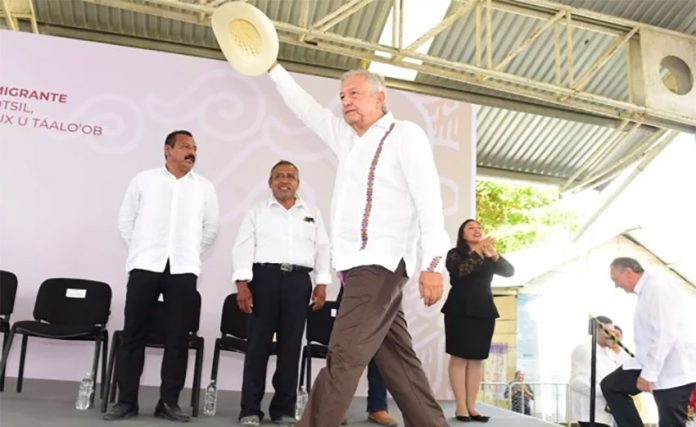
Train will cause no environmental damage, AMLO promised during a speech in Quintana Roo.
The Maya Train project will only go ahead with the support of the people, President López Obrador declared on Saturday.
During an address at an event in Felipe Carillo Puerto, Quintana Roo, López Obrador asked the chief of the National Institute of Indigenous Peoples, Adelfo Regino, to consult with the residents of all communities along the route of the new railroad before the project is put out to tender in December.
A nationwide consultation, held just before the government took office last December, found 89.9% support for its construction.
The president said he didn’t want to start building the railroad, which will run through five states in southeast Mexico, if opposition meant that it couldn’t be completed.
“. . . If that’s the way it’s going to be, I’d be better off not starting it because I’m not going to leave an incomplete project,” López Obrador said.
“. . . If the people say go ahead, we’ll go ahead. If the people say no, we won’t . . . they will decide,” he added.
After an event in Temozón, Yucatán, earlier on Saturday, López Obrador told reporters that undertaking the Maya Train project is “extremely important for the southeast” because it will generate jobs and stimulate development.
“. . . Never in history has such an investment been carried out. In Yucatán alone, 20 billion pesos will be allocated [to the project],” he said.
In Yucatán and at a later event in Calakmul, Campeche, the president asserted that construction of the railroad won’t have a negative impact on the environment or the region’s archaeological sites because it will make use of a right of way obtained decades ago for the southeast railway.
“. . . It’s a project for the benefit of the people. We will be incapable of harming the environment and the cultural wealth of our people; have confidence that it will be for the benefit of the people,” López Obrador said in Campeche.
“. . . I don’t want to take a single step if I don’t have the support of the people . . . I’m not going to leave anything half-finished. I want to finish everything . . .” he added.
The Maya Train is one of three major infrastructure projects the government plans to build in the southeast of Mexico, all of which face opposition on environmental grounds.
The government itself has conceded that construction of a new oil refinery on the Gulf of Mexico coast in Tabasco will affect the quality of air and water in the area and have an impact on local wildlife but says the project remains viable because the negative effects “will be controlled, mitigated or compensated.”
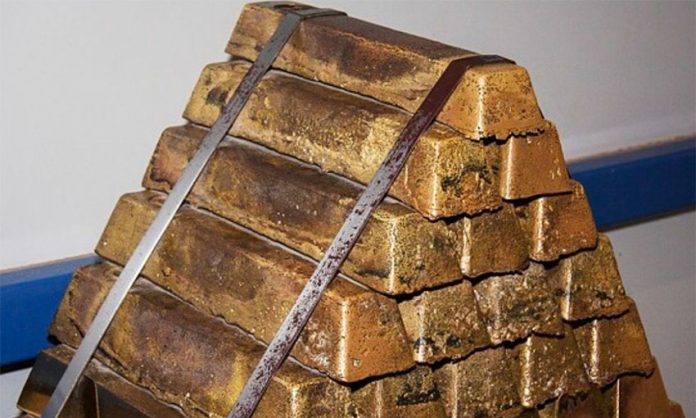
Stolen gold and silver ingots were being shipped from the Noche Buena mine in Sonora.
Thieves in Sonora stole a load of gold and silver ingots worth as much as US $8 million from an armored vehicle on Friday.
The 47 ingots, containing an alloy of gold and silver and called doré bars, belonged to the Penmont Mining Company and were being transported by the Sepsa security company when the vehicle was attacked by armed civilians on the Caborca-Sonoyta highway a little after 9:00pm.
The company revealed the estimated value of the loss in an official statement.
“The approximate total is estimated to be between $6 million and $8 million, which is insured according to the company’s security protocols.”
Unofficial reports have indicated that three Sepsa guards were injured in the attack.
The ingots were being shipped by Penmont, a company that is owned by mining giant Fresnillo, from the Noche Buena mine.
This is not the first time Penmont has been the target of highway robbery in the region.
In August 2015, an armed caravan of three vehicles stole four kilograms of gold and 100 ounces of crude silver, then valued at 4.3 million pesos (US $225,000), from a company vehicle.
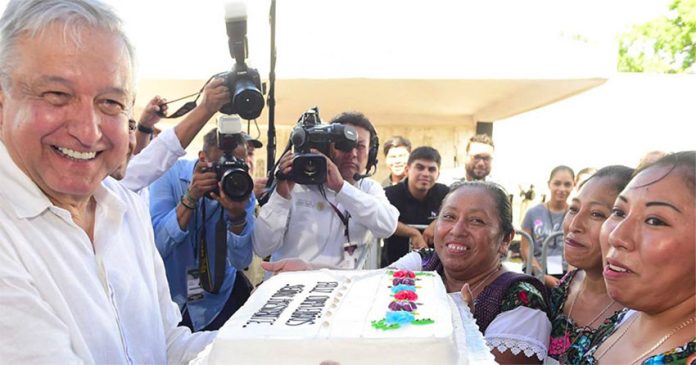
AMLO announced fair prices for honey during a visit to Temozón, Yucatán.
The federal government will create a social enterprise to buy Yucatán peninsula honey at fair and guaranteed prices, President López Obrador said on Saturday.
Speaking at a community event in Temozón, Yucatán, López Obrador said the idea came from Governor Mauricio Vila, who told him that Yucatán is the biggest honey-producing state in Mexico but producers receive the lowest prices in the country for their product.
“. . . According to the information that the governor gave us, there was previously a company that bought honey and there was a guaranteed price but things went badly for the company and there is no longer a guaranteed price . . . That’s why this injustice is committed [in Yucatán] . . . There is a lot of monopolization, a lot of price-fixing,” he said.
“We’re going to create a social enterprise that will buy all of Yucatán’s honey at a fair price, a guaranteed price and we’re going to seek to do the same for Campeche and Quintana Roo, all of the Yucatán peninsula . . .” López Obrador added.
A government collection center will be established where beekeepers can take their honey for sale, he explained. Private buyers “won’t disappear,” López Obrador claimed, but they will be forced to pay producers better prices.
López Obrador’s pledge to pay fair prices to honey producers came two days after the head of the National Science and Technology Council announced a bee conservation project on the Yucatán peninsula to counteract the threats apiculture faces from pesticides and genetically modified crops.
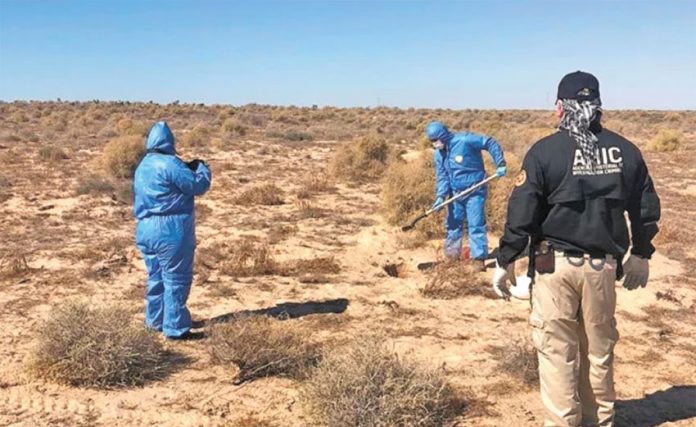
Officials at the site of Puerto Peñasco burial ground.
Led by a citizens’ search brigade, authorities in Sonora have found the remains of 10 more people near the tourist destination of Puerto Peñasco, bringing the total to 52 since search efforts began on October 23.
The remains were taken to Hermosillo on Sunday for processing, cleaning and DNA testing. Results will be compared with genetic information provided by families searching for disappeared relatives.
State authorities in the capital Hermosillo had sent investigative and forensic experts to Puerto Peñasco to continue in the search for more possible discoveries.
So far, experts have carried out 18 autopsies, nine of which have been processed by the National Commission for the Search of Disappeared Persons.
Although the findings in October prompted the Sonora Attorney General’s Office to state it would support the Searching Mothers, the collective called out authorities on social media, claiming the support was nothing more than lip service.
Sonora officials once again issued a call for all families with missing loved ones to submit DNA samples to cross-reference with DNA taken from the remains in order to identify the victims. Proper identifications require samples from at least two family members.
A 65-year-old Oaxaca fisherman who had stretched out on the sand for nap last Friday morning received a rude awakening when a crocodile measuring over two meters long attacked.
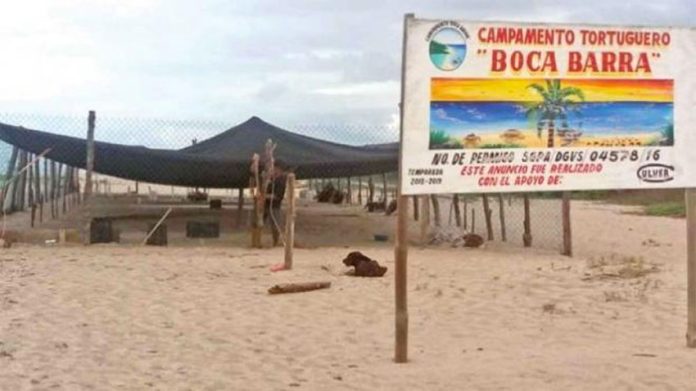
The attack occurred on the Boca Barra beach in Santa María Colotepec, just east of the popular tourist destination, Puerto Escondido.
Despite the animal’s size the man, identified as Amadeo Barrera, was able to escape and was treated by paramedics before being taken to the hospital in Puerto Escondido.
He suffered lacerations to his arm, leg and head by the crocodile’s teeth and claws, but was reported in stable condition.
State Civil Protection head Heliodoro Díaz said the animal was not in its normal habitat. Boca Barra beach is located where the Colotepec river meets the Pacific Ocean, but the crocodiles aren’t known to make their way so close to the river’s mouth.
Locals have reported that higher water levels in rivers, streams and lagoons has increased the risk of crocodiles leaving their established areas, and also the likelihood that they will attack animals or people.
Municipal authorities have requested that the environmental protection agency Profepa verify that crocodiles have not relocated to smaller lagoons near populated areas.
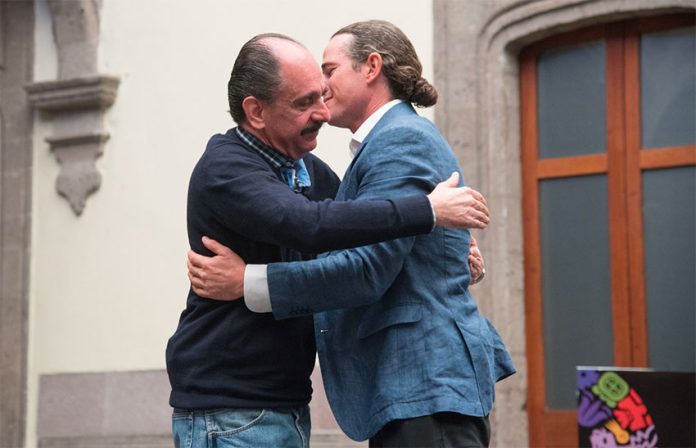
Five hundred years on, a hug between conqueror and conquered. Acosta, left, a descendant of Moctezuma, and Pignatelli, whose ancestor was Cortés.
Descendants of Aztec emperor Moctezuma II and Spanish conquistador Hernán Cortés met in Mexico City on Friday to mark the 500th anniversary of their ancestors’ first meeting.
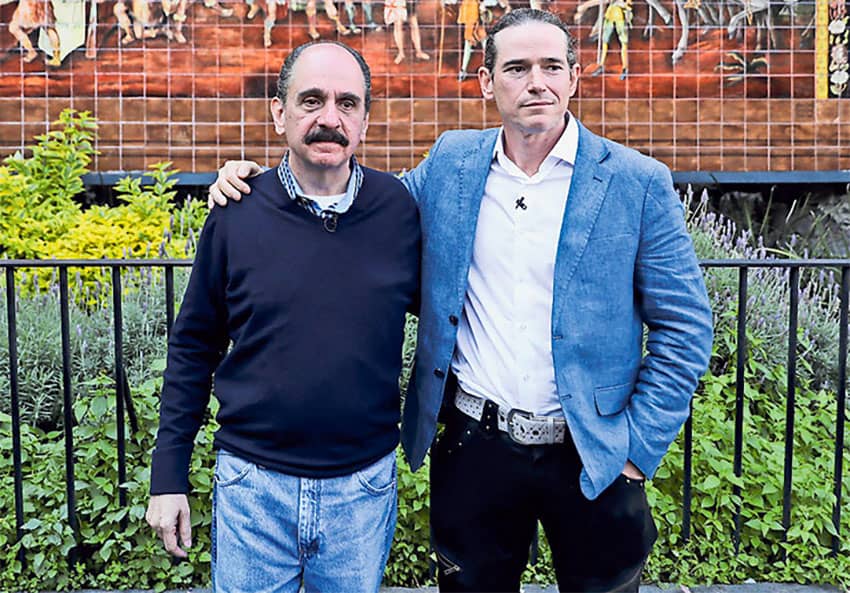
Federico Acosta, a Mexican who traces his lineage back 16 generations to the daughter of Moctezuma, and Ascanio Pignatelli, an Italian whose ancestry goes back the same number of generations to Cortés’ daughter, shared a hug at the exact same spot where their forebears met on November 8, 1519 in the Aztec city of Tenochtitlán.
They also visited the colonial church in the historic center of Mexico City where Cortés is buried.
Both men are sure of their lineage: Acosta’s family received a government pension granted to Moctezuma’s descendants until the 1930s, while Pignatelli’s family inherited one of Cortés’ noble titles but sold it 150 years ago.
Pignatelli traveled to Mexico on the invitation of filmmaker Miguel Gleason who is making a documentary about the Spanish conquest. He offered a personal apology to Acosta.
“I want to ask your forgiveness for all the bad things that happened,” he said. “We need to leave the past behind us. Today is a day for leaving all the bad things in the past.”
Acosta said the 500th anniversary of the meeting, which came two years before the Spanish conquered the Aztec empire, was “a historic moment” for all Mexicans.
“. . . We are the fusion of two cultures, the European and ours. We are the result of that meeting, the vast majority of us have Spanish and Mexican blood . . .” he said.
Asked if Mexico needs an apology from Spain, Acosta said no. “In the end, we are all family now,” he said.
However, President López Obrador, who requested an apology in March, renewed his call for Spain and the Catholic Church to say sorry during a visit to Yucatán on Friday.
“I still ask the king of Spain and Pope Francis, humbly, that they apologize for the abuses committed during the conquest and the colonial domination,” he said.
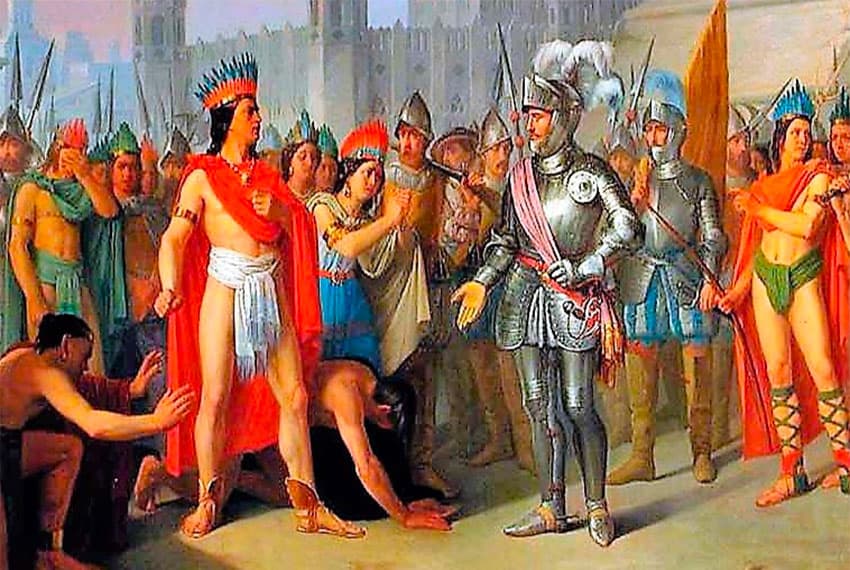
Moctezuma and Cortés in 1519.
Upon reaching Tenochtitlán from the Atlantic coast in modern-day Veracruz, Cortés and his men were met by Moctezuma at the entrance to the city.
The tlatoani, or ruler, of the city built by the Mexica, or Aztec, people, greeted Cortés and his companions with courtesy and offered them gifts in the hope that they would leave.
However, the gifts whetted the Spaniards’ appetite for more riches and they remained in Tenochtitlán and eventually took Moctezuma hostage.
On June 30, 1520, the Aztecs revolted and drove the Spanish out of the city. Many Spaniards were killed during the uprising which came to be known as La Noche Triste (The Night of Sorrows). But Cortés and the surviving men regrouped and just over a year later, they had conquered Tenochtitlán.
Acosta said that he was proud of the civilization that his ancestors built.
“We had order, we had honor, we had everything, and if we recover that, we Mexicans have proven that we can be the best,” he said.
Moctezuma’s descendant declined to condemn the conquistadores for their brutality and massacres, stating that they should be judged by the standards of their day.
“It’s not that there were good people and bad people,” he said. “It’s that that’s the way things were done.”
In addition to meeting with Acosta in Mexico City, Pignatelli traveled to Cholula, Puebla, where more than 5,000 Cholutecas were massacred by the Spanish and their indigenous allies on their way to Tenochtitlán in 1519.
The Italian lamented the bloodshed, telling the newspaper Milenio: “I know that there was a lot of suffering here, a lot of pain.”
At a church atop the Great Pyramid of Cholula, Pignatelli prayed for forgiveness for the atrocities committed by his forebear 500 years ago. Earlier this week, he also visited the grave of Cortés’ great-granddaughter Doña Ángela Cortés y Arellano, in Veracruz.
Acosta, left, and Pignatelli: ‘we are all family now.’
Pignatelli said he identified with the adventurous spirit of his forebear and that he can also see a physical resemblance between himself and Cortés.
“. . . I’ve always identified with him because he was an adventurer like I am. Since I was a boy I liked hearing about how he left Spain to go off in search of another world, we’re the same in that way, I also like to explore,” he said.
“. . . I’m an adventurer and a little bit crazy. I’m [also] very similar to Cortés [physically], even my hair although I don’t have a beard. I don’t have a home, I’m always traveling . . . I live life always looking for adventure . . .”
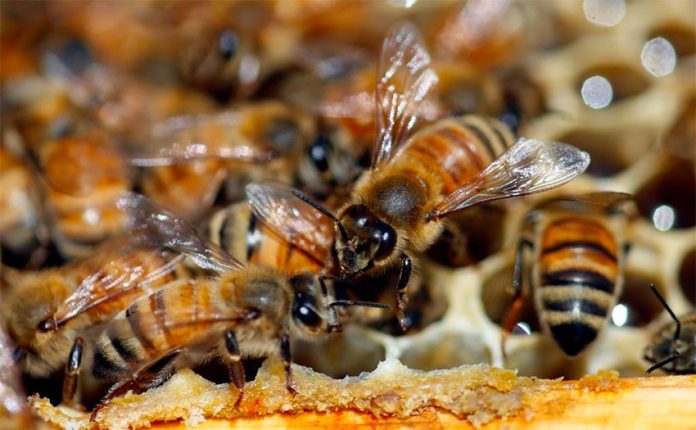
The National Science and Technology Council (Conacyt) will spearhead a bee conservation project on the Yucatán peninsula to counteract the threats apiculture faces from pesticides and genetically modified crops.
At a meeting with Yucatán peninsula beekeepers at the Maya Intercultural University in Quintana Roo, Conacyt chief Elena Álvarez-Buylla said the science council is committed to looking after Mexico’s natural resources and biological diversity.
“Beekeeping is an activity that is compatible with these principles. It’s important to support local communities, universities and technological colleges in . . . the production of Mexican honey and its national distribution,” she said.
“There will be no honey if the jungle is destroyed! It is possible to regain first place in the production of the best honey in the world,” Álvarez-Buylla added.
She explained that Conacyt is speaking with communities about genetically modified crops and pesticides with a view to banning both.
“Genetically modified crops, including soybeans, involve the use of toxins that are harmful to human health and destroy beekeeping . . .” Álvarez-Buylla said.
Communities and civil society organizations will collaborate with Conacyt on the bee conservation project on the peninsula, where bees have died off en masse allegedly due to crop dusting.
“The conservation of native bees is essential for the preservation of the forests and native flora of the Yucatán peninsula. Deforestation, fumigation in industrial agriculture and especially, genetically modified crops threaten the essential foundation of beekeeping,” the Conacyt chief said in a Twitter post.
Meanwhile, lawmakers in Guanajuato have unanimously approved a law that protects bees and beekeeping.
People found to have killed bees or harmed their habitat in the state will face fines of up to 8,000 pesos (US $420).
Paulo Bañuelos Rosales, a National Action Party lawmaker and president of the Congress’s agriculture commission, said the decline of bee populations is concerning and could represent a serious risk to food security and ecosystems.
“In the face of this reality, the residents of Guanajuato can’t remain in silence. We have to take make good use of legislative tools and public resources to make a difference, to save our environment and our families,” he said.
Bañuelos explained that 42 experts contributed to the drafting of the law.
“This law wasn’t designed from a desk, we went out to consult with beekeepers, [experts] at the University of Guadalajara . . . civil society organizations, ranchers, environmentalists . . .” he said.
“This is a good law that positions Guanajuato as a state where bees are considered a priority species . . .”
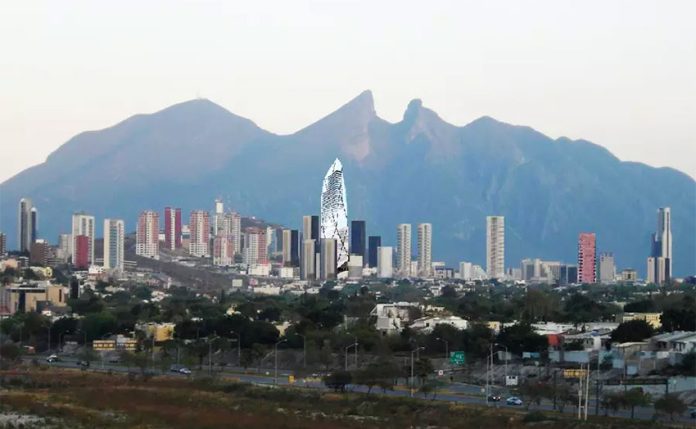
The three best cities in which to live in Mexico are San Pedro Garza García, Nuevo León; Colima, Colima; and Mérida, Yucatán, according to a new study.
Conducted by polling firm Gabinete de Comunicación Estratégica, Mexico’s Most Livable Cities surveyed residents of the 76 largest cities in the country including the 16 boroughs of Mexico City.
Their responses were used to generate ratings for each city in four different areas: quality of life, social cohesion, satisfaction with municipal services and performance of mayors.
San Pedro Garza García, part of the metropolitan area of Monterrey, came out on top in each of the first three while Colima residents thought most highly of their mayor.
San Pedro received a combined score of 61.7 to rank as the best city in Mexico, edging out Colima, which was two points behind with 59.6. Mérida followed just ahead of Sin Nicolás de los Garza, Nuevo León, and Saltillo, Coahuila.
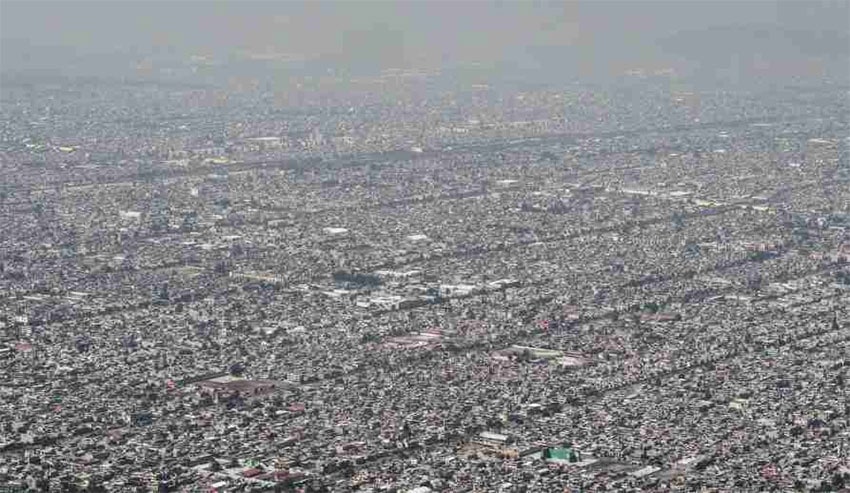
Ecatepec, dead last.
Rounding out the top 10 were Mazatlán, Sinaloa; Apodaca, Nuevo León; Chihuahua; Aguascalientes; and Mexicali, Baja California.
Venustiano Carranza was found to be the most livable borough in Mexico City, ahead of Benito Juárez and Iztapalapa.
On the other end of the scale, Ecatepec, México state – a municipality in the Mexico City metropolitan area notorious for violence – was ranked the least livable city in the country ahead of Tehuacán, Puebla, and Chetumal, Quintana Roo. Ciudad Victoria, Tamaulipas, and Puebla ranked as the fourth and fifth least livable cities.
The study also ranked six different regions of the country in terms of livability. The northern region was the best place to live followed by western Mexico, the northeast, Mexico City, the south and central Mexico.
Presenting the report, the director general of Gabinete de Comunicación Estratégica, Federico Berrueto, noted that there is a wide divide between Mexico’s most and least livable cities. Life in San Pedro Garza García is “completely different” to life in Ecatepec, he said.
Berrueto also noted that residents’ ratings of three northern border cities – Ciudad Juárez, Nuevo Laredo and Reynosa – fell this year compared to 2018.
The “deterioration” is “not necessarily associated with the quality of government,” he said, adding that the influx of migrants “seriously compromises the quality of life in those cities.”
Insecurity and poor municipal services were significant factors in the low rankings of many municipalities in the greater Mexico City area, Berrueto added.
Here is the full list of the 76 cities surveyed:
1-San Pedro Garza García
2-Colima
3-Mérida
4-San Nicolás de los Garza
5-Saltillo
6-Mazatlán
7-Apodaca
8-Chihuahua
9-Aguascalientes
10-Mexicali
11-Querétaro
12-Campeche
13-Guadalupe
14-Matamoros
15-Nuevo Laredo
16-Venustiano Carranza
17-Torreón
18-León
19-Culiacán
20-Hermosillo
21-Monterrey
22-Reynosa
23-Benito Juárez
24-Zapopan
25-Zacatecas
26-La Paz
27-Manzanillo
28-Iztapalapa
29-Gómez Palacio
30-Guanajuato
31-Cuajimalpa de Morelos
32-Veracruz
33-Lázaro Cárdenas
34-Miguel Hidalgo
35-Guadalajara
36-Azcapotzalco
37-San Pedro Tlaquepaque
38-Carmen
39-Cuauhtémoc
40-Gustavo A. Madero
41-Tepic
42-Coyoacán
43-Iztacalco
44-Benito Juárez (Cancún)
45-Pachuca
46-Milpa Alta
47-Durango
48-Juárez
49-Tlaxcala
50-Toluca
51-Tlalpan
52-Álvaro Obregón
53-Chimalhuacán
54-Nezahualcóyotl
55-Tlalnepantla de Baz
56-Chilpancingo
57-Xalapa
58-Cajeme (Ciudad Obregón)
59-Acapulco
60-Xochimilco
61-San Luis Potosí
62-La Magdalena Contreras
63-Centro (Villahermosa)
64-Tijuana
65-Morelia
66-Oaxaca
67-Cuernavaca
68-Tapachula
69-Naucalpan
70-Tláhuac
71-Tuxtla Gutiérrez
72-Puebla
73-Victoria
74-Othón P. Blanco (Chetumal)
75-Tehuacán
76-Ecatepec
UPDATED November 11:The full list of cities was appended to the original story.
Is Mexico safe? After an attack Monday that left nine dual Mexican-American citizens dead and with the country on track to record its most violent year in recent history, more and more people are asking the question.
With that in mind, Forbes news magazine asked experts whether traveling to Mexico is a good idea, while Mexico-based journalists with The New York Times responded to readers’ questions about the security situation in the country.
“Millions of Americans go to Mexico on vacation every year, so if we play the numbers game, the number of incidents is very small,” said Carlos Barron, a 25-year veteran of the FBI and founder of US Traveler Assist, a security and safety company that provides advice and services to American travelers.
According to the United States Department of State, 196 U.S. citizens died in Mexico in 2018 of whom 67 were murdered. The remainder died as the result of accidents.
The figures don’t dissuade Barron from recommending Mexico as a tourism destination.
“When I’m asked if Mexico is a safe place to go travel on vacation, my response is yes,” he told Forbes. Barron said that staying safe in Mexico largely comes down to common sense.
“Be smart about where you go. How are you going to get from the airport to your resort? When you check into a hotel, did you lock your door and use the top lock? What if something happens? Do I have the number of the embassy?
“Have I filled out a form for the Department of State so they know that I am traveling? Always think of safety and security as something that’s part of your trip,” he said.
Elisabeth Malkin of The Times pointed out that the security situation “varies drastically across the country,” and that drug cartels are most active in the northern border region and along the Pacific coast.
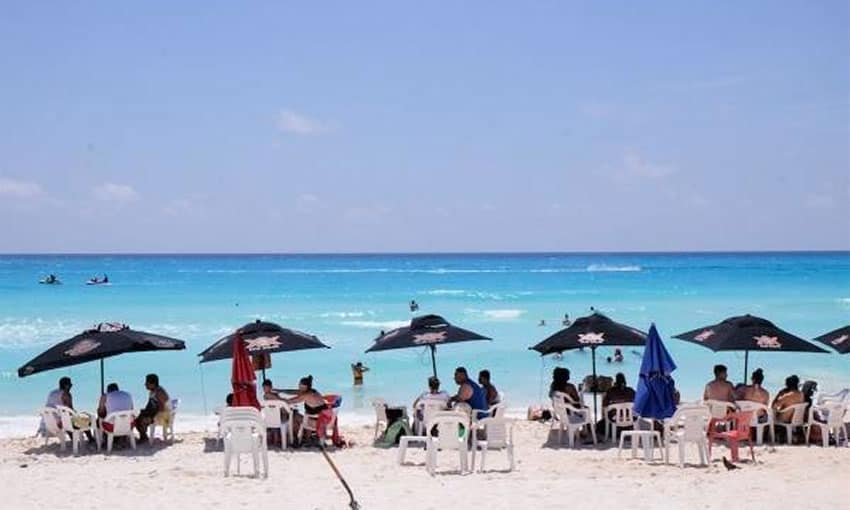
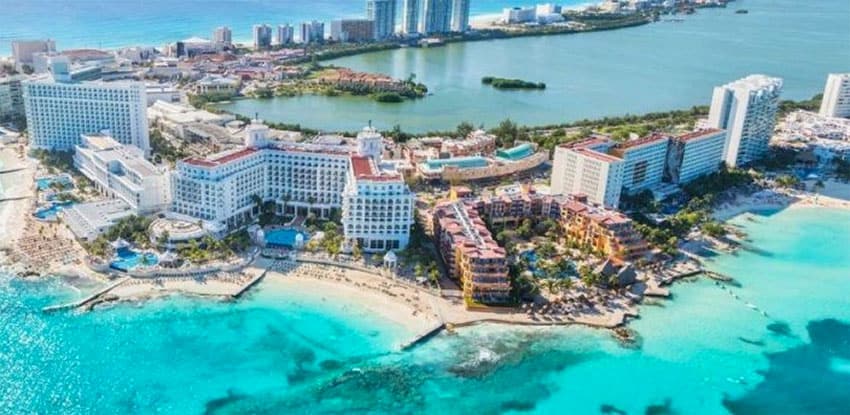
She said that a quarter of all homicides in 2018 occurred in just five cities: Tijuana, Ciudad Juárez, Cancún, Acapulco and Culiacán. Tourist areas in Cancún, however, “are fairly insulated from the city’s broader violence,” Malkin said.
Despite rising violence, Mexico City is fairly safe provided precautions are taken while Mérida, Yucatán, is considered as safe as Europe, she said.
Looks safe enough but use common sense regardless.
Asked by a Times reader whether it is safe to travel to Mexico, Malkin responded:
“Yes, it is safe for Americans to travel in most parts of Mexico, although tourists should exercise caution, just as they would in some parts of the United States.”
Adam St. John, CEO of travel risk management company Sitata, told Forbes that travelers need to be well-informed when choosing holiday destinations in Mexico.
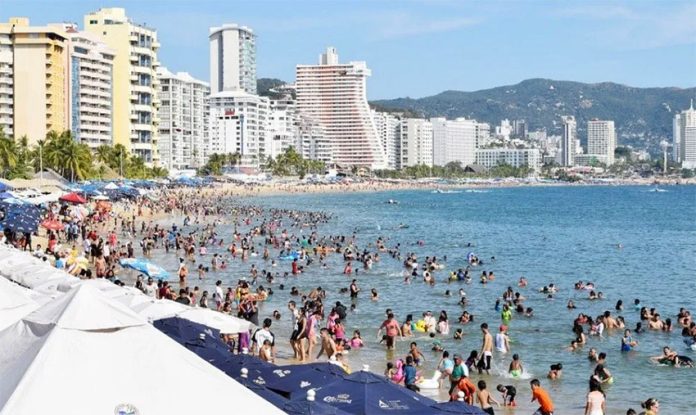
He noted that Acapulco was once “a world-renowned tourist hotspot” but is now “one of the most dangerous cities in the world due to violent crime.”
Anyone visiting the faded resort city “would be prudent to keep a low profile,” St. John said.
He also advised tourists to “stick to your resort area, do not dress in flashy or expensive clothes, and leave your accessories at home – do not make yourself an easy target for theft.”
St. John added that “female travelers should remain very cautious as violence against women is very high in several parts of Mexico and [has been] known to have taken place in secluded resorts, too.”
However, the operations manager for the Americas at the global travel risk intelligence company Riskline believes that it’s safe for women to travel to Mexico provided they use common sense and keep safety precautions in mind.
“While Mexico does suffer from high crime and homicide rates — undoubtedly linked to the drug trade — many areas of the country are still safe to visit, even for women,” Suzanne Sangiovese said.
“The vast majority of cartel-related violence that occurs in Mexico is geographically limited in its intensity, with narco-traffickers targeting each other, Mexican authorities or entities that stand in their way. It is rare for such violence to specifically target a female traveler or tourist unless she’s caught in the wrong place, at the wrong time.”
Sangiovese advised tourists never to leave their drinks unattended or accept drinks from strangers or new acquaintances and only use official and registered taxis. “Avoid public transport, especially at night, to limit exposure to possible cases of harassment,” she said.
The Department of State’s Mexico Travel Advisory remains at “Level 2: Exercise increased caution” although “Level 3: Reconsider travel” and “Level 4: Do not travel” warnings apply to several states.
Tourist areas of Cancún are ‘fairly insulated’ from violence.
Level 4 warnings apply to Colima, Guerrero, Michoacán and Sinaloa due to crime and to Tamaulipas due to crime and kidnapping. Level 3 warnings apply to Chihuahua, Coahuila, Durango, México state, Jalisco, Morelos, Nayarit, Nuevo León, San Luis Potosí, Sonora and Zacatecas.
Will the security situation change for the better any time soon? Not likely, says The Times’ Kirk Semple.
“President Andrés Manuel López Obrador has said he would focus his crimefighting strategy on addressing the problem at its roots, by investing in social development programs and initiatives that alleviate poverty. But this approach could take years to work — if it works at all.”
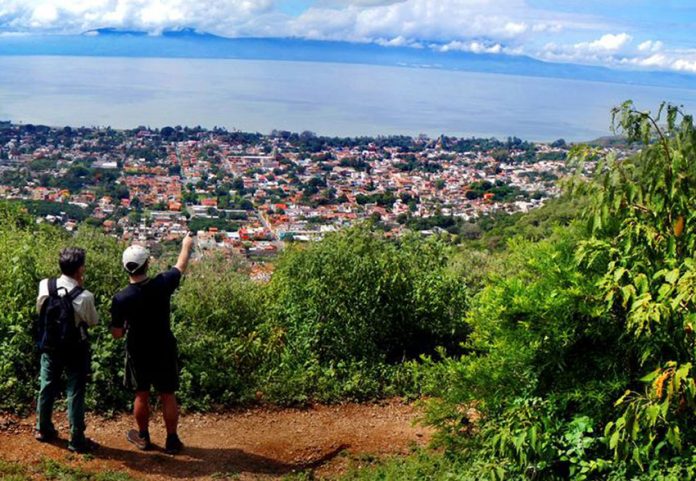
One day I received an invitation to hike in the hills above the town of Ajijic on the north shore of Lake Chapala. My guide was to be long-distance walker and author Cam Honan, who goes by the name of “Swami” when he’s trekking.
“I want to show you a place everyone calls the Indian Ceremonial Grounds,” said Honan. “Every so often a large number of indigenous people gather together up there for something called La Danza del Sol. It’s a beautiful, wide open space with good vibrations and a magnificent view of Lake Chapala.”
As we started our hike, I couldn’t help but reflect on how lucky the people are who live along Chapala’s northern shore. They don’t have to drive 50 kilometers to the nearest mountain; all they have to do is walk out the door, stroll up the street and step onto any one of dozens of narrow trails.
It’s amazing. One minute you’re on a city street and suddenly you are engulfed by high walls of luxuriant green vegetation. You feel like you’re in some exotic jungle, thousands of miles from civilization.
Honan took me on a long, meandering route to several picturesque spots overlooking the lake (he is, after all, a long-distance walker) and it was only after a few hours that we found ourselves approaching the Ceremonial Grounds along a narrow trail beneath a canopy of creeping vines.
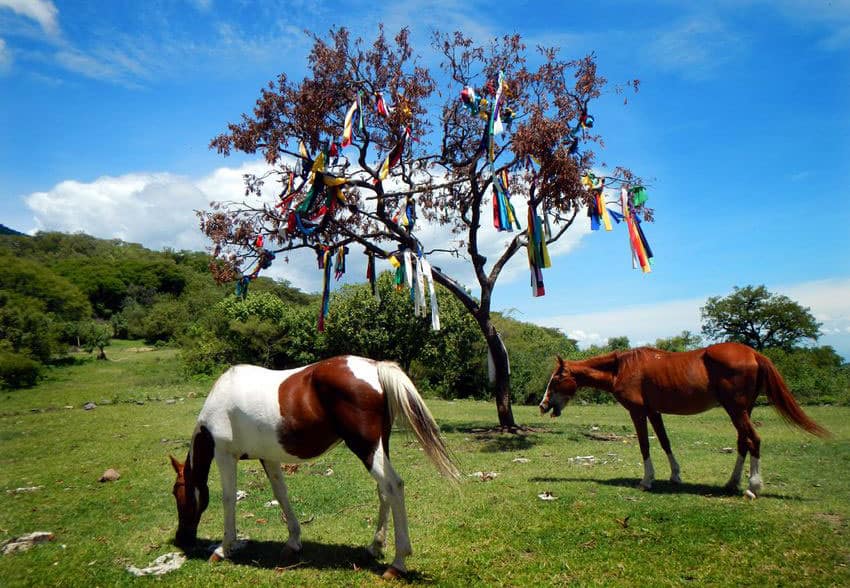
The Tree of Life, well decorated with colorful strips of cloth.
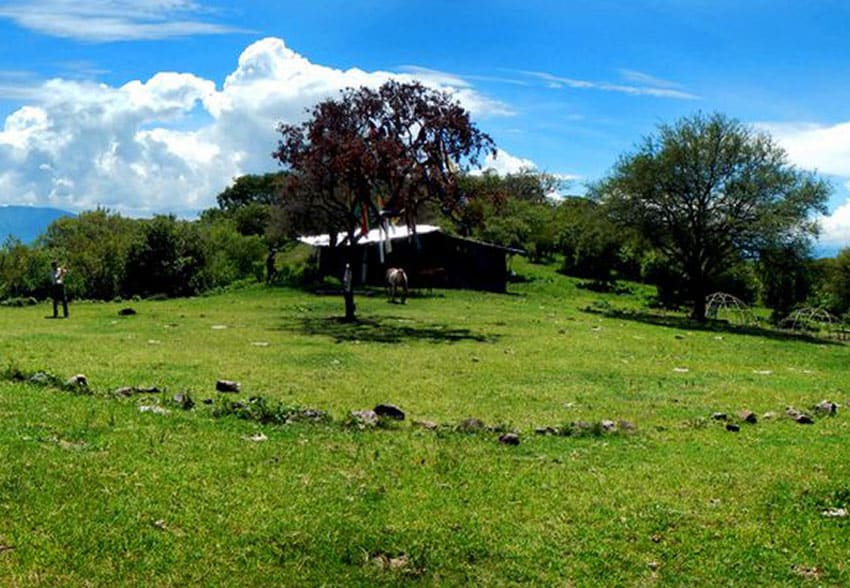
Then, suddenly, we stepped out onto a wide, flat, grassy meadow that took my breath away. In the middle of it there was a lone tree festooned with long red, white, blue, green and yellow strips of cloth. The tree was surrounded by a very large circle of stones and nearby, there were two buildings which, said my guide, serve for sheltering and feeding the many indigenous people who come here from far and wide.
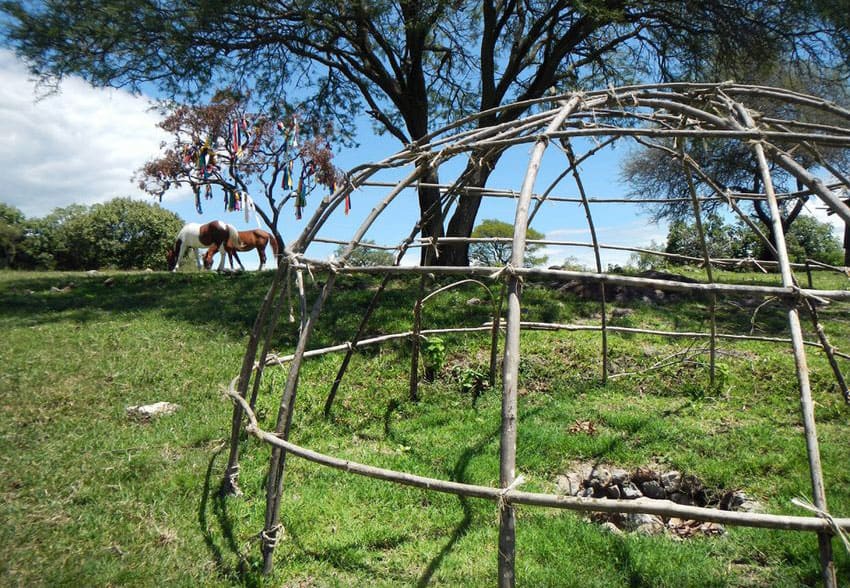
Just outside the circle there were two igloo-shaped frameworks made of thin branches. With the help of blankets, these are transformed into temazcales, or sweat lodges.
“Back in 2002 or 2003,” said Honan, “I saw a ceremony performed here. A group of men, shirtless, attached cords to bones which were literally sewn inside part of their chest. The cords were attached to this tree and all the men walked around it. There was music playing in the background. Then the music stopped and they all pulled back simultaneously — and out came the bones.”
Well, that description certainly got my attention and, back at home, I started to search for information about La Danza del Sol. I learned that the piercing ceremony is ancient and that its purpose is to offer personal sacrifice as a prayer for the benefit of one’s family and community.
The ritual became well-known thanks to the 1970 movie A Man Called Horse with Richard Harris, which is said to be based on the real-life experience of the Spanish explorer Álvar Núñez Cabeza de Vaca.
Of course I made a point to get myself a copy of A Man Called Horse and was truly amazed that such a fine film could have come out of Hollywood in 1970, not to mention the fact that it’s a western in which the Sioux speak Sioux the whole time!
The Ceremonial Circle on La Mesa de los Encinos.
The story of how the very first Danza del Sol was held in Ajijic is described in a thesis written by Aldo Daniel Arias, who was allowed to be present at the campsite by volunteering to do work like cutting wood and carrying water.
Arias says the organizers decided to hold the event at the spot I visited, known as La Mesa de los Encinos. This was a picturesque place, it seems, but originally it consisted of two hills side by side, not exactly a suitable site for holding a dance.
So, all sorts of volunteers went to the place and “a punta, pala y carretilla” — with picks, shovels, wheelbarrows and much hard work — they lowered the high places and raised the low places and ended up with a wide, flat, Meseta de la Danza.
Finally, in 1991, the first Danza del Sol was held on this mesa. Many people showed up from all over Mexico and the United States, plus over 100 dancers. It seems that the Danza is traditionally held in July or August, when plant growth is at its maximum.
I understand that, according to Arias Yerena, the main purpose of the event is to thank the Great Spirit for the gift of life. Curiously, the Tree of Life, which is four to five meters high, is not growing inside the circle but, like a Christmas tree, is chopped down in the woods, carried to the site and made to stand up in the center of the ceremonial circle. Decorated with colorful strips of cloth, it stays there all year and is replaced before the next dance begins.
To be admitted as a dancer, candidates must have assisted the group for at least the previous two years and must present an offering of copal or tobacco. In the ceremonial area, they must refrain from certain practices such as yoga, politics and Catholic rituals and may not use alcohol, marijuana, peyote or other plants, except for sage and tobacco.
When covered with blankets, this wooden framework becomes a sweat lodge.
During four days and nights, the dancers fast from all food and drink. Every day, in the full glare of the summer sun, they dance and sing for seven rounds (sessions), each lasting from 45 minutes to an hour. The singing is in the Lakota language, which most of the participants don’t understand.
Unlike Muslims, who can eat and drink once the sun goes down, these dancers must aguantar (endure) without sustenance for the entire period and I can’t imagine how they could do it. It is said that many suffer spells of dizziness, headaches, stomach aches, kidney pains and sheer exhaustion.
Perhaps some relief is experienced during daily sessions in the temazcal, but I doubt it, because another test of a warrior is to endure extreme heat during this ceremony.
Arias’ description of the rituals which take place before, during and after this steam bath tally with those practiced all over Mexico and suggest to me that the sweat lodge is the one indigenous ceremony which really unifies all the native peoples of the American continent.
The Offering of Skin takes place on the last day. According to Arias, it is made by passing two wooden stakes through the chest of the (male) participant, stakes which are attached to two cords which are tied to the tree.
At the end of the ceremony, the dancer dances backward away from the tree and breaks the skin where the stakes are embedded. When this happens, he prays and gives thanks and then makes a circuit of the stone circle, saluting the four cardinal directions.
[soliloquy id="93716"]
Says Arias, “the offering of skin is an act through which the dancers sacrifice a part of themselves, that is, a piece of their own flesh. In this way, the dancer becomes the offering itself, an act which results in his unity with nature and the Great Spirit.
In case you are thinking of giving this ceremony a try (which, they say, Richard Harris did), note that Arias states, “. . . Among these offerings, the most valued are those which are carried out with the most enthusiasm and pain.”
The writer has lived near Guadalajara, Jalisco, for more than 30 years and is the author of A Guide to West Mexico’s Guachimontones and Surrounding Area and co-author of Outdoors in Western Mexico. More of his writing can be found on his website.