Home Blog Page 1768

26 killed, 13 wounded after Veracruz bar set on fire, exits blocked

0
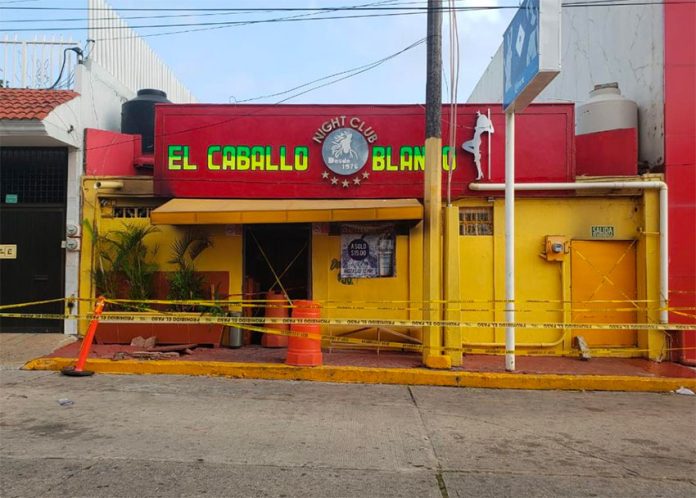
The Coatzacoalcos bar that came under attack Tuesday night.

A vicious attack on a bar Tuesday night in Veracruz killed 26 people and wounded 13 others, state officials said. Some of the wounded suffered burns to 90% of their bodies.

According to witnesses, the attack occurred at around 10:00pm when between five and six armed civilians entered the Caballo Blanco bar in downtown Coatzacoalcos and began shooting.

The attackers then threw fuel inside the building followed by molotov cocktails before blocking the emergency exits, leaving patrons trapped inside. The dead include 16 men and nine women, many of whom were table dancers employed by the bar.

Veracruz Governor Cuitláhuac García said on Wednesday that the owner of the bar was kidnapped on Saturday and later decapitated, according to evidence that surfaced in a video.

A criminal gang had wanted to sell drugs in the bar, the governor said.

García also identified one of the people responsible for the attack as a man who had been arrested in July and later released.

“Evidence about the deplorable crime in the bar in Coatzacoalcos points to one of the people responsible for the attack as [a man] who was arrested in July, but was released less than 48 hours later by the state Attorney General’s Office,” García wrote in a Tweet.

Veracruz Attorney General Jorge Winckler, who was responsible for releasing the suspect, was appointed by García’s predecessor Miguel Ángel Yunes, and has been a target of attacks by the governor since he took office last year.

In his morning press conference on Wednesday, President López Obrador echoed Governor García’s criticism of Attorney General Winckler, and said he has asked the federal Attorney General’s Office to take over the investigation.

“There’s a problem that needs to be investigated about the actions of the Veracruz Attorney General’s Office,” he said. “We’re asking the [federal] attorney general to take over this issue and carry out a thorough investigation.”

Since the beginning of the year, the Zetas cartel and the Jalisco New Generation Cartel have been fighting for control of Coatzacoalcos.

In April, 13 people died in a similar attack on a party at a bar in nearby Minatitlán.

Source: Reforma (sp), El Financiero (sp), e-veracruz (sp)

Anti-graft organization slams youth employment program for corruption

0
Nearly one million youths are reported to have signed up for the employment program.

An anti-graft group claims in a new report that the federal government’s youth employment program is sullied by corruption.

The enrollment records of the “Youths Building the Future” apprenticeship scheme contain implausible information that cannot be verified, Mexicans Against Corruption and Impunity (MCCI) said in the report ¿Cuántos son, donde están, qué hacen? (How many are they, where are they, what do they do?)

MCCI said that it detected the probable existence of “phantom” work centers and discrepancies between the number of persons enrolled in the employment scheme and the number who are actually undertaking training.

State-based federal officials involved in the implementation of the program made similar claims earlier this month.

MCCI said that the “Youths Building the Future” register added new beneficiaries and employers at a constant daily rate even on weekends, national holidays and during vacation periods.

“Virtually every day, the same number of men and women, of the same educational levels and ages, were enrolled,” the non-governmental organization said. “A register that grows without variation contains improbable information.”

The Secretariat of Labor and Social Welfare (STPS), which is responsible for the employment program, said this month that it had reached its goal of giving 3,600-peso (US $180) monthly scholarships to one million young people.

More than 150,000 workplaces are participating in the scheme, the STPS said.

But MCCI questioned the figures, stating in its report that the employment program register only contains very limited information about the employers.

Tax numbers and the addresses of participating businesses, among other basic information, are not listed, MCCI said, and in some cases only generic or first names are used for employers, such as “federal deputy,” “auto repair shop” and “María.”

“. . . It’s information that is absolutely incomplete and information that can’t be verified . . . The register . . . is not very transparent and therefore there can be no accountability,” MCCI executive president María Amparo Casar said at the presentation of the report.

In Mexico City, the group discovered that it was impossible to find any information at all about 53% of the 5,439 registered employers it reviewed.

In addition, 140 businesses contacted by MCCI said that they hadn’t joined the apprenticeship program even though they appeared in the register, 214 said that they registered but haven’t received apprentices and 136 companies said that they did receive scholarship holders but they no longer work with them.

Only 1,413 companies contacted by MCCI – 26% of the total reviewed – were able to prove that they are currently providing employment and training to young apprentices.

Some of the young people enrolled in “Youths Building the Future” have direct family ties with their employer and others have received threats of being excluded from the program after requesting a change of employer, MCCI said.

Despite the claims of irregularities in the register, and the STPS assertion that the scheme reached its employment target, Mexicans Against Corruption and Impunity said that only 32% of the budget allocated to the program has been used.

“By the end of 2019, there will have been under-spending of 15.641 billion pesos [US $781.7 million], 39% of the total of 40 billion pesos approved for the program. That money could be reassigned discretionally by the executive,” the report said.

Source: Reforma (sp) 

Another Guinness: Guadalajara wins for world’s largest folkloric dance

0
Folkloric dancers in Guadalajara on Saturday.

Guadalajara won the Guinness World Record for the world’s largest folkloric dance on Saturday.

Dressed in the colorful traditional dresses of the region, 882 dancers whirled to the Mexican folk song El jarabe tapatío, shattering the previous record by almost double.

The event was part of Guadalajara´s International Mariachi and Charrería Conference, which ends on September 2. Charrería is the local tradition of horsemanship and rodeo riding.

Achieved eight years ago with 457 dancers, the previous record was also held by Guadalajara.

Guinness adjudicator Carlos Tapia said there were initially 892 dancers in Saturday’s event, but 10 were disqualified for not adhering to the stipulations of dancing uninterruptedly for five consecutive minutes and not leaving the challenge site.

The record-breaking crowd of 882 dancers.

These types of feats are important for Tapia “because they mean that the whole world will recognize the cultural wealth of this beautiful country.”

Thousands of people gathered in Guadalajara’s historic center to bear witness to the record-breaking event and admire the beauty of the traditional costumes that fluttered to the rhythm of the mariachi music.

The women wore broad, brightly colored dresses and put their dark hair in braids, and the men wore the traditional charro cowboy suits.

The crowd and dancers cheered, and the mariachis struck up the folk song Guadalajara, Guadalajara, when the adjudicator announced the new record.

“We did it! We did it!” they shouted.

With the new record, Guadalajara boasts 11 of the 25 Guinness records held by the state of Jalisco.

Ballet Folklórico Guadalajara Record Guiness 2019

Among them are the world’s biggest robotics class, the world’s biggest bead mosaic and the world’s biggest marzipan.

In total, Mexico holds 230 Guinness World Records.

Source: UDG TV (sp)

Photos reveal cartel’s marijuana plantation in Mexico City

0
Hernández and a Mexico City marijuana plantation.

A Mexico City cartel is producing marijuana for sale on a plantation in the city itself, according to photos discovered by police during an arrest.

When city police arrested Tláhuac Cartel leader Carlos Ramón Hernández last Friday they found photos of marijuana plants in makeshift greenhouses in the borough of Tláhuac.

They also seized cocaine and methamphetamine in plastic containers as well as scales at his house in the Miguel Hidalgo neighborhood of the borough.

Hernández, who faces charges of attempted murder in relation to a series of killings, rose to lead the organization after the death of Felipe de Jesús “El Ojos” Pérez Luna and the arrest of his son Luis Felipe Pérez. Hernández has been wanted since 2017.

Police say he was responsible for the cartel’s finances, as well as for attacking other criminal organizations.

Mexico City Mayor Claudia Sheinbaum said today that marijuana plantations are not widespread in the city.

Source: Milenio (sp), Infobae (sp), Excélsior (sp)

Organized crime involvement seen in damage to archaeological site

0
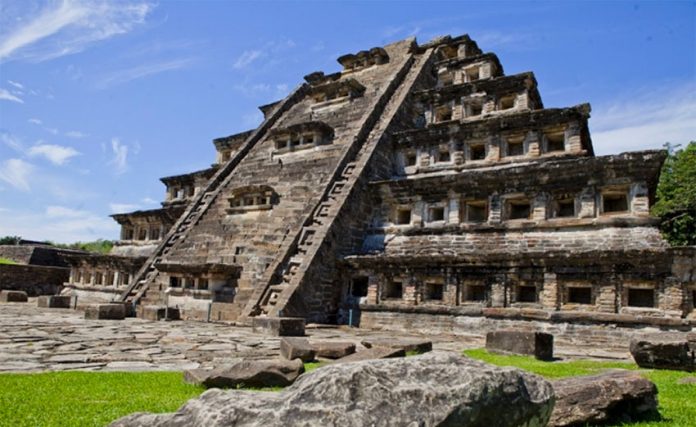
The Tajín archaeological site in Veracruz.

Recent damage to the El Tajín archaeological site in Veracruz was caused by armed civilians with links to organized crime, claims the director of the National Institute of Anthropology and History (INAH)

Diego Prieto told reporters yesterday that trees have been felled at the site, vegetation has been burned, soil has been removed, subterranean archaeological structures have been damaged and caretakers have been threatened.

Heavy machinery entered the 1,200-hectare site – most of which is privately owned – nine days ago, he added, explaining that it appears that preparations have been made for the construction of a new residential development.

The INAH chief said that available evidence indicates that the people who caused the damage “are linked to organized crime.”

No permits were sought to carry out the land clearing, which has now been halted.

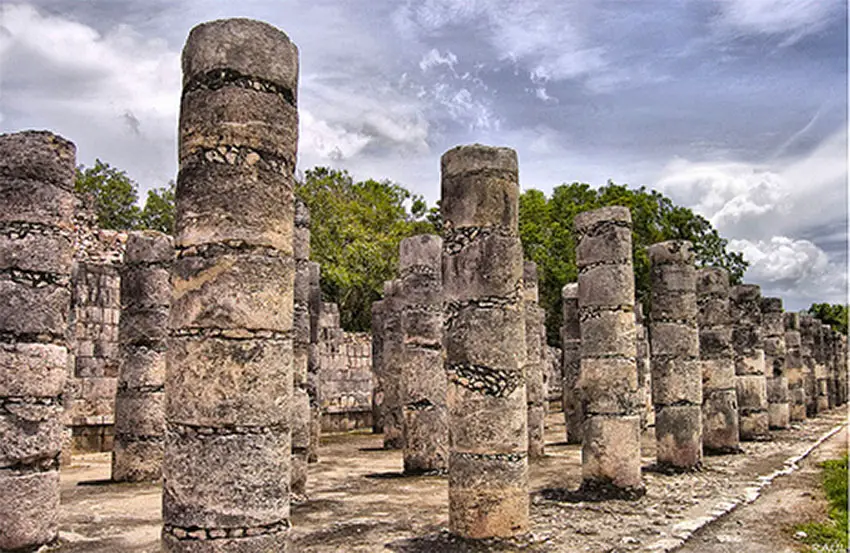
Damage at the site was located near Las Columnas (the columns).

Only 200 hectares of the El Tajín site are owned by the state of Veracruz and under the management of INAH but the institute is responsible for the protection of all of its archaeological structures, some of which are on private property.

Prieto said that the entirety of the site should be in public hands.

“The Tajín zone is an extremely important ancient Totonacapan city and an important place for the Totonac people of today,” he said.

INAH archaeology coordinator Pedro Francisco Sánchez said that a team of experts is currently assessing the damage and that a report will be completed in about two weeks. He also said that a criminal complaint has been filed against those responsible.

Sánchez explained that between 12 and 15 hectares of the site have been damaged but stressed that none of the main structures at El Tajín were affected.

Located about 20 kilometers southeast of the city of Poza Rica, El Tajín is a UNESCO world heritage site that was one of the most important cities of the classic era of Mesoamerica.

Source: El Economista (sp), El Universal (sp) 

Unity, trust themes of 150-meter-high border crossing on a rope

0
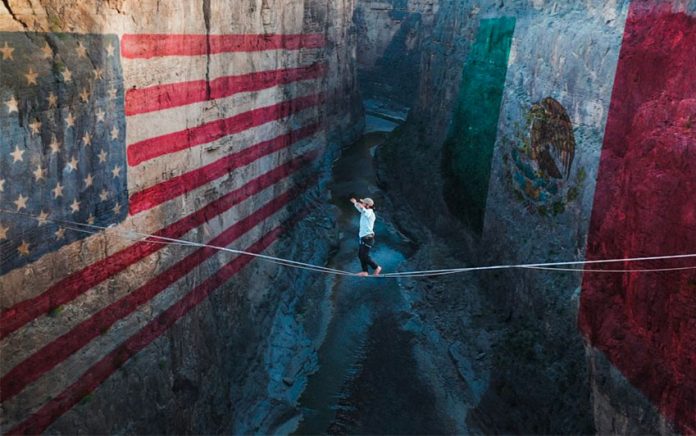
A frame from the film, The Imaginary Line.

At the end of January, one man from Mexico and another from the United States made a political point by crossing the border in a highly unusual way – they walked across a 150-meter-high slackline spanning the Rio Grande between Chihuahua and Texas.

The daring feat, documented in the newly-released short film The Imaginary Line, was the brainchild of 27-year-old Oregon man Corbin Kunst who, along with Jamie Maruffo of Mexico, completed the audacious crossing on January 25, the final day of a historic 35-day United States government shutdown precipitated by a standoff over funding for President Donald Trump’s border wall.

Prior to the crossing, a team from Mexico and another from the United States traveled down the Rio Grande to a section of the river between Big Bend National Park in Texas and the Cañon de Santa Elena National Park in Chihuahua.

There, the two teams – each placing complete trust in the other – connected cliffs on either side of the river with an almost 100-meter-long slackline.

“You’re putting your life in each other’s hands,” Kylor Melton, who made The Imaginary Line, told CNN. “It was so beautiful just to be a witness and to be a part of it.”

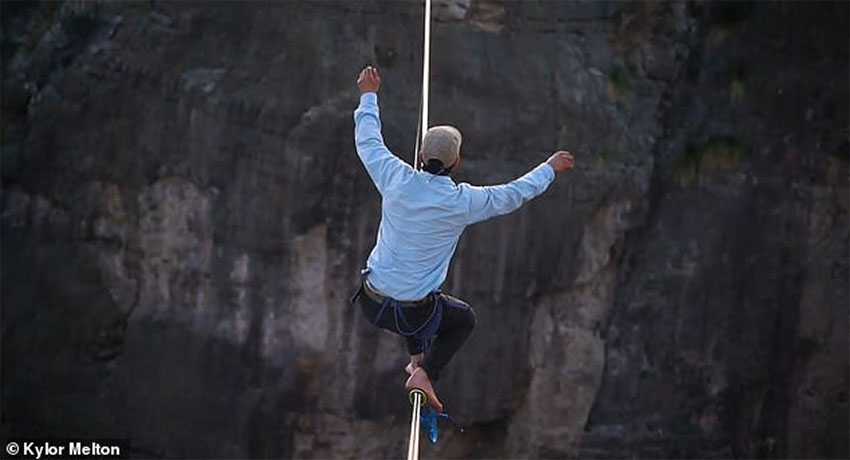
Corbin Kunst crosses the Rio Grande on a slackline.
Corbin Kunst crosses the Rio Grande on a slackline. kylor melton

Both Kunst, who works as a ropes-course technician, and Melton, a 26-year-old filmmaker, said they checked with lawyers to ensure that they did everything legally.

However, the night before the crossing, as the Mexican and American teams huddled around a campfire, Kunst warned that they could still face legal consequences.

“While in every way we’re respecting the laws, this mission is heavy. You are all putting your freedom on the line,” he says in Melton’s film.

“We’re taking a stand against an unjust system and so we may be treated in an unjust way. So, what we’re here to do is deconstruct the belief that this line separates us.”

The next day – as the film shows – both Maruffo and Kunst were able to successfully cross the slackline to reach the United States and Mexico, respectively, and the two men even met at the midpoint of the line, where they shared a handshake and fist bump.

Kunst said the crossing was “an act of solidarity to show that people can come together even when political differences tear us apart.”

the imaginary line

Before his crossing, he admits in The Imaginary Line to being “a little afraid, not because of the highline itself but because of what it stands for.”

“In a world that is constantly trying to tear us apart, we are here to come together to cross those imaginary lines that divide us and all I have to say is that we’re peoples that come from different lands but we’re all one,” Kunst said.

“We were there to promote cooperation,” he told CNN. “We want to have cooperation and trust all over the world, especially with our neighbors.”

In an interview with the magazine Outside, Kunst said the idea first occurred to him after he saw a photograph of the Santa Elena canyon.

“I thought, ‘how cool would it be to break this epic highline over the Rio Grande . . .?’”

He explained that the U.S. team was made up of friends, adding that he also knows everyone from Mexico who took part in the project and “already had trust in them.”

Melton said the two men fell “once or twice” but Kunst added that “highlining is actually a very safe sport – we were always tethered to the line.”

Asked what he was thinking about while performing the “stunt,” Kunst responded:

“I don’t like thinking of it as a stunt. It was much more than that . . . For me it was the most important slackline I have ever walked. It had so much power in it . . . The idea wouldn’t have gone anywhere unless people also felt that this was a powerful message. So, for me, as I was walking the line, that’s what was going on in my head . . . After I finished, I was pretty blissed out. I was ecstatic.”

As for the film, which premiered online on Sunday, Melton told Mexico News Daily via e-mail that his “greatest hope” was to “create a movement that goes far beyond ourselves using this highline as a medium for sparking a conversation and to create a positive shift in our world.”

Source: CNN (en), Outside (en) 

Police arrest ex-cop believed to be Jalisco cartel plaza chief in Veracruz

0
Suspected plaza boss 'El Jaguar.'

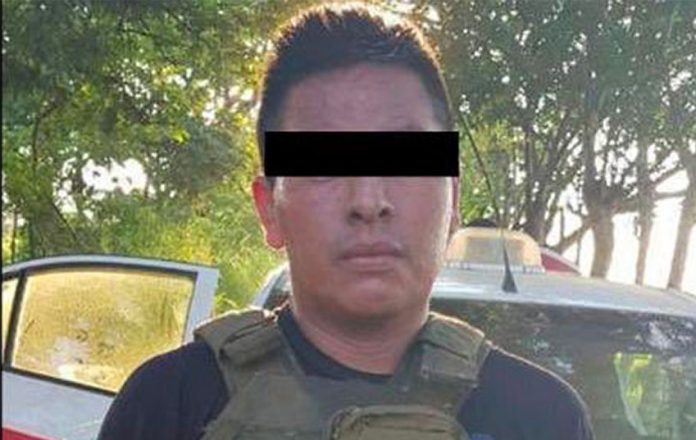
Veracruz police struck a blow against the Jalisco New Generation Cartel (CJNG) with the arrest of a former Veracruz police officer believed to be the cartel’s plaza boss in Tres Valles, Veracruz.

Antonio “El Jaguar” N. was arrested with another man in the Ejido neighborhood of Coatzacoalcos when they tried to flee from a police checkpoint. A search of the car revealed two AR-15 rifles, a Browning 9-millimeter pistol, 226 rounds of ammunition of various calibers, body armor and fake uniforms of various security forces including the navy.

According to the Veracruz Public Security Secretariat (SSP), “El Jaguar” had worked as a police officer in the municipalities of Cuitláhuac, Tlacatalpan and Juan Rodríguez Clara. He is linked to the killings of a lawyer and two agronomists, as well as other murders and disappearances in southern Veracruz.

Over the past 10 years, the CJNG has grown from controlling not only its home state of Jalisco to become one of the biggest criminal organizations in Mexico, operating in 22 of the country’s 32 states.

According to the United States Drug Enforcement Agency, the cartel also operates in Europe and Asia.

Source: Infobae (sp), Proceso (sp), Imagen del Golfo (sp)

Woman falls 25 meters practicing extreme yoga, breaks over 100 bones

0
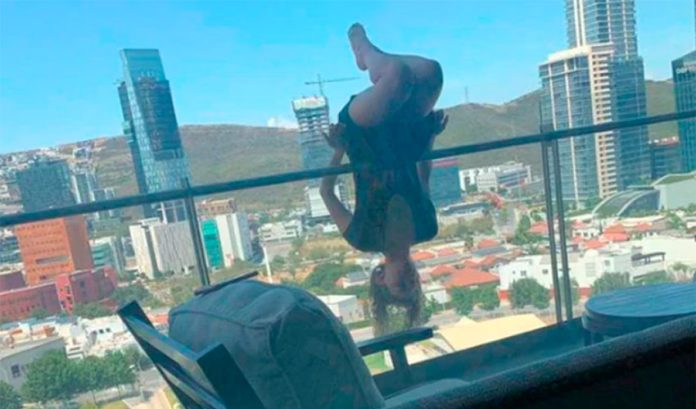
Terrazas practices yoga on her balcony.

An extreme sports practitioner broke over 100 bones when she fell 25 meters while practicing extreme yoga in Monterrey, Nuevo León, on the weekend.

Alexa Terrazas López, a  23-year-old student of the Monterrey Institute of Technology, was performing a yoga maneuver on the railing of an eighth-story balcony when she slipped.

Terrazas was rushed to Monterrey’s Zambrano Hellion Medical Center where she spent 11 hours in surgery, and will remain in sedation for at least two weeks. Surgeons will have to completely reconstruct her ankles, knees and face.

Through outreach on social media, Terrazas’ friends and family were able to raise enough blood donations to treat her, but the victim is still in need of platelet donations.

According to reports from friends on social media, doctors say Alexa will not be able to walk for three years and will need a great deal of physical therapy.

Surgeons will reconstruct Terrazas' ankles, knees and face.
Surgeons will reconstruct Terrazas’ ankles, knees and face.

A native of the state of Chihuahua, Terrazas is the daughter of businessman Alberto Terrazas Syffert, ex-president of the state chapter of the National Chamber for Industrial Transformation (Canacintra) and owner of the construction conglomerate Grupo Punto Alta.

Her mother is Belinda López, director of the Chihuahua Independent Club, an athletic school that specializes in instructing soccer players using alternative training techniques.

A nutrition student, Alexa Terrazas’ passion for extreme sports garnered her moderate popularity on her Instagram account, which features photos of her jumping out of a helicopter and riding a zipline upside down, among other feats.

The popularity of extreme sports has grown considerably in the last decade, among amateurs and professionals alike, as has the number of injuries resulting from them.

A 2014 study by the American Academy of Orthopaedic Surgeons (AAOS) revealed that more than 40,000 injuries were attributed to extreme sports annually during the 12-year study.

The study’s lead researcher and orthopaedic surgeon at the Western Michigan University School of Medicine, Dr. Vani J. Sabesan, noted at the 2014 AAOS annual meeting that social media culture had fostered the risk-taking among young people.

“Young people often lack judgement,” she said. “They see snowboarder Shaun White take the sport to a whole new level and some kids try to emulate his tricks. In effect, the culture says it’s OK to do this.”

Source: Infobae (sp), Today Online

Parents protest shortage of cancer medications for their children

0
Protesters at Mexico City airport on Monday.Protesters at Mexico City airport on Monday. lack of cancer medications for their children.
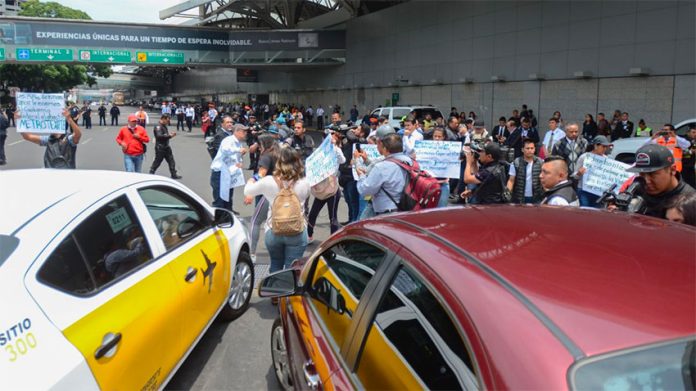
Protesters at Mexico City airport on Monday.

Parents of cancer victims protested at Mexico City International Airport on Monday to demand the supply of essential medications.

The protesters said there have been no cancer drugs at two Mexico City hospitals for the past 1 1/2 months, a situation that has forced the delay of their children’s treatment.

About 500 children who receive treatment at the Federico Gómez and 20 de Noviembre hospitals are affected by the lack of medicines, they said.

The parents blocked access to Terminal 1 at the airport during a protest that lasted more than 1 1/2 hours, the newspaper El Financiero reported.

Holding signs that denounced the lack of government funding for the purchase of medications and warned that the lives of their children were at risk, the protesters demanded to meet with federal health officials.

Another group of parents protested outside the Federico Gómez Children’s Hospital, where Mexico City government undersecretary Arturo Medina Calva arrived to seek dialogue.

The parents told him that they presented a complaint to the federal government more than three months ago but received no response.

Later yesterday, the federal Health Secretariat (SS) issued a statement which said that patients at the Federico Gómez hospital who require chemotherapy agent methotrexate will be able to access the drug.

The statement said that health officials sought the support of the Mexican Social Security Institute to ensure that the drug is supplied, although it also pointed out that the Federico Gómez hospital is authorized to purchase medications directly.

The Health Secretariat said that officials had met with 10 parents and the medical director of the Federico Gómez hospital to listen to their concerns and demands.

The secretariat has said previously that the lack of methotrexate is due to a worldwide shortage of the drug.

However, El Financiero reported that there are more than 20 applications to import the drug or its raw materials that have not been approved by the health regulator, Cofepris.

Parents of children with cancer indicated that they are prepared to stage larger protests at the Mexico City airport if the supply of cancer medications doesn’t improve and also warned they could set up blockades on highways such as that between Mexico City and Puebla.

Medicine shortages that were blamed on federal budget cuts to the health sector have been reported in more than 20 states this year.

However, Health Secretary Jorge Alcocer said in May that the funding problem had been “fixed.”

Source: El Financiero (sp) 

Commando kills girls aged 4, 13, 14 in Ciudad Juárez attack

0
Presumed members of the Mexicles, an arm of the Sinaloa Cartel.

A criminal gang in Chihuahua has denied responsibility for the killing of four people Sunday on a ranch in the Riberas del Bravo neighborhood of Ciudad Juárez.

State prosecutors have identified the Mexicles gang as the perpetrators of an attack that killed three sisters, identified as Linsay, Sherlyn and Arleth Sánchez Gordillo, aged 14, 13 and 4, and Rafael Gordillo González, 25, the girls’ uncle.

The girls were in a vehicle with their uncle and another man on the ranch when armed civilians entered and started shooting.

Anonymous sources told the newspaper El Diario that the girls’ father was kidnapped during the attack. The state Attorney General’s Office confirmed that a man was kidnapped, but would not say whether it was the girls’ father.

Police found 114 shell casings at the scene, some corresponding to AR-15 and AK-47 rifles.

More than five shooters are believed to have participated in the attack.

On Monday, prosecutor Jorge Nava told the newspaper Excélsior that the attackers were part of the Mexicles, a Ciudad Juárez street gang allied with the Sinaloa Cartel.

In messages left on pieces of plastic and hung from overpasses around Ciudad Juárez, a group identifying itself as the “Mexicles Special Forces” denied responsibility for the attack and blamed it on an internal conflict within the “Valle de Juárez” group.

“The Attorney General’s Office wants to put the responsibility on us for this cowardly attack with the goal of protecting the Valle de Juárez criminals, who are truly responsible,” the message read. “The true motive for the event was an internal war within the Valle de Juárez, and we are making it known that the names of those responsible for this cowardly act are Victor Elías “El Chito” and “El Chato.”

The Mexicles split with another Ciudad Juárez street gang, the Artistas Asesinos, in August 2018.

Source: El Diario (sp), Excélsior (sp), Infobae (sp)