Home Blog Page 1769

Cell phones, TVs, bicycles among belongings left behind on the Metro

0
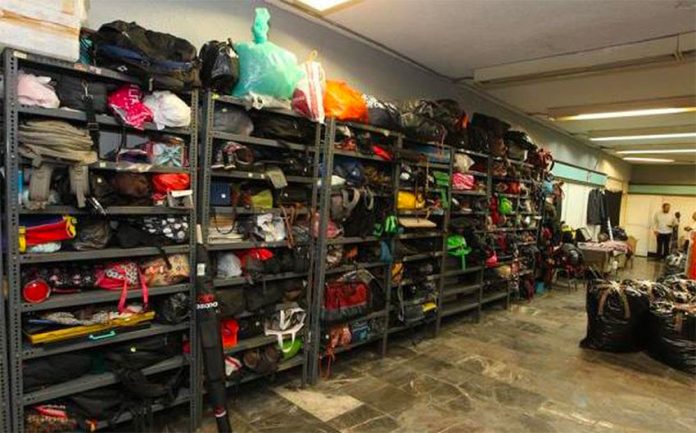
The Metro's lost and found department.
The Metro's lost and found department receives more than 200 items a month.

Televisions, cell phones, bicycles, a prosthetic limb and even an urn of cremated remains are among the plethora of objects left behind on the Mexico City Metro.

Head of the Metro’s Office of Lost Objects, Donovan Alvarado, said that personal identification cards, backpacks and cell phones are the most common objects left behind, but his office also receives computers, medical test results, microwave ovens, strollers, canes, crutches, books, money and more.

With an estimated 5.5 million average daily users, it’s inevitable that things will be left behind.

According to Alvarado, the Metro’s 5-peso (US $0.25) fare makes it a good option for people moving large objects across the city, and that some get claimed by the chaos.

“The Metro is a marvelous mode of transportation, and because of the facility of its use and its low cost, people use it to move large bags and packages, but some get lost in the fast pace of moving through the system,” said Alvarado.
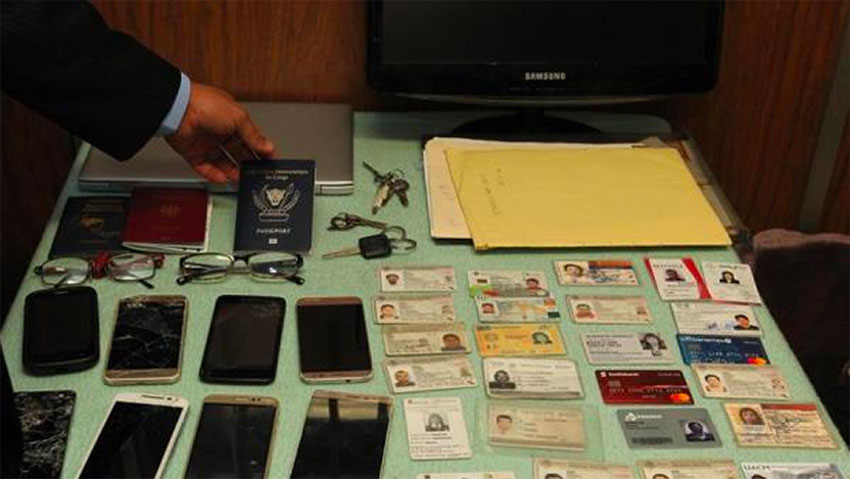
Passports and ID cards among items left on the Metro.

Between 200 and 220 lost objects arrive at his office each month, totaling 2,200-2,400 annually.

He said that after 10 years of collecting and returning lost items, he has noticed two annual high seasons for his office, located in the Candelaria station, which connects Lines 1 and 4.

The first is in August, when students go back to school, and the second is during the busy Christmas shopping season in December. He said students are the riders who lose the most objects during the school year.

Alvarado said that on average only 20% of the objects that make it to his office are reclaimed by their original owners, and many don’t make it there at all.

“It’s a minority of people who turn things in,” he said, adding that he believes that in the capital, personal need often trumps ethics and “if people find something, they don’t return it.”

People who lose objects have 90 days to claim them. After that, the office donates or recycles them.

Cell phones and other electronic devices go to a recycling program, clothes are donated to people in need and IDs are sent to the issuing entity or in the case of passports, the Secretariat of Exterior Relations (SRE).

Some owners have been located online through the Metro’s Twitter account, where a message was posted in June advising where the Lost Objects Office is located.

In addition to questions such as “Who could have forgotten their house phone?” and “Who the hell would forget a fax machine on the Metro?” there was one Metro user who was happy to have been reunited with a lost ID card.

“Twelve years ago I lost my elector’s card in Cuajimalpa and this office called to return it to me. Fantastic work by the person in charge.”

Mexico City’s Metro, operated by the System of Collective Transportation (STC), turns 50 on September 4.

Source: Milenio (sp)
Mexico reaches accord with pipeline companies that will save US $4.5 billion

0
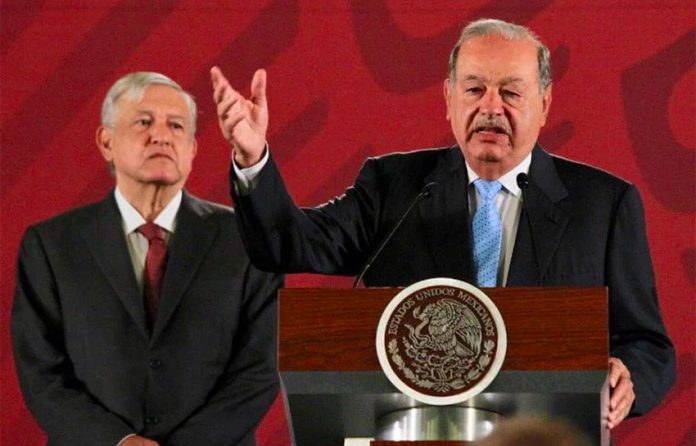
Carlos Slim speaks about the pipeline agreement during Tuesday's presidential press conference.

The federal government has reached an accord with three pipeline companies that will save US $4.5 billion, President López Obrador told reporters on Tuesday.

The companies are Carso, IEnova and TC Energy (formerly TransCanada Corporation), all of which built gas pipelines for the Federal Electricity Commission (CFE).

“I want to point out or emphasize that this was possible because of the will, the willingness of the businesspeople to [engage in] dialogue,” López Obrador said.

“The contracts had already been legally signed, the conditions, which we consider harmful to public finances, had already been agreed. That’s why we went to the owners of the companies so that, putting the legal commitments to one side, an agreement was reached that benefits everyone,” he added.

The deal reduces the amount that Mexico will pay the three firms to transport natural gas.

News of the agreement comes almost two months after the CFE announced that it had filed requests for arbitration in courts in the United Kingdom and France to annul clauses in seven gas pipeline contracts.

The CFE said the claims aimed to void certain clauses in contracts with Carso, IEnova, TC Energy and Fermaca. The president said that negotiations with Fermaca are ongoing.

López Obrador highlighted the willingness of Carso chairman Carlos Slim to engage with the government, pointing out that he “was the first to reach an agreement with the [electricity] commission.”

Slim, who addressed reporters at Tuesday’s presidential press conference, agreed with López Obrador that the new accord benefits all parties.

He said the government will pay fixed fees to the companies rather than ones that increase over time as stipulated in previous contracts, explaining that will ultimately reduce the financial burden incurred by the CFE.

In turn, steady, fixed revenue will enable Carso to finance more projects and increase investment in Mexico, Slim said.

The businessman said that importing gas from Texas, which he described as the cheapest in the world, will allow Mexico to phase out the use of diesel and fuel oil. Those fuels are not only more expensive than natural gas from Texas but also contaminate more, Slim said.

He also said the new pipelines will help stimulate development in the southeast of the country because it will be possible to transport greater quantities of natural gas to that region.

CFE director Manuel Bartlett said the new agreement will allow the sale of 8.2 billion cubic feet of natural gas per day.

The Texas-Tuxpan gas pipeline – built by TC Energy and IEnova – will be the first to go into operation as a result of the pact, he said.

The dispute over the contract for that pipeline caused diplomatic friction with Canada, whose ambassador to Mexico expressed concern in June about the government’s initiation of an international arbitration process.

“I’m deeply concerned about the recent actions of the CFE and the message they send that . . . Mexico doesn’t want to respect gas pipeline contracts,” Pierre Alarie wrote on Twitter on June 26.

Source: El Financiero (sp) 

Mixcoac archaeological site reopens in southwest Mexico City

0
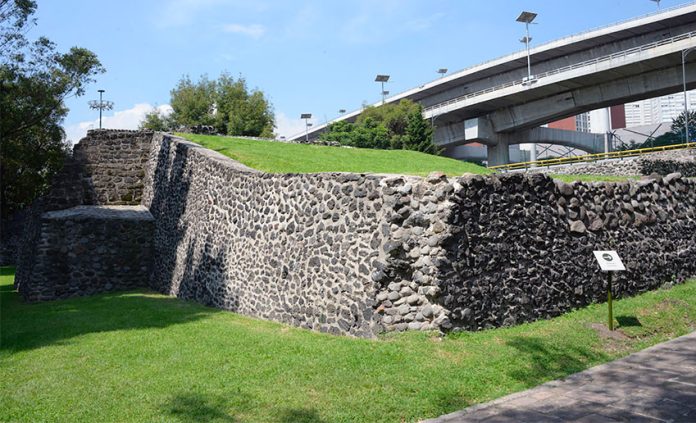
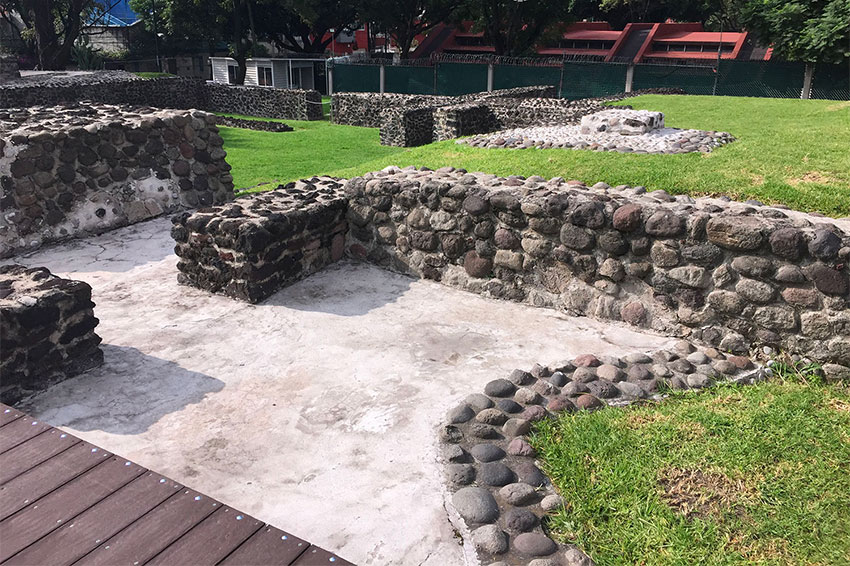
The Mixcoac archaeological site in Mexico City
The Mixcoac site is open again after 77 years. melitón tapia/inah

The Mixcoac archaeological site in southwest Mexico City has reopened after 77 years.

Located next to the capital’s Periférico, or ring road, in the neighborhood of San Pedro de los Pinos, the site is dedicated to the Mexica god of hunting, Mixcóatl, and was occupied for hundreds of years until the Spanish conquest of 1521.

It has been closed for the past 77 years to prevent the theft of historical artifacts.

The site features a pyramid dedicated to Mixcóatl, a ceremonial plaza, a central patio and a new museum, where visitors can learn more about the history of the archaeological zone and the people who lived there.

Pedro Francisco Sánchez, archaeology chief at the National Institute of Anthropology and History (INAH), explained that since the site closed only a limited number of people were able to visit as part of specially-organized visits.

Mixcoac is open free of charge seven days a week.

But now the site is now open to the public free of charge seven days a week between 9:00am and 5:00pm.

Sánchez said the site has a parking lot and public washrooms and that paths and ramps have been built to make wheelchair-accessible.

Roberto Gallegos Ruiz, who has led restoration efforts at the site during the past five years, explained at the opening ceremony on Saturday that the Mixcoac archaeological zone was rediscovered in 1916 using the so-called Uppsala map, which is now stored in the library of the university in the Swedish city of the same name.

Made in around 1550, the map is considered one of the most important from early Spanish colonial days.

Gallegos said that when he was a student in the 1950s, he played an important role in ensuring that the site wasn’t damaged or built over as a result of the construction of the Periférico.

“. . . We avoided that and I believe that has been my greatest achievement,” he said.

The Mixcoac site was once located on the edge of Lake Texcoco, which according to Sánchez, made it a place well suited for human settlement.

He said that its opening “fulfills one of the most important missions of our institute, which is to disseminate the knowledge generated from research,” adding “it’s a very unique place, immersed in the urban fabric [of Mexico City].”

Mixcoac is the 194th archaeological site to open to the public in Mexico. Others in the capital include Cuicuilco, Cerro de la Estrella, Tlatelolco and Templo Mayor.

Source: El Universal (sp), Milenio (sp)

Goodbye to the nun Sister Juana: new 200-peso note coming in September

0
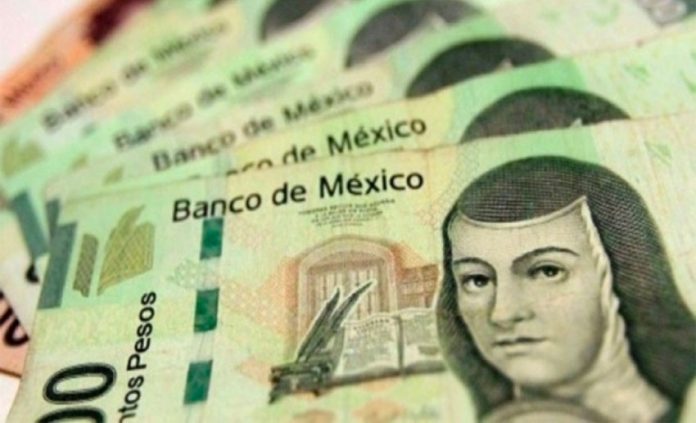
Adios Sor Juana: new banknotes are coming soon.
Adios Sor Juana: new banknote is coming soon.

Feminist poet and nun Sister Juana Inés de la Cruz will no longer adorn Mexico’s 200-peso notes once new bills go into circulation in September.

The Bank of México (Banxico) has announced that the new bills will feature the countenances of Mexican independence icons Miguel Hidalgo and José María Morelos.

The bill’s reverse side will feature an image of the El Pinacate y Gran Desierto de Altar Biosphere Reserve, a protected ecoregion in the Sonoran Desert.

Banxico’s Alejandro Alegre told the newspaper Milenio that bills are changed for three reasons: to apply more elements that will prevent counterfeits; to make them out of more durable, longer-lasting materials; and to incorporate features that aid the visually impaired and money counting machines in identifying them.

The 200-peso note is the second denomination to undergo a design change.

banknote
This is believed to be the replacement bill.

Last year, Banxico issued the new 500-peso bill, which replaced the faces of painters Frida Kahlo and Diego Rivera with that of former president Benito Juárez. The change, along with that of the bill’s color to blue, has caused confusion because it resembles the 20-peso note.

But the latter will gradually be taken out of circulation and replaced by a coin.

“The 20-peso bill costs less to manufacture, but lasts 40 months in circulation,” said Alegre. “Whereas the coin costs more than printing a bill, but lasts more than 30 years in circulation, so [the change] makes better use of public resources.”

One feature of Mexican currency that will not change, and for which it stands apart internationally, is the difference in the sizes of the denominations. This is another feature that helps the visually impaired identify the bills.

Sources: Sopitas (sp), Milenio (sp)

Irish poet finds links between Mexico and his home across the pond

0
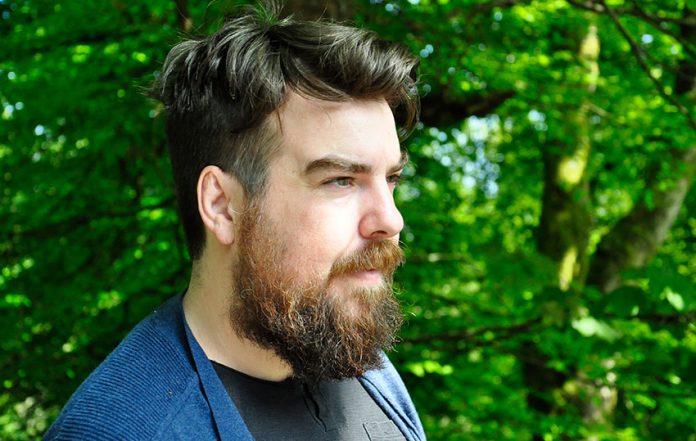
Brennan: 'Getting glimpses into Mexico through literature, through photography, it started to make sense to come here.'
Brennan: 'Getting glimpses into Mexico through literature, through photography, it started to make sense to come here.' Liliana Pérez-Brennan

Mexico City-based Irish poet Dylan Brennan’s first stint in Mexico came in 2002 when he was offered an English teaching job while at a carne asada stand in Monterrey.

“Well, I was vegetarian, so I just had the stuffed chiles,” he says over coffee at his humble apartment near the Monument to the Revolution.

Luckily, his carnivorous hosts didn’t hold his meatlessness against him, and so began his life in Mexico. His heart, however, seemed to have moved here long before.

As a child, he obsessed over an illustrated history of the Aztecs that his mother gave him, and in university he fell in love with the fiction of Mexican novelist and short story writer Juan Rulfo.

“Rulfo’s story Talpa just blew my mind,” he says. “The way he plays with time. The story jumps around; the way it’s told, I recognized the language of cinema in the story.”

The more he read, the more he knew he wanted to be in the place Rulfo wrote about.

“Getting glimpses into Mexico through literature, through photography, it started to make sense to come here.”

Fittingly, Brennan has been asked to write the introduction for a new translation of Rulfo’s collection that includes Talpa and is called El Llano in flames, to be published by Structo Press later this year.

He also co-edited the collection of essays Rethinking Juan Rulfo’s Creative World: Prose, Photography, Film.

He met his future wife Lily in Monterrey, and the two later moved to Ireland. Then over the next decade he spent time in her home state of Tamaulipas, more in Monterrey and a short spell in Mexico City.

It wasn’t until 2011, however, that Brennan knew he wanted to make Mexico his permanent home.

“There was kind of a practical side to the move, as well,” he says. “The economic crash hit Ireland pretty bad. I had two jobs, and I lost both in the same day. The next day I was offered a job at a university in Miahuatlán, Oaxaca.”

There, he began to take writing more seriously and started compiling the poems he’d sporadically written for years alongside newer ones for what would become his first book. As he did so, he began to notice similar themes running through them.

“I’d seen how Tamaulipas had changed, and how Monterrey had changed. People I knew had been killed, and someone I knew had been kidnapped, tortured and killed. The persistence of violence, and the history of violence in the country, that all linked into what was going on in the periphery of my own experiences.”

Blood Oranges was published in 2014 as a limited-edition print run by The Penny Dreadful Press. He is currently on the lookout for a publisher to take up a second printing.

In March, he was awarded the Ireland Chair of Poetry Bursary.

When asked about the influence Mexico had on the writing of the poems in Blood Oranges, his response is unequivocal: “Mexico isn’t just a backdrop to the book, it’s what the book is made of.”

Indeed, these poems encompass everything Brennan has found upon making a life here, from love to violence to rich history to tireless death, as in the succinct and forceful “Bone Couplet:”

skeletal hand in skeletal hand

lie the lovers of Tlatelolco

Whereas many canonical foreign authors writing about Mexico have tended to focus on what they considered exotic about the country, Brennan’s work strives to find connections between seemingly disparate worlds.

“While Mexico is very different from Ireland, and I like those differences, I also look for the links that connect the two,” he says.

“I have a concern that never goes away, that of not wanting to fetishize or exoticize what I see. Writers like D.H. Lawrence, Huxley, you read what they write about Mexico — and everything is a product of its time and place — but some of the stuff they come up with is just offensive.”

Thus he tends to shy away from describing the country with the word “magic.”

“There is something peculiar and special in this country,” he says. “There is great abundance and great horror, there’s so much life and there seems to be so much death, and it’s all coming together. And there’s something, I don’t know if I’d call it magical, but it’s intoxicating.”

Do you know someone you think would be a good subject for Expat Stories? Send us your nomination with a short explanation telling us a little about the person and why you think he or she would be interesting to Mexico News Daily readers, along with contact information for the nominee.

Teachers’ union puts its 3-billion-peso art collection on display

0
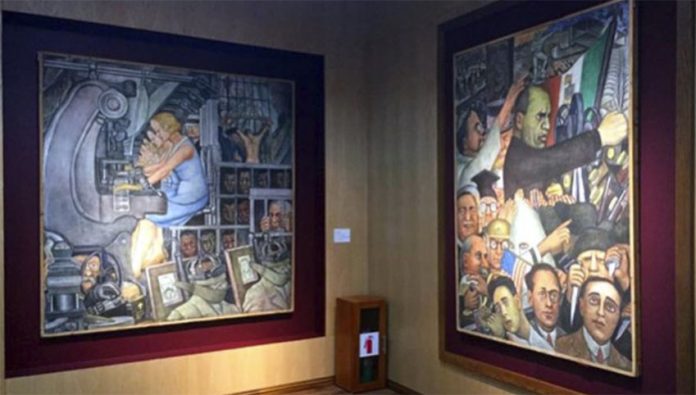
Two of the pieces on display at the teachers' union art exhibition.

An art collection owned by the SNTE teachers’ union and worth as much 3 billion pesos (US $150.6 million) is now on display in Mexico City.

It is made up of eight works by Mexican muralist Diego Rivera, six by Spanish painter Pelegrí Clavé and one each by Mexican artists Francisco Toledo, Pedro Coronel and Gabriel Orozco.

The works are on permanent display at the Contemporary Mexico Cultural Center, located on Leandro Valle street in Mexico City’s historic center.

Most prominent among the works are five of 21 mural panels painted in 1933 by Rivera for the New York Workers School, which was an ideological training center of the United States Communist Party.

The five panels, which were part of the Portrait of America mural, are called World War; The New Freedom; Modern Industry; Mussolini; and Defense of the Workers’ Land.

Former SNTE union boss Elba Esther Gordillo is believed to have bought the panels from former president Luis Echeverría although how much she paid for them is unknown.

The panels and other artworks were seized by the federal Attorney General’s Office after Gordillo’s arrest in 2013 on charges of embezzlement and organized crime.

The SNTE union recovered the art – which Gordillo purchased using dues collected from teachers – in June 2018.

“They are works with an incalculable value,” said Paul Achar Zavala, the SNTE-designated custodian of the artworks.

“I don’t know how much they could cost but they have a great historical value and it is great news that Mexicans can now admire them,” he said.

SNTE secretary general Alfonso Cepeda Salas, who last year estimated that the value of the 17 works of art could be as high as 3 billion pesos, said it was a “privilege” for the union to possess such a collection and to put it on public display.

“Apart from being very important assets for the teachers of Mexico and for education workers in general, the art is also [part of] Mexican heritage . . . it makes all of us proud . . .” he said.

Source: El Economista (sp) 

Make an example of El Paso killer, López Obrador urges new US ambassador

0
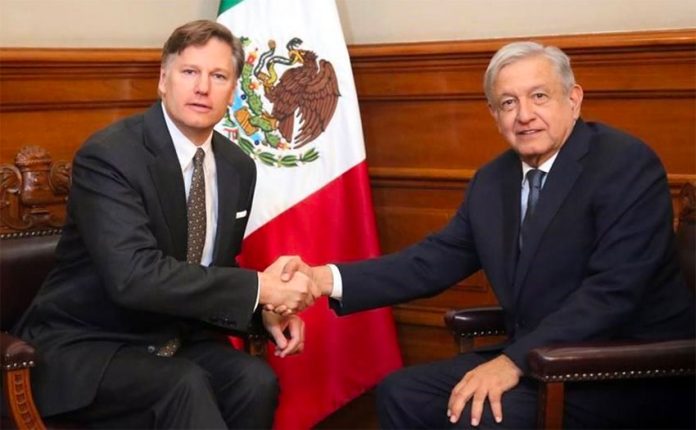
US Ambassador Landau meets with President López Obrador on Monday.

President López Obrador has called on the United States to impose an exemplary punishment against the perpetrator of the August 3 shooting in El Paso, Texas, in which 22 people including eight Mexicans were killed.

López Obrador relayed his message through United States Ambassador Christopher Landau, who presented his credentials to the president on Monday.

Foreign Secretary Marcelo Ebrard said López Obrador also called on U.S. President Donald Trump to speak out every day against hateful and xenophobic attitudes and acts against migrants.

Ebrard said the president told Landau that the government is watching the El Paso case very closely and that it believes that a punishment must be imposed that acts as a deterrent against similar crimes. However, López Obrador said earlier this month that he was opposed to the death penalty being imposed.

“. . . Justice must be served,” Ebrard said, “but there also needs to be a wider declaration . . . that this conduct, these attitudes, are not tolerated.”

'Denounce racially-motivated violence every day and do it more:' Ebrard to Landau.
‘Denounce racially-motivated violence every day and do it more:’ Ebrard to Landau.

“The ambassador said he understood [Mexico’s] position perfectly,” the foreign secretary said, adding that Landau told him and the president that the United States government has already unequivocally denounced racially-motivated violence.

Ebrard said the message conveyed to the ambassador was: “. . . OK, do it every day, do it more and in this case [the El Paso massacre] set an example with what you do.”

According to an affidavit filed by the El Paso Police Department, the 21-year-old suspect told officers that he targeted Mexicans, while in a manifesto published online the alleged shooter said he was carrying out the attack in “response to the Hispanic invasion of Texas.”

Ebrard said that he and the president also told Landau that the government remains interested in extraditing the accused killer, explaining that Mexico will attempt to do so if the United States doesn’t bring terrorism charges against the man.

On a more cordial note, Ebrard said that Landau indicated that Trump wants a good relationship with Mexico and very much respects the country.

In response, “the president . . . told him that we are seeking, within an environment of mutual respect, to continue making progress in our relationship,” the foreign secretary said.

Ebrard said that ratification of the new North American trade deal, the tomato war between Mexico and the United States and the development plan for Central America were also discussed at the meeting.

With regard to migration, Ebrard said that he and the president explained to the ambassador that the movement of people to the northern border has been reduced since Mexico and the United States struck an agreement in June that ended a threat from Trump to impose escalating tariffs on all Mexican imports.

In exchange, Mexico agreed to step up enforcement against undocumented migrants and to accept the return of all asylum seekers that passed through the country as they await the outcome of their claims in the United States.

Ebrard said that he will meet with Secretary of State Mike Pompeo in Washington D.C. on September 10 to discuss the migration situation and the implementation of development programs in Central America.

Source: Reforma (sp) 

Marijuana plantations destroyed by military down 70% in five years

0
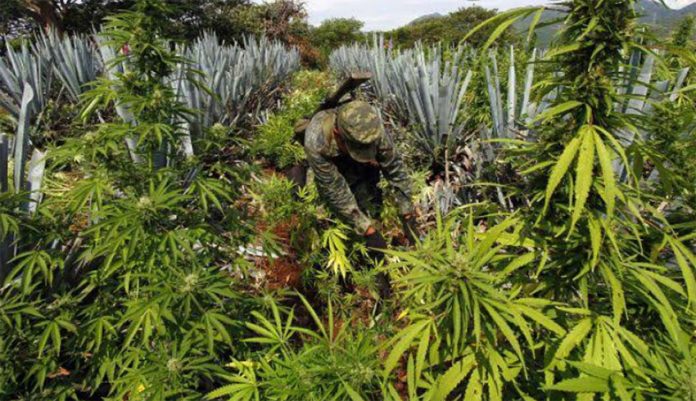
A soldier cuts marijuana plants
A soldier cuts marijuana plants as part of military efforts to eradicate the crops.

The area covered by marijuana and opium poppy plantations that were destroyed by the military between January and May was the lowest in five years, government data shows.

Information provided to the newspaper Milenio by the Secretariat of National Defense (Sedena) shows that the army destroyed 615.5 hectares of marijuana crops between January 1 and May 9, an average monthly eradication of 143.1 hectares.

The monthly average is 70% less than the area of marijuana plantations destroyed in the same period of 2014 and 33% less than that eradicated from January to May of last year.

Information supplied by Sedena also shows that Oaxaca has become a major marijuana-producing state.

In 2014, seven of the 10 municipalities where the largest areas of marijuana plantations were destroyed were located in the so-called Golden Triangle region of Chihuahua, Sinaloa and Durango.

The other three municipalities in the top 10 were Álamos, Sonora; La Yesca, Nayarit; and Tequila, Jalisco.

In 2019, however, six of the 10 municipalities with the largest areas of plantations destroyed by the military were in Oaxaca. They were San Juan Lachigalla, San Carlos Yautepec, San Pedro Quiatoni, San Mateo Yacutindoo, Villa Sola de Vega and Santa Lucía Miahuatlán.

The other four municipalities in the top 10 this year were Badiraguato, Sinaloa; Tamazula, Durango; Guadalupe y Calvo, Chihuahua – which took out the top three spots; and Guachochi, Chihuahua.

In 2018, the military destroyed 774 hectares of marijuana in Sinaloa, 668 hectares in Oaxaca, 432 hectares in Durango and 408 hectares in Chihuahua. Almost 90% of all marijuana crops eradicated last year were located in those four states.

But the bigger crop is the opium poppy.

Sedena data shows that the military destroyed 6,704 hectares of poppy crops between January 1 and May 9, more than 10 times greater than the area in which marijuana plantations were destroyed.

However, the monthly eradication average of 1,559 hectares was the lowest in the past five years.

In the same period of 2014, the military destroyed an average of 1,804 hectares of opium poppies per month, 16% more than this year.

Over the past five years, the military has eradicated large areas of poppy plantations in the mountains of Guerrero and the Golden Triangle region.

In 2018, the army destroyed 7,495 hectares of the plant in Guerrero, 5,740 hectares in Durango and 4,917 hectares in Chihuahua.

Source: Milenio (sp) 

6 gunned down and killed after disagreement over horse race

0
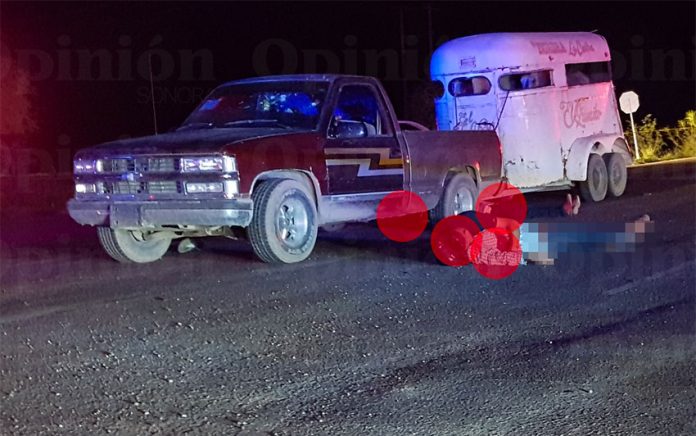
The truck in which the victims were traveling from horse races in Empalme.

Six people are dead and one wounded after an attack by gunmen in Empalme, Sonora, on Sunday evening over the results of a horse race.

The attack occurred around 7:00pm on Highway 85 as the victims were returning home from a horse race. They were traveling in a pickup truck pulling a horse trailer when they were attacked.

Sources said the shooting was related to a disagreement over secret bets made on the races, which were part of a traditional festival at the Santa María ejido.

Four of the dead were two fathers and their sons, two of whom were found embracing each other at the side of the highway.

Municipal police were the first to arrive to the scene and were later reinforced by state police and marines.

 Source: Opinión Sonora (sp), Net Noticias (sp)

More than 25 million students are back in classes

0
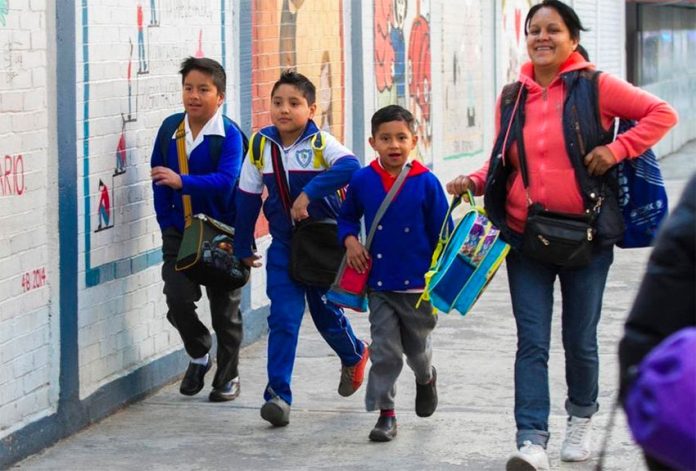
Students returned to classrooms across Mexico today.

More than 25.4 million students and 1.2 million teachers returned to school today, starting classes under an educational reform called the “New Mexican School.”

This school year will be the first complete scholastic cycle of President López Obrador’s “Fourth Transformation” plan to eradicate corruption and impunity.

The Secretariat of Public Education (SEP) stated that the country’s students will be at the center of public educational policy.

The department added that with the integration of the new secondary education laws, teachers will have a new professional system that will provide them with job security and justice in the workplace.

Education Secretary Esteban Moctezuma Barragán said the president aims to create a quality, inclusive public education system that gives attention to those who need it most.

“[The education secretary] invites students and teachers to work together with the SEP to begin the construction of the New Mexican School and highlights that the best in education is yet to come,” the secretariat said.

The SEP said it distributed 176 million free textbooks, fulfilling its promise that no student will go without the materials needed to succeed.

One major change in López Obrador’s educational reform was the elimination of the evaluation system put into place during the term of his predecessor, Enrique Peña Nieto.

“The matter of evaluation, which was what worried us most, is clear to us now,” said Arturo Pioquinto, a teacher at Rafael Solana primary school in Iztapalapa. “It is no longer an issue tied to the work environment, and this separation is a big relief.”

Still, much of the reform depends on the passage of the plan’s secondary laws, which will be voted on in September. This has caused many educators to begin the school year with uncertainty.

“There’s lots of uncertainty about many things,” said Édgar Gallego, principal at Rafael Solana. “As teachers, it is our job and responsibility to provide society with the certainty that we know how to do our jobs in the classroom.”

The Chamber of Deputies has until September 12 to vote on the secondary laws.

Sources: Milenio (sp)