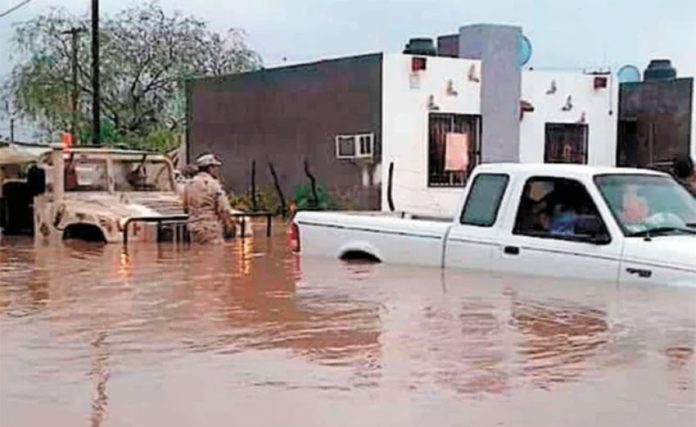
Tropical Storm Ivo left two dead and communities across the country ravaged by floods, sinkholes, hailstorms and damaged infrastructure over the weekend.
The deaths, a minor in Ahome, Sinaloa, and an adult male in Monterrey, Nuevo León, were both caused by electrocution. The seven-year-old child was electrocuted when lightning struck as he touched a refrigerator.
Sinaloa Governor Quirino Ordaz Coppel urged the federal government to send aid to victims in the affected municipalities of Guasave, Elota, Mocorito, El Rosario and Mazatlán, all in a state of emergency.
In Ahome, which was in the process of declaring an emergency, seven temporary emergency shelters were opened in Los Mochis to attend to 268 people forced to evacuate their homes.
A sinkhole opened up on the Mazatlán-Culiacán highway, forcing the closure of two of the road’s four lanes.
The state Civil Protection agency said that 25 schools had been flooded, but all had been cleaned up before the start of classes on Monday.
The same could not be said of schools in Comondú, Baja California Sur.
The start of the school year was postponed in Ciudad Insurgentes after heavy rains early Saturday morning flooded schools.
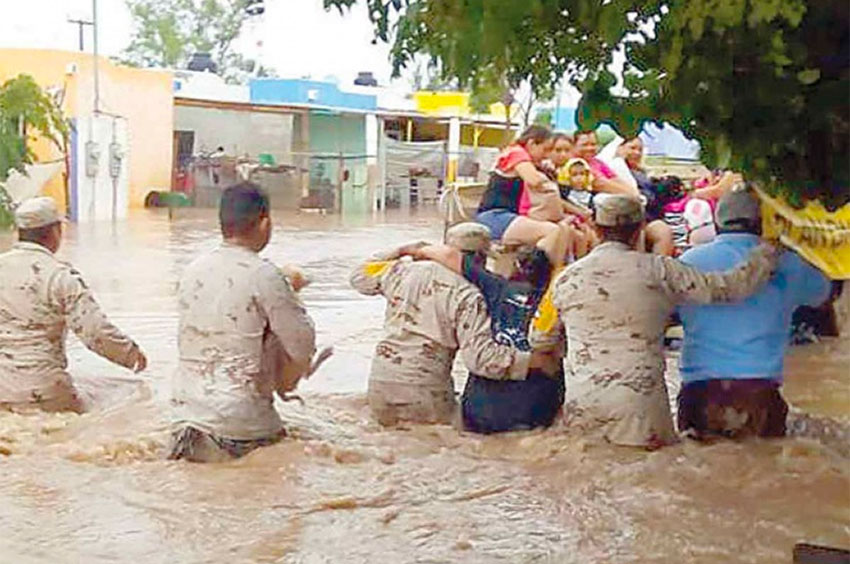
Soldiers provide aid to a family in Comondú. One took responsibility for the family dog.
State Governor Carlos Mendoza said that although the flooding damaged homes and forced evacuations, there were no casualties. He added that damaged homes will be assessed so that the owners can receive aid.
Other affected states include Sonora, Puebla, Michoacán, and Morelos, which saw heavy rains and hailstorms.
Ivo was downgraded yesterday to a tropical depression as it lay 480 kilometers to the west of Cabo San Lucas.
There were two violent incidents directed at the military Saturday in Michoacán, one with firearms and another with shovels and brooms.
The first was fatal for army Lt. Colonel Víctor Manuel Maldonado Celis, who was killed in a shootout with armed civilians in San Ángel Zurumucapio in the municipality of Ziracuaretiro.
National Defense Secretary Luis Cresencio Sandoval González and Security Secretary Alfonso Durazo confirmed the officer’s death and offered condolences to his family in Twitter messages on Sunday.
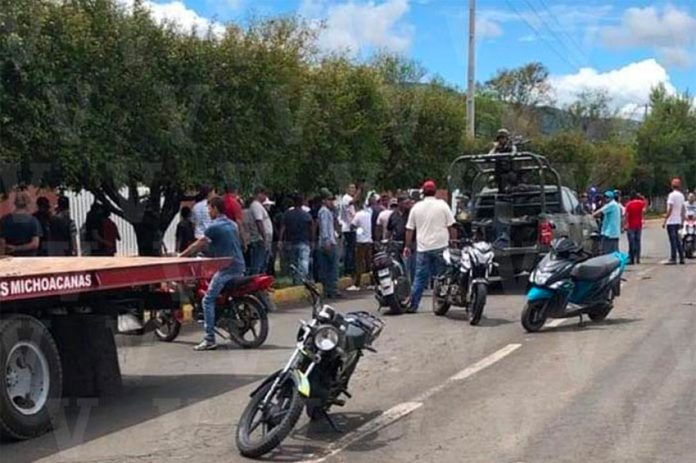
Later on Saturday, soldiers were attacked with shovels and brooms on the Zamora-Los Reyes highway in the nearby municipality of Los Reyes.
According to local media, the soldiers had detained a suspected criminal lookout who was informing someone about the military’s movements. But angry citizens showed up to defend the arrested man and threatened the soldiers with their makeshift weapons.
A video uploaded to social media showed about 10 soldiers backing up against a tree, pointing their rifles at the ground as the crowd threatens to beat them. At another point, army vehicles were hit with shovels.
Military sources who spoke with the newspaper Milenio said the soldiers were not hurt in the incident, but two vehicles were left with minor damage.
The soldiers decided to release the man they had arrested to prevent a confrontation.
Guerrero farmers have been waiting months for their fertilizer.
Delays in the delivery of free fertilizer to campesinos in Guerrero could cause famine in the near future, a human rights activist warns.
Thousands of farmers in the Montaña region of Guerrero have still not received the free fertilizer that is delivered annually by the government. The federal government assumed responsibility for the program this year.
According to Abel Barrera Hernández, director of the Montaña Tlachinollan Human Rights Center in Tlapa, Guerrero, the long-awaited fertilizer is used for subsistence corn farming.
The Guerrero Agriculture Secretariat said there are as many as 16,000 campesinos who have not received fertilizer in the Montaña region, one of the poorest in the country.
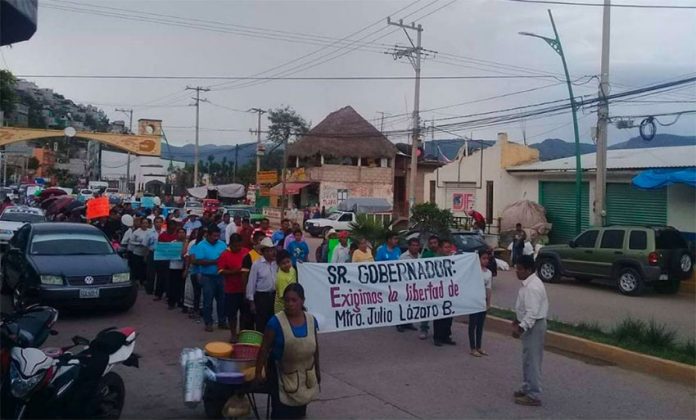
On Thursday and Friday, farmers in Tototepec took over the municipal palace in Tlapa, claiming that they could not exchange fertilizer vouchers given to them by the federal food security agency (Segalmex) because government warehouses were closed.
After speaking with the protesters Tlapa Mayor Dionisio Pichardo García spoke to Jorge Gage, the federal coordinator of the fertilizer program, who agreed to send trucks to Guerrero from Querétaro and Michoacán.
Meanwhile, farmers in the Montaña municipality of Acatapec have been blocking the Chilapa-Tlapa highway for more than a month near Tlatlauquitepec, demanding the delivery of 5,000 bags of fertilizer promised by Gage.
“Mr. Gage never came to the Montaña to resolve this problem,” said rights activist Barrera. “He wants to fix everything from Mexico City, and he only meets people there.”
Barrera added that in 2019, many campesinos in the Montaña region decided to plant corn instead of opium poppies because of a decline in the price of opium from 25,000 pesos (US $1,255) per kilogram to 4,000 pesos.
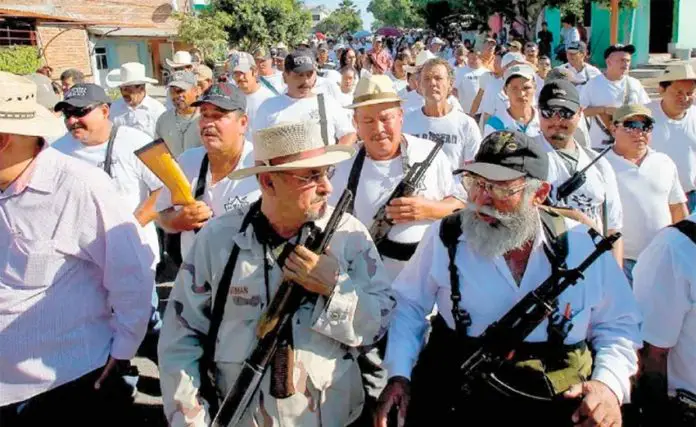
A file photo of one of Michoacán's first defense forces. In front at left is founder José Manuel Mireles.
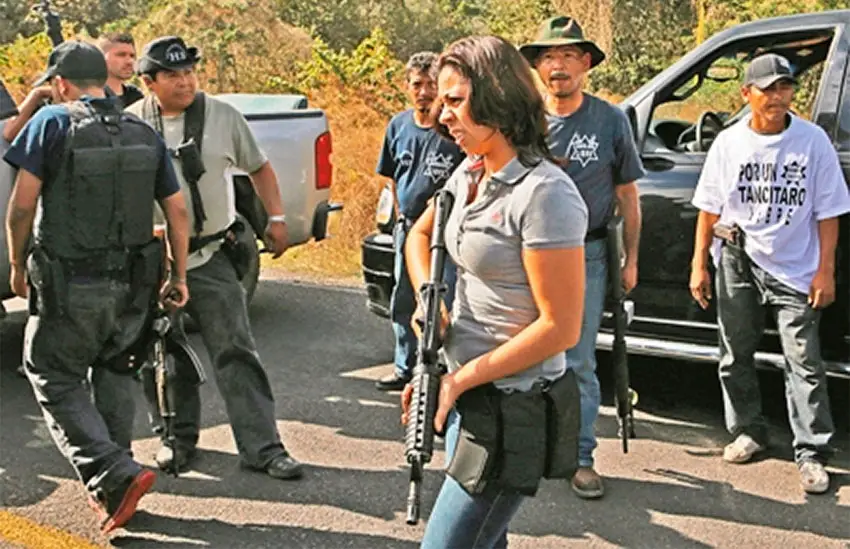
Self-defense forces are still needed in some parts of Mexico because municipal and state police lack the capacity to combat organized crime, according to two security experts.
Raúl Benítez Manaut, a professor at the Center for Research on North America at the National Autonomous University, and Martín Barrón Cruz, a researcher at the National Institute of Criminal Sciences, both acknowledged that some self-defense force members are involved in organized crime but agreed that the groups are a necessary evil because authorities are unable to combat criminal gangs in all areas of the country.
According to a report Saturday in the newspaper El Universal, there are at least 50 self-defense forces in Mexico distributed in six states: Guerrero, Michoacán, Veracruz, Morelos, Tamaulipas and Tabasco.
Data from the Interior Secretariat shows that Tabasco is the only one of those six where police numbers meet national standards of 1.9 state police officers per 1,000 inhabitants.
Michoacán, Veracruz and Morelos only have 0.7 officers per 1,000 residents, Guerrero has 0.9 and Tamaulipas has 1.1.
Self-defense force members in Michoacán in 2014.
The two experts said that police forces are also weakened because in some cases officers are not subjected to evaluations or they are allowed to continue to serve despite failing confidence tests.
Benítez told El Universal that in the absence of police that are capable of combating crime, some self-defense forces have gained legitimacy in the communities in which they work.
“There are self-defense forces that are quite legitimate and very much supported by the people,” he said.
“This happens in indigenous areas such as Oaxaca, Chiapas and even Michoacán, where they’ve gained a lot of credibility because they dedicated themselves to fighting organized crime when the government didn’t have the capacity to confront these groups,” Benítez added.
“In some towns, self-defense forces are still seen as necessary because of the voids left by the state. In Oaxaca, for example, there is a kind of community social service in which young people, without weapons, are guarding the entrance to a town . . . and people live in peace. However, if they don’t do that, organized crime could infiltrate because the police don’t have the resources or officers to be looking after the towns.”
Barrón said that “in some regions, the self-defense forces continue to be necessary,” explaining that “the problem is that there are no police, nobody wants to be a police officer anymore because of the risks that implies.”
“The government must study each region and determine what their needs are,” he added. “Only in that way will it manage to establish a legal framework and provide security to everyone.”
The former honorary consul of Canada in Cancún, Daniel Lavoie, was found dead in his apartment in Cancún on Sunday.
The body was found wrapped in a sheet, covered with pillows and the feet bound. A message left with the body read: “This happened to you for raping children.”
The murder was discovered when a friend went to look for Lavoie around noon on Sunday after he had been unable to contact him.
Lavoie, 62, had lived in Cancún for 33 years where he had served as honorary consul until eight years ago. Since retiring from the diplomatic service, Lavoie taught private French and English classes.
Many commenters on Facebook expressed grief for the killing, describing the victim as “a good friend” and “an honorable person.”
According to his Facebook page, he was a nature lover who had studied at the University of Quebec.
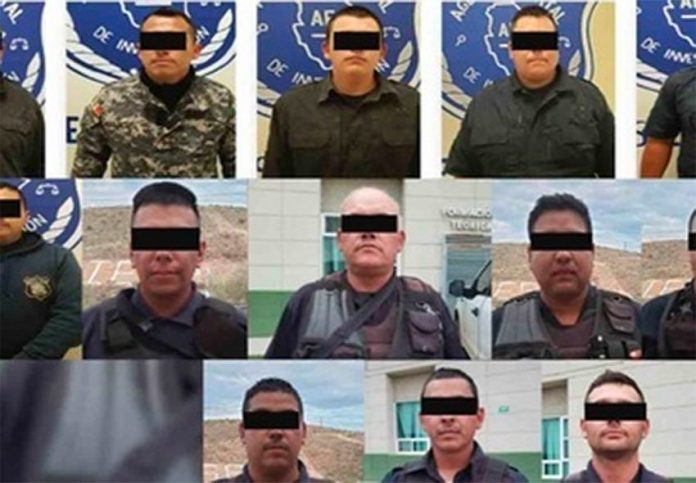
The arrest of a town’s entire police department in Mexico’s state of Chihuahua reflects just how insidious police corruption continues to be in the country, with governments at all levels seemingly unable to make any real difference.
Fifteen police officers from the municipality of Madera, Chihuahua, in northern Mexico, were arrested on August 15 during a joint operation by state and federal agencies, the Chihuahua Attorney General’s Office reported.
Madera’s police commander was among those arrested. Identified only as José Luis M. M., he had apparently provided protection services to drug traffickers in the area and obstructed the work of local authorities.
The arrest occurred after the police chief stopped operatives from state security agencies and threatened them at gunpoint to abandon an investigation in the region.
InSight Crime analysis
Entire police forces being rounded up for corruption and collusion with organized crime is nothing new in Mexico. In August 2018, 205 police officers were disarmed and suspended in the municipality of Tehuacán in central Puebla state, while 113 more were believed to have fled.
The ease with which corruption spreads inside the police forces and the vast impunity for participating officers means that successive government reforms have shown no concrete results.
An average of 1,688 corruption cases were registered for every 1,000 active-duty police officers in Mexico in 2017, according to a survey conducted by the National Institute of Statistics and Geography (Inegi). That translates to 1.6 acts of corruption for every police officer at the national level.
The state of Chihuahua reported that for every 1,000 police officers registered in the state, 133 had been participating in criminal activities. The state’s corruption rate is only surpassed by Mexico City, with a rate of 179 for every 1,000 police officers.
Mexican police forces are particularly vulnerable to corruption and infiltration by drug cartels, due to low salaries and a lack of government support. This makes the bribes paid by criminal mafias extremely attractive.
“It is far easier to develop training programs and improve selection criteria than to reverse a long history of extortion and bribery,” investigator Daniel Sabet was quoted as saying in a report published by the Washington Office on Latin America (WOLA).
Each new government in Mexico has proposed a new way to address the issue of police corruption, and it seems that none has been effective.
In fact, there have been repeated protests by police forces that have been invited to be part of the new National Guard force enacted by President Andrés Manuel López Obrador. According to federal police, the new law enforcement entity would not respect severance, hierarchy or seniority.
The writer is an investigator with InSight Crime, a foundation dedicated to the study of organized crime in Latin America and the Caribbean.
Robust trade with the United States in the second quarter enabled Mexico to record its highest ever current account surplus.
Bank of México data released on Friday shows that Mexico ran up a current account surplus of US $5.143 billion between April and June, the biggest since comparable records were first kept in 1980.
The surplus, equivalent to 1.6% of GDP, is the first second-quarter surplus achieved since 2010. In 2018, Mexico recorded a current account deficit of just under US $22 billion.
Mexico has become the biggest trading partner of the United States this year as a result of U.S. President Donald Trump’s protracted trade war with China.
Around 80% of Mexico’s exports, including cars, televisions and agricultural products, are sent to the country’s northern neighbor.
Goldman Sachs economist Alberto Ramos believes that Mexico is likely to continue to reap rewards from Trump’s feud with Beijing.
“Going forward, Mexico could potentially be one of the main beneficiaries of the trade-conflict between the U.S. and China, and global manufacturers could set base in Mexico given the competitive unit labor costs and logistical proximity [to the United States],” he said.
Central bank data showed that exports of goods were worth almost US $5 billion more than imports in the second quarter, the first such surplus in five years.
The remainder of the current account surplus was made up of services and financial flows, including interest payments and income transfers such as remittances.
Mexicans working abroad, mainly in the United States, sent US $9.403 billion home in the second quarter, a 20% increase over first-quarter figures.
While the surplus is good news, the central bank data still raised some questions about the health of the economy, which recorded 0.0% growth in the second quarter after contracting 0.3% between January and March.
Benito Berber, chief Latin America economist at investment bank Natixis, said the Bank of México figures showed that there was a sharp decline in non-oil imports, which highlights weakening domestic consumption and helps to explain the record current account surplus.
Ramos said that there was concern about slowing foreign direct investment and that Mexico’s portfolio flows, which measure the buying and selling of securities, had turned negative.
Segura: talks just formalize an existing partnership.
A priest from Michoacán has echoed the words of three state governors, declaring that there is no difference between self-defense groups and organized crime.
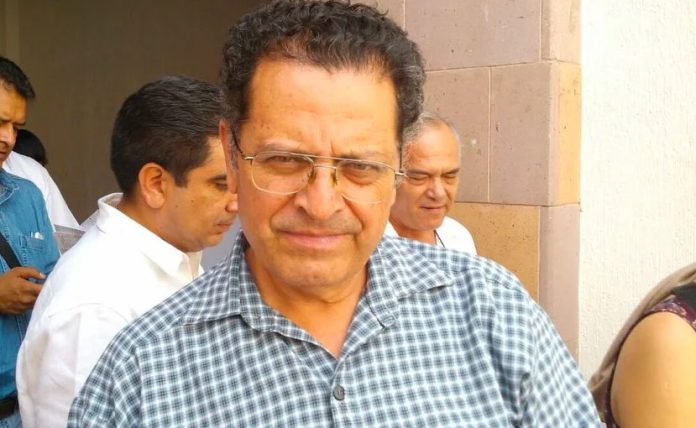
José Luis Segura Barragán, parish priest in El Rosario, a community in Apatzingán, said that by entering into dialogue with self-defense groups, all the government achieves is to formalize its partnership with criminals.
The priest’s comments came after the Interior Secretariat revealed this week that it had held talks with self-defense groups in Michoacán and Tamaulipas.
Segura, who witnessed the rise of self-defense groups in Michoacán’s Tierra Caliente region, said that in his experience, holding talks with armed gangs is not the solution to ending violence.
“. . . It has always been my position – and it’s not theoretical because I’ve been in complicated situations – that talking to criminal groups is pointless because these groups always have a criminal purpose . . .” he said.
“There are no self-defense forces anymore, those that were left became criminals . . .” Segura added.
“Holding talks with criminal groups would be nothing more than to demonstrate what is already official: the partnership of organized crime with the government.”
A 55-year-old Tamaulipas priest was murdered on Thursday night in Matamoros.
José Martín Guzmán Vega was attacked as he was returning to his church from a shopping trip. After hearing the priest’s cries for help, neighbors found him lying on the floor of the church, bleeding from multiple stab wounds.
He died later in hospital.
Eugenio Lira Rugarcía, bishop of the diocese of Matamoros, confirmed Guzmán’s death.
A motive for the crime was not immediately apparent.
Guzmán is the first Catholic priest to be murdered in Mexico this year. According to the Catholic Multimedia Center, 26 priests have been killed since 2012.
On August 3, Presbyterian minister Aarón Méndez Ruiz, director of the migrant shelter Casa del Migrante AMAR, was kidnapped in Nuevo Laredo, Tamaulipas, and has not been seen since.
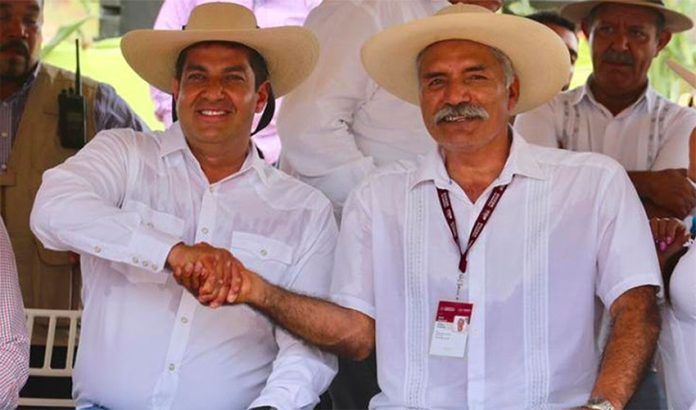
Undersecretary Peralta and self-defense force founder Mireles shake hands in La Huacana.
On the orders of President López Obrador, talks between the federal government and self-defense forces will cease, Interior Secretary Olga Sánchez told reporters yesterday.
“The president has given us a very clear instruction, he doesn’t want us to continue down this line and we’re going to respect the instruction. The intention was good, the intention was pacification,” Sánchez said.
The interior secretary said on Tuesday that her department had been in talks with armed groups “and they have told us that they do not want to continue” to engage in violence.
Sánchez said officials had met with groups in Guerrero, Tamaulipas and La Huacana, Michoacán, “that have been fighting each other but have now expressed their intention to disarm” and contribute to the pacification of Mexico.
The Interior Secretariat (Segob) quickly clarified that Sánchez was speaking about “authentic self-defense organizations” rather than criminal organizations. “The federal government does not have nor will have dialogue with any organized crime group,” it said on Twitter.
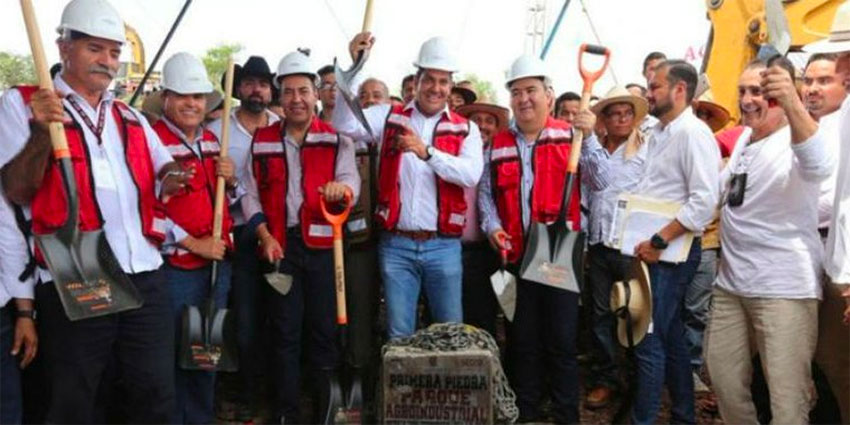
Inauguration of the agro-industrial plant in Michoacán. Which are the bad guys?
A group that Segob undersecretary Ricardo Peralta met with in Tamaulipas allegedly has ties to the Gulf Cartel. Governor Francisco García Cabeza de Vaca said that warrants have been issued for the arrest of some of its members.
Sánchez said yesterday that Peralta thought it was a good idea to go to areas of the country where there are high levels of violence in order to seek an “alternative” path to peace.
The secretary clarified that officials had gone to Tamaulipas and Michoacán but not to Guerrero, although she added that people from that state have approached the government to seek dialogue.
Peralta traveled on Wednesday to La Huacana where, accompanied by former self-defense leader José Manuel Mireles, he laid the symbolic first stone for a new agro-industrial park. In the same municipality last May, so-called self-defense force members detained and disarmed soldiers.
At his press conference on Thursday, López Obrador distanced himself from Peralta’s attendance at the groundbreaking ceremony, explaining that his government doesn’t endorse any projects in which armed self-defense groups are involved.
He directed the undersecretary to “stick to the constitution” while fulfilling his duties as a federal official. The president described self-defense groups as “illegal” and declared that they cannot be allowed to perform law enforcement duties.
Peralta attended the groundbreaking ceremony in La Huacana, López Obrador said, “because they invited him.”
“I do not agree. We talked about this issue in the security cabinet, and I have asked them to obey the mandates of the constitution and the laws,” he said, implying that he gave Peralta and other Segob officials a dressing-down.
Asked whether she had received a rebuke from the president, Sánchez paused before responding that she was only given an “instruction.”
The interior secretary rejected rumors that she was planning to resign, asserting that she is very secure in her position and that López Obrador has “great confidence” in her.
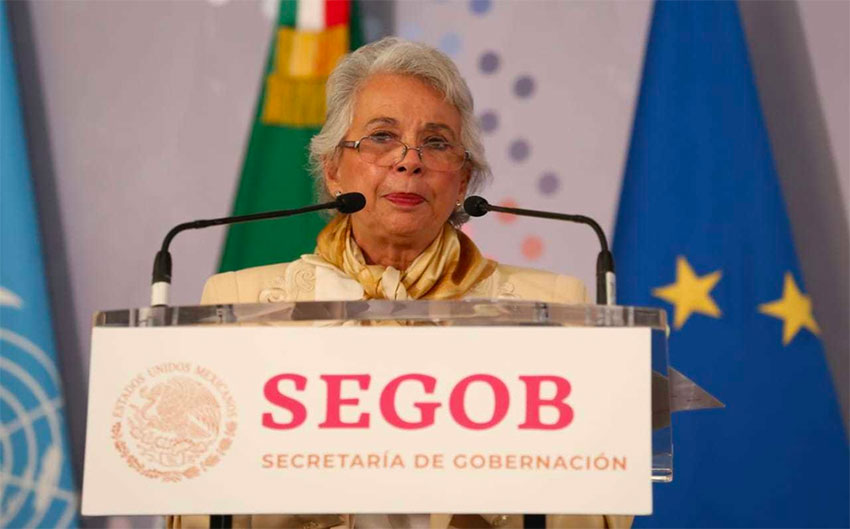
Interior Secretary Sánchez: ‘intentions were good’ but president was not on side.
“. . . I’m more secure than ever. These mischievous adversaries I have are always saying that I’m quitting or that I’m sick. I’m not quitting and I’m not sick . . .” Sánchez said.
The López Obrador government is coming under increasing pressure due to its failure to stem violence since taking office last December. Homicide statistics for the first seven months of the year show that Mexico is on track to record its most violent year in recent history.
The president formally inaugurated the National Guard at the end of June and said yesterday that his government is implementing a “new paradigm” in public security policy that includes attending to the root causes of violence.
The opposition National Action Party said in a statement this week that the president’s policies appear to add up to one big amnesty for criminals.
“The only thing in doubt is whether these [talks] are the first steps in a formal amnesty for drug traffickers, because there has already been a de-facto amnesty since February 1 when the president announced the end of the drug war and government drug seizures fell.”