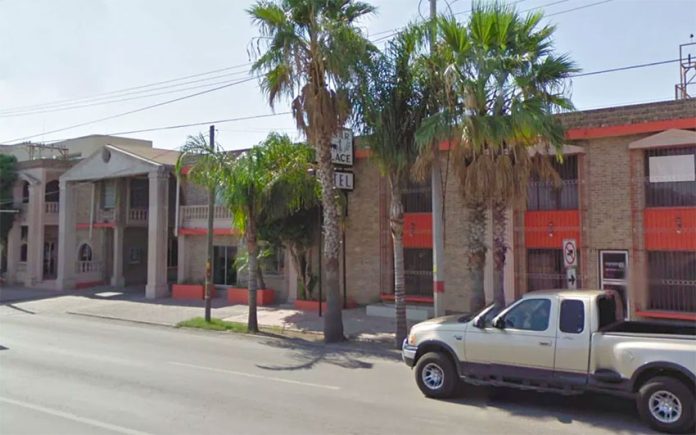
The Nuevo Laredo hotel where police were attacked.
A commando attacked a hotel in which state police officers were staying in Nuevo Laredo, Tamaulipas, early Friday, killing one officer and wounding two others.
State police said Northeast Cartel sicarios attacked the Santa Teresa Hotel with assault rifles and fragmentation grenades.
The aggression took place a few hours after Federal Police officers transferred 19 prisoners considered to be high-ranking members of the Northeast Cartel from municipal jails in Nuevo Laredo.
The cartel, which controls Nuevo Laredo, was formed after a split in the Zetas cartel and is led by Juan Gerardo Treviño Chávez, the brother of former Zetas leader Miguel Ángel Treviño Morales.
The assault on the hotel is the third attack on police in northeastern Mexico this week. On Wednesday, a group of Coahuila state police were ambushed on a highway near Piedras Negras, and were later fired on again as the wounded from the first attack were being taken to hospital.
Runners in last year's event. Costumes are part of the fun.
Thousands of runners will hit the streets of the capital on Sunday to compete in the 37th edition of the Mexico City Marathon.
The starting gun will sound first for wheelchair racers, who will leave the University Olympic Stadium in the south of the city at 6:45am.
Female athletes will embark on the 42-kilometer route to Mexico City’s central square, the zócalo, five minutes later, while male runners will depart at 7:00am.
For the first time, this year’s marathon has been designated as a Gold Label Status event by the International Association of Athletics Federations.
The route will initially see athletes running north on Insurgentes avenue until they reach the World Trade Center after which they will continue through the neighborhoods of Condesa and Roma.
The 2019 Mexico City Marathon route.
Runners will pass by the Chapultepec castle before reaching Polanco, where they will run down swanky Masaryk avenue and past the visually striking Soumaya museum.
On the home stretch, the 30,000 competitors will be able to admire the Angel of Independence monument on Paseo de la Reforma, the Monument to the Revolution and the Palacio de Bellas Artes (Palace of Fine Arts) in Mexico City’s downtown.
Around 200,000 spectators are expected to line the route to cheer on the runners.
Elite athletes participating in Sunday’s marathon will be vying for a 550,000-peso (US $27,700) first prize in both the men’s and women’s events, while each runner-up will pocket 245,000 pesos.
Foreign athletes have dominated the race during the past decade. Runners from Kenya won both the men’s and women’s events last year. The most recent Mexican winner was Karina Pérez, who crossed the finish line first in 2010.
Not all runners, however, take the event seriously. Last year, 36% of runners cheated by not following the correct route.
A runner sports an elaborate costume in last year’s marathon.
The British news magazine The Economist reported that the Mexico City Marathon has caused crowding on the city’s subway system in recent years but not only because several major roads are shut down for the event.
“It is also because cheating marathoners have been known to hop on for a quick detour to the finish line,” the report said.
Runners who cheat are doomed to disqualification because they carry electronic chips that are detected by checkpoints along the route.
However, disqualification doesn’t come until days after the race and therefore can’t stop the masquerading marathoners from getting their medal, snapping a triumphant selfie and basking in the crowd’s adulation.
Those found to have cheated this year will be barred from competing in the 2020 marathon and half-marathon.
For people interested in following the action at home, the marathon will be screened on the Claro Sports, Azteca and Capital 21 television stations.
AMLO, left, said Calderon's outfit was too big. The latter replied that for the president, it's the job that's too big.
Former president Felipe Calderón struck back after current President López Obrador blamed him for Mexico’s crime woes and ridiculed him for an outfit he wore 12 years ago.
López Obrador laid the blame for the country’s widespread violence on Calderón’s administration and invoked an actor from Mexico’s golden age of cinema to make fun of the former president’s declaration of war against crime.
“When he declared war on organized crime, he went to Michoacán, to Apatzingán, and he went dressed as a soldier,” the president said. “He put on a vest that was too big for him, looking like Major Borolas, and there he declared war.”
“Borolas” was the nickname of actor Joaquín García Vargas, whose characteristic style included a broad-shouldered suit jacket with wide lapels.
“Calderón stirred up a hornet’s nest and we inherited all this that we suffer today,” said López Obrador. “He didn’t even have a plan, and instead of attending to the causes, he wanted to solve the problem in a spectacular fashion, using only force.”
“These days there are more than 100 murders per day, almost twice as many at the end of my administration, which began to clean a house infested with venomous animals,” he tweeted. “Today he lets them grow, because he can’t tell the difference between scorpions and bees.”
In response to the mockery, Calderón, a frequent critic of the president, said the government was too big for López Obrador.
“For me, the vest didn’t fit well,” he said, “but for others, it is the job that is too big.”
During Calderón’s 2006-2012 term as president, 102,859 murder investigations were opened, while there have been 17,164 cases opened in the first seven months of this year, according to the National Public Security System (SESNSP).
If the homicides continue at the same pace, there will have been 175,000 cases by the time López Obrador’s term ends.
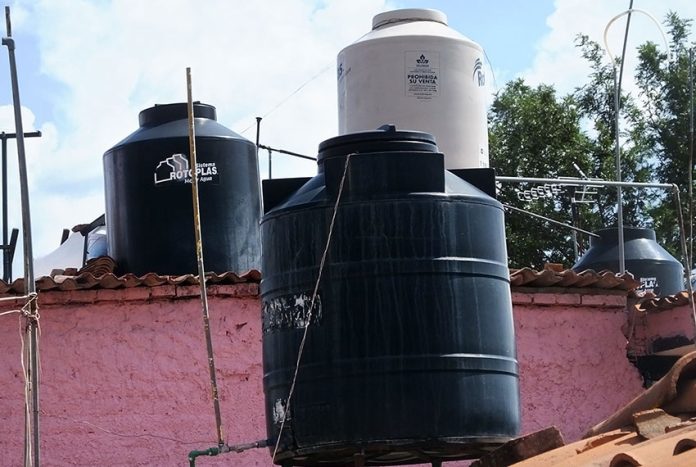
If you fly above most cities in Mexico, you’ll see a big water tank on the roof of virtually every house. These reservoirs supply undrinkable water to families and are known as tinacos.
To Guadalajara businessman Raúl Mejorada, tinacos are emblematic of serious problems in Mexico’s water distribution systems and for years he has fought to do something about them.
In May came the first breakthrough in Mejorada’s war on tinacos. Representatives of Jalisco and the town of Ciudad Guzmán, located 100 kilometers south of Guadalajara, signed a collaboration agreement with Mexican and Dutch companies to replace the local water distribution system with one that will bring potable water to every tap.
The project will totally revamp its utility networks, using cutting-edge technology to bring each household not only water, but utilities like electricity, telephone, internet, cable TV and gas.
Mejorada hopes the transformation of Ciudad Guzmán will be a showcase for what can be done in every municipality in the country.
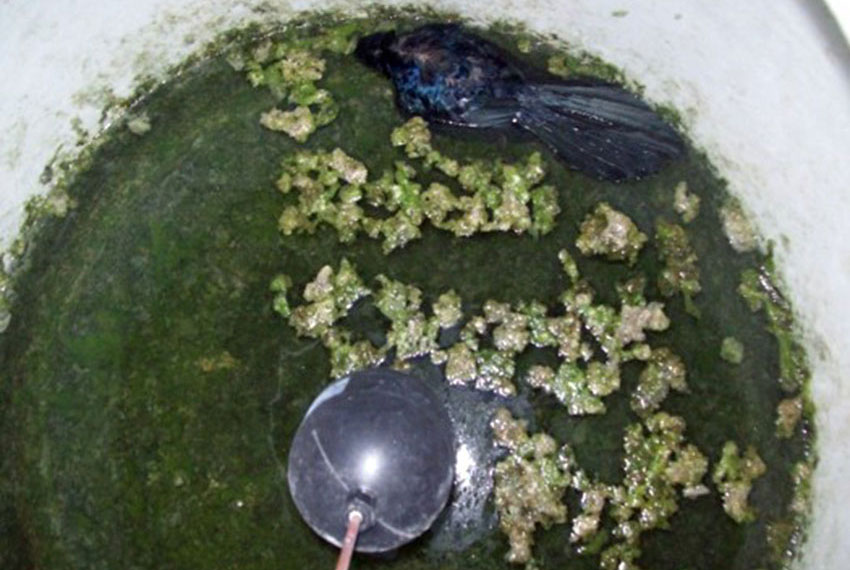
In many cases the tinaco is a breeding ground for germs.
At present, the citizens of most of those municipalities must heed the same advice given to tourists visiting the country: “Don’t drink the water!”
At first glance, one might imagine that this water problem results from contamination at the source, but it does not. Mexican law requires all towns to supply drinkable water. And they do.
The problem develops when the perfectly potable water leaves the purification plant. It runs through water lines which inevitably have cracks. These pipes frequently lie next to sewage pipes, which also have cracks.
While water pressure is constant in many countries, it may often drop to zero in Mexico. Whenever the pressure in the sewer pipes is stronger than the pressure in the water pipes, contamination can result.
The fact that the water may, at times, be reduced or off has forced consumers to install tinacos or other types of reservoirs to assure a constant supply of water. Unfortunately, each reservoir is a sort of giant petri dish in which bacteria such as E. coli can happily multiply.
To the rescue come companies that purify this same tap water — removing all the healthy minerals along with the bacteria, of course — and sell it in big bottles or demijohns called garrafones, which they deliver to the door of every single family and business. In spite of the monetary and environmental costs of this delivery system, Mexico is, per capita, the biggest consumer of bottled water in the world.
Raúl Mejorada of MGB Victoria, left, and Idsart Dijkstra of KWR.
According to the Inter-American Development Bank, the average Mexican drank 480 liters of bottled water in 2011, more than four times the amount drunk by a thirsty citizen of the U.S.
Mejorada has been decrying this sad situation for years, but the story gets worse.
Says Mejorada: “Among the leaky municipal water pipes, the individual pumps to bring it up to every rooftop, the tinaco itself and the jury-rigged patchwork of pipes distributing it throughout the house, a full 50% of the water distributed by Mexican towns and cities simply disappears. Every day half our water is wasted; is literally thrown away!”
No wonder World Resources Institute categorizes Mexico as suffering from High Baseline Water Stress, meaning that the nation consumes between 40% and 80% of the water supply available for a year.
“For more than 25 years,” says Mejorada, “we’ve been studying the water-supply problem in Mexico and comparing it to the systems of more developed countries where potable water is delivered under pressure 24 hours a day, 365 days a year.
“The Netherlands shines in its efficient, innovative approach to finding sustainable sources of water, storing and distributing it using modules which can increase as the city grows. Each of these systems can supply many consumers — 50,000-80,000 — assuring a constant supply of water under pressure.
Telephone and electrical wires will disappear from the typical Mexican skyline.
The Dutch system is simple, economical and efficient, but what is curious is that it is also economically viable and self-financing.
The system employs high-velocity flexible hoses with tube diameters as small as 40 millimeters for what is called a “self-cleaning network.” These tubes, together with hoses for gas and wiring for electricity, telephone, cable TV and internet, are all laid together using trenchless technology, a new way of tunneling without disruption on the surface.
This makes it possible to install utilities under rivers, canals and other obstacles with little or no damage to the environment. It is said that the resulting system is as earthquake-proof as you can get.
According to Mejorada, “Our program begins very simply. We select the best already-existing infrastructure and we concentrate it in locations where it’s easiest to obtain and distribute water. This immediately results in savings that allow us to implement these central systems in less viable and more complicated places.
“After this comes replacement of present-day water pipes and, in the long run, the eventual elimination of tinacos, reservoirs and individual pumps. This was achieved by Spain in the 1950s.”
A collaboration agreement was signed by the municipality, its water utility (SAPAZA) and Mejorada’s firm MGB Victoria, headquartered in Guadalajara. Dutch firms also participating are Eijkelkamp Soil & Water, Dareius and the KWR Foundation, a unique fusion of Dutch companies and a water research institute.
[wpgmza id=”231″]
In addition, the government of the Netherlands will also invest in the project through technology transfer, technical support and infrastructure.
Mejorada estimates the cost of investment in the Ciudad Guzmán project at about 300 million pesos with a return in less than eight years. He expects the project to be completed in about three years.
“Our aim,” says SAPAZA director Alfonso Delgado Briseño, “is soon to provide clean, safe drinking water at the tap 24 hours a day.”
But more than that, the Mexican and Dutch partners hope to turn Ciudad Guzmán into a compelling example for all of Mexico focusing on the sustainable use of water and energy.
[soliloquy id="87551"]
The writer has lived near Guadalajara, Jalisco, for more than 30 years and is the author of A Guide to West Mexico’s Guachimontones and Surrounding Area and co-author of Outdoors in Western Mexico. More of his writing can be found on his website.
Migrants from Africa and Haiti clashed with security forces in Tapachula, Chiapas, this week while protesting to demand transit visas that would allow them to travel to the northern border.
Hundreds of migrants began a protest on Monday outside the Siglo XXI migration station, where they blocked the entry and exit of buses transporting Central Americans on their way to be deported to their countries of origin.
The newspaper El Universal reported that migrants from Ethiopia, Mali, Cameroon, Somalia, Congo, Mauritania, Guinea and Haiti were among those protesting against the government’s decision to cease granting permits. They would allow them to travel to the border with the United States, where they intend to seek asylum.
Permits currently being issued only allow the migrants to stay in Chiapas, where they say there are no employment opportunities.
The newspaper El Financiero said that under current laws, migrants are entitled to receive a 20-day transit visa to travel to the United States but some have been waiting in Tapachula for more than three months without even being able to apply for one.
On Tuesday night, Federal Police officers and members of the National Guard attempted to break up the protest but were met with resistance. Scuffles ensued and four migrants were arrested and taken inside the detention center.
On Wednesday, there was another attempt to break up the protests during which a pregnant African woman fell to the ground and went into convulsions, reportedly due to sunstroke, fatigue and not having eaten. She was assisted by medical personnel from the migration station but lost the baby later, according to the advocacy group Pueblo Sin Fronteras (People Without Borders).
Director Irineo Mújica Arzate claimed there have been acts of repression and violence against the migrants on the part of federal forces.
His organization said in a statement that security forces have turned Tapachula into a “prison city,” conducting raids to hunt down migrants, and committing acts of abuse.
During Wednesday’s eviction attempt, women and children lay on the ground outside the migration station to prevent two police cars and another vehicle from leaving.
When police tried to forcibly remove them, the women fought back and accused the officers of committing acts of violence.
The National Immigration Institute (INM) acknowledged in a Twitter post that there was some “pushing and pulling” in the confrontations between authorities and migrants but asserted that the former had the latter’s safety in mind.
“. . . They were removed so they weren’t run over,” the INM said.
On Thursday, the protest continued and the migrants once again resisted attempts to move them on. At around midday, one migrant fainted and began to convulse, El Financiero said.
The migrants say they will continue to protest until they are issued the visas they seek.
Tens of thousands of migrants have entered Mexico since late last year and subsequently traveled through the country to seek asylum in the United States.
The majority have fled the Northern Triangle Central American countries of Honduras, El Salvador and Guatemala but increasing numbers of people from Africa, Caribbean countries such as Haiti and Cuba, and even Asian nations, have arrived in Mexico with the intention of seeking asylum in the United States.
Several large caravans have traveled to the northern border but migrants’ passage through Mexico has become more difficult as the result of an agreement with the United States.
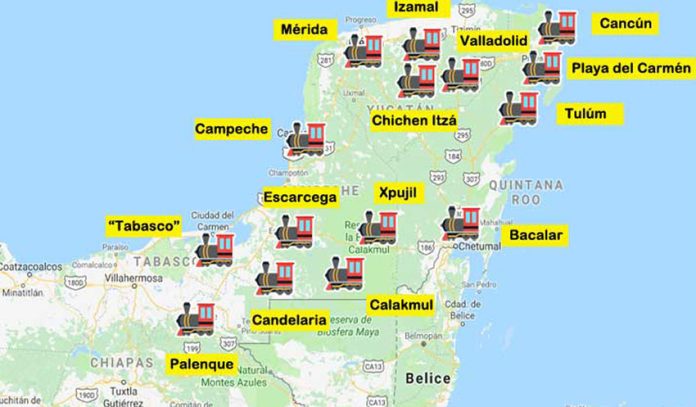
Three new stations will be added to the Maya Train line, the National Tourism Promotion Fund (Fonatur) said Thursday.
To be located in Cancún and Chetumal, Quintana Roo, and El Triunfo, Tabasco, the new stations will bring the line’s total to 18.
The additions will add 24 kilometers to the line, which is now planned to run nearly 1,500 kilometers through five states: Chiapas, Tabasco, Yucatán, Quintana Roo and Campeche.
The new station in Cancún will be located in the city center, providing residents with better access to the line. A station at Cancún’s airport was already planned.
The stations in Chetumal and El Triunfo will provide logistical support to the line.
The results of the project’s first tender were released on August 9 when it was announced that the contract for the train’s basic engineering had been awarded to the consortium comprised of Key Capital, Senermex Engineering and Systems, Daniferro Tools, Geotecnica and Supervisión Técnica.
Environment Secretary Victor Toledo has condemned the murder of biologist Nora López, whose body was found in a hostel in Palenque, Chiapas, on Wednesday.
The Chiapas Attorney General’s Office reported that López had suffered multiple stab wounds.
The environmentalist was working on a scarlet macaw breeding project in the Los Aluxes Park near Palenque.
“Once again the environmental sector is in mourning and joins together with family and friends in grief,” read a post on the Twitter account of the Secretariat of the Environment and Natural Resources (Semarnat).
“We pay homage to the women and men of Mexico who, from different fields, resist with dignity and strength the increasingly intense and powerful attacks that destroy the biological and cultural diversity of the country and the planet.”
The environmental and human rights organization Global Witness reported that 14 land and environmental defenders were murdered in Mexico in 2018.
Such numbers put Mexico at No. 6 on the list of most dangerous countries for environmentalists.
The numbers this year look even worse. Last year’s total of 14 was reached in June.
The Association of Zoos, Breeders, and Aquariums (Azcarm) expressed outrage over the incident and demanded justice.
“We are all profoundly sad, outraged, angry and desperate because we don’t see any level of government taking concrete actions to solve the grave problem of insecurity we are suffering all over the country and the terrible, endless wave of violence against women,” it stated in an open letter.
“Today, our close friend Nora is one more victim of those cruel crimes that do not cease in our country due to the terrible impunity we are suffering and the absolute inefficacy of our authorities to fulfill their obligation to protect our lives and guarantee our security,” it added.
A semi-truck carrying industrial waste lost a race against a freight train on Thursday afternoon in the Mexico City borough of Azcapotzalco.
According to witnesses, the crash happened after the truck attempted to beat the train to a level crossing. After it was struck by the train, the truck collided with a barrier .
The 50-year-old driver of the truck was taken to hospital.
Firefighters and Civil Protection personnel worked for several hours to remove the vehicles and debris and reopen the road.
The truck driver and the train conductor have both been called to testify before federal prosecutors. Mexico City police have opened an investigation into the crimes of aggravated injury and property damage.
A Tulum-based real estate developer will bring the first passenger drone to Mexico before the end of the year.
Nico Wilmes, CEO and co-founder of the company Los Amigos Tulum, told the newspaper El Economista that the plan is to offer scenic flights over the Sian Ka’an biosphere reserve as well as lagoons, cenotes and archaeological ruins located in and around Tulum, Quintana Roo.
“Everyone goes to Tulum for [new] experiences and this will be part of that,” he said.
The flights will take off from the company’s Panoramic residential development, which opened in May, and the Central Park Lagunas development, which is currently under construction and slated to open in 2020. The latter will feature Mexico’s first landing pad for passenger drones.
Wilmes, who moved to Mexico from Germany 10 years ago, said that after he became aware of Chinese passenger drone manufacturer EHang, he went to China to see the unmanned aerial vehicle with his own eyes, take a flight and purchase one.
This Zero Emission Passenger Drone Will Change The World
“. . . We’ve managed to become the first company that will bring this passenger drone to Mexico . . . currently these drones only operate in China and Austria,” he said.
Wilmes explained that the EHang 216 flies autonomously, without the need for a pilot, and uses electrical energy.
“It’s like an electric car and here in Tulum we produce a lot of renewable energy with our solar plants . . .” he said.
The drone is made out of carbon fiber and epoxy, has 16 small motors, supports up to 630 kilograms and can reach speeds of 130 kilometers per hour. It also has built-in safety controls and an automatic landing system.
Ehang says the aircraft is able to take off autonomously, fly a route, sense obstacles and land. If anything goes wrong, a human pilot steps in and takes over the controls from a remote station.
The EHang currently costs around US $340,000 but the company hopes to eventually reduce the price to around $110,000.
“The idea is that in the future [traveling in] this vehicle will be much cheaper than a taxi because in a taxi you pay for gas, the driver and maintenance due to the wear and tear of the car . . .” Wilmes said.
The CEO said that in the future, passenger drones could be a solution to traffic congestion in Mexico’s large cities.
To that end, Wilmes plans to visit several cities around the country in 2020 to talk about the viability of introducing passenger drones.
“We want to show that the Chinese are already flying [in passenger drones], that this is a reality. We’re committed to teaching about it and it will be up to Mexicans to decide what they will do with this technology . . . With a long-term vision and a lot of innovation, it will have a productive and positive impact,” he said.
Loggers will plant trees instead of cutting them down.
Two men who were caught illegally cutting down trees in Chiapas will be required to plant 3,000 new trees and clean up a river as a result of a novel approach to what was described as ecocide.
The two men were apprehended cutting down cedar trees without permission on a property near the city of Tonalá on May 29. Police confiscated a chainsaw, two containers of gasoline and a Ford pickup truck.
At a court hearing where the two men were facing charges of ecocide, their defense presented a reparations plan and asked for the charges to be conditionally suspended, which the Chiapas Attorney General’s Office (FGE) accepted.
Under the plan, the defendants will plant 3,000 kapok trees in the municipality of Tonalá and clean up the area around the Zanatenco river.
Their prosecution will be suspended for six months, during which time the defendants will be required to present status reports every two months.
The agreement is the first reparations plan approved by the FGE. Chiapas authorities say they have restored over 23,000 hectares of protected areas since mid-March.