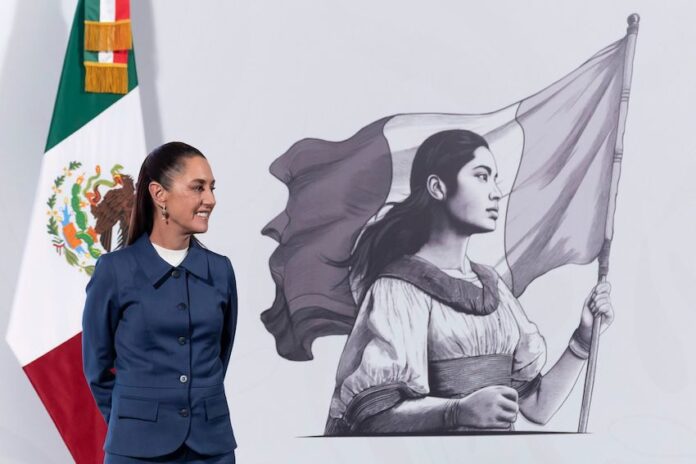
Sheinbaum rejected and then deflected a question from a reporter about whether she is "scared" of cartels. (Mario Jasso/Cuartoscuro)
At her Wednesday morning press conference, President Claudia Sheinbaum defended herself against a defamatory remark made by U.S. President Donald Trump.
She also spoke about her news consumption habits and a national pact that puts a cap on petrol prices.
The president had to defend herself against another claim by Trump that Mexico is “run by cartels” and “she’s very scared.” (Mario Jasso/Cuartoscuro)
Here is a recap of the president’s Sept. 3 mañanera.
Sheinbaum once again rejects Trump’s claim that she is ‘scared’ of drug cartels
A reporter noted that Trump claimed, once again, that Sheinbaum is “scared” of Mexico’s drug cartels.
“So I like the president very much. I think she’s a terrific woman. She’s actually an amazing woman in some, in certain ways, very elegant, beautiful. But Mexico is run by the cartels. It’s run by the cartels. … I’ve offered to send in the military, and she doesn’t want us to do that because she’s scared, she’s very scared,” the U.S. president said.
“We very much respect the Mexico-United States relationship and President Trump,” she continued, before deciding to change course and offer a public rejection of the U.S. president’s claim.
“This assertion he makes is not true, but we will maintain a good relationship,” Sheinbaum said.
She subsequently thanked Trump for the nice things he said about her in his interview with The Daily Caller this week.
Sheinbaum — ‘A voracious and critical consumer of information’
A reporter noted that the head of the federal government’s Digital Transformation Agency, José “Pepe” Merino, described the president as “a voracious and critical consumer of information.”
She asked Sheinbaum about Merino’s comment and how she keeps up to date with the news.
Sheinbaum said that three times a day she receives a “summary of what appears in the media, what appears on social media and what some [of Mexico’s political] commentators are saying.”
“I get it three times a day,” she stressed.
The president reading her thrice-daily news roundup. (claudia_shein/Instagram)
Sheinbaum said she also checks social media on her phone at around midday, after a quick post-mañanera breakfast and various meetings.
She subsequently reminded reporters that she devoted a lot of her career to “numbers.”
“I studied physics and then I studied energy engineering. And I was a UNAM professor and researcher for 20 years, with periods in which I also worked in government,” Sheinbaum said, referring to her academic career at the National Autonomous University of Mexico.
“So my mind is accustomed to making a quick analysis of numbers. So I’m very critical when a graph is presented to me. … Maybe that’s what Pepe was referring to,” she said.
Gasoline price cap deal renewed
Sheinbaum confirmed that an agreement between the government and gas station owners to cap the price of regular gasoline (Magna) at no more than 24 pesos has been renewed.
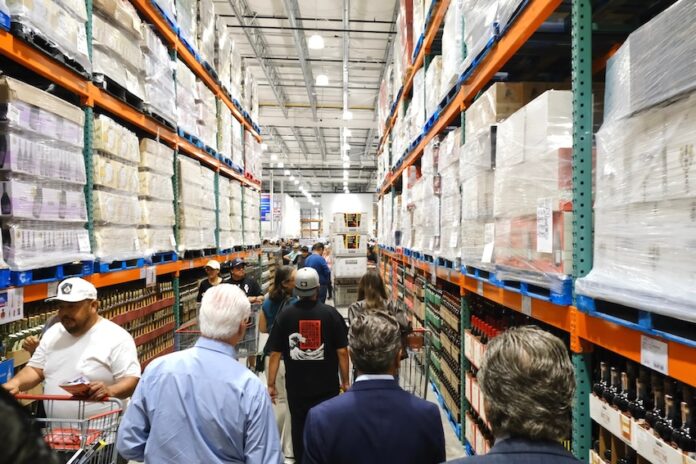
Costco is nearing completion of what it says will be its largest store in Latin America, even bigger than its store in Santa Fe, Mexico City. (Pablo Lemus/Facebook)
Costco is nearing completion of what it says will be its largest store in Latin America, occupying seven hectares in the municipality of Escobedo, part of the greater metropolitan area of Monterrey, capital of the northern state of Nuevo León.
After an estimated investment of US $100 million, the branch is scheduled to open in May 2026 in the La Encomienda neighborhood of Escobedo. It will feature 20,000 square meters of construction space, including a sales floor of 15,000 square meters that will display more than 5,000 products.
The parking lot will have capacity for more than 700 spaces across 35,000 square meters, and will house the country’s largest Costco gas station, equipped with 30 gas pumps. The gas station will also be the company’s first in Nuevo León.
The new branch will feature a Sushi Room, as well as such Costco standbys as a pharmacy, optician, hearing center and tire center.
Escobedo Mayor Andrés Mijes told Forbes that the project is aligned with President Claudia Sheinbaum’s Plan México.
“This development not only creates jobs, it also stimulates our local economy,” Mijes said. “We want the entire Monterrey Metropolitan Area to be proud of having the largest store in Latin America here.”
According to officials, Costco’s largest branch is set to create 350 direct jobs and 1,500 indirect jobs, with the potential to exceed 3,000 jobs when factoring in the impact on transportation, supplies, and local businesses.
Costco executive Moisés Sáenz noted that the support from the local government was crucial in bringing the project to fruition.
“From the very beginning, we found a supportive government,” Saenz said. “They supported us with permits and project design to ensure we complied with all regulations.”
Beyond the economic benefits, local media has reported that the project could lead to improvements in urban infrastructure, such as road rehabilitation, expansion of public services and increased security.
Furthermore, its location near the Laredo Highway places the branch at a strategic logistical connection point, allowing quick access to industrial corridors, key highways and the United States border.
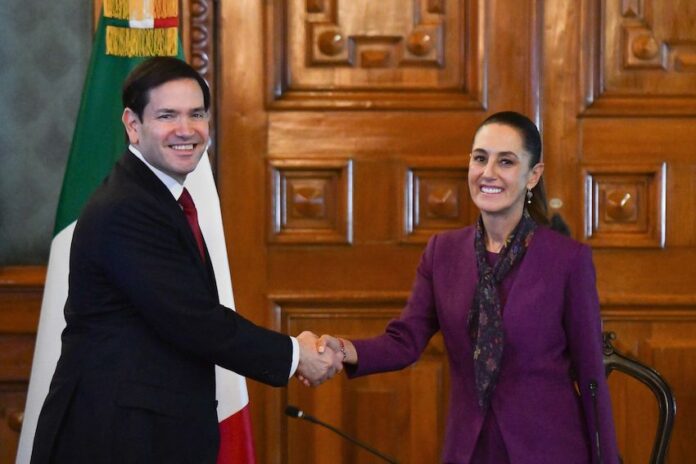
"I think that much credit is really deserved to President Sheinbaum and her administration in really taking things on that had not been taken on for a very long time," Rubio said on Wednesday, referring to the Mexican government's efforts to combat cartels and drug trafficking. (Mario Jasso/Cuartoscuro)
United States Secretary of State Marco Rubio said Wednesday that the U.S. and Mexico are “amplifying” their security cooperation as the two countries seek to combat organized crime groups and the narcotics they traffic on both sides of the border and around the world.
Speaking alongside Mexican Foreign Affairs Minister Juan Ramón de la Fuente at a press conference in Mexico City after a meeting with President Claudia Sheinbaum, Rubio also said that the current security cooperation between the United States and Mexico is the “closest … we have ever had, maybe with any country.”
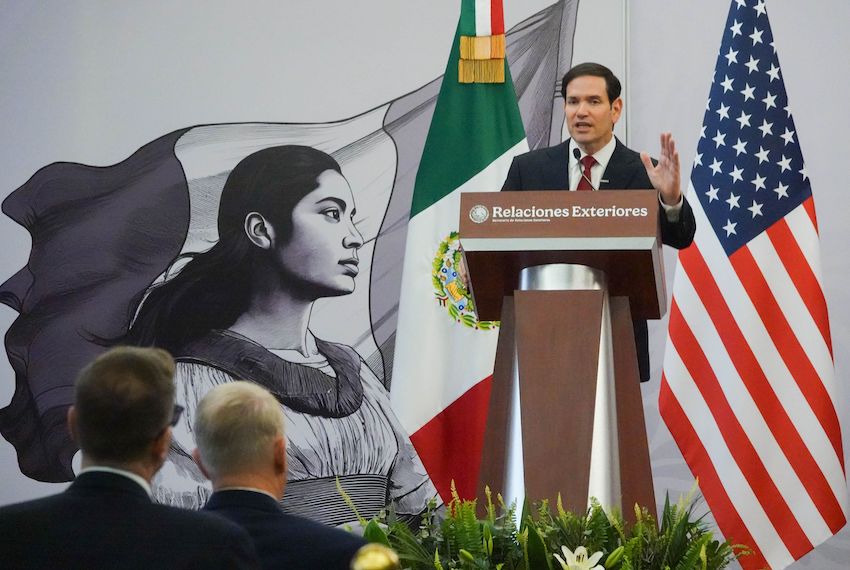
During a press conference at the Ministry of Foreign Affairs, Secretary of State Rubio was complimentary of Sheinbaum and optimistic about the prospective security cooperation between the United States and Mexico. (Galo Cañas/Cuartoscuro)
His remarks came after de la Fuente read out a “joint statement on security cooperation” that highlighted that the Mexican and U.S. governments have “established a high-level implementation group to meet regularly and follow up on mutual commitments and actions taken within their own countries.”
The establishment of that group is the main new development in the Mexico-U.S. security relationship.
Rubio: ‘We’ve always cooperated … we’re talking about amplifying that’
During a press conference at the Ministry of Foreign Affairs, Rubio, the son of Cuban immigrants, switched between Spanish and English in his opening remarks and in response to questions from reporters.
Asked what the “ideal scenario” would be for security cooperation between the United States and Mexico, the secretary of state first stressed that the two countries have “always cooperated.”
“There’s always been law enforcement cooperation. We’re talking about amplifying that, we have already started to do it,” Rubio said.
“This is a great example — let’s say there is a gun-running group that is coming out of the United States headed into Mexico, we identify it [but] we don’t get there in time to stop it. “We pass that [information] onto the Mexican authorities who can act,” he said.
“Likewise, they can identify a drug shipment that’s headed our way, maybe it got past their systems but now is in the United States and we can act on it,” Rubio said.
LIVE: US Secretary of State Rubio speaks to press ahead of meeting with Mexican leaders
He also said “there are opportunities to cooperate on equipment,” explaining that Mexico may have an interest in purchasing some U.S. equipment and vice versa.
Rubio said that bilateral security cooperation “also has to do with joint training.”
“Maybe there are things they [Mexico] do operationally that they have learned from their time taking on the cartels that would serve us on our side of the border, or vice versa things that we have learned from a training standpoint that they would benefit from,” he said.
“That’s the kind of cooperation we’re going to amplify on and operate together on, and I think it’s very valuable. That’s always existed at a certain level. What we’re talking about now is formalizing it, systemizing it, making it a regular ongoing feature of broader cooperation on an issue of mutual concern,” Rubio said.
‘The aim is to work together to dismantle transnational organized crime’
“The Governments of Mexico and the United States reaffirm our security cooperation, which is based on the principles of reciprocity, respect for sovereignty and territorial integrity, shared and differentiated responsibility, as well as mutual trust,” the statement says.
“The aim is to work together to dismantle transnational organized crime through enhanced cooperation between our respective national security and law enforcement institutions and judicial authorities. Additionally, we are working to address the illegal movement of people across the border. This cooperation through specific and immediate actions will strengthen the security along our shared border, halt the trafficking of fentanyl and other illicit drugs, and stop arms trafficking,” the statement continues.
The Mexican and U.S. governments also said that they have “established a high-level implementation group to meet regularly and follow up on mutual commitments and actions taken within their own countries, including measures to”:
“Counter the cartels
Strengthen border security and eliminate clandestine border tunnels
Address illicit financial flows
Enhance collaboration to prevent fuel theft
Increase inspections, investigations, and prosecutions to stop the flow of drugs and arms.”
The statement said that “close coordination” between the Mexican and U.S. governments “has allowed us to secure the border, reduce fentanyl trafficking, and advance intelligence sharing, all within our respective legal frameworks.”
“The two governments further intend to strengthen collaboration in public health and coordinate campaigns to prevent the abuse of illicit substances and opioids. Both governments reaffirm their determination to cooperate, protect our citizens, and make our communities safer,” it concluded.
In a brief statement on social media, Sheinbaum said that the Mexican and U.S. governments, after “several months of work,” had agreed to a “cooperation program on border security and law enforcement” — what she previously referred to as a new security agreement and a new security “understanding,” creating the impression that a more substantial pact was to be announced during Rubio’s visit.
She said the “program” is based on the principles mentioned in the joint statement, namely reciprocity, respect for sovereignty and territorial integrity, shared and differentiated responsibility and mutual trust.
‘An excellent meeting with President Sheinbaum’
In his opening remarks at his press conference with de la Fuente, Rubio said that he had “an excellent meeting with President Sheinbaum” and Mexico’s foreign minister.
“We’ve had a great relationship with the government of Mexico during the eight months of the Trump presidency,” said Secretary of State Marco Rubio from Mexico on Wednesday. (Mario Jasso/Cuartoscuro)
“In fact, we’ve had a great relationship with the government of Mexico during the eight months of the Trump presidency. It is the closest security cooperation we have ever had, maybe with any country, but certainly in the history of U.S.-Mexico relations,” he said.
He noted that Mexico has recently sent 55 cartel figures to the United States to face U.S. criminal charges, and highlighted that “the migration numbers today at the U.S. southern border are the lowest they have ever been” due to the “efforts” of both the Trump and Sheinbaum administrations.
Rubio also said that the establishment of the “high-level implementation group” consisting of U.S. and Mexican officials “means a lot.”
“This is a high-level group that will meet and coordinate on a regular basis to make sure that all the things we are working on, all the things we have agreed to work on, are happening, are being implemented,” he said.
For his part, De la Fuente said that Rubio’s presence in Mexico “ratifies the good relationship and the great collaboration that exists” between Mexico and the U.S. and which “will continue in the coming months and years.”
He said that Mexico and the United States had reached “a very good understanding to give shape and continuity to a program of cooperation.”
Rubio: ‘The president of the United States is going to wage war on narco-terrorist organizations’
“The United States has long … established intelligence that allows us to interdict and stop drug boats and we did that and it doesn’t work. Interdiction doesn’t work because these drug cartels what they do is that they know they’re going to lose 2% of their cargo and they bake it into their economics. What will stop them is when you blow them up, when you get rid of them. So they were designated as what they are; they are narco-terrorist organizations. … The president of the United States is going to wage war on narco-terrorist organizations. This one was operating in international waters headed toward the United States to flood our country with poison and under President Trump those days are over.”
While Rubio said that Trump will “wage war” on such organizations, a U.S. military attack targeting Mexican drug cartels on Mexican soil doesn’t appear likely to occur any time soon. The “respect for sovereignty” principle mentioned in the joint statement issued by the Mexican and U.S. governments on Wednesday would be broken if the U.S. acted unilaterally against Mexican cartels in Mexico, as Sheinbaum is vehemently opposed to any kind of U.S. intervention.
Rubio commits US to stopping flow of weapons to Mexico
Rubio also said that as part of the U.S.-Mexico “security plan,” the U.S. government will “stop the flow of armaments” to Mexico and other Western Hemisphere countries.
“And it’s not just Mexico, by the way. Those arms are flowing to Haiti, they’re flowing to Jamaica, they’re flowing to Trinidad, they’re flowing into the Caribbean and we’re going to put a stop to it. That is part of our implementation plan,” he said.
The Mexican government has long called on the United States to do more to stop the flow of firearms to Mexico, where they are used by cartel members and other criminals to commit crimes, including murder.
Will the United States’ ‘fentanyl tariffs’ on Mexican imports be lifted?
A reporter asked Rubio whether the announcement on Wednesday of the bilateral security “cooperation agreement” would result in the U.S. government removing the 25% “fentanyl tariff” on Mexican goods that don’t comply with the USMCA free trade pact.
The tariff took effect in early March due to what the White House said was a failure by Mexico to take adequate action against “the influx of lethal drugs” to the U.S.
Rubio noted that he doesn’t negotiate trade agreements, but said he would “certainly go back” to the United States and make other U.S. officials aware of “the level of cooperation that exists with regard to security.”
“We’ve made tremendous progress and obviously I know even as I speak to you today the economic team from Mexico is in Washington meeting with [U.S. Trade Representative] Ambassador Greer and also meeting with Commerce Secretary Lutnick. … Obviously we hope that will come to some positive result at some point soon because our economic relations are very important and we have a lot to build on with the successes of the USMCA,” he said.
By Mexico News Daily chief staff writer Peter Davies (peter.davies@mexiconewsdaily.com)
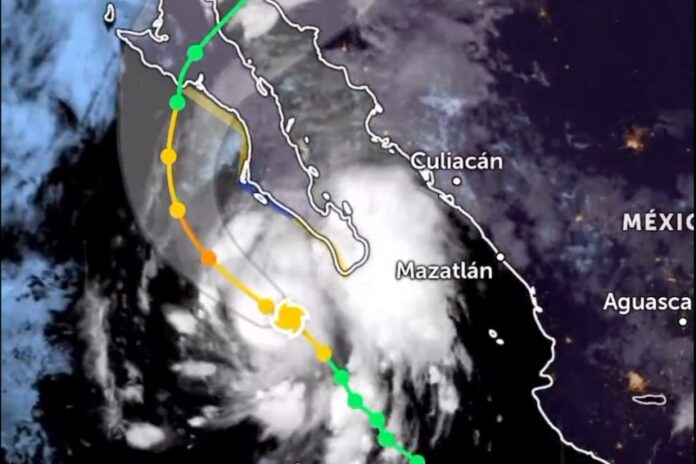
Hurricane Lorena threatens to dump even more rain on Baja California Sur and nearby states as it approaches the peninsula. (Conagua)
Tropical storm Lorena strengthened into a Category 1 hurricane early Wednesday morning, threatening Los Cabos and much of northwest Mexico with torrential rains, strong winds and high waves.
At 3 p.m. on Wednesday, the hurricane was located 255 km west of Cabo San Lucas and 285 km west of Cabo San Lázaro, Baja California Sur. The National Water Commission (Conagua) reported that it was moving northwest at a speed of 24 kilometers per hour, with wind gusts of up to 160 kilometers per hour (93 mph).
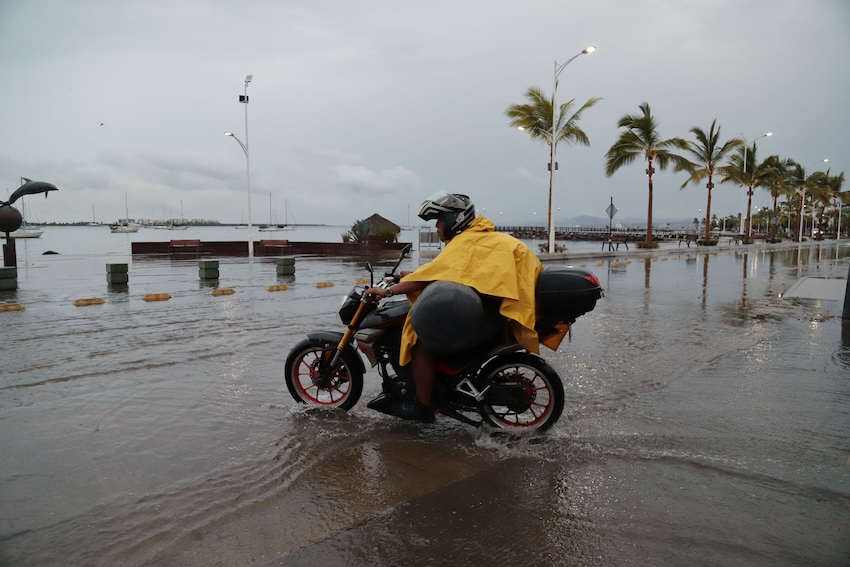
La Paz, the capital of Baja California Sur, was already experiencing torrential rains from Hurricane Lorena on Wednesday. (Gabriel Laros Herredia/Cuartoscuro)
Heavy rains of 75 to 150 millimeters (3 to 6 inches) are expected in the central and southern regions of Baja California Sur and Sonora, as well as Sinaloa. Baja California, Nayarit and Jalisco will also experience heavy rainfall.
Local authorities in Los Cabos ordered all schools to close on Wednesday as a preventive measure to protect the safety of students, teachers and administrative staff, minimizing risks associated with traveling to campus.
The official forecast predicts that Lorena could intensify into a Category 2 hurricane and make landfall Friday morning in western Baja California Sur, then cross the Baja California Peninsula and reach the coast of Sonora on Saturday, near Guaymas.
However, the U.S. National Hurricane Center is also considering scenarios in which the system could remain in the Pacific Ocean for a longer period. Thus, potential changes in its path and intensity cannot be ruled out.
Authorities have called on residents to remain informed and closely monitor official advisories. They’ve also warned that the expected rainfall may bring lightning and hail, potentially leading to flooding and mudslides. The forecasted winds could also knock down trees and billboards.
In September 2019, another hurricane named Lorena hit near Los Cabos as a Category 1, primarily causing damage to rural areas, roads, and substandard housing, as well as power outages. Its impact on urban areas was less severe.
Virtually any resident of Mexico City will attest that the cost of living has increased significantly in recent years. So, how much are people actually living on? (Cuartoscuro)
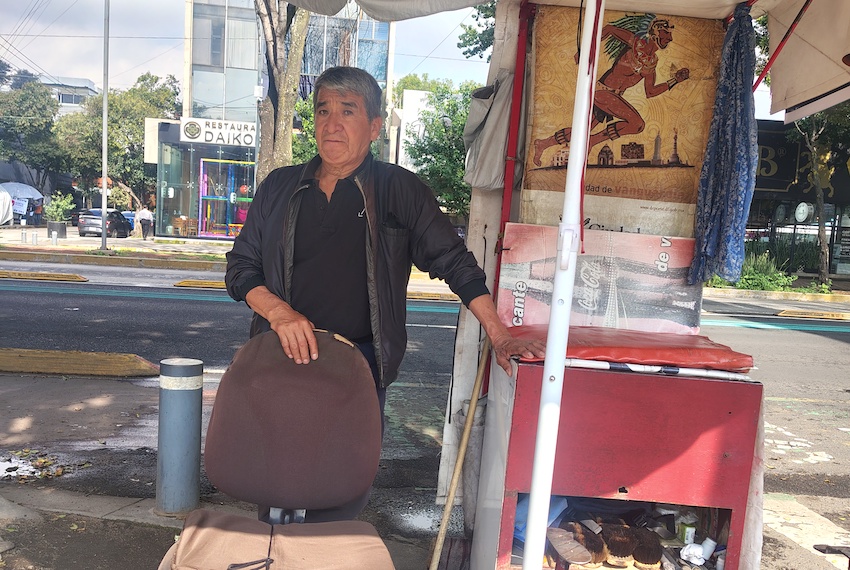
It’s just after 9 a.m. on a Friday morning and a seasoned shoeshiner is standing next to his stand on Mexico City’s Insurgentes Avenue, waiting for a customer.
His small business, which he has run as a sole proprietor for 25 years, is doing well “gracias a Dios” (thank God), he tells Mexico News Daily, using an expression that is ubiquitous in conversations across the country.
Luis has run a shoeshining business for 25 years and brings home between 500 and 1,000 pesos per day. (Peter Davies)
Luis says that his earnings are variable, but he generally takes home between 500 and 1,000 pesos (US $27-54) per day.
If he were to work every day of the month, and consistently earn the higher daily amount he cited, Luis’s take-home pay (excluding his business expenses) would just exceed the 29,500-peso (US $1,580) amount that, on average, Mexico City residents say they need to cover their monthly expenses, according to the 2023 National Financial Health Survey.
For many other workers who labor in the vast informal economy in Mexico City — and in formal sector positions as well — their salaries don’t even come close to that amount, leaving them struggling to get by in a city that, in recent years, has become a significantly more expensive place to live.
An improving landscape for Mexican workers
There have been some positive changes for Mexican workers in recent years.
During former president Andrés Manuel López Obrador’s six-year term, the percentage of Mexicans classed as “the working poor” also declined, falling to its lowest level on record last year.
In light of this slew of good news stories, Mexico News Daily hit the streets of Mexico City to ask workers about their jobs, their salaries and their capacity to cover the cost of living in the capital. This article focuses on low-paid workers in the formal and informal sectors of the economy. Future articles will consider the situations of higher-paid workers.
The minimum wage is up, but making ends meet is still tough for low-paid workers
As the minimum wage increased in Mexico in recent years, so did consumer prices.
Rents — which eat up a substantial portion of many workers’ salaries — have risen in Mexico City and other parts of the country in recent years, forcing some residents of the capital to relocate to more affordable, less central areas.
Indeed, virtually any resident of Mexico City will attest that the cost of living has increased significantly in recent years. Across Mexico, the majority of people — almost 84 million — don’t earn enough to pay for all of their basic needs, including food, housing, education and transport, according to a recent study by the think tank México ¿cómo vamos?
Below you will find a series of snapshots of the situations of low-paid workers in Mexico City, who feel the cost-of-living pressures as acutely as anyone.
Most of the workers Mexico News Daily spoke to for this article earn less than the average daily base salary of a formal sector worker, which was 614.3 pesos (US $33) at the end of July. The daily minimum wage in most of the country is set at 278.80 pesos.
On Félix Cuevas Avenue in the Del Valle neighborhood of Mexico City, an elderly vendor of alegría (bars of amaranth topped with nuts and raisins) told Mexico News Daily that he is paid 1,000 pesos (US $54) per week by his patrón (boss), who supplies him with his product.
He described the amount — which equates to a daily rate well below the minimum wage — as “very little.”
As a senior, the vendor — who has been selling alegría (literally happiness) for 15 years — is eligible for Mexico’s old-age pension of 6,200 pesos (US $332) every two months.
However, even when adding his meager wage and his pension together, the monthly total is below the minimum wage, which is 8,364 pesos (US $447) per month in most of the country, including Mexico City.
The security guard
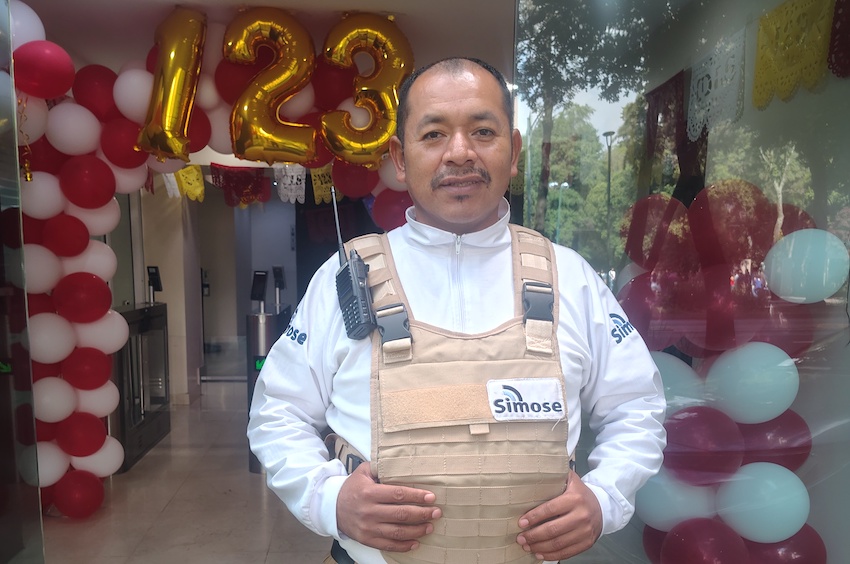
Outside a Montepío Luz Saviñón pawn shop on Insurgentes Sur (the southern section of Insurgentes Avenue), a security guard told MND that he takes home 4,500 pesos per quinceña, a period of 15 days.
Jorge’s salary — 9,000 pesos (US $482) per month — is slightly above the monthly minimum wage. (Peter Davies)
His salary — 9,000 pesos (US $482) per month — is slightly above the monthly minimum wage.
Jorge, who is employed by the private security company Simose, said that his salary has gone up thanks to the increases to the minimum wage in recent years, but is still “not enough,” especially considering he has a family to support.
Nevertheless, Jorge said he is grateful that he has a stable job with benefits, including medical insurance and an end-of-year bonus. He also said he is happy with what the current and former federal governments have done for workers.
Jorge also told MND that he likes his job, and — knock on wood — hasn’t had any major security problems to deal with.
The newspaper vendor
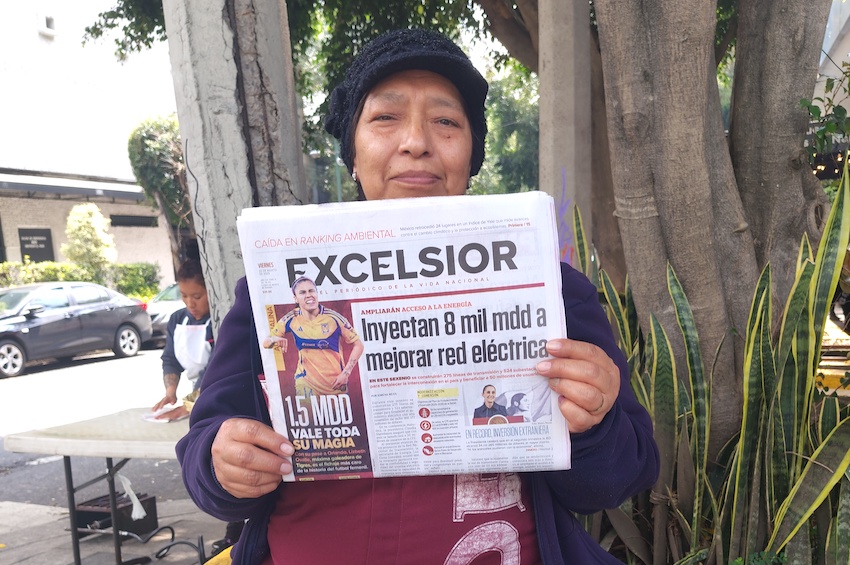
Further along Insurgentes, Mexico News Daily met 61-year-old Elpidía Juárez, who for the past seven years has been selling newspapers to passing pedestrians and motorists for Excélsior, the self-described “newspaper of national life.”
She said she earns 294 pesos (about US $16) a day, an amount slightly above the minimum wage and almost triple the 100 pesos per day she was paid when she first started with Excélsior in 2018.
Thanks to the annual increases to the minimum wage, Elpidía has seen firsthand the changes to her monthly income during her employment with the newspaper.
Juárez said she is paid weekly, taking home 1,470 pesos (US $79) for a five-day workweek. She said that her wage isn’t dependent on the number of newspapers she sells, and explained that she can return any unsold copies to Excélsior without incurring any penalty.
Elpidía earned 100 pesos per day when she first started with Excélsior in 2018. Now she earns around 300 pesos per day. (Peter Davies)
Juárez said she enjoys full benefits in her job, and noted that she has applied to receive the federal government’s “well-being” pension for women aged 60 to 64. Women aged 63 and 64 are already receiving a 3,000-peso (US $160) payment every two months and the scheme will be extended to younger sexagenarians soon.
Juárez, who agreed that the cost of living has increased significantly, said that the pension payment will help her and her husband cover their monthly expenses, including 6,000 pesos (US $320) rent for their apartment near Plaza Garibaldi, the square in the historic center of Mexico City where mariachi musicians entertain revelers around the clock.
The car washer
Luis, the second person of that name MND met on a recent Friday, washes and details cars at a Cadillac dealership on Insurgentes Sur. He said he has been in the job for six months and is paid around 4,000 pesos (US $214) per quincena, an amount more or less in line with the minimum wage.
Luis, who works eight hours a day six days a week, said he is happy with his current wage, although he admitted that it doesn’t go very far.
He expressed optimism that he could get a raise if he continues to work hard.
The pharmacy employee
Outside a Farmacias Similares drugstore on Insurgentes Sur, MND spoke to Ángeles, who in the absence of Dr. Simi himself was doing her best to promote the pharmacy and lure customers in to make a purchase.
She said that she works five days a week and takes home between 3,000 and 4,000 pesos (US $160-$214) per quincena depending on her hours. She also receives benefits.
Ángeles said that she has benefited from the increase in the minimum wage, but still finds it difficult to cover her expenses each month.
The Herbalife worker
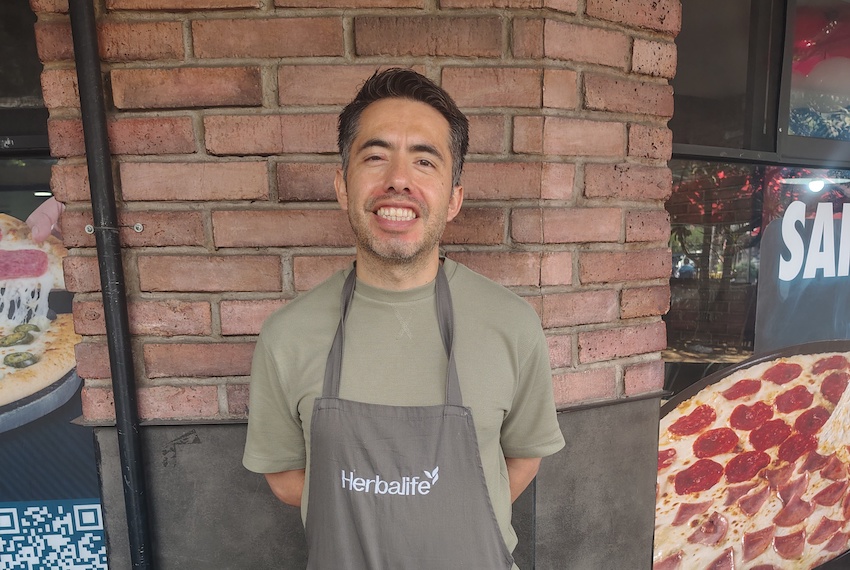
Juan Hurtado is 40 years old and has worked for 10 years at a Herbalife store located near Insurgentes Sur.
He told MND that he takes home 10,000 pesos (US $535) per month, but noted that he only works five hours a day five days a week, which works out to just over half the standard 48-hour workweek in Mexico. He also receives benefits as part of his formal sector employment package.
Hurtado said that 10,000 pesos per month wouldn’t be enough to live on if he were to live alone. Consequently, he shares an apartment with his brother not too far from where he works.
Juan Hurtado, 40, takes home 10,000 pesos per month at his part-time job. (Peter Davies)
Hurtado also said that he is always thinking about and looking for ways he can increase his income. He currently sells dietary supplements and health food products as a side gig, sometimes even personally delivering the goods to his customers’ homes.
The Pemex attendant
Mexico News Daily visited a Pemex gas station on the corner of Insurgentes Sur and División del Norte Avenue, where a young man was working his fourth shift pumping gas.
He and two of his colleagues told Mexico News Daily that their income comes solely from the tips they receive from motorists.
“You do very well, I didn’t know that,” the young man said, explaining that he had earned between 500 and 800 (US $27-$43) pesos per day in his admittedly short career so far as a Pemex gas station attendant.
While such amounts are well above the minimum wage, an income that is solely dependent on tips is, because of its very nature, unreliable and inconsistent.
Nevertheless, the worker MND spoke to was happy with his lot, and happy to talk — until a superior told him it was time to get back to work.
NOTE:
* Salaries, of course, are variable, and two people doing the same job aren’t necessarily paid the same salary.
Ever wondered how much the person who sells you beer in OXXO earns? Or how much your Uber driver takes home?
Mexico News Daily has compiled salary data for 10 different jobs from the employment website Indeed. The amounts listed are average monthly salaries, and apply to Mexico City rather than the country as a whole in some cases.
The earnings of workers in many positions can vary considerably due to a range of factors, including their location in Mexico and the number of hours they work. The salaries listed below are intended to be a guide rather than a precise tabulation.
A supermarket cashier earns around 4,900 pesos per month (US $262).
An OXXO store assistant earns around 7,700 pesos (US $412). (As this OXXO worker explains, employees’ earnings can increase thanks to bonuses and other incentives.)
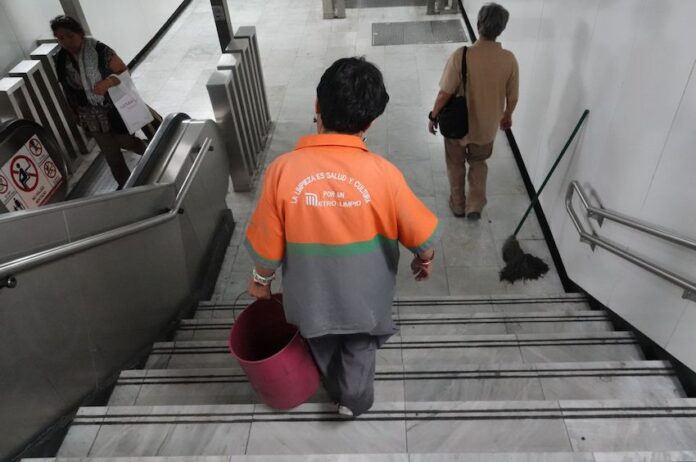
A cleaner earns around 7,850 pesos (US $420)
A gardener earns 8,040 pesos (US $430) in Mexico City.
A waiter earns around 8,500 pesos (US $455), excluding tips.
A domestic worker earns about 9,850 pesos (US $527) in Mexico City. (Such workers are supposed to be registered in social security by their employers, but many are not.)
A hotel receptionist earns about 10,350 pesos (US $553).
A taquero (taco cook and/or vendor) earns about 10,700 pesos (US $572) in Mexico City.
An albañil (construction worker/bricklayer) earns about 10,900 pesos (US $583).
By Mexico News Daily chief staff writer Peter Davies (peter.davies@mexiconewsdaily.com)
Hossein Nabor Guillén, shown here as mayor of Tixtla, Guerrero in 2016, was shot to death Tuesday while driving on the Chilpancingo-Tlapa highway. (José Hernández/Cuartoscuro.com)
A deputy minister in the Guerrero state government was murdered on Tuesday while traveling on a highway near Chilpancingo, the state capital.
Hossein Nabor Guillén, deputy welfare minister for social policy in the government of Governor Evelyn Salgado, was shot and killed by unidentified gunmen while driving on the Chilpancingo-Tlapa highway in the municipality of Tixtla.
Nabor was serving as deputy welfare minister for social policy in the Guerrero state government of Gov. Evelyn Salgado at the time of his death. (@QueCosaNoticias/on X)
The Guerrero Attorney General’s Office said on social media that it is investigating the crime, but didn’t provide additional details. The motive for the attack was not immediately clear.
The murder reportedly occurred at around 6:45 p.m. on Tuesday near a car dealership and pozole restaurant in the town of Tixtla, located around 17 kilometers east of Chilpancingo.
Nabor, mayor of Tixtla between 2015 and 2018, began his tenure as deputy welfare minister when Salgado took office in late 2021. He left the position last year to contest the state election as a candidate for deputy for the Morena party, but returned to the job in February.
“His passing leaves a great void in our hearts,” she wrote. “Hossein was a man committed to the causes of the people, generous, supportive, and always willing to serve others. His memory will live on forever among those of us who had the privilege of walking by his side. Rest in peace,”
Nabor was reportedly close to Salgado’s father, federal Senator Félix Salgado, who backed the now-deceased official’s candidacy in the 2024 state election in Guerrero. The deputy welfare minister was aiming to represent Tixtla in the state Congress, but lost the election on June 2, 2024.
A controversial photo
Nabor’s main rival for the Tixtla deputy position was Jorge Iván Ortega, now a state lawmaker who represents the Democratic Revolution Party (PRD). Nabor was a member of the PRD before switching his allegiance to Morena, the party founded by former president Andrés Manuel López Obrador.
Ortega is the nephew of Celso Ortega, identified as the leader of the criminal group Los Ardillos, which “dominates criminal action in the central region of Guerrero,” according to the Reforma newspaper.
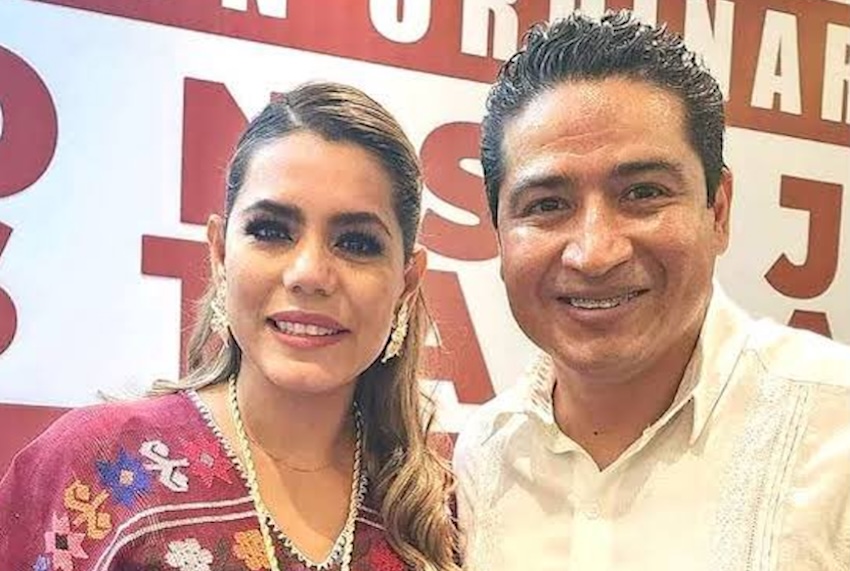
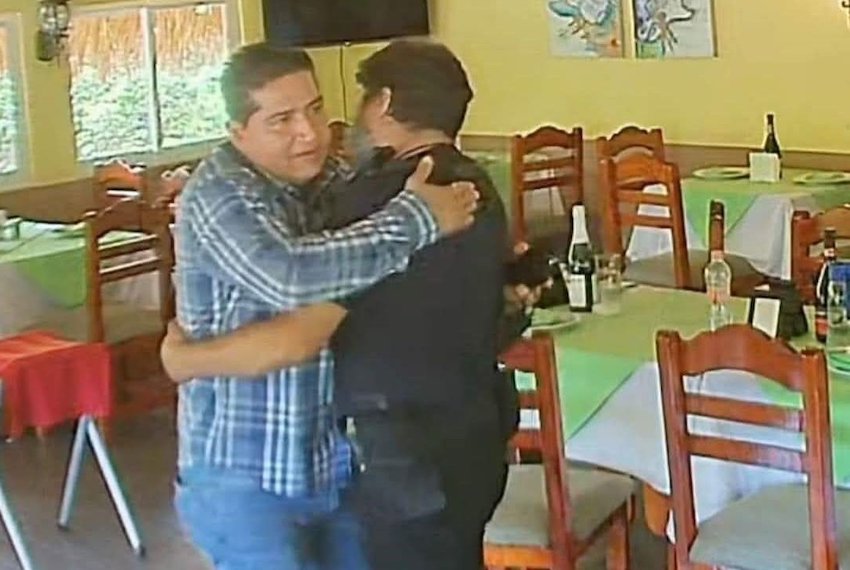
In May 2024, during the campaign period leading up to the election, a photo emerged of Nabor and Celso Ortega sharing a hug in a Chilpancingo restaurant. Former Chilpancingo mayor Norma Otilia Hernández Martínez was expelled from the Morena party after it came to light that she had met with Celso Ortega, but Nabor didn’t suffer the same fate.
According to the newspaper La Jornada, Nabor was accused of allowing Los Ardillos to operate in and around Tixtla when he was mayor of the municipality.
Nabor shared a hug with cartel leader Celso Ortega in a photo that caused controversy when it became public in 2024, but led to no consequences for Nabor. (@PandaDelAmor19/X)
Since Salgado became governor in October 2021, four mayors, one mayor-elect and seven former mayors have been murdered in Guerrero, the El Universal newspaper reported.
Among those killed was Alejandro Arcos Catalán, who was murdered last October just six days after he took office as the mayor of Chilpancingo.
Galindo’s 1999 illustration, “4th of July from the south border." (Feggo)
Mexican-American cartoonist Felipe Galindo — known professionally as Feggo — is at the center of a growing storm over artistic freedom and government censorship after his work was singled out by the Trump administration as objectionable in a directive targeting Smithsonian museums.
Galindo’s 1999 illustration, “4th of July from the south border,” became a flashpoint when it appeared on a recent White House list of artworks being criticized for allegedly promoting, among other things: open borders, the concept of white privilege, a wide range of sexual identities, anti-American sentiment and too much focus on slavery in the history of the U.S.
Reacting from Manhattan, New York — where the 68-year-old native of Cuernavaca, Morelos, has lived for over four decades — the multiple-award-winning Galindo, whose work has appeared in The New Yorker and other publications, voiced alarm over censorship.
“More than fear, I feel sadness and anger, because what the Trump administration is doing is censorship and against freedom of expression,” Galindo said in an interview with the Mexican news magazine Proceso.
“This administration is racist. Even Trump said it at one point: ‘Why aren’t people from Norway coming here?’ He’s like that, absurd and racist. This administration is against anything that shows empathy and/or generosity toward Latin American immigrants and what everyone who seeks a ‘dream’ of a better life in this country experiences, the vast majority of whom work and contribute.”
On his website, Galindo has posted an explanatory letter in English. “Dear Friends and Amigos,” he wrote, “MAGA censorship is hitting home!” He also posted it on his Instagram account.
He said critics of the work, including The Federalist, a conservative publication, stated that the image is “promoting open borders by depicting migrants watching fireworks through an opening in the US-Mexico border wall.”
The illustration — which has been widely published and exhibited in both the U.S. and internationally over the past 26 years, and was recently displayed at the Smithsonian’s American History Museum in Washington, D.C. — is part of Galindo’s series “Manhatitlan: Mexican and American Cultures Intertwined.”
“It has received awards and it’s in many private and public collections, including the Library of Congress,” he added. “I am very proud of this work. I’m also a proud Mexican and American citizen.”
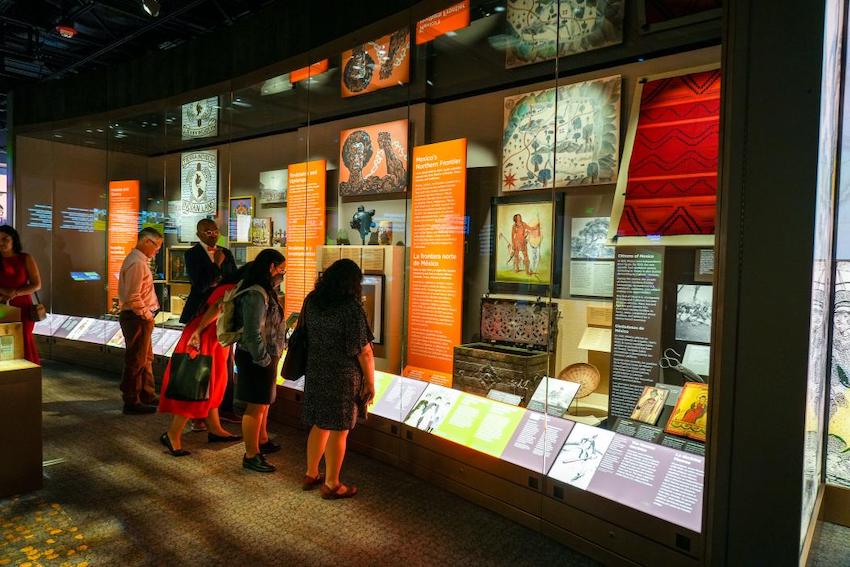
“¡Presente! A Latino History of the United States” was shut down in July — four months ahead of schedule. (National Museum of the American Latino)
Moreover, the exhibition in which it was displayed, “¡Presente! A Latino History of the United States,” was closed down. Also shut down in July — four months ahead of schedule — was the Smithsonian’s Molina Family Latino Gallery, home to the nascent National Museum of the American Latino.
Wrote Galindo: “Is this what the artists in the Hitler days felt when their works were labeled ‘degenerate art’?”
Galindo explicitly refuted the accusation that his work encourages border crossings.
“The work they’re pointing at is a metaphorical one,” he said. “It’s a man standing on a fence looking at what the United States looks like. I’m referring to the stars as fireworks and the border wall as the stripes of the flag. The reference is to the ‘old wall’ that divides the U.S. from Mexico, a wall of horizontal lines that George Bush Sr. put up after the Gulf War … the current wall is made of vertical lines and is much taller.”
Officials cited the upcoming “Our Shared Future: 250” programming as the reason behind the closures of the exhibit and museum.
A Smithsonian spokesperson said the “¡Presente!” space had to be de-installed to prepare for “Puro Ritmo,” a bilingual, salsa-themed exhibition seen as less controversial and set to open next spring.
The move leaves the National Museum of the American Latino without any public gallery space — notably during Hispanic Heritage Month in the U.S., which is observed annually from Sept. 15 to Oct. 15.
The Smithsonian is facing a 120-day deadline to reconsider its exhibitions.
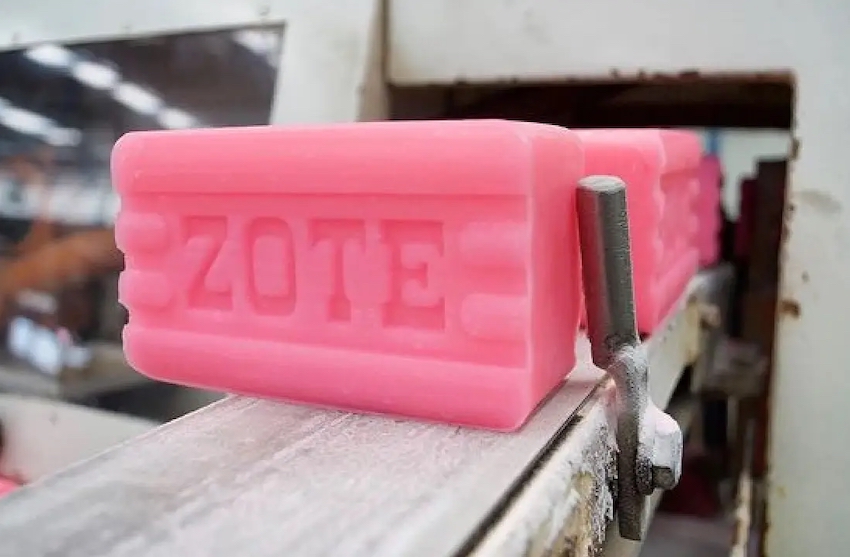
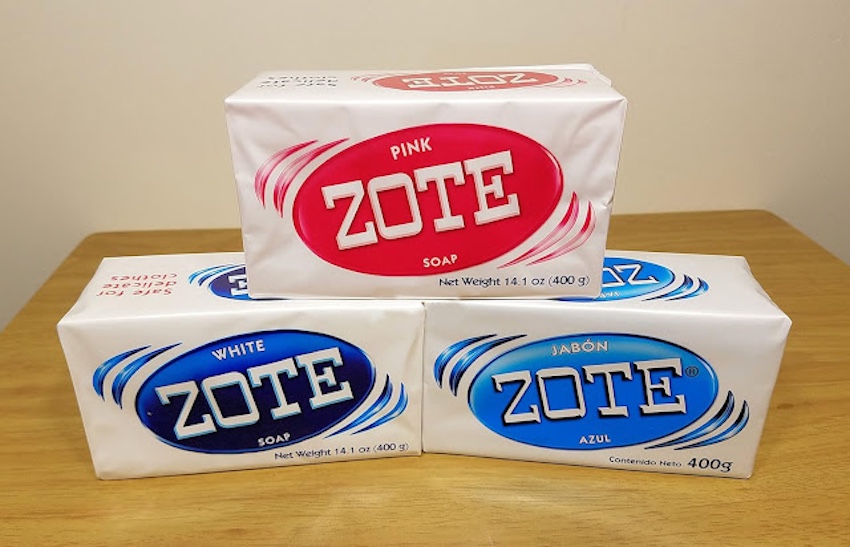
I don’t think I’m exaggerating when I say that almost every Mexican grew up with a grandmother or mother whispering alchemical secrets over the laundry. These weren’t just household tips — they were closer to rituals, formulas worthy of a medieval guild. Scrub your clothes with jabón Zote. For whites, use the white bar; for colored fabrics, the pink one. Boil them with baking soda and vinegar. Let the pot rest under the full moon. Scrub again until your arms ache. Then hang the laundry where the sun can bless it.
Zote is the talisman at the center of these domestic rites — passed from hand to hand, word to word, stubbornly outlasting the global detergent empires of Procter & Gamble and Unilever.
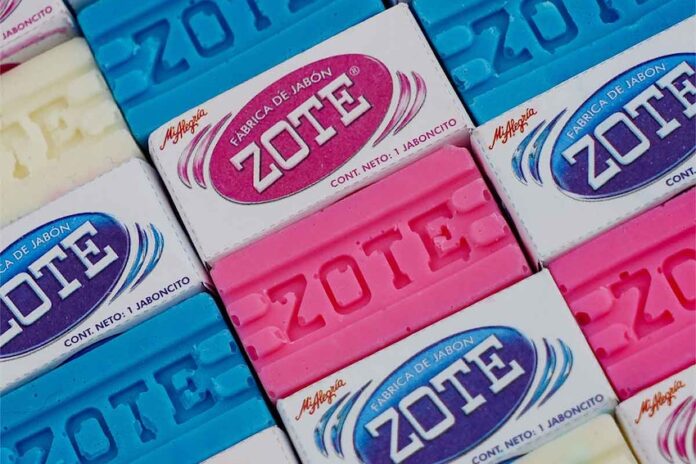
Proudly made in Mexico for over a century, no home is complete without at least one bar of Jabón Zote. (Fabrica La Corona)
How did a Mexican soap become one of the country’s most beloved brands? The answer lies in a time when hygiene itself was a collective endeavor.
Hygiene a century ago
Today, most Mexican homes — even those without a washing machine — have a washboard sink, and showers are fixtures of daily life. But a century ago, bathing and laundering were communal acts. Only the wealthy enjoyed private bathrooms; most people bathed in public bathhouses and scrubbed clothes on shared stone washboards, often fed by the same wells or springs.
These spaces were more than practical—they were social. They carried the hum of gossip, the kind of chatter so enduring that even today, when someone has irresistible news to spill, they’ll say “te tengo chisme de lavadero”—laundry gossip.
It was within this world that the González Padilla brothers from Tepatitlán, Jalisco, spotted an opportunity. Soap was not yet mass-produced. Each town had its own artisan who transformed animal fats and vegetable oils into rough, utilitarian bars.
The birth of La Corona
Made in Mexico: Jabón Zote
It was 1920. The Revolution had ended, and Mexico City pulsed with a desire for normalcy. Esteban, Loreto, and Daniel González Padilla arrived in the capital selling animal fat—then a scarce, prized raw material for soapmaking. But someone suggested a better idea: why not make the soap themselves?
They joined forces with master soap maker Zenón Martín del Campo and set up shop at Peralvillo Street No. 24, inside the Baños Corona bathhouse. Soon, shoppers heading to bathe began saying, “vamos a La Corona por jabón”—let’s go to La Corona for soap. Thus, the name of one of Mexico’s most enduring factories was born.
Their first bar, Tepeyac, appeared almost immediately. Demand surged. Within a decade, mule carts gave way to La Corona’s first motorized truck. By the 1930s and 40s, soaps like Corona and Roma dominated the market, fueling steady, unstoppable expansion.
Expansion and innovation
In the 1950s, Esteban’s son, Antonio González, took the reins. He relocated operations to Xalostoc, State of Mexico—where the factory still stands today—and launched La Corona into detergents in 1954. Unlike traditional soaps, detergents relied on petrochemical derivatives that dissolved grease with scientific efficiency.
But the defining moment came in the 1970s, when La Corona absorbed the production of Zote. Originally produced in Querétaro, the soap was reimagined with perfume and top-quality ingredients, then refined into Zote Rosa. Marketed as both laundry and bath soap with high quality, and extremely low price, it quickly became a sensation. Even after regulations prohibited its sale as a labeled bath product, women continued to use it that way—and still do. Today, beauty vloggers swear by Zote Rosa as the best way to clean makeup brushes. And almost every family has an elder who swears their hair was never more lustrous than when they washed it with Zote Rosa.
Innovation snowballed. In 1972, La Corona acquired Aceites Finos S.A., producer of the now-ubiquitous 1-2-3 cooking oil, and entered the edible oils business. As habits evolved, the company diversified again, introducing liquid laundry soaps—always with one ear tuned to consumer needs.
The secret to longevity
Unlike many Mexican companies swallowed by foreign buyouts, La Corona has remained a family enterprise. The González Padilla descendants still run it, treating their more than 5,000 employees as kin. Many families have worked at the plant for generations, passing down not just jobs but loyalty.
Their philosophy is almost radical in its simplicity. For decades, they refused to advertise, believing quality and word of mouth were the best publicity. Only with the rise of social media did this shift slightly. What hasn’t changed is their commitment to keeping prices low, reinvesting in new technologies—from Mexico, the U.S., Italy, Germany, and Canada—and listening closely to consumers.
Since 1986, La Corona has exported its soaps abroad. Today, 15 percent of production goes overseas—to the U.S., Ghana, China, Korea, and beyond. The scale is staggering: more than 300 tons of Zote produced every day, over 30 million bars each month. In Mexico, six out of ten laundry bars sold carry La Corona’s mark. All this in a detergent market valued at $798 million in 2024, projected to reach $1.23 billion by 2033.
Recognition and responsibility
Jabón Zote remains a simple, but essential mainstay of Mexican life. (Vitanel)
The company’s ethos has not gone unnoticed. In 2022, Statista and Forbes ranked La Corona the second-best employer in Mexico, outperforming even Silicon Valley giants like Google. That accolade reflects more than corporate success; it highlights La Corona’s conviction that prosperity is about human development as much as sales.
La Corona has built water treatment plants to recycle its effluents, cutting 27,000 tons of CO₂ emissions through sustainable practices. With low turnover, employees often build lifelong careers at the factory, forming an industrial family that spans generations.
From Foca, Carisma, and Venus Rosa to Roma, Blanca Nieves, and 1-2-3 Oil, La Corona’s products have quietly shaped Mexican daily life. The formula remains almost stubborn: high quality, low cost, and proudly Mexican.
Arte Zote
There’s something almost comic about Zote’s packaging. A no-frills block of soap wrapped in plain paper, stamped with bold blue or pink letters, and boasting the name “jabón Zote” that in Mexican Spanish sounds like both “soap” and “huge.” Yet despite its humble looks, Zote has survived the rise of detergents, the globalization of household brands, and the endless marketing campaigns of multinationals. In its own quiet way, Zote is as Mexican as tortillas or the Virgin of Guadalupe: ordinary, indispensable, and surprisingly resistant to change.
Over time, Zote has transcended its role as a tool of domestic ritual. Its pink and white bars—once humble, workaday objects—have become icons of Mexican culture. They appear on unofficial merch, inspire visual artists, and have been reimagined in sculpture and installations. Zote has slipped into the national imagination as more than soap: it is a symbol, both utilitarian and poetic, of Mexican resilience and ingenuity.
And in an age when multinationals rise and fall with the tides of Wall Street, La Corona endures like an old tree in Xalostoc—rooted, resilient, and fragrant with the pink scent of Zote.
María Meléndez is a Mexico City food blogger and influencer.
Wave flags, munch snacks and get a feel for Jalisco's unique culture throughout September. (Unsplash / Roman Lopez)
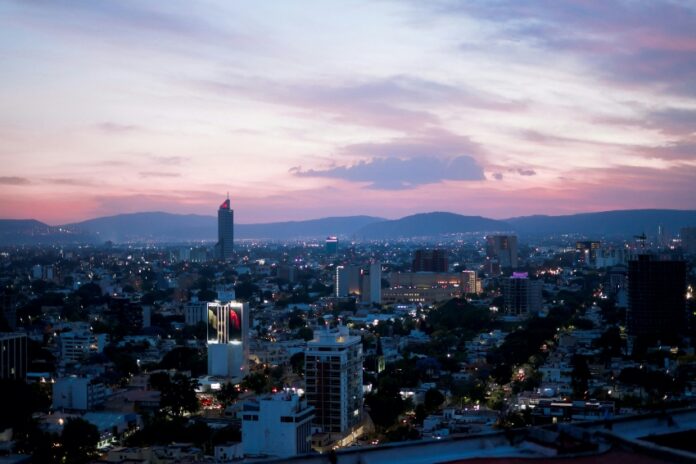
September is a month of celebration in Mexico as the country commemorates its independence from Spain. Beyond the festivities that mark this occasion, Jalisco’s capital will host a variety of events, including an Oktoberfest, a film festival, and a celebration of corn. Lake Chapala also contributes to the lineup with an exciting outdoor event featuring hot air balloons.
If you’re a film lover, especially a fan of European cinema, you won’t want to miss the European Film Festival. From documentaries that capture unique stories to dramas and comedies that portray life in different European countries, this edition brings together eight films with a wide variety of genres and narrative styles. Some of the featured films include “Historjá,” “Hotel Pula,” “Animal” and more.
Dates: Aug. 28-Sept. 5
Location: Cineteca FICG, Av. Manuel Gómez Morin 1695
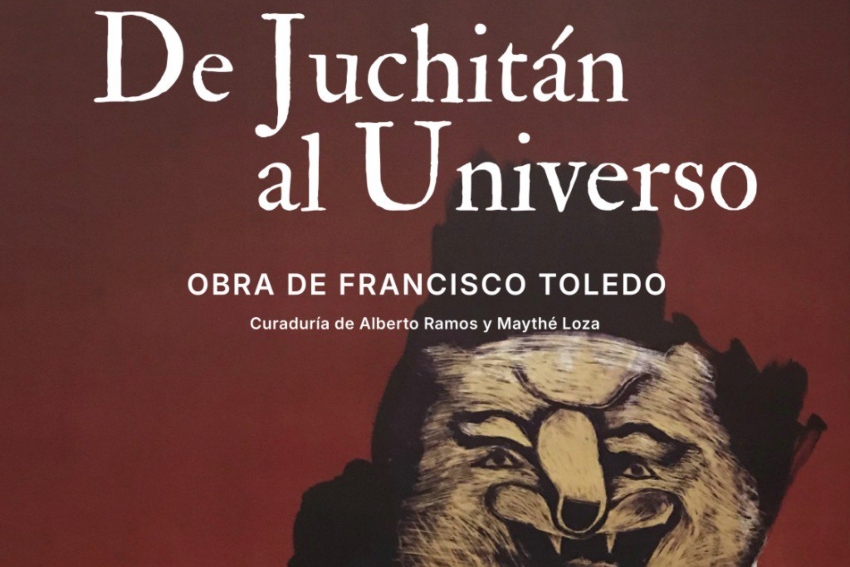
Francisco Toledo (1940-2019), one of Mexico’s most prominent artists, will be honored in Guadalajara with the exhibition “From Juchitán to the Universe: The Work of Francisco Toledo.”
Famous for his work as a painter, engraver, sculptor, ceramist, illustrator and cultural promoter, his work is characterized by a visual universe influenced by Zapotec art, fantastical animals and organic forms.
Dates: September-December 2025
Location: Guadalajara City Museum, Calle Independencia 684, Centro Histórico
To kick off Independence Day festivities along the Chapala shore, you won’t want to miss the folkloric hot air balloon festival that takes place in the Magical Town of Ajijic. The event sees local teams and families come together to launch colorful handmade paper balloons of various shapes and sizes. Dubbed the Ajijic Balloon Regatta, this event has taken place every September since the 1960s.
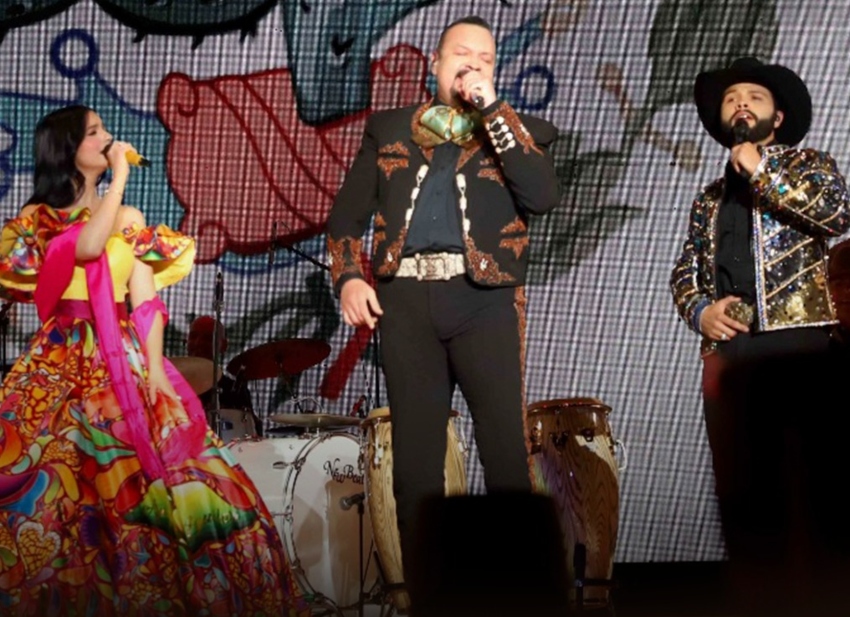
To mark Mexico’s 214th Independence Anniversary, Governor Pablo Lemús has announced a free concert featuring one of the most prominent families that represent regional Mexican music: Los Aguilar. The live performance will see the iconic Pepe Aguilar, along with his children Ángela Aguilar and Leonardo Aguilar, accompanied by a live mariachi band.
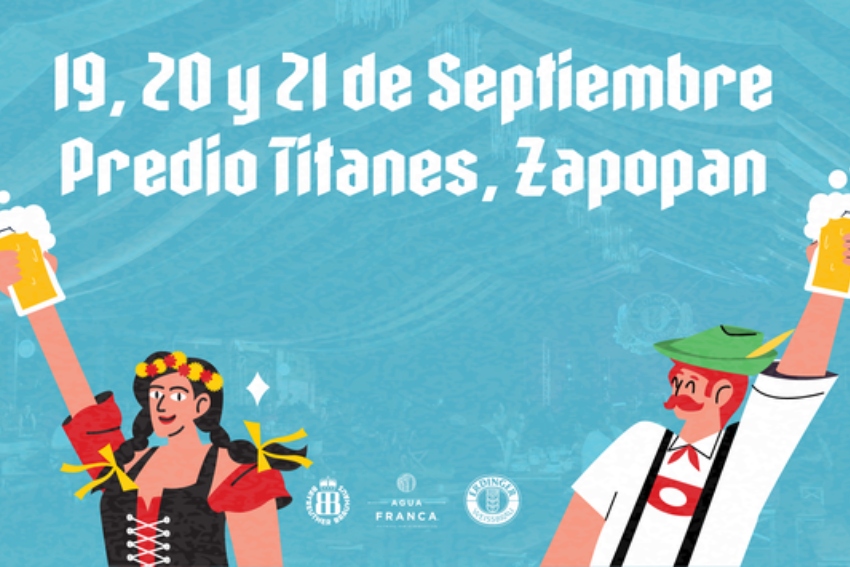
Traditionally known as Oktober Fest, this year’s edition has changed its name to OtoñoBierfest, in a nod to the word Autumn in Spanish.
Inspired by the German Oktoberfest, attendees can expect craft and German beer, traditional foods and live German music under a large tent decorated in Bavarian style. Featuring long tables and wooden benches, OtoñoBierfest promises an authentic Oktoberfest atmosphere.
Dates: Sept. 19–21
Location: Predio Titanes, Av. Sebastian Bach and Av. Tchaikovski, Zapopan
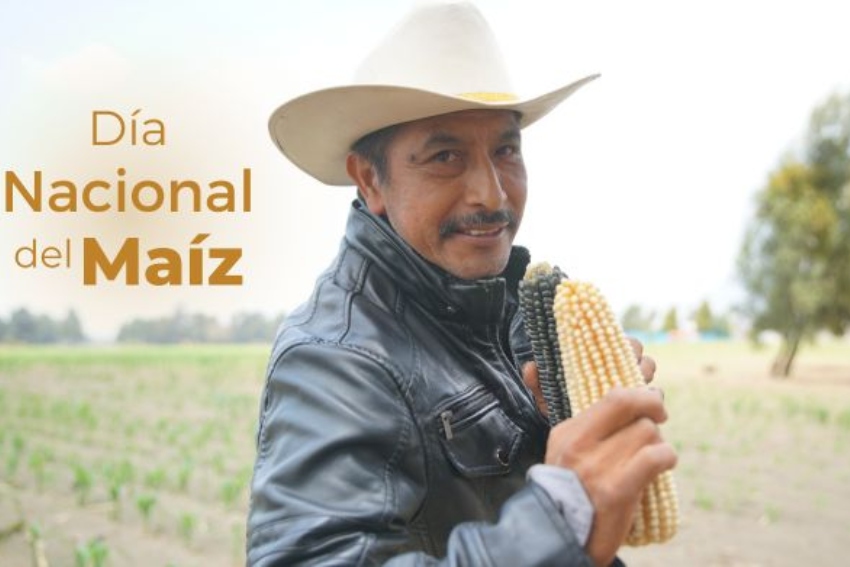
National Corn Day (Sept. 29) was established in Mexico to raise awareness and protect the diversity of native corn. To celebrate the occasion, Guadalajara will host an event to bring together corn producers, activists and the general public to enjoy ceremonies, workshops, corn tastings and exhibitions. The event will also feature live music and various artistic activities for the whole family.
Dates: Sept. 27
Location: Casa ITESO Clavigero (designed by Luis Barragán), C. José Guadalupe Zuno Hernández 2083, Col. Americana.
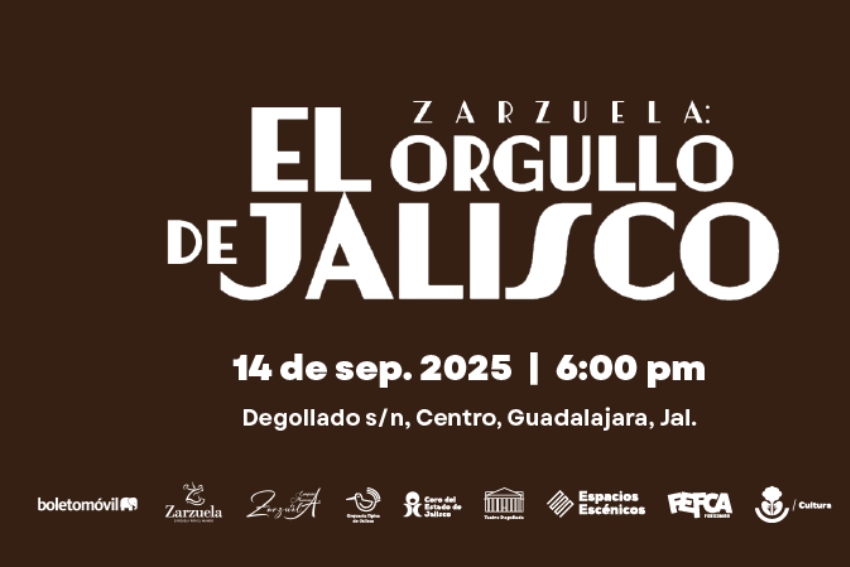
“El Orgullo de Jalisco” is a zarzuela composed by Federico Moreno Torroba that fuses Spanish tradition with typical Jalisco sounds. This year, it will be released again at the Degollado Theater in Guadalajara.The re-release will feature the Jalisco Symphony Orchestra, accompanied by 11 prominent singers and actors on stage.
Calling all plant lovers to attend the Plant Fest Guadalajara, an event centered around native flora. The event will bring together more than 30 plant exhibitors showcasing everything from cacti, succulents, collectible plants and orchids to carnivorous plants, fruit trees and more. Attendees will also be able to purchase gardening utensils, including pots, tools, soil and fertilizers.
Dates: Sept. 26-28
Location: Vía Libertad, Calle Colonias 221, Colonia Americana
Cost: Free
Gabriela Solis is a Mexican lawyer turned full-time writer. She was born and raised in Guadalajara and covers business, culture, lifestyle and travel for Mexico News Daily. You can follow her lifestyle blog Dunas y Palmeras.
Despite "all the difficulties, and all those who would prefer that there not be a good relationship between Mexico and the United States, we must always seek a good relationship with the United States," Sheinbaum said on Tuesday morning. (Presidencia/Cuartoscuro)
Among the topics President Claudia Sheinbaum spoke about at her Tuesday morning press conference was her upcoming meeting with United States Secretary of State Marco Rubio, who is making his first visit to Mexico as the Trump administration’s top diplomat.
Among other remarks, Sheinbaum revealed that she will embark on a whirlwind national tour and briefly spoke about the patriotic duty she will carry out on Sept. 15.
Sheinbaum: Meeting with Rubio will demonstrate ‘relationship of respect’ between Mexico and US
Sheinbaum said that Rubio would arrive in Mexico City on Tuesday afternoon ahead of bilateral talks on Wednesday.
She said that she and other Mexican officials would meet with Rubio on Wednesday for one or two hours, and then the U.S. secretary of state and Foreign Minister Juan Ramón de la Fuente will hold a joint press conference.
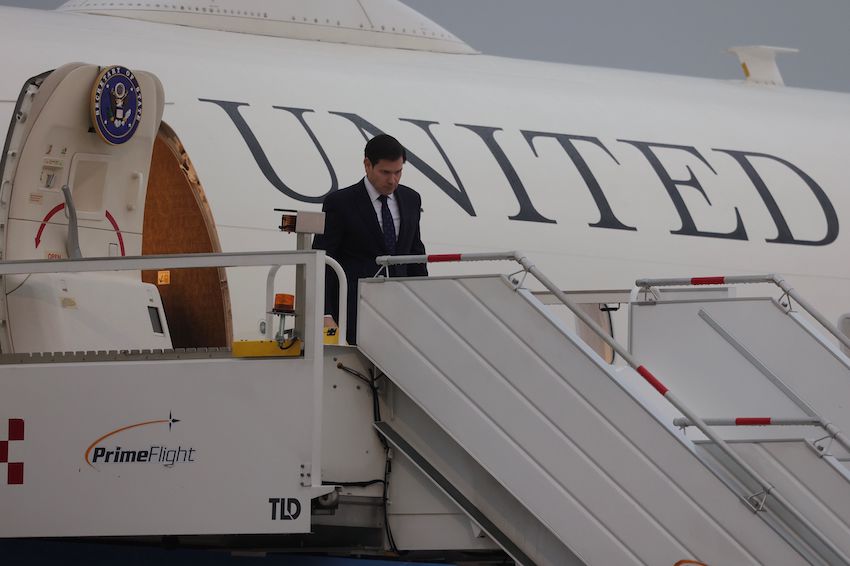
U.S. Secretary of State Marco Rubio arrived at the Felipe Ángeles International Airport (AIFA) outside of Mexico City on Tuesday afternoon. (Edgar Negrete/Cuartoscuro)
Sheinbaum — who last month rejected U.S. President Donald Trump’s claim that Mexico “does what we tell them to do” — asserted on Tuesday that “a good relationship” has been established between her government and its U.S. counterpart.
Despite “all the difficulties, and all those who would prefer that there not be a good relationship between Mexico and the United States, we must always seek a good relationship with the United States, because it is our neighboring country, because around 40 million first, second, third and fourth generation Mexicans live there, because we have many things in common, because we are trade partners,” the president said.
“Therefore, we must always strive for a good relationship. There will be moments of greater tension, of lesser tension, subjects on which we may not agree, but we have to seek a good relationship,” Sheinbaum said.
“And tomorrow’s meeting, I believe, will demonstrate that — a relationship of respect and, at the same time, a relationship of collaboration within the framework of respect for our sovereignties,” she said.
Sheinbaum to present government reports in every state in the country
A day after delivering her first annual government report in a 70-minute speech at the National Palace, Sheinbaum told reporters that she would visit every state of the country to present reports pertaining to each entity.
“Starting this Friday, … we’re going to visit all [32] entities of the republic in three and a half weeks,” she said.
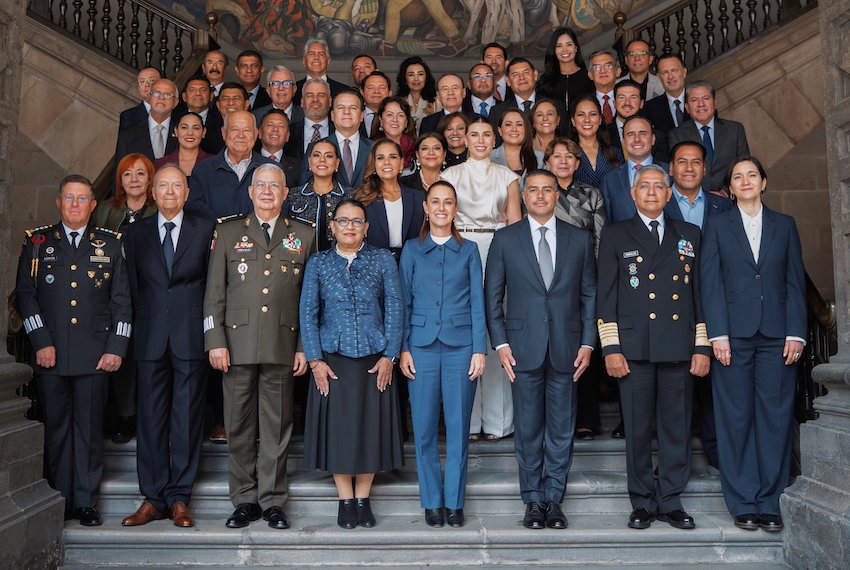
President Sheinbaum with all 32 governors of Mexico. (@claudiashein/X)
Sheinbaum said that in each state she would present “an individual report for the entity.”
“We’re going to inform the people. We’re going with the governors, all the governors. We’re going to go to three states in a day [in some cases],” she said.
“… We’re going to report on the welfare programs in each state, the public works that we’re doing in each state, the other things that are coming for [each] state. It’s an effort to be accountable,” Sheinbaum said.
Sept. 15 will be a proud day for Sheinbaum
A reporter asked the president how she feels about becoming the first female president to perform “El Grito” from a balcony of the National Palace on the night of Sept. 15, the day before Mexico’s Independence Day.
El Grito is a reenactment of the original “Cry of Dolores” made by the priest and founding father of Mexico, Miguel Hidalgo, in 1810. The cry marked the start of the Mexican War of Independence.











Sheinbaum pushes back on Trump’s most recent remarks about her: Wednesday’s mañanera recapped
At her Wednesday morning press conference, President Claudia Sheinbaum defended herself against a defamatory remark made by U.S. President Donald Trump.
She also spoke about her news consumption habits and a national pact that puts a cap on petrol prices.
Here is a recap of the president’s Sept. 3 mañanera.
Sheinbaum once again rejects Trump’s claim that she is ‘scared’ of drug cartels
A reporter noted that Trump claimed, once again, that Sheinbaum is “scared” of Mexico’s drug cartels.
Trump made the assertion in an interview with the news outlet The Daily Caller.
“So I like the president very much. I think she’s a terrific woman. She’s actually an amazing woman in some, in certain ways, very elegant, beautiful. But Mexico is run by the cartels. It’s run by the cartels. … I’ve offered to send in the military, and she doesn’t want us to do that because she’s scared, she’s very scared,” the U.S. president said.
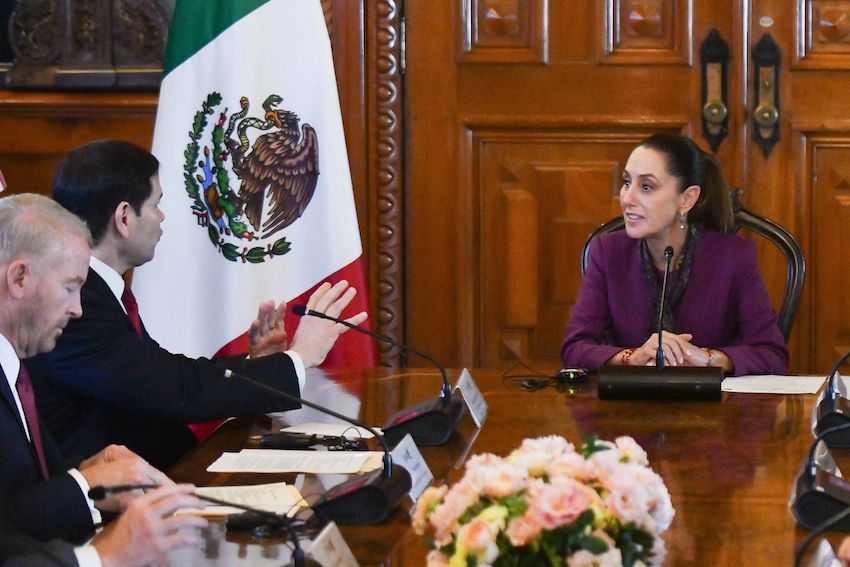
Sheinbaum initially declined to comment on Trump’s remarks, instead focusing on her upcoming meeting with U.S. Secretary of State Marco Rubio, which took place at the National Palace on Wednesday morning.
“Today there will be a very good meeting with … Marco Rubio,” she said.
“I’m not going to enter the debate in this case,” Sheinbaum said, noting that Trump previously accused her of being afraid of Mexico’s notorious drug cartels.
“We very much respect the Mexico-United States relationship and President Trump,” she continued, before deciding to change course and offer a public rejection of the U.S. president’s claim.
“This assertion he makes is not true, but we will maintain a good relationship,” Sheinbaum said.
She subsequently thanked Trump for the nice things he said about her in his interview with The Daily Caller this week.
Sheinbaum — ‘A voracious and critical consumer of information’
A reporter noted that the head of the federal government’s Digital Transformation Agency, José “Pepe” Merino, described the president as “a voracious and critical consumer of information.”
She asked Sheinbaum about Merino’s comment and how she keeps up to date with the news.
Sheinbaum said that three times a day she receives a “summary of what appears in the media, what appears on social media and what some [of Mexico’s political] commentators are saying.”
“I get it three times a day,” she stressed.
Sheinbaum said she also checks social media on her phone at around midday, after a quick post-mañanera breakfast and various meetings.
She subsequently reminded reporters that she devoted a lot of her career to “numbers.”
“I studied physics and then I studied energy engineering. And I was a UNAM professor and researcher for 20 years, with periods in which I also worked in government,” Sheinbaum said, referring to her academic career at the National Autonomous University of Mexico.
“So my mind is accustomed to making a quick analysis of numbers. So I’m very critical when a graph is presented to me. … Maybe that’s what Pepe was referring to,” she said.
Gasoline price cap deal renewed
Sheinbaum confirmed that an agreement between the government and gas station owners to cap the price of regular gasoline (Magna) at no more than 24 pesos has been renewed.
A six-month agreement took effect earlier in the year.
Sheinbaum said that 98% of gas station owners across Mexico are participating in the voluntary pact.
She advised motorists not to pay more than 24 pesos for a liter of regular gasoline.
“You’ll always find a service station … that has signed the agreement,” Sheinbaum said.
By Mexico News Daily chief staff writer Peter Davies (peter.davies@mexiconewsdaily.com)