Home Blog Page 1834

Iztapalapa No. 1 of the 3 most dangerous boroughs in Mexico City

0
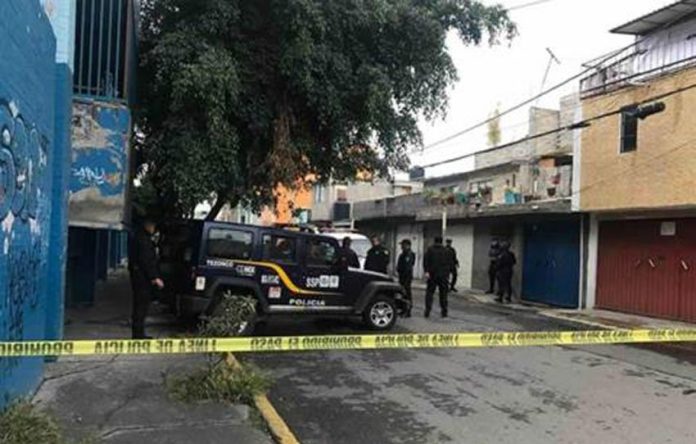
A crime scene in Iztapalapa.

A criminal analysis completed by law enforcement authorities in Mexico City has identified the capital’s most dangerous neighborhoods and boroughs as well as the times and days when homicides are most commonly committed.

And it’s not good news for Iztapalapa: the sprawling, heavily populated eastern borough is considered the most violent in Mexico City and is home to two of the capital’s three most dangerous neighborhoods, or colonias.

Between December and May, 184 people – 160 men and 24 women – were murdered in the borough, according to the analysis completed by the Mexico City Attorney General’s Office (PGJ).

A settling of scores was determined to be the probable cause of 30% of the homicides, 17% occurred during robberies and 16% of victims were killed during arguments or brawls.

The cause of the remainder of the murders in Iztapalapa is unknown.

Homicides in the borough most commonly occur on Sundays between 9:00pm and midnight, the analysis said, noting that between those hours a large number of parties and other events are held at which people consume large quantities of alcohol and drugs.

Within the borough, Citlali and San Lorenzo rank as the two most dangerous neighborhoods in Mexico City based on homicide statistics.

The PGJ said that high levels of alcohol and drug consumption in both colonias, their geographical location, turf wars between drug gangs, narrow streets with various entrances and exits and a lack of public lighting were among the factors that contribute to the high levels of crime.

Murders are most commonly committed with firearms by assailants who arrive in and flee from the neighborhoods on motorcycles.

The second most dangerous borough is Gustavo A. Madero, where there were 131 homicide victims in the six-month period to the end of May, followed by Álvaro Obregón, where 61 people were killed.

The former borough, located in the capital’s extreme north, is home to Zona Escolar, Mexico City’s third most violent neighborhood. In one week during the period analyzed, there were five murders in the densely-populated colonia, which borders México state.
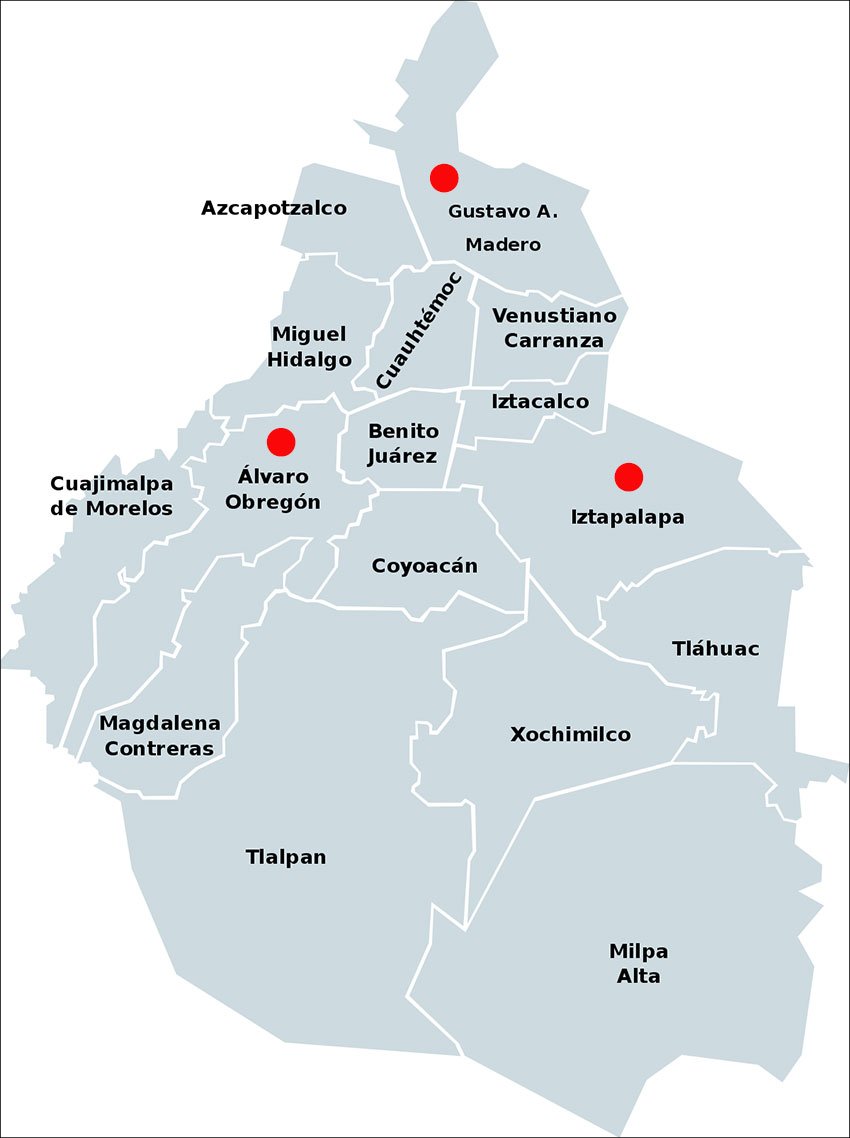
Identified with a red indicator are Mexico City's three most dangerous boroughs.
Identified with a red marker are Mexico City’s three most dangerous boroughs.

A lot of murders and other crime in Mexico City occurs on the outskirts, where criminals can easily move into neighboring México state and escape the jurisdiction of the capital’s police force.

Crime experts say that the ease with which criminals move between the two entities breeds impunity.

Francisco Rivas, president of the National Citizens’ Observatory, an independent organization that monitors security conditions, said that some criminal groups base themselves on the capital’s fringes “precisely because it generates greater difficulty in the prosecution of crime.”

Across Mexico City, there were 730 intentional homicides between December 5 and May 29, the PGJ said, but police only made arrests in 40 cases.

The period, which coincides with Mayor Claudia Sheinbaum’s first six months in office, is the most violent of the past 20 years. Kidnappings also surged in the first four months of 2019 to levels not seen in almost a decade.

The PGJ analysis said that a lot of the violent crime in the capital since Sheinbaum became mayor is due to turf wars.

The Jalisco New Generation Cartel, considered Mexico’s most powerful and dangerous criminal group, is encroaching on territory controlled by smaller criminal groups, such as La Unión de Tepito and the Tláhuac Cartel, and carrying out a “purge” of their members, the PGJ said.

Martín Barrón Cruz, a criminal researcher, said that violence in Mexico City has increased since the administration of former mayor Miguel Ángel Mancera, stating that his government’s denial that organized crime groups operated in the capital was a factor that allowed it to grow.

As soon as it took office, the current administration acknowledged that organized crime groups do operate in the capital but said it has a shortage of police officers with which to combat them.

Daniel Cunjama, an expert in criminal sociology at the National Institute of Criminal Sciences, said that violence in Mexico City could get worse.

“We have more and more young people recruited by organized crime who are working as sicarios [hitmen] and other positions . . . such as halcones [hawks or lookouts],” he said, adding that the criminals don’t just come from impoverished backgrounds but also the “middle and lower-middle classes.”

Source: El Universal (sp) 
Canyoning in Mexico: falling down waterfalls for the fun of it

0
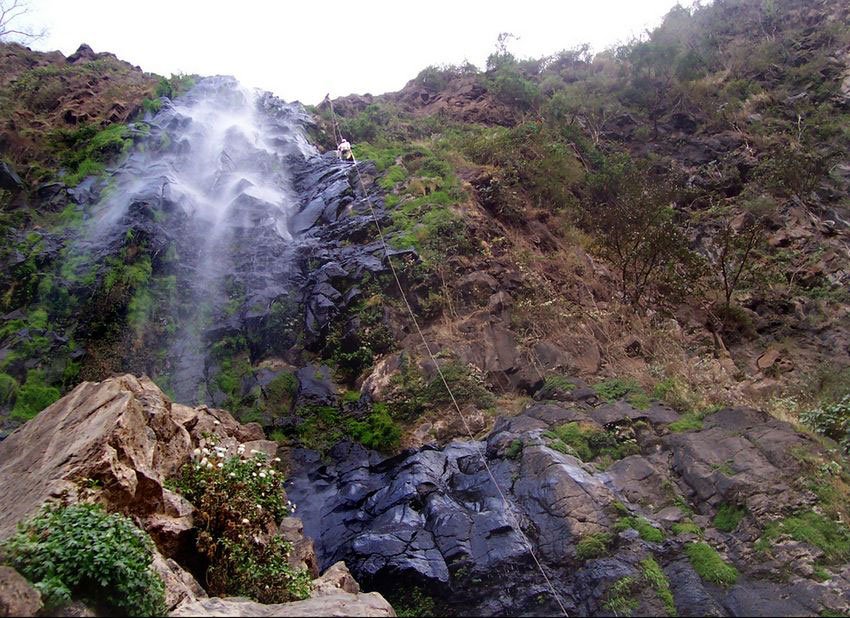
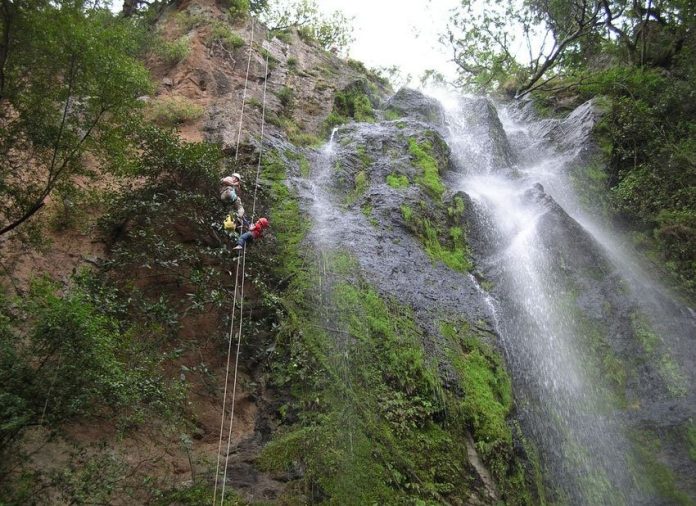
Father and daughter abseiling together at Nameless Falls.

Canyoning — known as canyoneering in theUnited States — is a sport which involves rappelling down cascades, lots of hiking and plunging into cold pools of water in order to follow a river down a canyon. It is practiced all over the world wherever river canyons are found.

The exploration of canyons is probably as old as the human race itself, but the modern sport of canyoning seems to have got its start in 1905 when Edouard Martel, “the father of modern speleology,” conducted a hair-raising hiking and rafting expedition down France’s Gorges du Verdon, the largest canyon in Europe.

Canyoneers are typically exposed to very cold temperatures and have to wear wet suits as they slide or jump down waterfalls, plunge into pools and then swim for their lives. When I first heard about this sport from my caving friends, I honestly thought that canyoneers must have a screw loose somewhere.

“What’s the point of rappelling,” I asked them, “if there’s not something important at the bottom of your rope . . . like a cave?”

When I asked Luis Medina, an experienced canyoneer who has represented Mexico in international canyoning events, what it is that he finds so attractive about canyoning, I was surprised by his reply.

Canyoning at San Martín Falls in Jalisco
Canyoning at San Martín Falls in Jalisco. Alberto Cortés

“I was a climber,” said Medina. “In 1998 I started climbing and I loved it. I could easily have spent 24 hours a day doing nothing but climbing. It became my passion, my religion, my everything!

“Well, I was doing a lot of rock climbing in Huaxtla canyon, just north of Guadalajara and because it was really hot there, I would cool off in the waterfall. So I was alternating between climbing and canyoning and little by little, my friends and I started doing more and more canyoning.

“Actually, canyoning is more fun than climbing because you are jumping, swimming, hiking, discovering new places, exploring, and you have more chance of seeing wild animals. So now I see climbing as more oriented toward technique and canyoning more toward nature.”

Medina told me that the very best place for canyoning in Mexico is the area around the city of Monterrey. “In this area,” he said, “you have Cumbres de Monterrey, Matacanes, Chipitín, Hidrofobia and La Garganta del Diablo (The Devil’s Throat), all of them with very high walls, limestone rock and big waterfalls. There are also great places in Tabasco, Veracruz, Hidalgo and all around Mexico City.

“As for Jalisco, we have beautiful, but rather short canyons like Aquetzalli, Huaxtla, Los Azules and the Sierra de Quila.”

Although I really prefer to stay high and dry on weekends, I found Luis Medina’s rationale for canyoning intriguing, so my ears perked up when my friend Rodrigo Orozco told me: “I’m going to abseil down a waterfall tomorrow. It’s located in a place so beautiful that I want to be buried there someday.”

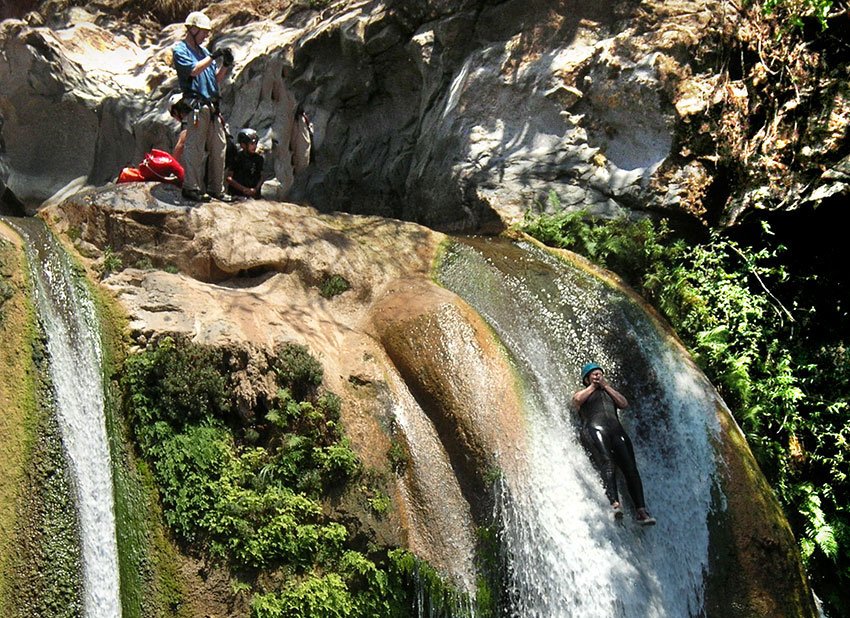
Sliding down a natural water slide in Aquetzalli canyon.

Now that got my attention, but when Rodrigo mentioned that he hates to get wet while canyoning, I really became interested. “I always put my rope as far from the falling water as possible,” he told me.

I was sold. “Dry canyoning? That’s for me!” I told him.

The next day I set off with Rodrigo Orozco and another canyoneer, Chris Lloyd, whose daughters, aged 9 and 7, were planning to do the rappel.

“If they can do it,” I said, “so can I.”

Off we drove to the spot where our 90-minute hike would begin. Remember that part about canyoning often including more hiking than rappelling? Well, in this case the landscape we passed through was so varied and beautiful, I soon forgot all about the waterfall jump. It was October and wildflowers were blooming everywhere. We were simply dazzled by the variety and profusion of all we saw.

Add to this the amazing talent of “Tarantula Man” Rodrigo for finding curious creatures every time he overturns a stone, and you have the recipe for a marvelous outing. Frogs, spiders, scorpions, brightly colored butterflies and, of course tarantulas, seemed to be lurking everywhere. So was plenty of mud and several streams we had to cross.

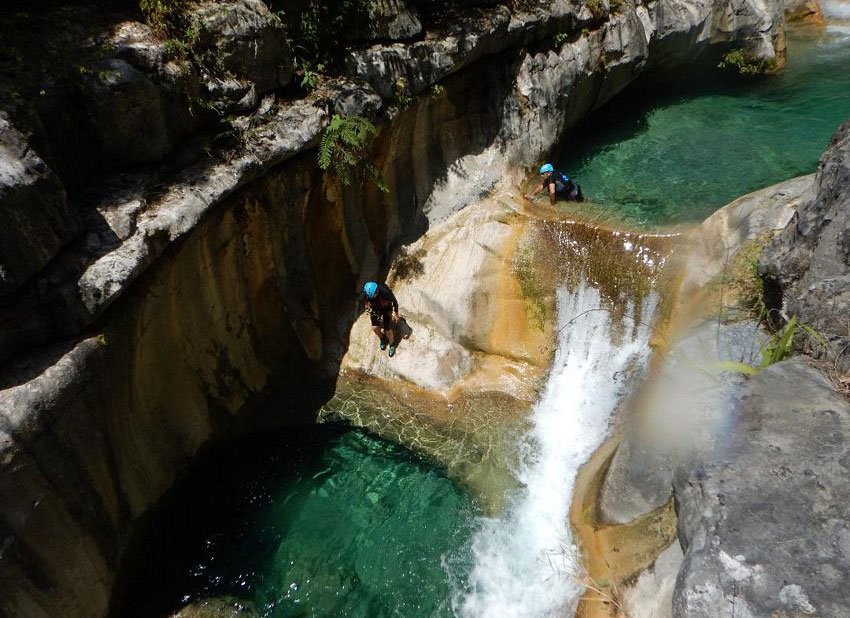
Matacanes Canyon, near Monterrey in Nuevo León.
Matacanes Canyon, near Monterrey in Nuevo León. Andrés Guerra

At last we reached our goal, which Rodrigo instructed me to refer to as “Nameless Falls,” as he would prefer to keep the place secret. My friends then attached a rope to a convenient tree, supposedly in a spot well away from the cascade. This, however, I couldn’t determine, since it was just about impossible to see anything directly beneath us.

“John, why don’t you go first?” said Rodrigo.

“OK, if you’re sure the rope reaches all the way to the bottom.”

“I hope so,” came the less-than-comforting reply.

I am a caver and I can assure you that leaning backward over the edge of a black, gaping cave entrance is a lot easier than doing the same out in the blue, where you can actually see the tops of trees far below you, giving your brain plenty of time to calculate the distance and imagine what will become of your body if something goes wrong.

This may be why some people never get beyond the first lesson in Rappelling 101 which, of course, includes standing at the edge of a cliff, connected to the rope by your rappelling device, leaning back and jumping. For some people, terror sets in during the leaning-back part, just at the moment they look down, and nothing on earth can get them to actually go ahead and jump, thus putting a quick end to their rappelling career.

[soliloquy id="81376"]

In my case, being the first to jump turned out to have a big advantage: a favorable breeze blew the spray from the waterfall away from me and I had a very pleasant and dry slide down the rope.

At last, from the bottom, I could see the waterfall in all its glory. It was about 60 meters high and much wider than the little river up on the top. There was a nice pool at its foot which would be inviting in the summer but I was happy to be wearing a jacket on this autumn day.

As my companions descended, each one got a little wetter than the previous because the spray had started to blow towards the rope. This meant that the last one over the edge, little Meli Lloyd (who came down with Rodrigo Orozco on parallel ropes), ended up soaked to the skin. To raise our body temperatures, we quickly began hiking up a very steep trail back to the head of the waterfall.

At last I could call myself a canyoneer of sorts, but I think it will be a long time before I forget little Meli’s final assessment of this sport, made as she stood soaked to the skin at the foot of the falls.

“What was it like, Meli?” we asked her.

Shivering, she looked up at us from under the helmet she was still wearing: “C-c-cold and w-w-wet,” she said through chattering teeth, and I will add no further comment.

Along with the thrills of canyoning come plenty of dangers. Flash floods, hypothermia and falling to your death are just a few to be considered. So, this extreme sport should only be practiced in the company of true experts using proper gear. Check out the canyoning excursions offered in the Monterrey area by Bakpak, Revista de Aventura.

The writer has lived near Guadalajara, Jalisco, for more than 30 years and is the author of A Guide to West Mexico’s Guachimontones and Surrounding Area and co-author of Outdoors in Western Mexico. More of his writing can be found on his website.

Three Mexican wolves born through breeding program in Coahuila

0
The wolf pups born at Coahuila's Desert Museum.

The population of the endangered Mexican wolf grew by three after pups were born at the Desert Museum in Saltillo, Coahuila.

Museum staff said it was the fourth successful captive breeding since 2015.

A total of 14 pups have been born in the facility since then as part of a binational Mexico-United States program designed to breed the endangered wolf.

Also known as a lobo, the Mexican wolf is a subspecies of gray wolf once native to a territory that straddled the border between the two nations, inhabiting the northern half of Mexico and parts of Arizona, New Mexico and Texas.

The lobo is also the smallest of North America’s gray wolves and the most endangered. As of 2017, there were 143 living in the wild and 240 in captive breeding programs.

The museum has 10 specimens under its protection, including the three new ones.

Source: Reforma (sp)

Fertilizer protests continue in Guerrero as delivery delayed

0
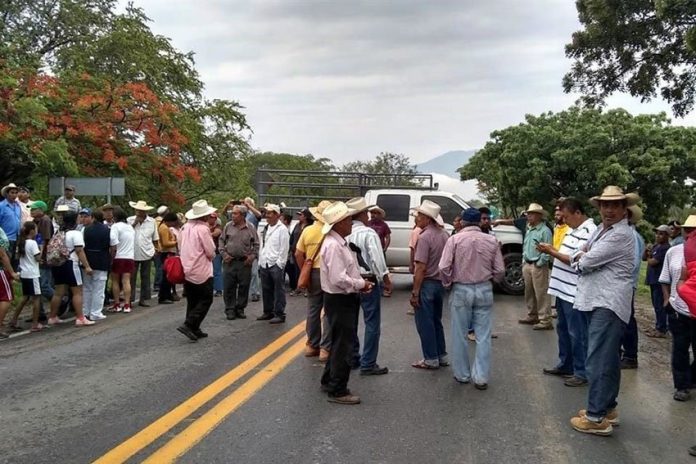
Farmers block the Iguala-Chilpancingo highway to demand their fertilizer.

Farmers in Guerrero have continued to protest this week against the delay in the delivery of fertilizer promised by the federal government.

One group of farmers yesterday blocked the Iguala-Chilpancingo federal highway while another stormed a warehouse where fertilizer was stored in the municipality of Tepecoacuilco.

On Wednesday, farmers from Atlixtac in the state’s Montaña region blocked the Chilapa-Tlapa federal highway and corn growers in Teloloapan occupied the municipal palace.

The former agreed to lift their blockade Wednesday night after they were told that federal authorities would meet with them in Chilpancingo yesterday.

Protests first broke out at the end of May in Heliodoro Castillo, where about 400 farmers detained soldiers and police officers to demand the government honor an agreement to distribute free fertilizer.

Farmers said delivery of the fertilizer was urgent because the rainy season had started, and they might miss their chance to plant.

According to Pablo Almícar Sandoval, the federal government’s super-delegate in Guerrero, the distribution of 120,000 tonnes of fertilizer began on June 3.

But almost two weeks later farmers in several parts of the state say they still haven’t received an allotment.

Guerrero Governor Héctor Astudillo predicted that protests will continue in the coming days if the delays persist.

He said that one of the main things that is holding up the delivery of the fertilizer is the number of bureaucratic procedures the farmers have to complete in order to access the fertilizer.

The governor said President López Obrador had good intentions but the federal distributors have complicated the allocation process.

“They’ve become [like] auditors and comptrollers from the past who operate ineffectively in the present,” he said.

Source: Reforma (sp) 

Anti-noise enforcement having negative impact: restaurants

0
Better keep the noise down.

Restaurant owners in Guadalajara say that enforcement of an anti-noise law in the city is seriously affecting investment and employment in the food service sector.

Aldo Alejandro de Anda García, Jalisco president of the national restaurant association Canirac, told the newspaper El Economista that closing restaurants for violating noise regulations puts dozens of people out of work and affects investments of millions of pesos.

For example, de Anda said, a Sonora Grill in the Providencia neighborhood of Guadalajara that was closed almost a month ago left 80 to 100 employees without work. He said over 50 million pesos (US $2.6 million) had been invested in the restaurant.

According to the municipal government, officials had received numerous noise complaints about the Sonora Grill before it was closed.

But de Anda said actions being take by authorities would indicate they are more focused on damaging the industry.

“Like these anti-noise operations they’ve been doing, where they bring five squad cars, 15 to 20 officers and dogs.”

De Anda said in April there had been no cases of abuse since anti-noise operations began but given “the security situation,” the sight of police cars and a large contingent of officials scares customers away.

In one case, he said, the mayor led an anti-noise operation in which many police officers and other officials entered restaurants to check noise levels.

Such operations scare guests who justly believe there is something more going on than a simple noise inspection, he said.

De Anda said that Canirac is willing to negotiate with the government to address the problem of noise at restaurants.

“We’re willing to work together, to have discussions, for them to tell us which places have been reported, where the problems are,” said de Anda. “We can have a dialogue with them, and if the dialogue doesn’t work, we can talk about sanctions.”

Under Guadalajara’s municipal law, businesses that generate more than 65 decibels of noise face a minimum fine of 2,500 pesos. Repeat offenders will face larger fines and can have their restaurant licenses suspended or revoked.

The anti-noise law applies to the entire municipality of Guadalajara, but the city has been focusing enforcement in Chapultepec, López Cotilla and Providencia.

Source: El Economista (sp), Informador (sp), Mural (sp), Milenio (sp)

Oaxaca entrepreneurs replace Styrofoam with banana leaves

0
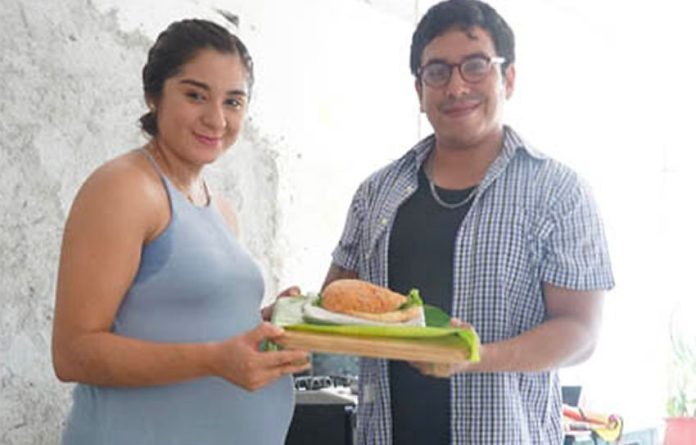
Oaxaca entrepreneurs and their environmentally friendly burger packaging.

Two young Zapotec entrepreneurs in Oaxaca are using an innovative and local alternative to plastic and Styrofoam to join in the effort to eliminate the use of non-biodegradable materials and prevent environmental damage.

Hambre Feroz (Ferocious Hunger) sold its first hamburgers to hungry customers just nine months ago in Juchitán, but already Samantha and Luis Fernando — who were identified only by their first names — have made a name for themselves by wrapping their meals in banana leaves.

The two say that the move towards ecologically-conscious packaging was inspired by innovative solutions in other parts of the world and a sense of urgency to move away from practices that pollute and degrade the environment.

“We saw how in Asian cultures, especially in Thailand, they use banana leaves [to package different foods] and we wanted to do it in our business, too, not to copy them or because it’s a fad, but because we believe that we need to protect the environment and to save it starting now. We cannot wait any longer; our mother Earth is undergoing an environmental collapse, and I believe that we should live naturally starting with our businesses and other small spaces.”

Packaging is especially important to Hambre Feroz; the company does not have a fixed location, but makes its sales online and delivers its products. Samantha and Luis Fernando said that although there was some initial pushback against their new natural packaging, many people have applauded the decision.

Wrapped and ready for delivery.

Another big advantage is that the new packaging saves money: the Styrofoam plates they used before cost double what they now spend on banana leaves in Juchitán’s market.

The two added that environmentally responsible packaging is just one of their efforts. They also donate a peso from every hamburger sale to a reforestation campaign that that they hope to launch soon in their hometown.

Additionally, the cooking oil they use in their hamburgers is recycled to make ecological soap, which they donate.

“Our principal concern is to begin to take care of the environment as well as fair business practices. We are young, but we are sure of the need to establish a socially responsible business.”

Samantha and Luis Fernando’s packaging solution follows a law approved in April by the Oaxaca Congress to ban single-use plastic throughout the state, giving its 570 municipalities one year to prohibit the material.

Local governments have also established measures to against non-biodegradable materials. At the beginning of this year, Santiago de Laollaga became the first municipality in the Isthmus of Tehuantepec to declare itself plastic-free and in the young business owners’ hometown of Juchitán, one of the principal food markets levies a fine on merchants who give plastic bags to customers.

Another Oaxaca entrepreneur who has eschewed Styrofoam is a Oaxaca city street vendor who now sells his corn snacks on corn husks rather than plastic.

Source: El Universal (sp), Istmopress (sp)

Residents say migrants’ shelter fenced for security, not discrimination

0
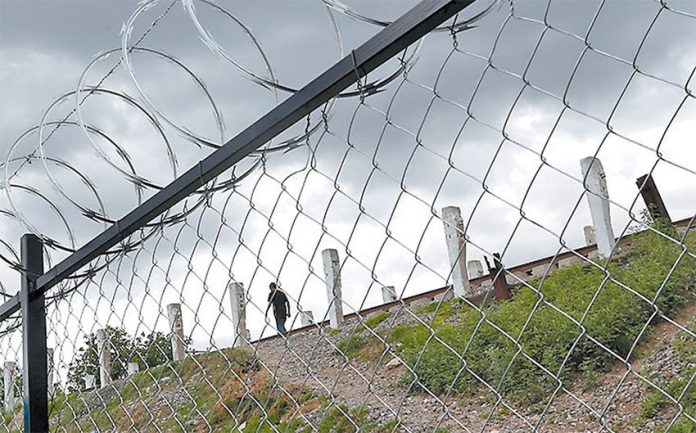
The fence surrounding a migrant shelter in Tlaxcala.

A razor wire-topped chain-link fence around a migrant shelter in Apizaco, Tlaxcala, was erected for security reasons and not because of discrimination, residents say.

Residents of the Ferrocarrilera neighborhood say that the fence was required to guarantee safety in the area.

They claim that the neighborhood has been overrun by drugs, disease and crime since the Sagrada Familia Shelter opened in 2010. Some residents say that migrants have broken into their houses, and that they don’t feel safe anymore.

“We can’t go outside after seven or eight at night,” Mónica Ramos told the newspaper Milenio. “We have to stay in our houses because of the insecurity.”

A large influx of migrants has overwhelmed the shelter’s capacity during the past year, with as many as 300 people sleeping in the facility. Neighborhood residents say that some end up sleeping on the street in front of their houses.

“We don’t have the tranquility we had before, and we feel afraid because there are people we don’t know,” said Julio Flores, a member of a neighborhood committee. “We don’t know who these people are who are in front of our houses.”

The committee came to an agreement with the municipal government to build the fence, whose gate will close between 10:00pm and 7:00am daily, preventing migrants from leaving the shelter. But now, some people in the neighborhood are asking the municipality to close the shelter indefinitely.

However, many others see the fence as a sign of discrimination against migrants. Shelter director Elías Dávila told Milenio that he understands the concerns of the neighborhood, but he is asking them to be tolerant and remove the fence.

“There are people who, thankfully, help migrants, but there are others who, influenced by [U.S. President] Trump, have racist attitudes,” he said. “The fence is a sign of discrimination, of contempt for migrants. It says, ‘We don’t allow migrants here, because they are migrants.’”

Representatives of the Catholic Church in Tlaxcala called the fence “antihuman,” and said they will appeal to the National Human Rights Commission to have it removed.

Source: Milenio (sp), El Sol de Tlaxcala (sp)

National Guard’s deployment to border complete by Tuesday: Foreign Secretary Ebrard

0
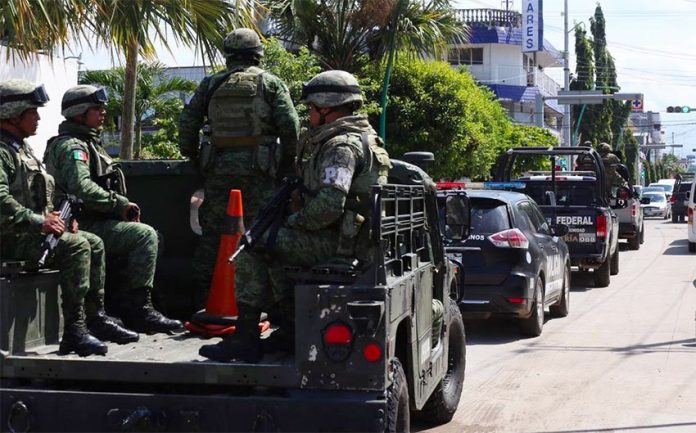
The first mobilization of the National Guard appears in Chiapas, though dressed in police and military uniforms.

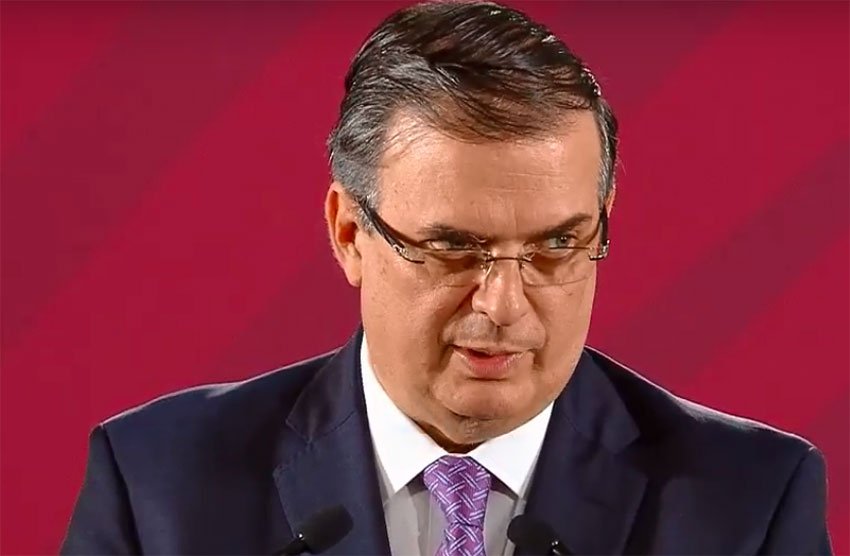
The deployment of 6,000 National Guard troops to the southern border will be completed by Tuesday, Foreign Secretary Marcelo Ebrard said today.

Mexico committed to the deployment and other measures to reduce migration last week as part of an agreement with the United States that ended the threat of a 5% tariff on Mexican exports to the U.S.

The first troops arrived in Tapachula Friday morning and began patrolling the city, but there was no indication they belonged to the new security force, the newspaper Milenio reported. Instead, it was made up of local and state police, Federal Police, the Gendarmerie, marines and soldiers.

Meanwhile, there was no official presence at the Guatemala border, some 50 kilometers away, and migrants were entering Mexico freely after crossing the Suchiate river aboard rafts, Milenio said.

Speaking at the presidential press conference this morning, Foreign Secretary Ebrard said “a lot of efforts have been made to accelerate the pace [of the operation].”

Ebrard: pace of the deployment has been accelerated.

There will also be an additional deployment of marines and soldiers to the border, he said.

Earlier this week, Ebrard said that 13 units of the National Guard will be deployed to Campeche, Chiapas and Tabasco – all of which share a border with Guatemala – as well as Veracruz and Oaxaca.

In Veracruz yesterday, he said the government will ramp up efforts to ensure that migrants register with authorities, and restrict their transit through the country to the United States border.

“If you want to cross our territory to arrive at another country, what you’re probably going to find is that we’re going to tell you ‘we don’t want you to cross our territory’ . . . Why? Because you’re going to create a problem for our country,” he said.

Ebrard said today that 825 new agents will join the National Immigration Institute to assist efforts to reduce irregular migration, explaining that the agency is understaffed.

“That’s been one of the most serious problems,” he said.

Almost 600,000 migrants have arrived at the southern United States border from Mexico this year, the United Nations Refugee Agency (UNHCR) said Wednesday, including more than 144,000 undocumented migrants who were apprehended by U.S. Customs and Border Protection last month.

Asylum applications in Mexico have increased by 196% this year, the UNHCR said, leading human rights and migration undersecretary Alejandro Encinas to predict that 80,000 requests will be filed this year.

Mexico’s tiny refugee agency has struggled to cope with the influx of applications, forcing it to ask the UNHCR for help to open three new offices.

With regard to the expansion of the United States’ “Remain in Mexico” policy, which the government also agreed to as part of last week’s deal, Ebrard said he will meet with U.S. authorities today to discuss the ports of entry through which the migrants will be returned and how many will be sent.

While agreeing to implement the anti-migration measures set out in the agreement with the United States, President López Obrador has consistently maintained that the best way to stem flows of people to the northern border is by investing in development projects in southern Mexico and Central America.

In May, Ebrard presented seven such projects to the United States government and proposed that it provide funding for them.

Today he said that the implementation of the Comprehensive Development Plan for Central America and southern Mexico will formally commence next week.

“We’re going to show that development really can [reduce] migration in the short and long term,” Ebrard said.

Meanwhile, President Donald Trump said today that the immigration agreement with Mexico includes a “safe third country” plan if efforts to curb migration to the border fail.

A photographer snapped an image of a document held up by the U.S. president earlier this week whose text appeared to indicate that Mexico had agreed to legislate such a scheme if its efforts to stem migration flows proved insufficient.

Asked in an interview today if the agreement included the “safe third country” option – which would force migrants to seek asylum in Mexico rather than the United States – Trump said that’s “exactly right, and that’s what’s going to happen.”

Source: El Financiero (sp), Milenio (sp)

Seniors waiting for funds watch as thieves steal the money

0
The scene of yesterday's robbery in Hidalgo.

Seven armed men stole up to 1.69 million pesos (US $88,000) in social welfare funds in Hidalgo yesterday as the intended recipients looked on.

The cash was about to be delivered to senior citizens in Zempoala but instead the thieves took off with the money in an incident that left two people dead and two wounded.

The incident took place around 9:30am in the municipal auditorium, where government officials were preparing to deliver 2,550 pesos (US $133) to each of 750 beneficiaries of the 60-and-over federal welfare program.

The thieves entered the building after shooting a police officer guarding the entrance, and went for the cash. About 200 senior citizens watched as a second guard confronted the criminals, shooting and killing one of them. The others fled with the money.

Police gave chase and forced the thieves to abandon their vehicle on the Pachuca-Sahagún highway, where they attempted to flee on foot to San Agustín Zapotlán.

A police car overturned before a second clash, killing one police officer and wounding a second.

The Public Security Secretariat later confirmed that the remaining six thieves had been arrested, and that their loot had been recovered.

Source: El Universal (sp),  SDP Noticias (sp)

17k bike tour will celebrate bicycle month in Mexico City

0
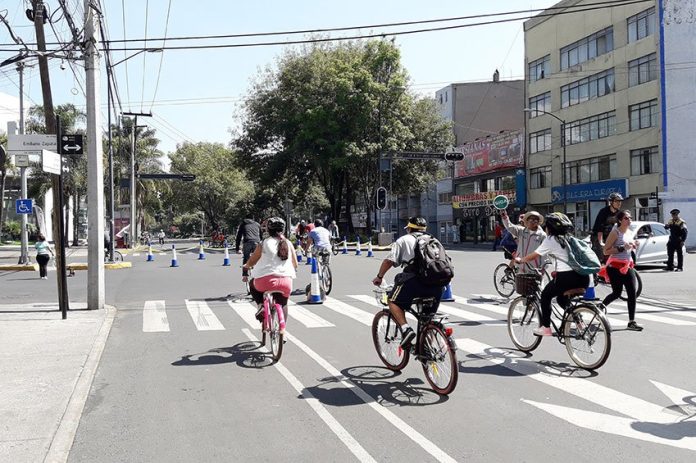
Mexico City cyclists are preparing for a 17-kilometer tour next weekend.

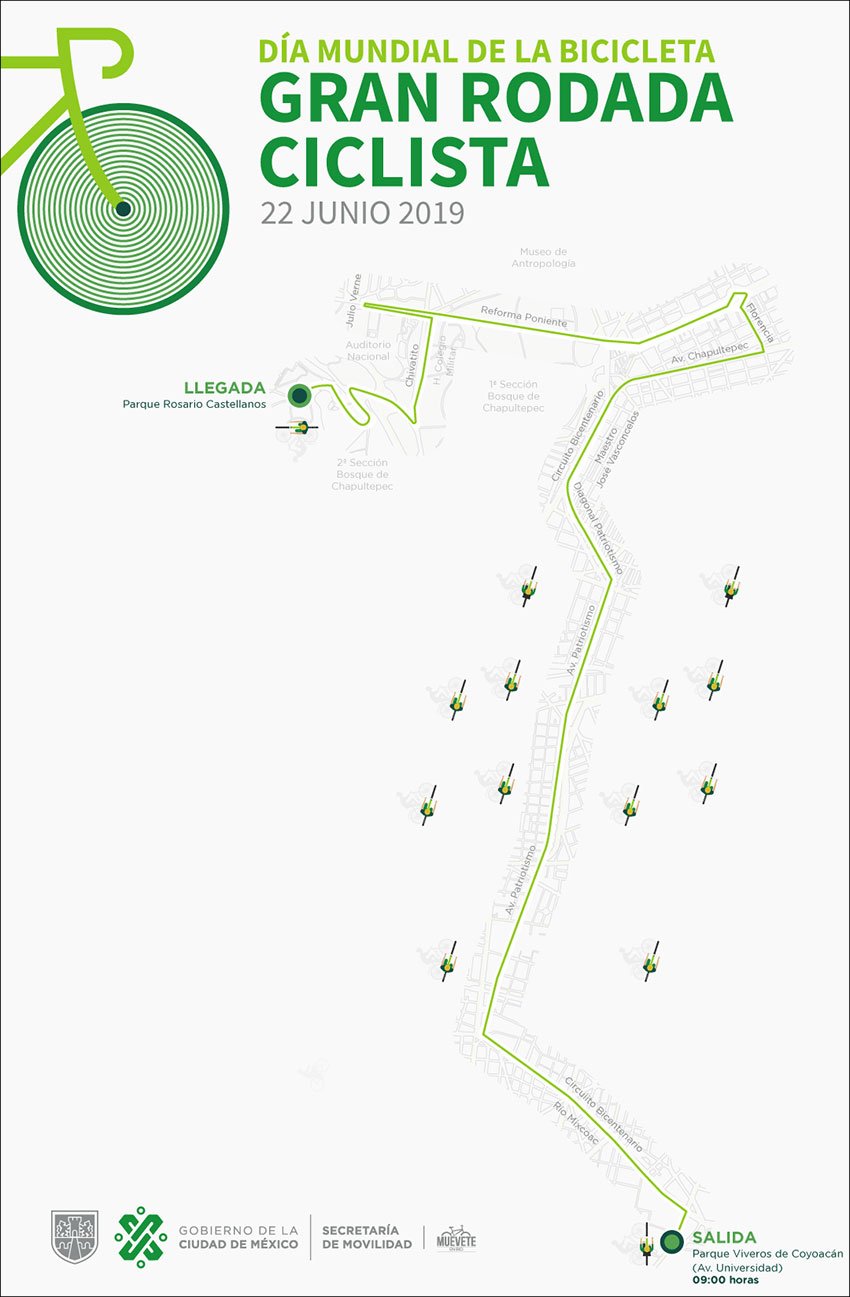
It’s bicycle month in Mexico city and to celebrate, the city agency Muévete en Bici CDMX (Move by Bike Mexico City) will hold a 17-kilometer bicycle tour, “La Gran Rodada Ciclista,” on Saturday, June 22nd, starting at 9:00am.

The 22nd is the 11th anniversary of Muévete en Bici CDMX. Every Sunday, from 8:00am to 2:00pm, they close 55 kilometers of roadways in the city to cars and other motorized transport. Cyclists, pedestrians and skaters follow the route, which goes through four boroughs, from Benito Juárez in the south to Gustavo A. Madero in the north.

At each traffic light, monitors hold double-sided placards to instruct cyclists to continue or to stop. On the final Sunday of the month, the route changes and becomes much longer, including Circuito Bicentenario, the parkway that encircles the heart of Mexico City.

For the Gran Rodada, the route begins in the south at Avenida Universidad and Circuito Bicentenario and heads north to the second section of the Bosque de Chapultepec, Mexico City’s central park. Cyclists are free to start or stop wherever they choose, or go the entire route if they are up for the challenge.

Muévete en Bici is part of the Environmental Secretariat. In addition to closing the roads for cyclists, they offer a host of family-oriented activities each Sunday located at roundabouts along the route. There are cycling lessons for children and tandem-bike riding for the blind at Glorieta La Diana.

The route of next Sunday's tour.
The route of next Saturday’s tour.

At Glorieta La Palma there is a play area for children, and you can borrow a bicycle, skates or a skateboard for free. (You must bring your voting registration card showing an address within Mexico City). The free bike rentals include special bicycles with back seats for kids and balance-assisted models. Below the Angel of Independence, Muévete en Bici offers free nutrition, yoga and physical activity classes.

Along the route, there are stations offering mechanical repair as well as medical service. It is advised to wear proper attire, including a helmet, and bring plenty of water.

Muévete en Bici also acts as an advocacy group for more bicycle infrastructure in Mexico City. Currently, 1.4% of daily trips in Mexico City are taken on a bicycle. During President López Obrador’s term, their goal is to increase that to 3%.

This year has seen 251 million pesos (US $13 million) of investment in bicycle infrastructure in the capital. There are currently 85 kilometers with another 40 kilometers still to be built.

Cycling enthusiasts are vocal about their desire to make Mexico City even more bike-friendly. A prime concern, voiced frequently on social media channels, is safety. Many bike lanes consistently have cars parked in them, forcing cyclists to compete against city buses and other traffic.

Despite legislation making those lanes exclusive to bicycles, the transit authority does not issue any type of fine or summons to violators. Many bike lanes have large potholes and faded paint at the intersections. Other bike lanes are shared with buses.

Many large cities such as New York and London have traffic lights with indicators specifically for cyclists, and Mexico City residents have taken notice, demanding their own such lights. The center and south of the city have the majority of cycling infrastructure, and residents of northern and eastern boroughs like Gustavo A. Madero, Azcapotzalco and Iztapalapa have taken to the Muévete en Bici website to request more bike lanes and bikeshare stations in their neighborhoods.

The next large project planned for completion in 2019 is the Sendero Compartido (shared pathway) on Paseo de la Reforma. It will run for three kilometers, from Lieja to Fuente de Petróleos, crossing through Chapultepec Park.

The residents of the outer boroughs will have to continue to wait for the government to act on their proposals for more bike lanes.

The writer lives and works in Mexico City.