Home Blog Page 1833

Young Jalisco entrepreneurs invent bio-oven that runs on water

0
Peiskos' founders and their bio-oven.

A group of young entrepreneurs from Guadalajara, Jalisco, has created a prototype of an oven that runs purely on water.

Developed over the past year, the eco-friendly device was made by a social enterprise called Peiskos, which means “warmth by a fire” in Norwegian.

The oven doesn’t use any combustible fuels but instead heats up after water is poured into an electrical input. The current of the water acts as a conduit, which causes it to undergo electrolysis, a process that separates the hydrogen and oxygen atoms and generates energy.

“We wanted to create a machine that allows users to create their own fuel,” said Davide Pallotta, one of the startup’s founders.

“The burning of this kind of fuel doesn’t create any kind of emissions. It is not bad for humans or humanity.”

The Peiskos founders told the tech website Contxto that the idea for the oven was inspired by the needs of society, especially families in Mexico who struggle with “energy poverty.”

They said many people can’t access or afford the energy necessary to cook, light and heat their homes or for entertainment purposes, and are forced instead to burn firewood, which not only contaminates and presents health risks but also contributes to deforestation.

“There are many communities that have difficulties getting services like gas, light or water,” said Edith Ibarra.

“Those distinctive factors shine a light on the type of vulnerable communities we want to work with.”

The six entrepreneurs have already taken their prototype to a squatters’ settlement on the outskirts of Zapopan for testing and to receive feedback from people who could benefit from it.

“There’s no better way to validate your business idea than directly validating it with the user,” Peiskos said in a recent post on Instagram.

The next step for the fledgling company is to secure venture capital that will allow it to expand.

“We’re looking to raise 1 million pesos [US $52,000] to establish ourselves and give us an important push into research,” said Ibarra. “Research and continued experimentation are very important so we can launch our product with the biggest force.”

The Peiskos founders won a startup competition at technology expo Talent Land in April and this month competed in an accelerator event in Mexico City sponsored by the free enterprise organization Enactus.

While the company didn’t come out on top in the latter competition, the young entrepreneurs remain determined to keep moving ahead with the development of their startup.

Eventually, Peiskos hopes to be able to donate ovens to underprivileged communities or sell them at a very low cost so they are accessible to the people who need them most.

Source: Contxto (en) 
Head of Veracruz anti-corruption council accused — of corruption

0
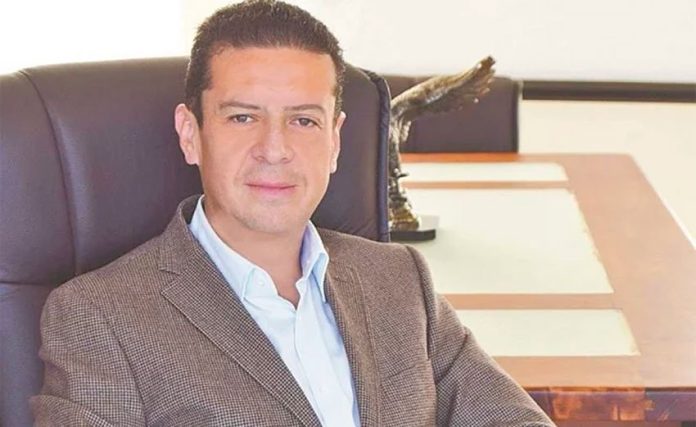
Corruption fighter Vazquez.
Corruption fighter Vázquez.

After resisting calls for his resignation throughout his entire one-year term, the head of a Veracruz anti-corruption council left office on Thursday after completing his mandate — and triggering several corruption investigations against himself.

Sergio Vázquez Jiménez had served as head of the Citizen Participation Council (CPC) of the state Anti-corruption System (SAE) but is now facing investigations for irregularities during his term.

He is also accused of using an accounting firm he owns to obtain phony government contracts during the administrations of former governors Miguel Ángel Yunes Linares, Flavino Ríos Alvarado and Javier Duarte. The latter is currently serving a nine-year prison term for corruption.

The accounting firm allegedly received directly awarded contracts to audit several government agencies, including the Xalapa water commission. According to an accusation by Xalapa Mayor Hipólito Rodríguez Herrero, the city paid 935,000 pesos to the firm in 2017 for auditing services that were never carried out.

The firm also used false addresses for its offices on official government documents, according to an investigation by the digital publication La Silla Rota. The addresses were registered by the notary Dulce María Ríos Guerrero, daughter of former interim governor Flavino Ríos. The use of false addresses is similar to schemes used by Javier Duarte to misdirect public funds.

The corruption accusations had been following Vázquez since he began his one-year term. In July 2018, he rejected calls for his resignation and insisted that his firm had received the contracts legally, and had carried out the audits.

Vázquez was replaced by Emilio Cárdenas Escobosa, who said he hopes to turn the SAE into an agency that will prevent the acts of corruption that characterized the last three administrations in Veracruz.

Source: e-consulta (sp), La Silla Rota (sp) El Universal (sp), Diario de Xalapa (sp)

Chapala development plan’s main focus is transportation, including a train

0
Jalisco Governor Alfaro prepares to release young fish into Lake Chapala.

The governor of Jalisco has presented a 533-million-peso (US $27.8-million) development plan for the Lake Chapala region, one of whose priorities is the study of a train service between Guadalajara and Chapala.

Enrique Alfaro said yesterday the plan is intended to provide social justice, economic development, improved security and more effective government for the more than 300,000 people who call the region home.

He also said that natural resources and the environment will be protected and that the different municipal governments in the region will work together to implement the plan.

More than half the funds – just under 303 million pesos – will go to upgrading highways and roads in the area, which includes the municipalities of Jocotepec, Chapala, Poncitlán, Tuxcueca, Tizapán el Alto, Ocotlán and Jamay.

Rehabilitation of the Jocotepec-Chapala is considered a priority project.

More than 26 million pesos will be allocated for the improvement of the region’s healthcare clinics, while funds have also been set aside to undertake a clean-up of Lake Chapala, which is polluted by a range of contaminants including arsenic and ammonia.

The lake will also be restocked with carp and tilapia. The plan’s goal is to release one million hatchery fish into the lake next year.

During a tour of the region yesterday, Alfaro went for a cruise on the lake and bumped its fish population by 250,000 with the release of young fish.

José Luis Valencia, chief of the state government’s strategic projects agency, said the development plan will also provide funding for Isla de Mezcala, a small island in Lake Chapala, and the Chapala Media Park, a technology precinct.

Financial support for companies will be made available via the Jalisco Business Promotion Fund, he said.

Alfaro said another priority project will be a train running between Chapala and Agua Azul in Guadalajara. He said the state is working with the railway company Ferromex to develop the project.

“. . .We’re doing the topographic surveys, they’re progressing and very soon we’re going to have a project ready. . .” and know how much money will be required, he said.

In addition, money could also go to sporting, tourism, education, agricultural, fishing and sewer projects as well as the establishment of new military facilities.

The launch of new transportation services on Lake Chapala and gastronomic corridors are under consideration as are the establishment of new markets, makeovers for lakefront promenades, a new bicycle path and a clean-up of the Santiago river.

However, Alfaro said that all potential projects must first be approved by committees that will be made up of government officials, members of the business sector, civil society organizations and citizens.

The governor added that he will personally supervise the progress of the plan.

Both state and federal governments provided funds for it.

Source: Milenio (sp), Informador (sp) 

Reshuffling at Attorney General’s Office but mayor denies there’s a crisis

0
sheinbaum and godoy
Sheinbaum, left, says there is no crisis. Godoy says there is.

Mexico City Mayor Claudia Sheinbaum is doing some reshuffling in the Attorney General’s Office to improve security in the face of continuing violent crime.

In an interview with the newspaper El Universal, Sheinbaum denied that there is a crisis of insecurity in the city, contradicting her attorney general, but said she is taking actions to reinforce law enforcement, especially in the areas of intelligence and training.

“There is not a crisis situation although it’s evident we need to reinforce security in the city,” she said. “The citizens are demanding it, and we are going to respond.”

Attorney General Ernestina Godoy said May 20 that violence in the city had reached “crisis” levels. “. . . we have a crisis situation in the city in terms of violence that is reflected in the number of intentional homicides” being recorded daily.

Sheinbaum said today the National Guard will begin working in the city in July, concentrating on Tláhuac, Iztapalapa-Nezahualcóyotl and Gustavo A. Madero-Naucalpan. Iztapalapa has been identified as the city’s most dangerous borough due to the high rate of intentional homicides.

Sheinbaum made no specific statements about her plans to reorganize law enforcement, but a Whatsapp message that was leaked on Friday indicates that Bernardo Gómez del Campo, head of the Mexico City police intelligence unit, will resign his post to take a job as security undersecretary.

Gómez’s departure comes at a time when his office is involved in three high-profile criminal investigations, including the kidnapping and murder of college student Norberto Ronquillo.

City police sources told the newspaper Milenio that Gómez will be replaced by Omar Hamid García Harfuch, who had previously served as head of the federal investigative police (AIC) before resigning earlier this month.

Sheinbaum said Mexico City will be a safe city, “that is what we are going to guarantee to citizens.”

Source: Milenio (sp), El Universal (sp), Sopitas (sp), El Heraldo de México (sp)

Foreign Secretary Ebrard reveals Trump’s ‘secret agreement’

0
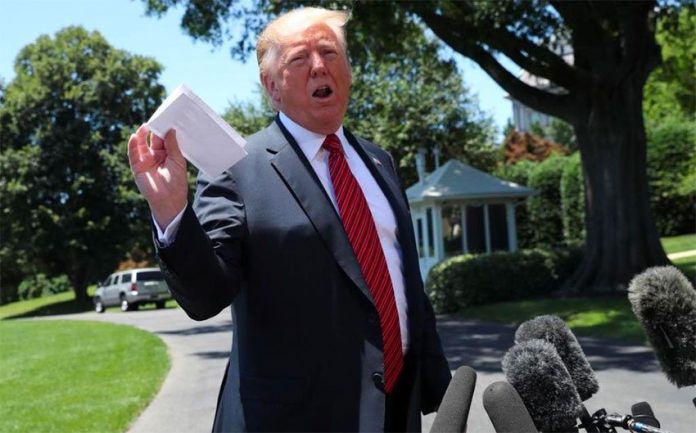
Trump holds up the agreement for reporters on Tuesday.

The so-called “secret” deal that Mexico reached with the United States as part of the new migration agreement — part of which was unintentionally revealed by President Donald Trump this week — was released yesterday by the federal government.

During an appearance in the Senate, Foreign Secretary Marcelo Ebrard gave lawmakers copies of the one-page “supplementary agreement,” which states that Mexico will take “all necessary steps under domestic law” to implement a safe third country agreement if the United States decides that measures to stem migration flows are not achieving the desired results.

The deadline is the third week in July.

As part of the June 7 bilateral agreement that ended Trump’s tariff threat, Mexico committed to deploying 6,000 National Guard troops to the southern border and agreed to the return of a greater number of asylum-seekers as they await the outcome of their claims in the United States.

Ebrard denied again yesterday that Mexico had entered into a secret agreement, telling senators that there was no commitment that he hadn’t already informed them about.

He said that discussions with the United States about the possible implementation of a safe third country agreement will begin after the expiry of the 45-day period.

However, the document states that the “United States and Mexico will immediately begin discussions to establish definitive terms for a binding bilateral agreement to further address burden-sharing and the assignment of responsibility for processing refugee status claims of migrants.”

“At a minimum, such agreement would include, consistent with each party’s domestic and international legal obligations, a commitment under which each party would accept the return, and process refugee status claims, of third-party nationals who have crossed that party’s territory to arrive at a port of entry or between ports of entry of the other party.”

The release of the document confirms what was already inferred from a photograph of part of the agreement’s text that was taken by a photographer on Tuesday as President Trump held it up before reporters.

On Monday, he tweeted about the unrevealed pact, writing that if “approval is not forthcoming, tariffs will be reinstated!”

After the release of the full text of the agreement, federal National Action Party Deputy Laura Rojas said there were still unanswered questions with regard to how much Mexico will have to reduce migration flows in order to avoid having to enter into a safe third country agreement, which the government had previously ruled out.

“The only thing that’s clear is the period of 45 days but we don’t know anything else. It’s them [the United States] who are going to set the parameters . . . Are they already agreed to or not? We don’t know that.”

Source: Milenio (sp) 

Death toll from Morelos semi accident rises to nine

0
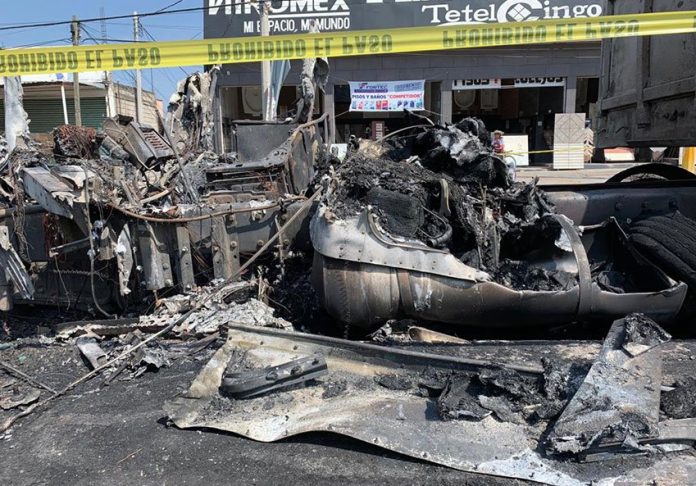
Wreckage of the semi after Wednesday's accident.

The death toll from the Morelos accident in which a semi’s brakes failed earlier this week rose to nine Thursday with the death of a 47-year-old man.

The semi collided with more than a dozen vehicles on the Mexico City-Cuautla highway on Wednesday morning after losing its brakes, initially killing six people and injuring 21. Three more people have died since.

One of the critically injured was a 30-year-old pregnant woman who was airlifted by helicopter from the scene of the accident to the Cuernavaca General Hospital, where she was placed in a medically induced coma. She remains in serious condition.

At least two of the people injured have been released from hospitals in Cuautla and Ocuituco.

A few hours after the accident, the state government announced that it planned to expropriate land to build an emergency escape ramp near the accident scene.

Yesterday, the federal Secretariat of Communications and Transportation (SCT) said its budget has the funds to build the ramp.

It conducted a topographic survey of the area last month and construction will start once the state has expropriated the land, it said.

Source: El Universal (sp)

Government’s auction of confiscated real estate set for June 23

0
Rancho Los Tres García, former home of a convicted narco
Rancho Los Tres García, former home of a convicted narco, is located in Naucalpan, México state, and is valued at 32 million pesos.

Confiscated real estate — one parcel housed a meth lab — goes on the block next week in another government auction.

The System of Administrative Allocation of Assets (SAE) has opened registration for the real estate auction that will take place on June 23 at Los Pinos, the former presidential home.

The 27 parcels are located in 11 states, while 10 are located in México state alone. All were confiscated by the Attorney General’s Office (FGR) or federal courts.

The total starting price of the properties is about 176.5 million pesos (US $9.2 million).

The cheapest is a lot in Culiacán, Sinaloa, priced at 215,100 pesos, while the most expensive is the Rancho Los Tres García in Naucalpan, México state, priced at over 32 million. It was confiscated from convicted drug trafficker Carlos Montemayor, father-in-law of Edgar “La Barbie” Valdez Villarreal, after the former was arrested in 2010.

This Cancún house is valued at 9.7 million pesos. Its narco-provenance is unknown.

Another property is part of the Centenario Ranch in Jilotepec, México state, which was confiscated after police found a methamphetamine laboratory there in 2011.

Anyone who wants to participate in the auction can buy passes until June 20. they can be purchased at SAE office and convenience stores across the country. After getting a pass, participants must then register at an SAE office.

Prospective buyers who want to participate by telephone can register at SAE offices before June 18, and will be required to leave a deposit of 20,000 to 500,000 pesos, depending on which items they wish to bid on.

Proceeds from previous auctions held by the SAE were directed towards aiding poor communities and addiction centers. The SAE did not say what the proceeds from the real estate auction will be used for.

Source: El Universal (sp)

Train slams into trailer after semi driver loses race in México state

0
Frame from security video shows the train pushing the trailer out of its path.

Another semi driver has once again tried to win a race against a train — and lost, this time in an urban area in the greater Mexico City metropolitan area.

Security cameras captured the semi traveling across a level crossing in the Rústica Xalostoc neighborhood of Ecatepec, México state, and almost winning the race.

But the train struck the back end of the semi-trailer, driving it sideways into a car, a school bus and a motorcycle that had stopped for the train on the other side of the crossing.

The collision also affected a nearby building with enough force to shake the camera mounted on it.

Police said one person suffered minor injuries.

Source: El Universal (sp)

Mexico’s poppy and heroin production down slightly but still at record highs

0
Mexico's poppy production remained high last year.

Poppy cultivation and heroin production remain at record-high levels in Mexico, according to the United States government.

The Office of National Drug Control Policy (ONDCP) said in a statement yesterday that an annual U.S. government estimate found that the area of land dedicated to poppy cultivation decreased by 5% from 44,100 hectares in 2017 to 41,800 hectares last year.

But the size of the area was the second highest recorded this decade and 298% above the low of 10,500 hectares estimated in 2012.

The ONDCP said that the potential for pure heroin production declined by 4% from 111 tonnes in 2017 to 106 tonnes last year. They were the only years in the last decade in which heroin production estimates have exceeded 100 tonnes.

Production last year was 31% higher than in 2016 and 308% above the lowest level estimated this decade – 26 tonnes in both 2012 and 2013.

Mexico continues to be the primary supplier of heroin to the United States, the ONDCP said, explaining that 91% of heroin seized by the Drug Enforcement Administration (DEA) in 2017 was determined to have originated in Mexico.

Six Mexican criminal organizations – the Jalisco New Generation, Sinaloa, Juárez, Gulf, Los Zetas and Beltrán Leyva cartels – have the greatest drug trafficking impact on the United States, according to the DEA.

“Poppy cultivation and heroin production in Mexico continue to threaten the United States,” the ONDCP said.

In 2017, the Centers for Disease Control and Prevention reported that 47,600 Americans died from overdoses involving opioids and that 15,482 of those deaths involved heroin.

“President Donald J. Trump is focused on stopping the trafficking of heroin and other dangerous drugs coming from Mexico.  He declared a national emergency on our southern border in part to ensure the safety of the American people from these deadly drugs,” the ONDCP said.

According to the Mexican government, cartels also ship fentanyl to the United States from 13 states.

The rising demand for the powerful synthetic opioid among U.S. drug users has been identified as the cause of plummeting opium gum prices in Mexico.

United States Secretary of State Mike Pompeo told senators Tuesday that during the migration tariff negotiations between U.S. and Mexican authorities last week there were also discussions about measures to stop the production and transit of illicit drugs.

“The joint declaration we signed was mostly focused on migration, but a good deal of the conversation was . . . about the traffickers’ desire to move whatever product will bring a market price that causes them to have an incentive to continue to do the things that disrupt so many lives here in the United States,” he said.

“We’ll try and take down these criminal enterprises between all of the elements of the U.S. government. We’ve donated equipment to the Mexican law enforcement, security forces; we’ve trained their officers to eradicate poppy and interdict drugs; we’ve provided them sniffing dogs. And yet, as you can see from the data today, many challenges remain.”

Source: Milenio (sp) 

Immigration chief who promised protective, caring policies resigns

0
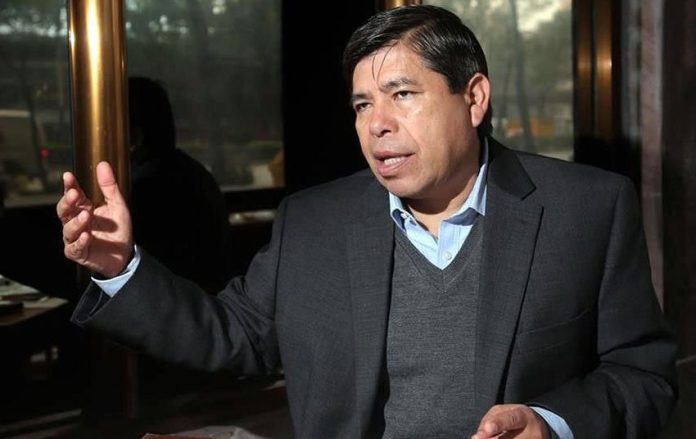
Guillén promised a kinder approach to immigration. Today, he resigned.
Guillén promised a kinder approach to immigration. Today, he quit.

Mexico’s immigration chief resigned today a week after the government reached an agreement with the United States to increase enforcement against undocumented migrants.

In a brief statement, the National Immigration Institute (INM) said that Tonatiuh Guillén López had presented his resignation to President López Obrador and thanked him for the opportunity to serve the country.

Guillén was sworn as INM commissioner on December 1, the same day that López Obrador took office.

A month earlier, Guillén vowed that Central American migrants would receive kinder attention during the López Obrador administration.

“We have to make the [immigration] institute much more protective, caring and humane,” he told the newspaper Reforma in an interview published on November 1.

Initially that was the case: in January the INM issued more than 10,000 humanitarian visas to migrants as part of a new government program that Guillén described as “super successful.”

“It’s really establishing a new paradigm in Mexico’s immigration policy that is based on Mexico’s laws and the country’s international commitments,” he said at the time, conceding that it wasn’t the “ideal scenario” for Donald Trump.

However, in more recent months, authorities started implementing stricter immigration policies amid increasing pressure from the United States to stop the flow of migrants from Central America.

The number of arrests and deportations increased and the INM stopped issuing humanitarian visas.

Human rights and migrant advocacy groups warned that the increasingly militarized approach to combating migrants’ transit through Mexico posed a threat to their rights, but the government agreed last Friday to implement even stricter enforcement as part of a deal to stave off tariffs threatened by the United States.

Among the commitments Mexico made were to deploy 6,000 National Guard troops to the southern border and to accept the return of a higher number of asylum-seekers as they await the outcome of their claims in the United States.

While Guillén hasn’t cited any reasons for his resignation, the government’s shift towards stricter migration enforcement appears the logical explanation.

“This really shows there’s a rift within the administration between the hard-liners, those who want to comply with Trump to avoid tariffs at all cost, and those who have qualms about militarized enforcement of immigration laws,” said security analyst Alejandro Hope.

Source: El Financiero (sp)