There is no evidence of mechanical malfunction in the crash of helicopter that killed the former governor of Puebla, said the Civil Aviation Authority (DGAC).
The agency revealed that an inspection of the helicopter’s two engines found they were functioning normally at the time of impact, although an internal memory system, which could have confirmed the engines’ status, was damaged in the crash.
Inspection of the rotors and transmission also failed to present any sign of malfunction.
The DGAC said all the damage to the helicopter was sustained on impact and there was no sign of a malfunction that could have caused the accident.
The accident occurred on December 24 just minutes after the helicopter took off from Puebla International Airport, killing governor Martha Érika Alonso and her husband — ex-governor of Puebla and Senator Rafael Moreno Valle, and an assistant and two pilots.
The crash has been controversial given that Alonso had been sworn in as governor just two weeks before after a bitter election contest whose results were challenged.
Transportation undersecretary Carlos Alfonso Morán Moguel called the accident “unusual,” citing the craft’s 60-degree, inverted, almost vertical fall.
National Action Party president Marko Cortés, leader of the political party to which the former governor belonged, went so far as to state that the crash had not been an accident, claiming that there had been a “suspicious silence” from the federal government and little investigation.
He added that the crash had occurred on a day with good weather and that the helicopter was in the hands of “expert pilots.”
In February, federal authorities released tapes of communications between the helicopter and the control tower at the Puebla airport, revealing that the pilot did not report problems with the aircraft or any failures in the moments prior to the crash.
The DGAC said it will continue its investigation, which is being assisted by experts from the Canadian Transportation Safety Board and the Italian Agency for Flight Safety, among others.
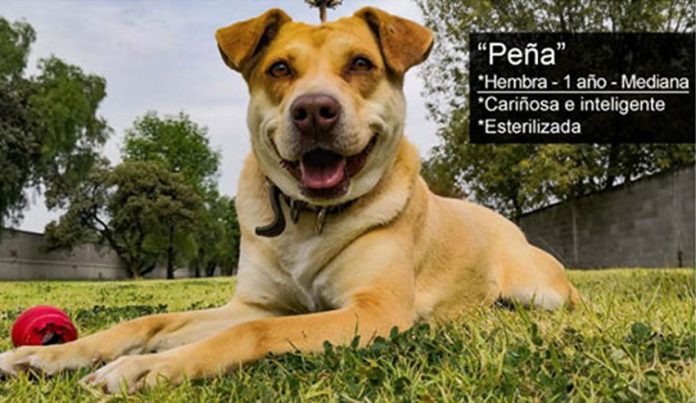
Looking for a dog? Uamy, El Norteño, Ferry, Santo, Tlahua and Neza are among 23 stray dogs that have been rounded up by employees of the Mexico City Metro and are now ready for adoption.
The dogs are being housed in the Canine Transfer Center, a space created through donations that has allowed the Metro system to protect the animals, according to a Metro press release.
“The Canine Transfer Center is a high-quality space that gives our transitory guests the quality of life they deserve,” reads the release. “It has a veterinary clinic, and is a space specifically designed for them where they are taken after being rescued by Civil Protection.”
The center is located on Avenida de las Culturas in Colonia El Rosario in the borough of Azcapotzalco, near the Colegio de Bachilleres 1 Metrobús station. Visitors should call (55) 5627 4142 before visiting.
Anyone wanting a dog must fill out a form and present identification and proof of address. The prospective dog owner must have their home inspected to make sure it fulfills the center’s requirements.
In preparation for being put up for adoption, the dogs are given rabies vaccines and are spayed or neutered.
Each dog has received a name based on the station in which it was found: Acato and Cata were rescued from the Acatitla station, while Ferri was rescued from Ferrería.
One of the dogs, Pazito, was rescued from the Talleres La Paz station in very bad condition with serious injuries to his front paws.
“Now he has completely recovered and is waiting in the Canine Transfer Center for a new family to adopt him,” said the Metro press release.
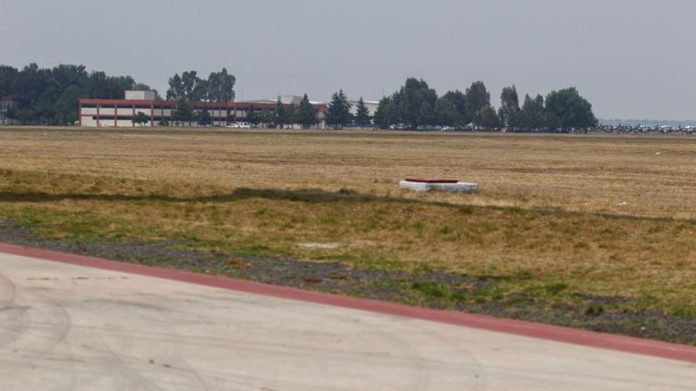
The airport site will remain quiet until permits are issued.
A federal judge yesterday ordered the definitive suspension of the new airport in México state until all necessary environmental permits have been obtained.
Both court orders were issued in response to injunction requests filed by the #NoMásDerroches (No More Waste) Collective, a group made up of civil society organizations, law firms and more than 100 citizens.
The collective said in a statement that the definitive suspension order obliges authorities to refrain from continuing with the construction of the airport until permits have been obtained that guarantee that the project will not damage the environment or threaten any relics located at the air force base site.
“The injunction granted by the federal judge seeks to protect the environment and assets [of] . . . archaeological, historical and paleontological heritage . . .” #NoMásDerroches said.
The National Institute of Anthropology and History said this week that the remains of mammoths, saber-toothed tigers and other prehistoric megafauna are buried beneath the ground at the airport site.
The #NoMásDerroches Collective acknowledged that the suspension order is subject to legal challenge by the government but is confident that it will be respected while it remains in force.
“If the government moves a brick, the official who does so will be committing a crime,” said Gerardo Carrasco, a lawyer for Mexicans Against Corruption and Impunity (MCCI), one of the collective members.
After the first suspension order was issued, Communications and Transportation Secretary Javier Jiménez Espriú said that work at the airport can’t stop because it hasn’t even started, adding that he expected environmental approval to be granted by the end of the month.
He said the government “completely agrees” that construction cannot begin until the relevant permits have been issued.
The secretary said that he hoped the project won’t have to stop once it is under way but with #NoMásDerroches having filed a total of 147 injunction requests against the airport, that remains a real possibility.
In addition to MCCI, other collective members include the Mexican Employers Federation, the Mexican Human Rights Commission and the General Council of the Mexican Legal Profession.
By handing down a second ruling against the airport project, “the federal judicial power once again demonstrates to citizens that it is a real counterweight to hasty and unjustified decisions of the executive power,” the group said.
US President Donald Trump announced the agreement in a tweet Friday evening.
Mexico and the United States reached an agreement Friday to end the threat of a 5% tariff on Mexican goods that was to go into effect Monday.
U.S. President Donald Trump announced at 7:30pm CDT that the two countries have signed an agreement and that the tariffs are “hereby indefinitely suspended.”
Trump said Mexico “has agreed to take strong measures to stem the tide of migration through Mexico, and to our southern border. This is being done to greatly reduce, or eliminate, illegal immigration coming from Mexico and into the United States.”
The chief measures in the agreement are the deployment of the National Guard to the southern border and allowing migrants seeking asylum in the U.S. to remain in Mexico while they await a decision from authorities in the U.S., according to Foreign Affairs Secretary Marcelo Ebrard.
He said Mexico agreed to deploy the National Guard to the southern border and elsewhere in the country starting Monday with the intention of reducing illegal immigration, while it will offer job opportunities and access to education and health services to migrants seeking asylum in the U.S.
A team of negotiators headed by Ebrard has been in talks with U.S. officials, including Vice President Mike Pence and Secretary of State Mike Pompeo, in Washington since Wednesday.
Mexico had offered earlier to send 6,000 members of the National Guard to the southern border to deter the entry of undocumented migrants.
The three students present their air quality findings.
A study has found that air pollution in Cancún from lead, zinc and other heavy metals is at times similar to that in Mexico City and Madrid, Spain.
Completed by three students of the University of the Caribbean, the study determined that cars, industry and environmental factors are responsible for the poor air quality in the resort city.
Presenting their findings yesterday, Mara Flores Moreno, Cinthia Pech Perera and Denisse Sánchez Toriz said they measured air quality at 40 different locations.
Heavy metals were detected in the air at every single site, and at certain times of the day the levels exceeded those considered safe by environmental authorities.
The students said that they detected cadmium, nickel, copper and boron in the samples they collected in the west of the city, while air in the downtown was found to contain copper, zinc, lithium, chromium and lead.
Lead, lithium, zinc and boron were detected in Cancún’s hotel zone.
The environmental engineering students recommended the installation of at least three permanent air-quality monitoring stations in different parts of the city.
According to federal regulations, all cities with a population greater than 500,000 are required to have such stations. But despite close to one million people calling Cancún home, the city has none.
At yesterday’s presentation, state Environment Secretary Alfredo Arellano Guillermo acknowledged that Cancún has an air pollution problem although he said that the situation wasn’t critical.
He said that later this month he will present a new air quality management plan intended to reduce the quantity of contaminants entering the atmosphere in Cancún and across the state.
The plan will promote the planting of native trees and greater use of bicycles and public transit among other measures.
The tank's a bit wonky but at least it has one — and seat to boot.
The various activities we engage in throughout our lives stem from either desire or necessity and are either voluntary or mandatory, period.
The grey areas could be when your partner “requires” something of you, or when your mom “made” you brush your teeth twice a day. However, most of our adult time on this planet can be described as a continual series of choices, some great, some not so great, and of course the disastrous ones we all want to forget.
But, throughout this life of mostly free choices, we all adhere to the mandatory portion of daily life.
Thus regardless of how we have meandered along the uncharted course of our lives there is a unanimity which pervades all of humanity — a single point of mind which no one can disavow. This irrevocable imperative is as compulsory as eating, drinking, breathing and sleeping, and none of us has any choice in this matter.
Of course, I am talking about “answering the call of nature.” Yes, the end process of the consumption of that excellent Italian dinner, or the more bothersome end process of bad street food; if it goes in, sooner or later it comes out.
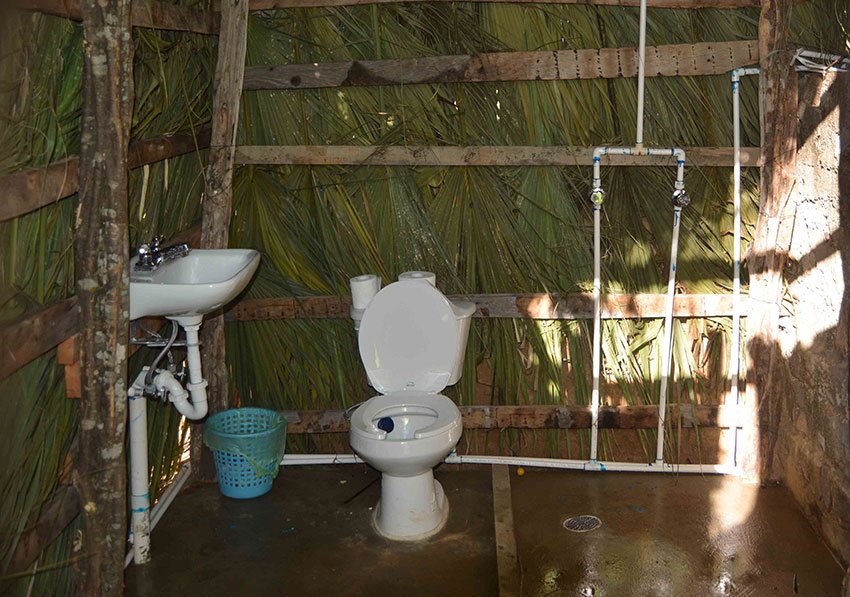
Dual-purpose toilet and shower. The empty trash container is a bonus.
I like to think of myself as a person who cares about others. Someone who might always have the back of those people I care about. At the moment I’m thinking about the backside of such people. Because here in Mexico, the facilities which accommodate this very natural process range from posh to pitiful, but can quickly deteriorate into the mortifying.
I have heard stories about primitive bathrooms in Asia and many other places, but from experience I know that it’s hard to imagine anything much worse than a men’s room in a sleazy Mexican cantina.
Many of us who live in Mexico have been in the marble and mirrored throne rooms of various resorts around the country, but fewer of us ever get to the spider infested outhouse in a primitive village. In this country just the daily function of “answering nature’s call” can be a cultural adventure all on its own, and the exercise holds many mysteries.
A clean bathroom has always been my No. 1 goal. And my No. 2 goal as well.
Historically speaking, north of the border the final stages of processing nutrients has been a brief respite from the humdrum daily existence we call life. Why else would there be magazine racks in restrooms? And of course, that’s why is it called a restroom.
Somewhere in the dark past of my squandered youth, I helped a friend excavate a 140-year-old outhouse pit in search of “pumpkin seed” whisky flasks and Acme beer cans.
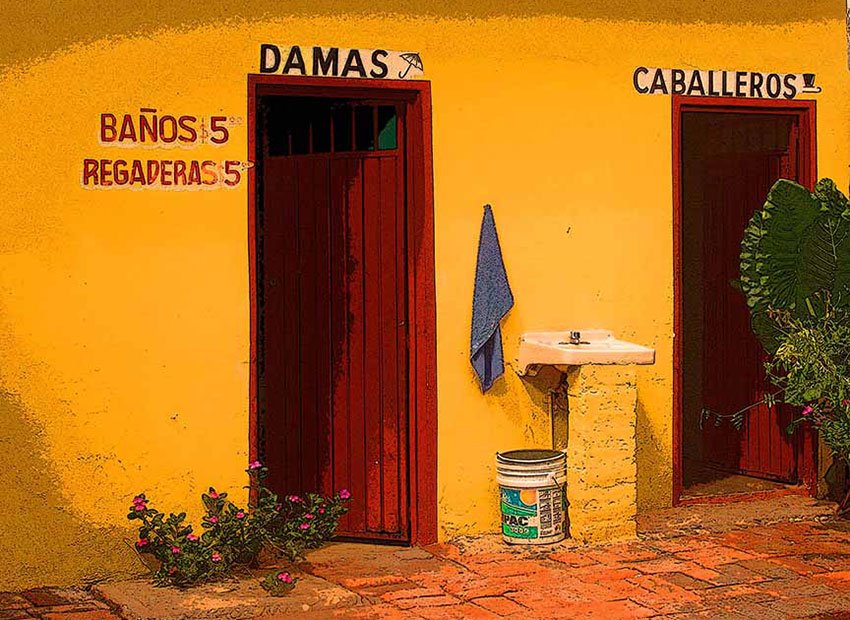
Looks promising from the outside.
This bit of archaeological burrowing confirmed my belief that the ubiquitous outhouse of yesteryear in North America was a type of short-term sanctuary for those ensconced within its rustic walls. A place of peace and solitude where the occupant could have a couple of beers or a few long pulls off the whisky flask, avoiding the critical looks of others.
Or just thumb through a Sears catalog before removing a couple of pages for you know what.
However, here in Mexico that semi-private room where you answer nature’s call is referred to as a lavabo or baño or even el sanitario. Which very clearly shows the Mexican culture does not consider the throne room to be a place of quiet contemplation or repose. In Mexico it is strictly the business of the body, which really clears up a bit of the mystery for me.
That all-important issue of whether the toilet seat should be left up or down is a non-issue in many Mexican bathrooms, because many Mexican bathrooms do not have a toilet seat.
When you come across a toilet without a seat, don’t fret, it is meant to be that way. The basic porcelain fixture is all that is required to take care of business. And further, the lack of a seat assures that no one gets comfortable and decides to scroll through their phone for the next 20 minutes; it is not a restroom, it’s a toilet room.
And what about the practice of never flushing the used toilet paper? Yuck, who wants to spend time in a cramped space with a bucket of soiled cellulose? Yes, it might be a necessity because of the pipes.
On the other hand, I believe this is just another ploy to keep anyone from lingering too long in the lavatory. However, there is something of a precedent for this questionable practice in that, 50 years ago, Mexican toilet paper had the consistency of kraft paper and most likely plugged more than one waste pipe.
And speaking of TP, always be sure to carry a bit with you to avoid the shock of an empty roll at that critical moment, an exciting event which still raises the stress level of the unprepared from time to time.
When traveling, or enjoying some of the more primitive settings in this colorful country, Acme Expat Immersion Therapy and Attitude Modification Program alumni not only carry their own, they also know that asking for a baño or sanitario can be an adventure in and of itself.
And at times the term sanitario can be a considerable misrepresentation of what you are about to face. The first clue is when you are handed the ubiquitous five-gallon bucket and are shown where to fill it with water prior to venturing into the “facility.”
If you are lucky, you will go to a reasonably clean, ceramic commode, minus the seat and tank, which requires the bucket for a mostly complete evacuation of the fixture. If you find the “facility” in a loathsome state of over use, exchange the bucket for a shovel.
And that’s the bottom line!
The writer describes himself as a very middle-aged man who lives full-time in Mazatlán with a captured tourist woman and the ghost of a half wild dog. He can be reached at buscardero@yahoo.com.
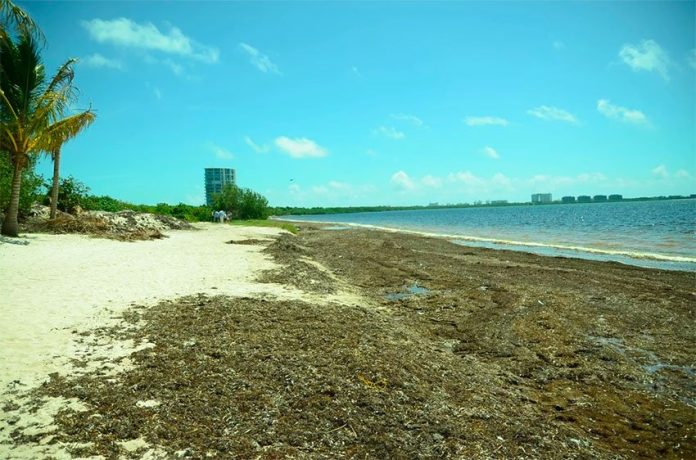
Massive amounts of sargassum are expected to wash up on Caribbean coast beaches in the coming days and weeks.
According to the Sargassum Early Warning System, a significant quantity of the seaweed is currently approaching Quintana Roo and is predicted to affect 500 kilometers of coastline from Isla Blanca north of Cancún to Xcalak in the extreme south of the state.
Cancún, Isla Mujeres, Puerto Morelos, Playa del Carmen, Cozumel, Tulum and Mahahual are among the destinations that are expected to see large amounts of sargassum over the weekend.
In Cancún, municipal authorities predict that 1,620 cubic meters will invade the city’s beaches this month.
That amount would be almost triple the 600 cubic meters that arrived last month and more than five times the quantity that washed up in April. Authorities responsible for collecting the sargassum, including the navy and the federal Secretariat of the Environment, are already struggling to keep beaches clean.
Lenin Amaro Betancourt, president of the Riviera Maya Real Estate Professionals Association, estimated that the arrival of sargassum this year has already cost the economy US $200 million and predicted that as many as 2,500 jobs could be lost as a result of the downturn in tourist numbers.
With their livelihoods under threat and faced with the inability of authorities to cope with the large quantities of sargassum arriving on Quintana Roo beaches, hotel owners in the state are implementing their own measures to combat the unsightly and smelly seaweed.
In Puerto Morelos, 15 hotel owners started an anti-sargassum initiative that has now caught the attention of the United Nations.
Under the Puerto Morelos Protocol, a diversion barrier has been installed off the coast that prevents 75% of sargassum reaching the beach and an industry that makes use of the seaweed has been developed.
Hotel owner Carlos Gosselin Maurel said the United Nations is interested in implementing the strategy in other Caribbean countries whose coastlines are plagued by sargassum.
Gosselin already met once with UN officials and will attend another meeting this month with the organization’s Caribbean-based representatives.
“We have to speak with the Barbados ambassador to the UN, who deals with Caribbean problems, and in that way we’ll be able to export the [anti-sargassum] protocol . . .” he said.
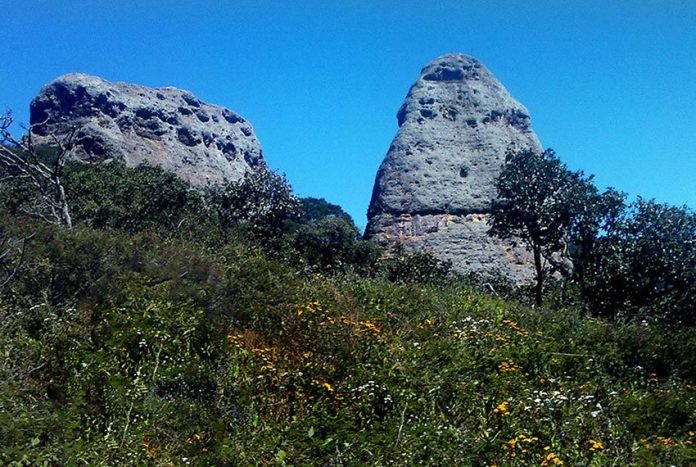
A few of the many large rocks in Quila frequented by climbers.
Many years ago a friend spoke to me of the Great Rocks of Quila: “They are simply a climber’s dream,” he said. “Too bad they are located in the middle of nowhere,” he added, “but then again, what a gorgeous place for camping . . . just the sort of place you would love, John!”
I was hooked, of course, and started studying the best way to get to the Sierra de Quila, located about 75 kilometers southwest of Guadalajara.
Then, still not sure how to get there, off we went over dusty dirt roads, asking for directions at every farm house and backtracking frequently. Finally we ended up camped on a bluff overlooking a vast forest dotted with several truly impressive rock formations with sheer faces 100 meters high, a rock climber’s dream indeed.
During our stay, we hiked through the pine forest to several of the monoliths and along the way, discovered spectacular multicolored meadows bursting with thousands of wildflowers. We also came upon what I considered a very ordinary-looking turtle, but when I published a photo of it years later on the internet, it raised a great deal of excitement.
“That was a Terrapene nelsoni, a spotted box turtle, John! They are extremely rare and you were very lucky to see one. I want to organize a hunt to find out if there are any more left in the Sierra de Quila.”
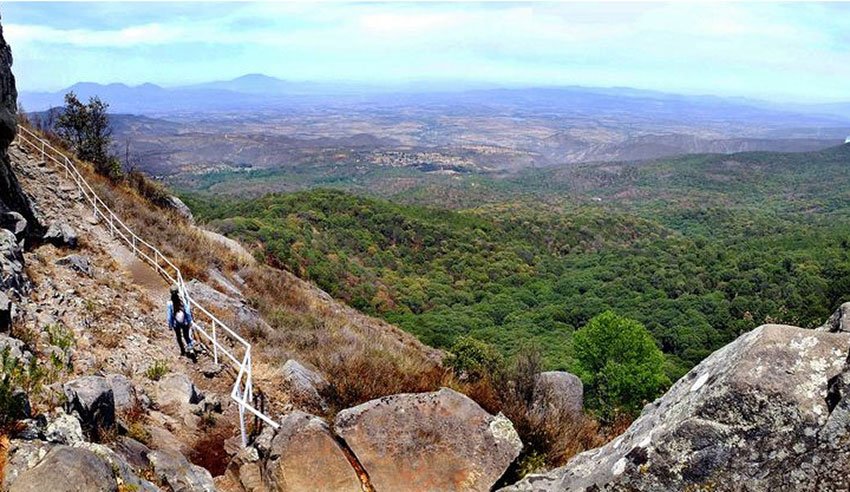
Panorama from Huehuentón Peak, 2,565 meters high.
Fortunately, over the passing of years, the Sierra de Quila had been declared a protected area and reasonably drivable roads had been built offering access to it. Today there are signs showing you where to go, several designated camping areas and even a few rangers to make sure visitors follow the rules.
Not long ago, I revisited the Quila reserve, this time quite easily, driving from Guadalajara to the little town of Tecolotlán, which means Place of the Owls. From here a long and winding road takes you north into the park. Even before leaving Tecolotlán we learned all about Quila’s attractions at the park’s little office in town.
“There are 11 waterfalls in Quila,” we were told, “the most spectacular being the gorgeous Cascada de Santa Rosa, with a vertical difference of 470 meters from top to bottom. And then we have mountain peaks like El Huehuentón (2,565 meters high). As for animals, we have jaguars, peccaries, pumas, jaguarundis, white-tailed deer, skunks, coatis and squirrels plus another 285 species of animals, but we are especially proud of our axolotls, which are famous for their ability to regenerate lost limbs.”
Soon we were out in the forest, wandering among gorgeous, delicate Lumholtz’s pines (Pinus lumholtzii), visiting several of the magnificent waterfalls and exploring the extensive ruins of La Máquina, a water-powered sawmill which must have been truly impressive in the days before electricity was available. It soon became obvious to us that every inch of this forest is dramatically beautiful and refreshing to walk or drive through.
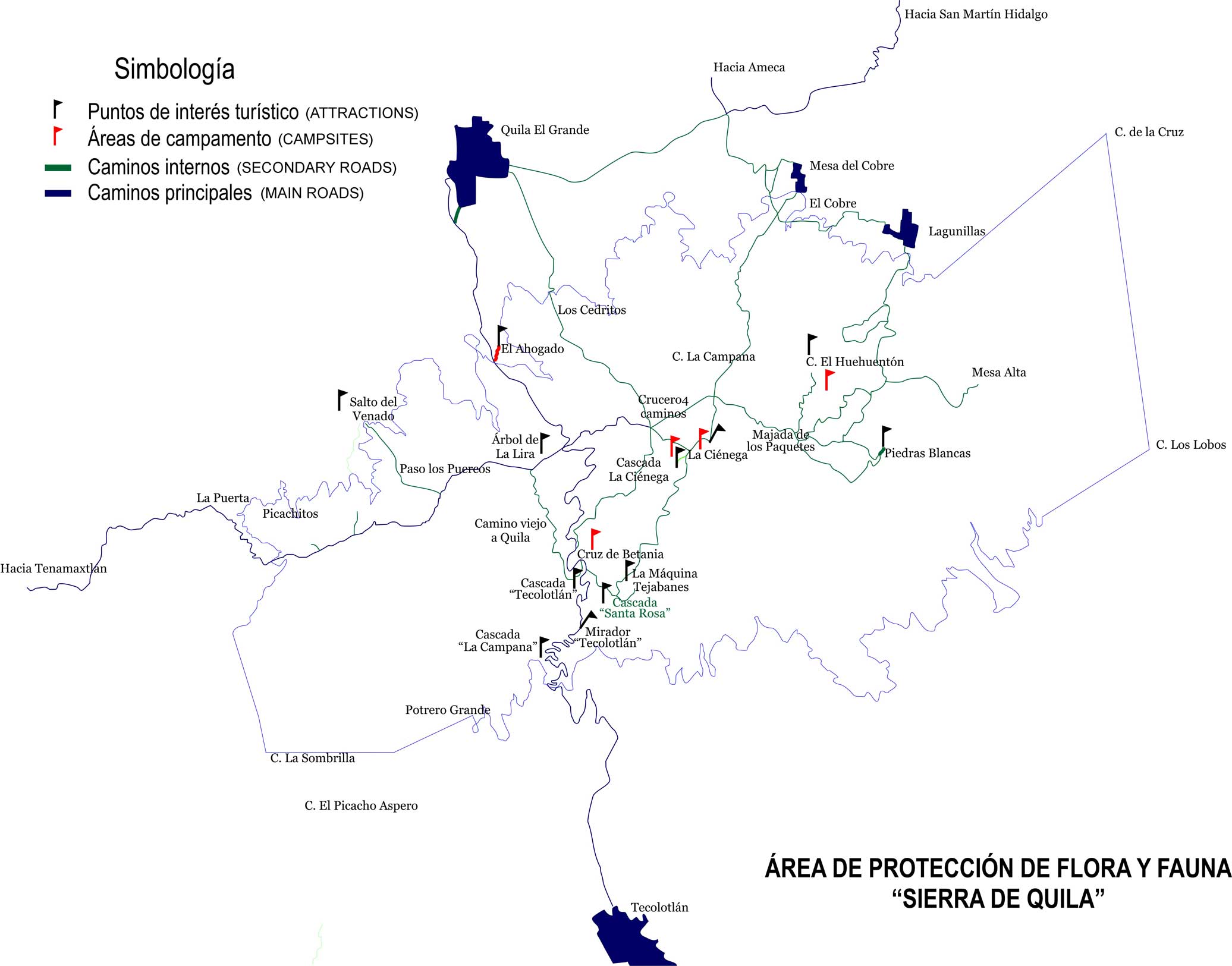
The protected area covers over 15,000 hectares, but it has many roads and you can find your way around easily using a map available here. The park has four designated campsites featuring running water as well as clean and working toilets.
One of the camping areas, called La Ciénega, also has an interesting little museum. Here, serenaded by a Mexican whip-poor-will, I spent a night under the stars with friends who promised to guide me to nearby Huehuentón Peak via a trail through the woods.
Enjoying the view from one of Quila’s Piedras Blancas.
The next morning, we started our hike by crossing a bridge over a small stream behind the museum. We walked along on a thick, soft carpet of pine needles through which the first tiny wildflowers of the rainy season were poking their heads. At two points we intersected with a dirt road by which you can get close to Huehuentón Peak by car, without the exercise.
However, you’d also miss fascinating creatures we spotted along the way, such as a mother scorpion carrying her babies on her back and a “National Congress of Ladybugs” all meeting on one plant — not to mention the breathtakingly beautiful forest.
Part of our breath, of course, was taken by the rise in altitude from 2,146 meters to 2,565 meters. Nevertheless, having loped along at an easy pace, we covered the distance from La Ciénega to the peak in two hours.
The last part of the route is up rustic steps to a gap between two tall rocks where our leader shouted to us: “Better put on your coats before you get up here — it’s freezing!”
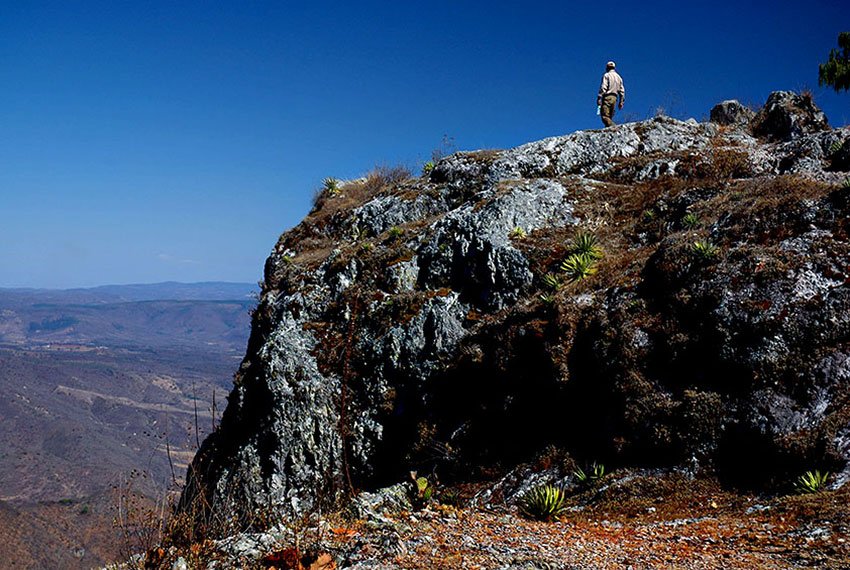
It was hard to believe, but true. On the other side of the gap, the wind was howling and the view was overwhelming. A short scramble with a guide rail for protection got us up to the top of a narrow pinnacle where there is barely room for a repeater antenna and a tiny one-room house where a ranger keeps watch for forest fires 24 hours a day.
During our brief visit, however, it was a movie he was watching! Fortunately, we saw no smoke on the horizon that day, only a 360-degree view of one of the most beautiful forests you could ever imagine.
[wpgmza id=”204″]
If you would like to visit the Sierra de Quila Nature Reserve, the drive should take a bit less than three hours either from Guadalajara or the Lake Chapala area. Because some roads leading to the park are unusually steep, I recommend that you go there via the town of Tecolotlán.
Just ask Google maps to take you to “La Cienega, Sierra de Quila,” where you’ll find the park headquarters, museum and a great camping area, with Huehuentón Peak only 2.6 kilometers to the northeast as the crow flies.
By the way, on your way to La Ciénega from Tecolotlán you’ll pass the impressive Cascada de Santa Rosa. Have a great trip!
[soliloquy id="80757"]
The writer has lived near Guadalajara, Jalisco, for more than 30 years and is the author of A Guide to West Mexico’s Guachimontones and Surrounding Area and co-author of Outdoors in Western Mexico. More of his writing can be found on his website.
Mujica, left, and Sánchez have been arrested for human trafficking.
Two advocates for migrants’ rights were arrested for human trafficking Wednesday, while federal finance officials yesterday blocked the bank accounts of 26 people allegedly involved in the same crime.
Irineo Mujica, director of a migrant advocacy organization that has helped several large migrant caravans cross Mexico, was arrested in Sonoyta, Sonora, at about the same time activist Cristóbal Sánchez was detained outside his home in the Mexico City borough of Xochimilco.
The federal Attorney General’s Office (FGR) said in a statement that Federal Police arrested the two men after warrants were issued by a judge in Chiapas.
The department said it received complaints in April and May from Honduran nationals against two Mexicans who, in exchange for payment, promised to bring them into the country and take them to the northern border in order to illegally enter the United States.
Mujica, who heads Pueblo Sin Fronteras (People Without Borders) in Mexico, faces charges of illegally transporting migrants, including children and adolescents, while Sánchez is accused of bringing undocumented migrants into the country, the FGR said.
Both men were transferred to a prison in Tapachula, Chiapas, on Wednesday afternoon.
Pueblos Sin Fronteras condemned the arrests in a statement on social media.
“[Mujica and Sánchez] were arrested by a Mexican government that promised to defend human rights but in reality is bending to the pressure of the anti-immigrant government of the United States,” it said.
“It’s not a coincidence that Irineo and Cristóbal were arrested the same day as the Mexican secretary of foreign relations, Marcelo Ebrard, met in Washington D.C. with United States Vice President Mike Pence and Secretary of State Mike Pompeo within the framework of the threats to increase tariffs on Mexican products . . . “
The advocacy group said that both men have defended the rights of migrants for more than a decade.
“Irineo is capable of taking off his own shirt to give it to a migrant brother and Cristóbal has always looked out for human rights as a result of his strong convictions and never for any other reason,” it said.
A day after the arrests, the finance department said in a statement that the Financial Intelligence Unit (UIF) had frozen the accounts of 26 people for their alleged participation in the trafficking of migrants and the illegal organization of migrant caravans.
The SHCP said that while caravans were traveling through Mexico between October 2018 and June 2019, the UIF identified a group of people who made “unusual” transactions from accounts in Chiapas and Querétaro to several countries, “including some considered risky jurisdictions by the Financial Action Task Force.”
It also said that a series of financial transfers from Querétaro to six northern border cities – Tijuana, Nogales, Ciudad Juárez, Ciudad Acuña, Piedras Negras and Reynosa – were detected.
The transferred funds originally came from El Salvador, Honduras and Guatemala – the three largest migrant source countries – as well as Cameroon, the United States and England, the SHCP said, stating it believed the payments were made in exchange for smuggling migrants and that criminal complaints will be filed.
The crackdown on the alleged people smugglers comes as Mexico continues to negotiate with the United States over new tariffs threatened by President Donald Trump.
The U.S. president said on May 30 that he will impose a 5% tariff on all Mexican exports from June 10, and that the duties will increase by an additional 5% at the beginning of subsequent months if Mexico doesn’t take action to reduce or eliminate migrant flows.
Mexican officials yesterday committed to sending 6,000 National Guard troops to the southern border, a move they said would bring an immediate reduction to the large number of Central Americans traveling through Mexico to the United States.
It appears that the commitment may have gone some way to appeasing Trump, who wrote on Twitter today:
“If we are able to make the deal with Mexico, and there is a good chance we will, they will begin purchasing farm and agricultural products at very high levels, starting immediately. If we are unable to make the deal, Mexico will begin paying tariffs at the 5% level on Monday!”
It remains unclear what he meant with his reference to purchasing agricultural products.
It seems even cows like to take a bit of time off and enjoy a visit to the beach.
A Webcams de México camera caught the vacationing cow at Playa Blanca in San Carlos, Sonora.
The webcast shared by the service on social media shows the cow taking a stroll on the beach and wading occasionally into the shallow waters, perhaps looking for a respite from the heat.
— Webcams de México (@webcamsdemexico) June 4, 2019
“Have you ever seen a cow enjoying the beach? We found an acua-vaca [cow is vaca in Spanish] swimming in the sea off San Carlos, Sonora!” the webcam service wrote on Twitter.
The cow became an instant star on social media, where one commenter asked: “What does a vaca do at the beach? Go on vaca-ción!”
Others gave the beach-going cow nicknames, with the most popular being vaquita marina, in reference to the endangered vaquita porpoise endemic to a small area of the Gulf of California.