Home Blog Page 1860

Woman to stand trial for beating that left neighbor a paraplegic in Playa del Carmen

0
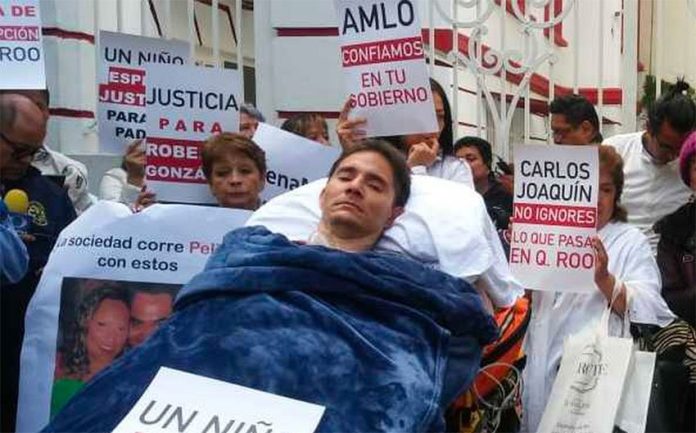
González, victim of a beating that left him a paraplegic, at yesterday's hearing.

Two years after the fact, María Fernanda Salcedo Medrano faced a judge yesterday for the first time to answer for a beating that left a neighbor a paraplegic.

Both Salcedo and her husband, Rodrigo Galán, are alleged to have beaten Roberto González in 2017 in a residential neighborhood of Playa del Carmen, Quintana Roo, an incident that was captured on tape by video surveillance cameras.

Salcedo did not make a statement at yesterday’s hearing but family members of the victim said they will produce sufficient evidence to link her to the attack.

González also attended the audience to testify, arriving in an ambulance accompanied by friends and family.

The victim’s wife, Blanca Rosalía Pérez Andrade, said she hoped the trial resulted in justice and the payment of damages for her husband’s injury. She also blamed the new justice system for the slow pace of the investigation.

“As Roberto’s family, from day one we have insisted and followed up on our denouncements, court dates, audiences and rulings. We have fully cooperated with the investigation and we have very strong evidence. Unfortunately, the new justice system heavily supports criminals, and until absolute guilt is demonstrated they are not going to do anything.”

Salcedo had been subpoenaed several times before but was excused on account of medical problems, although witnesses said she has been in good health.

Salcedo’s husband has not yet appeared before a judge due to an official complaint he filed against the proceedings, but the victim’s lawyers expressed confidence that this barrier will soon be tossed out.

In August of last year, the newspaper El Universal reported that Galán, if found guilty, could face more than 19 years in prison for his role in the beating, according to a statement by the Attorney General’s Office.

The victim was allegedly attacked by Galán after he complained to Salcedo about the couple’s dog, which had been attacking passersby.

Source: Milenio (sp), Noticaribe (sp), SIPSE (sp), El Universal (sp)

Big Pacific swell causes minor flooding in Acapulco

0
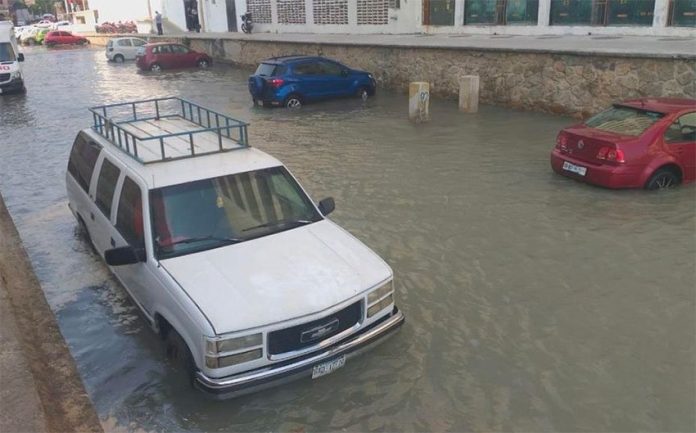
Pacific swell floods a street in Acapulco.

A big swell on Mexico’s Pacific coast caused minor flooding in Acapulco, Guerrero, yesterday afternoon.

The state Civil Protection office said sea water flooded El Morro beach and in a matter of minutes poured on to Juan de la Cosa street, between the Emporio and Playa Suites hotels in the city’s Golden zone.

Municipal police and firefighters responded and assisted residents and employees of the nearby hotels to remove at least five vehicles from the flooded area. No losses or damages were reported.

The swell — mar de fondo in Spanish — has been impacting Acapulco and other areas of the Pacific coast for the last few days, particularly at Santa Lucía bay.

Civil Protection warned that conditions will remain unchanged at least through today.

Source: Reforma (sp), Milenio (sp)

Unhappy citizens tie mayor to a post in Chiapas town

0
The hapless mayor of Siltepec is bound to a post.

A working visit to several towns in the municipality of Siltepec, Chiapas, became a hostage situation yesterday when residents tied the mayor to a post.

Pedro Damián González Arriaga traveled to the town of La Laguna, among others, to assess the needs of his constituents.

Residents requested welfare benefits and the paving of two kilometers of the town’s roads, but González explained that such an investment would cause an imbalance in the municipality’s budget.

The mayor offered to pave one kilometer of roads instead and to work toward obtaining enough resources to meet the town’s demands.

González returned to his office but was followed by a group of unhappy residents from several towns, who grabbed him and at least four municipal staff and tied the mayor to a post in the main square of Siltepec.

[wpgmza id=”190″]

The protesters told reporters that they were fed up with the mayor failing to meet the commitments he made while on the campaign trail, which included investing in public infrastructure and paving, among other public works projects.

They also accused González of using public monies to embellish municipal headquarters.

The mayor was treated in the same manner about three weeks ago but this time residents threatened to escalate their actions by shaving his head “as if were a sheep” and parading him around town if he failed to meet their demands and fulfill the promises he made.

Source: Milenio (sp), Reforma (sp), MVS Noticias (sp)

French-trained detectives go to work as Mexico City violence at ‘crisis’ levels

0
Godoy: Mexico City in crisis of violence.

Violence in Mexico City has reached “crisis” levels, the capital’s attorney general declared yesterday, while revealing that murder investigations have been deemed ineffective by a team of French homicide investigators.

Speaking at an event to mark the conclusion of a training course offered to Mexico City police by French forensics experts, Ernestina Godoy said, “we have a crisis situation in the city in terms of violence that is reflected in the number of intentional homicides” that are being recorded day by day.

There have been several incidents of gun violence on the streets of the capital in recent weeks including an attack in the notorious neighborhood of Tepito last Monday that left three people dead and another the next day in the trendy Condesa district that killed two.

In the context of rising murder numbers and low prosecution rates, a French homicide investigation unit traveled to the capital to meet with investigators, assess their work practices and provide them with forensic training.

After a two-month visit, Godoy said, the French team presented authorities with a damning four-page report about the homicide investigation processes followed by Mexico City officials.

It was determined that the methodology used by investigators to conduct murder probes “didn’t help at all” to solve the crimes, the attorney general said.

“That’s why our rate of solving homicides is so low,” she added.

As part of a strategy to remedy the situation, Godoy inaugurated yesterday five new investigative units made up of 193 detectives who were trained by French police.

The units will be based in the boroughs of Iztapalapa, Tlalpan, Gustavo A. Madero, Cuauhtémoc and Benito Juárez.

The attorney general’s declaration of a security “crisis” in Mexico City follows a warning from the United States to its citizens about dangers in the capital.

“There is a serious risk from crime in Mexico City,” the Overseas Security Advisory Council (OSAC) said in a report published this month.

“The general crime rate in Mexico City is above the U.S. national average, and crime varies widely. The low rate of criminal convictions contributes to the high rate of crime. Although there is no pattern of criminals specifically targeting foreign or U.S. businesses/personnel, criminals will target anyone perceived to be lucrative and vulnerable,” the report continued.

“Criminals select victims based on an appearance of prosperity, vulnerability, or a lack of awareness. Armed robbery, kidnapping, car theft, credit card fraud, and various forms of residential/street crime are daily concerns.”

Statistics published last week showed that robberies of businesses in the capital increased 54% to an average of 70 cases per day between December and March, the first four months of the new Mexico City government.

Mayor Claudia Sheinbaum predicted yesterday that crime rates will begin to fall in June or July once a new crime surveillance system is in place and the city’s police force takes possession of new police cars.

“. . . We’re working hard; I devote two hours a day, Monday to Sunday, to improving security conditions. We have a project, a program and the desire [to change the security situation],” she said.

However, Sheinbaum said last month that Mexico City is 10,000 police officers short of being able to effectively guarantee its citizens’ safety.

The worsening security situation in the capital is reflective of a wider phenomenon in Mexico.

A record 9,549 homicide cases were recorded across the country in the first four months of 2019, according to the National Public Security System (SNSP), a 3% increase compared to the same period last year.

Colima, Baja California, Chihuahua and Guanajuato recorded the highest per-capita murder rates.

Source: Milenio (sp), El Universal (sp) 

Mexico, UN economic commission present regional development plan

0
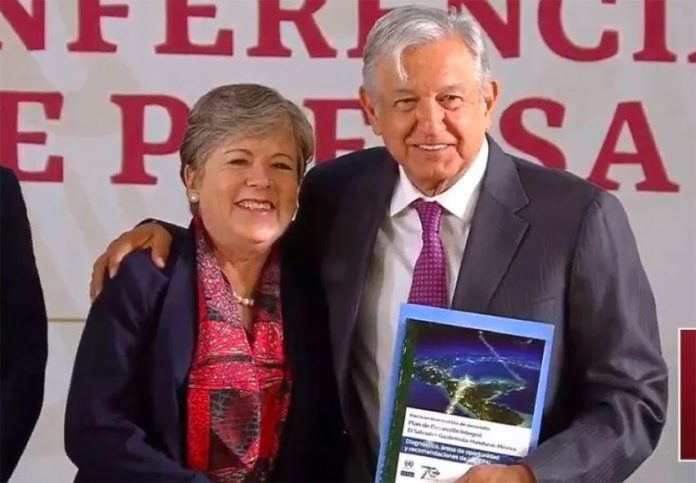
Bárcena and López Obrador announce new development plan.

The federal government and the United Nations today presented a regional development plan designed to improve economic and social conditions in southern Mexico and Central America and stem migration to the United States.

Foreign Affairs Secretary Marcelo Ebrard and Alicia Bárcena, executive secretary of the UN Economic Commission for Latin America and the Caribbean (ECLAC), offered details about the Comprehensive Development Plan at this morning’s presidential press conference.

“This is a roadmap of what we have to do to change the reality in the south of Mexico, Guatemala, Honduras and El Salvador,” Ebrard said.

The foreign secretary said that ECLAC drew up the plan in “record time” with the collaboration of Mexico and the three Central American countries. Its implementation “is a priority for this government,” Ebrard added.

The plan aims to address unemployment and violence in the region, which are the primary causes of migration.

Tens of thousands of people from Guatemala, Honduras and El Salvador have fled their countries in recent months to escape poverty and violence. Many are stranded in Mexico’s northern border cities while they await the opportunity to claim asylum in the United States.

Bárcena said the development plan is based on four core elements all of which are intended to guarantee human security: economic development, social well-being, environmental sustainability and comprehensive management of the migratory cycle.

She described the region of Central America known as the Northern Triangle as “more violent than the Middle East.”

A US $300-million regional electrical interconnection project, a 600-kilometer gas pipeline and a highway linking Guatemala to Tenosique, Tabasco, are among the initiatives proposed to generate employment.

Greater education opportunities including job training as well as initiatives to reduce corruption and increase salaries in Central American countries are also part of the plan’s agenda.

In addition, Bárcena said that ECLAC and the plan’s signatory countries will seek to have the cost of sending remittances to Mexico and Central American countries reduced so that migrants already in the United States are in a better position to support their family members back home.

“It’s extremely expensive for them to send their money . . . We’re going to help them so it’s cheaper and so that [their family members] can start businesses . . .” she said.

President López Obrador said he has asked Ebrard to seek agreements from the United States, Canada and other countries to support the development plan.

The United States committed in December to an investment of US $10.6 billion: $5.8 billion to the Northern Triangle (Guatemala, Honduras, El Salvador) of Central America and $4.8 billion to Mexico.

However, most of the U.S. funding was not new as it will be allocated from existing aid programs.

Earlier this month, López Obrador said that he wanted to end the Mexico-United States security cooperation agreement known as the Mérida Initiative.

He proposed that Mérida funds be directed instead to development and job creation in Mexico’s southeast and Central American nations.

“We don’t want armed helicopters. We don’t want resources for other kinds of military support, what we want is production and work. We’re seeking cooperation for development, not for the military, not for the use of force.”

Source: El Financiero (sp), Milenio (sp) 

‘Dirty Jew:’ anti-Semitism on the rise in Mexico and elsewhere

0
A gathering of the Jewish community in Puerto Vallarta
A gathering of the Jewish community in Puerto Vallarta. diario judio

On a quiet Sunday afternoon in Puerto Vallarta, a family was on their way home from the store. The father was at the front gate with his arms full of groceries, and his wife was across the alley with their two young kids in tow. An American man in his 20s approached her.

“Dirty Jew,” he said.

She froze, then reached for her phone to record the incident. As she fumbled with the phone, the man advanced on her and said it again.

“Dirty Jew.”

The mother decided to retreat, and the man walked on.

The family, easily identifiable as Jewish by their traditional dress, has been living in Puerto Vallarta for the last three years.

“It seemed so out of place, because we’ve had nothing but respect here,” says the mother, who asked not to be named in this article.

However, many Jews around the world who have not suffered anti-Semitism in the past are suddenly finding themselves subject to attack. Anti-Semitism is rising globally, including in Mexico.

Worldwide, 2018 was the most lethal year for Jews in a quarter-century. The United States witnessed the worst massacre of Jews in American history in Pittsburgh. New York City reports an 82% surge in anti-Jewish hate crimes in 2019 while anti-Semitic incidents account for 72% of religious hate crimes in Los Angeles.

Last year was the third consecutive record-setting year for anti-Semitism in Canada: British Columbia saw an increase of 129% in anti-Semitic incidents between 2017 and 2018, while the Prairies showed a 143% increase. Germany witnessed a 60% rise in violent attacks against Jews in 2018. In France anti-Semitic incidents jumped 74% in 2018.

In Mexico, anti-Semitic attitudes rose 11 percentage points from 2014 to 2017, according to an Anti-Defamation League report published in 2017, the most recent data available. That means that while just 50,000 Jews live in Mexico, 31,000,000 Mexicans hold antisemitic beliefs.

Fifty-six per cent of Mexicans believe “Jews have too much power in the business world,” 49% believe Jews are more loyal to Israel than Mexico and 27% think the Holocaust was a “myth” or “exaggerated by history.”

At least in 2017, the increase in anti-Jewish prejudice was not accompanied by a rise in physical attacks on Jews.

“In our day-to-day life we feel very safe,” says Rabbi Shneur Hecht, who leads Puerto Vallarta’s only synagogue, Chabad Puerto Vallarta. “But because the way things are in the world today, we need to take precautions.”

Like Jews elsewhere, the Jewish community in Puerto Vallarta has recently increased security. Just a couple of years ago, like most houses of worship, Chabad Puerto Vallarta left its doors open to the public.

Now the doors are locked. The congregation was rearranged so that the women are now seated away from the entrance. Security guards are hired for all major events, including weekly shabbat services.

As the threat to Jews mounts, many people still don’t understand what anti-Semitism is. Simply stated, anti-Semitism is a hostility to Jews. Also known as “the oldest hatred,” anti-Semitism has taken many forms throughout history, and its manifestations are often contradictory. Jews have been hated for being communists and capitalists. Jews have been hated for their religion and for being godless cosmopolitans.

Anti-Semitism comes from both the political left, such as today’s Labour Party in the United Kingdom, and the right, such as the National Rally party in France led by Marie Le Pen. The unifying theme is that Jews are the enemy of a good society.

Today, anti-Semitism most often takes the form of hating Israel, the world’s only Jewish state. The 2018 Global Anti-Semitism Report found most anti-Semitic attacks were related to Israel, stating “70% of anti-Jewish attacks were anti-Israel in nature.”

Smaller than Vermont and home to half of the world’s Jewry, Israel is routinely and falsely accused of the worst crimes in modern society — apartheid, colonialism, white supremacy and genocide.

There are fewer than 15 million Jews in the world today. They make up 2% of the U.S. population, a little over 1% of the Canadian population and less 0.03% of the Mexican population. When it is understood that the massacres, grave desecrations, boycotts, attacks, hate speeches and bullying taking place all over the world are being perpetrated all at once against such a small community, the scale of the menace reveals itself.

What can we do to prevent more anti-Jewish hate crimes from happening?

First and foremost, we must listen when Jews express concerns — including when the topic is Israel. Equally crucial is to speak out whenever we hear anti-Jewish rhetoric, whether Jews are present or not. We must be clear that in our communities, anti-Jewish hatred is not tolerated. Finally, we need to learn about the history of anti-Semitism in order to adequately address it.

For his part, Rabbi Hecht is undeterred in his mission to lead his community. “We’re going to continue doing everything that we are doing, no matter what happens,” he says. “The darkness only makes us want to create more light.”

The writer lives in Puerto Vallarta.

After just 11 days, new refinery gets environmental approval: energy secretary

0
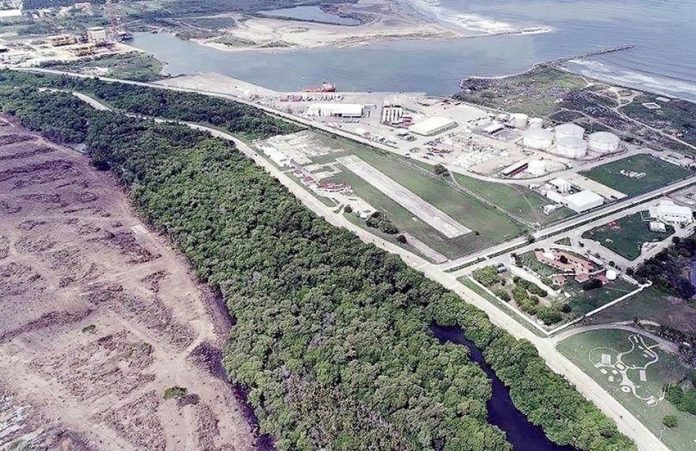
The site of the new refinery is the cleared land to the left.

Construction of the new oil refinery on the Tabasco coast will start on June 2, the federal energy secretary said today, stating that environmental approval has now been granted.

But the head of the government department that supposedly gave the green light for the project to go ahead denies that construction has been authorized.

It was just 11 days ago that the federal government announced that the state oil company and the Secretariat of Energy (Sener) will build the Dos Bocas refinery because the bids made by private companies were too high and their estimated timeframes to complete the project were too long.

Nevertheless, Rocío Nahle told a press conference this morning that approval for the project was issued last week after the government presented a 2012 environmental impact statement (EIS) to the Security, Energy and Environmental Agency (ASEA).

The study was prepared for an oil field with 93 wells that was proposed for the refinery site.

Nahle rejected the suggestion that the approval process was overly quick.

“No, it’s not so fast. It’s not approval of the EIS because we presented the one from 2012 and they’ve asked us to make certain changes or [undertake] certain studies,” she said.

When questioned about how construction of the US $8-billion refinery could begin without approval of a new impact statement, the energy secretary was evasive.

“They already gave us the document. They already gave us the document to be able to start the project. What they are asking for are practically bureaucratic matters,” Nahle said.

Later today, ASEA executive director Luis Vera Morales said the only permission granted to Pemex and Sener is to carry out further analysis and studies at the site.

Interviewed outside the National Palace today alongside Environment Secretary Josefa González Blanco, Vera gave an unequivocal “no” in response to a question about whether construction approval has been granted.

He said last week that approval of the environmental impact statement would take at least 60 working days.

When Vera was asked whether there is a possibility that construction of the refinery will begin on June 2, the environment secretary quickly interjected that it would, although she conceded that the process to obtain environmental approval has not been completed.

“There’s no problem starting on June 2, they’re putting in the requests and they’re very much on time,” González said.

Asked whether a seven-year-old EIS for a different project could be used in order to obtain approval for the refinery, she responded: “Of course, of course it can, it definitely can . . .”

Source: Reforma (sp), La Jornada (sp) 

Roma star Aparicio is ambassador of Oaxaca’s Guelaguetza this year

0
Yalitza Aparicio invites the world to Oaxaca's Guelaguetza.

The government of Oaxaca has appointed Roma star Yalitza Aparicio as the festival’s ambassador to the world.

“We are very proud and thankful to Yalitza for accepting this invitation . . .” said Governor Alejandro Murat, “she loves Oaxaca immensely.”

Aparicio’s involvement in the festival was announced with a short clip in which she dons her traditional Mixtec huipil — a loose-fitting tunic — and invites the world to join her for the celebration.

As a traditional song plays in the background, the actress narrates the scenes: “My land, my people, vibrant with colors. Music, dance and tradition. A magical world full of joy.”

The Guelaguetza is a festival in which the indigenous peoples of Oaxaca come together and showcase their heritage and traditions in the form of intricate traditional garments, dances, music and food.

The word itself is of Zapotec origin, and has been interpreted to mean the “reciprocal exchanges of gifts and services.”

This exchange has broadened to include a large number of national and international tourists that are drawn to the capital of the state every year, all eager to witness what has been described as the largest ethnic festival in Latin America.

If the festival was to have a face, none other would be more appropriate than that of Aparicio, who went from being a schoolteacher in her hometown of Tlaxiaco to a representative not only of her Mixtec culture but of all indigenous women of Mexico after starring in the film Roma.

The governor also announced new tourist routes based on recent exposure that the state, its traditions and people have had on the silver screen. They will include one based on Pixar’s Coco and another focused on Aparicio and her home town.

Called The Yalitza Route, the tourism promotion campaign will also highlight prominent Tlaxiaco natives Lila Downs, singer and recording artist, and painter Rufino Tamayo.

The Guelaguetza, also called Lunes del Cerro (Mondays on the Hill), will take place this year on July 22 and 29, with countess cultural activities scheduled to take place during the intervening week in the city of Oaxaca and across the state.

Source: El Financiero (sp)

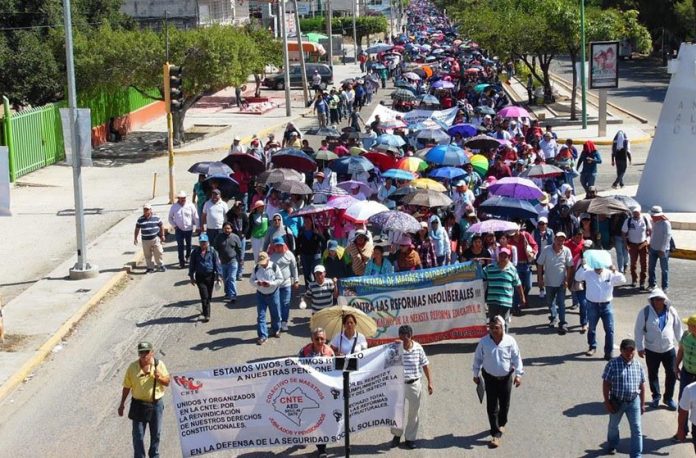
Union won’t allow ‘ideal’ teachers hired on merit to enter classrooms

0
A march by CNTE teachers in Chiapas.

Chiapas teachers hired by the Public Education Secretariat (SEP) have been fighting for two years with the CNTE teachers’ union, which is preventing them from taking their posts.

The teachers completed the education and evaluation requirements to teach and were designated “ideal” by the SEP. But now they say that dissident teachers affiliated with the CNTE have prevented them from entering the schools, sometimes even physically removing them.

The CNTE is opposed to an education reform passed in 2013 that required teachers to be evaluated on hiring or during their tenure.

In 2017, a group of teachers and education advocacy group Mexicanos Primero requested injunctions against the CNTE and the government of Chiapas for having made illegal agreements since 2013.

One of the teachers, Mónica Pérez, was chosen by federal education authorities to become principal of a middle school in Pueblo Nuevo Solistahuacán over two years ago.

But for two years she hasn’t been able to start work because a member of the CNTE is in her position.

“We haven’t been able to take our positions because the CNTE here in Chiapas has been interfering with those of us who got our jobs the legal way,” she told Reforma. “We are being prevented from taking our jobs in every school in Chiapas.”

Another teacher, Vicente Asaad Vera, was promoted to be a coordinator of biology education in six public middle schools after 35 years as a teacher. But he says that for two years the CNTE has been preventing him from doing his job, which involves making sure the teachers in the six schools follow the biology curriculum.

“We took the tests, we were ideal candidates, we were at the top of the list, we got the jobs, but we’ve been waiting for the government to enforce the law,” he told Reforma. “While the CNTE was mobilizing, we were improving ourselves, but now we’re being pushed out, disparaged and ignored.”

The situation is not likely to change since a new education reform has replaced that of 2013. It discontinues the evaluation of teachers.

Source: Reforma (sp)

13 states are sources of fentanyl, which is shipped through Tijuana to US

0
Police found fentanyl hidden inside jars of cream when they searched a courier service in Tijuana last fall.

Mexican cartels ship fentanyl-laced drugs to the United States from 13 states, according to the federal government.

In a confidential report seen by the newspaper El Universal, the Criminal Investigation Agency (AIC) said that drug trafficking organizations send heroin, cocaine and methamphetamine laced with the synthetic opioid to Tijuana from Mexico City, México state, Puebla, Michoacán, Jalisco, Querétaro, Morelos, Nayarit, Sinaloa, Durango, Baja California, Baja California Sur and Sonora.

Courier companies, private vehicles, buses, trucks and planes are used to get the illicit substances to the northern border city, from where they are smuggled across the border into California.

According to the United States Drug Enforcement Administration (DEA), the Jalisco New Generation Cartel (CJNG) and the Sinaloa Cartel are the main criminal groups that ship fentanyl into the country.

“Mexican traffickers order fentanyl from China, adulterate it, and smuggle it into the United States themselves, meaning an unknown amount of seized Mexican parcels containing fentanyl are ultimately of Chinese origin,” the DEA said in a 2018 report.

The AIC said that fentanyl precursors arrive in Mexico at the ports of Manzanillo, Colima, and Lázaro Cárdenas, Michoacán, from China, Hong Kong and Singapore.

The drug is then produced at clandestine labs in different parts of the country.

Such labs have been detected and raided in Baja California, Sinaloa, Sonora and Mexico City in recent months.

Police found 20,000 fentanyl pills at a lab in Mexicali last September and arrested two suspects, including a Russian man, the Associated Press reported.

Security specialist Ricardo Márquez Blas warned that Mexico is on track to become the largest producer of fentanyl in the world, predicting that the shipment of precursors to the country will only rise.

As a result, cartels will not only export more fentanyl to the United States but also begin to sell the drug domestically, especially in northern states, he said.

“. . . The cartels are also going to offer it to consumers in the country, if they’re not already doing so,” Márquez said.

Between 2007 and 2018, Federal Police seized more than 123 tonnes of fentanyl but according to a recent report by InSight Crime, a foundation dedicated to the study of organized crime in Latin America, “Mexico’s government does not see fentanyl as an important issue yet and has not devoted significant resources toward finding the principal drivers of the trade inside its borders.”

Fentanyl is 50 times more powerful than heroin, meaning that it can be lethal to users even in very small doses. In 2016, the United States Centers for Disease Control and Prevention estimated that the drug killed more than 20,000 Americans.

The rise in demand for the drug in the United States has been blamed for plummeting opium gum prices in Mexico.

After carrying out field work in the states of Guerrero and Nayarit, the Network of Researchers in International Affairs (Noria) said that prices paid to opium poppy farmers for the gum – the raw material for heroin – had fallen from 20,000 pesos (US $1,050) per kilo in 2017 to between 6,000 and 8,000 pesos (US $315-$420) last year.

Source: El Universal (sp)