Home Blog Page 1868

35 more bodies found in Guadalajara hidden graves

0
Looking for bodies in Zapopan.

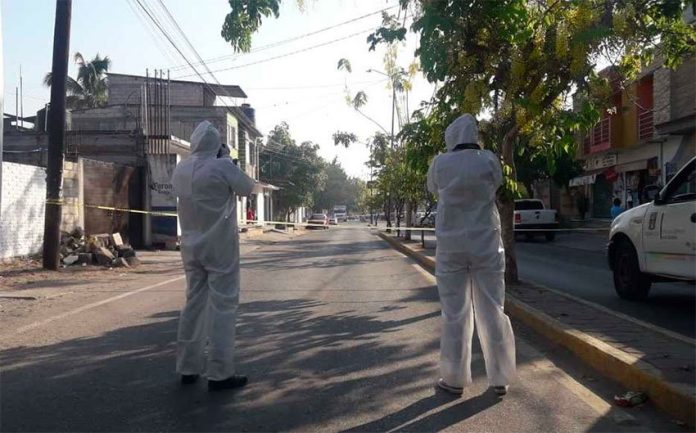
At least 35 bodies were retrieved last week from clandestine graves in the greater Guadalajara area of Jalisco, the state attorney general said on Saturday.

A week-long search and excavation operation at a home in the El Campanario neighborhood of Zapopan led authorities to at least 27 bodies.

Reports by neighbors on May 7 that “blood stains” were evident on the property led to the search.

Attorney General Gerardo Octavio Solís Gómez said digging continues at the site, using heavy machinery under the direction of structural engineers, as the digging has gone more than three meters deep.

Solís said all the victims had been executed, and that so far only two had been identified.

Solís said a similar discovery was made recently in the Quinta Verde neighborhood of Guadalajara, where nine kidnapping victims were rescued on May 3. Further inspection of the property led to the discovery of seven skulls along other bone remains, “which indicates there are at least seven people buried illegally.”

He explained that excavation at the site is more complex due to the presence of acids and lye that prohibit workers from digging for more than 20 minutes at a time.

One more body turned up on Thursday on a property in the Lomas del Mirador neighborhood of Tlajomulco, leading to the arrest of four individuals found on the premises.

Six vehicles were seized during the searches at the three properties, some of which had been stolen and used in criminal activities. There was evidence that they had been disguised as vehicles belonging to the state and federal Attorneys General’s Offices.

Source: El Sol de México (sp), Milenio (sp)

President delivers social and infrastructure spending in Jalisco, Nayarit

0
The president receives a warm welcome in Nayarit.
López Obrador receives a warm welcome in Nayarit.

Improvements to roads and street lights, new sports centers, a library and seafront walkway in Bucerías were among the projects announced by President López Obrador during a visit to Nayarit and Jalisco yesterday, where he and the cabinet secretaries who accompanied him also heard some complaints about new welfare programs.

In Bahía de Banderas, Jalisco, young and old citizens complained they registered for programs but had not yet received any support.

In response, López Obrador called for patience, asking that the “elephant” – the apparatus of government he inherited – be given time to learn to walk.

He also blamed the previous government for leaving infrastructure that was not there to help the people. Instead, the president charged, the government “was a facilitator of corruption, at the service of a rapacious minority . . .”

“The transformation [of Mexico] also means that we all have to act responsibly, send the subculture of abuse down the drain. None of this ‘he who doesn’t cheat, doesn’t get ahead.’ That can go to hell,” he said.

The president also took aim at Grupo Carso, a conglomerate owned by Mexico’s Carlos Slim, for failing to complete a decade-old project to build a highway between Jala, Nayarit, and Puerto Vallarta, Jalisco.

“A company has had the concession to build the highway here for more than 10 years but there’s no progress. I’m going to talk to them . . . [either] they finish it or the concession is taken away, it’s as simple as that,” López Obrador said.

But Grupo Carso responded to the president’s attack last night, stating that the section of highway with problems is between Compostela, Nayarit, and Jala, and that it only took over responsibility for that stretch six months ago after another company abandoned it. The project is now back on track, Grupo Carso said.

Accompanying the president on his tour of the Pacific coast states were Román Meyer, Secretary of Agrarian Development and Urban Planning, and Welfare Secretary María Luisa Albores.

The latter acknowledged that there have been delays in distributing financial aid, while the government’s delegate in Nayarit, Manuel Peraza, said political actors in the state have deliberately obstructed the census to identify people who qualify for welfare.

Social programs provide ajd to 90,000 senior citizens in Nayarit in the form of pensions. As the government has previously announced, pension amounts are to be doubled. In addition, 6,000 households will receive 1,600 pesos (US $83) every two months to help with childcare expenses.

Urban Planning Secretary Meyer said 530 million pesos (US $27.5 million) will be invested in Bahía de Banderas as part of the government program to improve the lives of residents of the working-class neighborhoods of Mexico’s leading tourist destinations.

He said that staying in an exclusive hotel in Nuevo Vallarta or Punta Mita can cost as much as 200,000 pesos (US $10,400) a night but nearby neighborhoods where hospitality workers live have “great deficiencies.”

The secretary said that 60 million pesos will go to the construction of a sports center and a childhood development center and upgrades to roads and street lighting in San Vicente.

The town of Mezcales will get 30 million pesos to pave roads and improve public lighting, while Bucerías will receive 190 million pesos to build a seafront malecón, or promenade, a library, sports centers, a childhood development center and a park, Meyer said.

Infrastructure projects will also be carried out in underprivileged neighborhoods of the resort city of Puerto Vallarta, Jalisco, where López Obrador and his secretaries concluded their tour.

Source. El Economista (sp), El Universal (sp), El Financiero (sp) 

Startup wins international contest with eco-friendly sugar alternative

0
Javier Larragoiti of Xilinat, the big winner at European tech conference.
'A sweet moment:' Javier Larragoiti of XiliNat, the big winner at European tech conference.

A Mexican company that transforms corn waste into a low-calorie, eco-friendly sugar alternative took the top prize at an international startup competition in Amsterdam, Netherlands.

XiliNat, founded by 29-year-old Javier Larragoiti, won US $310,000 in no-strings funding at the Chivas Venture contest, held in the Dutch capital as part of Europe’s leading tech fest, the TNW conference.

“This moment tastes pretty sweet!” Larragoiti said.

“I’m super happy to have been crowned winner of the Chivas Venture 2019; with this funding, we can go 10 times bigger and that means helping so many more people around the world.”

Larragoiti explained in a Chivas Venture video that the story of XiliNat began when he found out at the age of 18 that his father had diabetes.

He said there was a lack of “attractive options” to persuade people to stop consuming sugar, pointing out that even some diabetics won’t use sweeteners because they don’t like the taste and aren’t natural.

“We developed a patented technology to create the best sugar substitute. It has exactly the same taste, it’s low in calories, its protects your teeth against cavities, it’s ideal for diabetics and it’s completely natural,” Larragoiti said.

“Each tonne sold will benefit the health of at least 10,000 Mexicans and improve the lives of 13 farming families from whom we buy . . . [agricultural] waste,” he added.

At the Chivas Venture, an initiative of the company that makes Chivas Regal whisky, Larragoiti made a live pitch for funding to a judging panel that included actress Zoe Saldana and Alexandre Ricard, CEO of beverage company Pernod Ricard.

A total of 20 entrepreneurs from across the world competed for a total of US $1 million in funding.

Judges assessed each startup on their ability to create change using a viable business model.

Other companies that competed for funding included a Polish startup that transform tires and used rubber products into refurbished industrial projects, and a Portuguese business that created a platform that connects refugees and immigrants to volunteer language teachers.

Larragoiti’s innovative product, also called XiliNat, can be purchased on the company’s website for 200 pesos (US $10) for 454 grams.

Source: Contxto (en), PR Newswire (en) 

18th-century building in Veracruz will cost 1 billion pesos to save

0
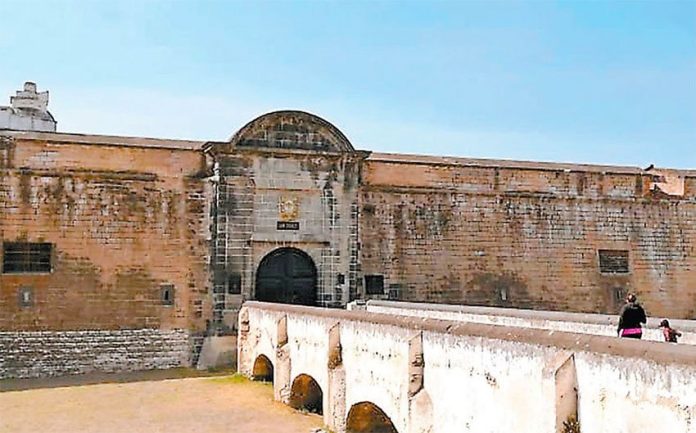
The 18th-century fortress that needs extensive repair work.

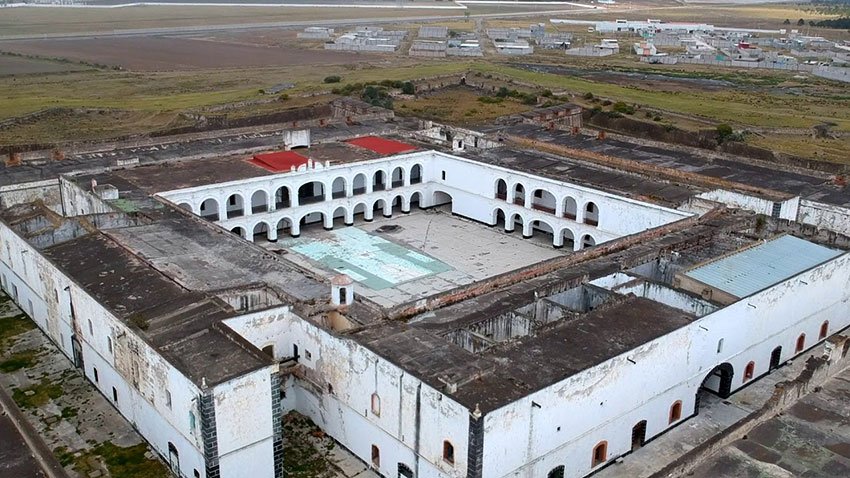
More than 1 billion pesos will be needed to save an 18th-century fortress in Veracruz that has fallen into disrepair since it ceased functioning as a state prison in 2007.

Located near the Puebla border in the municipality of Perote, the San Carlos Fortress requires extensive maintenance work, the newspaper Milenio reported after visiting the building.

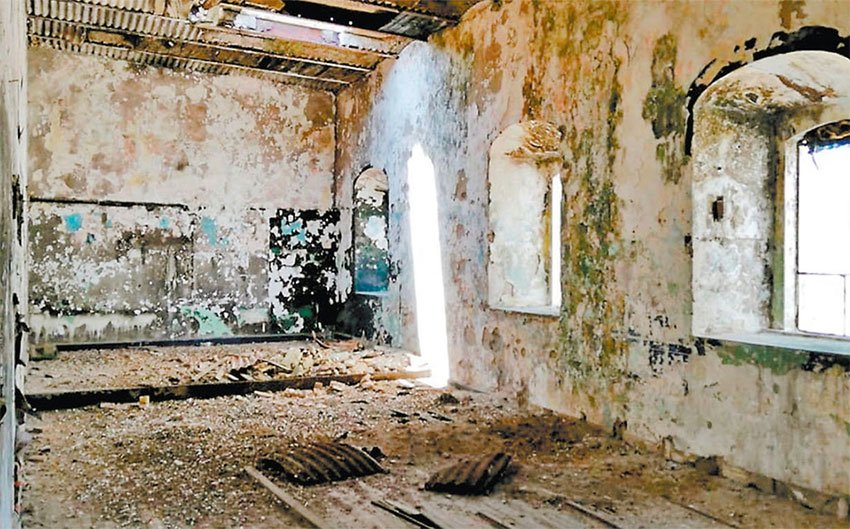
Parts of the roof are collapsing because its wooden beams are rotting and the walls are in poor condition due to water damage.

Gilberto Castillo, a former mayor of Perote, said that estimates for the repair work exceed 1 billion pesos (US $52.3 million).

However, getting the money currently appears nigh on impossible: municipal, state and federal authorities have shown no interest in saving the historic building, which was opened to the public after its almost 60-year incarnation as a state prison ended 12 years ago.

The facility served for many years as a state prison.

“. . . It’s very concerning to see that something that is so important in the history of Mexico is falling apart,” said Martha Ágape, a tour guide at the fortress.

Construction of the San Carlos Fortress, also known as the Perote Castle, concluded in 1777.

The fort was built on the orders of Joaquín de Montserrat, viceroy of New Spain between 1760 and 1766, to provide protection in case of a foreign invasion and the fall of the Castle of San Juan de Ulúa, a large complex of fortresses located 160 kilometers southeast of San Carlos in the port city of Veracruz.

[wpgmza id=”187″]

During the War of Independence in the early 19th century, the San Carlos Fortress was used by Spanish troops as a hideout and shelter.

In 1823 – two years after Mexico won independence – the fort became the fledgling nation’s first military college, while in 1843, Mexico’s first president, Guadalupe Victoria, died in the building’s infirmary, according to fortress archives.

In 1847, during the Mexican-American War, United States forces captured the fortress and during World War II, Italian and German citizens were imprisoned at the facility.

Repairs have been estimated to cost 1 billion pesos or more.

The Perote Castle became a state prison in 1949 during the presidency of Miguel Alemán Valdés.

Plans have been floated to establish three museums at the site – two military ones and another focusing on the history of the almost 250-year-old building – but like the much-needed repair work, no one appears to be willing or able to provide the required funds.

Source: Milenio (sp) 

Three banks ease Pemex burden, underwrite US $8-billion loan

0
Signing ceremony is to give Pemex some financial relief.
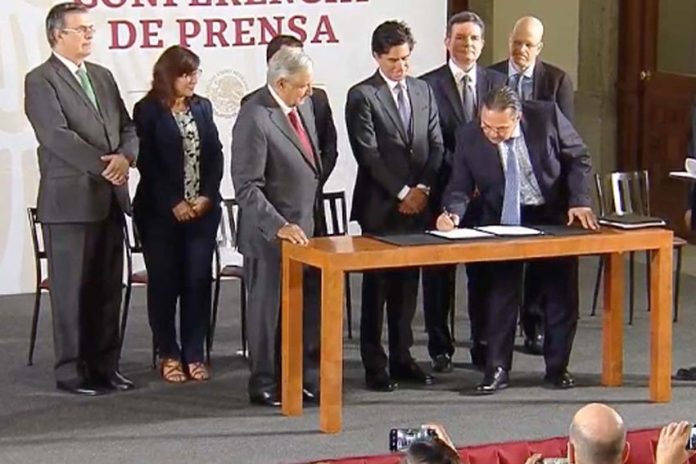
The signing ceremony at this morning's presidential press conference.

Three banks have reached an agreement with the federal government to underwrite a US $8-billion syndicated loan for Pemex, Mexico’s heavily indebted state oil company.

President López Obrador signed agreements with HSBC, JPMorgan and Mizuho Securities at his daily press conference this morning, stating that the banks’ commitment was evidence of their confidence in the Mexican economy and Pemex, which has debt of US $106.5 billion.

The loan – the largest amount ever borrowed by Pemex – is designed to allow the company to refinance its debt.

Both the president and Pemex CEO Octavio Romero stressed that it doesn’t represent new debt for the state oil company.

The latter said that the credit took five months to negotiate and explained that the deal will enable Pemex to refinance US $2.5 billion in debt as well as renew two revolving lines of credit for up to $5.5 billion over a period of three to five years.

“With this renegotiation, we are not taking on additional debt for Pemex,” Romero said.

Today’s announcement comes three months after the government presented a 107-billion-peso (US $5.5-billion) rescue package to reduce the company’s financial burden and strengthen its capacity to invest in exploration and production.

The three banks said they hoped Mexican and international banks would participate in the syndication process for the loan.

The CEO of HSBC México said the loan “showed the confidence HSBC has in Pemex, in Mexico and the current administration.”

Nuno Matos de Macedo added that the credit would give the state oil company more stability and flexibility in the allocation of resources.

The type of credit to be extended to Pemex is typically charged the London Inter-Bank Offered Rate, or Libor, plus 2.35%, or around 4.85% in total, according to the CEO of JPMorgan México.

“Below 5% for this type of instrument is very attractive,” Felipe García Moreno said.

Increasing Pemex’s oil production and refining capacity in order to reduce reliance on imports and eventually make Mexico self-sustainable with regard to its fuel needs is a priority for the federal government.

President López Obrador is forging ahead with plans for a US $8-billion refinery on the Tabasco coast, announcing last week that Pemex and the Secretariat of Energy (Sener) will build the project because the bids offered by private companies were too high and their estimated completion dates went beyond the three-year period requested by the government.

Business groups, analysts and others spoke out against the plan, stating that the state oil company and Sener don’t have the technical capacity to carry out the refinery project.

However, López Obrador remains optimistic that the government’s strategy for the company will yield positive results.

He said today that the fight against fuel theft was working and that Pemex should save 50 billion pesos (US $2.6 billion) this year.

Source: Milenio (sp), Financial Times (en)

A Mother’s Day message on the beach—written with sargassum

0
'Happy day, moms,' reads the message on a Cancún beach.

When life gives you lemons, make lemonade. And when nature gives you tonnes of sargassum seaweed, use it to write a message dedicated to mothers on their day.

That was the silver lining found by security workers at a private residential complex in the Puerto Juárez district of Cancún, who worked through the small hours of Friday morning to create their touching Mother’s Day message with about 50 kilograms of sargassum.

Come early morning, as local mothers were getting ready to take their young ones to school, they were surprised by the short message writ large on the beach that wished them a “happy day.”

And since seaweed is not a scarce at the moment in Quintana Roo, the workers gave their message a final flourish: a simple accompanying flower.

Residents of the complex started sharing photos of the sargassum Mother’s Day art. They went viral on social media before long.

Source: Milenio (sp)

IMSS can’t fill doctors’ positions in two states due to insecurity

0
The health service is having trouble filling positions in two northern states.

Security concerns have led to a shortage of doctors in the public healthcare system in Chihuahua and Tamaulipas.

National healthcare workers’ union (SNTSS) leader Arturo Olivares Cerda said IMSS hospitals in the two states have seen nearly as many positions remain vacant as they were able to fill.

In Chihuahua, hospitals hired a total of 185 doctors but 136 positions remained unfilled, and in Tamaulipas hospitals hired 158 doctors while 136 positions remained vacant.

Available positions come with a monthly salary of 28,000 pesos (US $1,465), considered to be a good salary in the sector, along with bonuses and government assistance with mortgages. Most of the doctors’ positions were also available in central urban areas of the two states, and not in rural areas.

Oliveras said that even though Guerrero and Veracruz both have higher levels of violence than Tamaulipas and Chihuahua, both were better able to fill positions than their northern counterparts, which the union leader attributed to their proximity to the center of the nation.

The IMSS hired 5,080 doctors nationwide in the second week of March. The states that saw the most hires were Mexico City with 957 new doctors, México state with 561, Jalisco with 365, Nuevo León with 258 and Veracruz with 247.

To resolve the shortage in Chihuahua and Tamaulipas, Oliveras said, state authorities, the IMSS and the SNTSS are working together to guarantee better security and labor conditions for prospective employees.

Source: Reforma (sp)

Medal-winning athlete banned for doping blames tacos al pastor

0
González crosses the finish line to win gold at the 2015 Pan American Games.

Champion race walker María Guadalupe González has claimed that a positive test for a powerful anabolic steroid was triggered by a meal of tacos al pastor and other meat she had eaten beforehand.

The 30-year-old Mexico City native was handed a four-year ban from competition this week by the International Athletics Federation (IAAF).

González has won numerous trophies including a silver medal at the Rio Summer Olympics in 2016 and has been training in preparation for next year’s Summer Olympics in Tokyo.

But she will not be able to compete in Japan unless she wins an appeal against the ban.

González tested positive for trenbolone after an out-of-competition drug test, but denies she took the drug. She said trenbolone is fed to cattle in Mexico to boost metabolism and burn fat. It is also used in higher doses by some athletes to increase muscle mass.

In a report, the Olympian detailed everything that she had consumed before the drug test, which included 200 grams of steak, five tacos al pastor and three medications that include trenbolone.

In response, the IAAF said that the amount of trenbolone found in her system was too great to have come from contaminated meat or pharmaceuticals. The federation engaged a security firm to look into Gonzalez’s claims, which had also included the assertion that a doctor had diagnosed her with anemia and instructed her to eat more meat.

The investigation concluded that González had probably forged hospital records and fabricated restaurant receipts. Although she had initially said she had consumed beef and pork, she later claimed to have consumed liver as well, which can contain higher levels of trenbolone.

“As the maximum permitted residue of trenbolone is five times higher in liver, she had an interest in having eaten liver.”

Although the ruling could prevent her from competing in future events, it does not strip her of her previous medals, including a gold in the 20-kilometer race at the 2015 Pan American Games and silver at the 2017 World Championships. González is expected to appeal the decision, which was issued last November, in the coming days.

Source: El Universal (sp), NPR (en)

Federal prisons on alert after five guards killed in Morelos

0
Scene of yesterday's attack on prison guards.

Security officials have put federal penitentiaries on alert after a group of hitmen attacked prison guards yesterday morning in Puente de Ixtla, Morelos, killing five.

Eight guards were waiting for a bus to transport them to the federal women’s penitentiary No. 16 in the Emiliano Zapata neighborhood. Just as the bus arrived so did armed civilians, who opened fire.

The other three guards were wounded.

[wpgmza id=”186″]

The burned remains of a vehicle authorities suspect was the one used by the hitmen was found later in San Gabriel Palmas, Amacuzac. Four guns and three full magazines were found at the scene.

State Interior Secretary Pablo Ojeda said administrative staff at the penitentiary had received anonymous threats a few weeks before yesterday’s attack.

The attack came two days after a lone gunman shot and killed two union leaders in the zócalo in Cuernavaca, a few steps away from state government headquarters.

A suspect was apprehended at the scene and will make a court appearance on Wednesday.

Source: Milenio (sp)

Flood-prone refinery site worsened by removal of mangroves: UNAM researcher

0
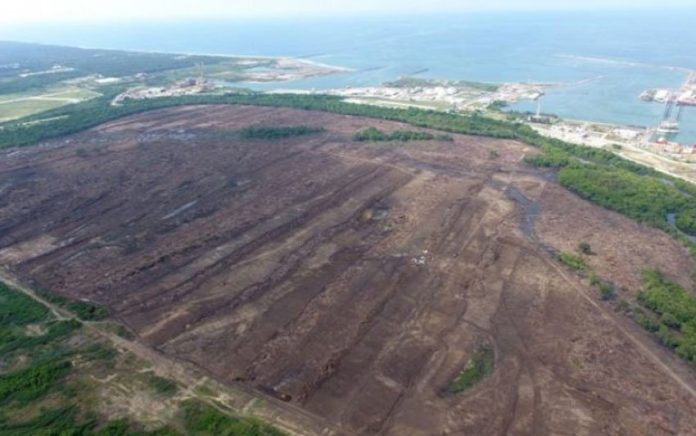
The flood-prone refinery site after it was cleared last fall.
The refinery site after it was cleared last fall.

The removal of mangroves at the site of the federal government’s new oil refinery in Tabasco has made the land more susceptible to flooding, raising questions about its suitability for the US $8-billion project.

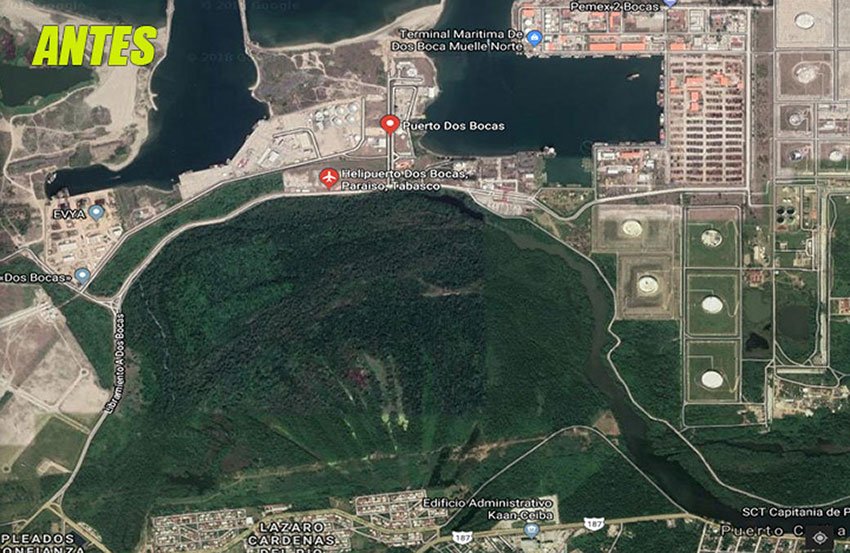
Between September 8 and October 1 last year, 230 hectares of mangroves and other vegetation were cleared from the refinery site on the Gulf of Mexico coast at Dos Bocas, a port town in the municipality of Paraíso.

The Mexican Center for Environmental Law (Cemda) said that neither environmental authorization nor permission to change the land use of the site was granted before the preparatory work began and consequently filed complaints with federal authorities.

In December, Mexico’s energy sector watchdog ordered that all work that alters the condition of the land must immediately cease but by that time the site was already flooding.

The newspaper El Universal reported that flooding began in October and that water has ebbed and flowed since, covering parts of the site.

The site before it was cleared of mangroves and other vegetation.

Satellite images showed that flooding decreased in February but increased again in March.

When President López Obrador attended a groundbreaking ceremony on December 9, he didn’t actually set foot on the refinery site because it was flooded, El Universal said.

The flooding problem was not unforeseen.

A 2011 environmental impact statement completed as part of a project to expand the port terminal at Dos Bocas said the land was not usable because it has flood-prone areas.

“The mangrove functioned as a natural seawater filter. By removing it, not only will that plot of land flood, it’s very probable that adjacent areas such as Puerto Ceiba and the neighborhood of Lázaro Cárdenas will flood. The area is going to turn into an enormous swamp,” said Fernando Álvarez Noguera, a researcher at the biology institute of the National Autonomous University (UNAM).

“Mangroves also function as a natural barrier against hurricanes, they have strategic importance for the life of the coast, that’s why they’re protected,” he added.

Álvarez, an author of a book about biodiversity in Tabasco, explained that when the tide rises seawater will now flow into the site and neighboring areas unimpeded. He warned that remaining vegetation will be damaged by the salt water.

The researcher also said that emissions from the new refinery will contaminate the air and that runoff could pollute the nearby Mecoacán Lagoon, where oysters are farmed.

The refinery, which the government announced this week will be built by the state oil company and the Secretariat of Energy, will also likely pose a risk to coastal animals.

Wildlife expert Marcelo Aranda has confirmed that iguanas, toads, crabs, coatis and tlacuaches (opossums), among other animals, live in the area. Crocodiles, turtles, deer and birds also inhabit coastal land near the refinery site.

By choosing to pursue the refinery project at Dos Bocas the government is ignoring 10-year-old advice from the state-owned Mexican Institute of Petroleum (IMP).

A 2008 IMP report warned that building oil infrastructure in the municipality of Paraíso posed soil, environmental and social risks.

Out of seven sites identified as possible locations for a new refinery, Paraíso presented the “greatest risk” and therefore such a project there is “not recommended,” the IMP said.

Source: El Universal (sp)