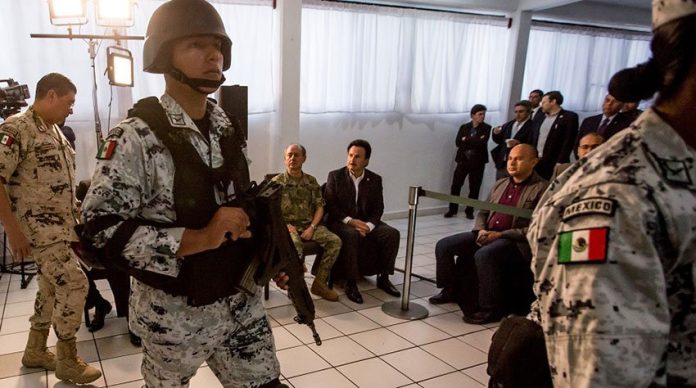
Members of the new National Guard, supplied by the army.
Neither the navy nor the Federal Police has yet provided any personnel to the National Guard, leaving the first units of the new security force to be made up entirely of soldiers.
The secretariats of the Navy (Semar) and Security and Citizens Protection (SSPC), which has responsibility for the Federal Police, said they can’t transfer personnel to the force because a secondary law establishing the regulatory framework for the National Guard is not yet in place.
The secretariats also said they cannot begin the recruitment process for the security force because of a lack of legal clarity regarding a range of aspects related to the formation of the Guard, including entry requirements, evaluation and training.
That information, which came in response to a request by news website Animal Político, contradicts statements made by President López Obrador this week.
Yesterday he said that members of the navy police had already joined the National Guard and earlier this week he declared that the recruitment process was under way.
López Obrador has said that the initial deployments are legal even without secondary laws in place as the constitutional reform that enabled the creation of the National Guard allowed them.
However, the president’s office refused to provide Animal Político with copies of “general agreements” that showed that to be the case, stating that “it’s not a matter within its jurisdiction” and that it has no obligation to provide information to support statements made by López Obrador.
The National Guard was declared constitutional in March after both houses of federal Congress and all 32 states approved the security force.
But while Semar said it plans to transfer 6,288 naval police to the force it has not specified when that will occur.
Senate committees will begin discussion and analysis of a National Guard Law next week and according to the constitutional reform which was published in the government’s official gazette on March 26, legislation governing the security force must be drawn up by May 25.
Senators have said the law will set out the complete architecture for the Guard’s operation, including how it will be organized and how it will collaborate with other entities as well as the requirements for recruitment that Semar and the SSPC are currently awaiting.
Luis Rodríguez Bucio, an army general with extensive experience fighting and studying Mexico’s notorious drug cartels, has already been named commander.
The federal government has expressed confidence that the broader deployment of the force will be effective in combating the record levels of violent crime that are currently plaguing the country.
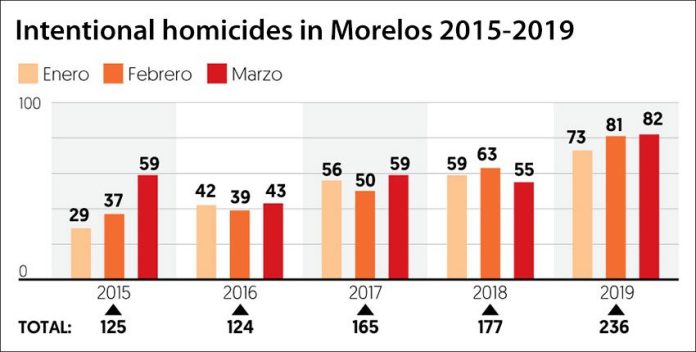
Homicides in the first three months of each year since 2015.
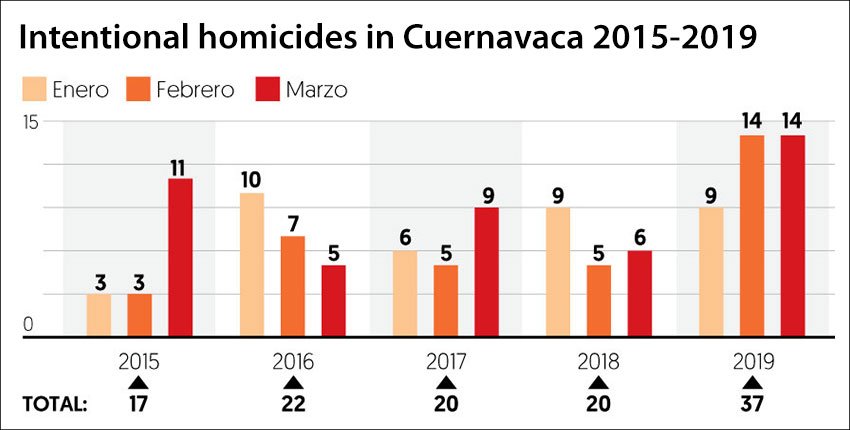
The number of homicides in Cuernavaca, Morelos, almost doubled in the first quarter of 2019 compared to last year, while murders across the state rose by a third, a situation that prompted the observation by a local activist that the state has kicked out the corrupt only to replace them with the inept.
The state capital recorded 37 intentional homicides between January and March, an 85% increase on the 20 registered in the first three months of 2018.
Statewide, there were 236 homicides in the first quarter, according to statistics from the National Public Security System (SNSP), a 33% spike compared to last year and almost double the 2016 figures.
A common denominator in the high levels of violent crime recorded in Cuernavaca in recent years and across the state in late 2018 and early 2019 is the governance of Cuauhtémoc Blanco.
The former soccer star became mayor of Cuernavaca at the end of 2015, a year in which there were 70 homicides in the state capital.
Homicides in Cuernavaca in the first three months of each year since 2015.
Last year, there were 103 murders in the city, a 47% increase compared to 2015.
Blanco was officially mayor until September 26, and four days later was sworn in as governor of Morelos.
Since he took the top job, there have been 580 homicides, the newspaper El Economista reported.
Javier Sicilia, a poet and founder of a group known as the Movement for Peace with Dignity and Justice, led a protest yesterday in front of state government offices in Cuernavaca to denounce the security situation and to urge authorities to take urgent action to combat violence not just in Morelos but across the country.
“[Former governor] Graco Ramírez was bad and it seems that this one [Blanco] is going to be worse,” Sicilia said, observing that the inept had replaced the corrupt.
Referring to a shootout in Cuernavaca’s central square Wednesday that left two people dead and another two injured, the activist said:
“That was the safest public space the state had, now nowhere is safe. There is negligence and idiocy on the part of state authorities not to mention the federal authorities, who aren’t taking the situation seriously . . .”
According to the Morelos interior secretary, turf wars are behind the high levels of violence.
Pablo Ojeda Cárdenas said that at least five competing cartels operate in Morelos, which is strategically located between Guerrero – a large drug producing state – and Mexico City.
Criminal groups, most notably the Jalisco New Generation Cartel and Los Rojos, are fighting over the route between the two locations, Ojeda explained.
Authorities have introduced a single-command policing system as part of the efforts to fight crime but Cuernavaca has not yet joined the other 35 municipalities in the program.
That situation makes statewide coordination more difficult, Ojeda said, adding that the application of a decree to bring Cuernavaca into the single-command system is needed.
The secretary said the only way to achieve positive security results is via coordination between all three levels of government, pointing out that Morelos security authorities meet every day with their federal counterparts, including the army.
However, Ojeda argued that Morelos needs more state police because it currently only has a force made up of 600 officers.
He added: “The municipal police forces are in very disparate conditions with salary levels which sometimes are not enough to have the minimum levels needed to keep them honest.”
Ojeda expressed confidence, however, that with a future deployment of the National Guard, recruitment of more police officers and greater coordination, authorities will be able to significantly improve the security situation.
Jorge Mátar Vargas, president of the Morelos branch of the National Chamber for Industrial Transformation (Canacintra), said that state authorities have lost control of security and that “the National Guard, soldiers, marines need to come.”
The government has earmarked 20 billion pesos to fix things like this.
A federal transportation official said there are big spending plans for non-toll federal highways, 22% of which are in bad shape.
Cedric Escalante Sauri said the highways have been poorly maintained, especially those in the states of Veracruz, Oaxaca, Chiapas and Guerrero.
The infrastructure undersecretary at the Transportation Secretariat said immediate attention is required on long stretches of highway that have been damaged by climate conditions and use.
“The largest portion of the budget for highways will go to service and maintenance of non-toll highways; we have close to 20 billion pesos (US $1 billion).”
He added that the investment doubles that of previous years, calling it the most significant investment ever made in the history of highway maintenance in Mexico.
Escalante said the federal budget for all the nation’s highways totals 42 billion pesos (US $2.2 billion). In addition to the 20 billion pesos for non-toll roads, 9 billion will go toward construction and modernization, 8 billion to access and rural roads and 5 billion pesos to other needs, such as signage.
Oaxaca will be a special focus, with funding going to improving access roads to 50 municipal seats. In total, 138 municipalities in the state do not have paved access roads, compared to 300 in the entire country.
Construction Industry Chamber president Eduardo Ramírez Leal said the federal government has invited regional businesses to participate in the highway revitalization plan, which should be considered as important as the administration’s other large infrastructure projects such as the Dos Bocas oil refinery and the Maya Train.
One goal of the government’s national development plan is to guarantee that at least 90% of the nation’s 40,590 kilometers of federal non-toll highways are in good condition by the end of the government’s term in 2024.
At Colegio IMI in Guadalajara, every student has an iPad.
Fresh winds are blowing through the stuffy halls of academia. A few days ago, I got to see these changes with my own eyes when I visited a little private school in Guadalajara called Instituto México Inglés (IMI).
“We don’t use textbooks here,” I was told by director Luis Medina. “Every one of our students has an iPad. And we don’t have exams anymore because the Apple system we use shows us each student’s production and progress literally moment by moment.
“As for teachers, we don’t use that word anymore. The members of my staff are coaches, who do their best to help our students carry out their own research. And we don’t have an old-style curriculum either. Instead, we present our students with a monthly challenge and they investigate it. This month’s challenge is ‘How to Resolve a Crisis.’”
To understand how a little school in Mexico reached this point, let’s pause a moment to reflect on what education has meant for most of the world’s history.
The traditional model of a school is a place where students come to sit at the feet of a teacher. The teacher expounds his or her knowledge of a subject and the student hopefully absorbs it or at least takes copious notes on the subject. Although the system has been around forever, it is highly inefficient simply because memorizing the words of a master is not enough to guarantee understanding of a subject. Awareness comes from personal investigation, from hands-on encounters.
In the previous millennium, knowledge was locked up in books and the best overview of what humanity had learned during its entire history could be found in encyclopedias.
Students write questions in English. Lying on the floor is permitted.
Then came the internet and search engines. Today no one would run to their bookshelves and open a dusty volume of the Britannica in order to investigate the concept of “bullying.” Likewise, no one would open their once highly esteemed Merriam-Webster to find out what an MP4 file is.
They would turn to Google. We would all turn to Google! So why would we send our kids to school and expect them to learn from textbooks?
“Already in 2005 we had an inkling of this,” Luis Medina told me. “An organization based in California did away with individual textbooks for math, history, etc., producing a course of subjects unified in a single printed volume which came in monthly installments.
“By 2015, however,” continued Medina, “it was clear that nothing in printed form could come close to offering the richness and timeliness of what Google was making available to everyone. This was when we decided to adopt an approach developed by Noel Trainor and Noemí Valencia in Morelia, Michoacán, called Knotion (Knowledge in Action).
“This is a true innovation because it is really learning in action, learning directed towards real life. There are now 70 Knotion schools in Mexico (and one in Guatemala) and already Knotion has been recognized at an international level as providing one of the best models for education in the world.”
“The founders of Knotion,” continued Medina, “have created an approach which replaces the study of ‘subjects’ like history and math with the investigation of challenges, with problems to be solved. The latest challenge is called Crises and the Resolution of Conflicts and the students are spending 20 days working on it. Naturally biology, history, geography, etc. all come into play when you dig into a subject like this.
IMI students query a representative of Condusef about financial problems.
“While investigating conflict resolution, some of our students heard about a Mexican government organism called Condusef, which means National Commission for the Protection and Defense of the Users of Financial Services. So what did the kids do? They went on the net to check it out and then got on the phone, called Condusef and asked for the email address of their delegate for western Mexico ‘because we need to interview her.’
“These are fourth-graders, 10 years old! Well, they were told to fill out a form for this and those kids went right ahead and filled it out and sent it in and as a result, a committee of eight of our students went to Condusef here in Guadalajara to ask them questions about how they are protecting people from financial abuse.
“This in turn made the kids realize that most people don’t know how to manage and save money, so they sent teams out to financial institutions like Banorte and La Caja Popular and they came back and presented what they had discovered to their fellow students . . . so, these students ended up teaching the other ones and thanks to the technology we use, they could share what they learned through videos, recordings and photos, with everyone learning from everyone else.”
Medina pointed out that in such a situation the teacher can’t be the teacher because he or she is not an expert on economy. The teacher becomes a co-researcher, a kind of guide and catalyzer, so Knotion uses the word coach instead of teacher.
“In a Knotion environment,” says Medina, “students gain competence not only in ‘hard skills’ like science and history, but they also become masters of ‘soft skills’ like communicating, problem solving, developing projects, teamwork, innovation, leadership and creativity — and all of these are what 21st-century companies are looking for in an employee.”
How, you might ask, was an approach developed in Morelia recently ranked in London among the top 10 educational systems in the world?
Playing chess is part of the program at IMI.
“How did it all begin?” I asked co-founder of Knotion, Noemí “Mimy” Valencia.
“We started our own little school 24 years ago,” she told me. “We started it for our own daughter. We had moved away from Mexico City and wanted to live in the country, but we couldn’t find a school that met our expectations. My husband Noel Trainor and I both had had the opportunity to study in schools that fostered our curiosity and creativity and empowered us. So when we saw that our little girl wouldn’t have that opportunity in Morelia, we started our own school and right from the beginning we and the other parents had one essential question: what’s best for the kids?
“That is what has been taking us on this journey, figuring out what kind of world we are living in, the kinds of skills and competencies our kids need in order to face the world we adults are leaving behind, and the kind of citizens that the world needs in order to become a better place. We are striving for a new humanity with different patterns of thinking and behaving and understanding. We want to create a new generation characterized by compassion, by tolerance and by social commitment, so they can really make a difference.”
Are they succeeding in this? Here is the opinion of a Knotion coach Cristina Pratts:
“The most important thing is to develop children who are autonomous, self-taught, who are forever curious and wanting to learn, and I think Knotion does this. From the very first moment they catch them and make them want to keep going, to know more, more and more.”
And here is what a Knotion parent, Lorena Rodríguez, has to say:
“I am overwhelmed by what I see happening in this escuela. In primary and secondary school they are doing the kind of research that — in my day— would have been carried out in graduate school.”
[soliloquy id="78242"]
Finally, as I finished my visit to IMI, Luis Medina casually mentioned that representatives of three of Mexico’s best universities had recently visited him, each one to quietly encourage him to send his graduates to their institution, “and all of them offered to give my students scholarships,” he told me with a proud smile, “100% scholarships!”
Now if you are looking for a mark of success, I think that pretty well takes the cake.
The writer has lived near Guadalajara, Jalisco, for more than 30 years and is the author of A Guide to West Mexico’s Guachimontones and Surrounding Area and co-author of Outdoors in Western Mexico. More of his writing can be found on his website.
Seasonal job opportunity in Quintana Roo: sargassum shoveler.
Pay: 5,000 pesos (US $260) a month for eight hours of work per day.
Conditions: harsh.
Since seasonal invasions of the smelly and unsightly brown seaweed began to increase in 2015, hoteliers in Cancún have been forced to employ so-called sargaceros to keep the resort city’s white-sand beaches clean.
Sargassum shovelers typically start their eight-hours shifts under the strong Caribbean coast sun at 6:00am and work throughout the day, gathering the seaweed into large piles with spades and pitchforks and then removing it from the beach using nets.
“It’s a frustrating job because what’s cleaned in eight hours, nature returns in 45 minutes,” said Roberto Cintrón, president of the Cancún and Puerto Morelos Hotels Association.
He described sargaceros’ work days as “very exhausting,” pointing out that one cubic meter of wet sargassum can weigh more than 250 kilograms. Six men are needed to move a net filled with the seaweed, Cintrón said.
“It’s very tiresome for us; after a while your back hurts and your muscles can’t take it anymore,” said hotel employee Alexis Esquivel.
“A little bit of help from the government wouldn’t be bad,” he added.
“Every day is a struggle that never finishes, it’s very difficult,” said Jorge Estrella, a hotel lifeguard who also works as a sargacero.
In addition to being frustrating and physically draining, the job of a sargassum shoveler is also stinky – the smell of the decomposing seaweed is often compared to rotten fish.
But someone has to do it.
With the arrival of more than one million tonnes of sargassum predicted this year, and claims that authorities are not doing enough to combat the problem, more sargaceros than ever are likely to be required this year.
Applications accepted at most hotels located on the Mexican Caribbean coast.
DogHero provides an accommodation service for pet owners.
Dog owners look for accommodation options for their pets now have their own special Airbnb in Mexico.
The Brazil-based startup DogHero streamlines the process of obtaining dog-sitting services, putting dog owners in contact with hosts that can look after their pets while their owners are on vacation or at work.
The service launched in 2014 in Brazil and arrived in Mexico last year. Less than 12 months later, DogHero has proved a success, says its co-founder and CEO, growing at a faster pace than it did in its home country.
Eduardo Baer told the newspaper El Economista that the firm is planning to invest US $7 million in Latin America, and 20% of that will be allocated to the service in Mexico.
” . . . We are very pleased with the reception, that is why we decided to invest, because here in Mexico we grew twice as fast as we did in Brazil. For us, this means that we are providing a service that Mexican users like.”
The service is currently available in 11 cities, including Guadalajara, Monterrey, Querétaro and Cancún, but DogHero intends to expand throughout the country.
The expansion will also bring a wider array of services DogHero has already implemented successfully in Brazil, such as pet insurance and training. Bauer said they are planning to run a trial of those services in Mexico by late summer.
The labor secretary provides an update on the scholarship program Friday morning.
Just four months after its implementation, a federal youth training and scholarship program has already signed up over half a million beneficiaries, more than half-way to its goal of reaching one million by the end of the year.
Labor and Social Welfare Secretary Luisa María Alcalde said today that the “Young People Building the Future” program has signed up 501,559 youths, 378,650 of whom are now receiving a monthly scholarship of 3,600 pesos (US $190).
Alcalde said 75,507 businesses, 70% from the private sector, have signed on to the program as tutors, another aspect of the program that provides specialized training to 18 to 29-year-olds.
Another goal is to discourage young people from involvement in organized crime. Alcalde said the program has been implemented in 100% of the communities identified as fuel theft hotspots.
She added that on average, participants are 23 years old, 20% have a bachelor’s degree and 58% are women.
The program, which has a budget of 40 billion pesos, is available in 92% of the country’s municipalities, with the highest enrollment numbers in Chiapas, with 81,120, Tabasco with 57, 720 and Veracruz with 49,959.
Mexican flag carrier Aeroméxico has been ranked third in the world by AirHelp, an online platform that helps air passengers get compensation from airlines when their flights are canceled, delayed or overbooked.
The AirHelp Score 2019 ranking of global airlines is based on three factors: on-time performance, service quality and claim processing.
Aeroméxico ranked third behind Qatar Airlines and American Airlines, obtaining an overall score of 8.1 points out of 10.
Broken down, that score shows that the airline obtained 7.8 points in on-time performance, 8.4 in service quality and eight in claim processing.
Government data showed that Aeroméxico’s on-time performance rate was 91.1%.
Aeroméxico was the only Mexican airline among the 72 whose performance was measured.
Business groups, a credit rating agency, the European Union and petroleum sector analysts have spoken out against the federal government’s decision to scrap the bidding process for the new oil refinery in Tabasco and build the project itself.
President López Obrador said yesterday that the bids received by the government for the Dos Bocas refinery had been rejected on the grounds that they were too high and because the companies’ estimated timeframes to complete the project were too long.
Instead, the state oil company and the Secretariat of Energy (Sener) will build the refinery, he said.
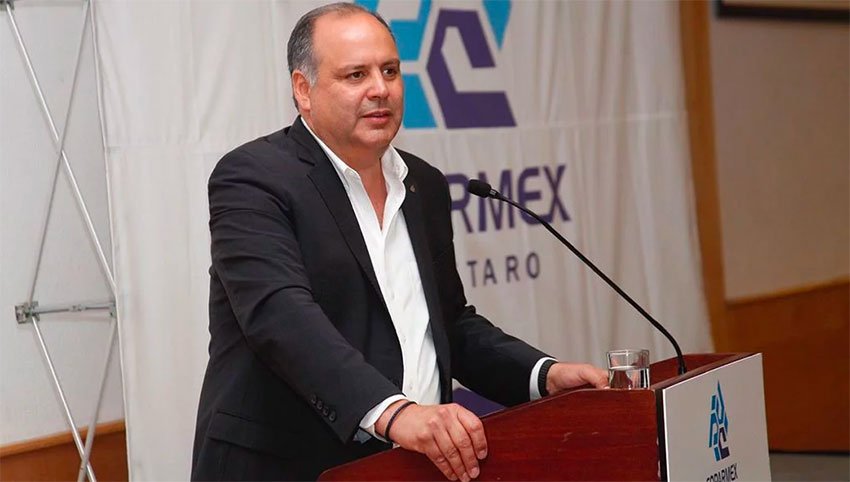
The Mexican Employers Federation (Coparmex) urged the government to reconsider its plan in consideration of the risks it could generate for Pemex and the nation’s public finances.
López Obrador said the refinery will cost no more than US $8 billion and be ready in May 2022 but Coparmex warned in a statement that there is ample evidence that the project won’t be all smooth sailing for the government.
‘Things could go wrong,’ warns Coparmex chief.
“Things could go wrong,” the business group said:
When the most indebted oil company in the world decides to undertake on its own a project of this magnitude in a line of business (refining) that has historically been unprofitable.
When specialist international companies decide not to participate under the conditions proposed by the government, warning of much higher costs and a longer execution time.
When the government has little or no experience in building refineries.
When the world is rapidly moving towards the replacement of fossil fuels with those that are friendly to the environment.
The Confederation of Chambers of Commerce, Services and Tourism (Concanaco) was also critical, stating that private companies could be dissuaded from investing in Mexico as a result.
Moody’s Investor Services said the move will place increased pressure on the finances of Pemex – it already has debt of US $106.5 billion – and the government.
“The fact that the project is advancing under the supervision of Pemex and the Secretariat of Energy is another task for the Pemex management team, which is already struggling to stop the decline in the production of crude and upgrade the existing refineries,” said Peter Speer, a senior vice-president at Moody’s and leading Pemex analyst.
Potential delays in the project and cost overruns pose risks both to the state oil company and the government, he said.
Klaus Rudischhauser, European Union ambassador to Mexico, said the government’s decision to take charge of the project sends a bad signal to international companies that are looking at the possibility of participating in the large infrastructure projects proposed by the López Obrador administration.
“I don’t know whether replacing a bidding process with national investment is a good response, I have my doubts,” he said.
Rudischhauser said that there is interest in European countries to participate in projects such as the Maya Train and the Isthmus of Tehuantepec trade corridor but stressed that it is essential to have clearly-defined international tendering processes.
Petroleum sector experts including former Pemex officials told the newspaper Milenio that the government’s decision was “bad news,” stating that the state oil company and Sener don’t have the technical capacity to carry out the refinery project.
Former Pemex refining director Juan Bueno Torio said the state-owned entity isn’t a construction company and doesn’t have the technology required to complete the project, while analyst Ramsés Pech said the private sector should invest in smaller refineries in strategic locations in order to improve the supply of fuel.
Opposition lawmakers were also critical, arguing that Pemex doesn’t have the necessary experience to build the refinery and contending that the US $8-billion budget will be insufficient.
In contrast, the ruling party’s leader in the lower house called the move a “brave decision.”
Mario Delgado said that putting Pemex in charge of the refinery project was just as ambitious as former president Lázaro Cárdenas’ creation of the state oil company.
Ricardo Monreal, leader of the Morena party in the Senate, expressed confidence that the López Obrador will fulfill his promise to build the refinery in three years without exceeding the budget, and called on others to show the same faith.
“I’ve known him for years, he’s perseverant and he’s going to achieve it,” he said.
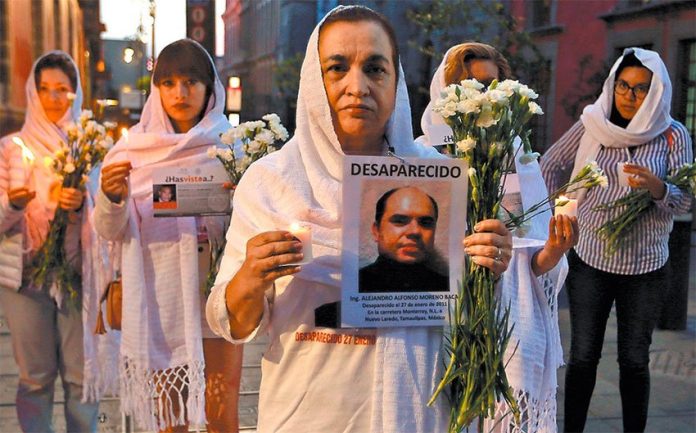
It’s Mother’s Day in Mexico but 40,000 moms whose sons and daughters are missing have nothing to celebrate.
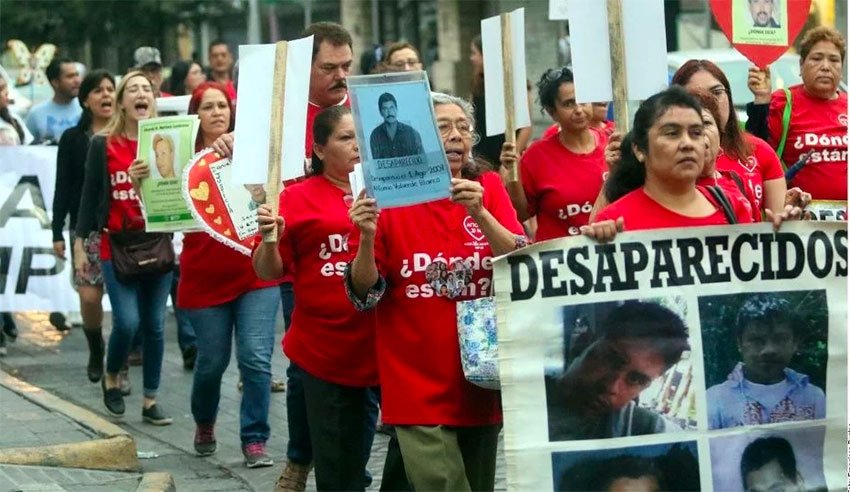
Thousands of mothers of the missing will march in at least 23 cities today to draw attention to their ongoing struggle to locate their children in a country where rates of violence remain stubbornly high, thousands of unidentified bodies lie in morgues and hidden graves are regularly discovered.
It will be the eighth consecutive year that mothers and other family members of missing persons take to the streets to demand that authorities increase their efforts to find their loved ones.
In Mexico City, the National Dignity March will begin at the Monument to the Mother and conclude at the Angel of Independence, located on the capital’s emblematic Paseo de la Reforma boulevard. Simultaneous marches are planned for 22 other Mexican cities.
Among the participants in the Mexico City march will be members of a collective from Coahuila known as United Forces for our Missing.
“. . . We have nothing to celebrate,” said spokesperson María Elena Salazar.
Mothers march in Monterrey, Nuevo León.
“Even though we have other children, one of them isn’t with us. While we don’t know what happened, we can’t let this date go by unnoticed.”
Salazar called on the federal government to treat all missing persons cases equally and not just focus on “emblematic cases,” such as the disappearance of 43 teaching students in Guerrero in 2014.
“We have a new government and we continue to demand that it help us and listen to us. It shouldn’t seek [to solve only] emblematic cases . . . we all have the same necessity,” she said.
In Veracruz, where crimes including homicides and kidnappings have spiked recently and a secret cemetery was discovered last month, Lucía Díaz, founder of the Solecito Collective, said that mothers of the missing will march today in the port city of Veracruz.
During a previous march, the collective received a macabre gift: a sketch of the location of a mass clandestine grave at Colinas de Santa Fe, a neighborhood on the outskirts of Veracruz city. The remains of 300 people were exhumed from the site.
However, Díaz said that the state’s top prosecutor is not offering the same support to the hundreds of collectives in the state that are made up of family members of the disappeared.
“The attorney general [Jorge Winckler] doesn’t make the slightest effort to hide his repudiation toward us,” she said.
Announcing the federal government’s search commission funding in February, human rights undersecretary Alejandro Encinas described Mexico as an “enormous hidden grave.”
“It’s estimated that there are currently 40,000 disappeared persons, more than 1,100 clandestine graves and around 26,000 unidentified bodies in morgues . . . that gives an account of the magnitude of the humanitarian crisis and the violation of human rights that we are confronting,” he said.