Home Blog Page 1888

A walk through the Mexico City markets of Colonia La Condesa

0
La Condesa’s only permanent market, Mercado Michoacán.

If you like to explore or shop in Mexico City’s numerous and diverse markets, the Condesa neighborhood offers three.

In downtown Condesa which, by the way, must be the electric scooter app capital of the world, is the tiny Mercado Michoacán, a beautiful art deco building shared with one of the city’s many iterations of Café Toscano and surrounded by the pearls of modern suburbia: Wing’s Army, 7-11 and Panam Shoes.

Aside from the nearby El Centenario cantina, Mercado Michoacán is one of La Condesa’s few older businesses to survive into the 21st century. It’s definitely worth a stop in for the gringas and sopes, but Michoacán really only provides the basics: you’ve got your chicken guy, your beef guy, some general stores and fruits and veggies.

It’s always surprising there isn’t a larger market in Condesa but maybe Mercado Escandón supplies the need. At Frutería las Delicias, Camelia Ferreyra Olivares tells me that it’s mostly neighbors that come in or visiting foreigners.

“Restaurants will come to buy,” she says, “if they run out of something. But they have distributors, so they don’t buy from us regularly.”

• Mercado Michoacán is at the corner of Tamaulipas and Av. Vicente Suárez.

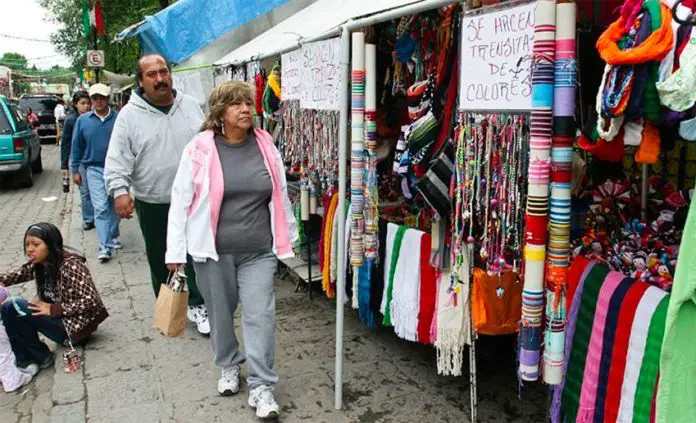
Every Tuesday, just blocks from Chapultepec Park, on the western edge of La Condesa lies the grande dame of Condesa-area street markets – Tianguis Condesa, the Condesa Tuesday Market.

Running along quaint Pachuca, lined with lush trees and quintessentially picturesque Mexico City architecture, Tianguis Condesa is a foragers’ paradise.

It’s best to come early, when the morning sun still feels good, before it gets too hot and the crowds form. The international food tours are ubiquitous, with foreigners learning about strange new fruits.

Melon and papaya pushers hand out samples and a hard sell, alongside vendors of clothing, cosmetics and housewares, all glowing pink under the CDMX-issued market tarps.

But the vegetables are the best reason to come, some of the most perfect produce you’re likely to find in the area, much of it sourced just outside of the city and likely picked only the day before.

Lilia Hernández has been selling fruits and dried nuts at the market for 40 years.

• Tianguis Condesa runs along Pachuca from Veracruz to Juan de la Barrera from 10:00am to 5:00pm every Tuesday.

On the other end of Condesa, right of to the side of busy Avenida Nuevo León, is the Condesa Friday Street Market, where the atmosphere is thoroughly upbeat. It’s Friday, very likely payday, and the clientele appear to be feeling fine.

Every tiny plastic stool is occupied at the counter of the simply named Barbacoa, known for its barbacoa flautas and a variety of sopes, quesadillas and tacos.

A spunky gray-haired woman in a double smock, plain white over pink gingham, multi-tasks throughout the stand, quick on her feet – patting out tortillas, wiping down tables, taking orders. It’s incredibly crowded, but even if you can’t find a stool, you’ll be able to eat on your feet at Barbacoa.

The flautas are perfectly golden with the crunch that tells you they’re fresh, topped with crema and queso fresco. Don’t be shy with the salsas – there are buckets full of them behind the counter.

Local workers on lunch break and visiting tourists are the bread and butter of most street market restaurants, and they visit this tianguis about 50/50, I’m told. Rodrigo Reyes, who works in an office nearby, tells me, “We come every Friday to fill our stomachs before going out for drinks after work.”

The Doña holding it all together at Barbacoa at the Condesa Friday Street Market.

Right behind Barbacoa, Pescados y Mariscos Los Pescaditos is almost equally busy. The fish cocktail “with everything” (meaning extra cocktail sauce, cilantro and avocado on top) is a perfect balance of lime, spice, crunchy bell peppers and a touch of extra sweetness.

Another specialty is the caldo de camarón, a deep red shrimp broth with plenty of richness to line the belly for a night on the town.

Moving away from the food vendors is a bit more of a local scene. At Ian Toys, Alejandro Mendoza washes a newly acquired action figure in a bucket of soap.

He’s been selling at the market for 20 years and specializes in older collectibles, like favorite superheroes and Star Wars and Jurassic Park figurines.

“Mostly adults buy the toys because kids are only into tablets these days — iPads,” he says, guessing that his clientele is about 80% adults and 20% kids.

“Kids don’t want to play with dolls,” he says with a smirk. “Some of my clients come about every week. I’ve had some clients for over 10 years, since they were kids.”

The beautiful fish cocktail from Los Pescaditos at Condesa Friday Market.

Most of the vendors move throughout the city, selling at a different street market every day, and despite Condesa’s fame as one of the city’s major tourist zones, I’m told sales are pretty equal on any given day.

But Tianguis de los Viernes is the fun one because everyone’s in a weekend kind of mood.

• Tianguis de los Viernes runs along Campeche from Saltillo to Ometusco and along Ometusco to Nuevo León every Friday until 5:00pm.

This is the second in a series on the markets and weekly tianguis (markets on wheels) of Mexico City.

Businesses issue warning over implications of public consultations

0
De Hoyos Walther, president of Coparmex.

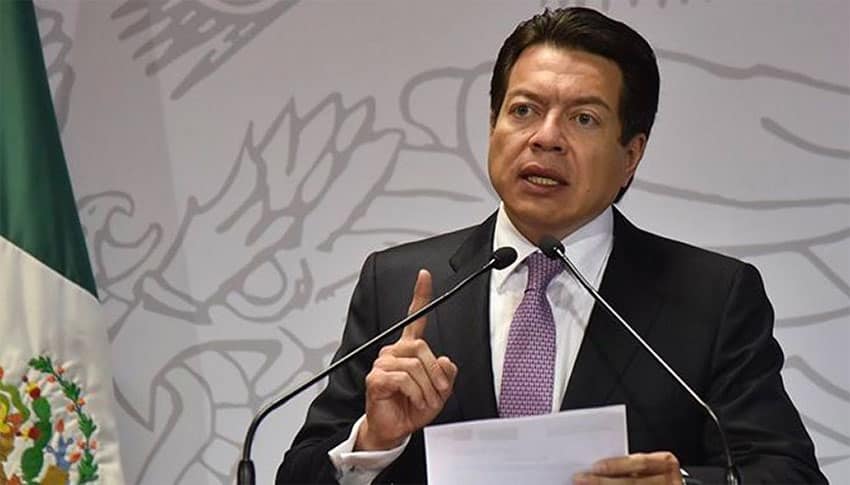
The Mexican Employers Federation (Coparmex) has sounded an alarm over constitutional amendments that it believes could have grave financial consequences.

The initiative, already approved by the lower house of Congress, is one that also lays the groundwork for a vote on the president’s performance, an issue that has been controversial on its own.

But Coparmex warned that there are broad implications in other parts of the initiative that allow for public consultation on a wide range of key economic issues, including who will pay taxes and how much.

Coparmex president Gustavo de Hoyos Walther cautioned that it would also make it possible for the president to pass new taxes in 2022.

“The public referendum initiative in its current form plants the ‘fourth year trap’ of this administration; it opens the door for technical decisions of great strategic responsibility for the country, like who pays taxes, to be decided by a manipulated public.”

He observed that under the proposed amendments a vote by 25% of the eligible population, or 21.7 million Mexicans, would be sufficient to pass binding legislation.

“That would mean that the results of a public consultation could be binding with the votes of only three states, like Mexico City, México state and Veracruz, or with the vote of people aged 20-29. With this small percentage, public referendums could put issues important for the nation’s stability at risk.”

Those decisions could end up being made on the basis of the government’s popularity rather than any technical analysis, de Hoyos said, and new taxes could be imposed despite the government’s promise there would be none during the first three years of the president’s term.

“The public consultation reform approved by the Chamber of Deputies could end up creating forms of [political] participation especially convenient for those currently in power, particularly when it comes time to decide important issues for our nation’s future.”

Source: Milenio (sp), Sin Embargo (sp)

50% of organized crime orchestrated from prison cells: Durazo

0
A federal prison or criminal headquarters?

Half of all organized crime in Mexico is planned inside jails due to corruption in the prison system, according to the federal public security secretary.

“Unfortunately, the prisons in the country are marked by corruption and the high rates of corruption sadly translate into 50% of organized crime being run from within prison facilities. This is an example of the challenge we have in front of us,” Alfonso Durazo said.

The secretary said that acknowledging the reality does not reflect poorly on the current government because it is not responsible for creating the situation. However, it does have an obligation to solve the problem, Durazo added.

The official also acknowledged the wider problem of corruption in Mexico, ironically describing Mexico’s low position on Transparency International’s Corruption Perception Index as a “feat” of past governments.

“In the year 2000 . . . Mexico was in 53rd place on the worldwide corruption rankings, six years later, the government of president [Vicente] Fox left our country in 70th place. Six years later, the government of Felipe Calderón left it in 100th place. In 2016, we’re in 123rd place, then 134th in 2017 and 138th in 2018 out of 175 evaluated countries,” Durazo said.

Security Secretary Durazo.

“Understand that it is quite a feat to move from one position to another when there are only 175 countries evaluated and that speaks to us about the scale of the challenge we have,” he added.

To stamp out corruption in federal security forces, the Secretariat of Public Security is implementing an anti-corruption and open government program, Durazo said, explaining that its goal is to create a culture of accountability.

Measures to combat corruption “historically haven’t existed in the security forces,” he added.

“They haven’t existed because these forces have been used to commit abuses against the population . . . In this government, we will never use public force to repress. Consequently, we won’t have anything to hide . . .”

Despite recent spates of violence in Guanajuato and Veracruz, Durazo said that the security situation in both states is under control.

Police and military operations have “constrained” and “weakened” feuding criminal organizations, he said, charging that both the Santa Rosa de Lima Cartel – a gang of Guanajuato-based fuel thieves – and the Jalisco New Generation Cartel (CJNG) have been debilitated.

In addition to on-the-ground operations against the cartels, financial authorities have targeted criminals’ bank accounts, Durazo said.

Despite President López Obrador saying in January that the government’s security strategy “no longer includes capturing drug lords,” the security secretary said that operations are under way to apprehend suspected CJNG leader Nemesio “El Mencho” Oseguera Cervantes and alleged Santa Rosa Cartel capo José Antonio “El Marro” Yépez Ortiz.

That strategy also includes the creation of the national guard, which has now been approved by all 32 state congresses. Durazo said a budget of 20 billion pesos (US $1.05 billion) will be required this year to pay the salaries and benefits of 21,000 new recruits and to purchase equipment for them.

Joining the recruits in the initial incarnation will be 35,000 military police, 15,000 Federal Police and 8,000 naval police, who will be integrated into the force with their own uniforms and equipment and under a separate budget, the secretary said.

Source: Milenio (sp) 

Pemex union leader noticeably absent from expropriation anniversary party

0
The Pemex union leader was absent from the party but signs demanding he be jailed were not.

The leader of the Pemex workers’ union was conspicuous by his absence at celebrations yesterday to mark the 81st anniversary of the expropriation of the Mexican oil industry.

For years, Carlos Romero Deschamps has attended the official expropriation anniversary ceremony to give the president of the day a pat on the back.

Union members would also chant, applaud loudly and generally show their support for the president and his government in an animated way.

But the first ceremony presided over by President López Obrador at the Miguel Hidalgo refinery in Tula, Hidalgo, was notably different.

Instead of union leaders and members – the former were not invited – government administration officials made up most of the audience at the ceremony, and their reaction to the proceedings was far more reserved.

Another difference to past ceremonies was the presence of banners that called for an end to corruption at the state oil company, an audit of the Pemex workers’ union and the imprisonment of Deschamps, who has been accused of involvement in organized crime, illicit enrichment, money laundering, tax evasion and fraud.

During the event, López Obrador gave an overview of the history of Pemex up to the start of what he calls the “neoliberal period,” which began in 1982 with Miguel de la Madrid’s presidency and continued up to the end of Enrique Peña Nieto’s administration last year.

During the 36-year-period, the president charged, Mexico’s petroleum industry was destroyed.

López Obrador, however, has pledged to “rescue” the energy sector and a month ago announced a US $5.5-billion bailout for the debt-laden state oil company.

The government also implemented an anti-fuel theft strategy this year which won widespread public support even though it caused widespread fuel shortages and yesterday Energy Secretary Rocío Nahle announced details about the tendering process for a new oil refinery on the Tabasco coast.

Mexico’s oil industry was nationalized by former president Lázaro Cárdenas in 1938 and closed off completely to foreign and private companies until the previous federal government ended Pemex’s monopoly with its 2013 energy reform.

Source: El Universal (sp) 

Government closed kitchens leaving users with nowhere to go

0
Medina cooks potatoes at his home in Michoacán.

The federal government’s decision to terminate its predecessor’s community dining program has left some erstwhile beneficiaries in a precarious position.

José Honorio Medina Gaspar, 85, of Santa Fe de la Laguna – an indigenous community in the Michoacán municipality of Quiroga – depended on the local comedor comunitario for his survival and that of his disabled adult children for two years.

The former government opened the Santa Fe community kitchen in December 2016 and around 300 people in situations of extreme poverty ate meals there on a daily basis until it closed at the end of January, two months after President López Obrador took office.

Speaking in his native language of Purépecha, Medina told the newspaper El Universal through an interpreter that he can’t believe that he will never again be able to sit down to breakfast or lunch at the facility.

He explained that he became a widower many years ago and since then assumed the sole responsibility of looking after his son and daughter, José and Lupita, both of whom were born with mental handicaps.

Since childhood Medina had worked as a potter but the death of his wife and his advancing age coupled with the task of caring for his children made it impossible for him to earn a living to feed himself and his family.

The opening of the community kitchen, part of the former government’s National Crusade Against Hunger (CNCH), was a godsend.

But since its doors were closed, Medina said that he and his daughter – José recently passed away – haven’t eaten with any regularity.

The octogenarian added that he was occasionally able to get a day’s work in the fields for which he is paid 50 pesos (US $2.60) but explained that’s only enough to buy some tortillas and beans.

Medina showed an El Universal reporter his wood stove where he was cooking two potatoes and a little bit of corn, and said that was all he and Lupita would have to eat for the foreseeable future.

“That’s what I’m going through now but what are we going to do? They’re not going to give us anything to eat again . . . There’s nowhere to go to eat,” he said.

The Santa Fe de la Laguna community kitchen is one of 460 that have closed in Michoacán since the new federal government took office.

Jordy Arres Hernández, the former coordinator of the program in the state, said there were more than 41,000 beneficiaries including thousands of children and many pregnant women.

Verónica Figueroa Bautista, manager of the Santa Fe facility, said the last time the government sent supplies was in December.

She subsequently received some support from local residents but it ultimately wasn’t enough to allow it to remain open.

The previous government’s anti-hunger campaign has been criticized for failing to end hunger and is under suspicion for corruption.

Source: El Universal (sp) 

Zip liners can now choose a hammock and five other ways to ride in Acapulco

0
For a more relaxing zip line experience, Xtasea offers the Sunset ride.

Zip line fans can get their fill of the thrill at the newly-upgraded Xtasea zip line park in Acapulco, the longest in the world over a body of water.

The zip line over Puerto Marqués bay is 1,800 meters long and 100 meters high. Riders could reach speeds up to 120 kilometers per hour before but improvements have bumped that speed to a breathtaking 140.

In addition, there are now six different options for aficionados to throw themselves into the void.

The Superman ride — lying on one’s stomach — has become the traditional way to zip line over the bay, but with the Twin two can share a ride and zip away together.

A more traditional experience is the Rider option, where the rider is held in a seated position by a harness.

The Superman ride at Xtasea.

If the height is not scary enough, visitors can choose the Nocturno option, which will throw them into the dark of night with little more than the lights below to give them any hint of their speed.

Few people may see zip lining as relaxing, but the Sunset option might be just that: riders lie on a hammock from which they can watch the the setting sun.

The last option is Free Jump, because why the heck not. Riders take a leap and free fall for 20 meters, attached to the zip line with a 20-meter rope for the ultimate experience.

Prices for the rides range between 600 and 1,800 pesos (US $32 and $95 respectively).

Construction of the zip line park began in the fall of 2016 and it opened in March 2017. It now ranks among the top five in the world.

Source: El Universal (sp)

To eat tacos of carnitas is to celebrate fall of the Aztecs: senator

0
The senator and the offending tacos.

A ruling party senator has provoked both a quizzical and critical reaction by declaring that eating tacos of carnitas is to celebrate the fall of Tenochtitlán, the Mexica or Aztec city that was located on the land where Mexico City now stands.

Jesusa Rodríguez made the controversial claim about the popular pork tacos in a video posted to her Twitter account last week.

“. . . Exactly 500 years ago, the conquest of the continental territory of Mexico began. With the conquest, the Catholic religion arrived and was imposed with blood and fire by fanatics and murderers who came to pillage our territory and our culture,” she said.

“. . . This conquest was completed on August 13, 1521, with the fall of the great Tenochtitlán, which was also the first day that tacos de carnitas were eaten in this country. The Spanish brought the pigs and the Mexicans provided the tortillas. Remember every time that you eat tacos de carnitas, you’re celebrating the fall of the great Tenochtitlán,” the Morena party lawmaker said.

Former President Felipe Calderón was among many social media users who responded to Rodríguez’s curious claim.

“Beyond the delusions of this lady (maybe that is how these political times are), as a michoacano [native of Michoacán] I love carnitas, they’re emblematic for us and certainly a gastronomic representation of our mestizaje [miscegenation of the Spanish and indigenous peoples], the pork from Spain and the tortilla from right here,” he wrote on Twitter.

“Crazy! It’s forbidden to eat tacos de carnitas because they remind us of the consummation of the conquest. And this senator has never eaten a taco de carnitas? Crazy . . .” wrote journalist Joaquín López-Dóriga.

Another journalist, Mario Campos, said he will now “remember the benefits of being a country with several cultures behind it” whenever he eats tacos de carnitas, while National Autonomous University (UNAM) historian Alfredo Ávila said there were inaccuracies in Rodríguez’s claims.

“When she asserts that the conquest of the ‘continental territory of Mexico’ began in 1519, she should have said of the continental territory that today is Mexico. At that time, it was territory of various altépetl [city-state] communities,” he wrote on Twitter.

Ávila also challenged other assertions made by Rodríguez, such as the claim that tacos de carnitas were eaten at the conclusion of the conquest.

“. . .  When you eat a taco de carnitas, you’re not celebrating the conquest of the altépetl of México. In fact, there are no testimonies that on August 13, [1521], that dish was eaten . . .” he wrote.

It’s not the first time that the Morena senator, theater director, actress and artist has courted controversy.

On March 8, Rodríguez asserted that it’s not common for Catholics to be intelligent.

Source: Nación 321 (sp)  

El Popo explosion causes ash fall in 12 Puebla municipalities

0
The volcano at 9:38pm Monday.
The volcano at 9:38pm Monday. cenapred

One of the strongest explosions recorded in recent years at the Popocatépetl volcano occurred last night, expelling incandescent rock fragments in a 2.5-kilometer radius around the crater and triggering an ash fall alert in the city of Puebla and 11 other municipalities.

Recorded at 9:38pm, the explosion expelled a plume that rose 1.2 kilometers above the crater. The mobile seismic alert SkyAlert reported that the blast could be heard 40 kilometers away.

The ash expelled in the explosion started to drift toward northeastern Puebla state and was followed by an ash fall alert issued by the state Civil Protection office for the municipalities of Atlixco, Cuauhtlancingo, Huaquechula, Ocoyucan, Puebla, San Andrés and San Pedro Cholula, San Diego la Mesa Tochimiltzingo, San Gregorio Atzompa, San Jerónimo Tecuanipan, Santa Isabel Cholula and Teopantlán.

Civil Protection authorities reiterated that a 12-kilometer security radius is in place around the volcano, as it is expected to continue exploding and expelling fragments.

That radius was breached a week ago when several people climbed to the top of the volcano and filmed video of the crater, drawing rebukes from authorities.

With regard to the ash fall, authorities advise the use of wet face masks in case of exposure, keeping pets indoors and windows closed, and sweeping up ash instead of washing it away.

Source: Reforma (sp)

AMLO signs off on not running again, but not without a jab at adversaries

0
The president signs a pledge not to run for re-election.

President López Obrador signed a written undertaking today that he will not seek re-election at the end of his term in 2024, declaring that six years is enough time to “eradicate corruption and impunity.”

The pledge comes in response to claims from opposition party lawmakers that a proposal to subject the president’s rule to a referendum three years after taking office is part of a ploy to enable López Obrador to perpetuate his power.

The lower house of Congress approved a constitutional amendment last week that would allow voters to have their say on a president’s performance midway through the six-year term, and López Obrador has said that if citizens choose to revoke his mandate, he will resign.

The president read out his commitment to reporters at his daily press conference this morning.

“. . . During more than 20 years, I have declared on several occasions that upon reaching a public position, I would subject myself to a revocation of mandate [vote],” López Obrador said, explaining that he made the promise while campaigning in the 2006, 2012 and 2018 presidential elections.

“So, in the middle of my mandate, in 2021, a consultation should be carried out in order to ask citizens if they want me to continue governing or to resign,” the president said.

López Obrador acknowledged in the commitment that he was elected to serve a six-year term but added that according to the constitution, “the people have every right to change the form of their government, in other words, the people install [the president] and the people remove [the president].”

To that end, the president explained that he asked Congress to make the required constitutional changes to allow the midterm referendum to take place.

“However, my political adversaries, the conservatives who think that I am like them – because their true doctrine is hypocrisy – proclaim that the proposal to subject myself to a revocation of mandate [vote] conceals the intention to stand for reelection in 2024,” López Obrador said.

“In light of this lie, it is necessary for me to reiterate my democratic principles and convictions to establish the following:

  1. I am a maderista [adherent of revolutionary and former president Francisco Madero] and supporter of his slogan ‘effective suffrage, no re-election.’
  2. Ideals and convictions inspire me, not the ambition for power.
  3. I believe that power only has meaning and becomes a virtue when it is placed at the service of others.
  4. I believe that six years is enough to eradicate corruption and impunity and turn Mexico into a prosperous, democratic and fraternal republic . . .
  5. I reaffirm that I’m not a supporter of and I don’t agree with re-election and under no circumstance would I try to perpetuate myself in the position I currently hold because that wouldn’t only mean going against the constitution but also betraying my principles and renouncing my honesty, which I consider to be the most valuable thing in my life.

. . .  I will leave the presidency on the exact day that the maximum and supreme law indicates and in 2024 I will go to [my ranch in] Palenque. But I also say with sincerity that I hope with my whole heart, with my whole soul, that what has been achieved [by my government] is very difficult to reverse, so that the country doesn’t go back to the vile and sad times in which the mafia of power ruled.”

Source: El Financiero (sp) 

Traditional parade or table dancing? Models generate criticism

0
Winged models helped celebrate the anniversary of the expropriation of the oil industry.

Edecanes might have a hard time finding work in Mexico City, but not in Agua Dulce, Veracruz.

The scantily dressed, eye-candy female models were banned in the capital last year by the previous city government, which ruled that the models would no longer be allowed at government events.

But there were several of the lingerie-clad models on Sunday at the traditional oil workers parade in Agua Dulce, Veracruz, creating some controversy on social media. One commenter asked, “Is this a traditional parade or a table dance?”

The carnival-like parade takes place on the eve of the official anniversary of the expropriation of the Mexican oil industry, a national holiday that commemorates the nationalization of the country’s petroleum reserves, facilities and companies under then-president Lázaro Cárdenas on March 18, 1938.

The models from the Mujer Bonita agency, wearing underwear, enormous wings and not much else, climbed aboard nine floats decorated to represent the different areas where Section 22 of the Mexican Oil Workers’ Union (STPRM) operates.

Some union members were not supportive of the display of near-naked women: “This is how Section 22 operates in Agua Dulce, Veracruz: throwing away money instead of supporting their temporary workers who have gone months without a contract.”

Source: Milenio (sp), Infobae (sp)