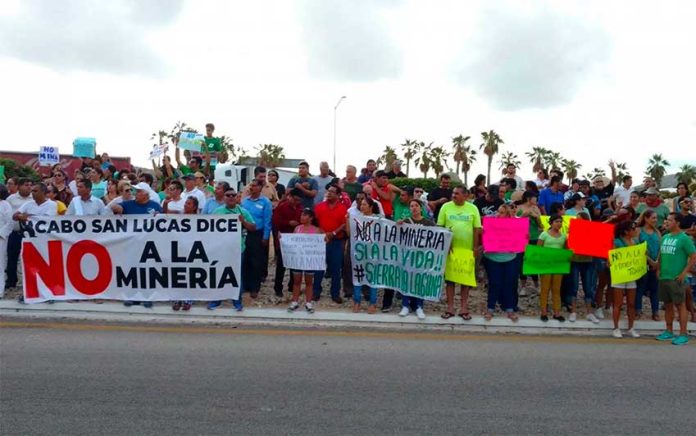
President López Obrador announced yesterday that a controversial gold mining project in Baja California Sur will not go ahead because of environmental concerns.
The president had said previously that the proposed Los Cardones open-pit mine project, located within a buffer zone of the Sierra de Laguna biosphere reserve in the municipality of La Paz, would be put to a public consultation but that plan has now been scrapped.
“I was in La Paz a few months ago and people were asking me to define my position about the mine. The time to define my position has now arrived and I can tell the people of Baja California Sur [that I say] no to the mine,” López Obrador said at a government event in Cabo San Lucas.
The president explained that he doesn’t support the mine “because we have to look after paradise, not destroy paradise.”
López Obrador added that in order for Baja California Sur residents to be able to continue making a living from tourism, “we have to take care of the environment,” and in order to have adequate water supply, “we have to take care of the water in the subsoil.”
Citizens and some politicians have opposed the mine project on the grounds that it could have a negative impact on groundwater in the Sierra de Laguna reserve and because in 2017 a federal tribunal quashed an environmental permit that had been issued for it.
In September last year, residents demanded that then president-elect López Obrador commit to stopping the mine from going ahead, but at the time he was non-committal and instead proposed a consultation.
Yesterday he explained that a public vote, such as those held on the new Mexico City airport and a thermal power plant in Morelos, wasn’t necessary because unlike those projects the mine wasn’t started during the administration of the previous government.
This project, López Obrador said, “would be up to me to start but I say no and that’s within my powers.”
The open-pit mine was to be built by Desarollos Zapal, a subsidiary of Invecture, a Mexican firm linked to Grupo Salinas.
According to the company, the site of the mine has estimated reserves of 1.2 million ounces of gold.
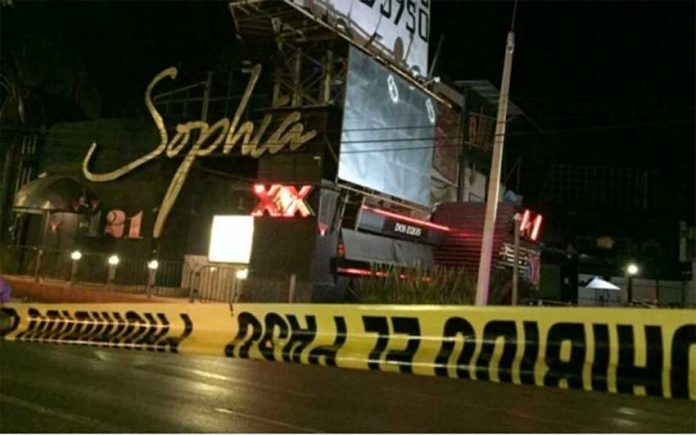
Crime scene tape at the Sophia bar Thursday night in Cuernavaca.
The Morelos state government has removed the Cuernavaca police chief after a bar shooting this week killed two people and wounded 10 others.
Security Secretary José Ortiz Guaneros announced the removal of José Trinidad González Flores after at least two assailants opened fire in the Sophia bar on Thursday night.
One of the dead was the daughter of an official with the state education institute.
In a statement on Twitter, Ortiz said that González had been incapable of containing systemic violence in Cuernavaca in any meaningful way. The former police chief’s replacement has not yet been announced.
The state government also released a statement urging bars to report threats or extortion attempts, which many speculated might have been a factor in Thursday’s attack, and to implement extra security measures, like panic buttons, video cameras and pat-downs of patrons.
In solidarity with the victims of the attack in the Sophia and as a protest against insecurity in the city, several popular bars and nightclubs in Cuernavaca, including Morgana, Janis and The Noise, announced that their doors would remain closed this weekend. They urged the government to take concrete action against crime in the state capital.
Interior Secretary Pablo Ojeda Cárdenas told a press conference that Morelos does not have enough police to effectively combat the crisis of violence in the state. He said the state will ask President López Obrador for an additional 250 police elements to reinforce security in Morelos.
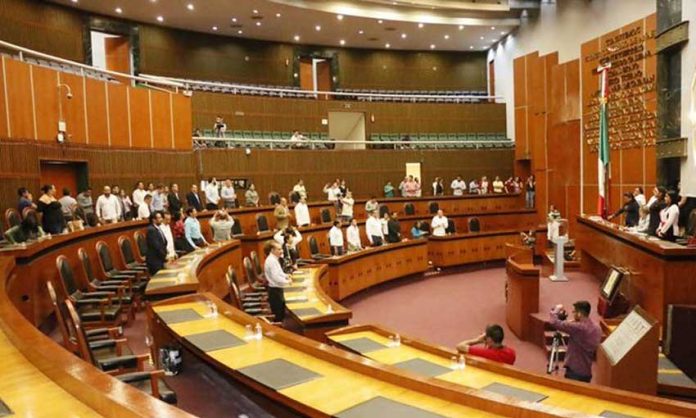
The Guerrero state Congress voted unanimously in favor of the new security force.
Lawmakers in Guerrero and Campeche unanimously approved yesterday the proposal to create a national guard the day after it passed the lower house of the federal Congress.
A simple majority of Mexico’s 32 state congresses must ratify the proposal in order for the new security force to be created.
In Guerrero, one of Mexico’s most violent states, there was no debate about the federal government’s plan to create the new force, which will initially be made up of just over 60,000 members, including Federal Police officers, military police and naval police.
By voting in favor of the proposal, all 31 deputies present in the state Congress yesterday expressed confidence that the deployment of the force will help to reduce spiraling rates of violence in the country.
Congress president and Morena party Deputy Antonio Helguera declared in an interview after the vote that it was “mission accomplished.”
The lawmaker warned, however, that federal authorities must take care to ensure that the national guard maintains total respect for human rights while working to combat insecurity.
A range of non-governmental organizations and the National Human Rights Commission (CNDH) have warned that the creation of the guard will perpetuate a failed militarized crime-fighting strategy first implemented by former president Felipe Calderón in 2006, and result in more human rights violations being committed by the armed forces.
In order to win support in federal Congress for the constitutional amendments required to create the national guard, the government agreed to modify its proposal so that the security force will have a civilian command rather than a military one.
Members of the military will only be permitted to carry out public security tasks for a period of five years after the security force’s creation.
Those recruited for the national guard will lose their military fuero or immunity and be tried in civilian courts if accused of committing abuses or human rights violations.
On Thursday, the federal Chamber of Deputies approved the national guard proposal with only one lawmaker voting against it.
Security Secretary Alfonso Durazo said that he hoped that state congresses would complete the ratification process within four months.
Durazo also said he hoped that through intense recruitment the size of the national guard would increase to 150,000 by the end of the year although he acknowledged that 360,000 members would be the ideal number.
However, some security experts have expressed skepticism that the creation of the force will be successful in combating insecurity in Mexico.
“Operationally, it doesn’t change anything,” Mexico City security analyst Jaime López Aranda told The New York Times, referring to the dual civilian and military policing model.
Asked whether the national guard would reduce crime and violence, he responded: “Of course not. It’s the same people doing the exact same stuff.”
What to do about transit thieves who want to steal your cell phone? Fool them with a fake one.
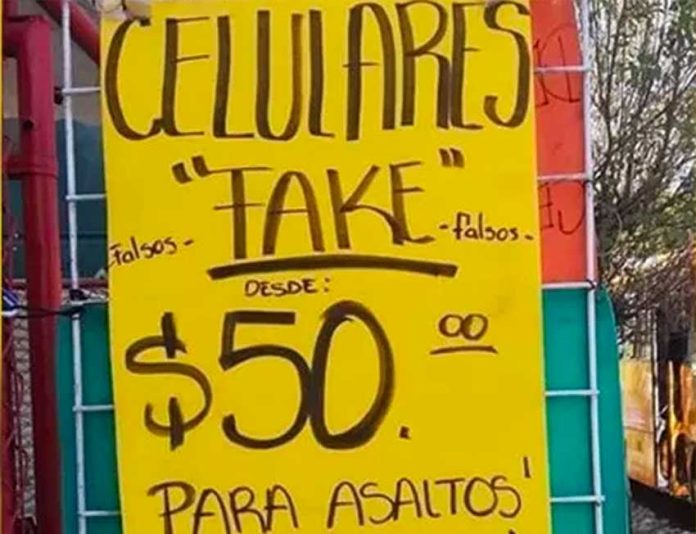
A spike in robberies on transit buses in a Puebla city neighborhood sparked the ingenuity of local entrepreneurs, who are selling fake mobile phones as decoys to fool thieves.
Urging transit riders to “take no risks,” the vendors are selling the devices at 50 pesos and up (US $2.60).
According to some social media users, the fake phones are plastic cases with a cardboard mockup of an actual phone inside.
A Route 10 bus can be seen in the background of a photo that appeared on social media showing a sidewalk sign advertising the phone. The route runs between the southern Puebla neighborhoods of Los Álamos and Los Héroes which, according to residents, has seen an increased number of robberies.
The sign says, “For assaults on public transit!”
According to the National Survey on Urban Public Security (ENSU) conducted by the national statistics institute Inegi, 75% of the population 18 and older feel insecure in their cities, and transit buses are among the places where they feel the most insecure.
Standard & Poor’s lowered its credit rating outlook for Mexico from stable to negative yesterday, stating that there was a one-in-three chance of a downgrade over the coming year.
The ratings agency maintained Mexico’s sovereign rating at investment grade status of BBB+ but said in a statement that President López Obrador’s plans to reduce the role of private enterprise in the energy sector and increase spending on the debt-laden state oil company raised concerns for government finances.
“The new strategy for the energy sector places an added burden on the already highly indebted government-owned energy company Petróleos Mexicanos [Pemex],” S & P said.
“The combination of Pemex’s weak financial profile and a more active role in the energy sector could raise the risk of higher contingent liabilities for the sovereign,” it added.
There are fears that the US $5.5 billion bailout of Pemex won’t be enough and that the government will have to fund additional rescue packages, which would further impact on its own financial health and increase borrowing costs.
S & P also said that “poorer than expected” economic growth and increased centralization of decision-making under López Obrador could weaken Mexico’s macroeconomic stability.
Growth is expected to slow further this year, according to forecasts by the Bank of México, the International Monetary Fund and private financial institutions.
In its fourth-quarter report, the central bank said this week that an investment slowdown and recent fuel shortages, rail blockades and strikes were among the reasons why it reduced its 2019 growth forecast to between 1.1% and 2.1% compared to a prediction of 1.7% to 2.7% in its previous report.
S & P said that it could return its credit rating outlook to stable within the next year but stressed that the government needs to manage the economy effectively, maintain moderate fiscal deficits and boost investor confidence.
The state oil company contributes around 15% of total government tax revenue but has debt in excess of US $100 billion and its oil production has declined for 14 consecutive years.
López Obrador has vowed to decrease Mexico’s dependency on petroleum imports and rescue not just Pemex but the entire energy sector.
Announcing the government’s rescue package on February 15, the president stressed that if Pemex needs more funding to reduce its financial burden and strengthen its capacity to invest in exploration and production, “there will be more support.”
Responding to a question about Standard & Poor’s revised outlook, López Obrador told reporters in Chihuahua today that he was unconcerned.
“We’re going very well . . . If the country is growing, we’re fine and in a good mood . . .”
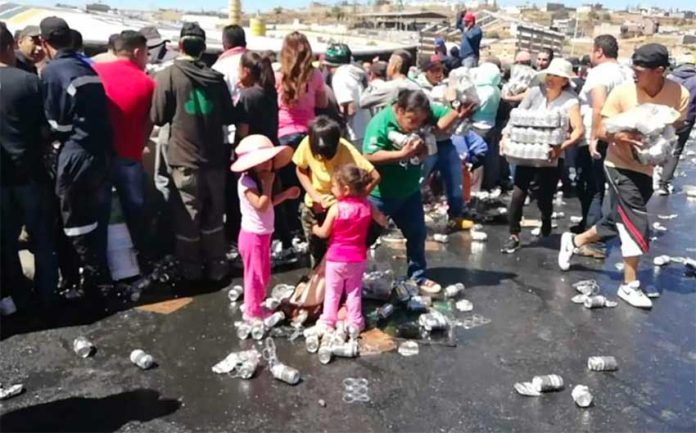
A crowd helped themselves to the contents of an overturned beer truck in Guadalupe, Zacatecas, yesterday.
People of all ages were attracted to the free beer after the accident occurred on the Zacatecas-Aguascalientes highway.
A crowd that included children and senior citizens soon arrived and some carried away entire crates of beer while others gathered the cans left strewn on the road.
Federal Police attempted to contain the pillaging but they were overwhelmed by the crowd until more police arrived.
Criticism of the looting appeared after photos of the incident were posted on social media. Some criticized the pillaging by adults who also allowed their children to participate in the theft.
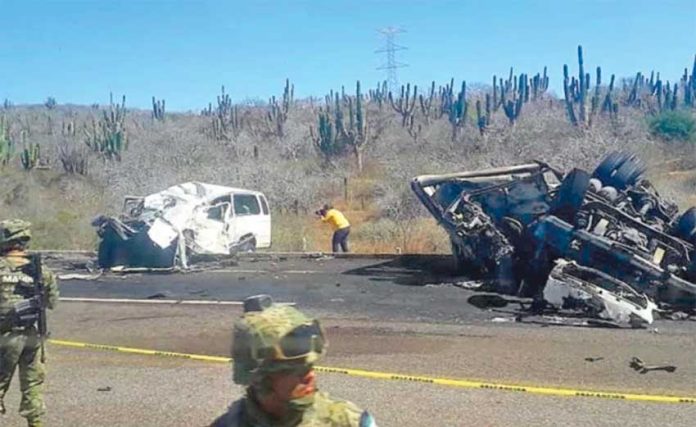
A traffic accident in Baja California Sur yesterday left seven people dead and another seriously injured.
State Civil Protection undersecretary Carlos Godínez León said the accident occurred around 9:00am on the busy Cabo San Lucas-Todos Santos highway and involved several cars, two pickup trucks and a semi-trailer.
Of the seven people killed in the accident, five were taxi drivers on their way to La Paz to meet with legislators and present their case against a new state transportation law.
The highway was closed for several hours after accident.
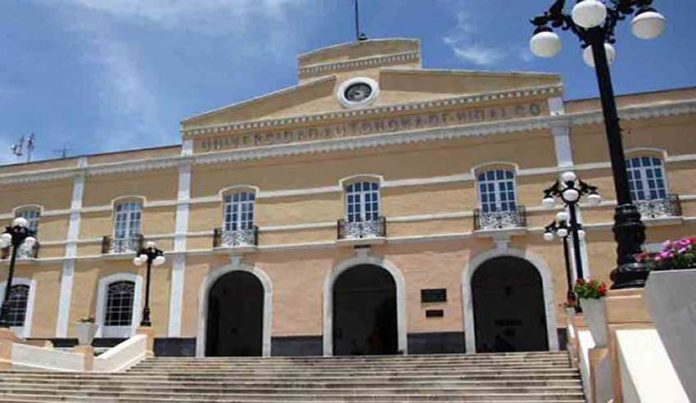
The Autonomous University of Hidalgo is at the center of a money laundering investigation.
The Autonomous University of Hidalgo (UAEH) is under investigation for money laundering after financial authorities detected that it received US $156 million from bank accounts in Switzerland and more than 20 other countries.
The Secretariat of Finance and Public Credit (SHCP) said in a statement this week that its Financial Intelligence Unit (UIF) received a financial system report alerting it to unusual financial movements in different bank accounts held in the name of a public university.
“The financial system reported the execution of deposits and international transfers coming from more than 22 countries; Switzerland, Spain, the United Kingdom, among others. Among the most relevant movements, it was detected that an educational center received around $150 million from bank accounts located in Switzerland,” the SHCP said.
UIF chief Santiago Nieto revealed yesterday that the Hidalgo university is under investigation and its accounts have been frozen. He pledged that there would be no impunity in the case, even if people linked to Mexico’s ruling party, Morena, are found to be involved.
“At the moment, I can’t give more information, I can only confirm that it is indeed the university [of Hidalgo]. The president of the republic has told me that we must have zero tolerance with corruption and zero tolerance for impunity. It doesn’t matter what party it is, this affects the financial system,” he said.
The revelation that the UAEH is suspected of money laundering came at the end of a difficult week for the university.
Last Saturday, the son of UAEH council chairman and former chancellor Gerardo Sosa Castelán was shot and killed, while on Monday the university’s official Facebook page was hacked.
Hidalgo Governor Omar Fayad acknowledged yesterday that “things have happened” since the homicide of Gerardo Sosa Cravioto in the municipality of Acaxochitlán and said he had instructed the state’s attorney general to do all he could to facilitate investigations into the crimes.
He also called on the family of the murder victim to provide any information it has that could help authorities in their inquiries.
Sosa Castelán, who is likely to come under investigation as part of the money laundering probe, is a former federal lawmaker with the Institutional Revolutionary Party (PRI) but distanced himself from the party after losing an internal contest to become the candidate for governor of Hidalgo in 2005.
He is now linked to and a supporter of President López Obrador’s Morena party although he is not a formal member, the newspaper Milenio said.
Current university chancellor Adolfo Pontigo Loyola yesterday denied that the university was involved in money laundering or other corrupt activities.
“We don’t have any money that is not the university’s nor have we received money from any country. Money that is deposited in university accounts . . . is strictly money of the institution,” he said.
Pontigo claimed that both state and federal authorities have completed audits of the university’s accounts and found no irregularities.
“The autonomous [university] of Hidalgo is among the best public education institutions in the country. We were never participants in the master fraud,” he said, referring to a corruption scheme in which federal agencies diverted government money through public universities.
“We’re among the best 1,200 [universities] in the world and above all, the Federal Auditor’s Office has audited us. We haven’t had any problem,” Pontigo added.
The chancellor said he was willing to support a wider investigation into the university’s finances but again stressed that authorities “won’t find any legal irregularity or extraordinary resources that shouldn’t be here and that are not of the university.”
Mexico continues to rank among the worst countries in the world on an index that measures the rule of law based on the experiences and perceptions of the general public.
For the second consecutive year, Mexico maintained a score of 0.45 on the World Justice Project (WJP) Rule of Law Index 2019. The index uses a scale from 0 to 1, with 1 indicating the strongest adherence to the rule of law.
While Mexico’s score remained the same, its position on the index dropped two places to 99th out of 126 countries.
In Latin America and the Caribbean, Mexico ranked 26th out of 30 countries, just ahead of Honduras, Bolivia, Nicaragua and Venezuela.
Corruption, insecurity and impunity were all factors in Mexico’s low score and ranking, the WJP said.
In the “absence of corruption” and “order and security” categories, Mexico ranked 117th out of the 126 countries while for “criminal justice” and “civil justice” it placed 115th and 113th respectively.
Mexico’s achieved its best ranking in “open government,” placing 35th. Mexico’s next best place was 73rd for “fundamental rights” followed by 84th for “constraints on government power” and 87th for “regulatory enforcement.”
The top five countries on the index were Denmark, Norway, Finland, Sweden and the Netherlands.
Venezuela was the lowest-ranked country behind Cambodia, the Democratic Republic of Congo, Afghanistan and Mauritania.
The top three countries in Latin America were Uruguay, Costa Rica and Chile, which ranked 23rd, 24th and 25th while in North America, Canada came out on top in ninth place overall followed by the United States, which ranked 20th.
A 2018 study by the WJP determined that the rule of law is weak in every Mexican state, particularly Guerrero and Baja California Sur, which were found to be the most lawless entities in the country.
While The Captured Tourist Woman (TCTW) and I continue to seek prices from contractors for our time and materials project, I have been pondering the history of the wider process of start to finish of what one day will be our Refugio de Olas Altas.
Purchasing a home in Mexico is not always a straightforward process, and if the property is in the restricted zone a foreign buyer can never get an actual title in the same way as it’s thought of in the first world.
The restricted zone is 100 kilometers from any border and 50 kilometers from any coastline. Foreign buyers within the zone must purchase through a trust instrument known as a fideicomiso. The bank holds the deed while granting most of the benefits of property ownership to the foreign buyer.
Having a bank hold title may seem a bit unconventional for those who live north of the border, but the process of generating the bank trust often turns out to be the least complex of the many and complicated machinations required to own property in a Mexican beach town.
My decade of experience as a contractor here had allowed me to see first-hand some of the horror stories about the purchase of Mexican real estate; they would rival those written by Stephen King. So, after living in Mexico a number of years, our present venture into Mexican real estate was cautious and very calculated.
Some repairs are in Bodie’s future.
TCTW and I had toyed over the years with the idea of purchasing a home here in Mazatlán. But our rent was quite reasonable, we had a great home in an excellent location with both city and ocean views, and off-street parking for both vehicles.
Good sense told us to leave things as they were. Plus, we had an excellent onshore breeze where we were, which helped to keep us cool in the warmer months.
Then one day a couple of years ago, when returning from a bike ride, I noticed a very new BMW with Jalisco plates parked close to our house. Arriving home, I went upstairs and looked across the large vacant parcel of land between us and the ocean.
There I saw two nicely dressed, 30-something men, pacing and gesturing, mostly towards the water, both with rolled up plans under their arms. I pointed this out to TCTW who responded with the kind of thunderous exclamation which sometimes gets attention in the local bars: “Oh, bugger!” She is an Australian so she often talks this way.
It wasn’t only that the (obviously planned) new construction would likely block a portion of our ocean view. It was also the thought of the dust clouds that would be carried into our drafty Mexican house by the excellent onshore breeze.
After contemplating for mere seconds the disaster that was about to befall us, I said “I think there might be a place for sale on the other hill, in an iconic position overlooking the bay of centro histórico, easy walking distance to all that’s fun in a cool Mexican city, and of course the view would be spectacular. “I’ll go check it out.”
My words piqued the interest of TCTW. To cut to the chase, I looked a few times, we made an offer and the game was on. Well, the word “game” implies some element of amusement or at least enjoyment.
Perhaps a better indication of our overall state of mind would be a constant sense of apprehension scratching at the recesses of the mind. The thought that the whole thing could go south at any moment, from some trivial, unknown, unexpected cultural or legal snafu was unsettling at best.
Instead of just choosing a notario, we researched and found a notario who also received one of his law degrees from Columbia University in New York. From time to time he litigated when things went wrong with sales or purchases, so he seemed to have built up a good knowledge of traps that could be avoided.
Since TCTW was a practicing attorney in her previous life and still thirsts for legal knowledge about anything she touches, she was confident he had a solid understanding of notarial practice, and both the law as well as all the vagaries of buying real estate in Mexico. He also turned out to be a negotiator extraordinaire.
Our first meeting with the sellers established the price of the property in pesos and the ensuing four meetings, which took place over the next month, hammered out the details — lots of details. Sitting across from us at the conference table during these meetings were four members of the family — three men and a woman, sellers of the property.
They happened to be one attorney, one accountant, one notario, and a real estate agent. So, along with TCTW and our notario/attorney, I was at a table that represented probably close to 25 years of relevant higher education, not to mention the levels of varying expertise.
I didn’t actually feel daunted, but I thought it best to simply smile and nod at the appropriate times while saying nothing, while of course ensuring TCTW and the others knew she had my support on all her points of view.
We knew early on that the original owner’s estate had not been probated since his death more than five years before. We learned during negotiations that his wife had also died and her estate had never been probated either.
In wealthy Mexican families this is fairly standard so we weren’t put off, but we did know it would probably take a number of years for the court proceedings to complete before the usual Mexican sale hijinks could even begin. Of course we had heard many horror stories about dead owners with dead relatives and probates that involved squabbling relatives, situations which took years to resolve if ever; this was not encouraging information.
But by now, we were committed, we weren’t going to walk away from a great house in such a fantastic location. At the heart of the deal, which was finally and amicably hammered out, was a binding agreement in which no cash was expended by us, and which allowed us occupancy of the property after six months if the deal was at that time not yet able to progress because of the probate proceedings.
It was during this six-month period we learned of a third probate which was also required to be completed prior to the sale. Needless to say, at the end of the six months we were in the house and getting interesting tidbits from time to time from the lawyer on the particular steps attained and obstacles overcome, along the way to the granting of the probates.
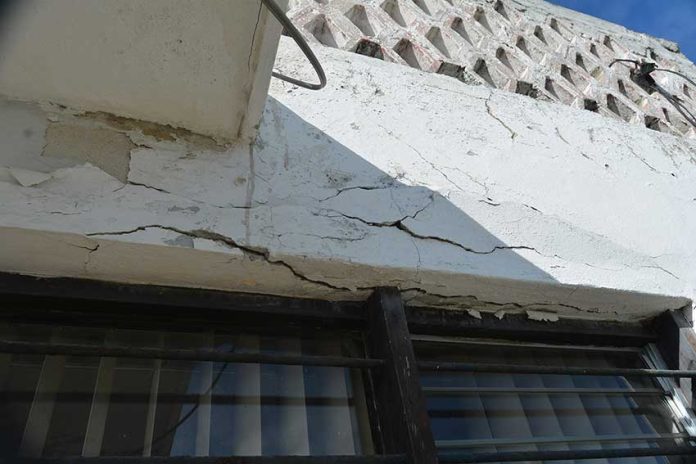
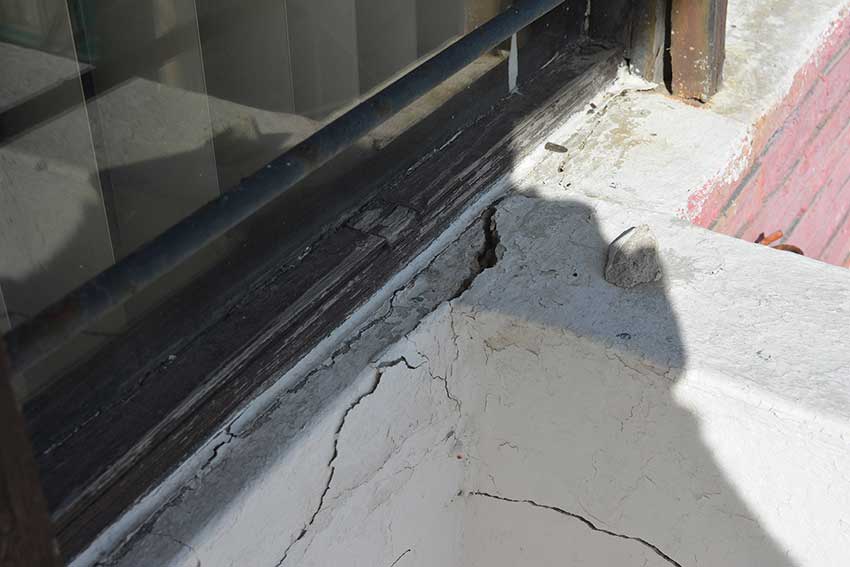
While we came closer to real ownership over 22 months, sizeable concrete pieces of the house were engaged, increasingly, in a losing battle with gravity. Our dread of the deal falling apart for any number of reasons was only exceeded by our dread of being maimed or killed by falling plaster and concrete.
In accordance with our concerns within a day of moving in, we closely scrutinized the severe cracks infecting the second-floor balcony, and we christened it The Balcony of Slow Death. The cantilevered shade structure above that balcony was named The Concrete Awning of Instant Death.
The first instance of a near-death experience from The Concrete Awning of Instant Death happened while I was heating up my barbecue in the only place it could be on the second floor, in a corner of The Balcony of Slow Death.
When I stepped back into the house to acquire another adult beverage, I heard a thunderous crash and felt a small shock wave ripple through the floor as 60 or 70 kilograms of concrete had detached itself from the shade structure and landed directly next to the barbecue at the spot where I stand while tending the barbecue! After several therapeutic shots of tequila, I ordered a pizza.
After waiting for almost two years, and constantly watching increasing numbers of pieces fall, the deal was finally consummated on January 18 this year, and we gave a collective sigh of relief. Soon the substantial building work could be begun. Of course we decided to celebrate with a night on the town.
In pursuit of that goal, we stepped out our door, and closed it firmly, not a slam mind you, but a firm close. This dislodged about 20 kilos of concrete from the eve of the parapet directly above us. Luckily we were chatting and moving slowly so we hadn’t gone far. Consequently the deadly missile which landed at our feet missed us by mere inches. Undaunted by the latest attempt by our house to kill us, we had an evening on the town with great food and a decent bottle of dago red.
And we’ve made a pact, that until the renovations are all done, that upon any occasion the house attempts to kill either one or both of us, we will celebrate, in similar fashion, foiling the grim reaper once again.
The writer describes himself as a very middle-aged man who lives full-time in Mazatlán with a captured tourist woman and the ghost of a half wild dog. He can be reached at buscardero@yahoo.com.