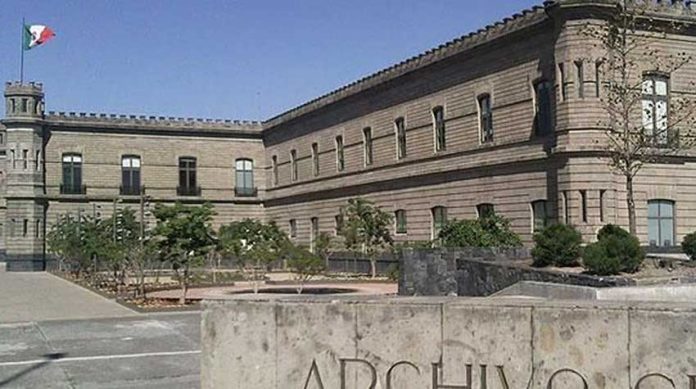
The National Archives will be the new home of police files.
The federal government will release thousands of previously-classified police files next week including those relating to political persecution, human rights violations and corruption.
President López Obrador signed a decree this week that will see files predating 1985 that were held at the recently-disbanded Center for Investigation and National Security (Cisen) made available to the public at the National Archives (AGN).
Speaking at his morning press conference, the president said today that there will be complete transparency in the opening of the files but stressed that the government will not seek to prosecute people named in them, explaining that “scapegoats should not be sought.”
However, if people who were politically persecuted or spied on want to file criminal complaints, that will be a matter for them, López Obrador said, explaining that “within the framework of the law” they have complete freedom to do so.
The president explained that the only limitations on access to the files will be those established by law and related to the protection of children and family members of victims.
Files which “may affect or harm people’s dignity, their human rights” will not be released, López Obrador said.
The president also said that “my file will be released next week but let it be clear that it will be [that with information] from 1985 back.”
Zoe Robledo, an Interior Secretariat undersecretary, said that in about a month the government will announce details about the release of police files relating to years from 1985 to the present time.
All government secretariats that currently hold such files will also have to submit them to the AGN, she said.
“All of the files that were protected will be . . . opened so that citizens can have access to them, particularly researchers. It’s part of the program to strengthen our historic memory,” Robledo said.
The undersecretary charged that the release of police files by past governments was only a simulation because it was Cisen itself rather than the AGN that stored and managed them.
Now, Robledo said, “the aim is maximum publicity, putting public interest and the truth first,” pledging that “no kind of simulation will be allowed.”
Carlos Enrique Ruiz, director of the National Archives said the agency “will apply a process to order and classify the files so that everyone interested can access what they’re looking for.”
The public will be able to start making requests to access them as of Monday, he said.
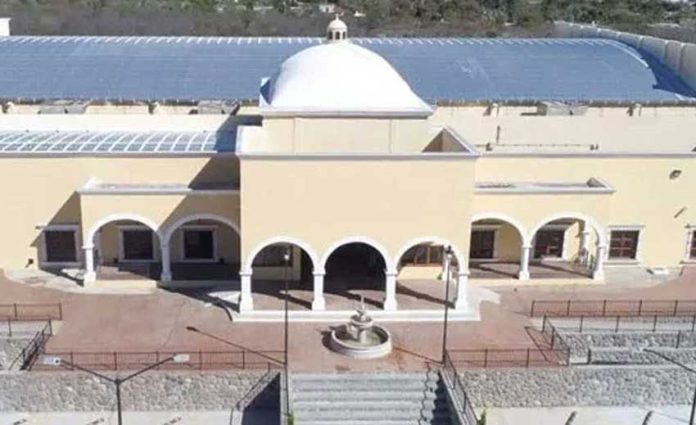
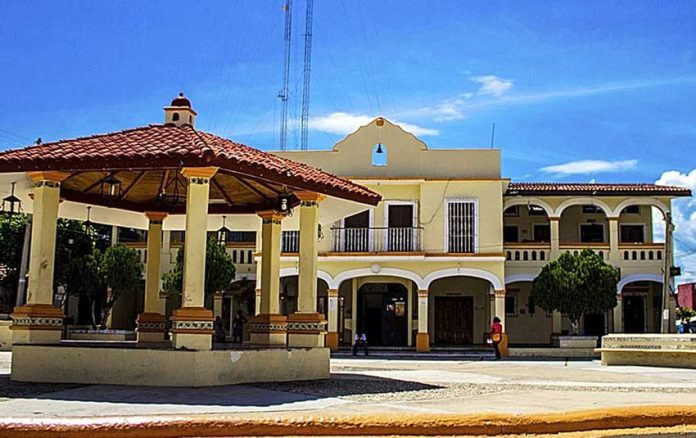
The town of Álamos in southern Sonora has opened a new convention center that is expected to help drive tourism in the region.
Álamos conventions director Danitza Rodríguez Sotelo told the newspaper El Economista that the state government invested 78 million pesos (US $4 million) as part of a larger plan to attract business tourism.
Work on the center, which has a capacity of 6,000 people, began in 2017. Rodríguez said that Álamos was the only location in the region with more than 300 hotel rooms.
He added that he expected the center to be a strong motivation for the construction of additional hotels in Álamos and in nearby Navojoa, amplifying the economic spillover.
The conventions director said that southern Sonora was uniquely equipped for hosting business meetings because of highway infrastructure and its proximity to large industrial and manufacturing centers, like Ciudad Obregón.
[wpgmza id=”159″]
“Every year, Álamos hosts the Álamos Alliance event, which is the most important event in the northeast for economists. Our new convention center will be its headquarters. Scientific tourism is another of the new sectors that we want to integrate, along with conventions for the manufacturing industry.”
He added that in addition to the investment in the convention center, authorities have made efforts to involve residents in Sonora’s southern region in new business models and ventures for the past three years.
Rodríguez said that despite problems caused by the disbanding of the Tourism Promotion Council (CPTM) as well as budget cuts to the magical towns program, Álamos will continue to implement vital infrastructure projects with the help of private support and a new-found kinship among conventions directors region-wide.
“. . . we support one another,” he said. “We are working together to create internal promotion programs. There is regional unity here; I mean that in the northern states, we support one another.”
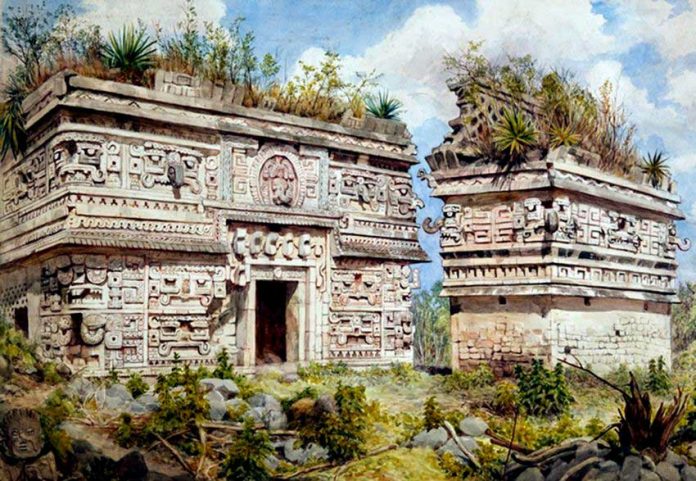
Adela Breton's watercolor of the east façade of the 'Nunnery' at Chichén Itzá.
In 1894, a man living near the famed ruins of Teotihuacán, 50 kilometers from modern Mexico City, discovered a small, pre-Hispanic house whose walls were covered with beautifully colored murals.
The place was called Teopancaxco or “La Casa de Barrios.” The paintings were the first of their kind found at Teotihuacán and visitors considered them spectacular.
Weather and time eventually did their damage to the murals and today we would have little idea of how they once looked if it were not for an extraordinary Englishwoman named Adela Breton who had fallen in love with Mexico’s ruins and who painstakingly reproduced these murals as watercolors.
Mary Frech, author of Adela Breton, a Victorian Artist Amid Mexico’s Ruins, says, quoting James Langley:
“Adela made the most comprehensive record of the murals at Teopancaxco. Her re-creation of the colours of the murals is unsurpassed compared with the few colour reproductions available, and thus constitutes an irreplaceable memorial of the now destroyed masterpieces.’”
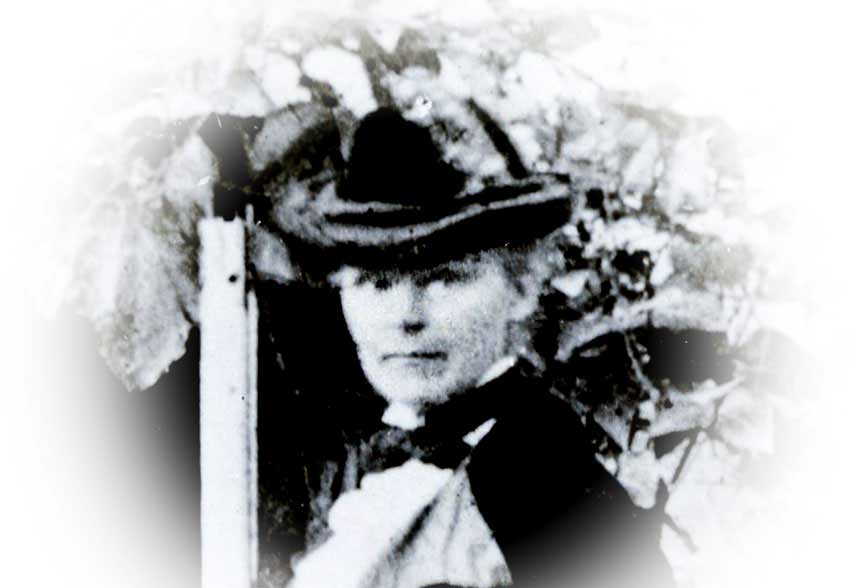
Adela Breton, English explorer and artist.
What was an unmarried Victorian gentlewoman doing in Mexico before the turn of the century, 5,500 miles from home?
Exploring, painting, sketching, measuring and photographing not only Mexico’s best-known archaeological sites like those at Chichén Itzá but, it seems, even obscure ruins from the extensive Teuchitlán Tradition of western Mexico which, it was generally believed, were unheard of before archaeologist Phil Weigand gazed upon the Guachimontones in 1969.
Proof of Adela Breton’s keen observations in Jalisco came to light when the Museum of Bristol decided to digitize many of her works and publish them on the internet. For the first time, people outside Bristol could see Breton’s sketches of the now famous Circular Pyramids of Teuchitlán in Jalisco.
“Accurate drawings of the Guachimontones made in 1896?” exclaimed Jalisco archaeologist Rodrigo Esparza. “That’s amazing!” Even more amazing was the discovery, again thanks to the Bristol Museum, that Adela Breton had taken the first known photographs of the three largest “Guaxi mounds,” as she labeled them.
Did Breton publish anything related to the Guachimontones? The answer is yes, but apparently only a few words. Here is what she says in a paper delivered at the International Congress of Americanists in 1902:
“Teuchitlán is a small town at the foot of a long spur of [Tequila] volcano . . . . At Teuchitlán, obsidian rejects are thickly strewn over a great extent of ground. In addition to the obsidian, it has a most interesting ancient site on the summit of the hill, and the remarkable mounds and circles called Huaerchi Monton half-way up.”
Tracing of a mural painting from Upper Temple of the Jaguars.
Breton was able to reach this remote corner of Jalisco thanks to a train line built only a few years before, a modernization project of President Porfirio Diáz. She brought with her plenty of trunks, her horse and her ever resourceful guide, Pablo Solorio, who somehow learned that a mound housing an untouched tomb had been discovered near the town of Etzatlán and had recently been opened.
After visiting the Guachimontones, Adela went to the Mound of Guadalupe and gives us what is probably the first description of the unearthing of a burial site in western Mexico. “Unfortunately,” she reported, “there was no skilled supervision, no data were secured and most of the figures were broken.”
Fortunately, however, the resourceful Adela was on hand for the event and recorded, according to Mary Frech, that “the mound was about 40 feet high and held a burial with pots, jewelry, clay ‘portrait’ figures ranging from 12 to 20 inches tall and other artifacts.” Of course, she sketched a number of those broken figures and even photographed the Mound of Guadalupe, of which today little is left to see.
Adela Catherine Breton was born in London in 1849. After the death of both her parents she was “easily convinced” by pioneer in archaeological techniques Alfred Maudslay to travel to Chichén Itzá to make sketches which would allow Maudslay to check the accuracy of his own drawings, before publishing his Biologia Centrali-Americana. Thus began her curious career as an archaeological artist.
Upon arriving in Yucatán, Adela developed a turbulent relationship with Edward Thompson, the United States consul there. According to the Harvard University Archives, Thompson wrote to Fredric Putnam, curator of the Peabody Museum of Archaeology, accusing Breton of “meddling” at Chichén Itzá.
Says Thompson: “To my horror I found out the day I left Chichén that she proposes to return to Chicheen shortly for another period of time. She certainly is an artist as regards landscapes at least and she has made one painting in the intervals of her work for Maudslay that is really very nice. She brought out the artistic points of the ‘Nunnery’ in a wonderful manner.”
[soliloquy id="72949"]
After a few months, he writes again to Putnam: “She has a very peculiar character but I think that she is one of those persons that improves as one knows them better. She most certainly is a true artist.”
In the opinion of Matt Williams of the Bath Royal Literary & Scientific Institution, Adela “developed into a world-renowned archaeological copyist thanks to her drawings of friezes, carved reliefs, painted plasters and other cultural treasures – some of which are now the only records that remain of items long since lost to vandalism and decay.”
According to Williams, Adela was a well-seasoned traveler and she once wrote: “I used to live chiefly on air and a few peanuts for the long riding journeys — 30 miles without any breakfast.”
“Adela chose not to marry,” he adds, “as it was the only thing that guaranteed a woman’s independence in those days. She wanted to be free to travel and chart her own destiny.”
According to Kate Devlin, a writer for Trowelblazers.com, Harvard anthropologist Alfred Tozzer once said, “You look at Miss Breton and set her down as a weak, frail and delicate person who goes into convulsions at the sight of the slightest unconventionality in the way of living. But I assure you, her appearance is utterly at variance with her real self.”
Adela Breton died at age 73 in Barbados in 1923, and left most of her work and collection to the Bristol Museum & Art Gallery.
The writer has lived near Guadalajara, Jalisco, for more than 30 years and is the author of A Guide to West Mexico’s Guachimontones and Surrounding Area and co-author of Outdoors in Western Mexico. More of his writing can be found on his website.
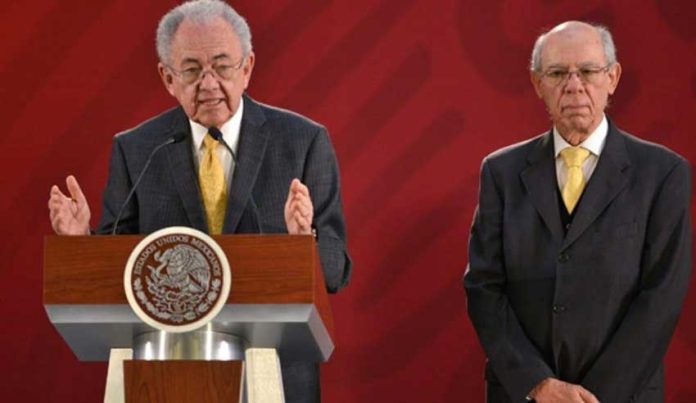
Jiménez, left, and Morán at yesterday's press conference.
The federal government yesterday released a transcript of the radio communication between the helicopter in which the governor of Puebla and her husband were killed and the control tower at Puebla International Airport, and said that there was no evidence that foul play caused the crash of the aircraft.
Martha Erika Alonso, former Puebla governor and Senator Rafael Moreno Valle, two pilots and a political aide all died after the helicopter in which they were traveling plunged to the ground just outside the city of Puebla on Christmas Eve.
The transcript reveals that the final communication between the helicopter and the air control tower was at 2:35pm on December 24.
The helicopter pilot who spoke to air traffic control didn’t indicate that the aircraft was experiencing any difficulties or problems.
However, when the air control tower next tried to contact the helicopter at 2:39 pm, there was no response and over the course of the next 10 minutes a further 10 attempts to reach the aircraft also went unanswered.
According to Carlos Morán Moguel, an undersecretary at the Secretariat of Communications and Transportation (SCT), investigations into the fatal crash have not found any evidence of outside interference, human error on the part of the pilots, previous mechanical problems with the helicopter or that there were explosives on board.
“. . . [There is] nothing that makes us imagine that there was any aggressive event against the aircraft,” he said.
Morán said the SCT expects to have a final report about the crash by the end of the year although he explained that investigations into aviation accidents can in some cases take more than two years.
Laboratories in Canada, Italy and the United States will review the fragmented helicopter parts during March and April, he said, explaining that there are “digital chips” inside the parts that could offer clues about the cause of the accident.
“There is a possibility of extracting some information even though they [the helicopter parts] are badly burned, experts tell us that information can be obtained,” Morán said.
On the day of the accident, the undersecretary said, the helicopter took off from a heliport in Puebla City called Triángulo de las Ánimas.
From there, the helicopter flew a distance of “fewer than three kilometers” to the home of business magnate José Chedraui, where it landed in the garden and picked up Alonso and Moreno, Morán said.
The information about the stop had not previously been revealed and contradicts comments made on the day of the accident by Security Secretary Alfonso Durazo, who said that the helicopter crashed after taking off from Triángulo de las Ánimas and made no mention of Chedraui’s home.
The final destination of the helicopter was to be a private heliport in Mexico City, where the governor and her husband are believed to have planned to attend a Christmas party.
However, around 10 minutes after the helicopter left Chedraui’s home it crashed in a field in the municipality of Coronango.
The release of the communication transcript yesterday came the day after President López Obrador said that he would ask Transportation Secretary Javier Jiménez Espriú to review a decision to place a five-year embargo on the release of the audio tapes.
“My recommendation is that there be complete transparency,” the president said.
The Civil Aviation Agency (DGAC), a division of the SCT, had said that releasing the recording was not in the public interest, would have a negative impact on aviation and national security and could place future international cooperation on aviation accident investigations at risk. However, shortly after López Obrador’s remarks, it backed down on its five-year embargo plan.
Morán said yesterday that he considered the embargo to be “excessive” but explained that the reservation of information for that period of time has been a standard practice of the DGAC.
He also acknowledged that there has been criticism of the government for not providing updates about the progress of the accident investigations but explained that was because there was “nothing new to report.” National Action Party (PAN) president Marko Cortés said this week there had been a “suspicious silence.”
Secretary Jiménez stressed, however, that the government won’t hide anything.
“When we have the experts’ report there will complete transparency and we’ll report what we can along the way. We have the clear instruction and conviction to reveal everything,” he said.
A section of the massive tunnel scheduled to be in operation in July.
A 10-year-long megatunnel project in Mexico City will be completed on July 10, the head of the National Water Commission (Conagua) has announced.
Blanca Jiménez said excavation of the tunnel was 81% complete and would be finished in April. Lining the tunnel with concrete is 95% complete, and will be finished in July.
Construction crews will work 24 hours a day, seven days a week until the project is finished, she said.
The 62-kilometer tunnel project will move 150,000 liters of wastewater per second. Officials say its completion is vital to reducing flooding in Mexico City.
During a tour of the tunnel with Jiménez, Mayor Claudia Sheinbaum stressed the importance of completing the project before this year’s rainy season.
“We have urged [Jiménez] to finish the tunnel before the 2019 rainy season. She has assured us she will do all she can to do so; it’s very important that it is completed so that we can reduce some of the flooding, especially in the eastern part [of the city].”
The mayor added that once the project is complete, the Mexico City government will need to focus on constructing better drainage systems to take full advantage of the tunnel and to reduce the city’s reliance on the underground aquifer, which may be in danger of running out, according to some sources.
“Our first priority is to protect forested areas and to generate new means for capturing household rainwater so that at least during the rainy season we can rely on other ways of getting water.”
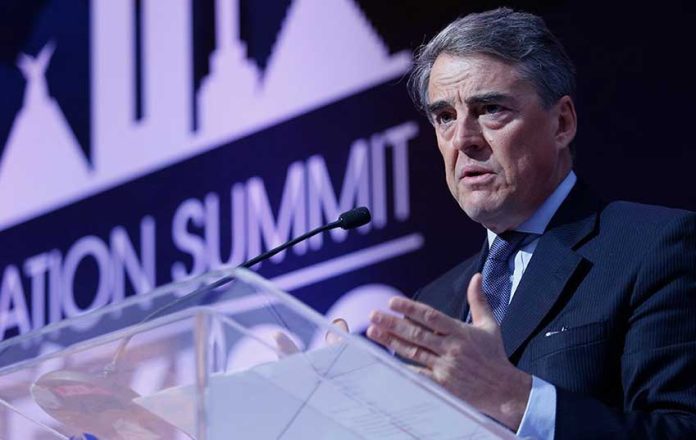
Operating three airports within close proximity to each other in Mexico City and México state will be “complex” and “challenging,” according to the head of the International Air Transport Association (IATA).
“The government’s plan is for three airports to serve Mexico City: the current one, Toluca and the Santa Lucía airbase. I will be frank. Making this work will be challenging,” Alexendre de Juniac said yesterday at an IATA aviation summit in Mexico City.
The former Air France CEO outlined a range of challenges that will arise from operating the three airports simultaneously as well as limitations of each individual one.
The Mexico City airport “is already operating above its design capacity,” de Juniac said, adding that “converting the government hangar to a terminal is unlikely to meaningfully improve the situation when there is no practical way to add a third runway.”
Toluca Airport’s single runway “can certainly be utilized more fully” but will likely only be used for domestic flights, de Juniac said, adding that the distance of 70 kilometers to the Mexico City airport “makes efficient connections nearly impossible.”
He also said that converting the Santa Lucía air force base in México state “will take time and significant investment” and that “the military will have to gain experience in running a civilian airport.”
That is a “very different thing” to running an airbase, de Juniac added.
“Even when we resolve the airport issues, we have a potentially even bigger challenge to provide safe and efficient air traffic management. The three airports are in very close proximity and the runway orientations are not parallel which makes it complex. Landing and take-off paths are further restricted by mountainous terrain. And high altitude with seasonally hot temperatures are an additional factor which need to be taken into account,” he said.
“I cannot over-emphasize the need for technical coordination with operators to carefully manage these parameters. Safety must never be compromised. And we don’t want to find that investments in these three airports are compromised by air traffic management requirements that ultimately limit their utilization. Getting air traffic management right is mission-critical,” de Juniac added.
The IATA chief said it was “no secret that we are disappointed with the decision to discontinue” the new Mexico City airport, which “would have secured Mexico City’s long-term position as a major global player in the aviation industry.”
However, de Juniac also said that “we accept that a decision has been made” and that “IATA is eager and fully committed to work with the government to find the most effective way to prepare Mexico City – and indeed the entire Mexican industry – to meet the growing demand to fly.”
Communication and Transportation Secretary Javier Jiménez Espriú agreed with the IATA boss that operating three airports will be challenging but stressed that the government is working to ensure that there will be no risks associated with their simultaneous use.
He explained that Navblue, a Canadian subsidiary of Airbus, will be responsible for restructuring the use of airspace so that flights can take off from and land at the three airports at the same time.
“It must be said that a large part of the work was already started by the Navigation Services for Mexican Airspace [Seneam, a government agency],” Jiménez said.
They [Navblue] told us in a first estimate that it would cost US $6 million but seeing the progress of Seneam, the quote will be less.”
The secretary added that French airport operator Aéroports de Paris is collaborating on the development of the master plan for the Santa Lucía airport, which will be built by the Secretariat of National Defense (Sedena).
Jiménez conceded that the government hasn’t yet provided detailed information about its plan at Santa Lucía, explaining that reaching agreements with investors involved in the canceled airport project was a constraining factor.
However, President López Obrador will announce details soon, he said.
Jiménez also said that it was likely that most airlines would only operate at one of the three airports in the greater Mexico City area to avoid logistical problems. All airport stakeholders will be involved in logistics planning for the three airports, he explained.
Meanwhile, materials purchased to build the cancelled airport project in Texcoco, México state, will either be put up for sale or used in other government infrastructure projects.
Tezontle and basalt, two volcanic rocks widely used in construction, could be used in the construction of the Maya Train or Isthmus of Tehuantepec train projects, Jiménez said.
Authorities in Tututepec, Oaxaca, have requested help from the state government after dogs were killed with poison.
As municipal police force search for those responsible, the state Attorney General’s office said there have been at least 27 cases of cruelty against dogs in the year since the crime was catalogued as a serious one in Oaxaca.
Of the 27 investigations, said spokesman Alejandro Alfonso Ramírez, “a settlement was reached between the parties in three cases, six cases were shelved, four were not filed properly, and three went to trial, with penalties of up to six months in jail.” The remaining cases remain open.
In one case a man dragged a puppy behind his taxi in the municipality of San Dionisio Ocotepec. The case went to trial and the driver was ordered to do six months of community service and pay for the dog’s medical treatment.
For the dog, meanwhile, the incident has turned its life around. It was adopted by a family in Switzerland, according to the newspaper report.
The Enquentro residential tower is one of the suspended projects.
The Mexico City government suspended eight massive construction projects worth US $500 million last month, citing building irregularities.
Mayor Claudia Sheinbaum ordered a review earlier this year of all building permits issued in 2017 and 2018 for large real estate developments.
After inspections were conducted at 174 building sites, the government announced on February 7 the suspension of 26 projects, including eight so-called megaprojects.
Among the large projects that have been halted is a US $85-million Hyatt Regency Hotel that was slated to open in the second quarter of 2020.
The Santa Fe Hotel Group announced on February 5 that it had been awarded a contract to operate the hotel that was to be built on Insurgentes Avenue in front of the World Trade Center but the government announcement two days later placed the agreement in doubt.
Impera Reforma, a 47-story tower planned for the capital’s emblematic boulevard Paseo de la Reforma, and a 30-story tower, The Summit, in the Santa Fe business district – two of this year’s most anticipated projects – are also suspended.
The other five suspended megaprojects are three other office towers and two residential developments.
The combined area of the office towers was to be 155,151 square meters – 15.5% of all new office space slated to be added in Mexico City this year – while 650 new apartments were to be built in the two residential developments.
A real estate developer who asked to remain anonymous told the newspaper El Financiero that some companies were undertaking construction projects that were larger and taller than those for which they had received approval.
Other building sector experts suggested that the suspensions could have been politically motivated in some cases.
Guillermo Sepúlveda, CEO of the commercial real estate firm Avison Young México, said the suspensions generated uncertainty among investors and that as a consequence they will take their money elsewhere.
“There will be companies that think that developing [projects] in Mexico City is very complicated and they’ll choose to go to Querétaro, Guadalajara, Monterrey, where there are more investment guarantees,” he said.
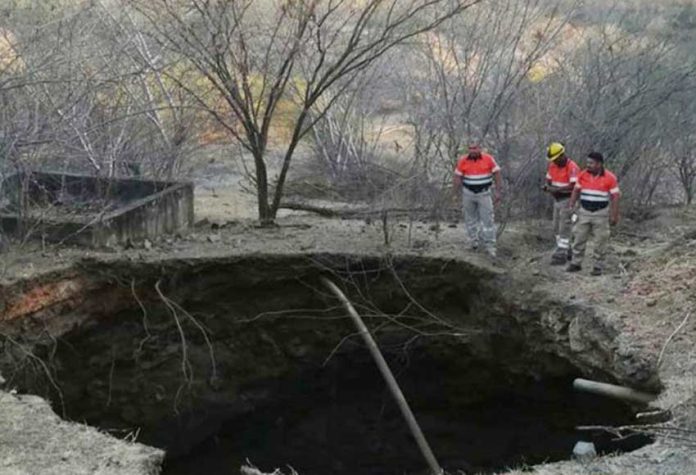
A new sinkhole has opened up near the Guerrero town of Pinzán Morado due to an abandoned mine shaft caving in.
The hole is 15 meters deep and 12 meters across and opened up 500 meters from the town, located in the Tierra Caliente municipality of Coyuca de Catalán.
Authorities cordoned off the area and started a risk assessment study but said the new sinkhole does not represent a danger to residents.
Another sinkhole appeared in that town last year. It measured 40 meters across and 100 meters deep.
Close to 30 dwellings and two schools were evacuated in July due to the high risk of collapse caused by the unstable ground.
A resident declared at the time that the Calentana gold and silver mine had operated for more than 25 years before it was shut down four years ago.
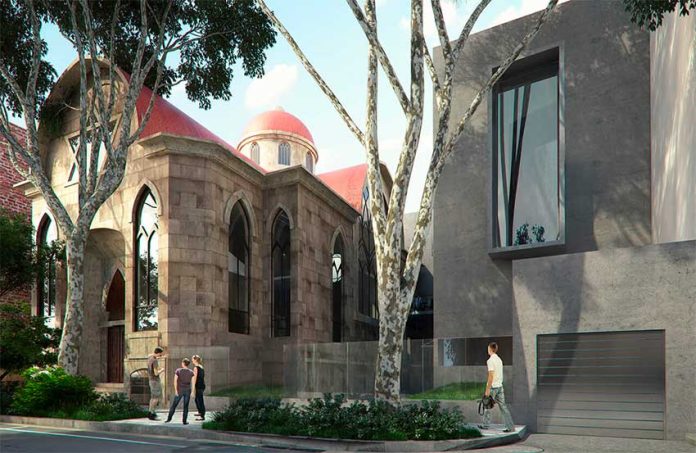
The new Jewish documentation and research center in Mexico City.
“If our main objective was to only serve the Jewish community of Mexico City we would have chosen a different location for the center.”
The words are those of Enrique Chmelnik, director of the new Centro de Documentación e Investigación Judío de México (the Center for Jewish Documentation and Research in Mexico) in Mexico City’s Colonia Roma.
“There have always been these windows through which the Jewish community looked out at Mexico and Mexico looked back in at the community. We see this center as a grand doorway between the two.”
We are seated in the center’s sleek and modern glass-walled conference room that looks down over one of Mexico City’s oldest synagogues. Sunshine shimmers through Star of David windows, casting red, blue and yellow shadows on the synagogue’s central atrium, now a library housing hundreds of donated books.
In 1938 this synagogue was the home of the Maguen David Jewish community, the place where their children married, where prayers were recited, and home of the city’s oldest mikveh, or ritual bathtub. As tiny specks of dust glitter among the silent chandeliers, the echoes of the community still vibrate in the walls.
The center’s director, Enrique Chmelnik.
Jewish history in Mexico City is complicated, explains Chmelnik. Despite the fact that most Jews live in similar neighborhoods and are surprisingly unified as a community within Mexican society, the community itself is fractured into several groups.
There have been Jews in Mexico since the country’s colonialization, he says, but an established community that identified strongly with its Jewish heritage really didn’t appear until beginning of the 20th century.
The majority of Jews that immigrated to Mexico came from Eastern Europe, the Mediterranean and the Middle East, some seeking religious freedom, others refuge from persecution; some looking for economic opportunities and others, including artists, poets and scholars, encouraged by the Mexican government for their European influence.
In 1912 the inaugural Jewish community was founded here, Sociedad de Beneficencia Alianza Monte Sinai, but 10 years later the first schism erupted when Ashkenazi Jews separated from Monte Sinai to form their own community. Two years later, Jewish immigrants from Mediterranean countries formed the Sephardi community, and in 1938 Syrian Jews from Allepo decided to separate from Syrian Jews from Damascus and form the community Maguen David.
According to Chmelnik, these divisions were incited by arguments over religious practices, hierarchies within the Monte Sinai community and the major cultural differences among the groups. They came from different countries, with different experiences and many different languages. While their religious traditions were similar, there were certain details that the groups felt they couldn’t overlook.
Today, few Mexico City Jews speak Arabic, or Polish or Yiddish and many aren’t religious enough for different prayers to make much of a difference. That’s why the center, which is trying to create a cross-community Jewish archive, thinks it has a good chance at success.
A page from a book by Isaac Berliner illustrated by Diego Rivera.
“Every day we are getting closer to unifying,” says Chmelnik, “and each year there are more cross-community organizations like this one. And I’ll tell you one thing that will definitely put an end the separation at some point in the near future: 70% to 80% of all Jewish marriages in Mexico City are among members of different communities.”
The roots of the archive go back to the 1990s when the Mexico City Ashkenazi Community was celebrating its 70th anniversary as a community. In the process of creating a commemorative book for the event, historians filtered through hundreds of documents and items in the basement of Acapulco #70, an important center for Ashkenazi Jews in Mexico City. What was there was in poor condition and an idea was hatched to preserve the historic documents in an official archive.
In time, the growing collection was added to UNESCO’s World Memory Program and talks began among the various communities to expand the archive’s breadth to not only include documents from the Ashkenazi community, but each of the others as well.
“The idea was to have the entire history of Jews in Mexico under one roof,” says Chmelnik.
By 2015 a communal archive was already in the works, with representatives of each community signing on to the project. Then the September 2017 earthquake hit and Acapulco #70 was damaged beyond repair, but volunteers and members of the community were able to rescue the archive.
Its new building at Cordoba #238 was already in the works and so plans were sped up to move the offices there as quickly as possible.
The new center opened in January of this year, its priority to collect each community’s archives, according to the inter-community agreement, and build the most important Jewish studies center in the country.
“This is a book by Yiddish poet Issac Berliner,” says Chmelnik opening the pages from right to left and landing on an illustration that looks vaguely familiar. “He was a good friend of Diego Rivera and so Rivera illustrated his book for him.”
We are standing among the metal bookshelves within the synagogue’s basement. There’s a chill in the air, which is not just the humidity-controlling air conditioning unit.
Tomes from a Nazi library in Berlin are among some of the archive’s oldest items. The Third Reich’s confiscated books were supposed to “prove” the dangers of Judaism, and therefore justify its eradication.
By the time the allied forces found this stash, most of the books’ owners had been killed. So they sent books, a bundle at a time, to Jewish communities across the globe, including 1,000 to the Ashkenazi community of Mexico City.
Posters protesting World War II are carefully preserved in thick plastic, signs defaming Jews are there along with them. Shelves stacked with photos and marriage certificates tell the history of the communities through the eyes of their members, the unofficial story as Chmelnik likes to say, the one you don’t find in newspapers and meeting minutes.
There are menorahs and mezuzahs of every shape and size, handwritten letters, journal entries – all once belonging to someone who is no longer here to tell their own story.
Authors researching books, community members researching family lineages and students searching for primary sources all find their way to the archive. While a long string of cultural activities fills the center’s docket, research here and in their library is by far their most important service offered to the public.
And while for the time being Mexico City’s Jewish community may remain segmented, this archive will serve as a safe home for the remnants of each of their separate histories, which is the legacy of them all.
Lydia Carey is a freelance writer based in Mexico City.