Home Blog Page 1933

Northern governor says southerners lazy; ‘cut out his tongue:’ says one

0
El Bronco, left: 'lazy southerners;' and Yunes: 'Cut off his tongue!'

Nuevo León Governor Jaime “El Bronco” Rodríguez, known for being blunt, labelled southerners lazy earlier this week. A southerner promptly labelled Rodríguez an idiot and suggested his tongue be removed.

At an event in Monterrey Tuesday, the 2018 presidential candidate said “the north [of Mexico] overcomes adversity while the south and southeast have the blessing of nature but the misfortune of laziness.”

The governor, well-known for using blunt and colorful language, added: “I don’t regret saying it that way because the policy of government must be to encourage those who want to work.”

After a backlash against his comments, Rodríguez said hours later that he had been misinterpreted and had not made any reference to laziness.

“I said that the north has greater adversity and that the south and southeast has greater possibilities, I said blessing, I didn’t say laziness . . .” he said.

One person who wasn’t prepared to let El Bronco’s remarks slide was Veracruz lawmaker and former candidate for governor Héctor Yunes Landa.

In a video posted to his social media accounts, the Institutional Revolutionary Party (PRI) federal deputy defended Mexico’s southerners before dubbing Rodríguez a buey – an ox, or in colloquial Mexican Spanish, an idiot.

“It’s true that those of us who live in the south have the blessing of the land but it’s also true that we work it every day. That’s why we’re national leaders in several crops like coffee, oranges, lemons, bell peppers, pineapple and bananas . . . We also have, precisely in my state Veracruz, the largest number of cattle in the country. Cows, bulls and bueyes [oxen] Bronco, like you,” he said.

Yunes also demanded a public apology from the governor and proposed cutting off his tongue – a riff on Rodríguez’s proposal during a presidential debate last year to cut off the hands of thieves.

“We don’t tolerate insults from anyone . . . I demand Bronco that you publicly apologize to Veracruzanos and all Mexicans who live in the south of the republic . . . I regret not having the imprudence that characterizes you but if I had it, as you once proposed cutting off the hands of thieves, I would propose cutting off the tongues of bigmouths,” he said.

Rodríguez is the second former presidential candidate in as many months to offend Mexico’s southern states after 2012 hopeful Gabriel Quadri claimed on social media in January that Guerrero, Oaxaca and Chiapas were a burden on the rest of Mexico.

Source: Infobae (sp), El Universal (sp) 

Michoacán plant’s nopal biogas will power half of municipality’s vehicles

0
Nopalimex plant in Michoacán.

A new chapter in a decade-long history of a Michoacán business commenced yesterday in Zitácuaro when the first industrial plant in Mexico dedicated to obtaining biogas and generating electricity from nopal, or prickly pear cactus, began operations.

The Nopalimex plant is expected to produce three million liters of biogas every year, enough to meet 50% of the fuel needs of the vehicle fleet operated by the municipality of Zitácuaro.

The company says that a cubic meter of the biogas it produces is equivalent to a liter of gasoline, but is 40% cheaper.

While the main focus of the new plant will be to obtain biogas and electricity, some byproducts will include ethanol, nopal for human consumption, humus and nitrogen-rich water that can be used as a fertilizer.

Governor Silvano Aureoles Conejo said at the plant’s opening ceremony that more municipalities and producers will be encouraged to participate in the innovative energy production initiative.

“I have been promoting this great idea, that we can create a green park from Cuitzeo Lake to Lázaro Cárdenas where we can grow nopal and install several biogas plants along the Siglo XXI highway, boosting the use of this resource,” he said.

The governor’s intention is to have all public transportation vehicles in the state convert to biogas engines, a process that costs between 25,000 and 30,000 pesos (US $1,300 and 1,500) per vehicle.

Source: El Financiero (sp)

Entrepreneurs await city’s revision after electric scooters shut down

0
Grin scooter users flash grins.

In April 2018, a Mexican startup called Grin started operations in Mexico City by placing 15 electric scooters on the streets of the trendy neighborhoods of Roma Norte and Condesa.

The scooters, activated for use by a mobile telephone app, proved to be popular so Grin quickly increased its fleet and expanded into neighborhoods such as Nápoles, Narvarte and Del Valle.

Business for the startup’s founders, Jonathan Lewy and Sergio Romo, was good.

But on February 14, the Mexico City government dropped a bombshell: it was revoking the permit that allowed Grin to operate.

Mayor Claudia Sheinbaum told a press conference that day that the company had failed to submit information to the Secretariat of Transport (Semovi) about its operations within the timeframe requested.

Mexico City authorities subsequently removed Grin’s more than 200 scooters from the capital’s streets.

The company quickly denied that it had failed to submit the relevant paperwork on time and four days later, it struck back, filing an injunction request against the government’s revocation of its permit and removal of its scooters.

An administrative court judge sided with Grin, granting a provisional suspension that ordered the government to “abstain from dispossessing the complainant’s scooters” and “to allow it to continue offering its sustainable, individual public transportation service.”

The conflict between Grin and the government flared up again this week after the former said on Twitter that in order to be granted a permanent operational permit, Semovi is asking for “unrestricted access” to scooter users’ “personal information” including trip data “in real time.”

Directing its post to scooter users, Grin added: “Our priority is you. That’s why on February 8, we didn’t give unrestricted access about your location in real time or your personal information.”

In a statement, Semovi promptly responded that it had not asked Grin or any other company that rents scooters or bicycles to provide such information.

Mayor Sheinbaum also weighed in on the issue, telling a press conference that Grin’s claim was incorrect.

“Personal data was never requested. The transportation secretary [Andrés Lajous] would be incapable of asking for it,” she said.

“What was asked for is that the locations of bicycles and scooters be available on an [online] platform, which is the same that was asked of all the companies,” Sheinbaum added.

The mayor would not comment further on the matter because Semovi is currently seeking to overturn the injunction granted to the scooter company.

She added that her government’s aim was to have an orderly city.

On Twitter today, Grin – which is currently operating in Mexico City but without a permanent license – said that “as the only Mexican scooter company, we are more than willing to collaborate with the Mexico City government to achieve an orderly city.”

To that end, the company said it presented to Semovi on February 15 “all the information that the law doesn’t prevent us from presenting.”

Source: El Financiero (sp), El Heraldo de México (sp) 

Bag of blood samples found on riverbank in Chiapas

0
Blood samples found in Chiapas.

Six kilograms of blood samples that had been dumped by a river in Cintalapa, Chiapas, were recovered on Tuesday by local and state authorities.

Neighbors said the bag had appeared on the bank of the Venta river more than 10 days before.

Authorities said contamination of the river with the blood was unlikely.

Municipal health director Ibisnet Rodríguez Meza also said the blood samples presumably belonged to a private medical laboratory that went out of business two weeks before officials recovered them.

The state Health Secretariat said it would conduct a verification of all medical laboratories operating in the municipalities of Cintalapa and Ocozocoautla, and that it would file a formal complaint before the state Attorney General’s office against whomever is found responsible for the improper disposal of the samples.

Source: Milenio (sp)

Canadian Ford dealerships find drugs in spare tires of new cars

0
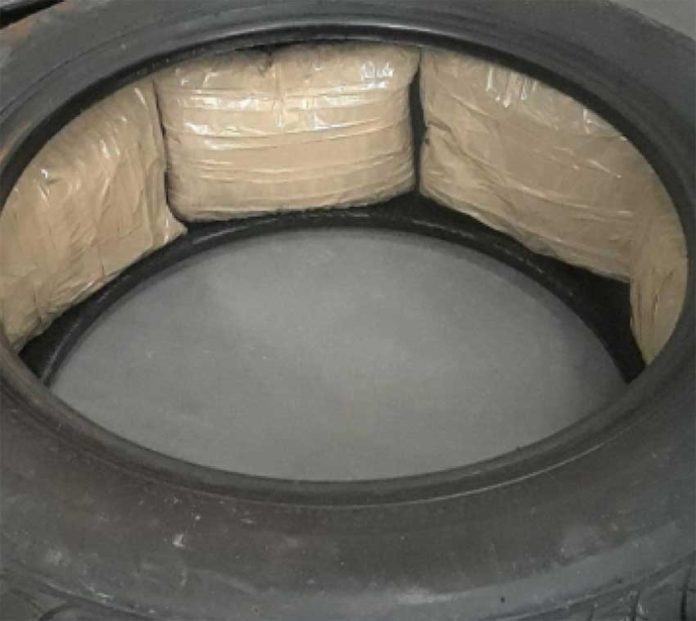
A spare tire containing meth, found inside a new Ford.

Not for the first time, new Ford vehicles have been shipped from Mexico with drugs stashed inside.

Canadian authorities seized 180 kilograms of methamphetamines that had been concealed in the vehicles’ spare tires.

Ontario police recovered an estimated US $3.4 million worth of the drug, in what is apparently part of a larger international investigation.

The vehicles had been sent by rail and, according to police, there is no doubt the shipments were made by the Sinaloa Cartel.

Authorities were alerted when a Ford dealership in Ontario discovered beige-taped packages lining the inside of the tires.

Police found meth in the spare tires of nine automobiles in four Ford dealerships in the state of Ontario, while other discoveries were made in Quebec and New Brunswick.

Police speculated that drug traffickers probably did not intend for the vehicles to reach the dealerships with the drugs inside.

They said the vehicles came from a Ford manufacturing plant in Hermosillo, Sonora.

No arrests have been made in the case, though investigators said the Ford Motor Company is cooperating fully. Authorities added that the discovery represented “an important interruption in drug trafficking” because of soaring methamphetamine use in Canada.

According to one report, use of the drug in Canada increased 590% from 2010 to 2017.

Similar finds were made in 2017 in the United States. Marijuana had been hidden in the spare tire compartment of brand-new Fords shipped by rail from Mexico.

Source: Milenio (sp), Global News (en)

Canadian tourist, 68, fights off attacker in Nayarit robbery

0
Marianne Clift immediately after the attack and a week later.

A 68-year-old woman’s taekwondo skills and resilience saved her life during a home invasion and robbery in a Nayarit beach town.

Canadian visitor Marianne Clift was alone in a vacation home that she and her husband had rented in Bucerias when she was awoken in the early hours of February 18 by a man choking her in her bed.

The retired elementary school teacher and church organist, who had studied taekwondo nearly 20 years prior, said she started “kicking like mad” and scratching and jabbing at the assailant’s face and eyes, but could not cry out because her attacker’s grip was so strong.

Then, Clift said she heard a woman’s voice and the man straddling her responding in Spanish, leading Clift to believe that there were two people in the house. When her attacker briefly loosened his grip, she yelled for help — and then she was knocked out by a punch in the face.

When Clift regained consciousness, her attackers were gone, along with her cellphone, money, passport, identification, bank cards, jewelry and keys to the vacation home. Clift later wondered if she had perhaps been left for dead.

[wpgmza id=”158″]

Staggering to the bathroom, Clift saw in the mirror that her eye and cheek were turning purple and blood was gushing from a cut on her cheek.

“I realized I had to get help.”

Unable to open the vacation complex’s front gate without her keys, Clift banged on another tenant’s door. She then walked to the home of a cousin who had a home nearby, where she called police.

Clift received six stitches at the hospital emergency room to close the knife wound on her cheek and was also treated for a second knife wound on her elbow and serious bruising on her chest and arm.

Investigators later told Clift that the attacker had climbed over the fence and used a screwdriver to break in through the locked front door of the home. She recalled that when the police saw the amount of blood in the house, the case was escalated to an attempted murder and robbery.

Clift said that news of her ordeal was especially hard on her family and her husband, who had flown back to their home in Sarnia, Canada, on a short business trip the night before the attack.

Clift found a safe place to stay while she filled out police reports and the Canadian embassy helped her secure a temporary passport and fly home.

Though her stitches came out on Monday and the black eye has faded, Clift’s neck and jaw remain severely bruised from the assault.

A frequent visitor to Mexico, Clift said that up until the attack she and her husband had felt safe in Bucerias, a town of about 17,000, and that their rented vacation home’s 12-foot fence and the proximity of a cousin’s house nearby contributed to their sense of security.

Clift said she does not expect the police to find her attackers.

Back home in Sarnia with her family, Clift said that recounting the story has often led her to laughter as well as tears.

“We’re a tough, resilient family,” the self-described “warrior woman” said.

“I have nothing but gratitude to be alive.”

Source: The Observer (en)

Bank of México slashes its 2019 growth forecast from 2.2% to 1.6%

0
Bank of México governor Díaz.

The Bank of México (Banxico) yesterday slashed its 2019 growth forecast for the national economy, citing an investment slowdown and recent fuel shortages, rail blockades and strikes among the reasons for its revision.

In its fourth-quarter report, the central bank predicted GDP growth of between 1.1% and 2.1% this year – a mean of 1.6%.

The mean is 0.6% lower than that forecast by Banxico in its previous quarterly report when it predicted 2019 growth in the range of 1.7% to 2.7%.

Yesterday’s downward revision was the third consecutive cut the bank has made to growth forecasts in its quarterly reports.

Banxico also trimmed its outlook for 2020 to between 1.7% and 2.7% growth compared to a range of 2% to 3% in its last report.

“Fuel distribution problems; the railway interruption; labor conflicts, particularly in Matamoros and the north of the country; and reduced petroleum production as well as persistent and more pronounced investment sluggishness. These are the elements that result in the revision to the [2019] growth forecast,” said Bank of México governor Alejandro Díaz de León.

The Banxico chief told a press conference that downward trending investment is particularly concerning given its importance to Mexico’s economic well-being.

In its report, the central bank said that if the “current mood of uncertainty that has been affecting investment” continues or deteriorates, more companies will postpone or abandon their investment plans and consumers will reduce their spending.

Another downgrade to the credit rating of Pemex or other state-owned companies would also place increased pressure on growth, Banxico said.

“We think it’s really important to try to protect the ratings and the ratings levels, including both the sovereign rating and those of the various [state] companies,” Díaz de Leon said.

The central bank warned last week about the risk Pemex poses to government finances while financial analysts and institutions have also signalled that the state oil company’s debt – in excess of US $100 billion – is placing pressure on Mexico’s sovereign rating.

In order to increase confidence and certainty and make Mexico a more attractive place for investment, Banxico said, the federal government needs to outline a clear agenda to improve security and the rule of law and to combat corruption and impunity.

The bank also said that it expects slightly slower inflation of 4.1% in the first quarter of 2019 and maintained its outlook for the fourth quarter of the year at 3.4%. The inflation rate will reach the 3% target in the first half of next year, Banxico said.

In the context of the central bank’s prediction of lower growth, economists at the bank Banorte predicted that in June Banxico would cut its benchmark interest rate, which is currently at a 10-year high of 8.25%.

“We expect Banxico to cut the rate by 25 basis points at its meeting on June 27. Additionally, it could cut a total of 50 to 75 points in 2019,” they said.

Source: El Financiero (sp) 

Documents sought showing there is not sufficient proof of airport corruption

0
Inai commissioners ruled that president's office must respond to information request.

The National Transparency Institute (Inai) has ordered President López Obrador’s office to release documentation to support the claim he made last month that there is no evidence “to file criminal complaints against those involved in possible acts of corruption” related to the cancelled Mexico City airport project.

During the campaign for last year’s presidential election, López Obrador frequently charged that the US $13-billion project was corrupt, using the claim as partial justification for his promise to scrap it.

In the lead-up to October’s public consultation on the new airport, the then president-elect continued to claim that the project was tainted by corruption and should therefore be cancelled.

However, referring to the suspected diversion of 17 billion pesos (US $883.5 million) by the Mexico City Airport Group (GACM) – the state-owned firm responsible for the project – López Obrador said in January that “there is no evidence” or “sufficient proof” to file criminal complaints against people who allegedly acted corruptly.

National Transparency Institute chief Joel Salas Suárez told a plenary session of Inai commissioners yesterday that a private citizen asked the president’s office to supply documentary evidence to back up López Obrador’s assertion that there was insufficient proof but the office replied that it was outside its jurisdiction.

Instead it suggested that the request be directed to the Secretariat of Communications and Transportation (SCT) and the GACM.

The applicant subsequently filed a complaint with Inai against that response, arguing that the president’s office should have such documentation.

Commissioner Salas said yesterday that the complainant’s grievance was justified because the president’s office has the responsibility to provide the president with “the information and details necessary for his activities, decision making and formulation of messages.”

“In a democracy, the opinion of a head of state is normally backed up by verified and up-to-date information . . .” Salas said.

He also said it has not been clarified “whether or not there were acts of corruption in the construction” of the new airport, emphasizing that the provision of such information was paramount because it relates to 169 billion pesos (US $8.8 billion) of public funds.

The six Inai commissioners voted unanimously to rule the response to the private citizen out of order and to instruct the department to provide the information sought in accordance with its legal obligations under transparency legislation.

“The office of the president of the republic must assume jurisdiction and . . . disclose the documents . . . .” Inai said in a statement.

Providing that information, Salas said, will ensure that the government’s “statements and decisions maintain the [same] legitimacy” as the government itself achieved in last year’s elections.

Source: El Universal (sp), El Financiero (sp) 

Business groups warn natural gas shortages could prove costly

0
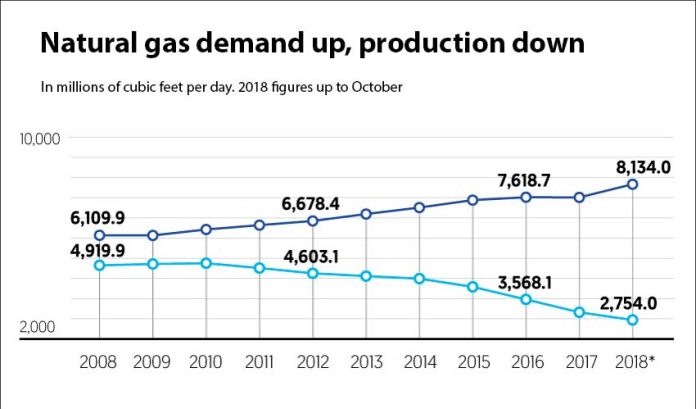
Demand is in dark blue, domestic production in light blue.
Demand is in dark blue, domestic production in light blue. sener/el financiero

Mexico’s productivity and economic growth are at risk due to a reduced supply of natural gas for industry, a business leader warns.

Juan Pablo Castañón, president of the Business Coordinating Council (CCE), said in an interview that gas shortages are going to force factories to shut down for periods and warned that electricity prices will go up.

“Our members have expressed their concern to us about the reduction of supply by one-quarter. That’s a very significant quantity and is going to cause technical stoppages. It will also have repercussions on the cost of electricity production going into the summer,” he said.

Castañón added that if industry is forced to substitute natural gas with fuel, their costs will go up and environmental damage will increase.

He said the private sector anticipated a reduction in natural gas supplies at the start of this year but added that the situation is a “little bit more intense than we expected.”

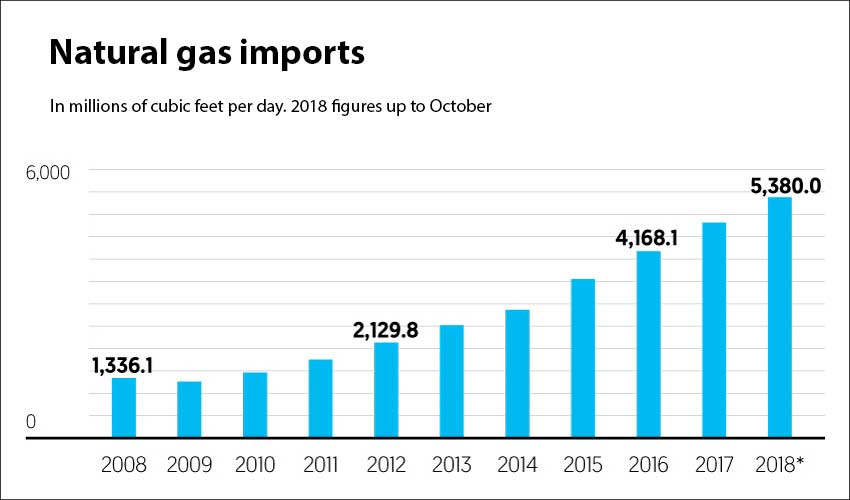
Natural gas imports 2008 to 2018.
Natural gas imports 2008 to 2018. sener/el financiero

The Mexican Employers’ Federation (Coparmex) confirmed that between July and October last year, its members received letters from Pemex telling them to limit their natural gas use due to circumstances that were beyond the state oil company’s control.

“We had to consume a reduced volume, although there was pressure [in the pipelines], the volume [of gas] was less,” said Edmundo Rodarte, head of the Coparmex energy committee.

He explained that pressure in natural gas pipelines has since dropped but Coparmex members companies have not received any further correspondence advising them to limit their gas use.

However, earlier this week the newspaper El Financiero reported that factories in central Mexico were informed by Pemex to reduce their gas consumption by just over a quarter because of distribution problems at one of its processing centers in Veracruz.

Agustín Humann, an analyst at the energy sector consultancy Marcos y Asociados, confirmed that was the case.

The former president of the Mexican Natural Gas Association said the shortages were confined to the center of the country but warned that they would have a “brutal effect” on industry.

An energy consultant at the public strategy firm Mercury said it was important to put an end to the shortages quickly, warning that if they continue for a prolonged period the impact on industry will be severe.

“In the short term,” Arturo Carranza added, “a solution could be to increase natural gas liquid imports.”

Mexico’s natural gas production has been declining for a decade, a period during which demand for the energy source has increased.

Imports have consequently risen significantly, putting Mexico heavily dependent on the United States for its natural gas needs, a situation that increases costs for industry but which is preferable to shortages.

Aldimir Torres Arenas, president of the National Association of Plastic Industries (Anipac), said the lack of natural gas is already affecting the petrochemical industry.

“. . . Sometimes we don’t have the material [we need] to produce. There’s no raw material more expensive than that which you don’t have,” he said.

Source: El Financiero (sp) 

Refineries showing some signs of life as production numbers rise

0
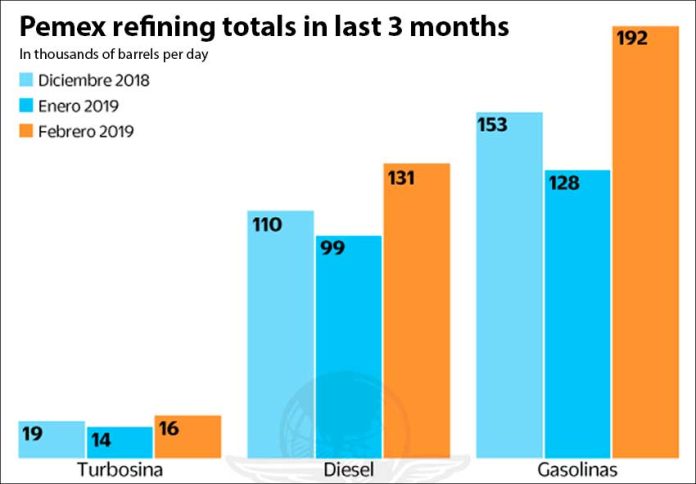
Aviation, diesel and gasoline refining in December through February.
Aviation, diesel and gasoline refining totals in December through February. Pemex, Secretariat of Energy/el universal

Mexico’s six petroleum refineries are showing new signs of life: fuel production and crude processing capacity are up and unscheduled stoppages have been reduced to zero.

State oil sector reports seen by the newspaper El Universal show that production of regular and premium gasoline in the third week of February was 86.7% higher than in the first week of January.

Diesel and aviation fuel production also increased, by 98.3% and 68.7% respectively in the same period.

The month-over-month figures are not quite as impressive but positive nonetheless.

Daily gasoline production this month has averaged 192,000 barrels per day (bpd) compared to 128,000 bpd last month – a 50% increase – and 153,000 bpd in December. Diesel production was up 32% to 131,000 bpd in February compared to 99,000 bpd last month.

While the signs are promising, the National Refining System (SNR) is still a long way from getting back to production levels seen a decade ago when they reached their highest point in 29 years.

During the last two weeks of this month, automotive fuel production has averaged 213,000 bpd – just 42.3% of the average daily production of 504,100 bpd in January 2009.

With regard to crude oil processing, the six oil refineries achieved an average capacity of 484,000 bpd during January but this month, the figure has increased by 15.7% to 560,000 bpd.

Looking at figures for the first week of last month and the third week of February, the increase is even more impressive.

Crude processing has increased from 309,500 bpd to 664,00 bpd in the period, a 114% surge. However, the figure represents less than 40% of the refineries’ combined processing capacity if they were operating at an optimal level.

Another good result for the oil sector is that there hasn’t been a single work stoppage at refineries this month compared to 40 in January and 48 in December.

According to the oil sector reports, Mexico’s oil production and processing problems were, as of the end of the third quarter last year, primarily linked to “operational problems” at the refineries in Ciudad Madero, Tamaulipas, and Minatitlán, Veracruz.

At the time both facilities were only operating at a minimal capacity.

To improve production and processing capacity across the SNR, an oil sector report said, it was “essential to continue general maintenance and preventative programs” at all refineries.

Petroleum production has been declining in Mexico for years.

Earlier this month, President López Obrador announced a 107-billion-peso (US $5.5-billion) rescue plan for Pemex aimed at reducing the state oil company’s financial burden and strengthening its capacity to invest in exploration and production.

He has pledged to reduce Mexico’s dependency on petroleum imports and part of his rescue plan for the sector includes the construction of a new refinery in Tabasco.

But while the president is optimistic, financial institutions rejected the government’s plan, describing it as insufficient and disappointing, while Fitch Ratings warned that it doesn’t insulate the state oil company against future cuts to its credit rating, which it currently rates at just one notch above junk.

Source: El Universal (sp)