A police officer is dead in Ocosingo, Chiapas, after a clash with thieves who robbed a plane carrying hundreds of thousands of pesos in federal aid for local communities.
According to the state Attorney General’s Office, the plane had just landed in the community of Santa Lucía when armed and masked civilians ran up to it, took the crew prisoner and helped themselves to 800,000 pesos (US $42,000) in money destined for student scholarships and other federal programs.
When police arrived on the scene and attempted to detain the robbers, one officer was killed and two others were injured.
After the thieves fled, personnel from the Attorney for Indigenous Justice Office arrived to investigate.
Business owners in Ocosingo say insecurity has worsened since March, and that municipal police stopped patrolling the municipality at the beginning of the year.
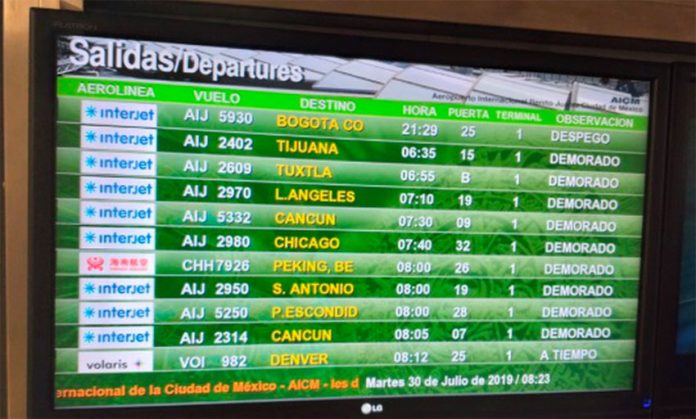
Departures screen at the Mexico City airport reveals Interjet's late (demorado) flights.
The ultra-low-cost airline Interjet cancelled 10 domestic flights in Mexico, affecting 1,557 passengers, according to the consumer protection agency Profeco.
Six of the cancelled flights were scheduled to leave from Mexico City, and the other four from Oaxaca, Mérida, Chetumal and Culiacán.
Numerous other flights were delayed, including international flights from Mexico City to New York, Havana, Bogotá, San Salvador and Chicago, affecting 659 passengers. According to sources who spoke with the newspaper Milenio, a total of 30 flights were delayed on Monday.
Passengers complained on social media, and said they were told by Interjet that the cancellations and delays were due to a shortage of personnel. Passengers also complained that they were not receiving information about the status of their flights.
Complaints of delays continued to appear on social media today.
Profeco has notified the airline that it is required by law to compensate affected passengers. A spokesperson for Profeco said the agency has attended 150 passengers who were inconvenienced.
So far in 2019, Profeco has received 830 complains against Interjet, which has paid over 6.2 million pesos (US $325,000) in compensation to passengers, as well as 506,819 pesos in fines.
If a flight is cancelled, an airline must put the passenger on another flight at no charge, and pay compensation of at least 25% of the cost of the flight.
The company told employees on Monday that it needs to hire 160 pilots in the next 12 months to keep its planes in the air.
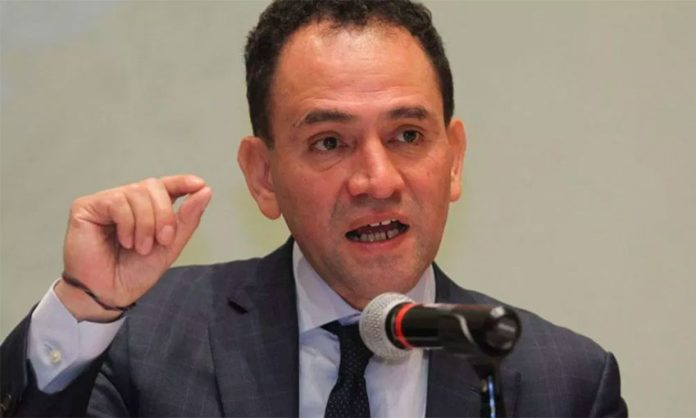
Finance Secretary Arturo Herrera has announced a 485-billion-peso (US $25.4-billion) stimulus package that he predicts will have an “immediate impact” on the ailing Mexican economy.
“We have decided on actions that would mobilize 485 billion pesos that would allow us to boost the creation of infrastructure projects, incentivize infrastructure investment and private consumption,” Herrera told a press conference yesterday.
Two-thirds of that amount – 320 billion pesos – will be spent on 1.2 million credits to support investment and consumption, 116 billion pesos will be used to accelerate spending on contracts by bringing forward purchases of goods and services that had been scheduled for 2020 and about 50 billion pesos will go to infrastructure projects.
The Secretariat of Finance (SHCP) said in a statement that a range of public-private projects would be included in the package.
It highlighted a 10-billion-peso waste management project in Nuevo León, a 2-billion-peso urban transportation project in Ciudad Juárez, Chihuahua, and a 1-billion-peso plan to build a desalination plant in Los Cabos, Baja California Sur.
The SHCP said that a state development bank would provide credits to more than 130,000 small and medium-sized businesses and 370,000 micro businesses.
It is unclear how much of the funds in the stimulus package, if any, are new, the news agency Reuters said.
The announcement of the stimulus package comes just days before the national statistics agency, Inegi, is due to publish second-quarter growth figures, which some analysts believe will show that Mexico has already slipped into a technical recession.
A recession would be a significant blow for the eight-month-old administration of President López Obrador, who as recently as last week maintained that he expects the economy to grow by 2% this year even as the International Monetary Fund cut its growth forecast to 0.9% from 1.6%.
The finance secretary didn’t estimate the impact that the stimulus package would have on growth but stressed that it wouldn’t affect the budget.
The SCHP noted in its statement that the global economy is slowing, stating that the main reasons for the deceleration are “trade tensions” between the United States and China and “geopolitical tensions” in some parts of the world including the United Kingdom’s pending departure from the European Union.
Herrera, who is new in the job following the sudden resignation of Carlos Urzúa earlier this month, said that “Mexico is not immune” to global headwinds, adding that “because of this we have been thinking about starting a program that aims to help the economy.”
The stimulus package contains “a series of actions that will have an immediate impact on the economy,” he asserted.
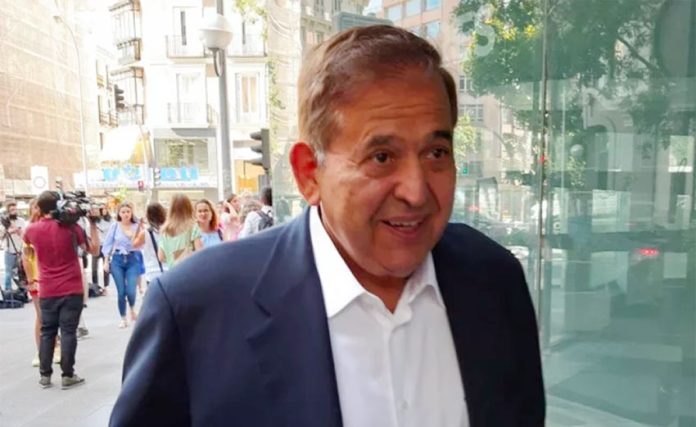
Steel company CEO Ancira speaks to reporters after his court appearance.
The CEO of a Mexican steelmaker who was arrested in Spain last May and faces extradition to Mexico says he is the victim of political persecution by President López Obrador.
Alonso Ancira, the owner of Altos Hornos de México, appeared before a Spanish judge on Tuesday, where he expressed his faith in the Spanish justice system and his refusal to be extradited to Mexico.
In a conversation with reporters after the hearing, Ancira reaffirmed his innocence and said that López Obrador is investigating Altos Hornos for political purposes.
“The accusation has no legal ends, it has political ends, and when politics gets involved, justice goes out the window,” he said. “. . . I don’t understand why he attacked my business. He’s hurt thousands of workers and he’s putting sources of employment at risk.”
Ancira, who is accused of bribery and money laundering related to the alleged overpayment by state-owned Pemex for fertilizer plants owned by Altos Hornos, offered to buy the plants back from the government.
“Return them to me, if you’re against it, return them,” he said. “It was a transaction that involved banks and international regulators. We’re not talking about buying oranges, dozens of people were involved, and that’s proven . . . If you don’t want them, give them back to me, and give me some time and I’ll pay everything back.”
Ancira was arrested by Spanish police in an airport in Mallorca in late May, based on an international arrest warrant. After spending a month in a Spanish jail, he posted bail of 1 million euros and was released after surrendering his passport and agreeing to appear before the judge every two days.
In September, Ancira’s case will be transferred to another court, which has the power to extradite him to Mexico. The proceedings will last several months.
Rosario Robles has been subpoenaed to a hearing in August.
A cabinet secretary in the Enrique Peña Nieto administration will be compelled to appear before a judge over corruption charges.
A judge granted a request Monday from the Attorney General’s Office (FGR) to bring criminal charges against Rosario Robles for the crime of abuse of public office. Robles served as social development secretary and agrarian development and urban planning secretary in the previous administration.
The crime she is accused of does not merit preventative custody, so she will be able to remain at liberty during her trial.
Robles is accused of involvement in a corruption scheme dubbed the “Master Fraud,” in which 3.4 billion pesos (US $178 million) from 11 federal agencies were diverted through shell companies and public universities in 2013 and 2014, when Robles was head of the Social Development Secretariat (Sedesol).
According to the federal Auditor’s Office (ASF), Sedesol directed 2.2 billion pesos to universities for services relating to an anti-hunger campaign that never materialized. The ASF has been investigating Robles since 2018, when Peña Nieto was still in office.
The “Master Fraud” was revealed in 2017 by the online newspaper Animal Político and Mexicans Against Corruption and Impunity.
Robles’ lawyer, Julio Hernández, confirmed that his client will attend the August 8 hearing.
“She will show up with her head held high, and with dignity, to the hearing before the federal judge . . .” he said. “We will prove that this is an unjustified action.”
In a letter to the media, Robles said she was not notified that she had been subpoenaed, and that she found out about it through media reports.
“It’s a flagrant violation of my rights and of due process,” she wrote. “It’s inconceivable that this was released to the media and not to me. Through this whole process, I’ve never had the opportunity to defend myself, I’ve never been asked to testify before prosecutors and I’ve never had access to court documents.”
Before serving in the Peña Nieto cabinet, Robles served as mayor of Mexico City and as president of the Democratic Revolution Party.
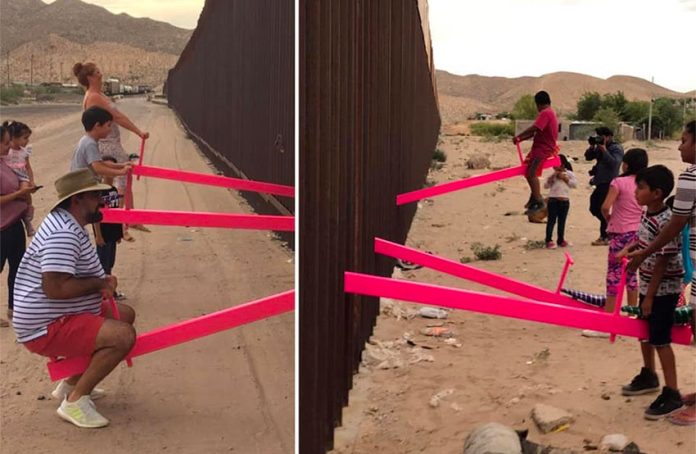
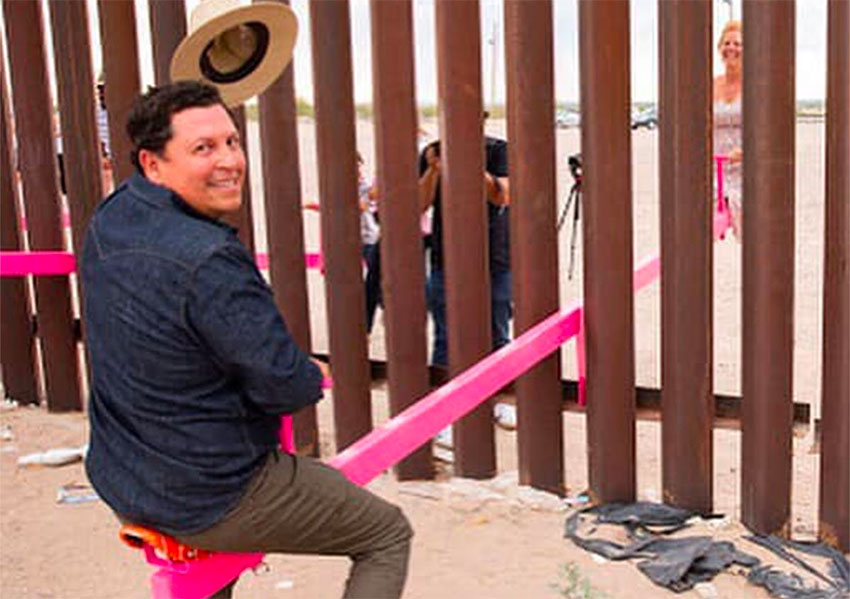
Seesaws appeared yesterday on the northern border.
There has been no shortage of innovative protests and projects at the barrier between Mexico and the United States in recent times.
A monumental photo of a toddler peering over the fence. A cross-border picnic. A plan for a binational bar. A human wall. A wall made of cheese. Massive hugging events.
On Sunday there was a new one: three bilateral seesaws – perfect metaphors for the interconnectedness of Mexico and the United States: what happens on one side of the border has a tangible effect on the other side.
Two professors from California came up with the border fence seesaw project 10 years ago but only on Sunday did it come to fruition.
The bright pink seesaws spanned the border fence between Anapra, a neighborhood of Ciudad Juárez, Chihuahua, and Sunland Park, New Mexico, allowing Mexican and American children to play together despite the physical division between them.
Seesaw project co-creator Rael.
“The wall became a literal fulcrum for U.S.-Mexico relations,” Ronald Rael, a University of California architecture professor and one of the two creators of the project, wrote on Instagram yesterday in a post featuring photos and footage of the seesaws in action.
“. . . Children and adults were connected in meaningful ways on both sides [of the border] with the recognition that the actions that take place on one side have a direct consequence on the other side,” he added.
Rael, who is also the author of the book Borderwall as Architecture, said that bringing the so-called “Teetertotter Wall” to life was “one of the most incredible experiences” of his career and that of Virginia San Fratello, a design professor at San José State University and the other architect of the seesaw project.
The border wall event “was filled with joy, excitement and togetherness,” he wrote.
The seesaw project won widespread praise among other social media users, and video of the “ups and downs” of children playing has gone viral.
“The symbolism of the seesaw is just magical. A border wall will not keep us from our neighbors,” Claudia Tristán, a member of United States presidential hopeful Beto O’Rourke’s campaign team, wrote on Twitter.
“Beautiful reminder that we are connected,” wrote Mexican actor Mauricio Martínez on the same social network. “What happens on one side impacts the other.”
The Texas-based Refugee and Immigrant Center for Education and Legal Services (RAICES), also applauded the project on Twitter, writing that “art is such a powerful vehicle for change.”
Quoting Rael, RAICES added:
“A beautiful installation at our southern border that reminds us that: ‘Actions that take place on one side have direct consequences on the other.’ We are all connected. We are all one.”
After 15 years of exploration and restoration work, the Zacatecas archaeological site Las Ventanas will finally open on August 2.
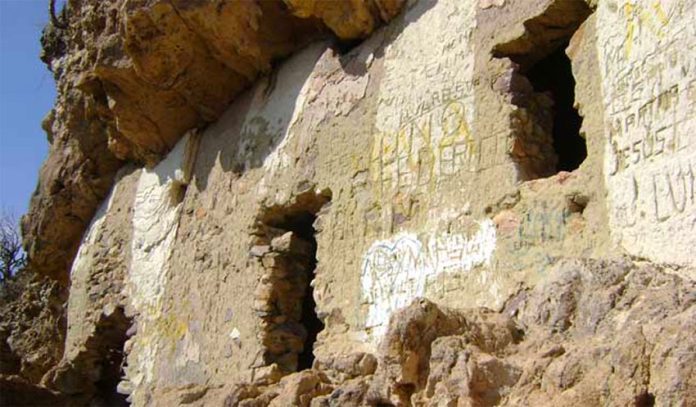
Located in the municipality of Juchipila, the site was occupied by the Caxcán people from about 100 AD until the arrival of the Spanish in the 16th century.
Archaeologists from the National Institute of Archaeology and History (INAH) uncovered nine structures during their long exploration of Las Ventanas, which means “The Windows” in English.
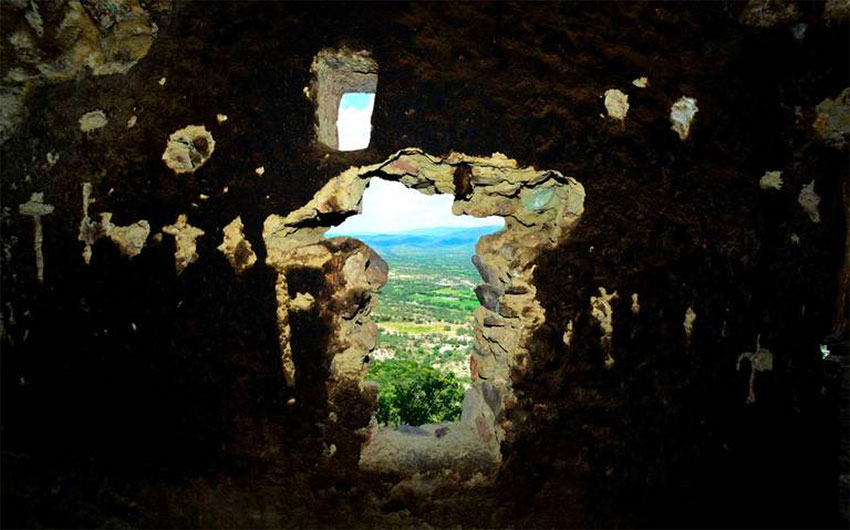
The name comes from the window-like openings in the stone structures. Archaeologists also identified 25 hillocks of varying sizes and shapes, which provide evidence that the site was used for religious ceremonies.
Las Ventanas was scheduled to open towards the end of the previous government’s term but only now is ready to receive visitors.
Looking out one of Las Ventanas’ windows.
Juchipila Mayor Rafael Jiménez told the newspaper Milenio that the inauguration of the site will be the culmination of a years-long dream.
Restoring the site and preparing it for opening “has been a very big effort,” Jiménez said, adding that around 150 people per day are expected to visit.
The increase in tourism to the municipality, located around 130 kilometers northeast of Guadalajara in the south of Zacatecas, will provide a boost for the local economy, he said.
“It’s good luck for us that despite budget cuts we’ve managed to open it . . . The three levels of government will collaborate for the operation [of the site] and security of the area,” Jiménez said.
Marco Antonio Santos Ramírez, an INAH archeologist who led the restoration project between 2012 and 2014, said the region where Las Ventanas is located was conquered later than other parts of the country.
“. . . Upon the arrival of the Spanish, there was an indigenous uprising that developed into the famous Mixtón war between 1541 and 1542. In Las Ventanas, which is an elevated point with pre-Hispanic structures . . . they [the Caxcán people] entrenched themselves to resist . . .” he said.
Santos added that excavations at the site uncovered the graves of children.
“That means that they preferred to sacrifice their children rather than have them fall into the hands of the Spanish,” he said.
The INAH archaeologist agreed with the Juchipila mayor that the opening of Las Ventanas will boost tourism.
“It’s a region that needs it because for a long time it’s been under the control of drug cartels . . . The archaeological zone will definitely create a lot of jobs and the peace we all want will resume,” Santos said.
Las Ventanas will be the newest addition to an archaeological tourism route in Zacatecas.
Other pre-Hispanic sites in the northern state include the recently-opened Cerro del Teúl, La Quemada and Altavista.
Contestants at Saturday's transgender beauty pageant.
After four hours of posing for judges, making wardrobe changes and responding to questions on social issues, Ivanna Cázares beamed on Saturday as an announcer declared her Miss Transgender Beauty Mexico 2019.
The contest was conceived two years ago as a means to encourage awareness and acceptance of transgender women.
Cázares, originally from Colima, beat out 21 other contestants from other states in the Mexico City competition, which included bikini, evening gown and regional dress rounds, in which she sported a traditional-themed outfit with leopard print and feathers.
Second-place winner Miss Baja California donned a vineyard-inspired getup featuring grapes.
Mexico does not have a good human rights record with regard to transgender people, according to LGBTQ rights group Letra Ese. It says 261 transgender women were killed between 2013 and the end of last year, making the country one of the most dangerous in the world for transgender women.
Cázares, who has a degree in communications and owns a beauty salon, told reporters that the pageant was a transformative experience for how she views herself. She said that although her family was supportive throughout her gender transition beginning three years ago, she has struggled with gaining acceptance from others.
After being crowned pageant queen, however, she said she now sees herself as a spokesperson for the transgender community in Mexico.
“We want to bring a message to society of respect for the trans girls of Mexico.”
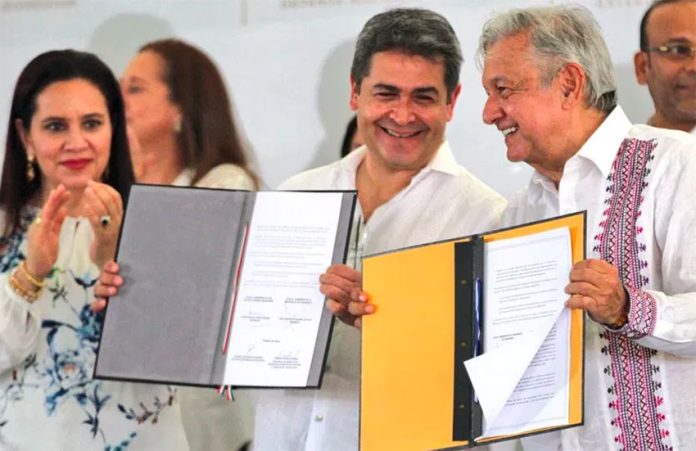
Honduras President Hernández, center, after signing an agreement with President López Obrador on Saturday.
President López Obrador has pledged to give US $90 million a year to Honduras, El Salvador and Guatemala to discourage Central American migration through Mexico to the United States with a regional development initiative.
On Saturday, the president signed a letter of intent to cooperate with Honduran President Juan Orlando Hernández. Following the signing, Foreign Secretary Marcelo Ebrard said the Mexican government will invest $30 million to create 20,000 jobs in Honduras over the next five months through a reforestation project based on the government’s domestic Sembrando Vida (Sowing Life) program and the apprenticeship scheme Youths Building the Future.
The president signed a deal with El Salvador President Nayib Bukele in late June, and Ebrard said the administration would offer the same investment to Guatemala after the second round of the country’s presidential elections in August.
But opposition leaders described the move as senseless, claiming that the expenditure is inconsistent with the administration’s austerity plan, which has slashed spending across the federal government, laid off government employees and cut many programs.
National Action Party politician Damián Zepeda accused the president of bowing to the United States’ immigration agenda to the detriment of the Mexican people.
“Mexico wants to sell an image of itself as being something it’s not; the president and his cabinet are out of touch. On one hand, Mexico is accepting an absurd position on the United States’ terms for migration, while on the other Mexico wants to solve other countries’ problems when it’s far from solving its own.”
Zepeda highlighted some of the administration’s problematic austerity measures, including a 25% cut in government spending, the dismissal of over 200,000 public servants, the withdrawal of daycare subsidies, incomplete pay for Federal Police and a shortage of medications in the public healthcare system.
Institutional Revolutionary Party lawmakers were in agreement. “They’re committing important federal resources when they have said ad nauseam that it’s necessary to find savings.”
President López Obrador brushed off the criticisms.
“Of course we are going to participate in this development program for Central America and Mexico, and we are going to do our share, including using our resources. Some are questioning this stance, even to the point of xenophobia.”
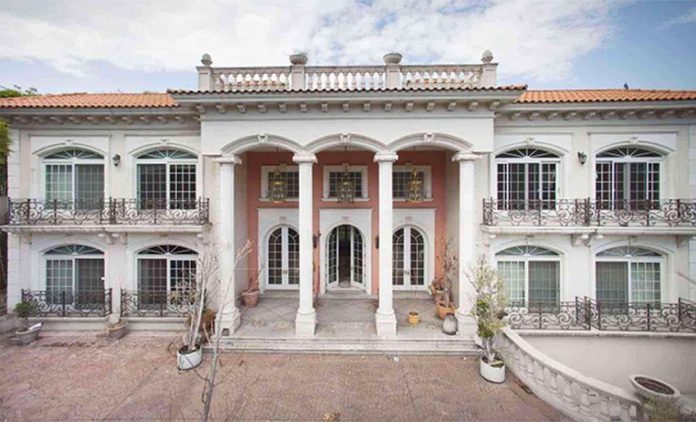
The Bosques de Las Lomas mansion that belonged to an accused narco.
A Mexico City mansion owned by a Chinese-Mexican businessman accused of drug trafficking and money laundering will go on the auction block next month.
Zhenli Ye Gon’s home in the affluent Bosques de las Lomas neighborhood was seized by federal authorities in 2007.
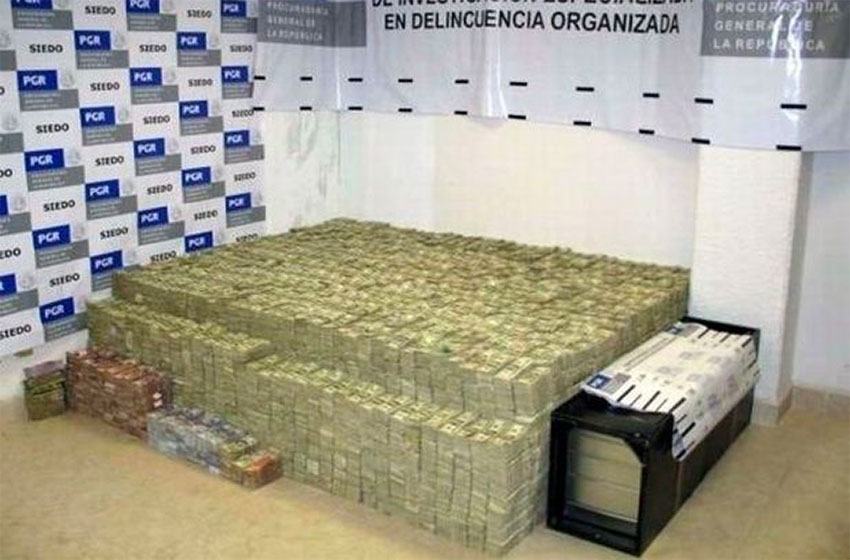
Authorities also seized huge amounts of cash found inside – US $206 million, 17 million pesos and 201,000 euros.
Police suspect that Ye Gon, allegedly a member of the Sinaloa Cartel, was importing huge quantities of chemicals from China to produce methamphetamine. He was arrested in the United States in 2007 and extradited to Mexico in 2016.
Speaking at the presidential press conference this morning, the chief of the System of Administrative Allocation of Assets (SAE), a federal agency, said that Ye Gon’s 1,500-square-meter home is valued at 95 million pesos (US $5 million).
Inside the opulent home of Zhenli Ye Gon.
“It’s a pretty plush house . . .” Ricardo Rodríguez said, adding that it was transferred to the SAE in 2012.
He explained that the seized cash went to the federal judiciary, the Attorney General’s Office and the Secretariat of Health.
However, President López Obrador said earlier this month that what was done with the money is unclear and that an investigation has been initiated to find out.
Former president Felipe Calderón, who was in office when the cash was confiscated, responded that the money was used to build 335 drug prevention and addiction treatment centers.
Today, López Obrador said that Ye Gon’s home previously belonged to a politician but declined to say who, advising reporters to find out for themselves.
“. . . We have to be careful with the power vested in the president, it won’t be hard to find out [who the owner was] . . .” López Obrador said.
The huge stash of cash found inside the house.
The luxurious home won’t be the first asset owned by Ye Gon to be sold by the federal government.
In 2014, the México state government paid 181 million pesos for an industrial warehouse in Toluca where the businessman allegedly planned to set up a methamphetamine processing facility.
Ye Gon, who became a Mexican citizen in 2003, has consistently denied all charges against him. It is unclear when he will face trial.