Home Blog Page 1944

Government presents 107-billion-peso plan to reduce Pemex’s debt burden

0
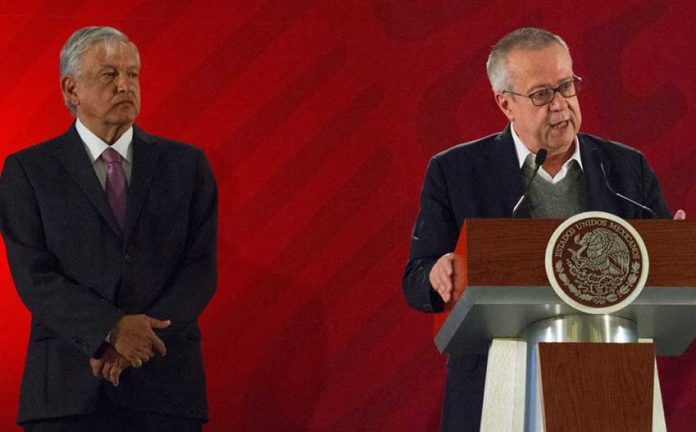
López Obrador, left, and Urzúa present Pemex rescue plan.

President López Obrador presented today a 107-billion-peso (US $5.5-billion) rescue plan for Pemex aimed at reducing the state oil company’s financial burden and strengthening its capacity to invest in exploration and production.

“We’ve taken the decision to support Pemex with everything,” López Obrador declared at his morning press conference, explaining that making the company profitable and productive was the great challenge of his government.

To that end, López Obrador said that the state-run company will receive a cash injection, its tax burden will be reduced and it will be cleansed of corruption.

The cause of many of Pemex’s problems is corruption, the president charged, especially dwindling oil production.

He described the rescue package, which is divided into four parts, as “an initial plan,” explaining that “if they require more, there will be more support.”

Pemex finance chief Alberto Velázquez explained that there will be a 25-billion-peso (US $1.3-billion) cash injection into the company and pledged that Pemex won’t take on new debt in 2019.

He said the second rescue measure consists of a plan to transfer 35 billion pesos (US $1.8 billion) from the Secretariat of Finance and Public Credit (SHCP) as an early payment of a debt the latter has with the former.

The company will be given a tax break of at least 15 billion pesos (US $800,000) this year, Velázquez said, explaining that its tax burden will be further reduced during the government’s six-year term and that the saving could be as much as 30 billion pesos next year.

Finally, an estimated 32 billion pesos (US $1.6 billion) in savings generated by the government’s crackdown on fuel theft will also be directed to Pemex.

Speaking after the rescue plan was presented, Finance Secretary Carlos Urzúa stressed that the government is committed to supporting Pemex, whose debt of more than US $100 billion makes it the most indebted oil company in the world.

“. . . The federal government, through the Secretariat of Finance, will do whatever it can to maintain Pemex’s finances healthy,” he said.

Reuters reported that investors were reassured by the announcement although they had expected stronger measures. “The announcement is positive and could be enough to remedy the company’s additional financial needs for 2019,” said Edgar Cruz, global markets credit research at BBVA in Mexico, while warning that it would not stave off another crunch next year.

The company must make more than $27 billion in debt payments over the next three years.

Fitch downgraded Pemex’s credit rating to just one level above junk last month, a move that was slammed by López Obrador, who accused rating agencies of hypocrisy because “they maintained a complicit silence” during the past government and “endorsed the so-called energy reform” even though “they knew that foreign investment didn’t arrive and investment in Pemex didn’t increase.”

The president said today that with the announcement of the government’s rescue package, including his pledge to stamp out corruption in Pemex, the ratings agencies will now “treat us well.”

He explained: “They have all the information, especially about corruption issues. They know very well what was happening in Pemex and the CFE [the Federal Electricity Commission].”

Source: El Economista (sp), El Financiero (sp), Reuters (en)

High electricity rates in northern Nayarit described as robbery

0
Residents protest CFE tariffs in Acaponeta, Nayarit, in December.

High electricity rates paid by at least 350,000 residents of seven municipalities in Nayarit have been described as “robbery” by a customer representative.

Oscar Luna Ayón, who represents electricity customers in Santiago Ixcuintla, said that residents in that municipality as well as Tuxpan, Acaponeta, Rosamorada, Ruiz, Tecuala and Huajicori – all in the north of the state – have been paying excessive rates to the Federal Electricity Commission (CFE) since 2002.

From May until October – the hottest months of the year – the CFE charges customers in the municipalities a lower, subsidized rate known as 1D but from November to April, the subsidy is suspended.

Despite protests, the CFE has ignored the customers’ complaints and failed to conduct a review of the excessive charges seen during the latter period, Luna said.

“It’s robbery. Power bills arrive with charges of 2,000 pesos, 4,000 pesos, up to 10,000 pesos [US $520], when homes only have air conditioning, which isn’t a luxury but a necessity for coastal areas,” he said.

State lawmaker Eduardo Lugo said that electricity customers and authorities in Nayarit are calling for the federal government and the CFE to apply the 1D rate year-round in Nayarit’s hottest municipalities.

Before he assumed the position, new CFE director Manuel Bartlett said that he planned to review power rates and that the López Obrador-led federal government would seek to introduce “social rates” that could see people on low incomes obtain government subsidies to offset their electricity costs.

Source: Milenio (sp) 

Miners union leader unites labor movement under new umbrella organization

0
Labor leader Gómez.
Labor leader Gómez.

A mining union leader and senator with Mexico’s ruling party presented a new labor federation yesterday that unites 150 unions, declaring that it will fight for the rights of a labor movement that was oppressed by past “neoliberal governments.”

Napoleón Gómez Urrutia, a controversial figure who has been accused of embezzling US $55 million from the National Union of Mine and Metal Workers, announced that the umbrella organization is called the International Confederation of Workers (CIT).

Despite his affiliation with the current administration, Gómez declared that the CIT is “not a government agency nor one of the political party Morena,” which is led by President López Obrador.

Speaking at mining union headquarters in Mexico City, he described government-appointed union bosses as “scum” who have lived off workers and called for old practices and vices that “destroyed and held back” the labor movement to be left behind.

“We’re going to move forward together, we’re going to support everything that represents the transformation of the work world towards labor justice [and] towards progress in union democracy. We’re going to support the free and secret vote so that workers exercise their right to choose the organization to which they belong and to choose the leaders that represent them,” Gómez said.

The union leader described the formation of the new confederation as a landmark in the history of Mexican trade unionism because it brings together organizations that are concerned about the country’s labor situation, the lack of representation for workers, abuses committed by employers and the absence of union democracy.

Gómez said that the recent strike action in Matamoros, which resulted in thousands of workers winning 20% pay raises and bigger annual bonuses, could spread and that the CIT would support them.

“As long as the conditions of exploitation continue for these workers, not just on the border but across the country, there is a risk that these conflicts will break out,” he said. “We will always be ready to advise and support them.”

Workers’ wages stagnated for decades in Mexico as pro-government unions cozied up with the once-dominant Institutional Revolutionary Party (PRI) to keep workers in check.

Gómez said that “we cannot continue to allow the labor sector to be left behind from the prosperity and progress in the country.”

He explained that while the objective of the CIT is “the unification of the labor movement,” it doesn’t intend to make trade unions disappear or steal their members.

Gómez said that United States labor groups such as the AFL-CIO, the largest federation of unions in that country, had expressed support for the CIT and declared that “it is time that we unions globalize ourselves” in a way similar to multinational companies.

However, he rejected any suggestion that foreign trade unions would interfere in the decisions and actions that the CIT takes, explaining that it was only “a question of solidarity.”

Gómez returned to Mexico last year to take up his position in the Senate after spending 12 years in exile in Canada, where he continued to run the mining union from Vancouver.

A group of 20,000 miners has accused him of stealing money owed to them in relation to the purchase of a state-owned mine by mining conglomerate Grupo México. The accusations have been described by Gómez as “political persecution.”

The leaders of several unions attended yesterday’s launch and congratulated Gómez for the formation of the new labor federation.

Among those in attendance was the secretary of the Michoacán branch of the STDSSM health care workers union, who said that for President López Obrador to achieve his promise to transform Mexico, a radical change to workers’ conditions is needed.

Guadalupe Pichardo also defended Goméz’s record as an advocate for the labor movement.

“We had never seen a union leader persecuted in such a way but comrade Napoleón was always with his working base. Let those who don’t defend the working class quiver,” she said.

Source: El Universal (sp), Associated Press (en) 

United Nations will oversee contracts, tenders to combat corruption

0
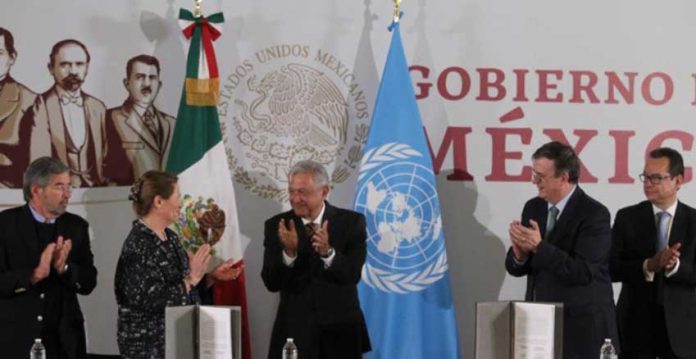
Mexican and UN officials applaud signing of agreement of support.

The United Nations will provide Mexico with support in the administration of federal contracts and projects through an agreement signed yesterday.

The UN Office for Project Services (UNOPS) will provide supervision and tracking of federal contracts, projects and tenders as well as assistance with big projects such as the sale of government vehicles and aircraft, economic proposals for the Maya Train and the purchase of medications.

Juan Ramón de la Fuente, Mexico’s permanent ambassador to the UN, said that the move “will allow us to advance . . . and to once and for all lay to rest the culture of corruption in this country and to welcome a culture of transparency and laws in all of the government’s actions.”

He called corruption in Mexico “endemic” and said the signing of the accord was in response to President López Obrador’s repeated calls to make a philosophy of ethics a central pillar in the functioning of the federal government.

De la Fuente added that the agreement with the UNOPS would reinforce steps taken by Mexico to meet the goals of the United Nations’ 2030 agenda, an ambitious plan to stimulate concrete advances in global poverty, hunger, health, education, gender equality, energy, urbanization, environment and social justice.

“We are sure that the UN, working through its specialized offices, will help us to get to the root of many of the problems that afflict us that have been pointed out on numerous occasions by President López Obrador: to get to the bottom of poverty and inequality and to promote actions that have a direct social impact.”

The president thanked the ambassador, whom he described as “first-class,” and said that not only would UN supervision allow public administration to run more smoothly and ethically, it would also give government the opportunity to recover funds previously lost to widespread corruption.

UNOPS executive director Grete Faremo said the new partnership will give the Mexican government access to essential resources to fight corruption and implement better-planned projects and infrastructure.

“We are here because the Mexican government has asked for our help. We are grateful and humbly accept. Working together offers us an incredible opportunity to increase efficiency and to implement more effective projects,” she concluded.

Source: El Universal (sp), Excélsior (sp), Aristegui Noticias (sp)

AMLO announces plans for Badiraguato, El Chapo’s hometown

0
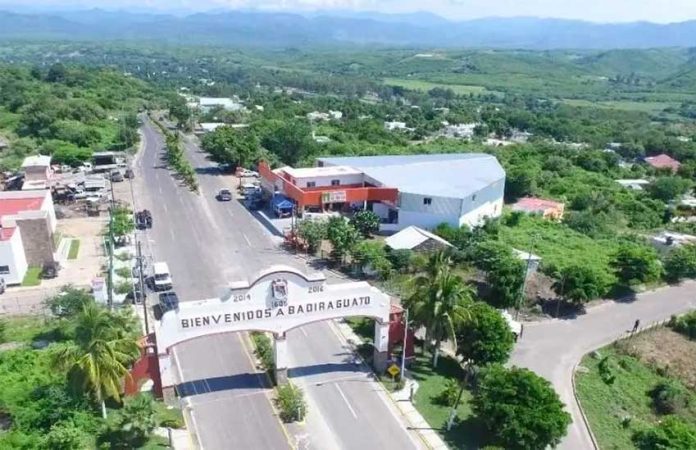
El Chapo Guzmán's hometown, Badiraguato.

President López Obrador will visit the hometown of convicted drug lord Joaquín “El Chapo” Guzmán tomorrow to inaugurate one government project and formally announce two more.

The president told reporters at his daily press conference that he will travel to the former Sinaloa Cartel chief’s native Badiraguato, a mountainous municipality 80 kilometers north of the Sinaloa capital Culiacán, to open a new stretch of highway that runs to Guadalupe y Calvo, a municipality in Chihuahua.

López Obrador said he will also announce the establishment of a new public university in Badiraguato that will specialize in forestry, explaining that the region has a lot of potential in the sector.

“Thirdly, the Sembrando Vida [Sowing Life] program is going to go ahead,” he added, referring to the government’s ambitious tree-planting project.

“We’re going to plant [trees] in the region, 50,000 hectares just next to Badiraguato . . .”

[wpgmza id=”150″]

López Obrador said the program will create 20,000 permanent jobs in the sierra region of Sinaloa and Chihuahua.

Asked about Guzmán’s conviction on drug trafficking charges Tuesday in a New York federal court, López Obrador said yesterday that it was a lesson that a life of crime and easy money doesn’t bring happiness.

Today, he said, Badiraguato shouldn’t be stigmatized just because El Chapo grew up there.

“Towns mustn’t be stigmatized, you can’t stigmatize Atlacomulco because the so-called Atlacomulco group is from there,” López Obrador said, referring to Institutional Revolutionary Party (PRI) politicians, including former president Enrique Peña Nieto, who hail from the México state municipality.

“Badiraguato is a town with history, a lot of people who deserve respect live there,” he added.

The leftist political veteran, who last month said that the drug war is over and arresting drug lords is no longer a priority, explained that the aim of the new government projects and programs in Badiraguato and the country as a whole is to provide options for citizens – especially young people – to earn an honest living and not be tempted into a life of crime.

“We’re seeking to regenerate public life,” López Obrador said.

Source: Reforma (sp) 

Violence cited in spring break cancellations in PV but not everyone is unhappy

0
Spring break: too much sex on the beach.

Spring-breakers are steering clear of the resort city of Puerto Vallarta: cancellations for the upcoming vacation period number between 10,000 and 13,000, according to the local chapter of the National Chamber of Business, Services and Tourism (Canaco-Servytur).

But some people are relieved.

The vice-president of the Puerto Vallarta Canaco-Servytur chapter, Martín Rodríguez Félix, told the newspaper El Financiero that he believes the travel warnings issued by the United States, disputes between local transportation companies and the ride-sharing service Uber, muggings of tourists and abuses of local tour companies have all had an impact on spring break travelers’ vacation plans.

Lost revenue is estimated at close to 400 million pesos (US $20.7 million).

Yet Puerto Vallarta ranked among the 10 Mexican cities with the lowest perceived levels of insecurity in a survey by the national statistics institute, Inegi, Rodríguez said.

The reaction to lost spring break traffic has been mixed, according to the newspaper Vallarta Independiente. It reported yesterday that half the comments on social media are from people who are not unhappy about the news.

Some residents believe the collateral damage caused by the vacationers, mostly youths from the United States, is more or less equal to the economic benefits they bring.

Comments revealed that on the negative side are the large quantities of garbage left on beaches and the tendency among the youthful visitors to enjoy open-air sexual activities.

Source: El Financiero (sp), Vallarta Independiente (sp)

López Obrador promises that heavily indebted Pemex will meet all its obligations

0
López Obrador will present a plan for Pemex on Friday.

Pemex will meet all of its debt obligations, President López Obrador said today, explaining that he will present a plan tomorrow to strengthen the state oil company’s finances.

“Pemex will never fail to fulfill a debt obligation, we will pay all of the obligations punctually,” López Obrador declared at his early morning press conference.

The president’s assertion follows Fitch Ratings’ downgrading of Pemex’s credit rating late last month to just above junk status.

The ratings agency cited the company’s high leverage and substantial tax burden as reasons for the downgrading to BBB- – the lowest investment-grade rating – and maintained its outlook for Pemex at negative, meaning that another cut could be in the cards.

Pemex is the most indebted oil company in the world, owing in excess of US $100 billion.

Further complicating the company’s position is that the quantity of oil it produces is at its lowest level in decades, mainly due to a lack of investment.

The plan to improve Pemex’s financial situation is expected to include a cash injection into the company as well as tax breaks.

López Obrador explained that one source of funding for the beleaguered company would be savings generated by the government’s crackdown on fuel theft, a crime that has cost Pemex billions of pesos annually.

A US $1.25-billion injection into Pemex is anticipated, which the president has said will help boost crude production, but analysts say that the target of 2.4 million barrels per day (bpd) by 2024, compared to 1.73 million bpd in December, is unrealistic.

Tax breaks could free up an additional US $3.5 billion for Pemex to invest more in oil exploration and production but Graham Stock, senior emerging markets strategist at asset manager BlueBay, believes that “Pemex needs $10 billion to $15 billion of relief per year.”

López Obrador stressed this morning that the government would not take on additional debt in order to help Pemex, amid increasing speculation that the company’s position could contribute to a downgrading of Mexico’s sovereign credit rating.

“We will not resort to debt,” he said before reiterating, “we will have no problems resolving our obligations.”

Source: Reuters (sp) 

Scientist replaces fashion designer at GM biosecurity unit

0
Designer Arrieta with President López Obrador.

A fashion designer who was employed as a deputy director of the federal government’s GM biosecurity unit has been replaced, the National Council of Science and Technology (Conacyt) said.

Edith Arrieta Meza, a fashion design graduate of a Mexico City university, left her position yesterday, Conacyt said in a statement, explaining that she was invited to collaborate with CIBIOGEM – a federal government agency that develops policies for the safe use of genetically modified organisms – on a study about agriculture and agrobiodiversity in the capital.

“. . . The employment relationship between Ms. Arrieta and CIBIOGEM has concluded,” the statement said, explaining that Eva Bermúdez García, a biochemist, will take up the role of deputy director of development, scientific innovation and technology due to “the technical requirements that will be needed in the future.”

Arrieta was not appointed as the head of CIBIOGEM as some media outlets reported.

Conacyt clarified that since February 1, the chief of CIBIOGEM has been Dr. Emmanuel González Ortega, who has a PhD in biotechnology from the University of Barcelona, among other scientific qualifications.

News of Arrieta’s employment at CIBIOGEM triggered a backlash on social media because of her seemingly incongruent academic background as well as her membership in the ruling Morena party.

But Conacyt defended her appointment, stating that she has “extensive experience in organizational work” and had developed her knowledge of traditional agriculture while growing up in Milpa Alta, a largely rural southern borough of Mexico City.

“We want to emphasize that Ms. Arrieta possesses profound traditional knowledge about native Mexican corn acquired throughout her life as she comes from a farming family in Milpa Alta. Although unfortunately we’re still not capable as a society to recognize the immense value of this kind of knowledge, it was fundamental in order to adequately carry out the task entrusted to Ms. Arrieta,” the statement said.

“In addition to her knowledge and experience, Ms. Arrieta has held public positions in the Tlalpan government in areas related to the conservation of agrobiodiversity, her overall profile justified the assignment she was given in CIBIOGEM.”

Source: El Financiero (sp) 

Pemex’s US $107-billion debt puts Mexico bonds on the edge of junk

0
pemex

Massive debt at Pemex is pushing Mexican bonds towards junk status as doubts grow over whether the government’s rescue plan for the state oil company will work.

Pemex is the most indebted oil company in the world, owing US $107 billion. But its output is declining.

As a result, Mexico’s government-debt spreads are now higher than those paid by emerging market nations that are rated two notches below Mexico’s BBB+, Bloomberg said.

A pertinent example is that of Brazil, which has a junk level credit rating because of its high level of indebtedness, yet Mexico’s average debt spread is wider than that of its Latin American peer.

After Fitch Ratings last month cut Pemex’s credit rating to one level above junk, sovereign bonds deteriorated further and there is now increasing speculation that Mexico’s credit rating could also be downgraded.

Just under 70% of respondents to a Bank of America client survey said that they expect Mexico’s credit rating to drop below investment grade in “coming years.”

President López Obrador has pledged to rescue Pemex but it is unclear where he will get the money to do so while maintaining his pledge of economic austerity.

“We have the resources . . . We’re going to lighten Pemex’s tax burden like never before,” the president said, explaining that “savings” – from where he didn’t specify – would fund US $3.5 billion in tax breaks.

However, Graham Stock, senior emerging markets strategist at asset manager BlueBay, believes that “Pemex needs $10 billion to $15 billion of relief per year but that is a significant tax cut — around 1% of GDP.”

Thwarting that possibility is that Mexico’s economy is slowing and many analysts believe that growth will be under 2% this year.

López Obrador has also pledged to inject US $1.25 billion into Pemex to boost crude production but analysts say that the target of 2.4 million barrels per day (bpd) by 2024, compared to 1.73 million bpd in December, is unrealistic.

They have also questioned the government’s decision to build a new oil refinery on the Gulf of Mexico coast in Tabasco in order to reduce reliance on United States imports because refining is less profitable than exporting crude.

“I don’t think Pemex can cling to investment grade much longer unless the government takes drastic action — and the government thinks it is taking drastic action, that is what is concerning,” said Shamaila Khan, head of emerging market debt at investment manager AllianceBernstein.

However, she also said that pumping more money into Pemex could damage Mexico’s fiscal position.

“To the extent Pemex support comes at the expense of fiscal performance, that is going to impact sovereign ratings,” Khan said.

Charles Seville, a senior director at Fitch, told Bloomberg that “to provide the scale of support that would be needed to really give Pemex more room to invest and turn around its business, it might require foregoing significant amounts of revenue from the government.”

Roger Horn, a senior emerging-markets strategist at SMBC Nikko Securities America in New York, said that Pemex isn’t Mexico’s only problem with regard to attracting investment, contending that it’s also the “erosion of the institutional framework that had underpinned investor confidence in the Mexico story over the past three decades.”

The government’s decision to cancel the partially built US $13-billion Mexico City airport project, taken before it assumed office, is one example of an action that has eroded investors’ confidence in the country.

Source: Bloomberg (en), Financial Times (en) 

Without evaluation, more teachers will be selling their jobs: watchdog agency

0
Bracho: government opening the door to selling teaching positions.

The practice of teachers selling their positions will be encouraged if the federal government goes ahead with a plan to eliminate evaluations for new teachers and those seeking promotion, the National Institute for Educational Evaluation (INEE) has warned.

Teresa Bracho, president of the autonomous public organization, said the crusade against corruption should also focus on education, pointing out that its new educational reform proposes eliminating processes for teacher recruitment and promotion that “combat the corrupt practice of the sale and inheritance of positions.”

“By eliminating from the constitution that entry into a teaching career and promotion is by merit . . . transparency in the processes to allocate positions is placed at great risk,” she said.

With evaluations carried out by the INEE, Bracho said, teachers are appointed to positions based on their knowledge and vocation for the profession. Without them, “the allocation of teaching positions would be unfair because they would be given to those who can buy them, inherit them or provide favors.”

Bracho acknowledged that the practice of selling positions has not been eliminated completely but charged that it is less commonplace than it once was and as a result more properly qualified teachers are in the nation’s classrooms.

“It’s not something that has been eliminated, it’s a practice in the education system that couldn’t be eliminated in one year or six, but progress was made and there was a clear operation against corruption and the illegitimate allocation of positions,” she said.

The official also defended the work of the organization after an attack on autonomous public organizations by President López Obrador, who yesterday accused them of “facilitating theft” by corrupt officials.

“Educational evaluation provides information about how education is progressing or moving backwards in our country and in each state. Without evaluation, there will be no information about the good things and bad things of our education system,” Bracho said.

In December, López Obrador and Education Secretary Esteban Moctezuma presented the government’s new educational reform, which among other points, proposed the elimination of the INEE and the establishment of a similar organization that is under the control of the government.

Bracho countered that without an autonomous INEE, educational results would be subordinated to political interests.

When the government first floated the idea, Bracho said the disappearance of the INEE would be akin to allowing the Secretariat of the Interior count the votes in a presidential election.

“The proposal of the president to eliminate an autonomous organization such as this represents an attack by the new government against the system of checks and balances of our democracy,” she said.

The INEE is “an essential autonomous organization,” Bracho added, and one that “generates objective, trustworthy and pertinent information.”

Source: El Financiero (sp), El Universal (sp), El Heraldo de México (sp)