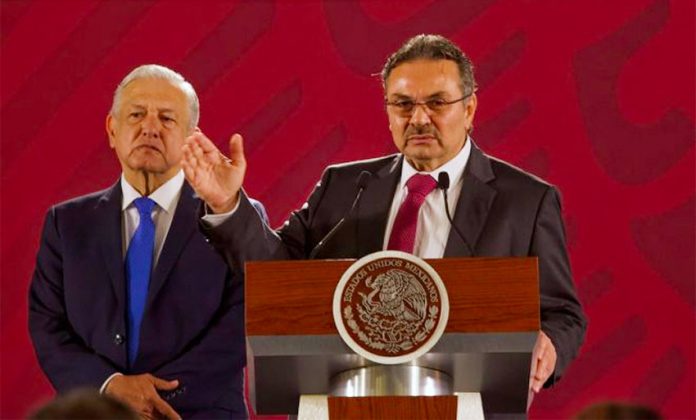
Pemex CEO Romero presents the oil company's new business plan.
Tax cuts, large injections of capital and increased oil production are proposed in the new business plan for the heavily-indebted state oil company Pemex.
Company CEO Octavio Romero said today that the company will pay 7% less tax and duties next year and an additional 4% less in 2021.
The plan will reduce the tax rate paid by Pemex from 65% to 54% in 2021, he said.
The government will inject 141 billion pesos (US $7.4 billion) into the company over the next three years, including 66 billion pesos in 2020.
Pemex will reinvest 221 billion pesos of its own funds next year while the tax cuts will generate savings of 45 billion pesos and the private sector will provide 14 billion pesos in the form of service contracts, according to a presentation at this morning’s presidential press conference.
All told, investment in Pemex will total 347 billion pesos ($18.2 billion) next year, while in 2021 it will rise to 411 billion pesos ($21.6 billion).
President López Obrador said the plan, approved unanimously yesterday by the Pemex board, is designed to transform “an oil industry in ruins” to one with the capacity to finance national growth.
“We are sowing oil . . .” he declared. The president has also pledged that a new $8-billion refinery on the Tabasco coast will start operations in May 2022.
Romero said that in the second half of President López Obrador’s six-year term “it will be Pemex which supports the federal government to finance growth and development in our country.”
He said the state-owned company is focusing its exploration efforts in shallow waters and onshore areas.
Pemex, which has long been the biggest contributor to public finances, currently provides about a fifth of the national budget even as oil output continues to decline, falling to a historic low of 1.625 million barrels per day (bpd) in January.
However, by the end of López Obrador’s administration in 2024, the company expects to produce 2.697 million bpd, a 66% increase on January numbers.
According to the new business plan, production will average 1.707 million bpd this year, 1.866 million bpd in 2020 and 2.069 million bpd in 2021.
While the production figures cited are positive, further downgrades to Pemex’s credit rating are expected if the plan fails to convince, the Financial Times said.
Analysts at the investment bank Citigroup said after the presentation of the new business plan that a downgrade for both sovereign bonds and Pemex is only “a matter of time.”
A cut to Pemex’s rating would likely place pressure on the peso, which fell 0.6% today on news of the plan.
In a note to clients, Citigroup also said the strategy “doesn’t solve the main structural problems of the company.”
Pablo Medina, vice president of Welligence Energy Analytics, told Bloomberg that “Pemex is trying to be too many things at the same time under the new government policy, and its portfolio is very inefficient.”
He said that to improve its financial situation, Pemex needs to sell non-core assets and restart joint ventures.
“They need to take advantage of what the energy reform allows, leverage capital and stop trying to do it all by themselves.”
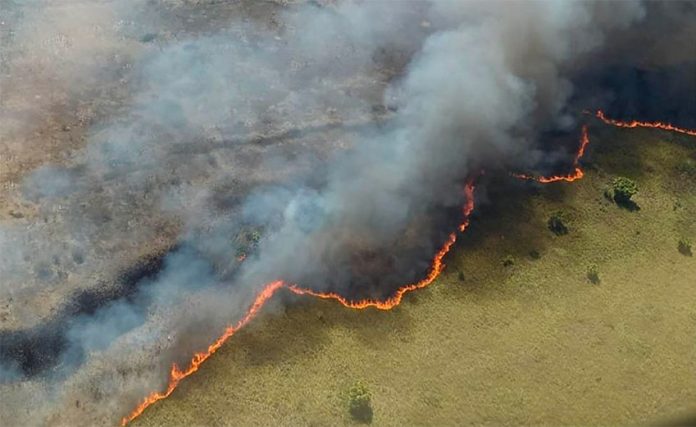
The wildfire advances across the Sian Ka'an Biosphere Reserve.
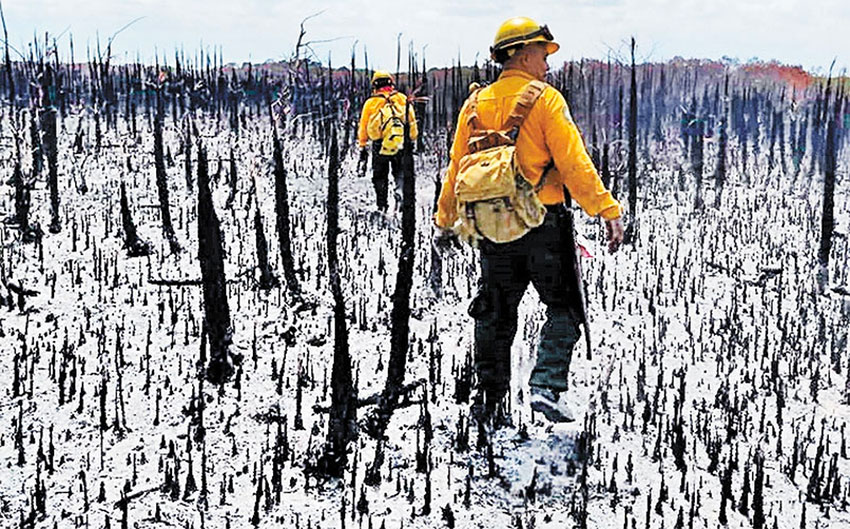
A wildfire that has burned away 2,500 hectares in the Sian Ka’an Biosphere Reserve in Quintana Roo rages on, continuing to threaten hundreds of native plant and animal species that live within the UNESCO World Heritage Site.
Reserve director Omar Ortiz Moreno said a joint team of army and navy personnel with special vehicles and a helicopter, firefighters, volunteers and authorities from the three levels of government have managed to bring 45% of the blaze under control and extinguish 15%.
Gonzalo Merediz Alonso, executive director of the organization Friends of Sian Ka’an, said the wildfire, which was initially discovered by satellite imaging on Sunday by the National Forestry Commission, was started by illegal fires lit by hunters in the forest’s underbrush.
“It is a common practice [in Quintana Roo] for hunters to set fire to the savanna to be able to better spot deer since the grass is very tall. Of course, this time it looks like things got out of control.”
Castillo Carballo, a legal assistant for the National Forestry Commission, said a fire eight years ago burned 3,000 hectares in the same area. He added that in the south and southeastern portions of the biosphere reserve, the flames were going out as they met with denser forest.
Firefighters walk through a burned area of the reserve.
“We hope that it continues doing that, but as a preventative measure we are opening gaps and setting up firewalls, which means that we should have the fire fully under control within a week.”
The flames are fed mainly by grass between 30 and 80 meters high, and sometimes leap as high as 3 to 5 meters, but are extinguished as soon as they make contact with denser forested areas or after all the grass has been burned.
“We must stay focused and prevent the fire from ‘jumping,’ which is why we have opened gaps and set up firewalls so that the flames come up against a barrier.”
State Civil Protection chief Adrián Martínez Ortega said fighting the conflagration has been complicated by especially dry conditions and by federal budget cuts, which have left the National Forestry Commission short-staffed. He said a 50% budget cut forced the commission to let go of several employees, including wildfire experts who had intimate knowledge of the affected area.
Friends of Sian Ka’an’s Merediz said the wildfire will have a direct and negative effect on the reproductive cycles of crocodiles, turtles, snakes, frogs and some birds, and that the burning vegetation will release a significant amount of carbon dioxide into the atmosphere.
“If someone committed a crime, they should be punished for it according to the law, because a reserve like the Sian Ka’an is an important tool for development and we must take steps to prevent this kind of devastation.”
The 528,000-hectare reserve is located in the municipalities of Tulum and Felipe Carrillo Puerto.
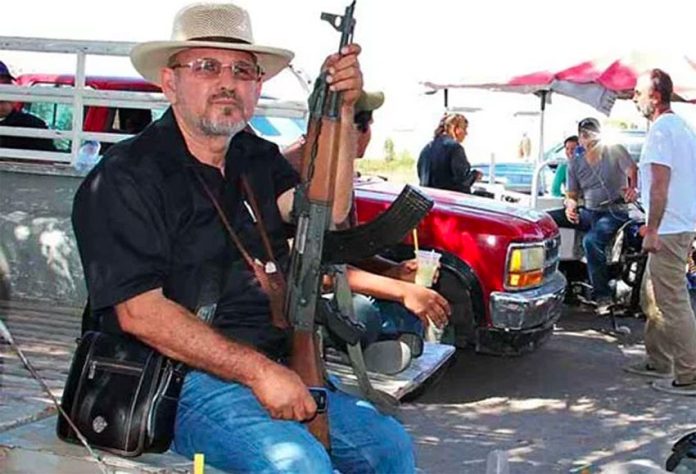
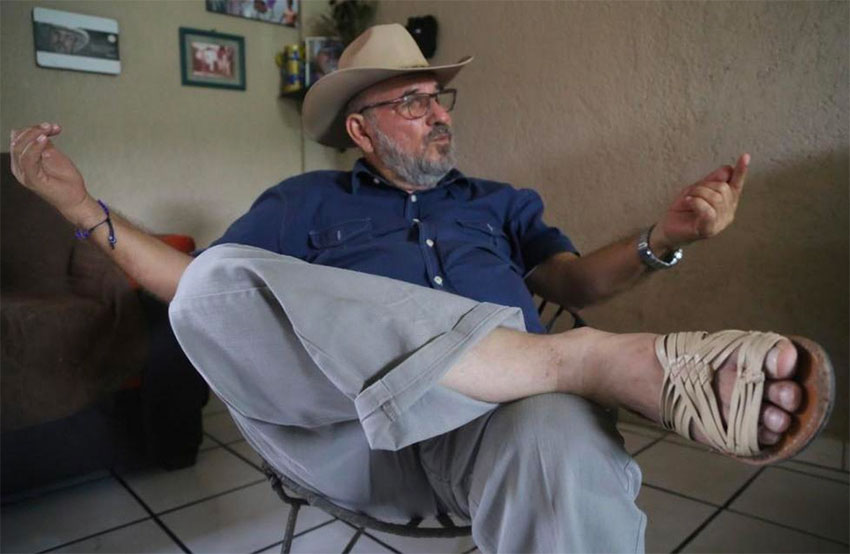
The founder of a self-defense force that took up arms against criminal organizations in Michoacán in 2013 announced yesterday that he was rearming.
Hipólito Mora Chávez wrote in a Facebook post that he would begin carrying a rifle and a pistol because governments have failed to provide security and are only interested in being in power and deceiving the Mexican people.
“Any authority that tries to detain me or disarm me will have to murder me because they won’t take me to jail or disarm me alive,” he wrote.
“When the government provides us with security . . . I’ll gladly lay down my arms . . .” Mora said.
In a radio interview, the former self-defense force leader stressed that he wasn’t joking about his pledge to avoid arrest.
“Nobody will put me in jail, I’ll shoot them if they try to arrest me. It’s a very strong statement that places my life and those of the people who work with me at risk but that’s the way I like to speak . . . without fooling anybody,” Mora said.
“I know that it’s illegal to carry a weapon, I’m aware of that but we’re not going to cross our arms and watch . . . people being murdered,” he said, adding that he travels in an armored vehicle and has several bodyguards.
Mora, who in February 2013 took up arms against the Los Caballeros Templarios cartel and other criminal groups in the Tierra Caliente region of Michoacán, charged in his Facebook post that the security situation is “worse than ever” and that authorities are “once again working with the cartels.”
They allow them to “move freely in the whole country and don’t arrest them,” he wrote.
Mora asked his Facebook friends and followers to share his post so that “it reaches all of Mexico” and people realize that “there are still men willing to die for others.”
The vigilante, whose son was killed in a 2014 confrontation between warring factions of the Fuerza Rural self-defense group that left 11 people dead, said he has a “very big moral commitment” with all the “good people” who died defending their families, adding that it would be “an honor to die for them.”
In an interview with the news website Sin Embargo, Mora further defended his decision to rearm himself.
The security situation ‘is worse than ever,’ Mora says.
“If one sees that the government isn’t doing its job, if one sees that in a large part of the country there are murders, extortion and kidnappings, and the criminals can move freely, well I ask myself: why can’t people who work honestly – as is my case because I have a small lime orchard – carry a gun to defend ourselves?” he said.
“What I’m saying to the authorities is give us the security we deserve. That’s what I’m asking for, I’m not challenging the government, if they take it as a challenge, that’s a matter for them. I know that there might be consequences and I accept them, I’m responsible for my statements and for whatever comes against me. The only thing I want is to deal with this problem,” Mora added.
He also said that state and federal politicians are constantly campaigning rather than working for the well-being of citizens.
“. . . But that’s not what Mexicans want, what we want is for them to provide us with security. The people in the government deny [that there is] insecurity, they’re always saying that everything is getting better but it’s not,” Mora said.
In response to Mora’s declarations, President López Obrador asserted that nobody is above the law.
“I believe that it’s in the interest of everyone to be in a country where there is a real and authentic rule of law. We [the government] are responsible for guaranteeing public security . . .” he said.
“. . . With regard to the opinions of people on this issue, I’m respectful of what they say. Just remember that we all must act with rectitude and adhere to the law.”
Inaugurating the National Guard at a ceremony in Mexico City on June 30, López Obrador acknowledged that his government has not yet made progress in combating the high levels of insecurity but he has expressed confidence that the new security force will be successful.
An average of 94 homicides per day made the first half of the year the most violent on record, and security specialists are not optimistic that things will improve in the final six months of 2019 even with the deployment of the National Guard.
Nearly 400 Central American migrants who lost limbs hopping freight trains in Mexico have received prostheses over the past eight years thanks to a Red Cross program.
Boarding northbound freight trains known collectively and colloquially as “La Bestia” (The Beast) is a common practice among migrants aiming to reach the United States.
Unfortunately, the occurrence of accidents while riding the rails is also quite common.
Guatemalan Luis Estuardo lost his left leg below his knee earlier this year after falling from “La Bestia” in Achotal, Veracruz, and getting caught up in the train’s wheels.
He is now undergoing rehabilitation treatment in Celaya, Guanajuato, and will soon be fitted – at no expense of his own – with a prosthetic leg.
The artificial limb will be funded by a program first started by the International Committee of the Red Cross in Chiapas in 2011.
Since then, 388 migrants have received prosthetic legs, arms and hands, and three years ago the program’s hub was transferred to Guanajuato, where it is supported by the local Red Cross, a migrant shelter in Celaya and the state’s Institute for People with Disabilities (Ingudis).
Alberto Cabezas, a spokesman for the International Red Cross in Mexico, described the program as “important humanitarian work,” explaining that it has also helped migrants who lost limbs due to the violence of criminal gangs.
After migrants leave hospital, they are transported to the Casa ABBA shelter in Celaya, where they stay while undergoing physical and psychological therapy provided by Ingudis. During the same period, the migrants are measured for prostheses.
Leticia Díaz, the program’s rehabilitation coordinator, said that making an artificial limb that fits perfectly and feels like a natural part of a person’s body is a “delicate process.”
She added that migrants who lose limbs go through a lot of suffering and emotional stress in the lead-up to being fitted with a new arm or leg and for that reason a psychologist offers support and helps them plan for a new life.
After receiving their prostheses, some migrants have opted to travel to the northern border to seek asylum in the United States while others have chosen to return to their home countries.
In the latter case, the Red Cross assists with the repatriation process.
United States President Donald Trump’s politics of control and fear toward Mexico and other Latin American countries has resulted in serious consequences.
In an effort to avoid a tariff of 5% that would rise gradually to 25% on all Mexican exports to the United States, Mexico agreed on the following measures to stop so-called illegal migration through its territory:
1) Secure the northern and southern borders with 21,500 soldiers from the newly established National Guard;
2) Strengthen efforts to deter, detain and deport “irregular migrants;”
3) Dismantle human smuggling organizations; and
4) Require those migrants who have already entered the United States to await the adjudication of their asylum claims in Mexico.
The bilateral migration announcement on June 7 corresponded with a field course on migration and human rights we were running in Mexico with undergraduate students from Wilfrid Laurier University.
On the ground, the effects of the U.S.-Mexico agreement were immediate, palpable and harsh.
The three-pronged policy to deter, detain and deport was already in effect under the administration of President Andrés Manuel López Obrador in Mexico, but it was accelerated following the June announcement.
Throughout Mexico, a system of non-governmental shelters provides migrants a place of respite, protection and humanitarian assistance.
We (Stacey Wilson-Forsberg, S. Richelle Monaghan and our students) visited one such shelter in the northern state of Zacatecas. Run by the Catholic Church, the inconspicuous concrete structure is set at the end of a dirt road off a main highway. Fenced in and “protected” by state police, the shelter cares for families with small children.
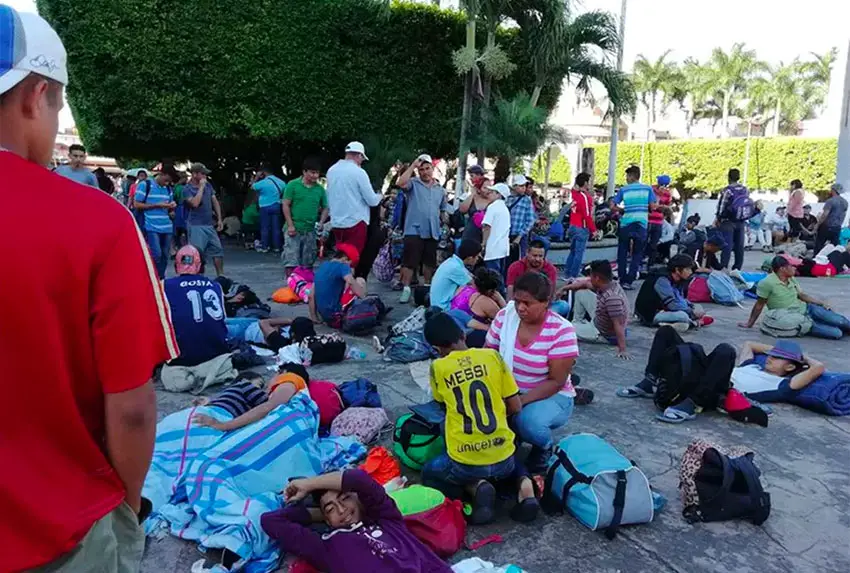
Central Americans camped out in Plaza Hidalgo in the city of Tapachula, Chiapas.
Of the 120 guests present on the afternoon of our visit, more than half were children. Most were barefoot and wore clothing that was either too big or too small.
As children played a game of duck-duck-goose and squealed with delight, the parents told us about their destination. When they all responded that they were “going home,” we realized that the shelter is being used by Mexican migration authorities as a detention center for families awaiting deportation back to Guatemala.
At another shelter, one of the largest in Mexico City, we met families waiting for permanent refugee status or temporary humanitarian visas.
During a friendly game of ping pong, we were approached by a little girl. She nodded at our invitation to play, but stood frozen as the ball bounced off her arms.
I (Stacey) put the ping pong paddle down, knelt to her level and asked if she was sleepy. When she indicated she was not, I hugged her until her body relaxed and her chin rested on my shoulder. I then learned that the little girl had arrived only minutes before with her parents.
After what must have been a long and harrowing journey from Honduras, she was dazed and in shock, possibly afflicted by resignation syndrome.
The ramifications of the migration agreement are most pronounced along Mexico’s southern border with Guatemala, an area known as the frontera sur in the Mexican state of Chiapas.
In the city of Tapachula, Chiapas, shelters are so full that people waiting to receive refugee status have no option but to camp out in the city’s Plaza Hidalgo. Here they wait for weeks or months, completely exposed to the elements as scorching hot, humid days end in torrential evening rains.
As we sat in a nearby restaurant, another little girl asked us for food. We followed her back to the plaza and met her family. Her parents spoke with us while they fanned her baby brother, who slept on the bare concrete.
“Where are you from?” we asked.
“Aren’t you going to ask me where I am from?” responded the pre-schooler.
“Where are you from?” we repeated.
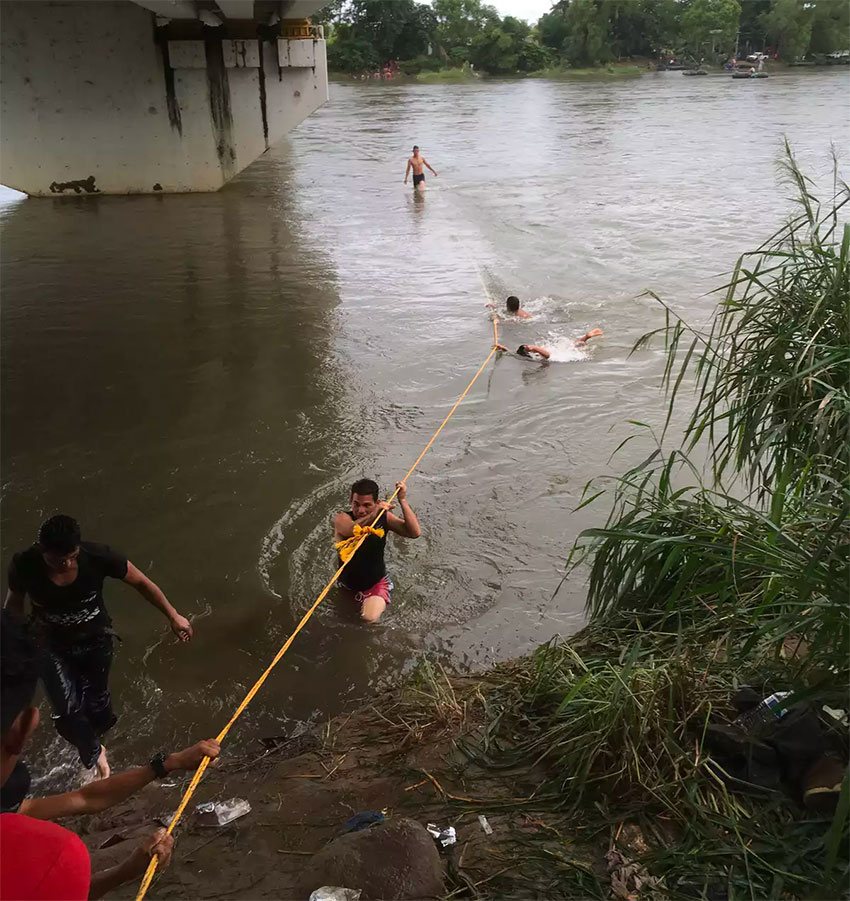
People cross the Suchiate river using a rope.
“Honduras,” she smiled.
In Ciudad Hidalgo, Chiapas, the border town where 98% of irregular border crossings occur, Central Americans await their return trip to Guatemala, El Salvador and Honduras on the shiny white tour bus that leaves the migration facility each afternoon.
Those not from Central America, such as the hundreds of Haitian migrants who are also stranded on the border, will be returned on planes.
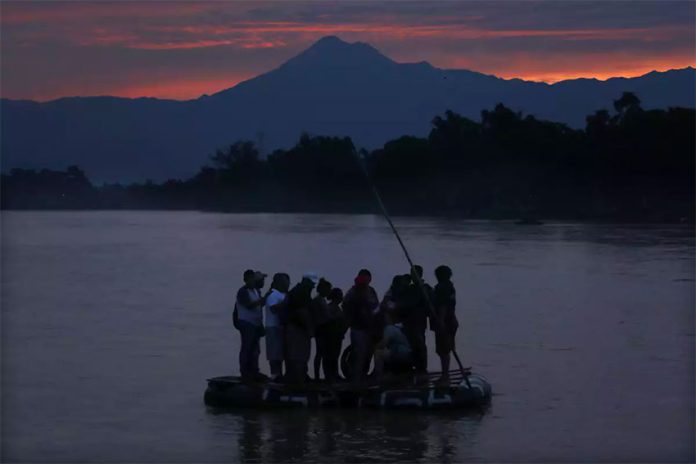
When we arrived on June 29 at the shore of the Suchiate river that divides Mexico from neighbouring Guatemala, state police were present but the National Guard was just arriving.
The daily flurry of black market trade between the two countries continued unchecked as merchandise floated across the river on rafts.
Merchants expressed concern that the soldiers would disrupt the daily exchanges of goods upon which both local economies are dependent. At the southern border, Guatemalans and Mexicans move back and forth over the river with little need to prove their country of citizenship.
The presence of some elements of the National Guard has also compelled migrants to reinvent new routes that are often more dangerous. And rather than being dismantled, networks of human smugglers, known as “coyotes,” appear to have grown even stronger. Several truck trailers have already been reported abandoned with men, women and children inside.
At a secondary border crossing in Talisman, Chiapas, migration officials stopped us as we headed to the port of entry. However, two state police allowed us to walk along the river and underneath the bridge.
On the bridge, official business takes place: passports are stamped, customs duties are collected and people await documentation to enter Mexican territory. Under the bridge, unofficial business takes place.
Here we observed a man being paid by another to take off his clothes and transport goods on his back by wading through the rapids. We also watched a family exit a raft attached to a rope extending to each bank of the river.
The family said “buenos dias” as they passed, exchanged words (and possibly money) with the police officers and entered Mexico.
A long history of U.S. exploitation and oppression portrays Central Americans as undeserving of prosperity, and criminal. Over the past month in Mexico, we were reminded once again that these migrants are not nameless, faceless statistics. They are people.
Nor are they illegal. They are exercising their rights to flee dreadful conditions of deeply entrenched economic insecurity, social exclusion, legacies of war and chronic violence.
The recent migration agreement between the United States and Mexico violates international refugee law and Mexico’s 2011 Refugee Law, which decriminalized migrating through Mexico without documents.
Under the 2011 law, the government provided migrant shelters with exceptional status from Mexico’s migration authorities. They are meant to be sanctuaries, not detention centers.
The 2011 law also gives people entering Mexican territory 30 days to apply for asylum. However, in its haste to placate Trump, Mexico is detaining and deporting asylum seekers before the deadline passes.
We were also reminded during our time in Mexico that migration is complicated and often contradictory. Residents in Tapachula depend on migrants as consumers even as they also resent their presence in the community. Migrant shelters provide much-needed humanitarian assistance, yet they also facilitate irregular migration, hence falling into the American category of “human smuggling operations.”
In the end, it’s likely the United States will continue to threaten Mexico with trade tariffs, and Mexico will respond with more drastic, inhumane measures.
But these measures will not stop the migration. Desperation is, after all, a powerful motivator.
The textbooks will be used by students in Michoacán and Oaxaca.
Critiques of the “neoliberal economic model” implemented in Mexico by past governments and biographies of former Cuban president Fidel Castro and revolutionary hero Che Guevara feature in “alternative” textbooks developed and distributed by the CNTE teachers’ union in Michoacán and Oaxaca.
Víctor Manuel Zavala Hurtado, leader of Section 18 of the CNTE, told reporters that the textbooks were designed to offer “complete” educational programs to students studying at preschools, primary schools and secondary schools.
But the ideological bent is clear.
In the preface to primary and secondary school textbooks distributed in Michoacán, the CNTE says that its education program is a response to the “neoliberal economic model, which seeks to put an end to public schools, denying the right to a free education.”
A sixth-grade social studies textbook asserts that former president Carlos Salinas de Gortari sacrificed Mexico’s sovereignty by implementing neoliberal economic policies, and that inequality in the country is the product of the same model.
A fourth-grade language skills textbook features lyrics of a popular revolutionary song that blames poverty on the greed and mistreatment of employers. Other revolutionary and anti-capitalist texts are found in textbooks designed for several different grades.
Horacio Erik Avilés, Michoacán head of the education advocacy organization Mexicanos Primero, said the textbooks are of “questionable academic quality” and reflect a curriculum that is distant from national and international trends.”
He told the newspaper El Financiero that the books’ content was not subjected to the scrutiny of academic experts and charged that their consequence would be the formulation of an “insular” and “isolationist” character in students who attend schools under CNTE control.
Avilés also claimed that the teachers’ union is aiming to raise revenue by asking for voluntary contributions from the parents of students who receive the books, many of which are photocopied rather than originals.
It’s not just the content of the books that is considered deficient. Newspaper reports pointed out that they are also littered with spelling and grammatical mistakes.
But the union’s Zavala said there were no plans to change the textbooks or discontinue the CNTE’s educational program.
“. . . We have more than 6,000 schools working with our program and we’re going to continue it. The goal of Section 18 is to spread the alternative program to all schools,” he said.
In Oaxaca, Section 22 of the CNTE said that official government-issued textbooks can still be used but it is “not a priority” to do so.
“. . .They’re auxiliary materials, Oaxaca has its own [educational] scheme . . .” the union local said.
President López Obrador issued a decree on July 1 guaranteeing water as a human right and establishing new administrative facilities to grant concessions of water for public use in marginalized communities.
This comes after attempts by the previous two administrations to privatize Mexico’s water supply.
Mexico City Mayor Claudia Sheinbaum has also recently announced plans to expand the availability of water for the city’s residents. Sheinbaum’s promise is that in six years, the length of her mayoral term, every resident will have water every single day.
In April, Sheinbaum created 75 brigades dedicated to finding and repairing leaks in municipal water delivery systems, with plans to expand that number to 150. In addition, 315 new workers have been hired and trained through the water utility, Sacmex, to fix leaks, responding 24 hours a day, 365 days a year.
Across the 16 boroughs of Mexico City, there are 150 leaks reported daily. An estimated 40% of the city’s water is lost to leaks — 88% in household connections, 10% in the secondary network of underground pipes and the remaining 2% in the primary network that brings water to the city from wells and neighboring states.
Fixing the leaks is only part of the solution. Since 2014, the non-profit organization Isla Urbana has been installing rainwater harvesting systems in houses across Mexico City, focusing mainly on the boroughs of Xochimilco, Iztapalapa and Tlahuac, which have some of the worst and longest periods of water scarcity. In these parts of the city, many families previously had no choice but to pay for a pipa (water delivery truck).
Isla Urbana has installed 11,000 household rainwater harvesting systems to date. Sheinbaum plans to offer government assistance to help install 10,000 more in 2019, and hopes to have installed a total of 100,000 by the end of her term.
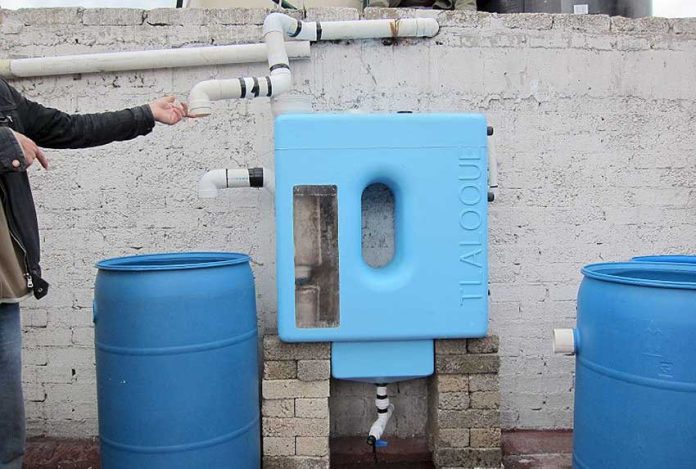
Every single rainwater harvesting system is a custom installation, since no two houses are identical. The system uses a device called a tlaloque (“assistant to Tláloc,” the Aztec god of rain and water) which fills up during the first few minutes of rain. This first water is very dirty as the rain washes all of the dirt off the roof.
Once the tlaloque is full, a ball floats up and blocks it, allowing the rest of the water to flow into a cistern. This reduces up to 75% of the water contamination before any further filtering or chlorine treatment. The water from the tlaloque can still be used for purposes such as watering plants or washing floors or cars. The water that flows into the cistern can be used right away for most household purposes, but must be cleaned further to be safe enough to drink.
Isla Urbana’s systems are designed to be used primarily during the rainy season. They advise lowering household consumption of water by up to 60% during the dry months. On their website, they have calculated the cost of paying for a pipa and show that even with the initial price of installation and the cost of maintenance, families can save a great deal of money by investing in such a system.
Mexico City used to be Tenochtitlán, the capital of the Aztec empire. The city was built around an elaborate system of canals that connected floating islands, or chinampas. During the Spanish conquest and the years that followed, the water was drained from the canals, and people rushed in to build on the dry lake bed.
Today, only a few canals remain in Xochimilco, but Mexico City gets just as much rainwater as ever, more annually than London, England.
This is why Mexico City has issues with flooding every year. By capturing rainwater for use in households, residents of the capital can begin to see the seasonal rains as a blessing, not a curse.
Water comes to Mexico City from two main sources. The first are the Lerma and Cutzamala systems, which bring it from far away. The second are wells drilled throughout the city that tap into the groundwater found in deep aquifers. It takes thousands of years for aquifers to replenish their water supply. As groundwater is extracted, the ground above it sinks.
If Mexico City continues to depend greatly upon these aquifers, subsidence will only get worse and the water will eventually run out. Improvements to the water transportation systems and rainwater harvesting take pressure off these wells.
According to Conagua’s 2018 statistics, 76.3% of households in Mexico do not drink water from the tap. In Mexico City, the distrust in tap water comes from destruction of infrastructure in the 1985 earthquake and a 1991 cholera outbreak. The demand for bottled potable water creates a billion-dollar industry, with 65 billion pesos (US $3.4 billion) spent on drinking water every year.
The current administration’s plans to provide water to citizens do not include a promise that this water will be clean enough to drink. For the foreseeable future, Mexicans will continue to rely on expensive garrafones.
Paramedics may soon be weaving through Mexico City’s notorious stand-still traffic aboard motorcycles, delivering emergency care in as little as 10 minutes.
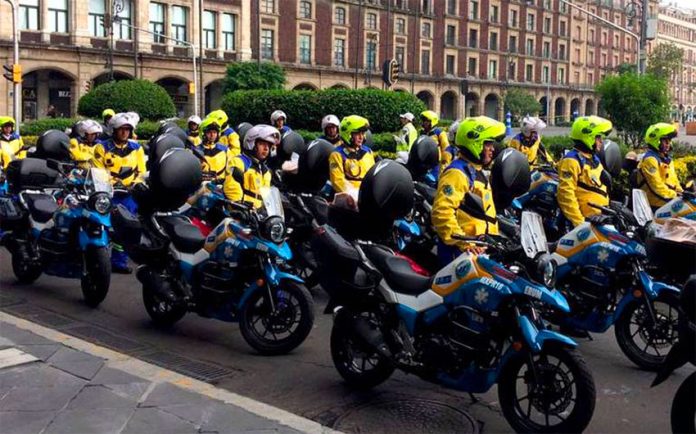
Mexico City Mayor Claudia Sheinbaum told a press conference that the city will invest 20 million pesos (US $1 million) in 73 motorcycle units and 50 traditional ambulances by 2020. Yesterday, she gave the green light for 40 moto-ambulances — 30 for the medical emergencies and rescue team and 10 for the Red Cross — to be assigned to posts in the capital’s 16 boroughs.
The mayor said the city government hired and certified 97 emergency medical technicians trained in essential life support to pilot the motorcycles with the goal of having 35 motorcycle units and 27 regular ambulances available for every emergency shift.
Additionally, the motorcycles will be equipped with a defibrillator, oxygen tanks and other emergency life support tools to stabilize a patient’s condition or give vital pre-hospital care while waiting for a regular ambulance to arrive. According to authorities, moving a patient is not actually necessary in 60% of 911 calls in Mexico City.
The director of the C5 emergency system said that 911 dispatchers will communicate to emergency medical crews whether each emergency warrants a motorcycle technician or a traditional ambulance. Juan Manuel García said the motorcycle crews will reduce saturation in hospitals and deliver life-saving care in a much shorter time.
“If we have enough ambulances and emergency services, much of the time we can treat a patient on site if it is not too serious, and in that way avoid saturating emergency care units in hospitals. The second advantage is that it decreases the emergency response time and saves live. When I got here, the average response time was 45 minutes, but now, thanks to strengthening the dispatchers’ ranks with doctors and regionalization [of emergency responders], we have brought the average response time down to 35 minutes.”
Sheinbaum added that with the new motorcycle units and new hires of additional paramedics and volunteers, she hopes to bring the average emergency response time down to 10 minutes by 2020.
Despite their differences, the former finance secretary described AMLO as the best politician in Mexico today.
Former finance secretary Carlos Urzúa said in an interview he disagreed with the government’s decisions to cancel the new Mexico City airport and to build an oil refinery on the Tabasco coast.
Urzúa also told the news magazine Proceso that he was opposed to the move by the Federal Electricity Commission (CFE) to seek to amend pipeline contracts and confirmed that he was referring to the president’s chief of staff when in his resignation letter he charged that there are “influential people” in the government “with a clear conflict of interest.”
The former secretary said he was in favor of continuing to build the airport at Texcoco, México state, because “the project was very advanced” and cancelling it would cause the loss of significant amounts of money.
Urzúa said that while it was true that a lot of the land around the airport “was controlled by people linked to the previous administration” – President López Obrador has consistently argued that the project was corrupt – “a strong government” could have expropriated it.
The ex-secretary also told Proceso that the plan to build a US $8-billion refinery at Dos Bocas “is not optimal in current conditions.”
He said the government needs to listen to petroleum sector experts, most of whom say the project can’t be completed within a three-year timeframe or for less than $15 billion.
“You can’t persist with an idea when there are companies that know more than you and they say the opposite. The problem of this government is its headstrong nature . . . Another of my differences [with the government] has to do with the Pemex business plan,” Urzúa said.
“I believe that the plan could be very good and could clean up the situation at the company in three years [but] it will only be possible if we avoid projects like the refinery and apply ourselves intensively to the exploration and production of crude.”
Urzúa, described by one analyst as the “adult in the room” in the López Obrador administration, said the decision by CFE chief Manuel Bartlett to seek arbitration to annul clauses in the contract for the Texas-Tuxpan gas pipeline was the final straw that led him to resign.
He said the problem with not respecting the contract is that TC Energy (formerly TransCanada) will sue the CFE and while the legal battle is ongoing the pipeline won’t be put into operation and ratification of the new North American free trade agreement could be threatened.
While the pipeline is out of action, the state-owned utility won’t be able to satisfy one-third of natural gas demand, he added, describing the scenario as “playing with fire and the well-being of millions of Mexicans who live on the Yucatán peninsula.”
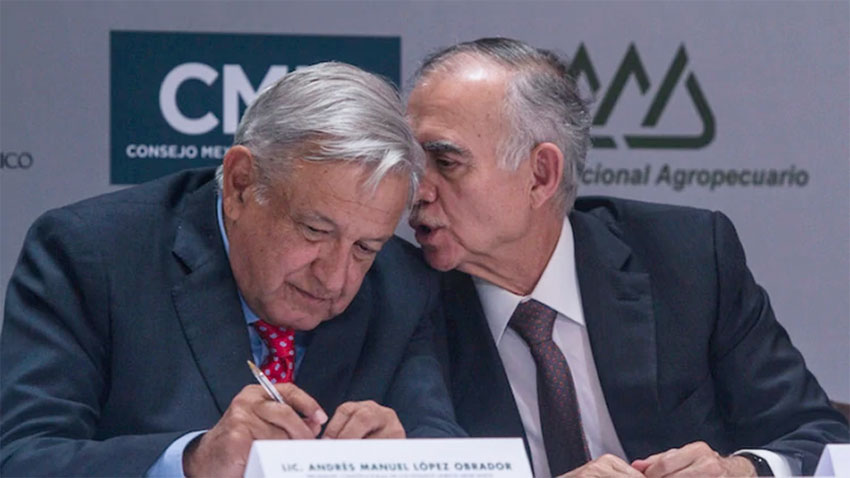
Alfonso Romo, right, has a conflict of interest, Urzúa charged.
Mérida and Cancún have both suffered blackouts this year due to a lack of natural gas to generate energy.
“A senior official and I went to tell the president a few days ago that what the CFE is doing is not for the benefit of Mexico,” Urzúa said. “We signed a contract and we must comply with it.”
The 64-year-old economist described presidential chief of staff Alfonso Romo, a wealthy business tycoon, as “the main conflict of interest” in the government.
Given that the president’s office manages confidential economic information on a daily basis, Romo and his immediate family members shouldn’t maintain any shares traded on the Mexican Stock Exchange, Urzúa charged.
He also said the chief of staff’s ideological and social beliefs are incongruent with those of the president.
“Ideologically, Romo is a man of the extreme right and in social terms he ranges between Opus Dei and the Legion of Christ. How did a man like that, who came to admire [former Chilean president] Augusto Pinochet and [Legion of Christ founder] Marcial Maciel, end up not just being a friend of López Obrador but the head of the president’s office?” Urzúa wondered.
He said Romo was responsible for appointing the heads of the Federal Tax administration and Mexico’s state-owned development bank, Bancomext.
Urzúa was critical of the government’s decision to allocate large amounts of funding to projects such as the Santa Lucía airport, the Maya Train and the Isthmus of Tehuantepec trade corridor before they have even started.
He also said that budget cuts, especially those made since March, have been too excessive and could cause problems in various government departments.
Despite his differences with the government’s agenda, Urzúa said he always got on well with the president.
“. . . I’m convinced that he is by far the best living politician . . . in Mexico today. Seeing him [in action] is very impressive, he has extraordinary social intelligence,” he said.
Urzúa said he believed that López Obrador shared his vision of developing Mexico along the lines of a Scandinavian social democracy but questioned how deep the president’s leftist credentials ran.
“I’ve never been a leftist from head to toe and deep down I don’t think he [López Obrador] is either. I don’t think that he takes Marxism seriously,” he said.
“The fact that he was fiscally conservative and at the same time placed great emphasis on social programs concerned me. The balance concerns me. It’s not easy to have budgetary balance and a lot of social programs at the same time,” Urzúa added.
“The big important difference between us [is that] the president doesn’t want to implement a fiscal reform. I do because I believe it’s the only way to reduce inequality. I don’t know why he doesn’t want to do it, maybe so as not to confront some business people, maybe because of the electoral cost . . .”
Seguro Popular's replacement will work with schools to train more doctors.
President López Obrador says Mexico needs 123,000 more doctors to cover the country’s needs.
“There are 270,600 general practitioners in the country, and according to international norms, we should have 393,600 doctors,” he said during a visit to a rural hospital in Michoacán on Saturday. “That means we’re 123,000 doctors short.”
According to the Organization for Economic Co-operation and Development (OECD), a country should have one doctor for every 333 residents. Based on a 2017 World Bank estimate, Mexico has only one doctor for every 477 people.
The president added that the shortage of doctors is related to low admission rates at universities for medicine programs.
“That’s why there’s a shortage,” he said. “We need more general practitioners, we need more specialists.”
He said 13,000 people applied for admission to the faculty of medicine at the National Autonomous University, but only 216 were accepted. The most popular career choice among prospective students is that of a surgeon. In February, López Obrador said, there were 11,198 applicants for 140 places.
He said the new National Institute of Health for Well-Being will work with universities to train more doctors.
The institute, which has not yet been approved by Congress, will operate with a budget of 80 billion pesos (US $4.2 billion) and replace the Seguro Popular, offering medical services to people who are not covered by social security.