Home Blog Page 1988

Calling a jaguar proved unsuccessful but it was a good adventure

0
The bramador, caller of jaguars.

Martha Armanta is the founder and president of Conrehabit, a Mexican conservation organization which provides wildlife rescue services as well as community outreach programs in the rural areas of southern Sinaloa, Mexico. Part 1 of this series can be found here.

I had been working with Martha for about a year when one day she announced a trip to the village of the bramador to test the potential for ecotourism.

I bombarded Martha with questions about the nature of the mission, where we would stay, how many people would come — and what is a bramador? With a smile and a palpable sense of enthusiasm she said, “El bramador is a master jaguar caller and he will try to call in a cat for us.” Bramador means “roarer” or “one who roars,” in this case a jaguar caller.

She went on to elaborate about how this place is not on any tourist itinerary and that the people were ready to share some of their natural treasures with the outside world. This looked to be an excellent cultural encounter with people very lightly touched by modern society.

This outing would be a test of the viability of ecotourism in areas where jaguars are being hunted because of livestock predation or “sport” shooting. If villagers perceived that the jaguar could be worth more alive than dead, it would be a first step in slowing the pervasive process of wildlife depredation along with habitat destruction.
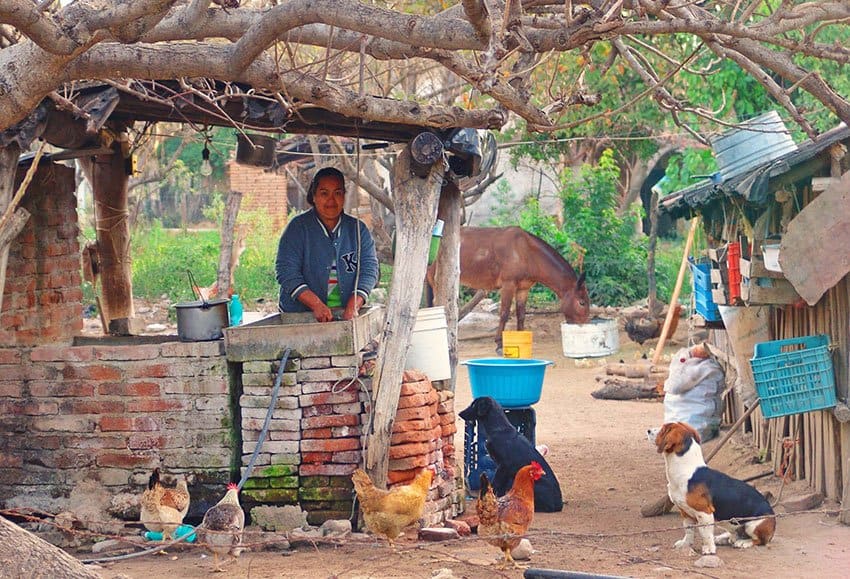
A kitchen in the village.

So our theory was that if eight gringos between the ages of 55 and 65 survived the culture shock of a trip with no restaurants, no hotels, no pavement, no telephones, no internet, no toilet seats and best of all, “no way out” until the next day, it just might work.

After arrangements had been put in place and enough brave souls had been located, Martha and I left town as a caravan of three vehicles with 10 people — along with my half wild dog Snickers — and headed into the lower reaches of the western Sierra Madre.

We arrived in the village about sunset and were greeted by a group of a dozen men and boys dressed in their Sunday best. The village jefe, Don Panchito, directed us to the home of the bramador where our vehicles disgorged their passengers.

The nine foreigners milled about and met the locals, while Martha helped to translate the many questions and corresponding answers that spilled forth from both sides of the language barrier. The minute that Snickers emerged from my truck she was surrounded by a dozen village dogs and all hackles were raised.

The attending canines went through the body language requirements, seemed to accept each other, and Snickers drifted off with them into the background menagerie of chickens, horses, mules and a few burros.

The talk turned towards the jaguars and the coming attempt to call one to within hearing distance. The plan was to head into the forest around 9:00pm, get four to five kilometers out and then let the bramador roar.
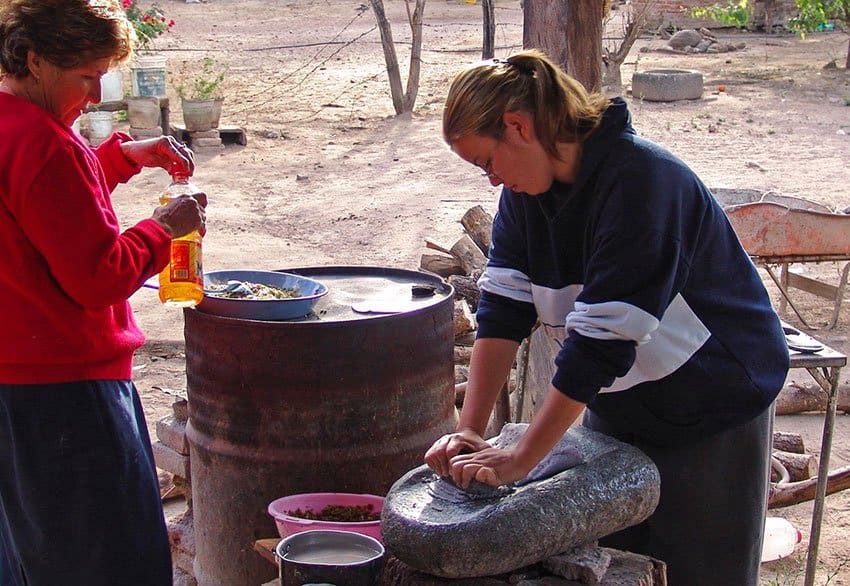
Making tortillas for breakfast.

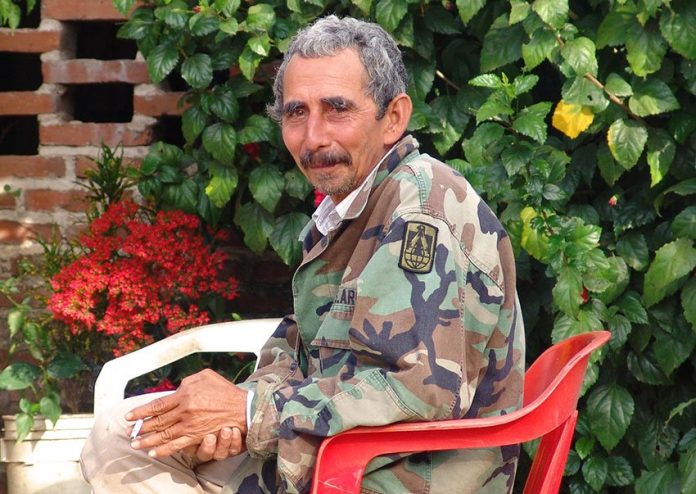
Don German was a man of medium height, slight build and somewhere around 60 years old, though it was hard to tell. The device he employs to imitate the low roar of the jaguar is a polished gourd less than a meter in length, with a hole in each end, one large and one small.

Up until now, this device was used primarily for the purpose of bagging a big spotted cat; this encounter could possibility be the first steps in a transformation of how rural Mexico perceives the natural world.

For our evening meal we ate standard village victuals and truly enjoyed every item served, especially the blue corn tortillas and the gordita cakes. We had watched the blue corn paste processed by hand in an ancient stone metate with a matching mano.

The dough was then patted into a tortilla and placed on the polished lid of a 55-gallon drum with a wood fire nestled in its blackened innards. Most of the villagers there cooked their food on the lid of a drum or on a grill supported by loosely laid bricks.

Even though all the adventurers had been told to bring some type of bedding and sleeping pads, only about half of them did so. This was my first experience in escorting gringos on such a trek, and I didn’t foresee this development.

It was clear that at least some guests would have a tough time without help from our new friends so we explained that some guests had nothing to sleep on. Of course, the villagers put their heads together to find a solution.
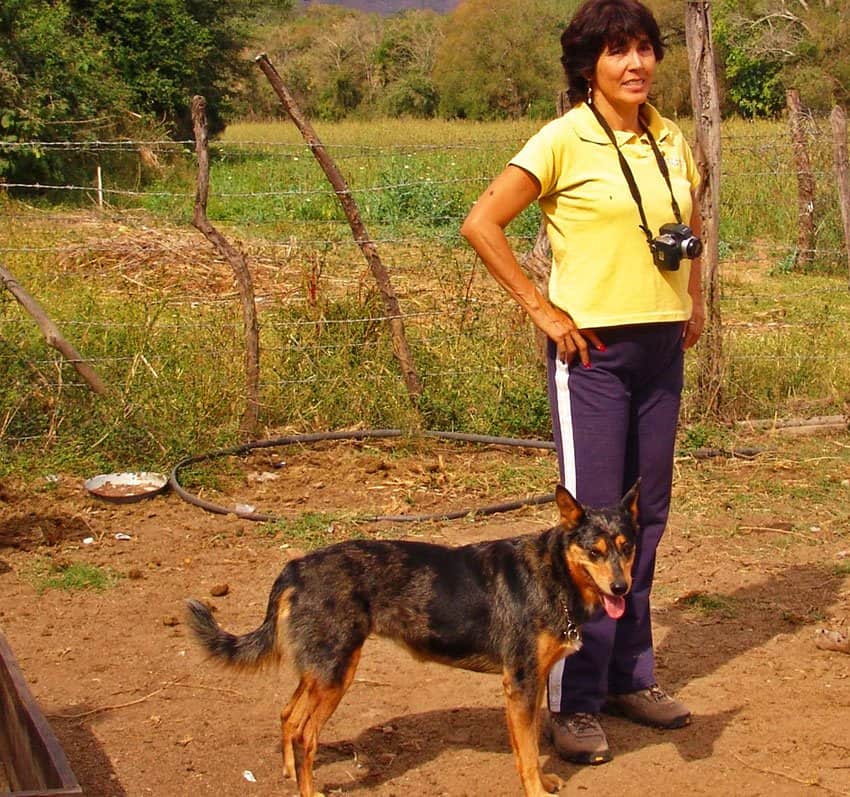
Martha and Snickers.

So we moved to plan B — some homes had extra beds available. Most of our group would enjoy a peaceful and comfortable night ensconced in village beds, while three of us ended up on the ground in a dilapidated structure with twinkling views up to the stars through roof holes.

Now it was time to sit around the campfire and listen to the bramador take a couple of practice runs on his gourd. I was expecting a deep cat-like roar to emanate from the dried vegetable shell, but it sounded much more like a cough than a roar; a low guttural burst of air.

After lubricating his throat with a long pull from a jug of cheap tequila, the next rendition of the cat’s cough sounded much more primal; a timeless echo resounding across the ancient flanks of the Sierra Madre.

Then it was time to take a ride into the forest in search of the elusive cat. Since I had the only large four-wheel-drive vehicle within miles, my truck became the tour bus. Our group numbered 10 people and a dog. In addition, it seemed that the number of locals required to guide this expedition was no less than six.

Fortunately the truck had a lumber rack with a mesh floor in the section over the cab, which was quickly commandeered by two campesinos with a 100,000-candlepower search light. As I plugged their heavy corded device into my cigarette lighter, I was beginning to think our expedition more resembled a redneck buck hunt than a stealthy insertion into jaguar territory.

Those in the back of the truck were standing in the bed, using the upper rails of the rack as necessary handholds. They were armed only with a few cameras, and the steely determination not to get pitched out on our short drive. After one look at the humanity packed into the confines of my truck, along with my suspicion that the roads would be in a high state of disrepair, I knew it would be a notable adventure for all.
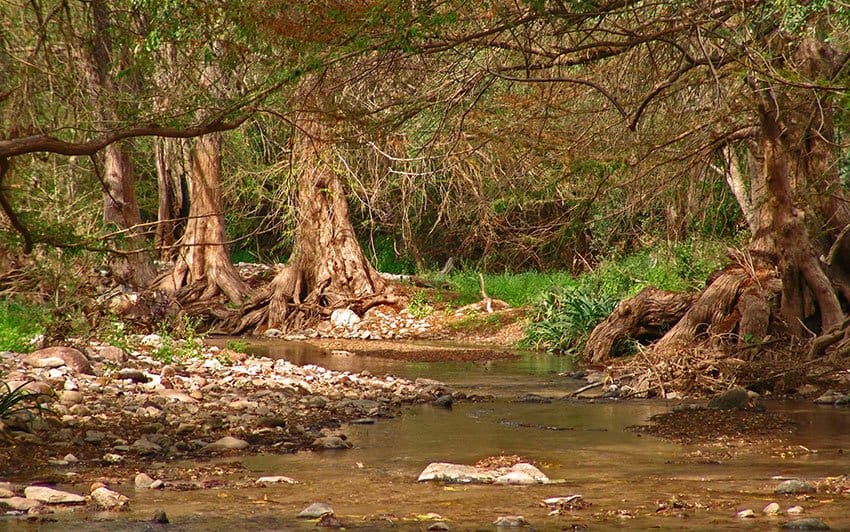
A creek in jaguar country.

The bramador was sharing the back seat with two women, the half wild dog and his by now somewhat depleted jug of tequila. After some time the road plunged into an old stream bed and then followed the dry water course, which morphed between a faint road to ruts and rocks. In time, conditions deteriorated into four-wheel-drive and low-range crawl as we left the creek bed and headed up a 20% grade.

As the search light panned the huge trees towering around us, dozens of large bromeliads could be seen clinging to outstretched branches of the old-growth cypress. The low hanging vines and occasional branches added a real organic element for those in the open-air section of the conveyance, including Martha.

Knowing her fears, several times I wondered if I should caution her about the potential for various types of slithery reptiles falling from the low hanging canopy. However, I figured if it actually happened, the event would be vastly more entertaining without the forewarning.

We came to a place where the road (the term road here is very generous) became a narrow shelf with a drop on the passenger side and a steep bank on the other.

In the middle of this side hill traverse, the ledge took a turn to the right with a washed out hole close to where one rear tire would track the turn. I made the turn high on the bank and thought the truck was in the clear.

But the back end suddenly dropped. In that split second of uncertainty, the search light wobbled and a collective gasp arose from all passengers, including myself and probably the dog. After a quick application of throttle, the truck popped back up on the ledge; but we were all awake now.

When we reached a point where it was no longer possible to distinguish exactly where to aim our tour bus, I was told to stop “because farther on the road is bad.”

We all climbed out of the truck, some with weaker knees than others, but we were all struck by the absolute stillness, the stark clarity of the night sky and how agreeably dark it was without the search light on.

The bramador wandered a few meters up a hillside and prepared for his one-act show, complete with gourd, and the now nearly empty tequila jug. He imitated the call of both the male and female jaguar with an amazing amount of dignity and aplomb, particularly considering the amount of spirits he had consumed.

I don’t think any of us actually expected the reward of a return call, especially after we had arrived in the area with all the aural subtlety of a steam-powered UFO. However, the bramador continued his show for some time. All the outsiders enjoyed it and were enthusiastic until he declared that even his brilliant efforts were unproductive against our pandemonium.

We returned to the village and wandered off to our predetermined sleeping places. That night, those of us in the dilapidated dwelling were serenaded for two hours by numerous village dogs attempting to drive several stray burros from the bramador’s yard.

Shortly after the cacophony of dogs and burros died off in the distance, 10 or more roosters decided it was dawn. They were only three hours early.

After packing up, we thanked our indigenous hosts for their gracious hospitality and reluctantly headed back to modern Mexico. My time spent visiting this area over the ensuing years has given me a deep admiration for the people who live the hard and lean life experienced by most of the rural communities.These people have very little, but what they do have, they are more than willing to share with trusted strangers.

(We began our ecotours in 2009 and are continuing to bring small groups into this remote area. Two years ago, the Mexican government granted protected reserve status to 17,000 acres held by this small community.)

The writer describes himself as a very middle-aged man who lives full-time in Mazatlán with a captured tourist woman and the ghost of a half wild dog. He can be reached at buscardero@yahoo.com.

New administration concedes presence of organized crime in CDMX

0
Attorney General Godoy: yes, there is organized crime.

Mexico City’s new government has conceded that organized crime groups operate in the capital, a claim that the previous administration had rejected.

Attorney General Ernestina Godoy made the admission yesterday during a press conference.

“Is there organized crime here in the capital?” a reporter asked. “Yes, there is,” Godoy responded unequivocally.

She added that the government is continuing to analyze the security situation and will soon provide more information.

Although former mayor Miguel Ángel Mancera denied that organized crime had a presence in Mexico City, there is evidence to suggest otherwise.

In September, hitmen believed to be members of La Unión de Tepito, a criminal gang based in the notoriously dangerous neighborhood of Tepito, killed four people and wounded six more in Plaza Garibaldi, a square popular with tourists known as the capital’s home of mariachi music.

The gang is allegedly supported by the Jalisco New Generation Cartel, considered Mexico’s most powerful and dangerous criminal organization.

In July last year, narco-blockades made an unprecedented appearance in Mexico City after the suspected boss of the Tláhuac Cartel, Felipe de Jesús Pérez Luna, was killed in a confrontation with marines.

Godoy said that the new government is concerned about the current security situation, especially the high number of homicides committed with firearms.

In just two days since Mayor Claudia Sheinbaum was sworn in Wednesday, 16 murders have been reported in the capital.

They occurred in several boroughs including Gustavo A. Madero, where eight people were killed Wednesday and yesterday, including three in one incident of gun violence and two in another.

On Wednesday, a presumed criminal was gunned down in the Benito Juárez borough, a Canadian man was killed in a shopping center parking lot in the business district of Santa Fe and a man was beaten to death near the Merced market on the fringe of the historic center.

Sheinbaum told a press conference yesterday that the security situation was serious, explaining that at the beginning of the past government in 2012 there were an average of two homicides per day but that figure doubled to four in the third quarter of 2018.

Francisco Rivas, director of the civil society organization the National Citizens’ Observatory, told the newspaper Milenio that “Mexico City is living through the worst moment of violence in its history.”

In the last 21 years, he said, “there has been a substantial increase in intentional homicides.”

City authorities are also confronted with the task of combatting high levels of other crimes such as violent robberies, whose incidence is at a six-year high, and retail drug trafficking known as narcomenudeo.

A 2017 report by the city’s Public Security Secretariat (SSP) and the Attorney General’s office identified 20,000 places where drugs were being sold.

Source: El Financiero (sp), Milenio (sp) 

Departments issue conflicting messages over Santa Lucía airport

0
Artist's conception of Santa Lucía airport.

Inter-departmental communication problems in the new federal administration led to confusion yesterday after contradicting statements were issued regarding the future of Mexico City’s airport facilities.

Tourism Secretary Miguel Torruco Marqués told a press conference early yesterday that the Santa Lucía Air Force base would become the terminal for international flights while the existing Mexico City airport would be home to domestic flights.

The result would be “a great metropolitan airport project,” Torruco declared.

But later in the day, the Communications and Transportation Secretariat said there had been some confusion and confirmed that the airports at Santa Lucía, Toluca and Mexico City would all handle both international and domestic flights.

The three facilities are to take the place of the new Mexico City airport, whose construction was cancelled by the new government.

Under the Torruco plan, international passengers arriving in Santa Lucía would have to travel 46 kilometers to making a connecting flight in Mexico City. When a reporter with the newspaper Reforma put the proposal to the test, it took 53 minutes to travel in a taxi from Santa Lucía to the Mexico City airport in light traffic.

The trip cost 457 pesos (US $23), including taxi fare and tolls.

Source: Reforma (sp)

AMLO announces more funding for Tourism Secretariat

0
AMLO at his morning press conference.

Fears in the tourism sector over a reduced marketing budget might have been assuaged somewhat by President López Obrador this morning.

He told his daily press conference that the Tourism Secretariat will be one of the departments that will see an increase in their budgets for next year.

Tourism Secretary Miguel Torruco announced yesterday that the Tourism Promotion Council (CPTM) would be shut down and that its annual budget of approximately 6 billion pesos (US $295 million) will be invested in the construction of the Maya Train.

López Obrador said funds allocated to the CPTM have been managed without transparency.

Source: Milenio (sp)

Senator proposes castration for rapists

0
Senator Armenta announces his castration proposal.

A senator with the governing Morena party is preparing a proposal that would punish rapists with chemical castration.

Alejandro Armenta Mier told a press conference that Mexico is in first place globally for cases of sexual abuse, physical violence and homicide committed against minors last year, adding that a total of 4.5 million Mexicans are rape victims.

In the state of Puebla alone, he continued, there are 800 recorded cases of femicides, 70% of which are also rape cases.

“. . . the Morena parliamentary group is in favor of combating violence against women and children. The purpose of this initiative is to castrate those who rape them,” said the senator from Puebla.

“. . . it is time to put a definitive stop” to this crime, Armenta said.

“I am a father, I have daughters, I have a wife; we have got to take drastic measures.”

The senator said he recognized the initiative might be controversial but he would seek a consensus with lawmakers from other parties as well as human rights organizations to determine what route to take to come up with more severe penalties in order to reduce the crimes in question.

Source: El Financiero (sp)

Finance Secretariat moves against people, businesses linked to Jalisco cartel

0
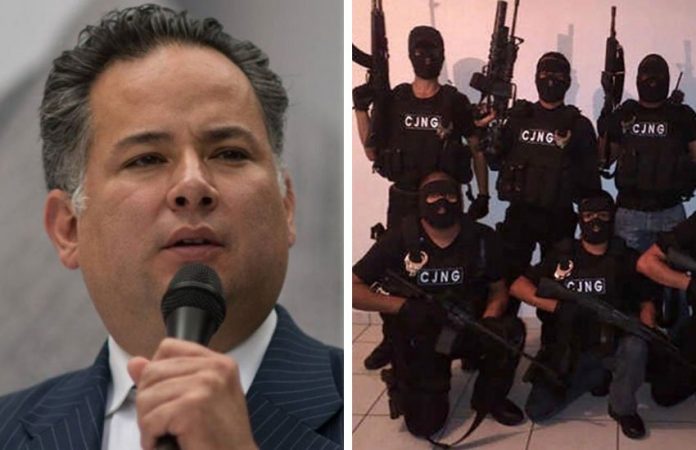
Nieto, left, is going after the Jalisco cartel.

In its first week in office, the new federal government has taken aim at the finances of the Jalisco New Generation Cartel (CJNG), considered Mexico’s most powerful and dangerous criminal organization.

Santiago Nieto, the new head of the Financial Intelligence Unit (UIF), a division of the Secretariat of Finance (SHCP), told the news agency Reuters yesterday that he had filed a criminal complaint against three businesses and seven people with links to the cartel.

The SHCP said in a statement Wednesday that it had filed its first money laundering complaint with the federal Attorney General’s office (PGR) “against members of organized crime” but didn’t identify which organization they belonged to.

“The administration of President . . . López Obrador has reiterated that combatting the financial structures of organized crime is a priority and this action is a firm step towards the pacification and wellbeing of the nation,” the statement said.

The complaint, the SHCP said, would allow “the commencement of legal investigations” against those it identified.

Nieto, who served as the top electoral crimes prosecutor in the past government before being dismissed in October 2017, said he was able to quickly file the complaints against the CJNG associates because they already appear on the United States Treasury’s Office of Foreign Assets Control (OFAC) black list of drug traffickers.

The early move against the CJNG marks the beginning of a new effort by the government to shed Mexico’s reputation for being weak on action against cartel finances.

“I am convinced the best way to prevent criminal behavior is by sending a message that these types of acts that violate trust and social norms will be punished,” Nieto said.

He explained that the new government wanted to send an early message that it would focus on taking legal action against criminal organizations “and especially seek to impose penalties.”

Although authorities have captured cartel kingpins such as Joaquín “El Chapo” Guzmán – currently on trial in New York – the war on drugs, launched by former president Felipe Calderón 12 years ago, still rages on.

A power vacuum created by Guzmán’s arrest as well as cartel splintering have triggered vicious turf wars which contributed to last year’s homicide figures being the highest in at least two decades.

As violence surged, massive quantities of illicit drugs continued to cross the border into the United States and in recent years, the CJNG significantly increased its power and extended its reach, gaining significant notoriety in 2015 when its members shot down a military helicopter in southern Jalisco. It wasn’t until this year that authorities arrested those allegedly responsible for the attack.

Among the highest profile crimes the cartel is alleged to have committed in 2018 are the torture and murder of three students in Guadalajara, an attack on state Labor Secretary Luis Carlos Nájera, also in the Jalisco state capital, and the disappearance of three Italian men in Tecalitlán.

In October, the United States government doubled the reward being offered for suspected CJNG leader Nemesio “El Mencho” Oseguera Cervantes to US $10 million while Mexico has offered a 30-million-peso (US $1.5-million) reward for information leading to his arrest.

Oseguera’s wife, Rosalinda González Valencia, allegedly the administrator of the economic and legal resources of the CJNG, was arrested in May but freed on a bail of almost 1.6 million pesos (US $82,000 at the time) in September.

Statistics show that between September 2017 and the end of June this year, the PGR didn’t obtain a single successful conviction against a CJNG member while the previous year only seven Jalisco cartel members received jail sentences.

While the federal government and the United States Drug Enforcement Administration consider the cartel Mexico’s most powerful, those statistics provide evidence that it is also the safest from prosecution.

In addition, the Financial Action Task Force (FATF), an intergovernmental organization that sets worldwide standards for combating illicit finance, criticized Mexico at the beginning of this year for systematically failing to bring money launderers to justice.

A FATF report cited data from the Financial Intelligence Unit that showed that already low prosecution levels were declining further.

Nieto said the rate had continued to decline this year, a situation he described as “alarming” in a separate interview with the newspaper El Financiero.

“In particular, it’s serious that the PGR hasn’t carried out actions to follow up on these complaints in order to prosecute the cases before judges and bring those responsible before Mexican courts,” he said.

The anti-money laundering chief said the new government would focus on filing more criminal complaints, freezing more bank accounts and seizing more assets from criminals.

Nieto also said that the López Obrador-led administration would prioritize combatting pipeline petroleum theft, a crime that new security secretary Alfonso Durazo singled out as a key contributing factor to the high levels of violence.

The government is expected to announce an anti-fuel theft strategy next week.

Source: Reuters (en), El Financiero (sp) 

The mortar makers of San Lucas: 600 years of experience makes all the difference

0
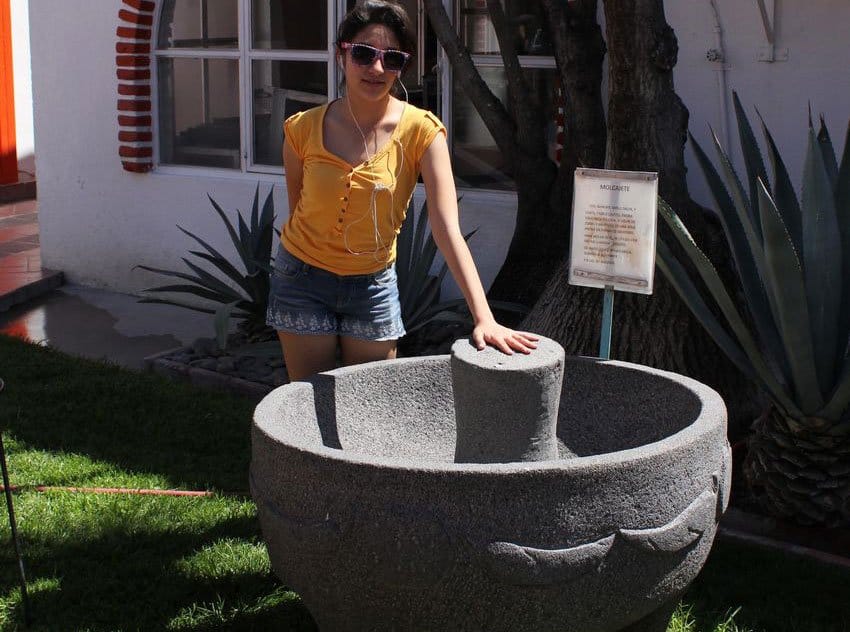
Giant mortar in San Lucas is now a fountain
Giant mortar in San Lucas is now a fountain. V. Cocula

A molcajete is a round mortar made of volcanic rock, used for mashing chile peppers, tomatoes and other ingredients for making salsas. You’ll find them in every market in Mexico and also in every museum, proving that they have been around for a very long time and are still useful.

When I asked people in Guadalajara where molcajetes are made, I either got a blank stare or was told, “They come from San Lucas.”

This is what brought me to a quiet plaza in the little town of San Lucas Evangelista, located on the shore of Lake Cajititlán, about 20 kilometers south of Guadalajara.

Seeing no signs related to mortar making, we walked up to a house at random and knocked on the door. When we told the lady of the house we were interested in molcajetes, a bright smile lit her face and she immediately ushered us inside. Here we met her son, Victor Cocula, who told us he was one of some 300 local people who follow the longstanding tradition of transforming hard basalt rock into practical appliances as well as works of art.

In fact, we could see such items in every corner of Cocula’s living room: sculpted busts, commemorative plaques and clever water filters along with the traditional mortars. “My ancestors have been making things like these for a very long time,” Cocula told me. “In fact, only recently a neighbor dug up a metate in the local cemetery which amazed all the craftsmen of the village. It appears to be some 600 years old, decorated with the head of a dog.

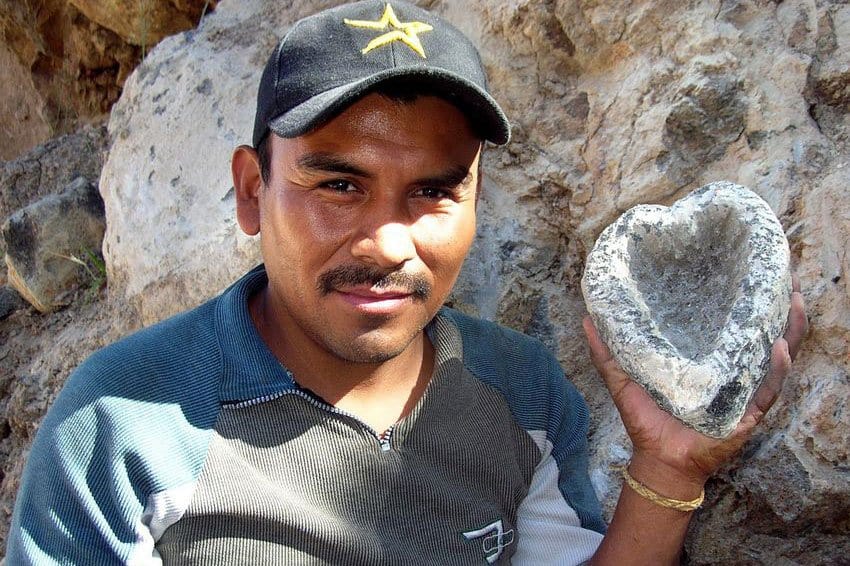
Victor Cocula with heart-shaped molcajete.

“The quality of workmanship is extraordinary. There are no tell-tale chisel marks on it anywhere — in fact, it’s so smooth it appears to have been machined. We can’t explain how it was done, but it’s proof positive that sculptors have been at work here for a long, long time.”

By now, of course, I was dying to observe the process by which these items had been made and I immediately accepted Victor Cocula’s offer to take me to the nearby basalt mines where the rock is extracted.

It turned out the mines — quarries really — were only a half-hour’s walk from the village. We climbed down into a long, deep manmade gully which seemed to go on forever. The steep walls on either side consist of basalt boulders undermined by decades of digging, and are anything but stable. “Over the years,” said Victor’s father, “we’ve lost five people to rock falls in these mines. Two of them died quite recently.”

We arrived at the family’s favorite spot along the trench and while his father deftly turned out a dozen “manos” (pestles), Victor walked me through the process of converting a rock into a sculpture.

“We are fortunate people here,” he told me as he tapped several rocks with a short hand pick. “If we need 100 pesos for something, we just walk up the hill to the mine and look for a rock that could be turned into a molcajete.”

He went over to a bowling-ball sized rock embedded in the wall of the trench, knocked the dirt off one spot and tapped the rock with the pointy end of his pick, producing small pits in the surface. “This rock is fine-grained but not too hard. See? All the holes are very tiny. Besides that, it has no sand embedded in it. The last thing people want is to find grains of sand in their salsa.”

Large molcajete on display at Zacatecas restaurant.
Bruce

He lifted the rock and, like a true Mexican Michelangelo, said: “I see a molcajete inside. I could turn this into a five-inch-diameter round one or a heart-shaped one. Now, the round one would bring me 70 pesos while the heart shape will be worth 150 pesos, so I’ll go for the latter. OK, it looks like there’s enough rock here to put three legs on this mortar, but first I have to check if there are any natural faults.”

A few swift blows revealed just such a fault and the craftsman removed a one-inch layer, leaving the rock flat on the bottom. “Oops, not enough room for legs anymore, but it’ll still make a fine piece. Now I have to see if this rock has “hilo.”

This, he explained, means that the rock will fracture in the direction the sculptor intends, rather than “doing its own thing.”

Qué bueno,” said Victor. “It has hilo,” and he deftly used the flat end of his pick to quickly give the rock the external shape he wanted. Then he turned the pick around and used the pointed end to begin hollowing it out. “These blows must be neither too heavy nor too light,” he commented as tiny chips flew everywhere.

“Don’t you ever get a piece in your eye?” I asked, noting that neither he nor his father was wearing goggles. “Ha! All the time,” he said laughing.

Sí, sí,” chimed in his father, “chips in the eye siempre!”

[soliloquy id="66899"]

In spite of the danger and grit, the Coculas truly love their trade. “Some years ago,” Victor told me, “my family got together and decided we would try to create the world’s largest molcajete. We made one weighing 800 kilos and it was promptly bought up by a famous restaurant in Zacatecas.

[wpgmza id=”119″]

“After that, we located a huge boulder of high-quality basalt and started work on an even bigger one. It took years, but last May we finally finished it. It’s 90 centimeters tall with a diameter of 1.90 meters and it weighs 3.3 tons. You can see it in the plaza of San Lucas, when you come to visit.”

Whether the Coculas’ mortar is the world’s biggest I will leave to the folks at Guinness to decide, but I can say that San Lucas is well worth a visit. The plaza may appear quiet and sleepy, but in almost every back yard, chips of basalt are flying.

The writer has lived near Guadalajara, Jalisco, for more than 30 years and is the author of A Guide to West Mexico’s Guachimontones and Surrounding Area and co-author of Outdoors in Western Mexico. More of his writing can be found on his website.

New security chief identifies six states that are insecurity hot spots

0
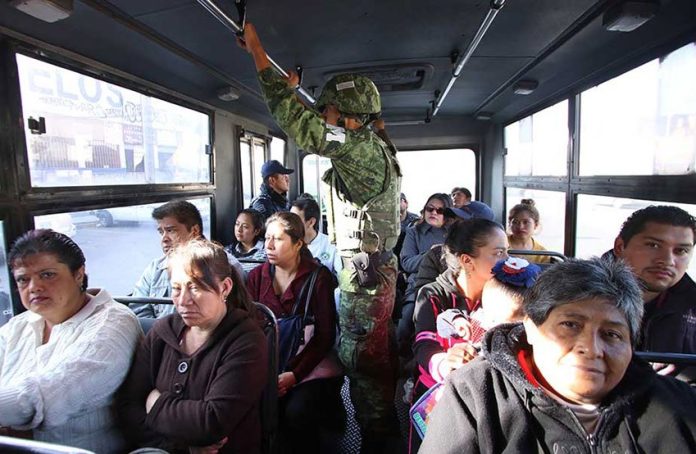
A member of the new National Guard on patrol on Puebla city public transit.

Mexico’s new security secretary has identified six states as insecurity hot spots: Puebla, Nuevo León, Jalisco, Guanajuato, Veracruz and Tamaulipas.

“There are focal points of violence that have been sustained over time, they already have a long history [of violence] and, of course, we’re going to face up to them. The conditions in which we have received the country isn’t a secret to anyone,” Alfonso Durazo told reporters yesterday.

“A range of indicators place us, unfortunately, among the most insecure countries in the world and that speaks to the challenge that all of us who participate in the realm of public security in the country face,” he added.

Durazo said that there is a range of factors contributing to the violence in the states identified as insecurity hot spots, although he singled out petroleum theft as a particular problem.

He said the new government will present an anti-fuel theft strategy next week “so that citizens know the way in which we are going to confront this challenge.”

Of the six states cited by the new secretary, only Guanajuato is among the top 10 most violent in 2018 in terms of its homicide rate, ranking fifth.

On Tuesday this week, there were at least 17 homicides in the state, most of which are believed to be related to fuel theft.

Durazo said that a de facto national guard – whose creation was proposed by the new government as a central element of its national security plan – started operations on December 1.

“We already have almost 50,000 elements spread out permanently in 150 regions of the country: 30,000 or 35,000 military police, around 8,000 navy police or a little less and the rest are Federal Police . . .” he said.

Durazo explained that the federal forces are deployed in every state in the country but the number of regions covered by a security unit had to be reduced to 150 from the 265 regions that had been drawn up because of limitations in the number of elements the government has at its disposal.

Units operating in states with coastlines are under the control of a naval commander while the army is in charge of those deployed to inland states, he added.

Durazo also said that security “personnel who are assigned to the national guard will retain the [same] income, seniority and rights” as they had in the force they originally belonged to, adding that “we will gradually improve the socioeconomic position of all of them through combatting corruption and the savings we can generate with the austerity program.”

The government’s proposal to create the new security force was criticized by a range of non-government organizations who argued that it would perpetuate the failed militarized crime-fighting strategy that was first implemented by former president Felipe Calderón in 2006.

More than 200,000 people have been murdered in the 12 years since the so-called war on drugs began and armed forces have been accused of a range of human rights violations including extrajudicial killings, enforced disappearances and torture.

Human Rights Watch called the government’s security strategy a “colossal mistake” and “potentially disastrous.”

Interior Secretary Olga Sánchez Cordero said yesterday that President López Obrador would wait to see what Congress and state legislatures say about the national guard plan before moving ahead with its formal creation.

Prior to taking office, the new president said the proposal would be put to a public consultation set tentatively for March.

The security challenges inherited by the new government are enormous.

With more than 31,000 homicides, 2017 was the most violent year in at least two decades and record-breaking levels of murders have continued this year.

López Obrador, who took office Saturday, is addressing the security situation in daily press conferences held at 7:00am at the National Palace.

Earlier this week, he said the government will have an “information system” in place by next week that “allows us to know how many homicides are committed in the country every day” in order to take specific actions in specific places.

“It’s incredible how such a serious problem, as the regrettable problem of insecurity and violence is, wasn’t monitored daily . . . That, I think, is a reflection of the problem . . . Imagine a government which has no exact up-to-date information.”

Source: Milenio (sp), El Economista (sp)  

Gulf Cartel’s Nuevo León plaza chief arrested in Mérida

0
Gulf Cartel boss El Chelelo during his arrest in Mérida.
Gulf Cartel boss El Chelelo during his arrest this week.

The suspected leader of the Nuevo León cell of the Gulf Cartel was arrested this week in Mérida, Yucatán, after committing a traffic violation.

Eleazar “El Chelelo” Medina Rojas, 46, was taken into custody by agents of the federal Public Security Secretariat. There is an outstanding warrant for his arrest in Nuevo León and he is also wanted by the United States Drug Enforcement Administration.

Following his apprehension, state police increased surveillance in various points in Yucatán in preparation for any violent reaction that might follow the cartel leader’s arrest.

Medina has been in custody before. He was arrested in 2007 and served an eight-year prison term. Upon his release in 2015 he returned to work for the Zetas cartel. He was arrested again in early 2016 but was released soon after.

Source: El Universal (sp), Milenio (sp)

Mexico City replaces speeding fines with non-monetary sanctions

0
Photo radar in Mexico City: get caught speeding and lose points rather than pay a fine.
Photo radar in Mexico City: speeding drivers will lose points rather than pay a fine.

As of today drivers caught speeding by traffic enforcement cameras in Mexico City will no longer have to pay a fine. However, they won’t be getting off scot-free.

The photo radar speeding tickets known as fotomultas will be replaced with other non-monetary sanctions designed to deter lead-foots from putting the pedal to the metal.

The new Mexico City government, which took office yesterday, has introduced a points system for all vehicles registered in the capital.

Each license plate will initially be assigned 10 points but if a driver is caught speeding or committing another traffic offense, he or she will lose one point.

A notification by mail will alert drivers to an offense and they will also receive a copy of a 10-point good driver’s guide launched yesterday by the new mayor, Claudia Sheinbaum.

Among the points: don’t speed, don’t drink and drive, don’t text and drive, don’t run red lights and don’t double park.

A driver can lose up to two points without any sanction.

However, if another offense is detected by cameras and a third point is lost, the driver will be required to complete a basic road rules course on line. Lose a fourth point and the online course increases in difficulty to the intermediate level.

Sanctioned drivers who fail to complete the course will not be granted appointments to have their vehicles verified as roadworthy and compliant with emissions standards at mandatory twice-yearly inspections.

If a fifth point is lost, drivers will have to attend a road rules course in person. For each additional point lost, they will have to complete two hours of community service.

That means that drivers caught speeding 10 times will have to complete 10 hours of unpaid work. But their pockets won’t be any lighter.

Failure to comply with the sanctions imposed will again lead to drivers being unable to have their vehicles verified.

Once a vehicle has been verified by city authorities, the 10 points corresponding to the license plate will be restored.

The new sanctions were detailed in a decree published today in the Mexico City government’s official gazette.

The elimination of traffic enforcement camera fines follows a declaration from Mayor Sheinbaum yesterday that “the abuse of . . . excessive charges for fotomultas, property tax and water, among other expenses, has ended.”

Source: El Financiero (sp)