The accused men are the former head of Pemex’s material assets department, Oziel Aldana Portugal, and Ramón Márquez Ledezma and José Carlos Sánchez Echavarría, both of whom worked in security roles.
Judge Rogelio León Díaz Villarreal set a period of four months for authorities to prepare their case against the accused, who will remain in preventative custody in México state as they await trial. The three men were arrested last weekend.
Sources with knowledge of the case told the newspaper Reforma that the organized crime unit of the federal Attorney General’s Office (FGR) has already gathered large quantities of evidence linking the accused to the perforation of illegal taps on fuel pipelines and to criminal gangs.
Among the evidence are testimonies from three former Pemex security agents submitted to the FGR by lawyer Jorge García Adriano in March 2017. The declarations implicated at least 20 Pemex officials in fuel theft.
The newspaper Milenio reported earlier this year that the testimonies were apparently not taken into account by law enforcement authorities until the new federal government began its crackdown on fuel theft shortly after taking office last December.
General Trauwitz, who was allegedly the mastermind of the internal fuel theft racket, was granted a definitive suspension order last week against his arrest for any crime that doesn’t warrant preventative custody.
On May 31, the former Pemex security chief failed to attend a court hearing at which he was to be formally accused. Trauwitz’s lawyer said he didn’t appear in court due to an unspecified health problem.
Catholic bishops are critical of the deal between Mexico and the United States under which Mexico has agreed to step up enforcement against undocumented migrants.
The Mexican Episcopal Conference (CEM), the highest authority of the Catholic Church in Mexico, said the planned deployment of 6,000 members of the National Guard to the southern border would amount to turning Mexico into a border wall.
“If as Mexicans, we’ve rejected the construction of a border wall, we can’t turn ourselves into that wall,” the statement read.
The bishops also questioned whether stricter enforcement can really solve the migration issue.
“Sending 6,000 members of the National Guard to the southern border doesn’t address the true root causes of the phenomenon of migration,” they said. “It seems that the goal of fighting poverty and inequality in Mexico and Central America has been substituted with fear of the other, of our brothers and sisters.”
The church urged Mexico and the United States to reconsider their migration policies, and promised to continue to provide humanitarian aid to migrants in Mexico.
“We remain firm in our commitment to give migrants the humanitarian aid they need as they travel through our territory,” they said. “We express our respect and recognition of the thousands of men and women from the Catholic Church, from other churches and from civil society who have, for decades, risked their lives to defend the fundamental rights of migrants in Mexico, the United States and Central America.”
Under the deal, which was signed last Friday by representatives of the U.S. and Mexican governments, Mexico will crack down on migration on its southern border, and will allow people seeking asylum in the United States to remain in Mexico while their claims are being processed.
In exchange, U.S. President Donald Trump withdrew a threat to impose a 5% tariff on all Mexican imports.
An audacious suspected hitman and extortionist entered a police station yesterday to inquire about his girlfriend’s drug arrest. He did not leave of his own accord.
Authorities announced that a top suspect in last year’s deadly attack in Mexico City’s popular Plaza Garibaldi was taken into custody in the city’s northwestern borough of Azcapotzalco.
Police said José Mauricio “El Tomate (The Tomato)” Hernández Gasca, a suspected hitman with the Unión de Tepito gang, was detained when he went to check on his girlfriend, who had been arrested several hours earlier for selling cocaine on the street.
Police did not initially recognize Hernández, who had grown facial hair and lost weight since security cameras captured his face during the Garibaldi attack on September 14. But a fellow gang member in custody did and offered to identify him to police in exchange for his freedom.
Police promptly took the 25-year-old into custody and turned him over to the Attorney General’s Office.
Authorities believe that Hernández and Víctor Hugo Ramírez, the 23-year-old leader of the Tepito gang who was arrested in March, led last September’s so-called “mariachi massacre” in Plaza Garibaldi, a square in downtown Mexico City famous for its musicians.
Three men dressed in mariachi costumes opened fire on a bar located in a corner of the square, killing six people and wounding seven others, before fleeing on motorcycles.
Authorities say the attack was an unsuccessful attempt on the life of Sergio Flores Concha, leader of the Fuerza Anti-Unión, a rival gang to the Unión de Tepito.
The bloody rivalry between the two, both of which boast alliances with major drug cartels in Mexico, has been as as the cause of a surge in violent crime in the capital in recent months.
Authorities revealed that they expect Hernández’s trial to be an easy conviction and a victory for law enforcement owing to a large body of evidence and eyewitnesses of the Garibaldi attack.
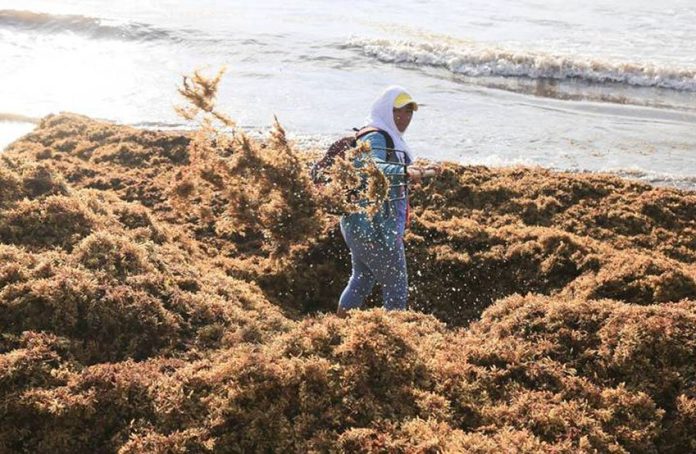
A worker removes seaweed from a Quintana Roo beach.
The government of Quintana Roo has declared a state of emergency in order to access funds to deal with the large amounts of sargassum that are washing up on the state’s beaches.
The state described the situation as an “imminent natural disaster.”
“The arrival and decomposition of large quantities of sargassum should be addressed with a double perspective, of guaranteeing the protection and use of the natural environment, and consequently, guaranteeing the normal development of human health,” reads the decree.
The state of emergency makes it possible for federal funds to be directed toward gathering and disposing of sargassum in Quintana Roo, where eight state agencies are working together to craft a plan to address the problem.
The declaration applies to the municipalities of Lázaro Cárdenas, Isla Mujeres, Benito Juárez, Puerto Morelos, Cozumel, Solidaridad, Tulum, Felipe Carrillo Puerto, Bacalar and Othón P. Blanco.
Governor Carlos Joaquín González said the state hopes to receive 600 million pesos (US $31 million) to fund the emergency actions. He said the funds could come from local, state and federal governments, as well as the World Bank and the Inter-American Development Bank. Any revenue generated by the commercialization of the macroalgae will be used to offset the cost of the program.
Over the past few months, hundreds of cubic meters of the seaweed have been washing up on beaches in the Mexican Caribbean, causing huge losses for tourism companies and damaging coastal ecosystems.
In addition, a study by UNAM scientist Rosa Elisa Rodríguez Martínez found that some sargassum contains high levels of arsenic and heavy metals. That could complicate ideas to reuse collected sargassum as livestock feed, compost or even as an ingredient in food for human consumption.
However, the environment secretary cautioned that there’s not enough evidence to conclude that all or most sargassum washed up on beaches contains dangerous levels of contaminants.
“From what I understand, in a preliminary analysis, some heavy metals were detected, but that’s not enough to say it’s a constant,” Alfredo Arellano told Milenio. “To make an affirmation about the presence of heavy metals, we would need many more samples, from different areas.”
Right to asylum is a principle that has been planted within Mexico's foreign policy, President López Obrador said today.
The right to asylum is “sacred,” President López Obrador said today as his government moves to implement stronger measures to reduce migration flows to the northern border.
Speaking at his morning press conference, the president said that previous federal governments – even “conservative, retrograde” ones – always respected that right, declaring that “it’s already been planted within Mexico’s foreign policy.”
As part of a deal to stave off tariffs threatened by United States President Donald Trump, Mexico last week undertook to increase security measures to curb irregular migration, a commitment which includes the deployment of 6,000 National Guard troops to the southern border.
Even before that commitment, human rights and migrant advocacy groups warned that the government’s increasingly militarized approach to combating people’s transit through Mexico posed a threat to migrants’ rights.
But the president pledged today that migrants in Mexico will be both respected and protected.
“The right to asylum that we have to guarantee is a sacred right for all Mexicans and in these times in which we are attending to the migration issue, we are always going to treat migrants with respect and give them protection . . .” López Obrador said.
“I’ve said it [before] and I repeat it, in this situation we’re going through now, we’re going to be very respectful of the government of the United States, of President Donald Trump and more than anything of the American people, but at the same time we’re going to respect migrants’ human rights,” he added.
“How is that balance going to be maintained? Well, that has to do with the noble function of politics, sometimes it’s scorned [but] it’s possible to avoid confrontation, that’s why politics was invented, to avoid confrontation, to avoid war.”
In an unusually short press conference by the president’s standards, López Obrador said the government’s “complete” plan to curb migration will be presented tomorrow.
A woman covers up against high temperatures in Hermosillo.
Local authorities in the city of Hermosillo, Sonora, are taking emergency measures in the face of some of the worst heat the city has ever experienced.
Temperatures of 48 C made Tuesday the hottest June 11 on record in the Sonora capital, exceeding the 45 degrees recorded on June 11, 1993.
On both Monday and Tuesday, the 48-degree temperature also won Hermosillo the distinction of being the hottest city on the planet, beating out desert cities in the Middle East.
In response, Hermosillo authorities have opened seven emergency shelters to protect homeless people from the potentially deadly heat.
The shelters will remain open during the day throughout the summer.
One Hermosillo official said the temperature could rise above 50 C in the next few days.
Civil Protection director Santa Aguilar Castillo said that starting at 1:00pm every day, the agency will search for people in the streets and take them to the shelters. Anyone who doesn’t wish to go will be offered fresh water and electrolytes.
Authorities also cancelled classes in three Hermosillo schools that are located in rural areas because of concerns about the heat. The Sonora Health Secretariat is asking residents to take precautions, including remaining hydrated, avoiding exposure to the sun and using sunscreen.
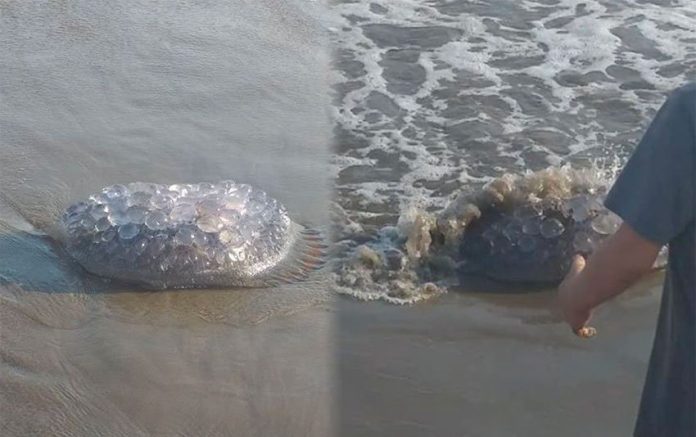
Visitors to Maviri beach in Sinaloa captured these images of the stinging jellyfish.
A beach in Sinaloa has been closed after hundreds of visitors were stung by jellyfish both in the water and on the beach.
State Civil Protection chief Francisco Vega Meza said that closing Maviri beach in Topolobambo bay was necessary to protect visitors because the creatures are usually not visible.
Yellow and red flags have been placed near where the jellyfish have been seen.
Because jellyfish prefer warm water with high salinity and usually live 30 to 60 kilometers from the coast, the slightly cooler temperatures and lower salinity near the coast create a natural barrier.
But this year, less rain than usual has meant warmer, saltier coastal waters and a more welcoming environment for jellyfish near the beaches. Authorities hope that the start of the rainy season will reduce the salinity and drive the jellyfish away from shore.
Between June 8 and 11, almost 500 people were treated for painful jellyfish stings, mostly on their legs.
The beach will remain closed at least until Monday, when authorities will reevaluate the situation and decide whether to allow visitors to return.
Vega said that stings can be treated by washing the affected area with sea water and using cold compresses. Anesthetic cream with lidocaine can be used to control the pain.
If a victim experiences cramping, muscle spasms or fever after being stung by a jellyfish, medical attention should be sought immediately.
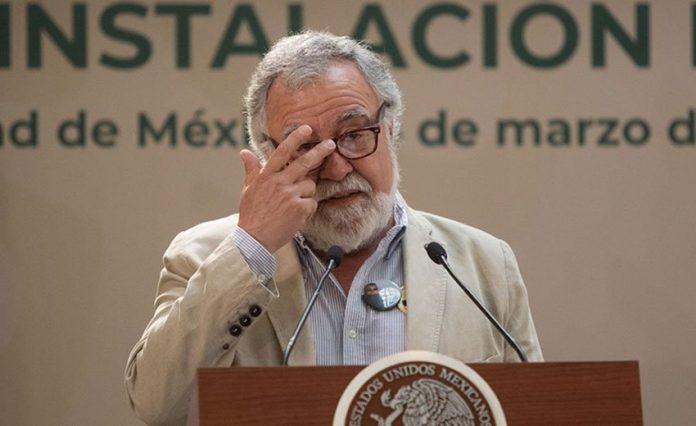
Alejandro Encinas predicts a nearly fivefold increase in migrants returned by US.
A senior government official has predicted that the United States will return as many as 50,000 asylum seekers to Mexico in the coming months, a figure that would represent a nearly fivefold increase on the number of migrants already returned under the Trump administration’s “Remain in Mexico” policy.
With the number of migrants seeking asylum in Mexico also on the rise, Alejandro Encinas, undersecretary for human rights, migration and population, said yesterday that the government will have to quickly strengthen its capacity to attend to the “refugees.”
As part of a bilateral deal reached last Friday that ended United States President Donald Trump’s threat of a 5% tariff on Mexican goods, Mexico committed to send 6,000 members of the National Guard to the southern border to deter the entry of undocumented migrants and agreed to allow the return of all migrants seeking asylum in the U.S. as they await the outcome of their claims.
In a joint declaration issued on June 7, the two countries said that “those crossing the U.S. southern border to seek asylum will be rapidly returned to Mexico” and “Mexico will authorize the entrance of all of those individuals for humanitarian reasons.”
The statement also said that Mexico will offer returning migrants “jobs, health care and education according to its principles.”
The expanded implementation of the Migrant Protection Protocols, as the “Remain in Mexico” policy is officially called, will stretch government resources, especially in northern border cities where there are already large numbers of migrants.
A Mexican immigration official said last week that nearly 10,400 asylum-seekers have already been returned to Mexico as their cases are processed in United States immigration courts, while many more migrants are still waiting in border cities for an opportunity to file claims with U.S. authorities.
The director of a migrant shelter in Reynosa, Tamaulipas, this week condemned the new migration pact, stating that already overwhelmed shelters will be unable to cope with the increased number of arrivals from the U.S.
The number of migrants crossing the northern border into the United States has increased significantly in recent months, fueling Trump’s anger as he attempted to pressure Mexico to do more to reduce migration flows.
The United Nations Refugee Agency (UNHCR) said yesterday that 593,507 migrants have arrived at the southern U.S. border from Mexico this year, and that asylum applications in Mexico have increased 196%.
The agency called for “an urgent meeting of states in the region to map out coordinated action to address this growing displacement challenge effectively and sustainably, in ways that prioritize protection of lives and well-managed borders.”
An immigration official said over 10,000 asylum-seekers have already been returned.
UNHCR Mexico official Joseph Herrero told the newspaper Milenio that more than 27,000 Central Americans have filed asylum claims this year and that 30% of those are minors.
More than 1,000 children are currently housed in the country’s 53 migration detention centers, according to the National Immigration Institute, some of which are severely overcrowded.
Interior Secretary Olga Sánchez Cordero said yesterday that there is an “emergency situation” in Mexico with regard to migration, citing statistics from the United States Customs and Border Protection that show that more than 144,000 people were arrested after illegally crossing the northern border last month.
The measures to curb migration that Mexico has agreed to adopt respond to that situation, she said.
“We’re going to have a special Mexican model,” Sánchez said, adding that it will comply with the United Nations Global Compact for Safe, Orderly and Regular Migration.
“We’re going to sponsor work visas for migrants and we’re going to give attention to their human rights,” she said.
President López Obrador said yesterday that the sale of the presidential plane will help to fund the attention given to migrants – and efforts to curb their entry into, and travel through, the country.
After predicting that the number of people seeking asylum in Mexico will reach 80,000 before the end of the year, undersecretary Encinas also said that migrants’ rights will be protected.
“We will have to strengthen . . . our commitment with regard to migration and attention to refugees because we’re not going to renounce what has been one of the clear, historical characteristics of Mexican policy – to guarantee [the right to] asylum, refuge and dignified treatment for those people who come to our country to seek a different opportunity in life.”
At least five marine species are at risk due to overfishing in Mexican waters, a non-governmental organization has warned.
After conducting an audit of the fishing industry in Mexico, the ocean conservation organization Oceana said that red snapper, grouper, bluefin tuna, sharks and octopus are all endangered due to overexploitation.
The NGO said the failure to update the National Fishing Charter (CNP), a document that details which species are at risk, has allowed the endangered species to continue to be caught in large quantities when their fishing should have been restricted.
The National Fisheries Institute (Inapesca) has updated the CNP only six times since the year 2000 when it should have been updated annually, Oceana said.
The charter sets regulations for 735 different marine species in 83 different fisheries, of which fishing in 66 – or 80% of the total – is currently subject to restrictions.
However, Oceana said that overfishing in those fisheries continues to occur.
Esteban García-Peña, the organization’s Mexico director, said that in addition to Inapesca’s shortcomings, the National Aquaculture and Fisheries Commission (Conapesca) has granted permits for the fishing of grouper, bluefin tuna and red snapper during the closed season for those species.
Oceana said it is the responsibility of Inapesca to notify Conapesca about the overexploitation but noted there is a lack of communication and collaboration between the two agencies.
Another factor contributing to overfishing is the significant increase in the number of fishing boats.
Between 2011 and 2018, statistics show, 2,670 new vessels began operations even as fish stocks were in decline.
The Secretariat of Agriculture (Sader) said in a statement this week that it had detected irregularities in the granting of new fishing permits by Conapesca in the years before the new government took office last December.
Between 2007 and 2018 – a period encompassing the terms of the last two federal governments – the number of fishing licenses granted increased exponentially when they should have been restricted.
Sader said that “presumed acts of corruption” in Conapesca have been referred to the relevant authorities.
Around 295,000 people are directly engaged in fishing in Mexico and the sector generates revenue in excess of 38 billion pesos (US $2 billion) a year.
But Oceana warned that the livelihoods of those employed in the industry are threatened by the “scant availability of species to fish.”
The NGO said it is crucial for the government to implement “strategies and actions for the protection and restoration” of overexploited fisheries.
Oceana director García-Peña contended that “fishing blindly, as we say is occurring in the fishing sector in this country, puts food security at stake.”
A federal court yesterday issued a new provisional suspension order against the new Santa Lucía airport that also instructs federal authorities not to make any changes to the site of the abandoned Mexico City airport project.
The court order came in response to injunction requests filed by the #NoMásDerroches (No More Waste) collective, made up of civil society organizations, law firms and more than 100 citizens.
The Mexico City-based administrative court ordered construction at the Santa Lucía project to stop until the federal government proves that it has all necessary air safety permits.
The government has already been served with federal court orders instructing it to cease construction until it proves that it has all necessary environmental permits to build the US $4.1-billion airport.
The directive to leave the abandoned Texcoco airport intact came just one day after the project chief of an ecological park planned for the site said the foundations of the X-shaped terminal and part of a runway will be left under water as the result of the restoration of a drained lake.
The #NoMásDerroches collective has filed 147 separate injunction requests that could hold up or threaten construction of the new airport at the Santa Lucía Air Force Base in México state.