Monday, March 2, 2026
Home Blog Page 1994

An interview with Ilse Hable, Guadalajara’s popular plein air painter

0
The artist painting at a spot overlooking Guachimontones archaeological ruins.

The most recent works of Austrian-born artist Ilse Hable are currently on display at the Jalisco Chamber of Commerce in Guadalajara.

The exhibit of 27 oil paintings is entitled ¡Aguas! which may appear to mean “waters” in Spanish, but is also an expression used to grab someone’s attention: “Watch out!”

In this case, our attention is called to the latest works of one of Guadalajara’s great artists.

“What is it that attracted you to Mexico?” I asked the painter.

“Mexico was my first great adventure when I was a young person,” she told me. “I had landed a well-paid job as a fashion designer in the capital and stayed there for 10 years. During that time I got to know quite a bit of the country and fell in love with it. Now, more than 35 years later, and dedicating myself to painting fine art, I still love Mexico and visit it frequently.

“There are so many things I appreciate here, I have a hard time deciding how to start: I have found Mexicans to be very friendly and caring. They appreciate any effort made by foreigners to learn their language; they are happy to invite you into their home, share their food with you and show you their culture. And what culture!

“As a painter I appreciate beauty. Mexico is a huge country and I don’t pretend to know it all, but I have spent time painting inland and near the Pacific and Caribbean coasts and the landscapes are gorgeous. Volcanoes, lakes, ochre hills and agaves, tropical vegetation, beautiful oceans, colorfully dressed locals, a feast for the eye of an artist! I have made many paintings in Mexico and have also had a number of exhibitions here.”

“What’s your favorite place in Mexico?” I asked Ilse.

“My favorite state is Oaxaca, rich in pre-Hispanic history and exuberant in color and folklore, like the Guelaguetza, a yearly festival of dance and thanksgiving. I also admire Oaxaca’s richness in arts and crafts, second to no other state of Mexico.

“Just think of the famous alebrijes, miniature fantasy creatures, carved and painted in great detail and with bright colors. Especially beautiful are the handmade textiles, like the blouses and huipiles and also the rugs, all produced by the native indigenous people there.”

Regarding her ongoing exposition at the Chamber of Commerce, Ilse commented: “¡Aguas! is what you would shout when a big wave is coming, and here I’m thinking, ‘watch out for water because it may not be around for long!’ So this theme is calling attention to water and in these paintings you will see it in all its forms, as a liquid, as steam and vapor and as ice in my painting of a glacier, which I made after a trip to Alaska.

“Apart from the theme of water, I think this collection of paintings shouts to the heavens that nature is beautiful. Here I am celebrating the beauty of water and I invite everyone to come take a look!”

Ilse Hable was born in Vienna, Austria, where she studied art and received a master’s degree from the Akademie fuer Angewandte Kunst. She earned several prizes, including first prize for the 1970 World Exhibition in Osaka, Japan. During the next 10 years she dedicated herself to a career as a fashion designer in Europe and eventually came to Mexico where she helped to bring about a revolution in haute couture. She also sang in a Mexico City choir where she met her husband, Andrew Taylor.

In 1983 she moved to California and began dedicating her time exclusively to the fine arts. She has studied with the well-known painters Sebastian Capella, John Asaro, Wolf Kahn, Albert Handell and Bert Silverman.

Hable presented her first one-person show in La Jolla, California, in 1987 and has continued exhibiting her work in 17 individual shows and 39 group shows. Her work has been exhibited in several museum shows and in commercial galleries in the U.S. and Mexico.

Ilse Hable prefers painting on location rather than in a studio. She enjoys discovering outdoor beauty in little-known sites off the beaten track, such as the crater of Tequila Volcano or the hidden-away hot springs of Tamara Canyon.

On numerous occasions I have accompanied Ilse and her husband to truly remote places reachable only by hiking along rough paths that hardly deserve the name “trails.” Finally, dripping with sweat, we stand before an awe-inspiring, feathery waterfall pouring into a pool of clear, clean water, just begging us to jump in.

With red and blue dragonflies dancing in the air all around us, Ilse opens her backpack and extracts items which she miraculously turns into an easel. It’s the beginning of another of her wonderful creations!

“Plein air painting is always fresher than studio painting and is what I love to do,” she says enthusiastically. “I love the challenge of trying to capture the beauty of a striking scene on a small canvas. As my teacher Sebastian Capella always said, ‘If you can express it with one stroke, don’t use two.’”

Ilse Hable’s ¡Aguas! paintings will be on display until November 5 at the Jalisco Cámara de Comercio (tel 38 80 90 90), located in Guadalajara at 4095 Avenida Vallarta. The building is open Monday through Friday from 8:00am to 6:00pm and Saturday from 8:00am to 1:00pm. Admission is free.

I suggest you check out the photo galleries and blog on Ilse Hable’s web page.

[soliloquy id="63555"]

The writer has lived near Guadalajara, Jalisco, for more than 30 years and is the author of A Guide to West Mexico’s Guachimontones and Surrounding Area and co-author of Outdoors in Western Mexico. More of his writing can be found on his website.

Moody’s warns AMLO’s oil export strategy threatens Pemex finances

0
AMLO's petroleum export plans could pose some problems.

The incoming federal government’s proposal to stop exporting oil poses a threat to the finances of state oil company Pemex and Mexico’s credit rating, the financial services company Moody’s has warned.

Senior analyst Nymia Almeida said Pemex would be more exposed to volatility in the exchange rate because its income would be limited to the sale of gasoline in pesos whereas 87% of its debt — US $104 billion as of last June — is in dollars and other hard currencies.

“This new plan could also force Pemex to import crude, a situation that would add even more to the exchange-rate and cash-flow risks,” she added.

Importing crude, in turn, would weaken the oil company’s credit rating with the extent of the damage dependent on the quantity of oil it needs to import, Almeida said.

In addition, the risk of Pemex’s cash flows declining over the next three years is high due to the incoming government’s intention to not raise fuel prices.

Almeida said that while the federal government has reduced its reliance on petroleum income since the implementation of its 2013 tax reform, a loss of income from oil exports could add considerably to Mexico’s deficit.

Stopping oil shipments would cost the new government income worth almost 2% of gross domestic product (GDP).

President-elect López Obrador said in Tabasco last weekend that Mexico would stop exporting oil in the medium term in favor of meeting domestic demand.

“We’re not going to sell crude oil abroad in the medium term, we want to process all our raw material,” he said.

“We’re going to extract only what is needed for our internal consumption.”

López Obrador, who will take office on December 1, has pledged to “rescue” the energy sector by building a new refinery in Tabasco, revamping the six existing ones and upgrading power stations operated by the state-owned Federal Electricity Commission (CFE).

Mexico’s oil production has been in decline for over a decade but newly-discovered reserves with up to 180 million barrels of crude oil are expected to help boost production.

López Obrador has pledged to increase crude oil production to 2.6 million barrels per day (bpd) by the end of his six-year term, up from 1.82 million bpd in August.

Last month, the president-elect assured private energy executives that their oil contracts will not be canceled if they meet existing terms and a new round of oil auctions scheduled for February looks set to go ahead.

Source: El Financiero (sp) 

Student one of 20 finalists in UN competition with climate-change video

0
Competition finalist Andrea Rosales.

A student from Toluca, Mexico state, is one of 20 finalists in the United Nations global youth video competition.

Andrea Sofía Rosales Vega, a student at the Autonomous University of México State (UAEM), was one of 1,500 students who submitted a three-minute video highlighting climate change activities being undertaken by youths around the world.

Two of the 20 finalists will be selected the winners on the basis of the number of views their videos receive on YouTube. The winners will be provided a round trip to a UN climate change conference in Poland December 2-14.

Rosales, 20, is a member of EcoUrban, an environmental project created by UAEM students that has developed “a lid for a life” program in which the students gather used PET plastic and sell it to a recycling plant.

The funds obtained are used to support several local organizations dedicated to fighting cancer and supporting children living with it.

The program also sells shirts and other clothing made from recycled plastic. The NGO collaborates with several local artists and designers to create a clothing collection that promotes social ecological awareness.

The funds obtained from the sale of shirts, hoodies, backpacks and caps are then reinvested by EcoUrban to set up more plastic collection centers.

Rosales made the “lid for a life” program the focus of her video and is now awaiting to see if it generates enough views to send her to Poland.

As of today it had been viewed 10,467 times.

“I invite everyone to support this project and to be socially responsible, to be aware of our footprint on the planet, of the impact we have over it. We have an obligation to leave a different world,” she said.

Source: El Financiero (sp)

GYVC 2018 | Sofia, Mexico "Eco Urban" | Responsible production & consumption

The first 100 migrants of a huge caravan enter Mexico, apply for refugee status

0
Here they come: the first Honduran migrants crossed into Mexico this morning.

The first 100 Honduran migrants crossed the Mexico-Guatemala border this morning at Ciudad Hidalgo, Chiapas, where they applied for refugee status from the National Immigration Institute (INM).

They are part of a migrants’ caravan that left Honduras a week ago to travel to the United States to seek work and flee from crime and poverty. The caravan has since grown to numbers that some estimates put as high as 4,000.

The Mexican ambassador to Guatemala said this morning that the travelers are being asked to cross the border in groups of 100 to 150. Luis Manuel López said the migrants seeking refuge will be sent to a shelter to wait for their applications to be reviewed, a process that can take up to 10 days.

If approved, they must wait a further 45 days to receive their official refugee status, he explained.

One group of about 500 people arrived yesterday in the Guatemalan border town of Tecún Umán, a town on the southern bank of the Suchiate River across from Ciudad Hidalgo, Chiapas, 35 kilometers southwest of Tapachula.

The newspaper Milenio reported that the majority of the group were going to wait for other members of the huge caravan to arrive before trying to cross the border.

It is unclear how many of the migrants have visas that are required to formally enter Mexico.

The federal government said Wednesday that if migrants enter the country illegally they will be detained and deported.

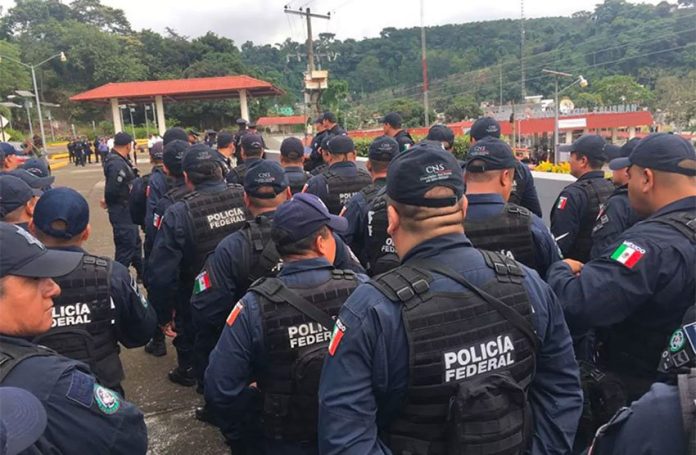
A large contingent of Federal Police officers has been sent to Chiapas to help secure the border area.

Some migrants succeeded in crossing into Mexico yesterday and are continuing their northward journey towards the U.S.

Foreign Affairs Secretary Luis Videgaray said after a meeting with United Nations officials yesterday that the UN Refugee Agency (UNHCR) has agreed to help attend to the migrants.

The immigration institute said yesterday that it would only offer 50 appointments per day to hear refugee requests and that migrants would have to wait in Guatemala until they can be assessed.

A large number of women, children and elderly people are part of the group that arrived in Tecún Umán, where they stayed last night in a migrant shelter or in the town’s central park.

Many of the migrants received treatment from the Guatemalan Red Cross for blisters and other injuries to their feet caused by countless hours of walking.

Among the worst cases was that of a 65-year-old Honduran man identified only as José Luis, who suffers from kidney disease for which he requires dialysis.

Yet he remains intent on reaching the United States, where he hopes to find work so that he can send money back to his family in the notoriously dangerous city of San Pedro Sula.

Not all are from Honduras. A young man from El Salvador who was among those who arrived in Tecún Umán told the Associated Press it was his third attempt to enter the United States. He hopes to land a construction job in Los Angeles, California.

Despite an increased police presence on the Mexican side of the border, Milenio reported that people continued to cross the Suchiate River yesterday without going through official immigration checkpoints.

Rafts made out of wooden planks attached to inner tubes of tractor tires ferried undocumented travelers across the river from Guatemala to Mexico, where prices for basic food items are much lower.

A member of the migrant advocacy group Pueblo Sin Fronteras (People Without Borders) was arrested in Ciudad Hidalgo yesterday.

The INM said in a statement that Ireneo Mujica, who said he is a dual Mexican-United States citizen, was detained after allegedly acting aggressively towards its officers and municipal and federal police.

However, Pueblo Sin Fronteras said that Mujica was detained “illegally, with violence and without an apparent motive” while participating in a peaceful march of solidarity with the migrant caravan.

The advance of the huge caravan, the second this year, has once again infuriated United States President Trump, who yesterday threatened to deploy the military and close the United States’ southern border.

In response, former Mexican president Vicente Fox, a frequent Trump antagonist, took to Twitter to hit back at the U.S. president and also to take a swipe at president-elect López Obrador, who said that once he takes office visas will be offered to Central Americans who want to work in Mexico.

“About the caravan: as always, @realDonaldTrump [is] demonstrating his lack of humanity, straight away resorting to aggression as a response and here @lopezobrador_ [is] offering something we don’t have, demonstrating his lack of vision. It’s clear here that extremes don’t work,” he wrote.

Source: Milenio (sp), Infobae (sp), Associated Press (en)

Official arrested in Sinaloa used mattress case

0
A Sinaloa man finds a used mattress inside its new covering.
A Sinaloa man finds a used mattress inside its new cover.

An official at the Sinaloa Social Development Secretariat was arrested yesterday in connection with the purchase of 2,000 used mattresses that were distributed to flood victims in Culiacán.

Carlos Baltazar Castro Olivas is charged with fraud.

Castro had been absent from his office since the mattress story became public.

Earlier yesterday, Castro’s father called a press conference to tell reporters that his son was absent because he had traveled to Guadalajara, Jalisco, to file a formal complaint against the supplier of the mattresses, identified as Isabel Reyes Villanueva.

Baltazar Castro Blanco, a local businessman, insisted that his son did not commit a fraud. He explained that in the days after the September 20 flooding he was looking for mattresses and found a supplier in Jalisco.

Some 14,000 mattresses had already been purchased in Sinaloa, exhausting the inventory in the state. So Castro Olivas bought more in Jalisco, unaware that they were used products that had been re-covered.

Castro Sr. said he had come forward to explain the situation because his name and that of the family business had been linked to “an embarrassing and unacceptable affair.”

He also offered an apology to the recipients of the old mattresses on his own behalf and that of his son.

The mattresses were distributed last weekend to flood victims, who became aware that the products smelled after removing them from their plastic bags. In one case, a woman said her mattress smelled like rotting meat. She found what she thought was a bloodstain after removing its cover.

Source: El Universal (sp), El Debate (sp)

Young man is 16th victim of lynching this year in Puebla

0
Site of the lynching yesterday in Puebla.
Site of yesterday's lynching.

A suspected burglar was lynched in Puebla yesterday, becoming the 16th victim of deadly mob justice in the state this year.

According to authorities, residents of the Jorge Murad neighborhood in the state capital caught an approximately 20-year-old man trying to break into a house early yesterday morning.

They detained the young man, tied him to a post and beat him to death.

The vigilantes abandoned the victim’s near-naked body with a sign on his chest that read: “This happened to me for being a ratero [thief].”

Puebla Mayor Claudia Rivera said that no emergency calls were made to alert authorities to the incident, which occurred near Puebla’s largest market.

“We found out through the media. The police were the first to respond . . . As soon as we were notified, an operation was launched in the area,” she said.

Rivera added that the state Attorney General’s office will be in charge of the investigation to identify and locate those responsible for the crime.

During 2018, there have been 183 attempted lynchings in Puebla and police have prevented the deaths of 203 people targeted by angry mobs, according to the state Secretariat of Public Security (SSP).

The highest number of cases have occurred in the municipalities of Puebla, San Martín Texmelucan, Acajete and Amozoc.

The targets of the attempted lynchings have been accused of committing crimes including robbery, rape, assaults and kidnapping.

Two suspected child snatchers were beaten and burned alive by angry citizens of a town in the Puebla municipality of Acatlán de Osorio in August. A day later, two more people were killed in the same fashion in Hidalgo.

Behind those lynchings was hysteria whipped up by fake messages circulating on social media which supposedly served to alert citizens that a wave of kidnappings was taking place.

The SSP said that in 40% of attempted lynching cases this year, the perpetrators had no proof that their targets had actually committed the crime they were accused of.

Source: El Universal (sp) 

Pemex workers cast secret ballots for union leaders for the first time

0
Partners in corruption? A file photo of President Peña Nieto, ex-Quintana Roo governor Roberto Borge and union boss Romero.
Partners in corruption? A file photo of Peña Nieto, ex-Quintana Roo governor Roberto Borge and union boss Romero.

Members of the Mexican Petroleum Workers’ Union made history this week when they cast secret ballots to elect union leaders. But critics labeled the process a sham.

On Wednesday, members of the Pemex workers’ union voted to fill leadership positions at each of the union’s 36 locals but dissident union members say the election was rigged to ensure that the winners were supporters of longtime union boss Carlos Romero Deschamps.

Juan Carlos Chávez González, president of the Democratic Alliance of Oil Workers, said the idea was to elect 36 leaders loyal to Romero, who would then ratify him as leader for another six years.

“Everything is a maneuver to leave Romero Deschamps as leader, despite the opposition of the president-elect, Andrés Manuel López Obrador, who demands democratic elections,” Chávez said.

López Obrador has promised to modify the laws on union elections so that workers can elect their leaders freely and democratically through a secret vote.

At the elections this week Pemex workers voted in the privacy of booths installed at their workplaces. But for Chávez, it didn’t mean much: he said the vote was little more than a simulation.

He accused the national leadership of threatening union workers over their vote, and charged that those responsible for counting the votes had close ties to Romero. For that reason, his union did not participate in the elections.

“We’re not going to lend ourselves to a cheap ploy,” he said. “They simulate democratic elections, but it’s like going to play a soccer match on their field, with their ball, with their referee and with their rules, just to be destroyed.”

A rival to Romero said much the same. María de Lourdes Díaz Cruz, head of an organization that advocates for reform at the Pemex union, charged that there were irregularities in the election process, which she said was marked by lies and impediments to the registration of dissident groups.

“There was no union democracy, it’s a farce.”

Díaz announced in August she wanted to challenge Romero for the union leadership, saying it was time to end “repression, intimidation and violence against workers on the part of vandals and corrupt leaders” when elections came around.

She called for Romero’s removal and an investigation into abuses and illicit enrichment.

In 2013, Forbes magazine named Romero one of the 10 most corrupt politicians in Mexico.

His critics have pointed out that it is unlikely that his union salary — less than US $2,000 per month — is able to finance his family’s lifestyle.

In a speech on Wednesday in Tamaulipas, López Obrador spoke against union corruption, taking a direct shot at Romero.

“None of this ‘I want to be a union leader because if I’m an oil leader I’m going to bathe in money, because I’m going to sell positions, because I’m going to award contracts for money’ — that’s going to go down the drain, that’s ending completely,” he said.

The corruption goes beyond the oil workers’ union, he said. “. . . it’s not just Romero Deschamps.”

According to Chávez, the election represented an attempt by the Institutional Revolutionary Party establishment to solidify control in the union before the end of President Peña Nieto’s term next month.

“It is a crude strategy that is being carried out by Pemex, by the federal government,” Chávez said. “They intend to leave Romero Deschamps at the head of the oil union for six more years to serve as a counterweight to López Obrador.”

Source: Reforma (sp), Excelsior([sp), El Universal (sp), El Sol de Puebla (sp)

Bus’s brakes fail, killing 11 and injuring 24 in Michoacán

0
The site of the accident that killed 11 yesterday in Michoacán.
The site of the accident that killed 11 yesterday.

A bus lost its brakes in Michoacán yesterday afternoon, killing 11 passengers when it struck a logging truck, went off the road and collided with an abandoned house.

Another 24 passengers were injured in the accident on the Angangueo-San José del Rincón highway in Cantingón, Angangueo.

The passengers, who were from the Michoacán communities of Angangueo, Ciudad Hidalgo and Zitácuaro, were returning home from a pilgrimage to Tlalpujahua in the northeast of the state.

The injured were transferred to hospitals in Zitácuaro and Ciudad Hidalgo.

Source: Eje Central (sp), EFE (sp)

Slide buries two homes, kills six after heavy rain in Oaxaca

0
Soldiers clear a highway in Oaxaca.

A landslide in Oaxaca this morning buried two houses and left six people dead, state Civil Protection officials said.

Today, the National Defense Secretariat sent 150 soldiers to clear the rubble after a hillside collapsed after heavy rain in the municipality of San Pedro Ocotepec. The houses were buried under trees, soil and mud.

Army personnel were also working today to open a local highway after it was closed by landslides.

[wpgmza id=”96″]

The six victims were reported trapped in the slide rubble early this morning but no one survived. Officials recovered the bodies of two women and four children.

Heavy rains were brought on by the interaction between cold front no. 6 and a weather system in the Gulf of Tehuantepec.

Ocotepec is located in Oaxaca’s Sierre Norte region and has a population of about 2,000.

Source: Milenio (sp)

Aqueduct will carry recycled water to Baja’s winemakers

0
Vineyards in the Valle de Guadalupe will be getting more water.

Winemakers in the Valle de Guadalupe region of Baja California are betting on an innovative solution to their water shortage problem.

An Israeli company, Odis Asversa, will build an aqueduct between Tijuana and the well-known wine region to carry recycled wastewater to the area’s vineyards.

Although the company won a state government tendering process to complete the project — the first of its kind in Mexico — the winemakers will foot the US $1.5-billion bill.

The Valle de Guadalupe region currently has only one source of water — the Guadalupe aquifer, which is overexploited.

Odis Asversa, which has operated in Mexico for more than 25 years, predicts that it will be able to send 1,000 liters of high-quality water per second to Valle de Guadalupe, located in the municipality of Ensenada.

Company director Fabián Yáñez said that each wine producer will be responsible for building its own connection to the aqueduct system.

He also said that technology used by Odis will allow the quantity and quality of water transported in the aqueduct to be monitored in real time.

“We’re going to have online quality control 24/7. If the water meets the standard, it’s delivered to the winemakers. If it doesn’t . . . the water is immediately sent back,” Yáñez said.

Hans Backhoff Guerrero, a Baja California wine industry representative, told Milenio Televisión that the aim of the project is to provide winemakers with high-quality water that will allow them to increase their production.

Yáñez added that the aqueduct will guarantee water supply to winemakers in Valle de Guadalupe in the long term and help to save drinking water.

Winemakers are currently growing grapes on about 5,000 hectares of land in Baja California but once the aqueduct is in operation, Backhoff said, an additional 1,000 hectares could be supported.

The northern state is Mexico’s largest wine producer. Its wineries have won countless accolades at national and international wine competitions.

Source: Milenio (sp), Conacyt Prensa (sp)