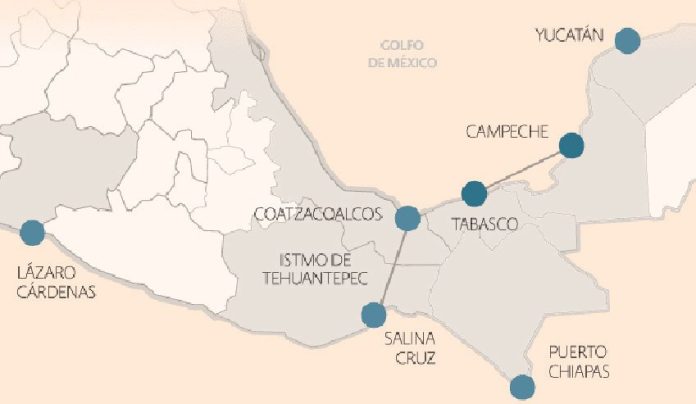
The Special Economic Zones whose elimination was announced today.
President López Obrador confirmed today that his government will eliminate the country’s seven Special Economic Zones (SEZs), declaring that they were of “no benefit” to the economy.
The president responded bluntly to a reporter who asked at his morning press conference whether the SEZs are going to disappear.
“Yes, completely,” López Obrador said.
“They were supposed to help but they never did anything to help. They [the former government] did business, they bought land, they squandered resources [but] there was no benefit at all.”
The Enrique Peña Nieto-led administration created SEZs in Puerto Chiapas, Chiapas; Salina Cruz, Oaxaca; Lázaro Cárdenas-La Union, Michoacán and Guerrero; Coatzacoalcos, Veracruz; Seybaplaya, Campeche; Dos Bocas, Tabasco; and Progreso, Yucatán.
Each zone offered generous financial incentives to attract investment including a zero corporate tax rate for 10 years.
Gerardo Gutiérrez Candiani, former head of the federal agency responsible for the SEZs, had predicted they would attract investment of US $42 billion over the next 15 to 20 years.
Sources inside the president’s office confirmed that the government will pursue “development projects” instead of the SEZs.
The zones were created in late 2017 and early 2018. One year ago, the federal government announced a 50-billion-peso stimulus package to encourage investment in them.
In addition to canceling the SEZs, López Obrador said that his administration has eliminated other government programs and agencies that generated little or no benefit for the country.
“The Tourism Promotion Council was canceled yesterday,” he said, referring to a vote in the lower house of Congress that approved the agency’s disbandment.
“It was a bottomless pit, it didn’t promote tourism, it used money to buy loyalty . . . to pay for advertising in newspapers . . . Do you remember [international trade and investment agency] ProMéxico? It doesn’t exist anymore either.”
A 28-year-old Mexican chef who owns two restaurants in New York City has been named the world’s best female chef.
Daniela Soto Innes was awarded the title by organizers of the World’s 50 Best Restaurants.
The organization commended Soto, the youngest winner ever, for her “dynamic and inventive” cooking at the contemporary Mexican restaurants Comse and Atla.
Born in Mexico City and raised in Houston, Texas, she returned to her home turf to spend her formative years training under chef Enrique Olvera at the award-winning Pujol restaurant in Mexico City.
By 2014, Soto had settled in New York, where she and Olvera opened Cosme, promptly gaining the attention of local gastronomy fans.
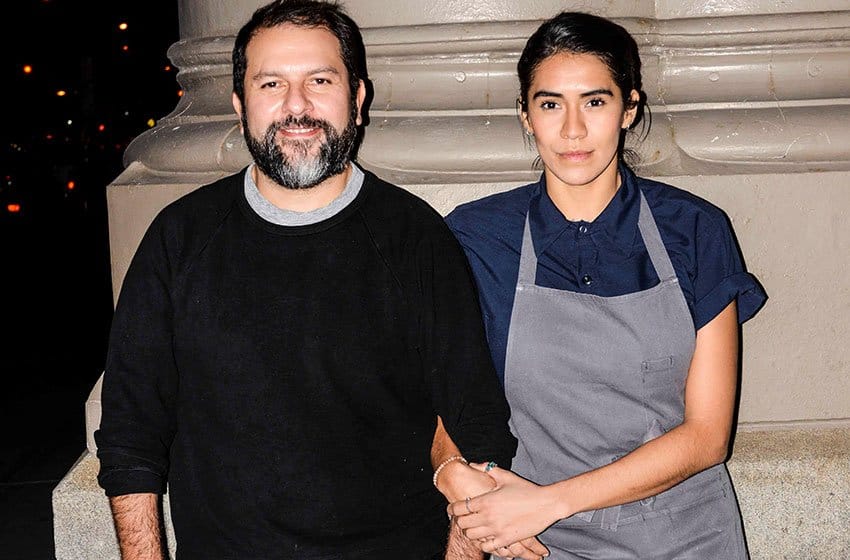
Chefs Olvera and Soto.
Two years later she was given the Rising Star Award by the James Beard Foundation and this year she has been shortlisted for best chef.
At Cosme, the menu is anchored with Mexican flavors and traditions and includes dishes such as duck carnitas, barbacoa with shishito peppers, quelites, avocado and salsa, and corn husk meringue desserts.
Her second restaurant, Atla, is an all-day casual eatery that serves Mexican classics like huevos rancheros and quesadillas.
Soto and Olvera are now working on opening two new restaurants in Los Angeles later this year, a Japanese-influenced Mexican restaurant and a taquería.
“Both older talent and young talent deserve all the respect at all times, and we should be able to hear what has to be said,” she told World’s 50 Best in reference to her own youth.
“It doesn’t matter whether you’ve been cooking 40 years or one year. There are cooks who weren’t even cooks when they joined me a year ago, and they’ve taught me a lot more than what I knew when I was 14.”
Soto said she hopes to inspire and support people of all ages, races and nationalities in becoming cooks.
“I grew up with a line of really strong women that love to cook. When I was born, my mother was a lawyer . . . but she wanted to be a chef because my grandma had a bakery and my great grandma went to cooking school. Everything was about who made the best cake, who made the best ceviche, who made the best mole. I just knew that it was the thing that made me the happiest,” she said.
Soto wrote on Instagram that the award was “for the Cosme team, for my family, for Mexico. For the kick-ass women and men that give us their support!”
She will accept her award at the World’s 50 Best Restaurants presentation on June 25 in Singapore.
The number of homicides in Playa del Carmen, Quintana Roo, in the first quarter of 2019 was six times higher than the same period last year, statistics show.
There were 55 homicides in Solidaridad, the municipality where the resort city is located, between January and March compared to nine in the first three months of last year.
The figure accounts for one-third of all murders in the state in the first quarter of this year and is equivalent to one-half of the total number of homicides in Solidaridad last year.
Only Benito Juárez, the municipality where Cancún is located, recorded a higher number of homicides between January and March, with 96.
The high murder rate in Playa del Carmen continues a trend that began in July last year.
There were 28 intentional homicides between January and June 2018 but 82 in the six-month period to December, an increase of almost 200%. The surging murder rate came a year after Cancún saw a similarly steep rise in homicides.
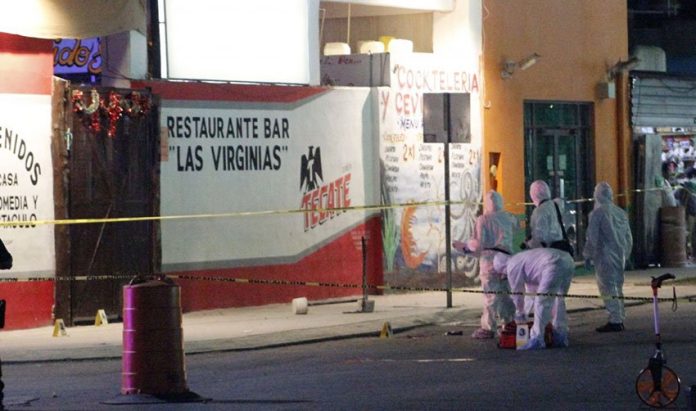
In the first week of this year, seven people were killed in a bar shooting in Playa del Carmen, after which Mayor Laura Beristain said that municipal authorities would work “hand-in-hand with the state government in a head-on fight against crime” and that “we cannot and must not allow the image of Solidaridad as a tourist destination to continue to be stained.”
The following month, she appealed to President López Obrador to call on the media in Quintana Roo to stop “bashing” Playa del Carmen by publishing front page stories about violence.
During the presentation of the government’s national tourism strategy in Chetumal, Beristain claimed that newspapers were publishing sensationalist headlines such as “Solidaridad, 100 days of blood” and “Solidaridad, violence and crime grow” to retaliate against a loss of government advertising revenue.
“It’s not true, that [kind of violence] is not happening in Playa del Carmen, Solidaridad . . .” she said.
However, the most recent homicide statistics paint a different picture.
According to the president of the Citizens’ Observatory of Quintana Roo, a civil society organization, the growing levels of violence in Solidaridad are the result of a turf war between criminal groups.
“The municipal seat, Playa del Carmen, is one of the main markets [in the state] for drug dealing, and it’s an important plaza that several organized crime groups are competing for,” Gerardo Bonilla said.
“The problem is that Quintana Roo doesn’t have the institutional strength to deal with a phenomenon of this nature,” he added.
Bonilla charged that Governor Carlos Joaquín, who presented a new anti-crime strategy in February, has lost control of the security situation and expressed skepticism that the deployment of the National Guard will make a difference.
He also stressed that violence is a statewide problem, pointing out that Quintana Roo was considered the ninth most peaceful state in Mexico in 2017 but has now dropped to 29th.
“. . . To have lost 20 places in a couple of years and to now be one of the three most insecure states is not a minor matter,” he said.
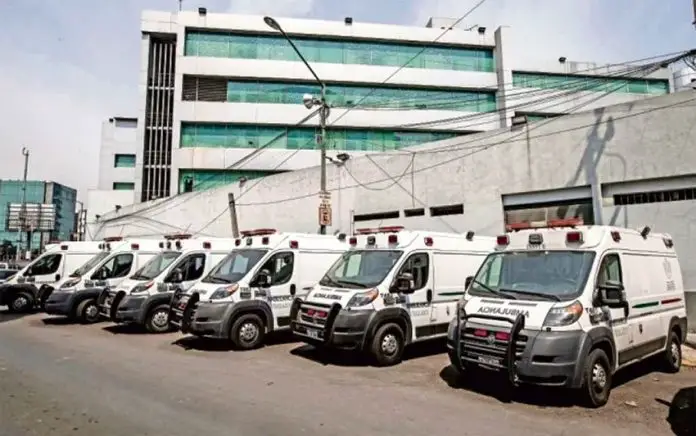
Nearly all the ambulances at a Mexico City hospital for government employees are unusable — they’re out of gas.
Only two of the 13 ambulances parked outside Darío Fernández General Hospital have gasoline, according to a driver who requested anonymity.
Furthermore, the source revealed that driver’s license renewals are frequently delayed and travel allowances never reimbursed.
“Before, there was a mileage chart and that’s how we knew what we were owed per trip, but they changed it and now in theory they give us a travel allowance for every trip. But for the last six months we have paid money out of our own pockets for gasoline and food, and they haven’t reimbursed us for any of it.”
But the driver said the lack of gasoline is not the only reason for the vehicles being parked.
“Some drivers do not have their papers up-to-date: their licenses are expired, and [the ISSSTE] is supposed to pay for it. We cannot risk going on an emergency call without our papers in order. If there’s an accident, nobody is going to back us up.”
The finance director of the health agency revealed before the Senate Health Commission this week that it is essentially bankrupt and will run out of cash by July.
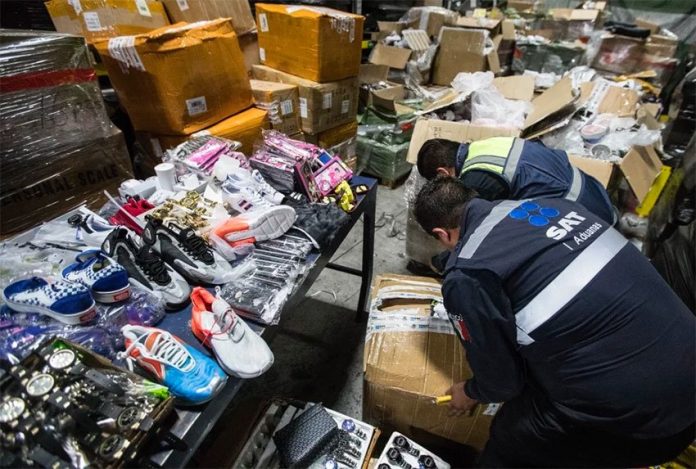
Customs agents inspect goods seized at Mexico City airport.
Customs agents have seized more than 45 tonnes of pirated goods from a storage facility within the Mexico City International Airport (AICM).
The confiscation is the largest ever of its kind at the airport, where shipments of drugs and cash are often seized.
Among the counterfeit goods were large quantities of clothes, shoes, watches, jewelry, bags and mobile phone accessories.
The pirated brands included Lacoste, Nike, Adidas, Louis Vuitton, Gucci, Rolex, Calvin Klein, Bulgari and Casio.
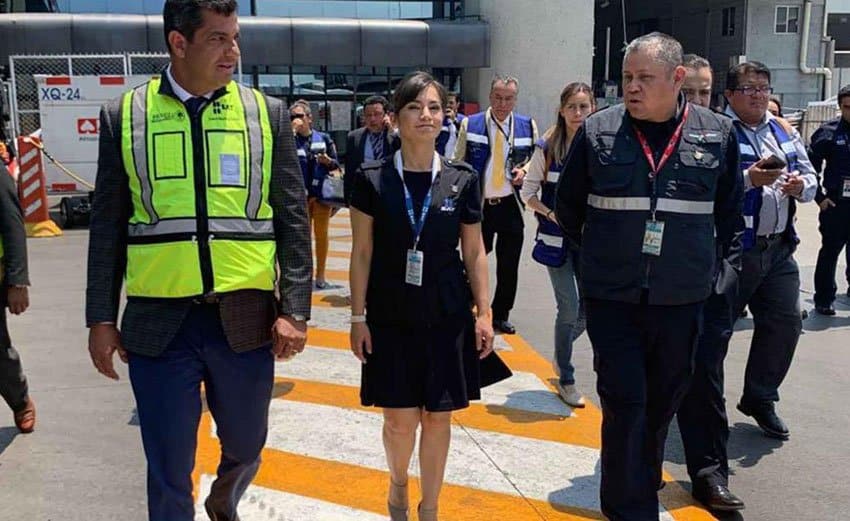
Ricardo Peralta, head of the General Customs Administration (AGA) at the Federal Tax Administration (SAT), praised the work of the airport customs team including its chief, who has only been in the job since Tuesday.
New customs administrator Baglietto, center.
“The presence of the new administrator, Damaris Baglietto, and the team made up of experts on organized crime and investigation is beginning to yield great results,” he said.
Baglietto, 44, is an expert in money laundering, drug trafficking and organized crime with experience in investigation and prosecution.
The AGA described the seizure as a severe economic blow for traffickers of pirated goods, estimating that the value of the counterfeit items on the black market would be 200 million pesos (US $10.5 million).
Most Mexico City confiscations of pirated goods, known colloquially in Mexico as fayuca, come as the result of operations carried out in the Tepito neighborhood – home to the capital’s most notorious black market – or at street stalls in other parts of the city.
Most counterfeit items smuggled into Mexico come from China or other Asian countries.
Following yesterday’s seizure, customs officials contacted legal representatives from the companies whose goods had been pirated to provide information that will allow them to file copyright infringement complaints with the federal Attorney General’s Office (FGR).
Peralta said the new airport customs chief will oversee increased efforts to detect customs personnel who are involved in smuggling illegal goods into the country.
He explained that drug seizures at the airport are up, adding that 68 people have been charged with smuggling offenses in the last four months, 18 of whom were customs employees.
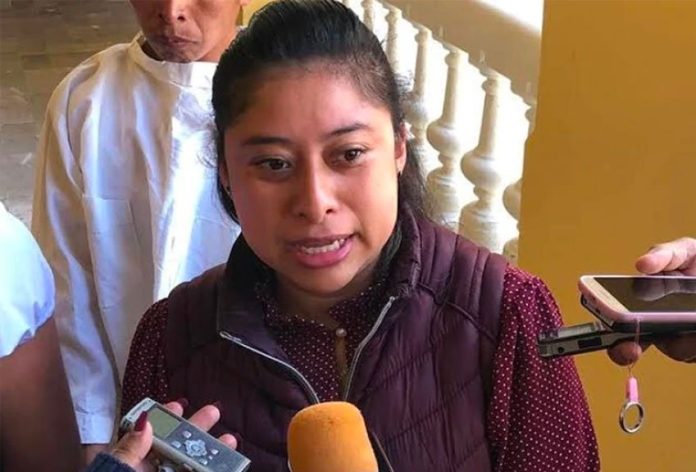
The mayor of Mixtla de Altamirano, Veracruz, was murdered last night along with her husband and another man when they were traveling on the Zongolica-Orizaba highway in the Zongolica sierra region of the state.
Individuals in another vehicle opened fire on the mayor and her companions in the municipality of Los Reyes at about 10:00pm, killing Maricela Vallejo Orea, her husband Efrén Zopiyactle and their chauffeur.
Governor Cuitláhuac García Jiménez condemned the “cowardly” attack and promised that justice would be served.
He also said he and Vallejo had made great progress together, building a new health center and promoting Mixtla’s indigenous culture.
Vallejo’s term in office got off to a rocky start when threats were made against her if she did not resign her post. She was offered 300,000 pesos (US $15,700) to do so in December 2017, but declined.
She denounced the threats at the same time her uncle was shot and killed in the central Veracruz town of Tlilapan.
Earlier this year, Vallejo was one of the principal speakers at a forum on violence against women and girls and proposed the creation of an agency in every municipality to address violence against women.
Initiatives such as this draw attention to problems using humor and social media.
A friend of mine here would often joke that the only way for Mexico to solve its corruption problem would be for it to totally outsource the government — say, to Denmark or Sweden, one of those northern European countries with a small population and maybe some extra time and goodwill on their hands.
I have my own completely unreasonable proposals, like having all government officials take a lifetime vow of (relative) poverty, tied to the minimum wage perhaps, and/or requiring them all to use only the public options (schools, hospitals, roads, etc.) for themselves and their families. So far my proposals have gained little traction.
Mexico is certainly not the only country with these kinds of problems, though it ranks 138 out of 180 (the 180th being the most corrupt) countries on the Corruption Perception Index for 2018.
Since I first came here in 2002, I’ve never quite been able to square this with all the wonderful things I know Mexico and Mexicans to be, and I firmly believe that if we could make things truly more just, even by, let’s say, 30%, that Mexico would be one of the top destinations in the world.
It has everything: beautiful and varied natural landscapes, world-famous cuisine, fun and vibrant holidays and a generally inclusive, generous and gregarious cultural personality. The language isn’t too hard to learn, and even if you butcher it people will do their best to understand you and tell you how well you speak.
Mexicans can make jokes on the darkest of days, and rather than seeing this as a sign of disrespect, I think it speaks to a great resilience of a people used to rolling with the punches of outside circumstances.
(My personal favorites, upon the election of United States President Donald Trump, were variations of “So, do we need to go pay for our part of the wall at the OXXO, or will it just be automatically taken out of our paychecks?”)
So what do we need to get to this 30%? The laws on the books are quite good; they exist, and for the most part are downright progressive. The missing ingredient is a power structure prepared and dedicated to enforcing them, immune to bribes and graft, or at least somewhat afraid of the embarrassment of being caught in the middle of it, and if not that, then afraid of being caught and punished.
How do we convince powerful people accustomed to making much of their money through less-than-honest means to act for the common good instead, and not take more than their fair share? How do we hold people accountable when the rule of law is too weak to back it up, or in some places, downright absent? What would it take?
Many opponents of AMLO make fun of his phrase la mafia del poder (“the mafia of power”), but I think it’s a pretty good description of what we have in this country and in most others. And just as drivers in places where they can be seriously penalized for infractions tend to behave on the road, powerful people in places where they simply can’t get away with the shenanigans they’d like to tend to act responsibly.
This makes me sound like a real pessimist, I know, but it’s hard to believe at this age that people change behavior that benefits them personally unless they’re forced to or embarrassed into it.
One group that calls themselves Los Supercívicos (“super citizens”) have effectively used public embarrassment and subsequent public praise to affect change (they have a YouTube channel, a Facebook page and even an app for ordinary citizens to participate!)
They not only publicize the problems that people record, but they give credit for the solution.
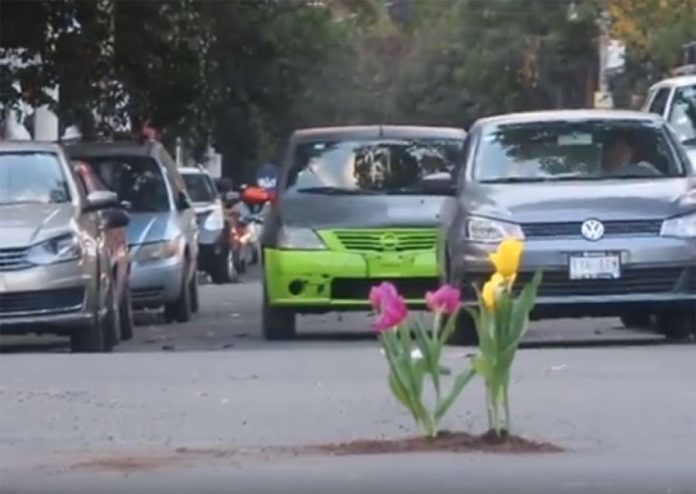
Big gaping hole in the sidewalk that someone could fall into reported by a Super Citizen? Solved! Thanks, Mayor Cuauhtémoc! Other groups of citizens have set out to plant flowers in potholes, drawing attention to an oft-ignored problem in urban settings.
There is certainly always room for good ol’ fashioned protests, but the combination of humor and publicity that the era of social media has brought has made for a potent fusion.
This is a great start, and gives me hope that Mexican society as a whole is making progress in its struggle toward a fair and just society.
It’s a way of combining the natural tendency to make a fatalistic joke about problems that seem out of our control and to draw attention to them in ways that might actually get them solved.
It’s not the solution to everything. We still need well-trained and well-paid police officers (pro tip: 6,000 pesos a month does not count as well-paid); we need qualified, competent, and honest city and state administrators and transparent budgets; we need a reasonable minimum wage that actually covers what the Mexican constitution says it should by law; we need lawyers and judges that can’t be bought; and we need an independent organization with the power to prosecute, dedicated to assuring that politicians aren’t taking taxpayer money and stuffing it into million-dollar condos in Dallas.
Maybe I’m naive, but I think when people feel they can get a fair shake and do well by being honest and respectful toward their communities, they’ll be more honest and respectful toward their communities.
There’s nothing inherent about Mexican culture that makes corruption inevitable; we’ve inherited a system in which many believe that corruption is necessary to get their needs met.
I don’t think we’re going to be outsourcing Mexico’s government anytime soon, but I have hope in our new current administration, more than I’ve had in the previous ones I’ve observed since coming here almost 18 years ago.
In the meantime, I’ll keep arguing for my “vow of relative poverty” proposal.
Sarah DeVries writes from her home in Xalapa, Veracruz.
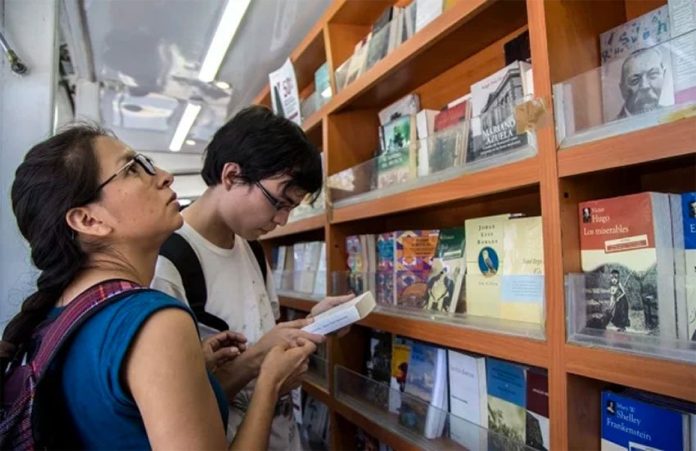
The number of Mexicans who read books and other materials has decreased since 2015, according to a survey conducted by the National Institute of Statistics and Geography (Inegi).
Forty-two percent of respondents said they had read at least one book in the past 12 months compared to 50% in 2015.
Among those who do read books, the average number of titles finished per year remains unchanged at 3.3.
The proportion of people who read a wider range of materials including books, newspapers, magazines, comic strips and internet content (excluding social media) also went backwards, declining from 84.2% of the population in 2015 to 74.8% this year.
Almost half of all respondents to the Inegi survey said they didn’t read due to a lack of time while 21.7% said that they had no interest in reading.
More than 20% of those surveyed said they only understood “half” or “a little” of what they read.
In addition, Inegi found that only 11% of respondents had been to a library in the past year, that just under 60% had books other than textbooks at home and that one-third were read to by their parents when they were children.
The survey was carried out at 2,336 homes in all 32 states during the first 20 days of February. Respondents were literate adults living in cities of 100,000 people or more.
Paco Ignacio Taibo II, a writer and head of the government-affiliated non-profit publishing group Fondo de Cultura Ecónomica (FCE), said there won’t be you-have-to-read campaigns but instead that “doors will be opened so there is access to reading for millions of Mexicans who today don’t have access for different reasons.”
He has already launched a series of eight books priced at US $2 or less and last month declared he was confident that the government could “turn Mexico into a republic of readers.”
Construction of the federal government’s new airport in México state will begin Monday, President López Obrador announced today, just as an official report came out warning that it could reach saturation just 10 years after starting operations.
“I’ll say in advance, because my chest isn’t a storeroom and I always say what I think, that we’re going to start construction of the new airport next Monday,” the president said at the inauguration of the 2019 Aerospace Fair.
The fair is being held at the Santa Lucía Air Force Base, which will be converted into a commercial airport that is expected to begin operations in 2021.
López Obrador said the 78-billion-peso (US $4.15-billion) airport will be named after Felipe Ángeles, a military hero of the Mexican Revolution.
He explained that there are 3,000 hectares of land available for construction at the Santa Lucía site whereas the current Mexico City airport has just 600 hectares.
AMLO speaks today at the inauguration of the Aerospace Fair.
“We’re talking five times the surface [area],” López Obrador said, adding that unlike the ancient lakebed in Texcoco, México state, where the cancelled Mexico City airport project was being built, the Santa Lucía site is “solid ground.”
The president declared that his decision to cancel the US $13-billion signature infrastructure project of the previous government had saved the Santa Lucía base from closure.
“It was saved from disappearing by the controversial decision not to build the Texcoco airport. The AICM [Mexico City International Airport] and this military airport would have had to close if that project continued because of air interference,” López Obrador said.
At his morning press conference earlier today, the president referred to a Secretariat of Defense (Sedena) report stating that the projected cost of the airport has increased by more than 8 billion pesos. The overrun is mainly due to changes in the original master plan which are required because of the presence of a 2,625-meter hill near the airport.
López Obrador denied that the original plan didn’t consider the hill.
“Of course, the hill was taken into account Do you know since when? Since around 50 years ago when the Santa Lucía military airport was built . . . I imagine that the hill existed then,” he said.
But while the plan might have considered the hill, the budget did not.
The president has argued that pursuing the Santa Lucía project instead of Texcoco will save billions of pesos and solve the current Mexico City airport’s saturation problems more quickly.
But the Institute of Engineering at the National Autonomous University (UNAM), Sedena and the Military School of Engineers said in an environmental impact report that the new airport’s capacity will soon be tested.
The report said that if air traffic is redirected to Santa Lucía from the existing Mexico City airport and the one in Toluca in order to ease congestion, “it is estimated that this airfield will begin to experience saturation problems 10 years after it is placed in service.”
The findings were based on a 4% annual growth projection for demand for airport services in the Valley of Mexico.
In its first year it is expected that around 18 million passengers will use the Santa Lucía airport but its planned capacity is for 100 million passengers a year, although little detail has been provided to show how that will be achieved.
It is estimated that the Santa Lucía, Mexico City and Toluca airport will have a combined capacity of around 80 million passengers annually but demand will likely exceed that figure in the year 2032.
In 2051 – the year Santa Lucía’s predicted 30-year life span will expire – demand will be around 170 million passengers a year, the UNAM/Sedena report said.
When you find yourself in the doghouse at 3:00am, take comfort in knowing there’s a 24-hour flower market in Mexico City.
Surrounded by blacktop and decaying concrete sprawl, among the bus and taxi exhaust of the Mexico City struggle, just south of Centro in Colonia Jamaica, lies an oasis of greenery, THE flower market – Mercado Jamaica.
Entering from Avenida Morelos, Jamaica Market is the usual Mexico City market, albeit an impressive one. The fresh produce veritably spills out from its stands. Watermelon and avocado specialists display their wares sliced into halves as proof of worth. The gleaming red strawberries are the largest I’ve ever seen, like a child bully’s fist.
Piles of beautiful mole, mountains of sweets – piñatas made with the traditional seven points (for the deadly sins) or in the costume of the currently most popular superhero.
Walk a bit deeper into the market and the first fragrance hits the nose, just a bit leafy at first, like fresh-cut grass carried on the wind.
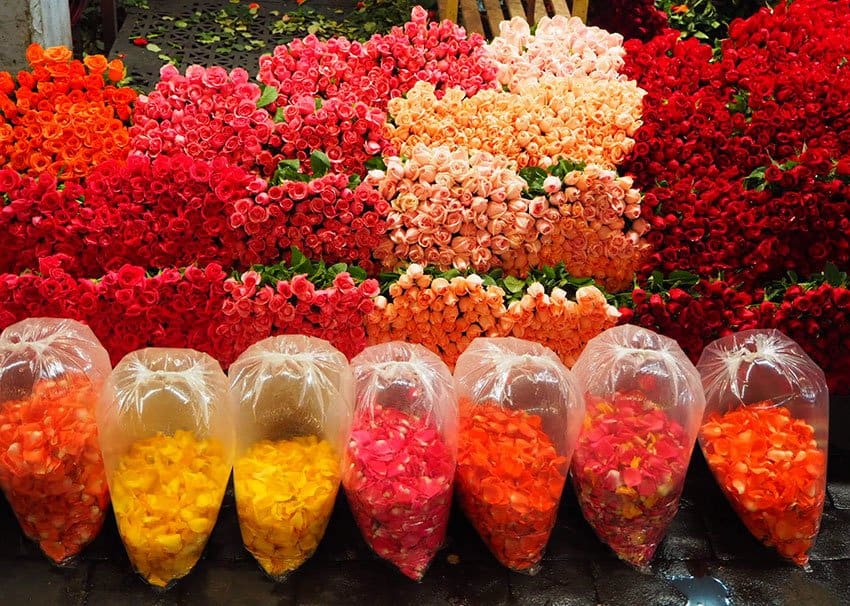
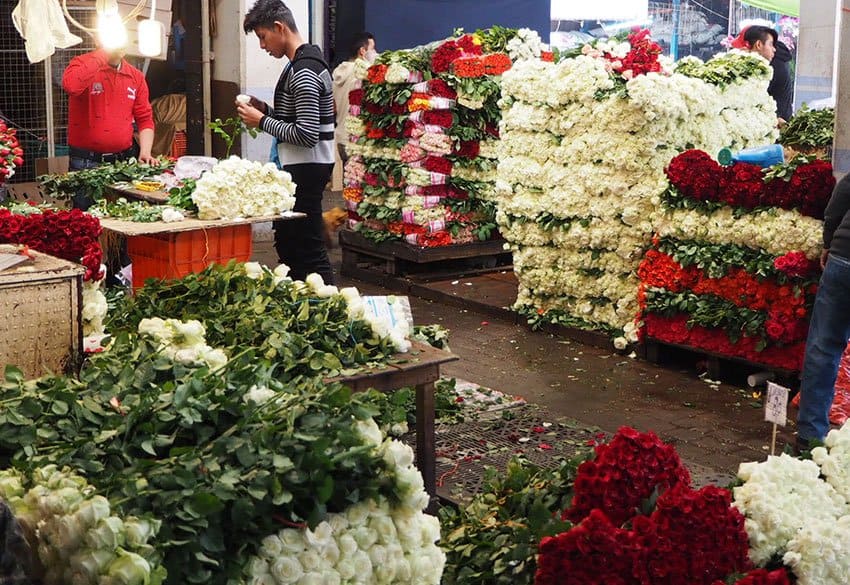
A rainbow of roses and petals to choose from.
Approaching the back, it grows more apparent, a forest after the rain. And rounding the corner into huge bouquets and mounds of fresh-cut lilies is the true magic scent – a lush jungle of chlorophyll and the sweet aromas of hundreds, possibly thousands of flower varieties intermingled.
Mercado Jamaica must be what perfumists dream of, a warehoused biosphere, the world of flora together under one roof – the concrete jungle, as it were.
Mercado Jamaica opened its doors in 1957 on the grounds where flower sellers already had a large presence. It has just over 1,000 stalls dedicated to the sale of approximately 5,000 types of flowers, foliage and plants. Although there are a number of markets in the city that sell huge numbers of flowers and plants, like Xochimilco, Central de Abastos and San Angel, Jamaica is the only one open 24-hours a day and generally offers a wider variety of imports.
Along the easternmost edge are the large ticket items – the enormous arrangements of roses, chrysanthemums, Gerbera daisies and sunflowers in huge leaf-bottomed boats or massive hearts and crosses.
These are the big event flowers for first communions, weddings, birthdays and funerals. A sign advertises “car bows” for those who just need a giant garnish to go along with their extravagant gift.
Most of these stands are open 24/7, I’m told, because the work is usually custom and intensive. And if you’re a client picking up, you certainly don’t want to lose the funeral flowers to Mexico City traffic.
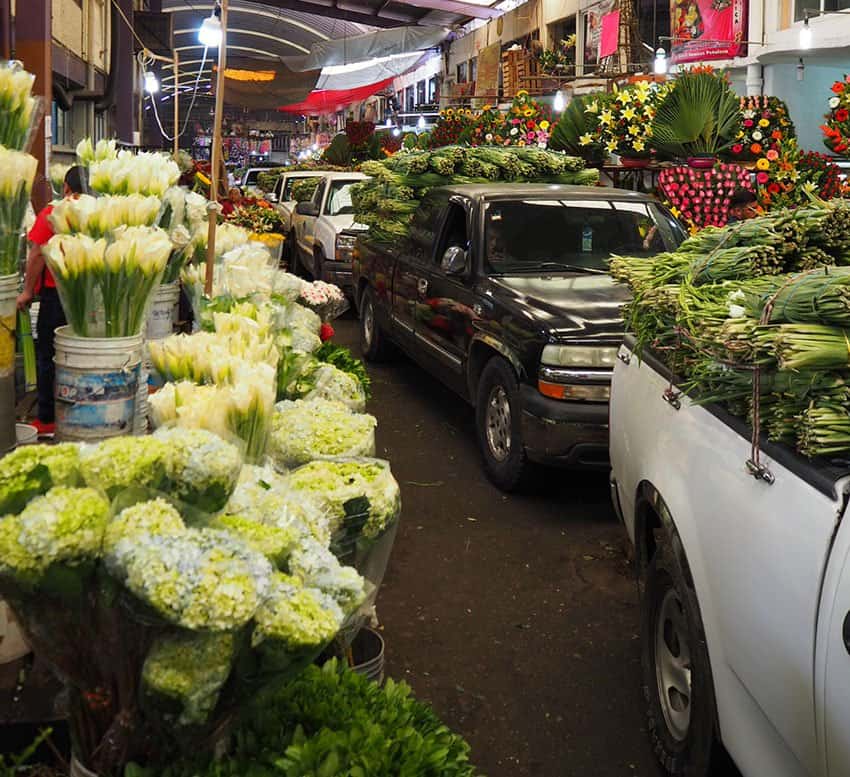
Pick ups loaded with lilies enter the market.
“What’s the 3:00am scene like?” I ask.
After many brushoffs – “I swear I’m not a snitch, I’m a journalist” – I finally get a kind and studious-looking man to chat, though he prefers his name not be used.
He’s been here for 20 years and specializes in sunflowers. His stand is open 24/7, but these days he works 9:00am to 9:00pm, only seven days a week. “Who’s here at 3:00am?”
He makes a fist, thumb pointed up and tips the thumb toward him to signify “drunk folks, late-night imbibers,” and his legs totter a little to sell it.
“They come to apologize to their girlfriends for something they’ve done,” he says. “But there aren’t many at that time. Regular sales start at about five in the morning.”
Pickup trucks drive through, their beds weighed down with flowers. Rainbows of roses are stacked meters high. Plastic bags of petals grow misty as the sun sneaks through the ceiling, lapping rays of light on them like the hand of God.
Employees work expertly with hands and machetes to break down flowers.
This is wholesale area, the vendors generally selling right out of the backs of their trucks to others that will resell them on the street or in neighborhood flower shops. Piles of lilies are worked through expertly with machetes. Vendors constantly splash their goods with water to keep them fresh.
Workers join for lunch at food counters, shooting the breeze and landing well-timed but good-hearted jibes, as only those with years of familiarity can do. The diableros, known for their acumen handling the product, push hand carts full of perfectly stacked flowers out to cars and vans waiting in the parking lot.
There are clearly wealthy ladies in pantsuits, presumably from Polanco or Lomas de Chapultepec; muscled and veiny old men in cowboy hats; and little kids in aprons, stitched with the logo of their company – the future generation of Mercado Jamaica.
I step into one of the booths to ask why the woman has hung a “No Photography” sign. “So other florists don’t steal my designs,” she tells me.
Hector Bialostozky has been creating flower arrangements for restaurants and businesses around Colonia Roma for three years. “Sometimes things are cheaper in Central de Abastos, for example,” he says. “But there’s more diversity of flowers in Jamaica. And you can get things for arranging that Abastos doesn’t have, like vases, foliage, roots, things like that.”
Bialostozky is also a performance artist who creates politically charged works. His flower design company, Flores Magón, is named after noted Mexican revolutionary and anarchist Ricardo Flores Magón. He says he tries to find a political aspect to his flower arranging work.
“Because of my political art background, it was tough to accept my work as a florist. But I like the meditative aspect of flowers, and the contact with people and space, so at least I’m out in the world interacting. And it’s been good to work with the aesthetics – theory of color, composition and the relationship between objects and space. I feel like it’s a continuation of my work in the arts, and it’s a good business.”
“You create relationships with people in Jamaica,” he says. “They begin to know you, charge fairly. Some become friends.”
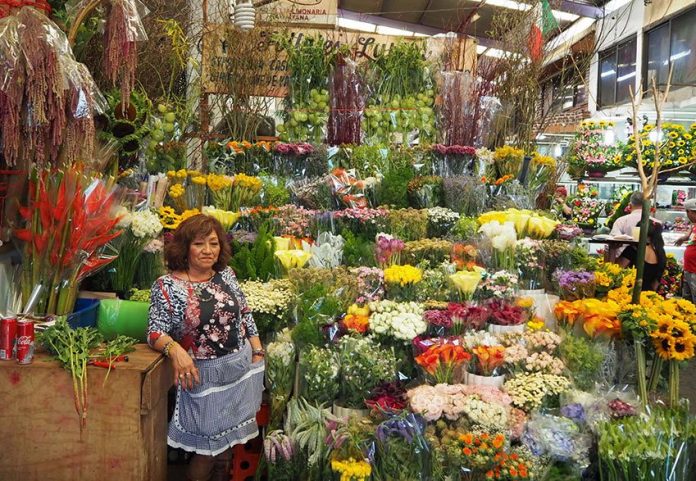
Among the stands recommended by Bialostozky for the diversity of product is Follaje de Lupita (Lupita’s Foliage) at the market corner of Congreso de la Unión and Guillermo Prieto. Doña Lupita started selling flowers with her mom and grandma when she was 5 and has been at the market since its inception.
Her stand is a massive burst of color, perhaps the most impressive individual scene in the entire market. She says they mostly sell to florists but have a lot of clients that simply enjoy the art of flower arranging. Among her most exotic flowers, she says, are leucos, with tiny orange tips spreading out from the head like a firework exploding, and veronicas, with fuzzy pointed fingers covered with tiny pink and purple petals.
Directly across Guillermo Prieto is Mercado Jamaica Comidas dedicated to selling, almost exclusively, huaraches. The mostly female staff of each stand yelps out, “Huaraches de pollo, huevo, costilla!!!”
At Huaraches Angelita, Angela García has been running the place for 30 years, but began working alongside her mom in ‘57. “I don’t know why the market became known for huaraches,” she says. “It used to be memelas . . . Unintentionally so . . . but now it’s huaraches.”
Along Prieto run the shops with the decorative pieces needed for arranging. Vases of every size and shape, giant dried leaves, decorative bicycles made of tangled vines and branches – all things beautiful and corny – lead the way to Plaza Jamaica, a smaller market for specialty items, like tulips, peonies and orchids.
At Flores de Holanda, the flowers arrive weekly by air from Holland. Tulips generally run 200 to 220 pesos for a dozen or peonies from 220 to 270. They tell me there’s some production in Mexico, but in Holland they can produce all year.
At El Paraiso they show me the plátano tuna stalks full of tiny little bananas topped with pink and purple flowers.
“It’s interesting to see how the flowers change with the seasons.” says Bialostozky. “Sometimes yellow cempasuchitl [marigolds] for Day of the Dead. In winter everything is white and pink with cherry and peach blossoms.”
“When you don’t know anything about the flower world, you think there isn’t much diversity,” he continues. “But when you get to Jamaica, you really realize how many species there are.”
On Tono Street, back at the mercado proper, are the potted plants: weird little succulents, citrus trees, fruit bushes and hundreds of indoor varieties. In search of a San Pedro cactus, I ask a woman who’s clearly been here for decades.
“Yeah, I know that one,” she says. “We don’t have it, but we can get it.”
You can find it all at Mercado Jamaica.
• Mercado Jamaica is located at Guillermo Prieto 45, Colonia Jamaica, open 24/7, 365 days a year.
This is the seventh in a series on the bazaars, flea markets and markets of Mexico City: