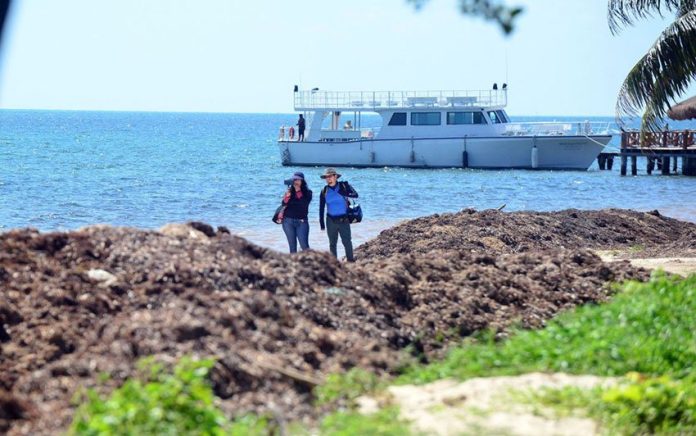
A file photo of sargassum on a Quintana Roo beach.
An enormous mass of sargassum seaweed is expected to make landfall on the beaches of Quintana Roo within the next 24 to 48 hours, according to information gleaned from satellite images.
Obtained by the Optical Oceanography Laboratory at the University of Southern Florida, the images show a huge sea of sargassum that is predicted to land on the entire Quintana Roo coastline.
Strong easterly winds are helping drive the brown algae ashore.
Marine biologist Estaban Amaro warned that the sargassum could be expected through June, threatening the region’s tourism-based economy.
“All of the models and satellite images that we have been downloading predict that we are going to see a lot of sargassum arrive in the next few weeks, and not just in April, but also in May and June. We’re going to have at least three months of a lot of sargassum, which will obviously have an important impact on the tourism industry in Quintana Roo.”
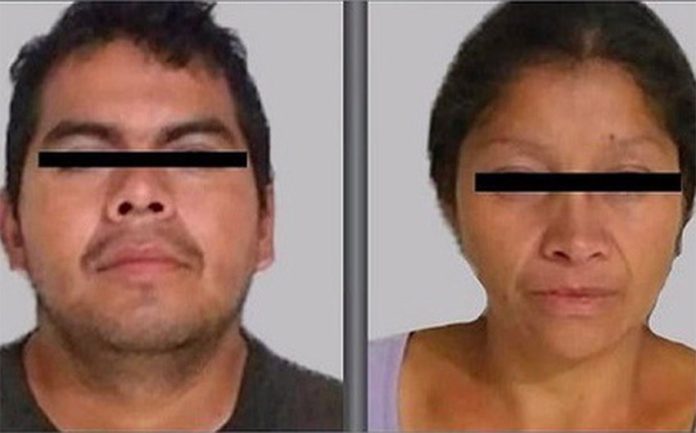
Ecatepec killers have been given their first sentences.
Two serial killers from Ecatepec, México state, were sentenced to 15 years each today in the first of seven gruesome cases that earned the couple the moniker “the monsters of Ecatepec.”
Today’s sentencing was for the disappearance of Nancy Nohemí N.
The couple laughed as they heard their sentences, maintaining a cavalier attitude they showed during previous court appearances.
Upset by the response, victims’ relatives who were present in the court shouted, “Murderers!”
One later declared “give them 15 years or a fucking life sentence it doesn’t matter . . . because nothing will bring my daughter back.”
The couple were arrested in October as they were transporting the dismembered human remains of two of their victims in a stroller. More body parts were found by investigators in the couple’s home and other locations, and both confessed to eating parts of their victims.
The suspected plaza leader of the Jalisco New Generation Cartel in Jalisco’s Los Altos region was arrested on Monday by police with the state Attorney General’s Office.
The arrest of Alexis N., known as “El Chofo,” followed a formal complaint filed in December after he and two accomplices attempted to steal a vehicle from a holding facility in Lagos de Moreno.
The attempted armed robbery was foiled by the owner and authorities, but the perpetrators escaped arrest.
No force was needed to apprehend the 20-year-old suspect, who is now in the custody of the state justice system.
He has been linked to various homicides in Lagos de Moreno and fuel theft.
An autopsy revealed that the mayor had received a machete wound to his head and that he had been subjected to torture.
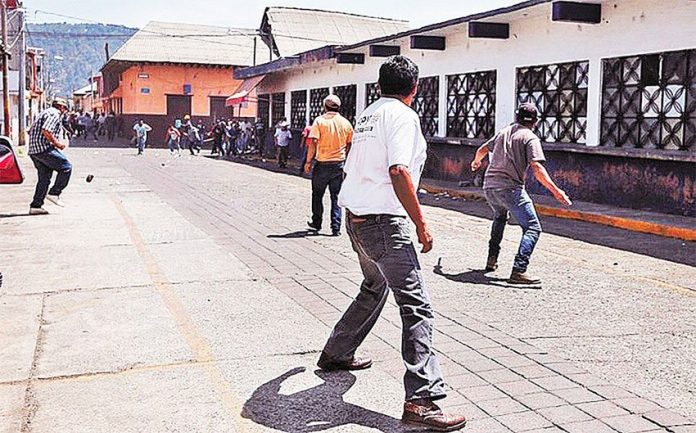
Around an hour after state authorities reported the discovery of Otlica’s body, a group of Nahuatzen residents went to municipal headquarters to accuse members of the Indigenous Citizens’ Council (CCI) of the mayor’s murder.
The latter – who opposed the deceased mayor’s rule – threw fireworks in an attempt to disperse the angry residents who responded by throwing rocks at the municipal palace.
The Michoacán government deployed 250 state police officers to restore peace to the streets of Nahuatzen. No arrests or injuries were reported.
The CCI has blocked access to the municipal offices to protest against what it claims were fraudulent local government elections last July.
The council also opposed Otlica’s manner of governing, arguing that Nahuatzen should be ruled by ancestral indigenous customs and traditions, a form of government known as usos y costumbres, and that the council should manage the municipal budget.
In November, the slain mayor filed a criminal complaint against members of the CCI for threats received both by him and other government officials and attacks to which they had been subjected. Four people were arrested, including the group’s leader, Gerardo Talavera.
The Michoacán Attorney General’s Office (FGE) said yesterday that it had opened an investigation into the mayor’s murder and pledged that “there will be no impunity.”
Otlica is the fifth Michoacán mayor killed since Governor Silvano Aureoles took office in October 2015.
President López Obrador declared this morning he won’t fight with the United States government after President Donald Trump accused Mexican soldiers of pulling their guns on U.S. soldiers in an incident at the border two weeks ago.
Trump declared on Twitter this morning he was sending troops to the border in response. “Mexico’s soldiers recently pulled guns on our National Guard soldiers, probably as a diversionary tactic for drug smugglers on the border. Better not happen again! We are now sending ARMED SOLDIERS to the border. Mexico is not doing nearly enough in apprehending and returning!”
The incident took place April 13 when six Mexican soldiers approached two U.S. soldiers in a vehicle near Clint, Texas. According to Newsweek magazine, the latter were “gently searched” and questioned.
Later it turned out that the Mexican soldiers had inadvertently crossed the border into U.S. territory.
Broadcaster CNBC reported “it was not immediately clear whether the president’s tweet meant that more troops will be deployed or if their mission will change. The White House did not respond to a request for comment.”
Mexico’s Foreign Affairs Secretariat said this morning that the incident was not out of the ordinary and that both governments were in contact throughout the situation.
The president said at his morning press conference that his administration “will not fall for provocations,” and “the most important thing is to say that we want a relationship of mutual respect and cooperation aimed at development . . .”
He also stated that the April 13 incident will be analyzed taking into consideration the remarks of his U.S. counterpart, “acting in accordance to the law and our sovereignty.”
Senator Sánchez condemns the media during a press conference.
A Morena party senator has accused media outlets of blowing out of proportion the story of Friday’s massacre in Veracruz in favor of a policy of “destructive opposition.”
Gloria Sánchez accused news outlets of “magnifying the drama” in their reports of the attack on a bar in Minatitlán that killed 14 people.
The senator from Veracruz noted that President López Obrador will visit Minatitlán this weekend to explain his security strategy directly to citizens “because unfortunately the media is blowing the story out of proportion.”
Sánchez’s comments provoked rebukes from politicians, journalists and others. One commenter urged her to “ask the family members of the victims and the residents of Minatitlán if the massacre was ‘dramatized.’” Others pressed the senator for an explanation of which of the events she considered to be false.
Later, Sánchez claimed on Twitter that she had meant “drama” in a different context, explaining she used the word to describe “an unfortunate occurrence that deeply unsettles us.”
She said Veracruz’ problems with insecurity were complicated and would not be solved “overnight,” declaring that the state government is working diligently to address the situation.
Violence has worsened in Veracruz since Governor Cuitláhuac García took office on December 1.
In the Veracruz city where 14 people were massacred in a bar Friday night, authorities are flying blind: most of Minatitlán’s security cameras don’t work.
Just 19 of 202 security cameras are operational, meaning authorities have no images to assist in the investigation into the crime and had no real-time footage that could have allowed them to respond quickly to it.
Mayor Nicolás Reyes said state authorities are largely to blame because they are responsible for the maintenance of 172 of the 202 cameras, of which only 10 are in working order.
He also said that even if a security camera had captured images of the perpetrators of Friday’s attack, municipal authorities wouldn’t have had access to the footage.
“All the municipal cameras are [monitored] in the C4 [security control center], which the state government is in charge of. We don’t manage them, we don’t have any [cameras]. Nothing. It’s completely managed there,” Reyes said.
The funeral for two of the victims — a man and his infant son.
“The truth is that . . . we had no idea that this was going to happen on the night of Good Friday . . . It surprised us enormously . . . We couldn’t predict this. [Such a large massacre] had never happened in Minatitlán or in Veracruz,” Reyes said.
The mayor said municipal authorities are now seeking at least 1.5 million pesos (US $79,000) in funding to ensure that the 30 cameras for which they have responsibility are maintained in working order.
Reyes also said the municipal government has reached an agreement with federal authorities for the army to carry out patrols of Minatitlán, a city which is home to one of Mexico’s six state-owned oil refineries.
Statistics from the National Public Security System (SNSP) show that there have already been more murders in Minatitlán this year than during all of 2018.
Between January and April 19 – the day of the massacre – there were 27 homicides committed with firearms compared to 25 last year.
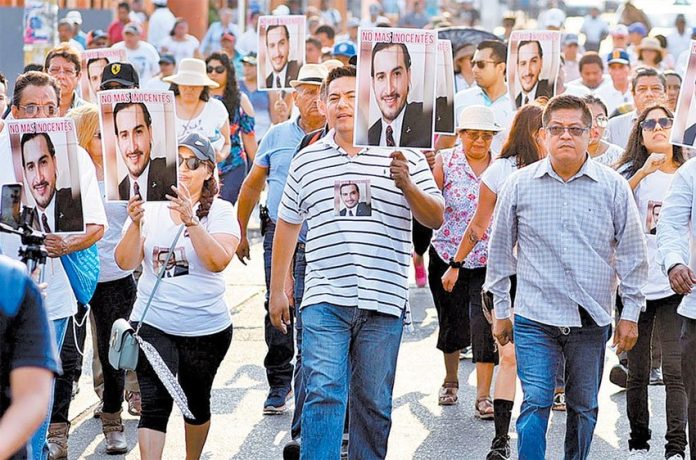
Yesterday afternoon, family members of the victims and local residents marched through city streets to protest against the high levels of violence and to demand immediate action by authorities.
They said that extortion, home invasions and armed robberies are also on the rise in the city.
President López Obrador, whose administration is faced with combating record-breaking homicide numbers, said yesterday that he will visit Minatitlán this Friday and reiterated that he is “working every day to guarantee peace and tranquility in the country.”
Around 300,000 migrants traveled through Mexico en route to the United States in the first three months of this year, according to the federal interior secretary.
Olga Sánchez Cordero described the migration flow as “unprecedented and “unusual” but acknowledged that a “mother of all caravans” did not appear as she warned last month.
However, “six caravanas madrecitas” (little mother caravans) of around 2,000 people each reached Mexico in recent months, she said.
Sánchez told a press conference that the highest number of migrants have come from Honduras with smaller numbers from Guatemala, El Salvador and Cuba as well as African and Asian nations.
The interior secretary said that Mexico is facing a migration situation unlike any in the past but rejected that the government has changed tack in dealing with migrants.
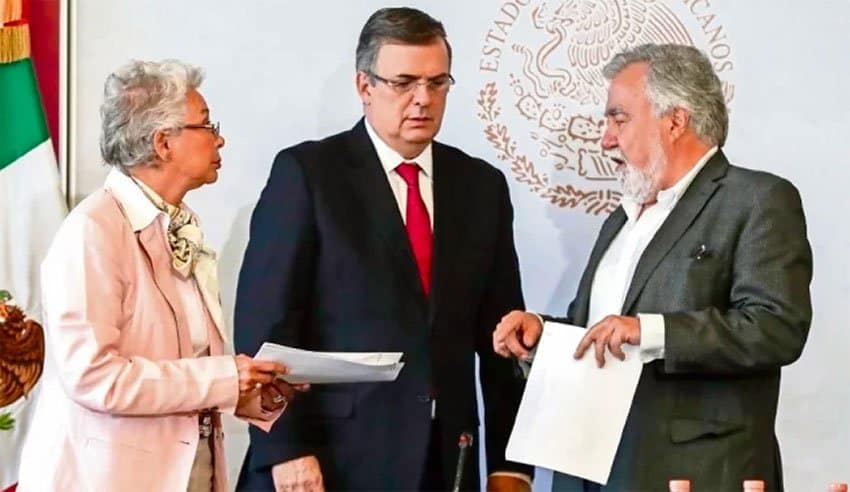
Sánchez, Ebrard and Encinas at yesterday’s press conference.
“We’re doing everything that is in the hands of the federal government to attend to these migrants and provide them with humanitarian attention. What we ask for is that they contribute with two basic forms of conducts: firstly, respect our laws and our authorities and secondly, accept registration as a pre-condition in order to decide their migratory situation in our country,” Sánchez said.
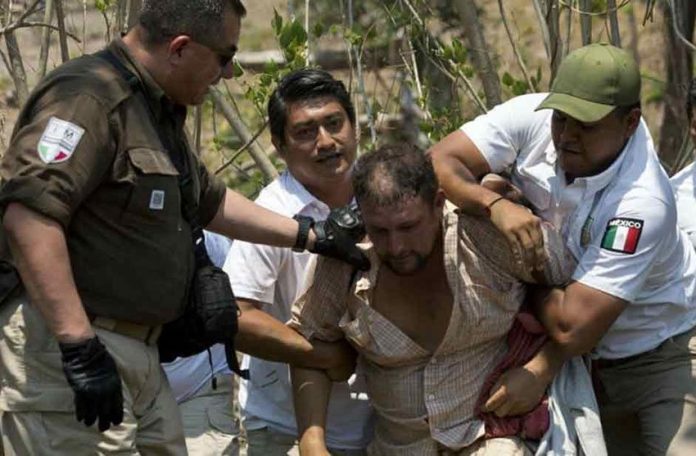
The detention of 371 migrants including women and children in Mapastepec, Chiapas, on Monday occurred because people had acted aggressively towards National Immigration Institute (INM) personnel, she explained.
Foreign Affairs Secretary Marcelo Ebrard rejected that Mexican authorities are detaining migrants in response to pressure from United States President Donald Trump to stop flows of people to that country.
Mexico’s migration policy “hasn’t changed and won’t change,” he said.
Ebrard added that he will travel to Washington D.C. next month to discuss bilateral issues including migration.
He acknowledged that the two countries’ “points of view” and “policies” on a range of matters are “different” but explained that one of the main reasons for his trip is to “improve the bilateral relationship.”
Ebrard also said that the Comprehensive Development Plan for Central America, which is designed to address the root causes of migration, is almost complete and will be publicly presented next month.
Also present at yesterday’s press conference was INM chief Tonatiuh Guillén, who revealed that 11,800 migrants were deported from Mexico in the first three weeks of April and 15,000 in March. In April last year, 9,650 migrants were deported.
A large number of migrants remain in the country, in Chiapas and several northern border cities, where most would-be asylum seekers face long waits to file their claims with United States authorities.
Human rights undersecretary Alejandro Encinas said the government is looking at creating a special fund to deal with the historically high levels of migration to Mexico.
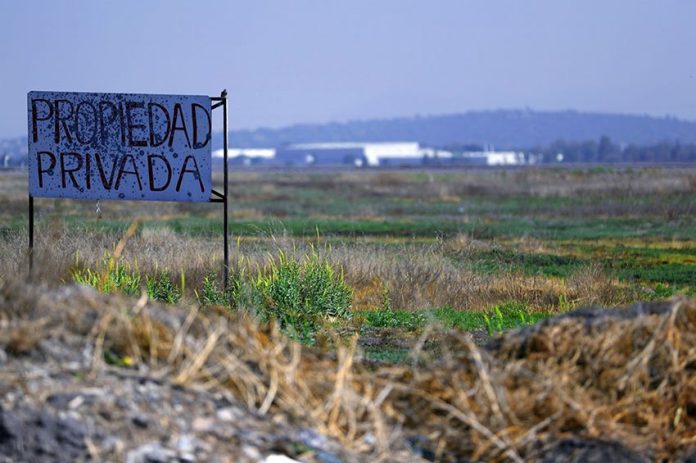
Site of the new airport at Santa Lucía Air Force Base.
The projected cost of the federal government’s airport project in México state has shot up by more than 8 billion pesos mainly due to the presence of a pesky hill less than 10 kilometers from the construction site.
However, the plan has had to be modified due to the close proximity of the 2,625-meter-high Cerro de Paula, according to a Secretariat of Defense (Sedena) report seen by the newspaper El Economista.
The position of the two commercial runways has been changed as a result, which means that several military facilities will have to be relocated. The cost of the changes is estimated to be more than 6.7 billion pesos (US $354.3 million).
The new master plan is being drawn up by French airport operator Aéroports de Paris and is expected to be presented in the second half of the year.
Higher than expected costs to purchase land that will serve as a sound buffer around the airport and to carry out a range of studies have also contributed to the projected cost rising from 70.34 billion pesos (US $3.7 billion) to 78.55 billion pesos (US $4.15 billion), an 11.5% increase.
The federal government has pledged that the new Santa Lucía airport will begin operations in 2021.
It is expected to operate simultaneously with the existing Mexico City airport and that in Toluca – both of which will be upgraded – although some aviation experts have questioned whether that will be viable given their close proximity to each other.
Located in the México state municipality of Zumpango, the Santa Lucía site is 50 kilometers north of Benito Juárez International Airport in the capital and around 100 kilometers northeast of the Toluca International Airport. A new 11.9-billion-peso highway is planned to link the first two airports.
The first stage at Santa Lucía, which will be built by Sedena, includes construction of two runways, a terminal building, a parking lot with space for 4,000 cars, a control tower, a maintenance hangar and a freight terminal, among other facilities.
The airport is planned to eventually have four different passenger terminals and an annual capacity of 100 million passengers.
However, in its first year of operations, it is expected that around 18 million passengers will use the new facility.
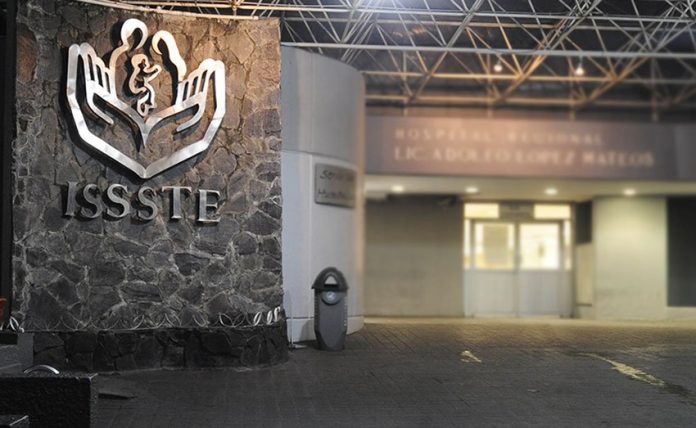
The state health plan for public servants is bankrupt and will run out of cash this summer if it doesn’t get a bail-out, its administration and finance director said yesterday.
Mario Zenteno Santaella of the ISSSTE warned that the agency would need a cash injection by July to continue functioning.
He told the Senate Health Commission there was a 128% increase in ISSSTE’s liabilities last year to 18.9 billion pesos (US $1 billion), compared with 8.3 billion pesos (US $439 million) in 2017.
Zenteno blamed the problem on previous “neoliberal” governments, accusing them of abandoning and dismantling the health service. He said liabilities totaled an average of 6 billion pesos each year from 2012 until 2017, before skyrocketing last year to nearly 19 billion pesos.
He hinted that the huge increase was related to the fact that 2018 was a presidential election year.
“There are parties responsible [for this situation], and we will reveal them in due time.”
The director went on to paint a general picture of widespread corruption, which he admitted might not yet be entirely stamped out. He revealed that under previous governments, the directors’ positions at the institute were used as a pay-off to losing gubernatorial and mayoral candidates.
Zenteno said another enormous drain on the institute’s finances was a 13.4-billion-peso annual contract signed with the medical distribution provider SILODISA, which provides expensive services that the ISSTE could be capable of carrying out internally.
He also mentioned irregularities in the prices the institute pays for supplies because of widespread collusion in the privatization and decentralization of services. For example, an anti-fungal antibiotic costs 640 pesos in the 20 de Noviembre hospital, but it can actually be purchased for 208 pesos.
Zenteno also said the ISSTE owes money to employees.
“I hope that when we see each other again in October we can very clearly show you how we’ve advanced, but I reiterate that the institute is bankrupt — and we’re not magicians.”
Asked about the situation at this morning’s presidential press conference, President López Obrador said the problems were not insurmountable.
“There is no crisis that cannot be dealt with.”
He said “we’re going to make progress because [now] there is discipline in the management of the budget, there is no corruption, there are no superfluous expenditures, there are no luxuries in the government. We are taking in more than last year.”
The president also managed a dig at one of his successors, blaming former president Vicente Fox for tax amnesties that cost “billions of pesos.”