Beetles from across the country and elsewhere have been crawling their way up to Rincón de Guayabitos, Nayarit, for the traditional Guayafest, an event organized around the iconic, two-door, rear-engine Volkswagen car.
Organized by the Tepic-based TPC Bugs Club, Guayafest will be celebrating its 20th edition this weekend, attracting over 350 Volkswagens, including vochos and combis, as the bugs and the VW vans are commonly known in Mexico.
Festivities begin today at 5:00pm with a two-hour parade that runs through Los Ayala and La Peñita de Jaltemba. Participants will be accompanied by a security detail from the Compostela and state traffic police.
Back in Guayabitos, participants will be feted in the town’s main square with plenty of beer, tacos and live music.
Tomorrow at 8:00am proud Volkswagen owners will sign up for the competition in 35 categories, from classic vehicles dating back to 1949 to the latest models.
[wpgmza id=”174″]
Two hours later the cars will be on display for judges to assess and the public — around 1,000 attendees are expected — to admire. At 3:00pm, awards will be given to the first three places in the original, modified and custom categories.
Billed as a family-friendly event, there will be food, drink and entertainment, and an area were spare VW parts and accessories will be on sale.
There will be more music and other activities throughout the day tomorrow. Admission is free.
Rincón de Guayabitos — a town that consists of little more than a 2.5-kilometer stretch of golden sand and two parallel streets — is located just over one hour north of Puerto Vallarta.
Mexico’s banana exports broke a record last year after shipments rose 7.9% over 2017, according to the federal Secretariat of Economy.
Close to 570,000 tonnes of bananas worth US $259 million were exported, mostly to the United States which purchased $193 million worth.
Japan was next at $13 million followed by the Netherlands at $11 million, and Russia, South Korea and Ukraine at $5 million each.
Banana producers in Mexico have the benefit of being able to harvest their produce year round and technological resources in refrigeration and transportation mean that no market is too distant to enjoy the product fresh, said a report by Opportimes.
The chief producers have consolidated their commercialization process, setting up warehouses in the Iztapalapa wholesale market in Mexico City. It is estimated that 80% of the banana production from the main producer states is sold and shipped from that distribution hub.
Mexico was the world’s 15th biggest banana exporter in 2017 with 2% of the total. Ecuador was No. 1 with exports totalling $3 billion.
Hands are raised in agreement with a policy of prudence in Mexico's dealings with the US during AMLO's 'public consultation' in Veracruz.
President López Obrador has been accused of being “submissive, timid and cowardly” in the face of United States President Donald Trump’s latest threats towards Mexico, but lawmakers from the president’s own party defended his non-confrontational approach to diplomatic relations.
Trump took to Twitter yesterday to threaten to close the southern border next week “if Mexico doesn’t immediately stop all illegal immigration coming into the United States.”
He also wrote that “Mexico has for many years made a fortune off of the U.S.” – presumably referring to Mexico’s trade surplus with the United States – “but they just take our money and talk.”
The latest aggressive tweets continue a long tradition of Trump using Mexico as his punching bag.
As he has done on several occasions since taking office in December, López Obrador yesterday refused to be baited by Trump’s threats.
“We want to have a good relationship with the United States, we’re not going to argue,” the president said.
Later in the day, López Obrador asked supporters at an event in Veracruz whether he should reply to Trump every time that he refers to Mexico.
“No,” the crowd shouted back at him. “Is it true that we should have good relations with the government of President Donald Trump?”
“Yes,” they responded, to which López Obrador quipped, “look at the people, the people are wise.”
He then asked people to put up their hands if they believed that the government “should act with prudence” in its relationship with the Trump administration.
The majority of attendees duly raised their hands, drawing a smile and applause from López Obrador who remarked, “that’s my people.”
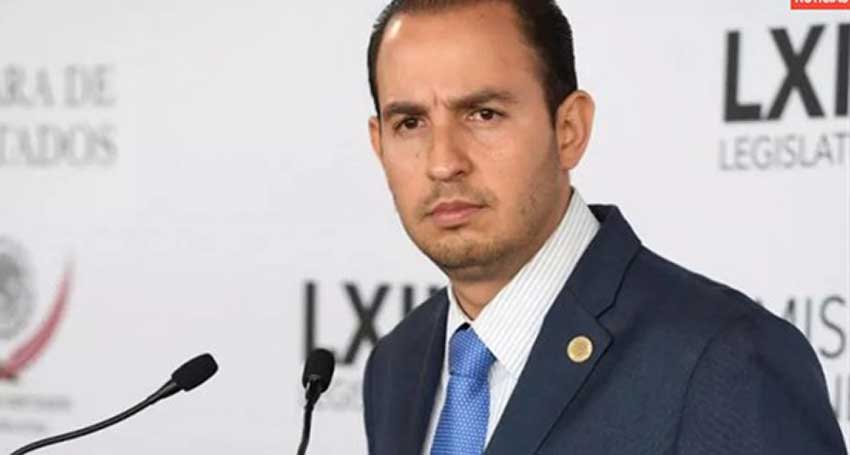
National Action Party leader Cortés criticized the government for a ‘cowardly’ response to Donald Trump.
The approach of the president – and that of his government more widely – to dealing with Trump and the United States government was criticized by the national president of the opposition National Action Party (PAN) at an event yesterday in San Luis Potosí.
“The submissive, timid and cowardly attitude that the government has had with respect to Donald Trump and his position against Mexico concerns us. We ask the federal government [to show] bravery, strength and dignity to defend Mexicans. We can’t have the government simply responding with silence,” Marko Cortés said.
There has been “a shameful silence” in response to Trump’s threats to close the United States border, Cortés charged, although Foreign Affairs Secretary Marcelo Ebrard did address those threats in a Twitter post yesterday morning.
“Mexico does not act on the basis of threats. We are a great neighbor,” Ebrard wrote.
“Ask the million and a half Americans who have chosen our country as their home, the largest community of Americans outside the United States. For them we are also the best neighbor they could have,” he continued.
Senate president Ricardo Monreal said he will ask lawmakers from all political parties in the upper house to come together to sign a parliamentary note that will be sent to the United States Congress to denounce Trump’s insults and threats towards Mexico.
“We’re going to make use of our parliamentary diplomacy . . . We’re not going to tolerate harmful and insulting attitudes towards Mexico,” he said.
However, the Morena party senator predicted that the U.S. president will only harden his attitude and language about Mexico as part of a strategy to win support in the lead-up to the 2020 election.
Trump will seek to get out of his “muddle” of domestic problems by accusing Mexico of doing nothing to help stem immigration to the United States and “vociferating against global migration,” Monreal said.
“We must understand that he’s worried about votes because a lot of people have withdrawn their support for him due to his xenophobic, racist and intolerant attitudes,” he added.
The senator asserted that López Obrador has acted prudently in the relationship with Trump and the United States government.
“Obviously he won’t confront the United States with a scornful or forceful attitude but rather one of respect . . .” Monreal said.
“However, President Trump mustn’t confuse prudence with weakness,” he added.
Héctor Vasconcelos, another ruling party senator and former ambassador to Denmark, also defended López Obrador’s decision to not respond to Trump’s “broadsides” against Mexico.
“Imagine if the president of Mexico entered into this dynamic of [making] statements that are increasingly violent, that could even become slanderous. That would be to move towards a situation that would jeopardize the bilateral relationship. The president of Mexico cannot enter into a competition to see who makes more violent statements,” he said.
“. . . We can’t let ourselves get hooked and respond to broadsides with more broadsides,” Vasconcelos added.
Like Monreal, the senator contended that Trump’s latest outburst was politically motivated.
“Unfortunately, this issue of the migrant caravans is entwined with the agenda and electoral calendar in the United States,” Vasconcelos said.
“There are elections there next year. De facto campaigns have already begun and that has further clouded a complicated issue. The statements and threats of President Trump have more to do with satisfying his electoral base with a view to next year’s elections than anything else.”
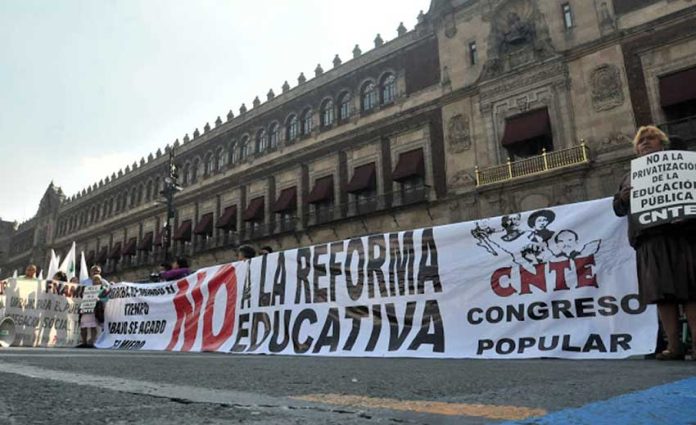
Teachers during a protest last month at the National Palace in Mexico City.
Evaluating teachers is not a priority for the federal government, President López Obrador said today as debate over the new education reform continues.
The president pledged that the government will strengthen Mexico’s public teacher training colleges and therefore evaluation won’t be vital, although the government doesn’t intend to do away with it completely.
“. . . Evaluation isn’t essential for us because if the teacher training colleges are strengthened, teachers are going to leave well-prepared to carry out their educational work . . .” López Obrador said.
Compulsory evaluations introduced by the previous federal government as part of its 2013 education reform were condemned by the CNTE teachers’ union, which has held countless protests to demonstrate its opposition.
Education Secretary Esteban Moctezuma reiterated today that teacher evaluation as provided for in new legislation will not be used punitively to determine whether a teacher keeps his or her job as was the case under the administration led by former president Enrique Peña Nieto.
The CNTE union nevertheless remains unhappy with the composition of the new education reform and has continued to place pressure on the federal government to change it by blocking access to the lower house of Congress this week.
The blockade was lifted early this morning but union members warned that they would return next week if their demands are not met.
CNTE member Gonzalo Martínez Villagrán told a press conference yesterday that the union wants the complete abrogation of the 2013 education reform, freedom for political prisoners and immediate reinstatement of teachers who were dismissed after failing evaluations.
In the new education legislation prepared by the government, around 80% of the education laws introduced by the Peña Nieto government remain.
Opposition lawmakers said yesterday that they will withdraw their support for the new education reform if López Obrador and the government give in to the demands of the CNTE.
“. . . We will not accept moving backwards just to please a small group that is seeking to pressure and blackmail [the government] in search of privileges,” said René Juárez, leader of the Institutional Revolutionary Party (PRI) in the lower house of Congress.
“The president should talk to the discontented teachers to reach positive agreements, not to give them everything they ask for,” he added.
Democratic Revolutionary Party (PRD) lower house leader Verónica Juárez Piña said “the agreement will be at risk if they make changes to what has already been approved without consulting and without the consensus of all parties.”
Juan Carlos Romero Hicks of the National Action Party (PAN) said “if there are changes in central issues, like evaluation and the control of [teaching] positions, we obviously won’t support the reform.”
The coalition led by López Obrador’s Morena party has a majority in both houses of Congress.
However, as the 2013 education reform required changes to the constitution, the president needs the support of two-thirds of Congress in order to repeal it and pass his government’s plan.
Most of the union opposition to the education reforms comes from the state of Oaxaca, where most of its membership is based. The Section 22 local has a long history of often-violent protest and its quarrels with different governments over the years have been more about political differences than education.
A new clothing and accessories line carrying the brand of former Sinaloa Cartel leader Joaquín “El Chapo” Guzmán, complete with the convicted ex-drug lord’s name and signature on every article, is slated to hit shelves this summer.
This week, Guzmán received special permission from the Metropolitan Correctional Center to sign the intellectual property rights to his name and signature over to a company headed by his wife, Emma Coronel.
El Chapo Guzmán: JGL LLC became an official entity today.
Coronel, a former beauty queen, told the news network CNN that the project will be dedicated to securing the future of the couple’s seven-year-old twin daughters.
Alejandrina Guzmán and her El Chapo 701 label.
“I’m very excited to start this project, which was based on ideas and concepts that my husband and I had years ago.”
Guzmán attorney Mariel Colon Miro said the ex-drug lord will not have any role in the company.
“It’s not his project; it’s Emma’s project.”
Another of El Chapo’s lawyers, Michael Lambert, agreed, stressing that Guzmán will not see any of the company’s profits.
“He wanted to be able to set something up — a legitimate enterprise — for the benefit of his wife and his two daughters.”
U.S. authorities have said they will attempt to confiscate billions of dollars that they believe Guzmán’s organization earned as proceeds from drug trafficking, but former federal prosecutor Duncan Levin doubted they would be successful.
“A lot of the assets are in the name of other people. It’s hard to find them, and once you find them, it’s hard to get the buy-in of the Mexican government.”
Levin said the U.S. government could use the new company to seize some of Guzmán’s assets for attempting to make money off his crimes and infamy.
Colon said the enterprise intends to collaborate with fashion designers but Guzmán’s wife will be heavily involved in all aspects of the company, including design.
Design work for many of the products, including baseball caps, T-shirts, denim jackets, sweatshirts and phone cases, is already in progress.
But Coronel is not the only member of the family who has seen the marketing potential of the El Chapo brand. Alejandrina Guzmán, supposedly a daughter, has launched El Chapo 701, whose website advertises myriad products though none appears to be available for purchase yet.
As I sit at my desk attempting to bang out this week’s column, the noise of rotohammers combined with the off-key songs of several laborers fill our crumbling house with a discordance only experienced during a Mexican construction project.
After waiting an anxiety-fueled 22 months for our house deal to close, we finally began our renovation project 10 days ago.
We started with the demolition of several interior walls and the removal of most of the plaster on an exterior wall. Our work crew consisted of three laborers with two rotohammers, one 12-pound sledge hammer, two small hand sledges, a few chisels, two square-bladed shovels and 100 used, woven polyethylene feed bags for the rubble.
The Captured Tourist Woman had never experienced the complete and utter destruction wrought by hard-working Mexicans with power tools and sledge hammers; she was very impressed.
The first staging of scaffold, on an outside wall, was erected before all else. All three assured me they were capable of erecting multiple frames of scaffolding to create a safe working platform. I pointed them to a stack of frames, braces and planks and showed them where to start.
Since the ground below the scaffold setup was level and solid, I felt the assembly would be a simple test of their skills or lack thereof. As I left them to their devices, I envisioned Larry, Moe and Curly faced with a similar task. I was not disappointed by my canny premonition when I reappeared 10 minutes later.
I then worked with the three of them for 20 minutes and we successfully erected the scaffold across the back wall of the house. Sometime after lunch, when they had stripped off the bad plaster at the west end, we needed to move the western-most section of scaffold to the eastern end to access the wall at that end.
However, that scaffold section needed to have the legs extended because the ground dropped off four feet to the sidewalk. I pointed to a couple of six-foot wooden posts and explained the process of attaching leg extensions.
All three were smiling and nodding while assuring me with a repeated chant of “No hay problema.” Again, I left them to accomplish this seemingly simple task on their own.
When I returned a bit later, they had laid the 4×4 posts on two stacks of bricks which resembled something illustrated by Dr. Seuss; all higgledy-piggledy and wiggledy-figgledy. I stopped them before they attempted to stand a scaffold frame on their shaky construction.
I placed one of the posts alongside and parallel with a scaffold leg and explained how the post would be lashed on with multiple wraps of high quality Mexican bailing wire. They all grasped the concept quickly, or at least the part about the use of the wire seemed familiar.
As I watched, they all jabbered their rapid-fire Spanish, heavily laced with local slang, and formulated a plan. Two of the workers each grabbed a side of a scaffold frame and held it up vertically and elevated it to the approximate position it would assume once the posts were added. The third worker then picked up a post and held it against one leg of the scaffold with his shoulder, and then attempted to wrap up the assembly with the wire.
In retrospect, I should have stopped them when the two had picked up the scaffold frame, but my morbid curiosity held me back. By the time I put up my hand, and said alto, the two workers clutching the frame were having a very hard time keeping it in the air.
We found a nice level piece of ground and laid the frame down. I then directed them to lay a post next to each leg, take a rough measurement of the amount of extension required to level out the assembly over the uneven ground. With two workers holding the post tight to the frame, the third wrapped the wire and tightened it with the standard Mexican tie wire hook used for rebar. They found this simple feat of true Mexican engineering quite impressive.
The 45 minutes I had spent observing their antics gave me an accurate gauge of their construction experience, which was minimal at best.
The only thing I ask of any worker is to show up on time and work to the best of their ability. I found that questioning a worker will not reveal their true capabilities or skill level. After all, every albañil (mason) claims to be a tilesetter and every electrician claims to have in-depth knowledge of electrical systems.
And of course, with laborers being at the bottom of the construction hierarchy, their self-proclaimed expertise can be anywhere from digging holes to brain surgery.
To some, my method of testing the three laborers may be perceived as being cruel and unusual, but it quickly cuts to the chase of who can do what.
The next installment of this series will examine several pressing questions. Can old albañiles be taught new tricks? Will the use of modern tools and methods be instantly embraced, or fiercely rejected?
The writer describes himself as a very middle-aged man who lives full-time in Mazatlán with a captured tourist woman and the ghost of a half wild dog. He can be reached at buscardero@yahoo.com.
Smoke in San Felipe after clash between fishermen and the navy.
Three people were injured in a confrontation yesterday between the navy and suspected illegal totoaba fishermen in San Felipe, Baja California.
The Secretariat of the Navy (Semar) said in a statement that a man was accidentally shot yesterday morning as he tried to escape in a vehicle that was towing a boat that had allegedly attacked a vessel operated by an environmental organization.
Occupants of the first boat recovered illegal fishing nets that had been removed from the vaquita porpoise reserve in the upper Gulf of California by Sea Shepherd Conservation Society activists and then returned to San Felipe, said the navy.
There, they boarded a pickup truck and attempted to flee navy personnel but collided with a navy vehicle. One person was shot in the confrontation that ensued, Semar said.
According to local media, the wounded man was 37-year-old Enrique García Sandez. He was taken to a local clinic but later transferred to a hospital in Mexicali with serious injuries.
The news website El Imparcial reported that a 65-year-old woman and a 17-year-old were also injured in the confrontation. The latter, Ricardo Zúñiga, was treated at a Mexicali hospital.
Rosa María Zaragoza González was in the street during the clash and grazed by a stray bullet . She was treated for the injury at a San Felipe clinic.
After the confrontation, Semar said, a group of people protested violently in front of navy facilities. A vehicle and two small boats were set on fire and navy facilities were attacked with Molotov cocktails and other objects.
Although their use is prohibited, fishermen have continued to use gillnets to catch totoaba, whose swim bladder is a delicacy in China and commands high prices.
The vaquita marina, the world’s smallest porpoise, often become entangled in the nets and die.
Swarms of monarch butterflies at the El Rosario Sanctuary.
It had been over eight years since I last visited the El Rosario butterfly sanctuary located near the community of Ocampo, Michoacán, so I decided it would be interesting to revisit the area after hearing several conflicting reports regarding this year’s migration.
Some friends said the trek was disappointing (strange given that the number of monarchs this year was up by 144%) while others I knew raved about the experience.
What I do remember of my first visit was that the climb to the top was long and arduous and took my late husband and I over an hour to do. At the top of the hill there was a single rope, guarded by locals at the entrance so that you did not step over into the sanctuary.
We were instructed to lower our voices in order not to disturb the colony of what seemed like billions of butterflies within arm’s reach. The magical sight of the monarchs rising in the air when the sun peeked from behind the clouds was indescribable, and I remember vividly the sensation of them landing on us.
Fast forward many years later to an overnight stay in Morelia and a four-hour drive to El Rosario the next morning. On the way our tour guide for our group of five explained some of the rules and regulations once in the sanctuary, the usual things such as keep your voice low, don’ t litter, stay on the path at all times and refrain from touching the butterflies, even those that were dead.
Butterflies at rest near the sanctuary entrance.
I was impressed by this because one of the many things I had heard about the sanctuary was that not enough care was being taken to guard the colony from the numerous tourists. It was encouraging to see that for this tour company at least, conservation was important.
Driving into the sanctuary, however, was much different from what I experienced before. For one thing, there were far more butterflies at lower altitudes than I remembered. In fact, I was concerned by the number that hit our minivan as we drove very slowly and carefully into the parking lot.
They swarmed the area as we walked to the entrance to pay our 50-peso fee. Nearby, mini-restaurants dotted the area off to one side. Gone, it seemed, were the charming restaurants and souvenir shops that once lined the pathway on the way up or down.
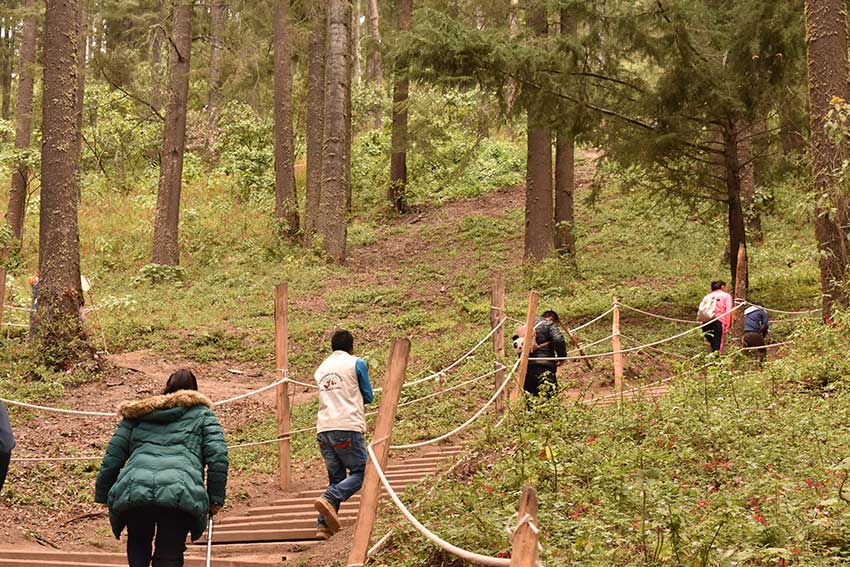
Whereas before our path was crude, the new one was mostly wooden stairs, with ropes along each side to help you along, and several benches on which to rest. The climb would take between 30 and 40 minutes, our guide said, (much less than I remembered) but this time around I chose to go by horseback.
It was an easy switchback climb for the horses, and with the guide running (yes, running) beside my horse, we made it to the top in seven minutes! Even as an experienced rider, I was taken aback by how close it was. Another short walk from where I dismounted, and I was there.
Was I disappointed? Yes and no. Yes, I could easily see the magnificent clumps of butterflies from the path and when the sun came out millions of monarchs rose in the air. No, they did not land on me, which is of course a good thing as human contact is not to be encouraged. But I enjoyed the spectacle for quite some time before heading down.
At a stop off point before the sanctuary a lone butterfly passes by at a lower altitude than is desired.
I was surprised to see numerous mounds of dead butterflies on and around both sides of the path. Coupled with the inordinate number of butterflies in the lower elevations, I decided to investigate the cause.
Moisés Acosta first came to Michoacán as a young man after studying tourism in Mulegé, Baja California Sur. Although not a biologist or an expert in zoology and botany, he somehow landed a position at the Monarch Butterfly Biosphere Reserve office due in part of his knowledge in tourism.
Here he dedicated himself to educating people about the dangers facing the monarch population. But he was often discouraged by visitors who disobeyed clear directions not to enter the areas of the colony that were cordoned off.
The complete disregard as to what was needed to protect the monarchs from extinction caused him to reach out to scientists and biologists in the Americas, where he garnered support from non-governmental agencies who have been able to pressure the government of Mexico.
He then decided to build his own butterfly farm, Papalotzin, for educational purposes.
But Acosta suffered many trials when launching the project in Zitácuaro, Michoacán. At one point his sanctuary was burned out. Although nothing was proven, cans of gasoline — suggesting arson — were left at the site.
A young girl covered in butterflies.
The fire occurred right after Acosta contacted authorities about illegal logging in the Sierra Chincua sanctuary in 2015, in which 10 hectares of forest at the heart of the sanctuary were destroyed.
Back at El Rosario, the reason why more butterflies are being seen at lower elevations is due to the creation of artificial watering holes near the sanctuary entrance, Acosta says, explaining that the move attracted the monarchs and prompted them to form colonies too close to the entrance.
Many are now exposed to automobile fumes and human contact.
I also contacted a tour operator I met years before and he sent me to seek answers from a scientist who had much to say about the migration of the monarchs and the preservation of the species.
I learned that the preservation of the monarch butterflies is a project that should be shared equally by the United States, Canada and Mexico if the species and indeed all pollinators are to survive. The pressure to preserve the population is huge but the protection of reproductive habitat is the responsibility of the U.S. and Canada, said the scientist, who wished to remain anonymous.
What happens in the winter months is the responsibility of Mexico. “We need to work together and collaborate to protect the monarchs instead of blaming each other for the decline or danger that the butterflies are in.”
Canada and the U.S., particularly in the prairies and in large industrial agricultural areas, must decrease the amount of herbicides and pesticides they spray on their crops of corn and soy, and use more of the land to plant milkweed for the monarchs on their migration path, he said.
Walking the paths to the top at El Rosario Sanctuary.
Another concern in Mexico are the logging practices of some of the locals. The trees that monarchs favor — and that are vital to their survival — have been subjected to “reforestation” practices by people who stand to gain financially from the effort.
The problem is the Oyamel tree does not do well when transplanted and it’s best if these ecosystems regenerate naturally. As well, the forest needs to be dense. Although it was necessary to clear some of the forest when a recent storm knocked down many of the trees, it is hard to say how many were knocked down and how many were cut.
As overwhelming as all the issues concerning the monarchs sounded, another source, scientist Pablo Jaramillo López, offered some suggestions as to how we can safeguard the future well-being of the monarchs:
1. Government, farmers and citizens need to work together to encourage the planting of local species of milkweed and other nectar flowers in their gardens and fields in the U.S. and Canada.
2. Stop logging practices that will hurt the migration of butterflies and discontinue pumping water into lower altitudes and away from where they would naturally form their colonies.
3. Encourage tourists to visit the sanctuaries between November and January instead of cramming all tours into February and March, thereby decreasing the human impact on the species.
4. Education as to how to behave at the sanctuary.
5. Although there are five sanctuaries in Mexico open to the public now, there are other areas that are not. These should remain so.
The writer is a Canadian who has lived and worked in Mexico for many years.
Edrington executive Juan Barbato, left, and Mexico manager Campos toast the Mexican whisky market.
With the consumption of 1.3 million cases a year, Mexico is the second largest consumer of premium scotch whisky in the world, second only to the United States, according to the Scottish distiller Edrington.
On Monday, the company’s distribution agreement with tequila maker José Cuervo will come to an end. Edrington intends to be its own distributor and make its entire portfolio available in Mexico.
One of the company’s popular brands is The Macallan, a premium single-malt whisky whose sales run about 24,000 cases a year in Mexico, which is now among the top 10 markets in the world for the product.
“We had an international presence in all markets, but we were missing Mexico,” said Edrington México general manager Juan Campos at a press conference this week. “We see a great opportunity for whisky.”
The company wants to double its whisky sales here within the next five years, he said.
Edrington has opened offices in Mexico City and Guadalajara to that end.
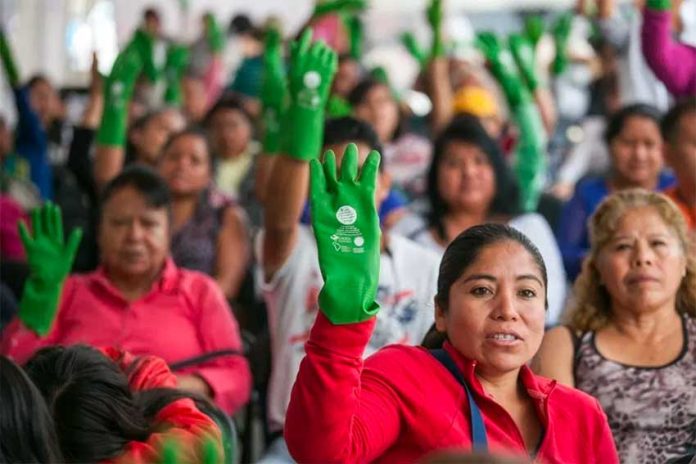
Domestic workers at a rally for better pay and benefits. The green glove is a symbol of the movement.
Domestic workers have told the National Minimum Wage Commission (Conasami) that their daily salary should be set between 102 and 550 pesos (US $5 to $28).
Conasami president Andrés Peñaloza told the newspaper El Financiero that talks with domestic workers are currently taking place and that a formal salary proposal will be presented to the commission’s governing body in May.
“. . . They’ve suggested a range that goes from 102.68 pesos up to 550 pesos,” Peñaloza said, but added that some workers have pushed for a daily wage of between 205 and 300 pesos (US $10.50 to $15.50).
The daily minimum wage for all workers increased by 16% on January 1 to 102.68 pesos but data shows that domestic workers earned an average of 155 pesos per day during the first month of this year.
Peñaloza said Conasami will continue to discuss the wage issue with domestic workers in different parts of the country and that it will also take into account criteria recommended by the International Labor Organization (ILO).
There are 2.3 million domestic workers in Mexico, of whom 40% earn the minimum wage and just 3% have access to social security and health care benefits.
In an amparo, or injunction, the SCJN ordered the Mexican Social Security Institute (IMSS) to implement a pilot program in the first half of this year that will ensure that domestic workers have access to the benefits they will be legally entitled to.
Today, the rules under which the pilot program will operate were published in the federal government’s official gazette.
Starting tomorrow, employers will be able to enroll people who work in their homes in the pilot program either through the IMSS website or at its offices.
Employers will be required to pay a monthly fee to IMSS that will give their employees access to sickness, maternity, health care, disability and retirement benefits as well as life insurance.
Contributions paid by employers will vary depending on how many days per month they employ a domestic worker.
If a housekeeper works at two or more homes, his or her employers will share the IMSS enrollment expenses.
The SCJN said that within a period of no longer than three years, all domestic workers in Mexico should be enrolled in a robust and effective social security scheme.