Home Blog Page 2112

The restaurateur who’s turning Tulum’s waste into a compost farm

0
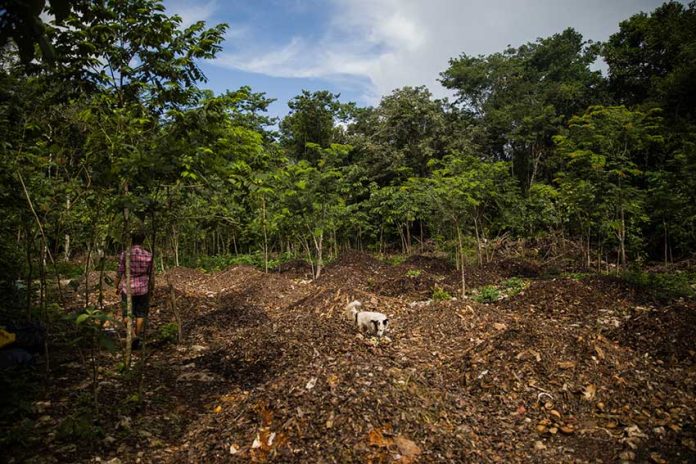
Heaps of compost occupy an open space in the jungle of Woolis Farm.
Heaps of compost occupy an open space in the jungle of Woolis Farm. jenna Belevender

Mauricio Jervis never intended to be a chef. Nor did he anticipate becoming an expert in compost and recycling.

But now, the owner and chef of a Tulum restaurant whose supplies are locally sourced is also the founder of an organic waste management organization that seeks to take on the town’s massive trash problem, brought on by rapid population growth and an explosion in tourism.

Still, Jervis said, he’s not a savior. Just a guy with ideas who saw a problem that needed addressing.

A native of Mérida who also dabbles in photography, Jervis first became aware of the town’s trash problem when asked by fellow chef and writer Juan Pablo Inés to photograph the former garbage dump site for a Yucatán magazine. Inés would later become a partner in Jervis’ restaurant.

That dump site, an eight-hectare, clear-cut part of the jungle roughly 9.5 kilometers from Tulum, received 160 tonnes of waste per day (40-60% of which was organic). The new official disposal site has been open only a year and is already at capacity.

Shocked at the level of inefficiency and contamination, where garbage seeps into the underground river systems which form the region’s freshwater cenotes and winds up in the ocean, Jervis sought to provide an alternative.
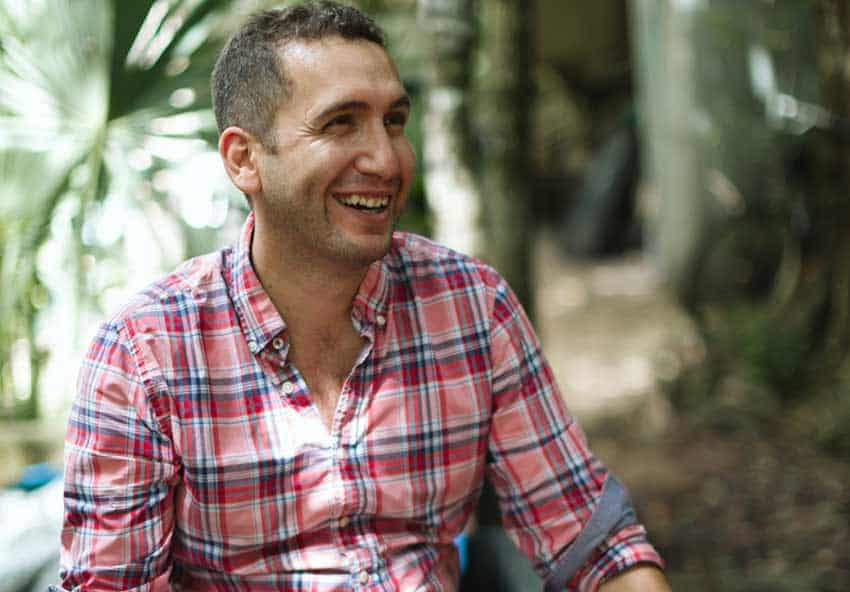
Chef and organic farmer Mauricio Jervis at Woolis Farm, north of Tulum.
Chef and organic farmer Mauricio Jervis at Woolis Farm, north of Tulum. jenna Belevender

He founded Woolis Green Solutions in 2016 and now has 20 clients, including restaurants and hotels in the Tulum area. During high season, he and his team collect nearly two tonnes of organic waste each day, all of which travels in the back of a pickup truck to Woolis Farm, about a half-hour north of Tulum.

Jervis, also the owner and executive chef of Tulum’s Farm To Table restaurant, says the ideal scale of the recycling and composting project would be unlimited. But the issue is that some businesses don’t want to spend the money.

“Every restaurant prices things differently. At Farm To Table we have a 45% food and beverage cost which most people would be freaking outraged at,” he said.

“But what we are trying to do is completely different. On average, each restaurant produces about two kilos of waste for an average two-course menu, so you’re looking at about three to four kilos for a fine dining experience for two. For 100 people at our restaurant, we produce 200 kilos of waste per day. That’s a very general number that varies day to day. It’s really a result of whether we’re paying attention or not.”

Solutions for reducing waste in restaurants can be as simple as one of Farm To Table’s methods, which includes emptying the fridge each day before dinner service begins and seeing what can be used again. This results in an ever-rotating menu.
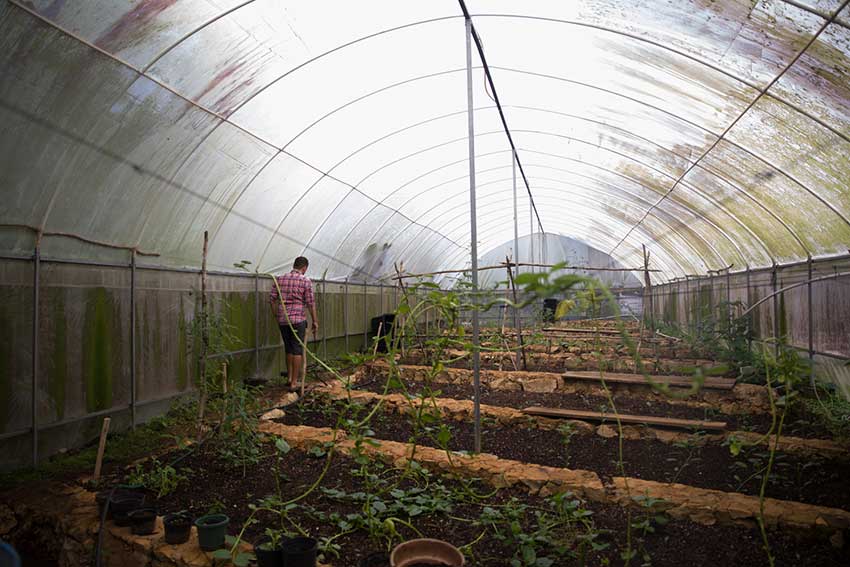
Jervis walks through the greenhouse at Woolis Farm
Jervis walks through the greenhouse at Woolis Farm. jenna Belevender

“You’re always going to have some sort of waste, it’s just how creative are you to reduce it,” Jervis said. “For us, it costs about seven pesos more on a dish to do this. You don’t have to make a profit on it, so instead of paying 150 pesos for three tacos on the beach, you have people pay 160 and you put on the menu that the extra 10 pesos is going toward a compost solution for the town.”

Jervis says that hotels and restaurants will often feign excitement at the proposal. Woolis, which gets its name from the Mayan word for “cycle,” will distribute boxes that fit up to 50 kg of waste, and will remove them for 550 pesos. A one-time staff training fee is 1,500 pesos, and businesses are charged a monthly collection fee of 3,500 pesos per tonne of waste collected.

All waste is taken to Woolis Farm, in the vicinity of nearby Puerto Aventuras, sorted and distributed for animal feed and aerobic and anaerobic composting which ultimately becomes the fertilizer and soil for the herb, fruit and vegetable gardens.

“There are restaurants that promote having compost and I know for a fact that they don’t,” Jervis said. “There are restaurants in town that literally publish with magazines saying that they compost and are healthy and local, but you’ll find smoked salmon and tuna on their menu, from Alaska. We advise restaurants that they shouldn’t offer it on their menu and their response will be ‘well, the customer wants it.’”

Jervis sees Farm To Table as one of the vehicles to spread the word around the region.
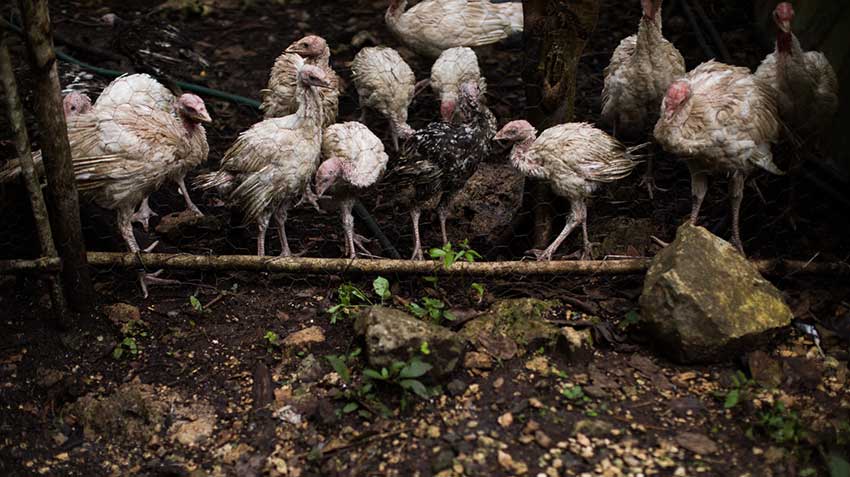
Free-range chickens at Woolis Farm.
Free-range chickens at Woolis Farm. jenna Belevender

“The people I really want to reach are dishwashers, waiters, cooks, chefs; those are the people I’m going for,” Jervis said. “Management, owners; I don’t care about them. They should be educated anyway. The chefs and bussers are the ones who have their hands on it.”

Woolis Farm lies on a perpetually shady and bumpy dirt road leading from the highway into the thick of the jungle, where Jervis has taken over a parcel of seven hectares and a hacienda-style home.

Six people live and work on the farm, where chickens, pigs and any number of jungle animals roam freely. Jaguars, owls and monkeys have been known to make an appearance. Frogs and spiders are ubiquitous.

The state of Quintana Roo is blessed with abundant freshwater and sunshine, so little irrigation is needed. The property has its own cenote, which is fed by rainwater filtered through layers of limestone.

“Here, you taste that spice in the food which comes because there is activity in the soil,” Jervis said, handing me a piece of arugula nearly as potent as a habanero. These pigs, their pork is good for you. It is high in omega 9s, omega 2s and omega 6s. I learned that recently because a professor that is studying native breeds of pigs was here and he’s comparing the factory pig to the free range, waste-fed pig.”
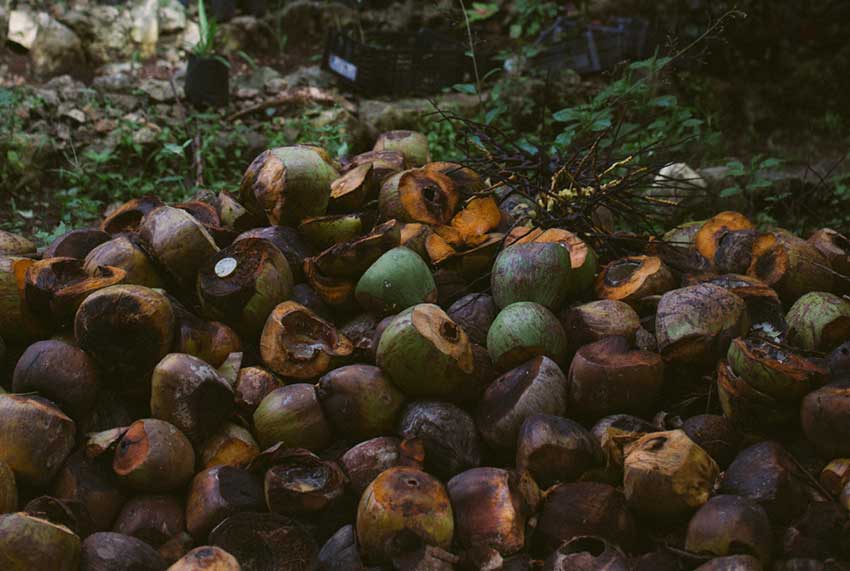
Remains of coconuts will eventually become compost and fertilizer.
Remains of coconuts will eventually become compost and fertilizer. jenna Belevender

Woolis also aims to educate local children on how to be conscious with waste and about the underlying problems behind climate change.

“Society tends to be really small-minded when it comes to these problems,” Jervis said. “Plastic is enemy No. 1 today, but back when I was a kid, it was aerosol. We just keep looking at these one-dimensional things and say ‘if we fix this, we’ll be OK.’ But the biggest problem really isn’t plastic in the ocean, rather the production of plastic, and burning of fossil fuels and not taking care of our waste.”

Farm To Table opened in April 2018 on the main restaurant strip, which is the highway that passes through Tulum. The menu features all Mexican-made beverages and local food products such as lionfish, an invasive species which appears on the menu as a way to reduce harm to native fish.

Other dishes, such as duck tamal with cauliflower purée and grilled nopal filled with locally made cheese, are examples of the rotating menu options.

Still, Jervis says Farm To Table is approaching the social aspect of the food chain with its organic farm, which will make organic food available to a wider audience. The idea is to create clean food on the cheap. The reason the restaurateurs haven’t jumped on the bandwagon with him, he says, is based on greed.

Megan Frye is a writer, photographer and translator living in Mexico City. She has a history of newsroom journalism as well as non-profit administration and has been published by several international publications.

Photographer Jenna Belevender is based in Detroit and has a strong background in editorial, documentary and environmental portraiture.
A lot of gas stations located near pipelines sell stolen fuel: intelligence chief

0
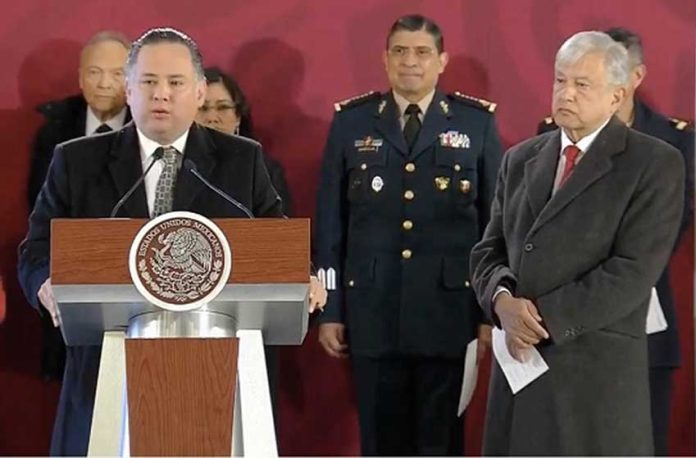
Nieto speaks at this morning's press conference as the president looks on.

Many gas stations located near petroleum pipelines sell stolen fuel, the federal government’s financial intelligence chief asserted today.

Santiago Nieto, head of the Financial Intelligence Unit (UIF), a division of the Secretariat of Finance (SHCP), said the sales of “a large proportion” of such stations exceed the quantities of fuel they purchase from Pemex, the state oil company.

“What does that mean? That differential can’t be [attributed to] anything else than the supply of stolen fuel,” he said.

Speaking at President López Obrador’s daily press conference, Nieto said that this month the UIF has analyzed information provided by banks about transactions made by gas stations that are located near Pemex pipelines.

“All reports related to gas stations were analyzed using two models. In most of the municipalities through which pipelines cross . . . deposits, particularly in cash, are being made . . . They’re reported by the banking system,” he said.

“. . . A large proportion of gas stations make deposits and transfers in cash that differ from the amount of funds with which they operate . . . This [analysis] has led us also to open a series of money laundering cases. In the 32 federal entities, we found more than 14,000 reports of unusual operations . . .” Nieto added.

The intelligence chief said the amount of money detected by the UIF that is linked to the commercialization of stolen fuel and “laundered in the Mexican financial system” was 10 billion pesos (US $526.8 million).

In 32 cases, the SHCP, the Secretariat of Security (SSPC) and the Federal Tax Administration (SAT) have taken legal steps to freeze accounts that have allegedly been used for the deposit and transfer of funds linked to stolen fuel, Nieto said.

“. . . Five specific cases have already been taken to the PGR [federal Attorney General’s office] with the idea to bring them before the courts quickly. In these cases . . . businessmen [are involved] but also public servants including a Pemex official, a former state deputy [and] a former mayor . . .”  he added.

“The modus operandi involves not just the commercialization of stolen fuel but also the laundering of capital through the financial system,” Nieto said.

“We’ve detected international transfers of varying significant amounts that, in some cases, exceed US $2 million, purchases of luxury cars . . . We’ve also detected public servants who purchase property on an annual basis in their own names or those of family or people close to them. They buy airline tickets, jewelry, artwork to launder capital which comes from the theft of fuel.”

Source: El Economista (sp) 

Previous presidents were accomplices to corruption or turned a blind eye: AMLO

0
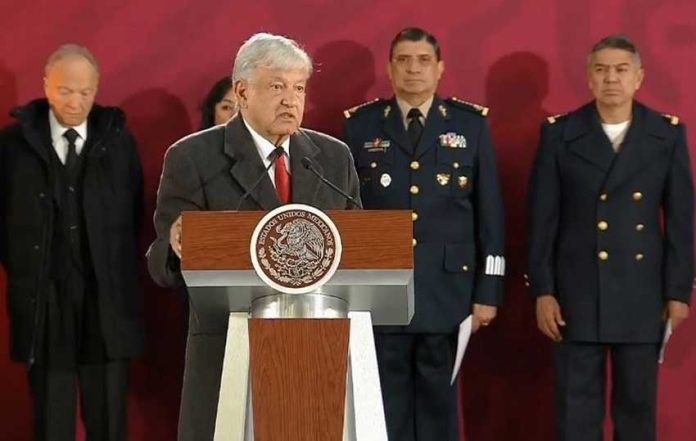
López Obrador speaks during his daily press conference.

President López Obrador said today his predecessors were either accomplices to corruption or they turned a blind eye — “there’s no way [they] didn’t know.”

“I’ve said it before, that all the juicy business done in the country, deals of corruption, were greenlighted by the president. To state it clearly, it’s not that they ‘didn’t know’ or ‘the president had good intentions but he was deceived’ — it’s a lie,” the president told his daily press conference.

He also said that if Mexicans demand punishment for the acts of corruption committed by his predecessors, his administration will act accordingly.

Such an action would  “aim high” and not at lower-level public workers.

In the past, he charged, scapegoats were used to “simulate a fight against this crime.”

“Corruption [starts] from the top down and [ex-presidents] shielded behind scapegoats . . . and the president was protected and unpunished,” López Obrador said.

“If we are going to open the files, let’s go all the way to the top,” he continued before checking off the names of his predecessors: Carlos Salinas, Ernesto Zedillo, Vicente Fox, Felipe Calderón and Enrique Peña Nieto.

Ex-president Fox did not take long to offer a reply, calling on the president to present proof.

“AMLO is defaming many people. I challenge him to present proof . . . and if he does not to be quiet.”

Fox declared he was not involved in any act of corruption during his time in the public service. “Back then we didn’t even know the term ‘huachicol [fuel theft].”

Source: El Financiero (sp)

Gasoline shortages continue to worsen in Jalisco, affecting 35 municipalities

0
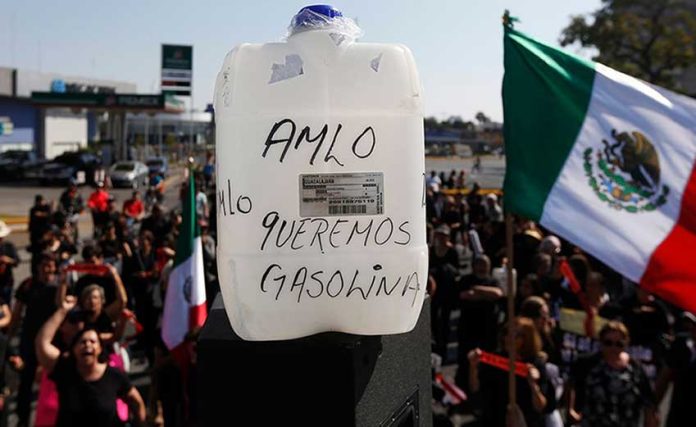
A message for AMLO: 'We want gasoline.'

Gasoline shortages worsened in Jalisco over the weekend and are now affecting at least 35 municipalities, according to a state government official.

Alejandro Guzmán Larralde, strategic coordinator for growth and economic development, said yesterday that there is only enough fuel in the state to meet half the demand.

“The area affected is expanding . . . We estimate that the shortage in the entire state of Jalisco has increased from 20% to 50% . . .” he said.

In Guadalajara, Guzmán estimated that the quantity of fuel in the city on Saturday was 40% below demand. The problem has been felt most acutely in the west of the city.

He explained that the fuel shortages are impacting several sectors of the economy such as tourism, agriculture and manufacturing.

The farming municipalities of Lagos de Moreno, Tepatitlán, Ameca and Tala are among the worst affected by the shortages, he said.

Guzmán added that the tourism-oriented municipalities of Tequila, Chapala, Tapalpa and Mazamitla have all seen a reduction in visitor numbers.

“. . . People probably want to save fuel rather than go sightseeing,” he said.

Authorities in several municipalities “have reduced to a minimum the use of their official vehicles,” Guzmán said, explaining that public security, among other government services, had been affected.

The official said that the lack of fuel in Jalisco has not yet caused a shortage of food or other products but added that production cycles are beginning to face delays because some factories’ inventories have been depleted.

Jalisco Governor Enrique Alfaro Ramírez said in a radio interview today that there has been a lack of information from both Pemex and the federal government about the fuel shortages, which have also affected several other states.

He added that the lack of gasoline in the state is having a significant impact on the economy that could worsen if the shortage problem isn’t resolved.

A Mexico News Daily reader in Chapala/Lakeside said there is panic among resident because it appears there is no gas in the entire area. Most want to know how they can find information about tanker deliveries, he said.

His suggestion was they wait on the highway for a Pemex truck and then follow it.

Gasoline shortages, which the federal government has explained is the result of President López Obrador’s decision to close several major petroleum pipelines as part of a strategy to combat fuel theft, were first reported in some areas around two weeks ago.

Source: El Economista (sp), W Radio (sp)  

Government hands out booklet to encourage harmony, strengthen values

0
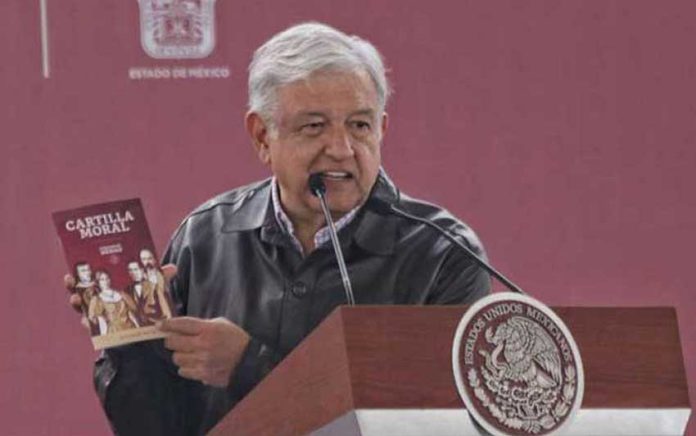
President López Obrador announces distribution of Cartilla Moral.

The federal government has begun the distribution of a booklet intended to encourage harmony and strengthen values.

Cartilla Moral is a 1944 booklet by celebrated Mexican writer and diplomat Alfonso Reyes, written at the request of the secretary of education at the time.

The booklet, divided in 14 chapters with headings like “Patriotism,” “Family,” and “Culture and Civilization,” was originally intended as supplementary material in a governmental push to reform public education.

President López Obrador said that the booklet is the first step in starting a national reflection on Mexico’s principles and values in order to encourage harmony and respect for diversity. The president blamed the urgency of such a dialogue on the corruption of previous administrations and a dearth of employment opportunities, as well as a decay of the country’s moral, cultural and spiritual values.

“As [Cuban writer] José Martí said, man does not live by bread alone; to achieve true happiness he needs both material well-being as well as spiritual well-being,” said the president.

He explained that the text does much to further his administration’s desired “rebirth of Mexico” through its treatment of justice and the attention it gives to the family unit, civic duty, nature, patriotism and common human values.

Distribution of the booklet began yesterday in Valle de Chalco, México state, before the announcement of the federal government’s new pension plan.

The president encouraged those present to share the booklet with family members and discuss the “morals, ethics, and values that we need to build a better society.”

He said that although the text was not obligatory reading, his administration would soon make it widely available.

Source: Milenio (sp)

Politician slammed for remarks about poor development of 3 states

0
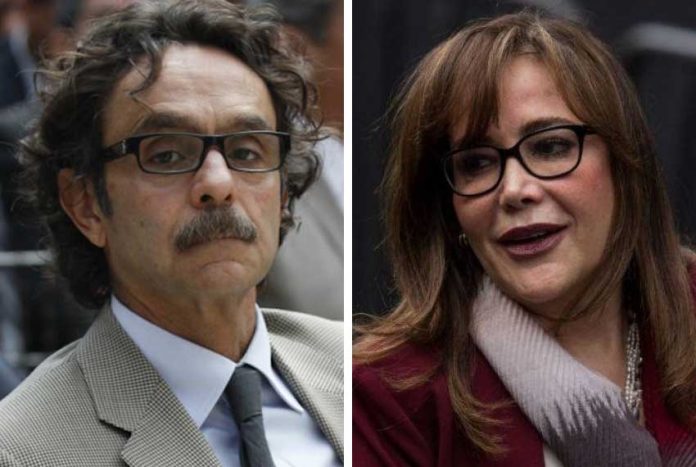
Quadri received a stiff rebuke from Polevnsky.

A former candidate for president has been heavily criticized for a post on social media in which he charged that three southern states were a burden on the rest of Mexico.

“If Mexico didn’t have to carry Guerrero, Oaxaca and Chiapas, it would be a medium-development country and an emerging power,” Gabriel Quadri, candidate for the New Alliance Party in the 2012 presidential election, wrote on Twitter Friday night.

The claim triggered a hostile reaction from members of the general public, government officials, journalists, social leaders and politicians including the governors of the three states at which Quadri took aim.

“Your comment is unacceptable and offensive for Oaxaca. I demand a public apology to all residents of Oaxaca,” the Governor Alejandro Murat wrote in a Twitter post directed at the former presidential hopeful.

His counterpart in Chiapas also took umbrage at Quadri’s remarks.

“Gabriel Quadri is wrong, he must apologize, Chiapas has great wealth, especially cultural [wealth],” Rutilio Escandón Cadenas wrote on Twitter.

“In addition to being triggers of the republic’s economic development, in Chiapas, Oaxaca and Guerrero the citizens are committed to and proud of our country,” the Chiapas governor said in another post.

Guerrero Governor Héctor Astudillo also took to Twitter to respond to Quadri, pointing out that the state has played an important role in Mexico’s history.

“I have instructed to send to you, Gabriel Quadri, facsimiles of [independence document] Feelings of the Nation, the Declaration of Independence and the Abolition of Slavery in Mexico, signed in Chilpancingo, documents that show Guerrero’s great contribution to our country,” he wrote.

“We’re also attaching photographs of our tourist destinations packed with visitors and the monumental flagpole of Iguala, the municipality where this patriotic symbol [the Mexican flag] was born,” Astudillo said in another Tweet.

Much stronger language came from the head of the ruling Morena party.

President Yeidckol Polevnsky took aim at Quadri’s intelligence at a press conference Saturday, asserting that Mexico would be better off without him.

“This country would be a lot richer without brainless people like him,” she said, claiming that he is also “ambitious, vulgar, corrupt and a fraud.”

Polevnsky, a federal senator between 2006 and 2012, added that “a person of such low ilk, who says [such] stupid things . . . doesn’t deserve my attention.”

Several state and federal lawmakers also hit out at the ex-presidential candidate, who is also a civil engineer, economist and environmentalist.

“With all respect, your comment is stupid!” wrote Othón Cuevas Córdova, a Morena party lawmaker in Oaxaca, in a Twitter post.

“. . . His irresponsible comment only reflects an immense ignorance of the greatness of our country,” federal Senator Raúl Bolaños Cacho Cué said.

Writer and activist Tryno Maldonaldo responded to Quadri’s remarks with a witty rearrangement of the ex-candidate’s controversial post.

“If Gabriel didn’t have to carry Quadri, he would be an intellect in medium-development,” the former wrote.

In response to the calls for him to make a public apology, Quadri dug in further, writing on Twitter:

“Sorry, but it’s the bad governments and those in charge of the useless institutions that have made Guerrero, Oaxaca and Chiapas the poorest and most backward states of Mexico that should offer an apology.”

In another post yesterday he wrote: “It’s curious that almost nobody wants to identify causes of and responsibility for the poverty and backwardness of Guerrero, Oaxaca and Chiapas, and that they only launch a lynching campaign against the messenger. Symptomatic and ominous; it only augurs the perpetuation of the problem.”

The three states are generally considered Mexico’s poorest.

Source: El Universal (sp), Milenio (sp), Reforma (sp), Sin Embargo (sp) 

Best picture and three other Critics’ Choice awards for Cuarón’s Roma

0
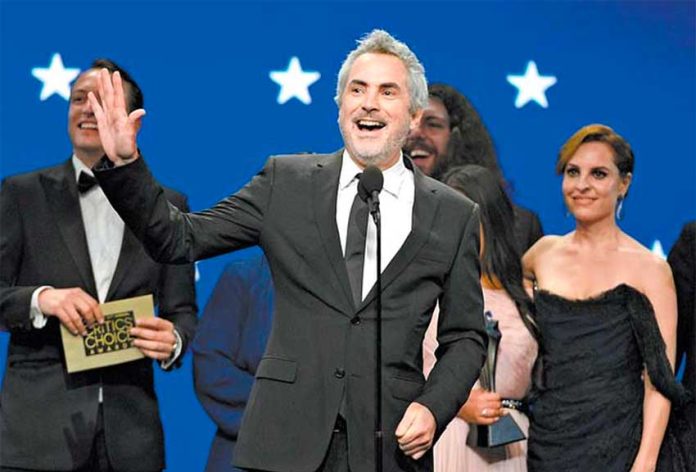
Filmmaker Cuarón at the Critics Choice awards.
Filmmaker Cuarón at the Critics' Choice awards.

For the first time in the history of the Critics’ Choice Movie Awards, a foreign language film has taken home the award for best picture.

Alfonso Cuarón’s black-and-white family drama Roma was judged the best on a list that included nine other films.

Roma was also the chosen as the best foreign language film, and the filmmaker himself won two other Critics’ Choice Awards for directing and cinematography.

Yalitza Aparicio’s debut performance in the film earned her a nomination for best actress. The film was also nominated for best original screenplay, best production design and best editing.

At last night’s awards ceremony in Los Angeles, Cuarón thanked his team and Netflix for their support after quipping that “this bunch of Mexicans are not as bad as sometimes they are portrayed.”

He also said that while films may not break down walls, they can offer a window to the other side, “and when we look through this window, what we see is our own reflection.”

Cuarón spoke of walls at a related event the day before.

“I want to salute the Los Angeles Film Critics Association,” he said. “Thanks to your help we can break down walls.”

Source: Entertainment Weekly (en), Variety (en), Milenio (sp)

Michoacán governor criticizes Pemex for silence on fuel shortage

0
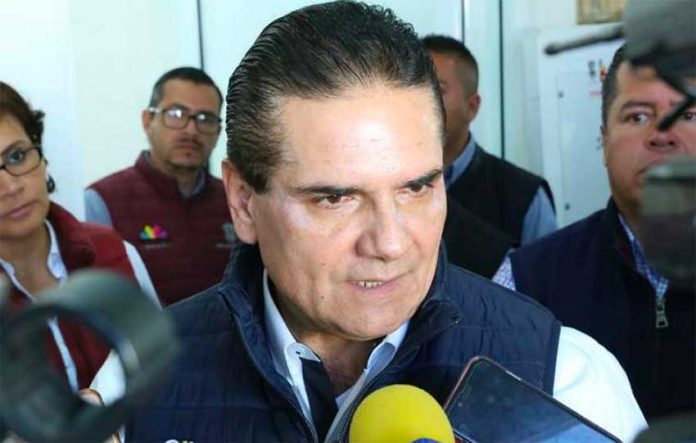
Michoacán Governor Aureoles.

Pemex’s alleged silence about fuel shortages has drawn a strong rebuke from the governor of Michoacán.

In a series of tweets, Silvano Aureoles yesterday urged the state oil company and the federal government to provide answers in light of gasoline shortages in his and various other states around the country.

He criticized Pemex CEO Octavio Romero Oropeza for not responding to official requests for information regarding the fuel shortages, which he described as rude and showing “a lack of respect.”

“We demand to know with certainty and in a timely manner when and how we will be able to restore normal fuel distribution,” he said in the tweet.

Aureoles said the state government has helped the public transportation sector by providing security for dedicated tankers delivering fuel.

The governor observed that while he supports the federal government’s fight against fuel theft, the strategy was poorly executed and should not have adversely affected economic activities or the livelihoods of citizens.

Michoacán has been one of the states most affected by the fuel crisis, a result of President López Obrador’s closure of pipelines in a strategy to combat fuel theft.

State officials say gas shortages have had a severe impact on the economy.

Source: Milenio (sp), López Dóriga Digital (sp)

Semi’s cargo of cattle robbed after Veracruz collision that kills migrant

0
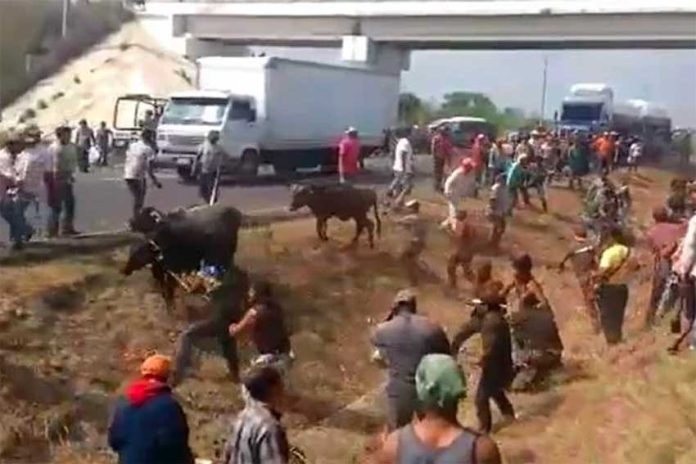
Cattle are rounded up after highway accident.

There were two casualties in a collision between two cargo trucks in Veracruz yesterday, but there were few survivors among the cattle being shipped in one of them.

An undetermined number were either stolen or butchered on site.

One person died and another was injured in the collision on the La Tinaja-Cosoleacaque highway.

Unofficial sources told the newspaper El Universal that Central American migrants were traveling in one of the trailers involved. They fled the scene to avoid being arrested.

While they fled, neighbors arrived and helped themselves to the livestock inside the trailer.

Several animals were pulled from the wreck and taken away. At least one was butchered right there at the accident scene.

No arrests were reported.

Source: Sin Embargo (sp), El Universal (sp)

Dozens help themselves to free gasoline at pipeline tap in México state

0
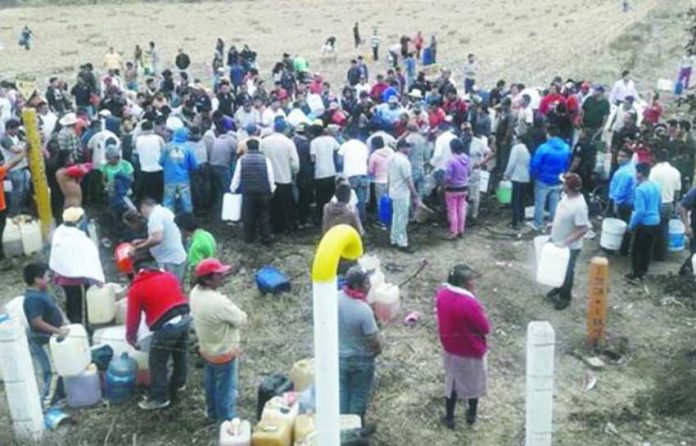
Residents of Acambay load up on free fuel.

Dozens of people were caught on camera Saturday helping themselves to fuel at an illegal pipeline tap in México state, as gasoline shortages continue to frustrate motorists in several parts of the country.

Footage that circulated on social media showed a large group of people frantically filling containers with gasoline in a field next to a highway in Acambay, a municipality around 90 kilometers north of Toluca.

México state is one of more than 10 states affected by gasoline shortages that the federal government has explained are the result of President López Obrador’s decision to close several major petroleum pipelines as part of the strategy to combat fuel theft.

Late Saturday afternoon, the México state Secretariat of Security reported via Twitter that police had attended the site of the illegal tap and were guarding it as they waited for the arrival of personnel from Pemex. No arrests were reported.

A video posted to Twitter by security officials showed a stream of fuel in the field where the pipeline tap occurred which, according to the newspaper El Financiero, was at least one kilometer long.

López Obrador spoke yesterday about the incident and urged people not to “tarnish themselves” by protecting huachicoleros, as fuel thieves are colloquially known.

“They punctured one of the pipelines and told people: ‘[come and] get gasoline, there’s gasoline here,’ and some people were there with buckets, collecting it. I call on people to not play ball with these crooks. Even if they say, ‘there’s gasoline here, make the most of it,’ [I call on people] not to protect these criminals [but] to act with honesty . . .” he said.

“[I urge] he who wants to earn an income to approach the social program coordinators in the state governments. There is information so that work and income can be had without the necessity of . . . stealing. It’s preferable to leave children in poverty than to dishonor them. We have to raise the moral standards of public life in Mexico,” López Obrador added.

Speaking at an event in México state at which he announced higher pensions for senior citizens, the president reiterated his claim that fuel theft costs the government 65 billion pesos (US $3.4 billion) a year.

“That money is now going to be used for the benefit of the people, that’s why I call on all citizens to move forward together. There are inconveniences . . . there are lines at gas stations and people are worried . . . but if you continue to support me, if you have confidence that this will be resolved, between all of us we’re going to feel very satisfied to have put an end to fuel theft,” López Obrador said.

The president told reporters this morning that the pipeline between Tuxpan, Veracruz, and Mexico City, which was repeatedly “sabotaged” last week, resumed service at 11:00pm Friday.

López Obrador said the pipeline, one of the most important in the country, is transporting 170,000 barrels of fuel a day, adding that supply will “soon” return to normal.

Federal security forces, including the military, are now guarding seven pipelines and will be deployed to protect five more, army General Arturo Velázquez said at the president’s daily press conference.

In total, just over 5,000 members of the army, navy and Federal Police have been deployed to anti-fuel theft operations across the country.

Asked whether he feared for his life as a result of implementing the anti-theft strategy, López Obrador responded:

“He who fights for justice has nothing to fear. I’m a human being, I have fears like all human beings but I’m not a coward.”

Source: Reporte Indigo (sp) El Financiero (sp), Milenio (sp)