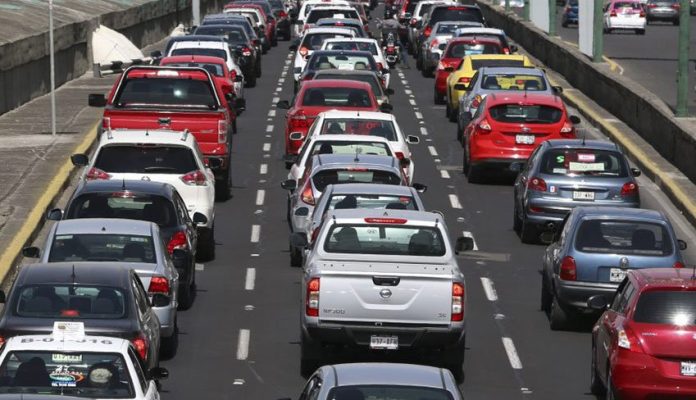
More sustainable transportation is one goal of Mexico City's new government.
The Mexico City government will allocate 18.1 billion pesos (US $908.1 million) in 2019 to public works projects, the government said yesterday.
Construction work on two bridges, two hospitals and two massive bicycle parking stations will start or continue next year and an extension of one line of the Metrobús system will be completed.
Speaking at a press conference alongside Mayor Claudia Sheinbaum, Public Works Secretary Jesús Antonio Esteva said the government will focus on improving existing public infrastructure and building new public works projects.
It will also aim to make the capital’s public transportation more sustainable and improve the delivery of city services.
One of the new bridges, Esteva said, will be built in the borough of Venustiano Carranza near the Mexico City airport.
The government will initially invest 270 million pesos ($13.5 million) in the project although its final cost is expected to be 900 million pesos ($45.1 million).
The other bridge will be built in front of the Central de Abasto – Mexico City’s huge wholesale market – in the sprawling eastern borough of Iztapalapa. The initial investment will be 180 million pesos (US $9 million).
The Cuajimalpa hospital, one of five large infrastructure projects that the last government left unfinished, will be allocated 350 million pesos ($17.5 million) for work to continue while that in Topilejo, in the southern borough of Tlalpan, will be expanded with a 150-million-peso ($7.5 million) investment.
Eleven health care centers will also be upgraded with an investment of 80 million pesos ($4 million).
A 20-kilometer extension to Line 5 of the Metrobús system is expected to be completed early next year while stations on two other lines will be upgraded.
Mayor Sheinbaum said last month that the same system, which this year began operating London-style red double-decker buses on one if its seven lines, would get 1 billion pesos ($50 million) to build two additional lines as part of a 10.2-billion-peso ($511.1-million) investment in public transportation.
One of the new bicycle parking stations will be built at the Tláhuac subway station, located on Line 12, and the other will be at the Rosario station, where Lines 6 and 7 meet in the northwest of Mexico City. Together they will cost 50 million pesos ($2.5 million).
The leftist Morena party government will also spend 10 million pesos to build two new higher education campuses, 50 million to renovate the run-down Cosmos Cinema, 150 million to complete construction of the Iztapalapa Interactive Children’s Museum and 200 million to upgrade the Santa Martha Social Rehabilitation Center.
Funding for the Secretariat of Public Works will increase by 52% next year compared to this year.
When she took office on December 5, Sheinbaum, like her political ally President López Obrador, pledged that her government will not fail.
The federal government will remove the IVA value-added tax from gasoline and diesel in the northern border region, the economy secretary said yesterday.
The measure will take effect January 1 as part of the introduction of a northern border free zone, where the IVA will be reduced across the board from 16% to 8% and the maximum income tax rate (ISR) will drop to 20%.
Graciela Márquez Colín told a press conference that taking the tax off fuel would “reduce the gap” between gasoline and diesel prices on the Mexican side of the border and those on the United States side.
“. . . What we’re trying to do is close that gap to stimulate companies and provide them with lower energy costs,” she said.
“These measures, [lower] energy prices and tax incentives are accompanied by a twofold increase in the minimum wage . . . The minimum wage on the northern border is going to be 176 pesos [US $8.80] . . .” Márquez added.
A liter of regular gasoline in the northern border region currently costs on average 20.03 pesos (US $1), the newspaper El Sol de Tijuana reported. Without IVA, the same liter of fuel would cost 16.83 pesos (US $0.84).
“. . . The important thing here is the relief on consumers’ hip pockets,” said Alejandro Borja Robles, president of the Tijuana Gas Station Owners’ Association.
“Money that is saved will be used in other businesses, which logically will be a benefit for all. You can see the will of the government to support the border region, something that we hadn’t seen in more than 18 years,” he added.
Borja also said the removal of the IVA from fuel would encourage people who usually fill up their cars in the United States to do so at home.
The president of the Baja California College of Economists praised the government’s decision to eliminate the IVA on gasoline and diesel as well as the implementation of the free zone.
“Everything that can be done to stimulate companies and make them more competitive looks good to me,” Domingo Ramos Medina said.
He added that investment in the border region, consumption and employment would all increase.
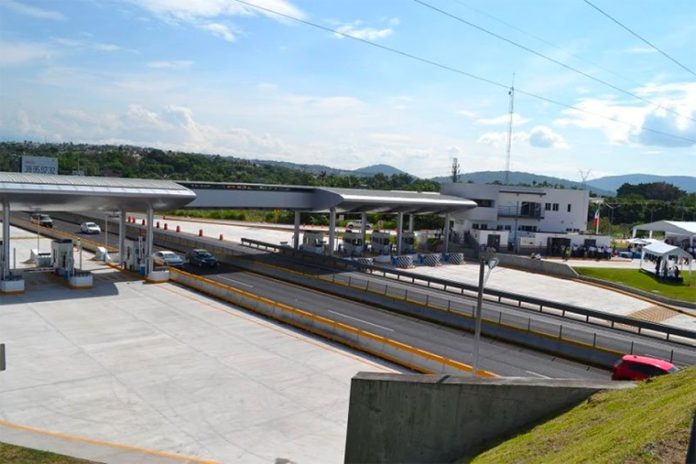
The agency responsible for federal highways and bridges will stop accepting credit and debit card payments at toll booths starting January 1.
Capufe, part of the Secretariat of Communications and Transportation (SCT), said the change will reduce wait times at the booths.
“This measure is to provide a better service and streamline the movement of users through the network of bridges and highways the agency runs throughout the country,” said Capufe in a statement.
The agency said that by accepting only cash and its own electronic payment solution, called TAG-IAVE, the time spent by motorists at toll booths will be “significantly reduced.”
It takes six times as long to process a card payment as it does to accept cash, it said.
One pundit saw it as a step backward.
“I do not understand it. It’s in clear opposition to the promotion of banking services in the country,” said Javier Risco of broadcaster W Radio.
Thousands of Mexican and foreign vacationers will soon hit the roads and many will find out about the new accepted payment methods while traveling. But the federal Tourism Secretariat has announced a traveler care program consisting of 34 assistance units that will operate 24/7 throughout the Christmas holiday season. It officially started yesterday and will conclude on January 4.
With Capufe’s TAG IAVE cards motorists can transfer funds from their bank accounts, set up monthly recurring payments or let the TAG-IAVE system debit their bank accounts directly.
The indigenous peoples of Mexico apparently had a nose for superfoods. Before the arrival of the Spaniards, they were happily consuming amaranth and chia, both of which have only recently been rediscovered and made available commercially.
Well, they had a third superfood that is also making a comeback. It’s called spirulina and, according to the United States National Institute of Health, it “became famous” after it was successfully used by NASA as a dietary supplement for astronauts on space missions.
Spirulina looks like algae, but it’s something even more primitive. I first heard the word used when I visited the back yard of my neighbor, Rodrigo Orozco. At the far end of his property there is a big hothouse, which I assumed was for growing vegetables.
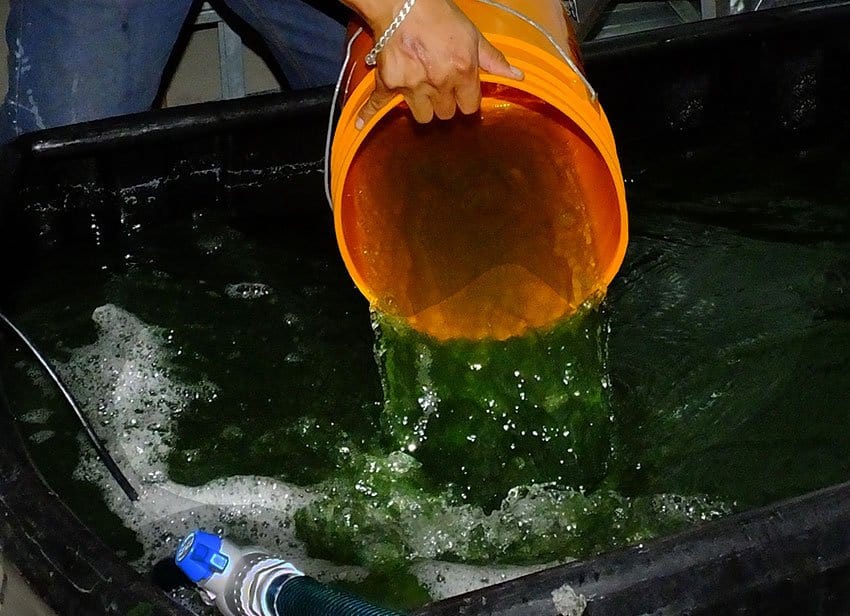
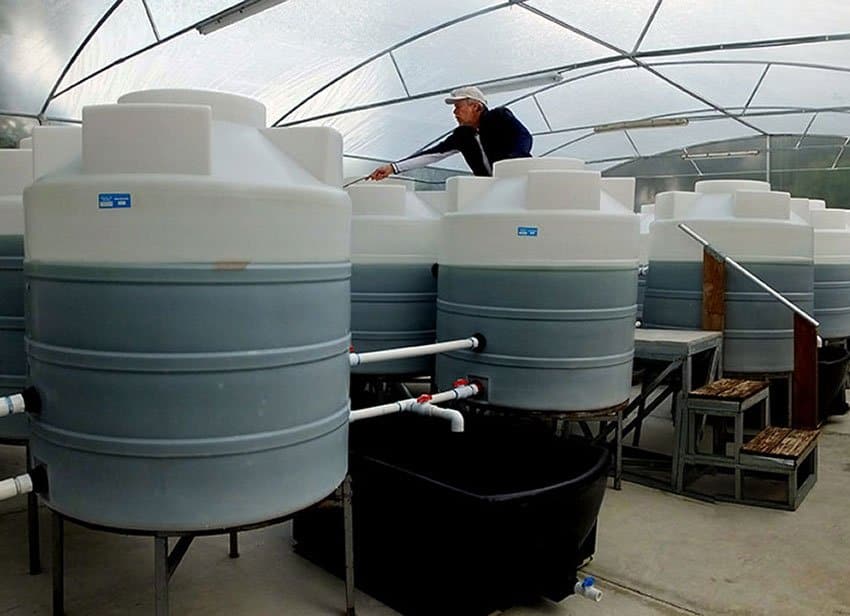
“Actually, I’m growing something else in here, something blue-green and slimy,” Orozco told me as he opened the hothouse door. Inside I found 24 huge, translucent vats.
“Inside these is spirulina,” said my neighbor. “It’s a cyanobacterium, one of the first living things to exist on our planet and because it’s able to do photosynthesis, it’s green in color. It also produces oxygen, but curiously, can only live in a very alkaline environment. Thousands of years ago, people in Africa and Mexico noticed it. In Mexico, the Aztecs, especially the runners, consumed it regularly. They called it tecuitlatl, which I am sorry to say, translates as something like ‘rock poop.’”
Stirring up the spirulina as it passes through a silk screen.
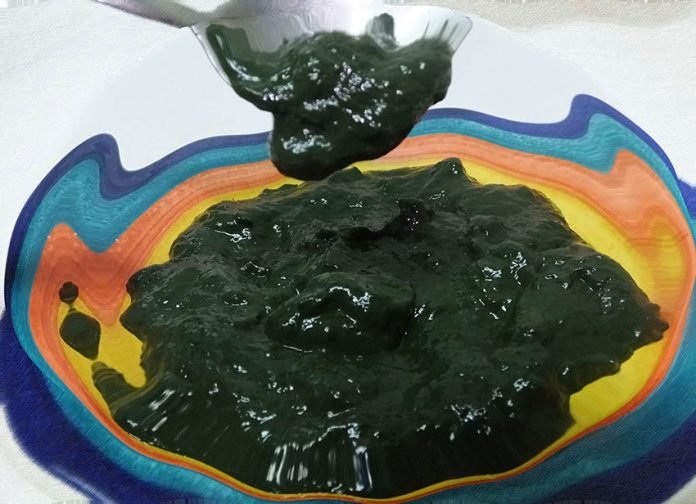
Orozco told me the Aztecs harvested it by sticking long poles into certain very alkaline lakes and coating the poles with this thick goo which they dried and made into little flat cakes. These cakes were common food in those days and are described by Bernal Díaz del Castillo in his book, The Discovery and Conquest of Mexico. While visiting a market, Díaz observes:
“Fishermen and others were selling little cakes made of something like slime, which they collect from that big lagoon. This they thicken and make into cakes which taste a bit like cheese.”
Just as they frowned upon amaranth (for religious reasons), the Spaniards took a dislike to this “Aztec cheese” and drained many of the alkaline lakes where spirulina grows naturally. So, like many other good native Mexican customs, eating tecuitlatl came to an end after the Conquista and was forgotten.
Orozco went on to describe how a curious event brought spirulina production back to Mexico centuries later. In the 1970s, he says, a company called Sosa Texcoco, the biggest producer of sosa cáustica (caustic soda or lye) in the world, was working in El Lago de Texcoco and at an international convention they complained to other colleagues in the business that they were having problems separating the lye from a pesky green substance growing in the highly alkaline lake.
Hearing this, a Japanese scientist looked at them and said, “You are fools! That green stuff is much more valuable than lye. It’s Arthrospira maxima, commonly called spirulina.”
So, in the early 1970s, Sosa Texcoco gave birth to the company Spirulina Mexicana, which quickly ended up becoming the world’s largest producer of spirulina. But the company was a co-op and suffered from organizational and other problems and eventually went broke.
Interconnected vats of spirulina in a hothouse warmed to 40 C.
“And that,” said Orozco with a wry look, “was the end of modern production of spirulina in Mexico.” Today, he says, the biggest producers are in the U.S., South America and Europe.
I asked Rodrigo Orozco how he learned about this obscure Aztec food.
“My wife is a vegan,” he told me, “and the only protein she gets is from seeds like almonds. Then we heard about something called spirulina and the name sounded funny to me. What is this stuff? I never heard of it before. So I Googled it and found it was an amazing sort of superfood, but I was ashamed to discover it was also something very, very Mexican, and yet I had never heard of it.
“I found out the Aztecs used to eat it every day as a common source of protein, so both my wife and I started taking spirulina . . . and I soon experienced a big change in my life. I had more resistance riding my mountain bike than my compañeros and the next day, instead of feeling sore, I felt great. It turned out spirulina is a potent anti-inflammatory.
“Spirulina also seems to be the richest source of protein on the entire planet. Beef and soybeans are nothing in comparison. I also found out it has all the basic amino acids needed by human beings, and it has iron, calcium, magnesium, copper, beta-carotene and the entire B-group of vitamins.
“And your humor changes: you become more positive. Also, I used to have a terrible memory, but now I’ve only got a bad memory: that’s an improvement, believe it or not!”
[soliloquy id="67850"]
Orozco discovered it was not easy to grow spirulina. “You can’t just throw it into a pond and expect it to grow. It’s not an alga but a cyanobacterium, so named for its bluish-green color. I took a course about spirulina, but found out almost nothing about growing it. So I tried on my own for over a year and it kept dying on me.
“Finally I found somebody who offered courses on the growing of it and today I am harvesting around four kilos per week. Rather than drying it, which I think reduces its benefits, I press it and freeze it in small, thin rectangles which look a bit like Andes Mints. To take one, you just drop the ‘mint’ into a glass of your favorite juice, like an ice cube. Since the spirulina has very little taste of its own, you hardly notice it’s in your drink.”
One of the most prominent promoters of Spirulina is Jean-Paul Jourdan, a French professor of history and author of the book Grow Your Own Spirulina. Fascinated with this miraculous micro-algae, Jourdan spent more than 12 years working on the development of low-cost techniques for spirulina production in Africa. It should be noted, by the way, that spirulina is the only foodstuff ever approved by the United Nations for fighting malnutrition.
Jourdan demonstrated that people anywhere could make a hole in the ground, seal it with plastic, fill it with water, and make the water alkaline with easy-to-find ingredients such as urine and rusty iron.
As Rodrigo Orozco found out, growing your own spirulina can be daunting at first, but the Spirulina Academy says, “after a few tries, it gets much easier, and in no time you’ll be growing and eating fresh spirulina!”
While working in Oman, I was shown stromatolites in the limestone. These I was told were the oldest fossils in the world. Now, thanks to my enterprising neighbor, I’ve learned that those were fossils of the oldest foodstuff on earth: microbial mats, mostly composed of cyanobacteria which, to top it all off, are credited with changing the atmosphere of the earth hundreds of millions of years ago from 1% oxygen to around 20%, as it is today.
So I can’t disagree with my neighbor Rodrigo when he says, “¡Como la spirulina, no hay nada más! – there is simply nothing else quite like spirulina.”
The writer has lived near Guadalajara, Jalisco, for more than 30 years and is the author of A Guide to West Mexico’s Guachimontones and Surrounding Area and co-author of Outdoors in Western Mexico. More of his writing can be found on his website.
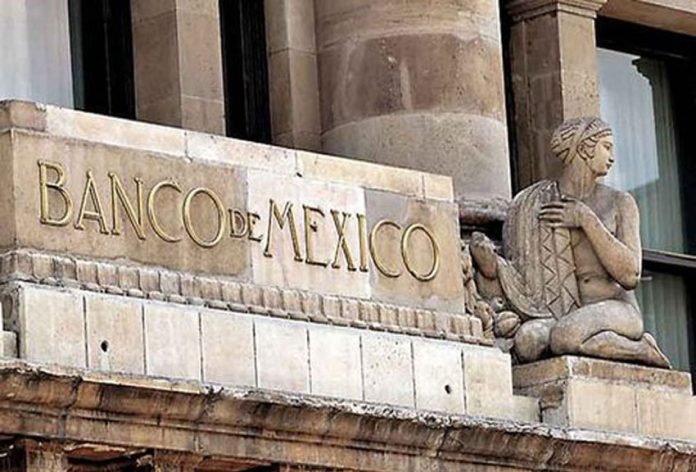
The Bank of México (Banxico) raised its benchmark interest rate to the highest level in 10 years yesterday, and there are signs it could go even higher in 2019.
The central bank’s board voted unanimously to increase the rate by 25 basis points, as expected, to 8.25%, the highest level since the introduction of a new benchmark rate policy in 2008.
Banxico cited higher than expected inflation and uncertainty generated in part by the new federal government’s economic policies as factors that contributed to the hike, the fourth this year.
“The balance of risks with respect to the expected inflation trajectory has deteriorated and maintains an upward bias within an environment of marked uncertainty,” the bank said in a statement.
The central bank targets 3% annual inflation with 1% tolerance in both directions but inflation in the first half of December was 5%, according to statistics institute Inegi, and 4.87% in the last half of November.
Banxico warned that the minimum wage increases announced earlier this week could “bring about wage revisions that exceed productivity gains and create cost pressures.”
It also said that “the balance of risks for growth is still skewed to the downside and has deteriorated.”
Last month, the bank cut its growth forecast for next year to between 1.7% and 2.7%, while many analysts are predicting that economic expansion will be at the lower end of that range.
In its 2019 budget presented Saturday, the federal government predicted 2% growth although Finance Secretary Carlos Urzúa said that it was a “conservative” estimate.
Banxico also recognized that the value of the peso has recently declined – particularly after President López Obrador announced that the US $13-billion Mexico City airport project would be cancelled – although it rallied yesterday on news that the government had won investor support for an airport bond buyback offer.
“The Mexican peso exchange rate continued to reflect the uncertainty regarding the policies of the new administration,” the bank said.
Bank of México Governor Alejandro Díaz de León told the newspaper El Financiero that Banxico could raise rates again next year if inflation doesn’t begin to trend downwards.
“It’s important for us to remain alert to the balance of risks environment . . . and in case it is necessary, maintain the benchmark rate [at its current level] as long as it is needed or, when appropriate, strengthen the [bank’s] monetary policy position so that inflation resumes a downward trajectory towards the inflation target,” he said.
“What the interest rate hike seeks to do is consolidate an environment of stability. If the anchor of [positive] expectations in the economy was lost, it would be very costly in terms of economic activity . . .” de León said.
In its statement, Banxico also called on the government to provide “a climate of confidence and certainty for investment, higher productivity and a sustainable consolidation of public finances.”
According to derivatives market forecasts, there is an 85.6% chance that Banxico will raise borrowing costs next year, and there is some speculation it will do so the next time the bank’s board meets on February 7.
“The guide to the future continues to be hawkish. Therefore, we can’t rule out another rate hike during the first quarter of 2019, particularly if inflation continues to trend upwards,” said Alberto Ramos, chief economist for Goldman Sachs in Mexico.
Alonso Cervera, chief Latin America economist for Credit Suisse, also said that Banxico’s decision was “a hawkish hike,” adding “there’s nothing in the statement that suggests the bank is done hiking.”
However, a survey of analysts conducted by Citibanamex forecast that there would be no new rate hikes in 2019.
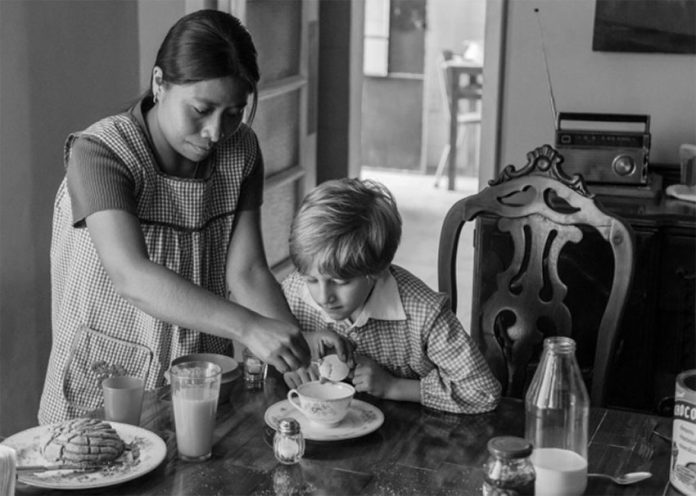
Yalitza Aparicio as Cleo with one of the children in her care. (Archive)
Alfonso Cuaron’s Roma offers a timeless, original portrait of life in Mexico City in the early 1970s in the colonia of the same name. It made a limited cinematic debut earlier this month, and as of last Friday is now available to watch on Netflix.
More like a poem than a movie — in the Hollywood sense at least — Roma is not for those who crave plot, elaborate dialogue or choreographed action sequences. Shot almost in docudrama style, its subject matter is daily life in all its mundaneness.
Happenings are depicted from a distance, always teasingly close but rarely close enough to fully satisfy our curiosity. Many early exchanges in the movie are too quiet, too quick, or too “banal” to capture our attention completely.
But it’s precisely this subtlety — of both content and composition — that enables Roma to stir such honest, universal emotion. Its impact is multiplied by its imagery, which is consistently stunning in its beauty or in its oddness — sometimes both.
It’s easy to imagine Roma laid out frame by frame as a photographic exhibit. The combination of all these elements is what makes Roma stand out — as an exemplar of poetic realism, and a movie that makes a certain mark on the heart.
Roma’s realism is for the most part its distinct lack of plot. It follows the life of a character called Cleo (Yalitza Aparicio) and the family she serves (as the live-in “help”). Almost biographical in style, the film documents Cleo’s daily life and by way of doing so captures the sometimes fickle but ultimately consistent dynamics of her relationship with the family matriarch — Sofi — and her children.
Interspersed with daily life — with a distinct lack of emphasis — are what would classify as major events: Cleo’s confession of her pregnancy, the minor earthquake that shook the city in 1971 and the seemingly accidental incorporation of the Tlatelolco massacre which coincides with the start of Cleo’s labour pains.
Just as in real life, these incidents are understated when they occur, recognizable as major life events only in hindsight, in the broader context of time and history.
Along with realism, Roma provides poetry in equal measure and most impressively does so without compromising the former. As with many of the great 20th-century writers — most evocative perhaps of Ernest Hemingway or Anton Chekhov, characters’ personalities are exposed through as little as one or two symbolic actions.
A great example is our introduction to Cleo’s ultimately traitorous lover Fermín when he enters a cafe as Cleo and her friend are finishing their lunch. After Cleo gets up to leave with Fermín, he snaps back to her empty place to finish what Cleo has left of her soda. As well as revealing Fermín’s greed, this simple sketch combines with others to create the sense of impending tragedy in the movie’s early scenes, and to signify the depth of character that keeps us engaged.
It seems inevitable that much of the commentary on Roma will focus on its depiction of the dynamic between Cleo and her patrons; the struggle of Mexico’s poorer (by and large indigenous) populations versus the quality of life enjoyed by Mexico’s growing middle class.
The parallel the movie draws between the two main female characters — who represent these opposing social groups — is hard to miss, as is the symbolism of the closing image of Cleo climbing an outdoor staircase, seemingly ascending into the sky.
But whatever social commentary Roma does contain, it’s not deliberate. Any attempt at pointed critique would be drastically undermined by the movie’s conscious nostalgia, perfectly represented by the decision to shoot in black and white.
Above all Roma is a timeless, universal reminder of how the past — and our experience of it — is inevitably, beautifully colored by emotion.
Natalia Greene writes from Mexico City, where she lives in the Roma district.
A BAIC dealership in Playa del Carmen, Quintana Roo.
Chinese auto maker BAIC is planning to begin construction of a plant in Mexico in 2020 that will start building electric and internal combustion engine vehicles in 2022.
During his third visit to the country, the company’s executive vice-president said BAIC believes Mexico is the best option in Latin America to open a new plant.
“We receive a lot of delegations in Beijing from different states in Mexico and we talk with them about the automotive industry in Mexico and we see potential for investment,” Li Xingxing said.
The state-owned company already uses a production line in a Veracruz facility operated by Mexico-based AT Motors for the final assembly of vehicles it sells in the domestic market.
But because none of the actual manufacturing process is completed in Mexico, each BAIC vehicle pays a 21% import tariff.
From its own Mexican factory, the company intends to sell cars locally, export to countries in South America such as Chile, Colombia and Brazil and eventually ship vehicles to the United States.
Samuel Echeverría, director of operations for BAIC in Mexico, said that eight states are vying to attract the Chinese automotive company.
He explained that the firm is currently weighing its options but suggested that it could ultimately decide on a state in the Bajío region, central Mexico or the southeast of the country. The new plant is expected to generate around 2,000 jobs.
Echeverría said the exact amount that will be invested in the new plant has not yet been fixed but added that it would be less than US $2 billion, a figure that was floated by anonymous company sources earlier this year.
He added that the plant would have an initial production capacity of 20,000 units a year. BAIC currently sells six models in Mexico but sales remain quite low – just 2,000 units in 2018.
However, the company anticipates that domestic sales will increase to between 4,000 and 6,000 next year and for the first time it will enter Mexico’s electric car market.
BAIC already has 34 dealerships in Mexico and plans to open 15 more in 2019 and a further eight in 2020. The company first entered the Mexican market in 2016.
The plant planned for Mexico would be BAIC’s seventh outside China and its first in the Americas.
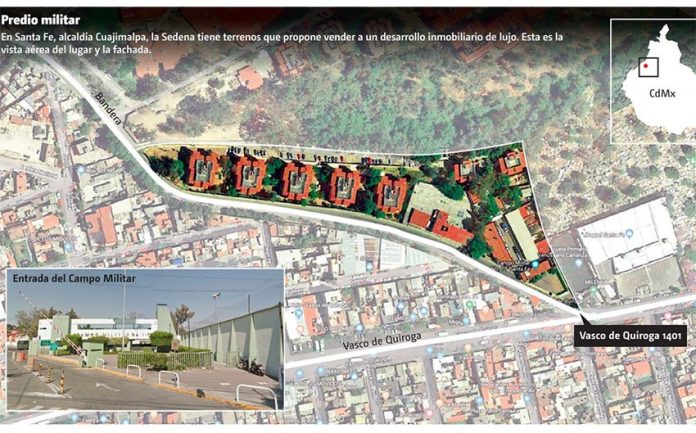
The military site where luxury apartments would be built to fund the National Guard.
The federal government is planning to build luxury apartments on a military site in Mexico City in order to partially fund the new National Guard.
President López Obrador said this morning that the sale of apartments in the proposed residential development on the Santa Fe site would earn the government between 20 and 30 billion pesos (US $1 billion to $1.5 billion).
The previous government had planned to sell off the 100-hectare site but scrapped the plan in July.
Money earned from the project would go to building 80 “facilities” for the National Guard across the whole country, López Obrador said, referring primarily to barracks.
“I’m going to defend the project because it means getting around 20 billion or 30 billion pesos, which we would use to build the facilities we need for the National Guard . . .” he said.
“If we see that a consultation is required, we’ll consult, when we have the project [ready], we’ll present it but the citizens will decide, that’s the important way to address this issue,” the president explained.
However, later in his morning press conference, López Obrador seemed to indicate that his mind was already made up.
“We’re going to do it because we need the resources, 266 [National Guard] contingents are needed to guarantee public security and 120,000 to 150,000 elements are needed and they require facilities . . . because there are currently no facilities, there are no elements, it’s a disaster, they [the past government] didn’t care about citizens’ security,” he said.
López Obrador rejected any suggestion that Santa Fe – a business district in the west of the capital – would become overpopulated.
He explained that the Secretariat of Defense would be responsible for construction of the project, which would cover 30 hectares of the military site.
The other 70 hectares will become parkland that will link up with the Chapultepec Forest.
“It won’t become saturated, we’re talking about leaving most of the property as green area, it’s not going to be a private property developer [who completes the project], it’s not a private deal, it’s the very government, in this case the Secretariat of Defense who will carry out the urbanization in accordance with regulations . . .” López Obrador said.
Prior to today’s announcement, Interior Secretary undersecretary Zoé Robledo said the government was considering the project but explained that finding the money to undertake it was a challenge.
After the last government’s plans to sell the site became public early this year, local residents argued that a new residential development would place further pressure on already stretched infrastructure in the area.
At the time, real estate experts speculated that the land could fetch up to US $1 billion.
The new government’s National Guard proposal also got a cool reception from some security analysts and several non-governmental organizations, that argued that it would only perpetuate the unsuccessful militarization model implemented by former president Felipe Calderón in 2006 and continued by the last federal government.
The federal government has backed off on two budget cuts announced last week, explaining that they were the result of clerical errors.
President López Obrador told a press conference yesterday that public universities would receive an extra 4 or 5 billion pesos (US $200 to $250 million) next year after several higher education institutes including the National Autonomous University (UNAM) were highly critical of cuts to their budgets.
“We reviewed the budget and found that there was a reduction in the budget for public universities . . . That’s why the decision was taken to correct the error. An adjustment will be made to the government’s operating expenses in relation to the secretariats, government agencies [and] the executive,” he said.
Under the government’s 5.8-trillion-peso (US $288-billion) 2019 Economic Package, presented by Finance Secretary Carlos Urzúa Saturday, UNAM, the Metropolitan Autonomous University (UAM) and the National Polytechnic University would have seen their budgets cut by 6.2%, 7.7% and 4.7% respectively.
At least two marches had been scheduled for today in Mexico City in protest.
Later yesterday, Foreign Affairs Secretary Marcelo Ebrard said that there had also been a “clerical error” in the allocation of funding for Mexico’s overseas consulates but added that it would be fixed.
This year, consulates received 244 million pesos (US $12.3 million) in funding but in the 2019 budget they were only allocated 42 million pesos (US $2.1 million), an 83% reduction.
“We’ll correct it . . . I suppose or we suppose that it is a clerical error because [an] 85% [cut] is almost like disappearing [the consulates] so we’re going to leave [their funding] as it was,” Ebrard told reporters.
The new government, which took office on December 1, also said that a clerical error was to blame for the failure to include in its new education plan a paragraph that describes UNAM as an autonomous learning institute. That triggered claims that the López Obrador administration planned to strip it of autonomy.
“. . . If it’s necessary we’re willing to add the part about autonomy,” the president said.
The vaquita porpoise is the focus of a letter by scientists to President López Obrador.
A group of prominent scientists has issued an appeal to President López Obrador to issue a ban on possessing gillnets in the upper Gulf of California to save the endangered vaquita porpoise.
Mexico has banned the use of gillnets in the area but enforcing the ban has proved almost impossible.
So the scientists have urged a ban on their possession, which could be enforced by inspecting fishboats before they leave shore.
“This is the only practical option for effectively enforcing the law,” wrote the letter’s signatories, who include Barbara Taylor, a conservation biologist at the National Oceanic and Atmospheric Administration of the United States, and Omar Vidal, representative in Mexico of the World Wildlife Fund.
The letter also stressed the need to protect the vaquitas remaining in the wild, a daunting task that the latest research suggests can still be accomplished.
During an inspection visit carried out in September in the Gulf of California, specialists sighted six or seven vaquita specimens, including a cow with its calf.
Observations suggest that vaquitas live concentrated in a 20 by 40-kilometer area, small enough to be protected with buoys that would impede the entry of fishboats.
Gillnets that are used to fish illegally for totoaba — another endemic fish species from the Gulf of California whose swim bladder is considered a delicacy in Asia — have led to the drastic decline in numbers of the vaquita porpoise, leading to its near extinction.
“Your administration can save the vaquita and set an example for Mexico and the world,” the scientists wrote to López Obrador.