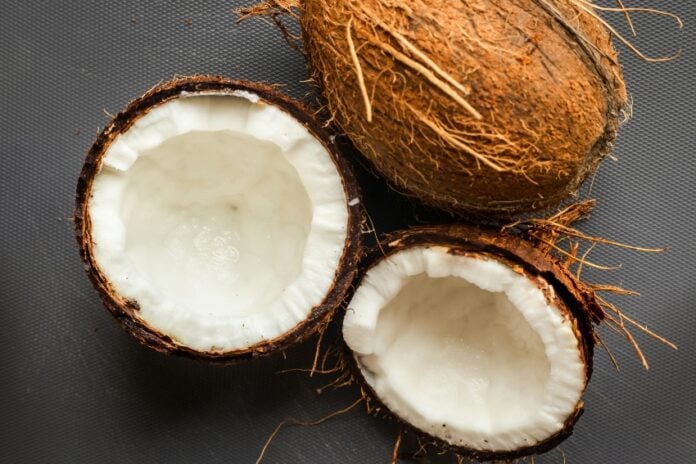
Coconuts and byproducts like copra are big business in the state of Guerrero. (Louis Hansel/Unsplash)
“You have to try the coconut candy,” says Kerry Skinner, Awareness, Brand and Culture manager of Playa Viva, an eco-friendly resort tucked into Guerrero’s wild coast where I’m staying for a long weekend. I take her word for it and sink my teeth into the sweet, round patty, known here as a cocada. Made of shredded coconut, sugar and condensed milk, the candy is baked just enough to caramelize the rounded edges to a golden brown. It’s delicious.
As I contemplate how many I can reasonably eat without calling too much attention to my lack of willpower, Kerry points to the walls above the kitchen, adorned with colorful hand-painted masks carved from coconut shells, and I think about the homemade coconut milk I poured into my coffee this morning. I pop one more candy into my mouth and resolve to find out more — but later. The hotel’s “disconnect to reconnect” policy means the internet can wait.
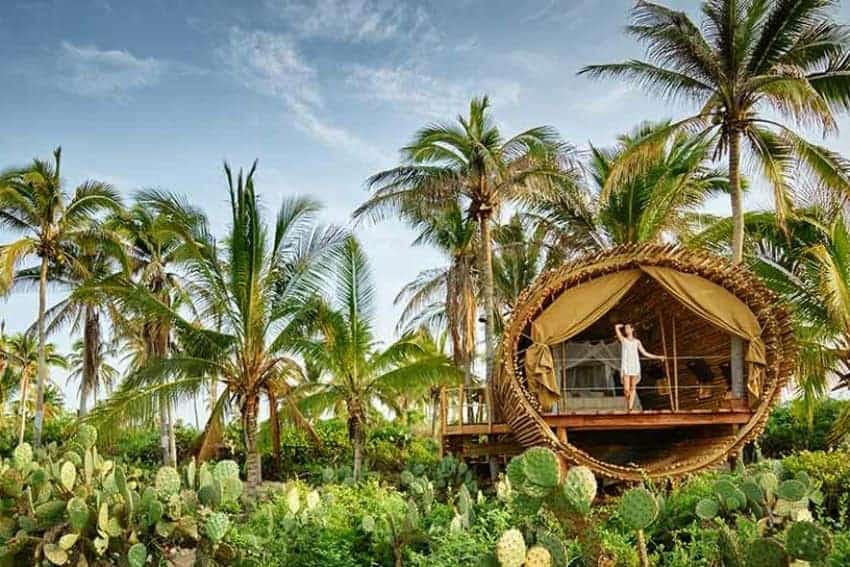
Playa Viva is an eco resort 35 kilometers south of Ixtapa-Zihuatanejo on Mexico’s Pacific Coast. (Playa Viva)
How coconut came to Guerrero’s coast
Coconut is one of Guerrero’s historic coastal crops. Spanish settlers brought coconut palms from the Philippines to the Acapulco coast in the 16th century, where they thrived in a climate as humid as the one they’d left behind. Coconuts were used for food, drink and fermentable sap — in fact, producers in the Philippines discovered coconut wine, which was temporarily banned through a royal decree in 1612 to protect the Spanish grape wine industry. The ban didn’t stick. Filipino sailors soon introduced the lightly fermented coconut wine on their visits to Guerrero. It became known as tuba, and is still found in the region’s roadside stands and markets.
The crop that built — and broke — a coastal economy
If tuba unsettled colonial wine merchants, copra would go on to reshape entire coastal economies. Copra — the dried white meat of mature coconuts — quickly became an indispensable part of Mexico’s vegetable-oil and soap industry, used to make oil for soap factories, cosmetics, detergents, industrial lubricants and food manufacturing. For a long time, coconut was grouped in the “oilseeds” category with cacao and cotton.
In the 1930s, President Lázaro Cárdenas’ post-revolutionary agrarian reform folded coastal Guerrero into a national pro-oilseed push, aimed at supplying the country’s 100-plus soap factories and dozens of oil mills. The reform gave coastal land to ejidos — communal landholding groups — and to ex-Revolutionary soldiers, integrating them more deeply into copra production and tying entire communities to the fate of a single crop. By the 1950s, Guerrero had become Mexico’s principal coconut-producing state, and it remains as such. Yet, it still ranks near the bottom on development indicators, making it a resource-rich region suffering from entrenched poverty.
When coconut money turned violent
The coconut boom came with violent undertones. Monoculture — the practice of producing just one crop over large areas — invited pests, pesticide dependence and soil exhaustion. As prices swung on global markets, middlemen and mills set the buying price of copra, taking the largest share of the value chain. At the same time, small producers absorbed the shocks of price crashes, rising input costs and costly upkeep of aging plantations.
In the 1960s, conflict involving copra money and producer unions led to Guerrero’s bloodiest memories: the “masacre de copreros” in Acapulco. A group of smallholder growers mobilized against a state-backed leadership they believed was skimming off profits and keeping prices low. The demonstration was met with bullets: dozens were killed or injured in and around Acapulco’s center, and no one in the chain of command was ever held responsible. The massacre radicalized a generation on the coast, feeding guerrilla movements and cementing coconuts’ place in Guerrero’s longer story of state violence and peasant resistance.
From roadside stands to resort spas
Roadside stands appear in abundance on the drive from Zihuatanejo — women selling rounds of cocada from plastic-covered trays, stacked on wooden stands under shady palms. The colonial-era confection has no single inventor, but has been claimed and reinvented by coastal communities across Mexico and Latin America for centuries. On Guerrero’s coast, they are inescapable in the best possible way — often flavored with guava, tamarind or pineapple.
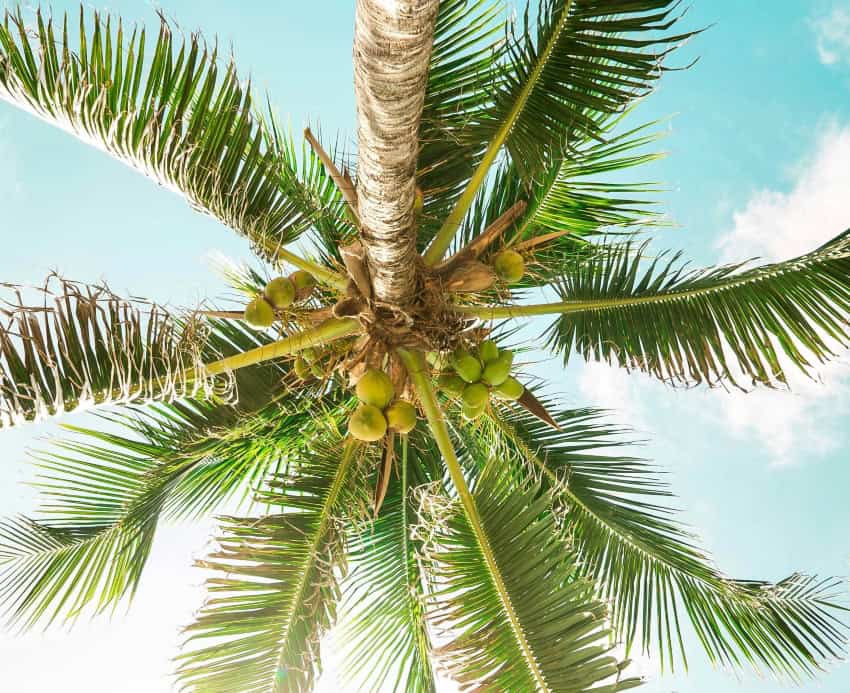
Coconut palms have been important economically in Guerrero since they were brought from the Philippines in the 16th century. (Gerson Repreza/Unsplash)
At Playa Viva, guests enjoy homemade coconut milk with coffee or poured over housemade granola. The resort obtains cold‑pressed coconut oil locally, extracted from coconuts grown in the grove using a small hand‑press. The oil shows up in the kitchen and spa, used for beachside spa treatments, often infused with lemongrass, rosemary and citrus leaves. The boutique sells bottles to take home, sourced through the Juluchuca Women’s Cooperative (a branch of ReSiMar, a watershed regeneration project), which also produces turmeric and moringa powders.
The masks on the kitchen wall are made by artisans who carve and paint coconut shells into suns, animals and carnival figures — Kerry mentions that guests commonly buy them as souvenirs, even though that wasn’t the initial intention. Near the kitchen is a small wooden stand selling fresh coconuts for water and as a snack, chopped and topped with lime, salt and tajin.
Reinventing a coconut’s contribution
Coconut production plays another surprising role on the resort grounds. In 2021, Playa Viva added six new treehouses to its original 12, inspired by the Mobula manta ray migration that passes annually in front of the property. The structures aren’t supported by conventional foundations, but rather are suspended in mid-air by palm trees transplanted from the resort’s own coconut grove. Moreover, palm trees do their part to stop beach degradation by reinforcing sand dunes. “They don’t just look pretty holding up the treehouses; they also serve a purpose,” says Kerry.
Where copra once dominated, small producers and cooperatives are finding value in what used to be considered waste: shells made into masks and bowls, husks spun into fiber for rope, mats and brushes; plus bottled coconut water for drinking and oil cold-pressed for cosmetics and cooking. A single coconut that might once have been sold off cheaply for copra now has the power to create half a dozen higher-value products.
How to ethically buy coconut
Buying coconut doesn’t automatically mean supporting the people who grow it. Profits still tend to pool with mills and middlemen unless travelers deliberately seek out cooperatives and transparent producers — looking for labels that identify a community rather than just a brand, or asking hotels directly which groups they source from. Playa Viva, for its part, invites guests on permaculture farm visits, artisan workshops and local tastings where payment goes straight to growers and makers.
Standing in the shade of Playa Viva’s palms, ready to stuff yet another cocada into my mouth, I think about how easy it is to consume all of this without asking where it comes from. The coconut in my coffee, the oil on my face, the mask on the wall — all of it connects back to communities that have tended these fruits for generations, often without seeing much of the profit. The least we can do as travelers is ask who made it, and attempt to pay them fairly for it.
Interested in supporting Guerrero’s watershed regeneration project? Playa Viva adds a 2% Regenerative Trust contribution to each guest’s bill, which is directed to its ReSiMar watershed regeneration project and community initiatives. For more about ReSiMar, click here.
Bethany Platanella is a travel planner and lifestyle writer based in Mexico City. She lives for the dopamine hit that comes directly after booking a plane ticket, exploring local markets, practicing yoga and munching on fresh tortillas. Sign up to receive her Sunday Love Letters to your inbox, peruse her blog or follow her on Instagram.
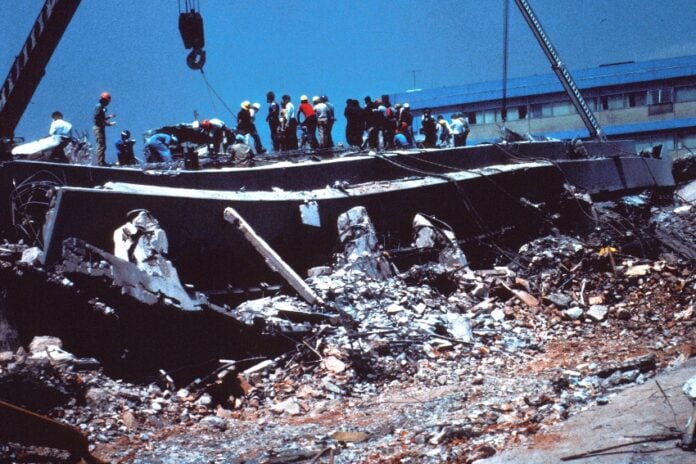
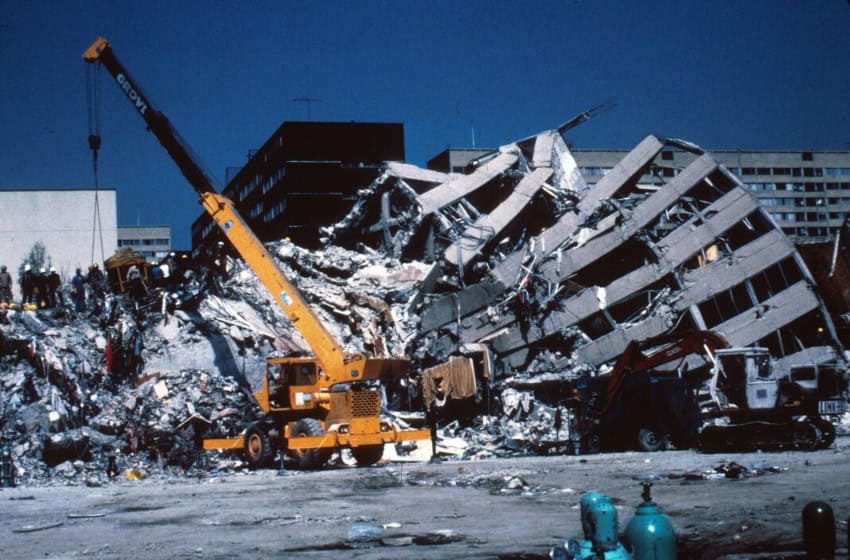
This hospital, like many other buildings, collapsed during the 1985 Mexico City earthquake. (United States Geological Survey)
María Gutiérrez returned home around 7:20 am that morning, having just dropped off her teenage daughter at school. She lived on the sixth floor of the Nuevo León, a massive cement building in the Tlatelolco housing complex. María pulled into the parking lot, and after getting out of her car, looked up: “As I got out of the car, I could see my home, everybody’s home, the entire building being ripped apart. Walls, windows, everything crumbled. And I could not get there.” While she drove her oldest to school, María’s mother-in-law and three youngest children remained behind.
40 years on, the catastrophic Mexico City earthquake looms large in the memories of those who survived it. (United States Geological Survey)
Mexico City had experienced earthquakes before, but nothing like this. The earthquake was felt all the way in Houston, Texas, over 1,000 miles away. Unlike other tremors when the earth slid side-by-side, this time it buckled up and down as well. The ground literally bounced and buckled. Worse still, it lasted for what seemed like forever: just under three full minutes. Years later, Gloria Amador recalled, “I lived in the ‘Artega’ building of Tlatelolco. I grew up in Tlatelolco, and in 1985, I was very young, 17 years old, and I was very, very frightened by the earthquake because in my house, tiles and vases began to fall. There was a feeling that we might lose our lives at any moment.”
The tragic irony was that throughout the 1970s, most of the Tlatelolco housing complex remained vacant because of the killings that occurred in 1968. No one wanted to live at the site of one of the worst episodes in recent Mexican history, one orchestrated by their own government. The Chihuahua building, used as the staging ground by the soldiers, stood virtually empty for much of the 1970s. It was only when rents dropped to rock-bottom prices in the early 1980s that people started moving back to the area. By 1985, the housing complex was almost completely full.
The devastation
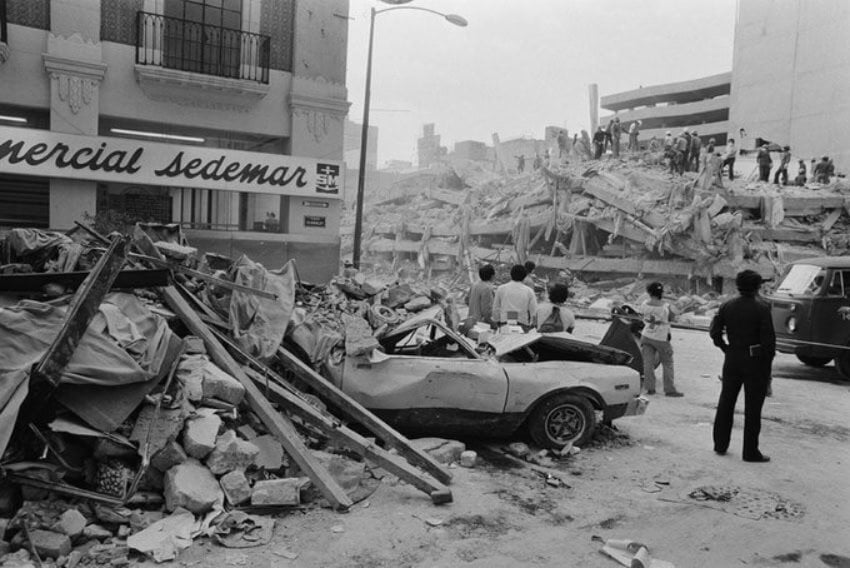
Within minutes that September morning, utter devastation reigned across the entire city. More than 370 buildings collapsed, including the National Medical Center and the Cardiology Hospital (where 70 doctors and nurses were killed), numerous government buildings, tourist hotels, the central telephone switching station and the main studio of Televisa. There was no electricity, no water, no communications and no public transport of any kind. Roads were impassable. It was as if a massive bomb had gone off, with entire neighborhoods flattened.
“On paper, at least, a well-conceived plan existed in the Interior and Defense ministries to rapidly mobilize security forces and other government personnel in the event of a massive earthquake,” according to Jonathan Kandell in “La Capital: The Biography of Mexico City.” Unfortunately for the people of Mexico City, those plans existed only on paper and were never implemented, or even attempted. The government’s immediate response was simply to send military units to the most heavily damaged areas and then cordon them off.
That was it. They did not start digging to extricate survivors or remove rubble, or assess which sites should get priority in rescue operations. Soldiers simply stood there, ostensibly to prevent looting, but in actuality, they merely prohibited local residents from attempting to mount their own rescue efforts.
The disaster
“As another sign — if one were needed — of how the system had frozen down to its very heart, the Ministry of Foreign Affairs proudly announced that ‘under absolutely no conditions’ would they request aid, least of all from the United States,” noted historian Enrique Krauze in “Mexico, Biography of Power: The History of Modern Mexico, 1810-1996.”
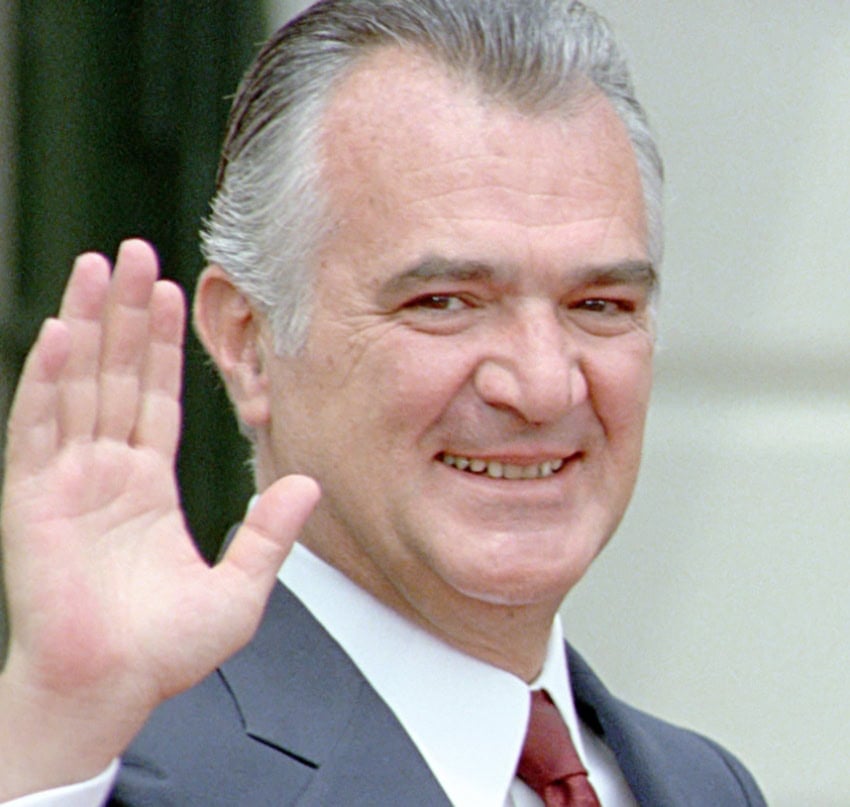
Mexican President Miguel de la Madrid in 1986, one year after the Mexico City earthquake. (Public Domain)
“The public was not only willing to accept aid; they were begging for it. The disaster was in every way immense.”
The presidential administration of Miguel de la Madrid was caught completely flatfooted, and it was obvious they did not know how to respond to such a disaster. By the next day the president even went so far as to proclaim: “We are ready to return to normal life. We are prepared to deal with this situation, and we don’t need outside aid.”
But after a second smaller earthquake hit 36 hours after the first one, he went on national television and admitted, “The truth is that in the face of an earthquake of this magnitude, we don’t have enough resources to confront the disaster quickly and easily.”
The aftermath
In the aftermath of the earthquake, with thousands of people trapped beneath the rubble, the authorities seemed utterly ill-prepared to handle any aspect of the relief effort. “Almost as soon as the ground stopped trembling, the political aftershocks began. Throughout the capital, ordinary Mexicans railed against their government for its ineptitude during the emergency,” Kandell wrote.
Although there were endless examples of ineptitude and incompetence throughout the disaster crisis, one episode stood out for the Nuevo León residents. Standing amidst the rubble immediately after the earthquake, the surviving residents began to organize themselves. One group went to get whatever food and water they could find. Another group took off trying to find ambulances and medical aid. And still another group of residents went to speak to the housing complex director, hoping to gain his assistance in finding help.
After an hour, they returned and informed their fellow residents that the director told them that he was quite busy and perhaps he would be able to see them at the end of the week. This was the director of their housing complex, an area whose residents made up 40% of those affected by the damage of the earthquake, and he said he had no time for them. Fully one-quarter of the 103 buildings in the housing complex had collapsed, and he hopefully would see them at the end of the week. The residents could not believe what they were hearing. They were rightfully stunned.
The residents of Tlatelolco
Damage from the earthquake was too severe for many residents to return to their buildings. (X, formerly Twitter)
After that meeting, the surviving residents of Tlatelolco, as well as those of Mexico City, realized they would never be able to return to their residences. The damage was too severe and it was too dangerous. They became known as the damnificados, the displaced refugees of the earthquake. On Sept. 22, the Tlatelolco damnificados held an impromptu meeting in the Plaza de Tres Culturas and elected Cuauhtémoc Abarca as their leader. Cuauhtémoc Abarca lived in the Nuevo León building, and on the morning of the earthquake, he had been up early and had gone outside to prepare for his morning jog, a simple act that probably saved his life.
“In a way we had never done before, we had to make our own decisions,” he recalled. “The earthquake hit, and then we found out that the director couldn’t see us, the borough president was not in his office and the mayor wasn’t taking visitors. All of a sudden, we were living in a city without a government.”
The surviving residents of Tlatelolco would have to make decisions on their own. This was not something the Partido Revolucionario Institucional (PRI) system encouraged. The PRI political machine was very much a top-down system, and people were not supposed to take initiative in their community. The earthquake changed that, and in fact, neighborhood associations like this one sprang up all over the city.
The work brigades
So, with the government incapable of helping in recovery efforts, ordinary Mexicans took it upon themselves to form work brigades and try to dig survivors out by hand. The people who came together in those work brigades cut across class lines. Middle-class housewives hauled rubble alongside street punks. Students from the south side bicycled to the city center to help factory workers clear rubble. It didn’t matter.
“There was an instant emergency response from the civilians, who organized themselves into teams to dig for survivors, get the wounded treatment, and get food and shelter to the displaced. Groups of everyone from chavos banda, street punks, to housewives to the tenor Plácido Domíngo cleared rubble by hand; volunteers nicknamed topos, moles, tunneled into the collapsed buildings to bring out survivors,” wrote historian Paul Gillingham in “Mexico: A 500-Year History.”
But it was a daunting task, and while these spontaneous rescue efforts served to unite ordinary Mexicans, the earthquake exposed something more sinister: government corruption.
The textile workers
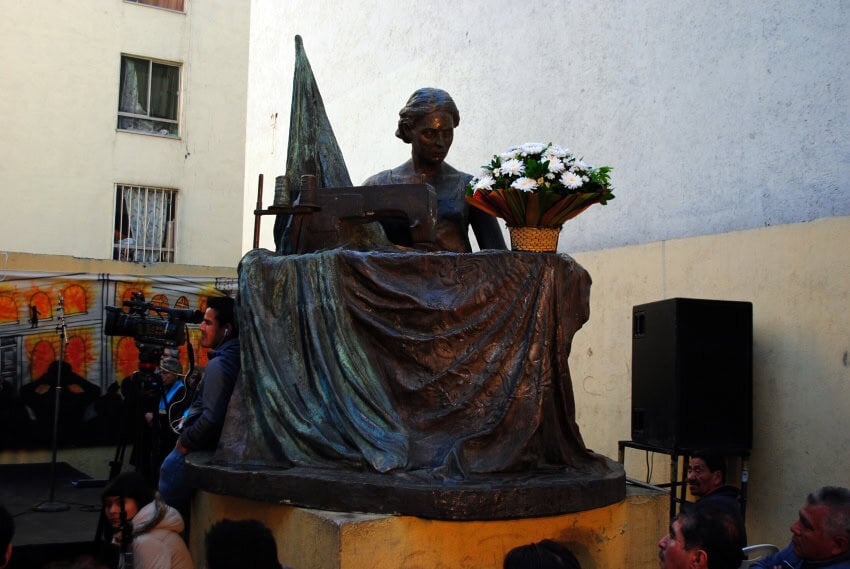
Bronze statue of a seamstress at the site of collapsed factory. (Protoplasma Kid/Wikimedia Commons)
It turned out that public buildings like hospitals and housing complexes were far more likely to have collapsed. Old rumors resurfaced about bureaucratic collusion with shady construction owners. Paul Gillingham pointed out that “Public buildings showed a greater propensity to collapse, their structural pillars turning out to be filled with sand.” Corners obviously had been cut, and kickbacks paid to attain building permit approval. Worse still, per Gillingham, “The earthquake revealed 200 illegal textile factories in the area, buildings unfit for the machinery they contained; the floors collapsed down through the buildings and killed 1,600 working women.”
One of these textile factory workers, Evangelina Corona, remembered: “We women who worked as seamstresses had horrible working conditions. What the earthquake did was to reveal this reality … In many factories, we found that the seamstresses were made to work extra hours without pay at all. Workers told stories of being punished. In some cases, bosses arrived, opened the door for the workers, they entered, the doors were closed and they couldn’t leave. That was another of the reasons why so many seamstresses remained under the rubble after the earthquake, because they couldn’t open the doors.”
“First came the screams from the seamstresses buried under one of the capital’s collapsed textile plants.” Then, said Gloria Juandiego, she began screaming. “The bosses got the equipment out, the raw materials, their safe boxes; they prioritized that.”
Press coverage
The PRI party newspaper, El Nacional, initially refused to even report on the devastating tragedy unfolding in Obrera. For them, thousands of seamstresses killed or trapped in illegal sweatshops weren’t even worth reporting about. But, eventually, even El Nacional couldn’t avoid the unfolding tragedy. However, when El Nacional finally “joined in the coverage,” wrote Gillingham, “it stressed how many of the sweatshop owners were of Jewish and Lebanese descent, not really Mexican at all.”
By Oct. 24, the people of Mexico City had gotten to the point at which they had enough. They needed a way to express their frustration, accentuate their voices, and keep pressure on an unresponsive government. So, in an effort to unify all of the neighborhood associations, they formed the Coordinadora Única de Damnificados, the Unified Coordinating Committee of Earthquake Refugees (CUD). The committee then suggested a protest march should be held in two days, and the final destination point ought to be Los Pinos.
The PRI offensive
Forty thousand people showed up and marched to the presidential palace, demanding that the government find adequate housing for all of those displaced by the earthquake (about 180,000 people by that point). The government responded by stating that their inspectors determined that 23 buildings had been so severely damaged by the earthquake that they had to be demolished, but the residents would be provided with “equivalent housing.” The government then let it be known that this equivalent housing was in Estado de México, up to 70 miles away. The Tlatelolco, in particular, would be redeveloped as office complexes, undoubtedly with lucrative construction contracts available to those shady business magnets with close ties to the PRI. These announcements only prompted more public protests by the CUD.
Architect Guillermo Carrillo Arena did not react well to those who questioned his culpability in earthquake deaths. (Facebook)
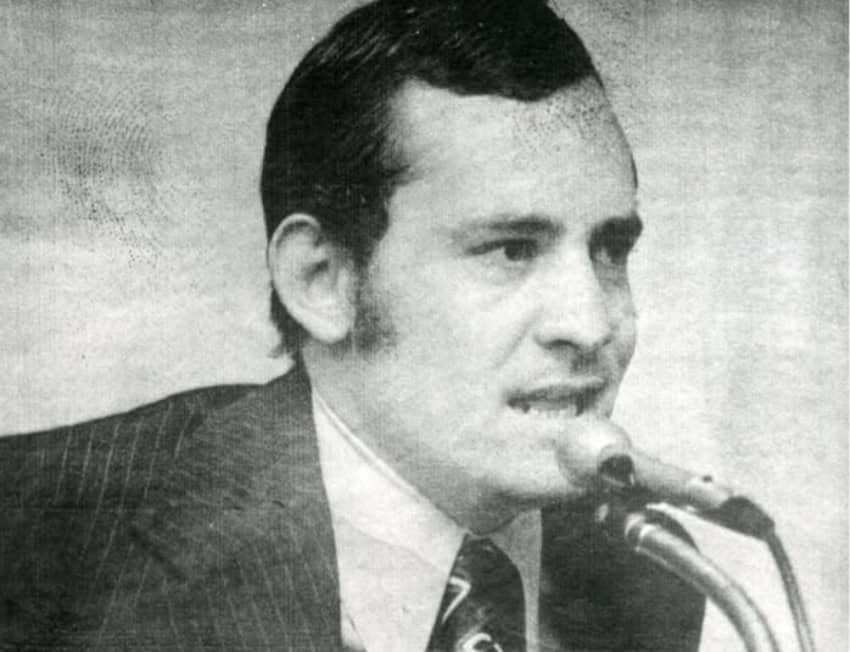
In response, PRI officials went on the offensive. They claimed that the protestors were in fact “bad Mexicans” who were supported by “seditious leaders moved by murky interests.” In particular, the federal minister of the environmental agency, Guillermo Carrillo Arena, an architect who was playing a key role in the earthquake recovery, leveled outrageous remarks at anyone who questioned him. As a top government official, he had approved the plans for the construction of the two government hospitals that had collapsed, which killed hundreds of people. At a press conference, reporters asked him if he felt responsible for those buildings collapsing and ultimately those deaths. Carrillo Arena responded: “The only thing I can say about that question is that whoever is asking it is a prostitute and an imbecile.” After comments like that, the damnificados’ resolve only strengthened.
A master stroke
The CUD was unsure what to do next, but determined to stage a protest that would keep pressure on the government. The damnificados then settled upon a master stroke. In the first week of January 1986, they moved back into their damaged, dilapidated buildings in whatever crevices they could find. The buildings were structurally unsound and in no way inhabitable, but the move made a statement.
Within days, President de la Madrid fired Carrillo Arena. Then de la Madrid assembled a new team of officials that opened negotiations with the CUD to develop a plan. As journalist Julia Preston noted in “Opening Mexico: The Making of a Democracy,” a new plan emerged with “much more emphasis on restoring structures that could be fixed, so that the homeless would not have to suffer the additional trauma of starting life again in a distant location.”
This was a surprising and unlikely reversal for a government that rarely, if ever, considered the wants and needs of ordinary Mexicans when proposing development projects. According to Cuauhtémoc Abarca: “People woke up. They began to see the government not as something superior to them but as an equal with whom they could talk, negotiate, and even win a round or two. No one could remember ever seeing a government project defeated as categorically as we defeated the plan to move us out of Tlatelolco.”
A turning point
This increasing sense of accomplishment permeated Mexican society and allowed Mexicans to view themselves, and their government, in an entirely new light. In fact, when President Miguel de la Madrid opened the 1986 World Cup ceremonies in Mexico City, the Mexican fans booed, whistled and shouted at him. This might never have happened before the earthquake, and the government’s failed response to that disaster.
The 1985 earthquake represented a turning point not only in Mexican society but most especially in Mexican politics. One-party rule does not work if that party is completely incompetent. Instead of looking to the government for answers, neighborhood associations (and ordinary Mexicans in general) began to work together to find solutions to local problems.
Cuauhtémoc Abarca in 2015, on the 30th anniversary of the 1985 Mexico City earthquake. (Protoplasma Kid/Wikimedia Commons)
Cuauhtémoc Abarca said, “The earthquake threw down walls, and it also threw down barriers between communities. Instead of lines of communication from the top down, suddenly we had lines of communication that were horizontal, between different organizations and barrios, or, better yet, from the bottom up.”
“The earthquake was also invigorating,” explained Preston. “In its wake, because of the government’s failure to (adequately) respond, there emerged a new form of popular political action, called autogestíon, do-it-yourself politics. … The new force that emerged from the earthquake was civil society. The citizen groups that formed were independent of the PRI, but they had no direct ties to opposition parties either. They mobilized Mexicans across class lines.
“If the 1968 Tlatelolco massacre had revealed the repressive core of the system, the earthquake exposed its depths.”
Robert McLaughlin, Ph.D. is a historian specializing in Cold War Latin American history.
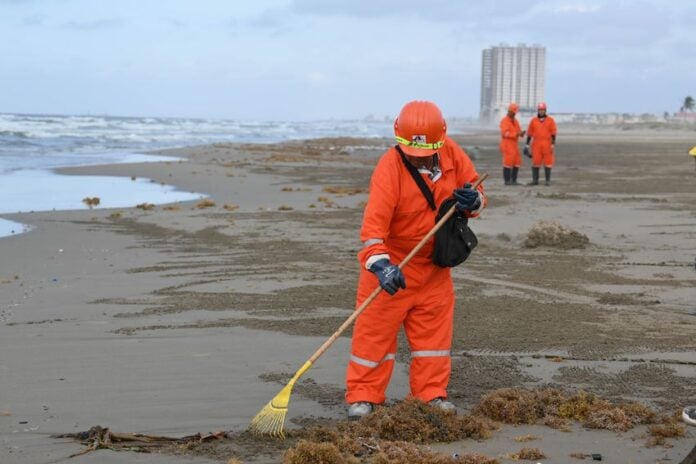
More than 50 workers from the company MAYA, a subcontractor for PEMEX, carry out intensive cleanup efforts along the beach of Coatzacoalcos, Veracruz, as part of the government's response to the presence of an oil spill in the area. (Ángel Hernández/Cuartoscuro)
A new poll published this week found that 40% of U.S. voters consider Mexico a good neighbor, while 28% say it’s a bad one. That’s not a terrible headline for Mexico, until you note that its net favorability score among Americans has fallen 16 points since last spring, with cartel activity, fentanyl and unauthorized migration topping the list of U.S. grievances.
The findings arrive at an instructive moment in the bilateral relationship. USMCA negotiations are underway, and the mood music has been notably warmer than the rhetoric coming from the White House: Last week, U.S. Ambassador Ronald Johnson told the American Chamber of Commerce that the treaty review is “an opportunity to deepen integration,” not a risk. He also applauded the “historic” security cooperation by the Trump and Sheinbaum administrations.
Domestically, the week of March 23–27 delivered economic and political friction that touched on everything from the cost of borrowing to the cost of governing.
Didn’t have time to follow the news this week? Here’s what you missed.
China threatens to hit back over Mexico’s tariff hikes
Trade tensions between Mexico and China escalated sharply this week after Beijing declared it has the right to retaliate against the tariffs Mexico imposed on more than 1,400 Chinese products at the start of the year. China’s Ministry of Commerce, following a formal probe, determined that Mexico’s duties — ranging up to 50% and affecting more than US $30 billion in Chinese exports — constitute trade and investment barriers.
The ministry said losses to China’s mechanical and electrical sectors alone could reach $9.4 billion, with the automobile and auto parts industries bearing the brunt.
In a pointed response, Economy Minister Marcelo Ebrard insisted Mexico was within its rights to protect domestic industries in textiles, footwear and steel, and denied that U.S. pressure had anything to do with it, though the duties are widely seen as a goodwill gesture ahead of the ongoing USMCA review.
China, whose goods exported to Mexico dwarfed Mexico’s exports to China by a ratio of roughly 13 to 1 in 2025, could seek dialogue, escalate to the World Trade Organization, or impose retaliatory measures on Mexican goods. However, Mexico’s relatively small export footprint in China limits Beijing’s leverage.
Banxico cuts rates despite rising inflation — and the peso pays
The Bank of Mexico’s board voted 3-2 on Thursday to cut its benchmark interest rate by 25 basis points to 6.75%, even as annual headline inflation climbed to 4.63% in the first half of March — its highest level since 2024.
The board cited weak economic activity, the exchange rate and the level of monetary restriction already in place. Banxico acknowledged that inflation risks remain tilted to the upside, and raised its forecasts for three of the four quarters of 2026, but maintained that headline inflation will converge to its 3% target by Q2 2027.
Markets reacted swiftly. The peso slid past 18 per US dollar on Friday morning for the first time since early December, pressured by the surprise cut, a stronger US dollar and geopolitical risks tied to the Middle East conflict. The currency was trading at roughly 18.12 per dollar on Saturday morning.
Sheinbaum faces further setbacks to electoral reform
After last week’s defeat in the Chamber of Deputies — where her coalition allies in the Green Party and Labor Party defected — President Sheinbaum came back this week with a recalibrated approach to electoral reform. Her new strategy avoids constitutional amendments, which require a two-thirds supermajority, in favor of changes to secondary legislation that need only a simple majority to pass.
The Senate approved a version of the bill on Wednesday, but not without further trimming it. The provisions that survived focus on reducing what Sheinbaum characterized as excessive perks for lawmakers at all levels of government and for National Electoral Institute officials: eliminating special bonuses for electoral councilors, capping municipal councils at 15 members and limiting state legislature budgets to 0.7% of their state’s total budget. Savings from those cuts are to be redirected to health care, education and welfare programs. The federal Senate’s own budget is also slated for a reduction under the bill.
What didn’t survive the Senate vote was a provision that would have allowed a presidential recall election to be held concurrently with municipal, state and federal elections in 2027. Sheinbaum suggested at her Thursday press conference that her own Labor Party allies killed it out of fear that running the recall alongside legislative races would boost Morena at their expense.
The stripped-down bill still needs to clear the lower house of Congress, where the original constitutional reform failed earlier this month. Whether Sheinbaum’s coalition holds together for this softer version remains the central political question heading into next week.
Ceci Flores finds her son after 7 years of searching
In one of the week’s most emotionally resonant stories, Ceci Flores — the founder of the search collective Madres Buscadoras de Sonora — announced that she had found what she believes are the remains of her son Marco Antonio alongside Highway 26 near Hermosillo, seven years after his disappearance.
Flores identified the site partly through clothing found at the location; DNA analysis is pending. Marco Antonio went missing in 2019 when an armed group abducted him along with another brother. Flores’s collective, which she founded in 2019, has now been involved in recovering more than 2,700 bodies and reuniting 2,400 living people with their families.
The personal milestone arrived against the backdrop of a broader national reckoning. On Friday, President Sheinbaum presented a landmark government report on Mexico’s missing persons crisis, revealing that 132,534 people remain officially listed as disappeared, the vast majority of them registered since 2006.
Authorities claim they have discovered evidence of legal activity — tax filings, phone records and other traces — for more than 40,000 of those individuals, leading to the reclassification of 5,269 as located alive. However, investigations into more than 46,000 cases have not yet begun due to incomplete data. Critics, including the NGO Causa en Común, questioned whether the data fully reflects a crisis that shows no signs of slowing.
Rare school shooting in Michoacán leaves 2 teachers dead
A 15-year-old student killed two teachers at a high school in the Pacific coast city of Lázaro Cárdenas, Michoacán, on Tuesday morning, in a shooting that President Sheinbaum addressed directly at her Wednesday press conference.
The victims, María del Rosario, 36, and Tatiana Bedolla, 37, were both teachers at the private Antón Makárenko High School. The alleged perpetrator was detained at the scene; he reportedly gained access to an AR-15 rifle and opened fire after initially being blocked from entering the campus.
President Sheinbaum addressed the shooting at her Wednesday morning press conference, calling it “very painful in many senses.” She noted that the victims appeared to have been deliberately targeted, and said her government was determined to treat the attack as an “isolated incident that is not repeated.” To that end, she announced plans to expand a mental health program already operating in some middle schools to a wider audience of students the same age as the alleged shooter.
Gulf of Mexico oil spill: Cover-up accusations mount
The Gulf of Mexico oil spill that reportedly began in early February continued to generate controversy this week as more than a dozen environmental organizations, led by Greenpeace and the Mexican Center for Environmental Law (Cemda), publicly accused the government of concealing the disaster’s scope and timeline.
The aerial images they presented suggest the spill originated near Pemex’s Abkatún platform as early as Feb. 6, with containment vessels visible by Feb. 13 — weeks before officials publicly acknowledged the problem.
The slick has now spread across roughly 600-700 kilometers of Gulf of Mexico coastline, affecting the Veracruz Coral Reef System and six other protected natural areas. President Sheinbaum disputed claims of a major catastrophe and accused Greenpeace of spreading an “unscientific” infographic — though the organization had already clarified the image was illustrative, not satellite-based.
Pemex denied responsibility, and the privately owned vessel initially blamed by Veracruz Governor Rocío Nahle was cleared following inspection.
Economy minister inaugurates joint forum of binational trade chambers
On Monday, Economy Minister Marcelo Ebrard inaugurated the first Forum of Binational Trade Chambers in Mexico, uniting over 20 Mexico-based trade chambers that represent companies from Argentina, Australia, New Zealand, Belgium, Brazil, Chile, France, Germany, Ireland, Israel, Italy, Japan, the Netherlands, Spain, Switzerland, the United Arab Emirates and the United Kingdom, among others.
The forum, organized with significant input from India’s Embassy in Mexico, is designed to align the collective market intelligence of its member chambers with the priorities of President Sheinbaum’s Plan Mexico economic initiative. Ebrard used the occasion to signal that the government sees international trade partnerships as central to its nearshoring and investment ambitions, and announced plans to visit India as bilateral trade grows.
FIFA President Gianni Infantino traveled to Guadalajara’s Akron Stadium on Thursday night to personally watch Jamaica defeat New Caledonia in a World Cup qualifying match before nearly 41,000 fans.
His presence — just 34 days after violence in Jalisco following the killing of cartel leader El Mencho — was a pointed signal of FIFA’s confidence in Mexico as host country. The game went off without incident, and Infantino is set to meet with President Sheinbaum on Monday to review World Cup preparations ahead of the June 11 kickoff at Azteca Stadium.
Good news of the week
⚖️ Mexico’s Congress passed a new anti-femicide law that broadens the legal definition of femicide and increases prison sentences — a significant step in the country’s long fight against gender-based violence, and one that carries added resonance given the incel-linked school shooting in Michoacán earlier in the week.
Several storylines from this week carry momentum into the coming days.
The stripped-down “Plan B” electoral reform still needs to clear the lower house of Congress — whether Sheinbaum’s coalition holds together for the softer bill will be an early test of her legislative footing.
On the economic front, the peso’s slide past 18 to the dollar and Banxico’s surprise rate cut raise a practical question for ordinary Mexicans: with inflation already at 4.63%, will borrowing costs coming down translate into relief at the checkout counter, or simply more pressure on the currency? And then there is the Gulf oil spill. Evidence assembled by Greenpeace and Cemda points squarely at Pemex’s Abkatún platform as the source — and suggests the government knew weeks before it said anything publicly. With Holy Week bringing thousands of tourists to Gulf coast beaches starting this weekend, the coming days may determine whether the spill becomes the first serious stain on Sheinbaum’s portrait of transparency.
Mexico News Daily
This story contains summaries of original Mexico News Daily articles. The summaries were generated by Claude, then revised and fact-checked by a Mexico News Daily staff editor.
Iran's National Team may or not compete in the 2026 FIFA World Cup due to the Iran War with the U.S. (Fars Media/Wikimedia Commons)
With the 2026 FIFA World Cup — part of which will take place in Mexico — finalizing the last qualifiers, events in the Middle East have raised serious questions about the tournament, particularly concerning Iranian participation.
But this is perhaps not surprising, if only because every other time Mexico has hosted the World Cup, there has been some political upheaval going on in the background.
The first Mexico-hosted World Cup: 1970
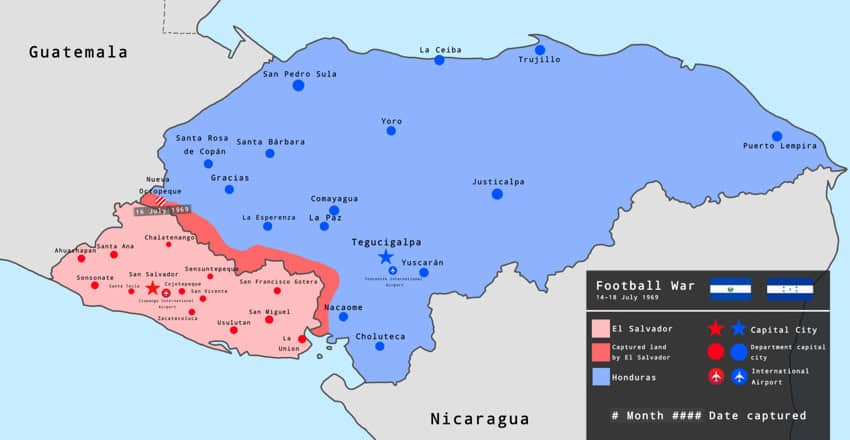
The “Football War” between Honduras and El Salvador was precipitated by the teams meeting in the 1970 FIFA World Cup. (Juan Jose 1969/Wikimedia Commons)
For our first instance, we have to go back to 1969, when Mexico was preparing for the 1970 FIFA World Cup.
Mexico was such a dominant regional soccer power in Latin America at the time that no Central American team had ever reached the World Cup finals before. This time around, however, with Mexico as host getting an automatic slot in the tournament, a Central American nation had the chance to qualify.
But when El Salvador was drawn in to play neighboring Honduras in the summer of 1969, the matchup was such an emotionally and politically charged one that it indirectly led to a military conflict between the two countries, often referred to today as “The Football War.”
Also dubbed The 100-Hour War, the conflict was reported in the press outside Latin America as a brief, quirky event in which hot-blooded Central Americans were so passionate about football that they went to war with each other over it. Yet it was not a joke. Nor was the conflict over just a football match.
Although the fighting “only” lasted 100 hours, it was an intense conflict, and fatality estimates range from 3,000 to 6,000, the vast majority of whom were civilians.
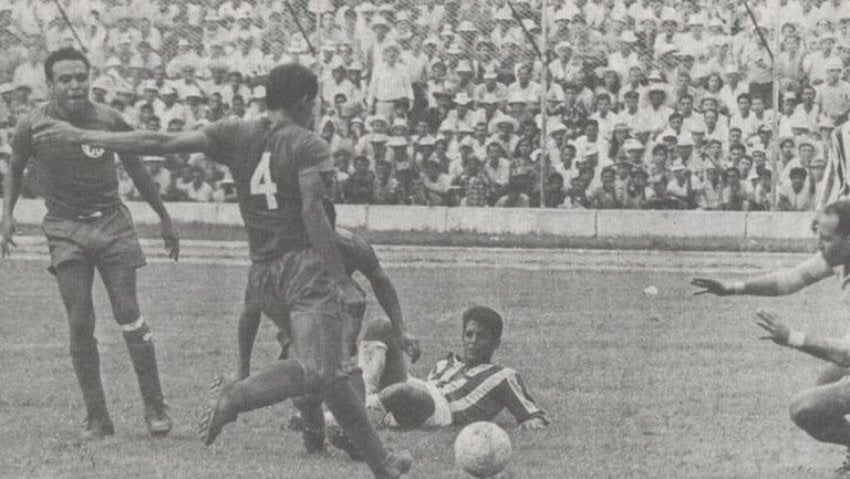
The 1970 World Cup match between Honduras and El Salvador took place amid escalating tensions between the two countries. (X, formerly Twitter)
The teams played their first qualifier match of what would become a three-game series on June 8, 1969, in Honduras. The home side won 1-0, but this first matchup was not without conflict: The night before the game, Honduran fans threw rocks at the visitors’ hotel and banged on drums to keep the Salvadoran team awake. There were also riots at the match.
This set the scene for an even more tense second qualifier in San Salvador a week later, on June 15. Salvadoran fans rioted outside the Honduran team’s hotel — some even reportedly threw dead rats into the team’s hotel room windows — and the Honduran team had to be driven to the stadium in armored vehicles.
El Salvador won that match 3-0, with the Honduras coach famously saying that had his team won, he wasn’t sure that his players would have gotten out of the stadium safely. His statement was apparently not an exaggeration: During the post-match celebrations in the streets of El Salvador, violence broke out between the opposing teams’ fans.
The hostile treatment of their team in San Salvador, combined with resentment over old economic grudges, helped to provoke anti-Salvadoran riots all across Honduras, with Hondurans burning Salvadoran immigrants’ homes and thousands of Salvadorans fleeing the country.
Then, the day before the two teams arrived in Mexico City for a third and final game on June 27, El Salvador broke diplomatic ties with Honduras in protest against what it said had been the Honduran government’s failure to protect Salvadoran citizens.
At this point, the potential for fan violence was clear to everyone: The small crowd in Mexico City’s Estadio Azteca was separated and closely monitored by a force of baton-wielding Mexican police that almost outnumbered the fans. Although the situation was well controlled, tensions remained high, with El Salvador fans shouting “murderers” at Honduras fans on the opposite side of the pitch.
Iranian soldiers fighting in the country’s war against Iraq, which took place from 1980 to 1988. (Wikimedia Commons)
El Salvador won the match 3-2, thus qualifying for the World Cup finals the following year. Not long afterward, on July 14, El Salvador’s military crossed the border into Honduras and the 100-Hour War began.
When El Salvador came to Mexico again in the summer of 1970 to make their World Cup debut, they lost all three games, including going down 0-4 to Mexico.
1986: Another Mexico World Cup, another war
When the World Cup returned to Mexico 16 years later in 1986, the run-up was once again affected by a war, this time in the Persian Gulf.
By this time, Iraq and Iran had been fighting for nearly five years. We tend to forget that at the time, the Western powers were largely pro-Iraqi, with Saddam Hussein being portrayed as a brave soldier defending the region from the religious fanatics in Tehran, which had this reputation in the West ever since the Iranian Revolution had deposed the pro-Western Pahlavi dynasty in 1979 and established the current theocracy.
FIFA had no trouble allowing the warring countries to enter the competition, but, for the players’ safety, it insisted that both teams play their home games on neutral ground. Iran objected and was disqualified, but Iraq — which played its “home” matches in the King Fahd Stadium in Saudi Arabia — qualified for the tournament.
History repeats in 2026
Incredibly, 30 years later, with the World Cup returning to Mexico, the tournament will once again take place in the shadow of a Middle Eastern war.
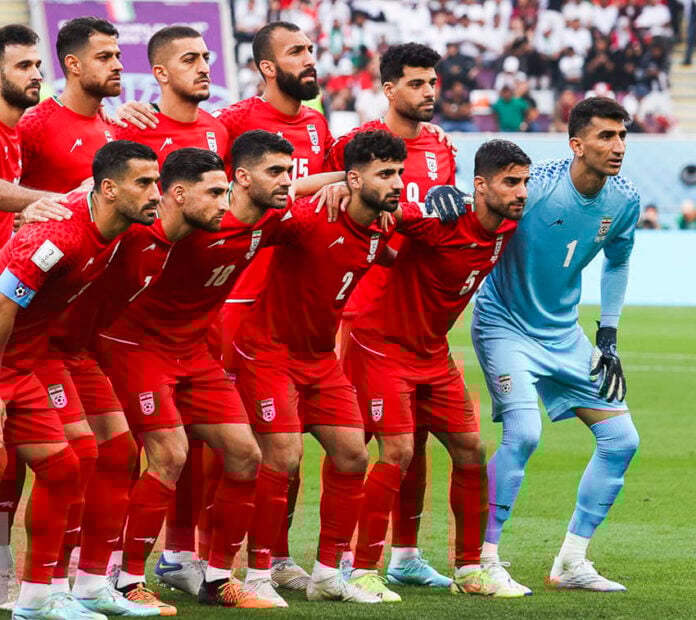
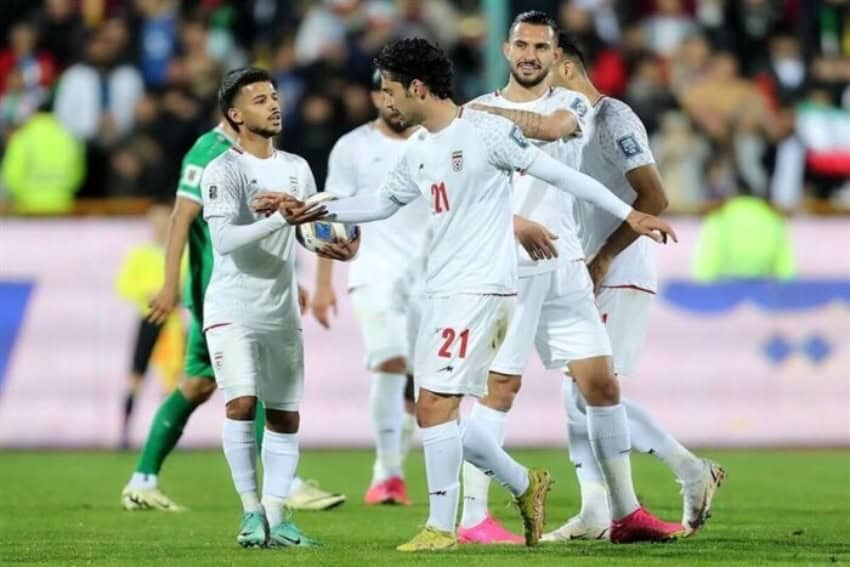
Iran’s National Team has qualified for the 2026 FIFA World Cup and is scheduled to compete in the U.S., a country with which it is currently at war. (Persian Football)
This fact has already had an impact: Iraq, although not directly involved in the conflict between Israel, the United States and Iran, requested that its final qualifying game — due to take place in Monterrey, Mexico, on March 31 — be delayed, pointing out the difficulties right now of traveling out of the Middle East, where thousands of flights have been disrupted as routes are closed for safety reasons and some airlines have canceled all flights in and out of the region until at least the summer.
FIFA has, however, insisted that Iraq meet its commitment, which is perhaps not surprising, given that the date is so close. To date, the Iraqi team is expected to arrive on time in Mexico by private jet. With regional sides Jordan, Qatar and Saudi Arabia already qualified, there might be further logistical problems down the line, but nothing that shouldn’t be solvable.
In the case of Iran, the situation becomes far more complex. While Iran has qualified for its sixth World Cup tournament (and third consecutive appearance), it is at war with one of the hosts. At the moment, the Iranian team is based in Turkey and should have no trouble getting to the United States, where all three of its group matches are currently scheduled. However, will they want to come? Will the U.S. let them in?
The Iranian government might actually be relieved if the national team ends up not participating. Several members of Iran’s women’s national team — in Australia for the AFC Women’s Asian Cup in March — originally accepted an asylum deal from the Australian government after their refusal to sing Iran’s national anthem at a match resulted in threats of prosecution as “wartime traitors” back in Iran. Although only two players ended up taking the asylum deal, it was still an embarrassment for the government in Tehran.
Even before the World Cup begins, the Middle Eastern conflict has already had an impact on Iran’s men’s squad: Striker Sardar Azmoun, considered one of the national team’s biggest stars, plays in the United Arab Emirates. He apparently upset Iranian authorities when he posted a photo of himself standing with Dubai’s ruler, Mohammed bin Rashid Al Maktoum, and was summarily dropped from Iran’s World Cup squad, a decision likely to unnerve many of his teammates.
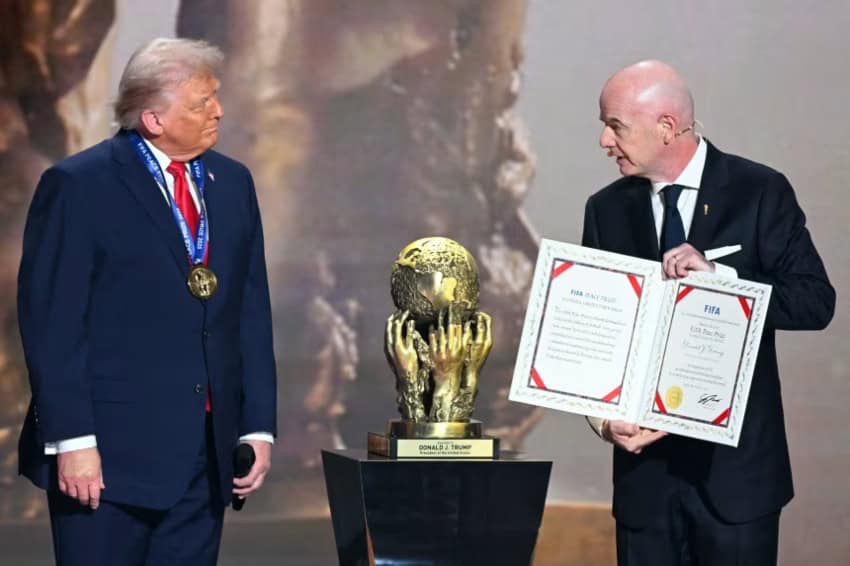
U.S. President Donald Trump receiving the FIFA Peace Prize, before subsequently declaring war on Iran, a country that is currently scheduled to play in the 2026 FIFA World Cup in the U.S. (Getty Images)
And so there are various possible outcomes due to the Iran conflict right now — including a late-in-the-game Iran boycott to President Trump suddenly canceling the team’s visas. Adding to the uncertainty is FIFA President Gianni Infantino’s very special relationship with President Trump — made clear when Infantino famously invented The FIFA Peace Prize, apparently to stroke Trump’s ego.
FIFA is, hopefully, a little embarrassed that their Peace Prize winner has bombed Venezuela, kidnapped the nation’s president, threatened Cuba and Greenland and launched a sudden attack on Iran that has so far cost nearly 1,500 lives. However, the organization is unlikely to make any decisions that might upset the American hosts.
In all this fuss, meanwhile, people have forgotten the absence of Russia, which has been given an indefinite suspension by both FIFA and the Union of European Football Associations (UEFA) after Russia invaded Ukraine in 2022.
Ukraine, scheduled to open its World Cup campaign in Monterrey on June 14, could still qualify, and it would be interesting to see how the crowd responds to the team. Is the stadium going to be decked in blue and yellow to support Ukraine, or is a war that is dragging into its fifth year going to be marked by crowd apathy? Similarly, if the unpopular war in Iran goes on much longer, will Trump and his inner circle turn up at matches where they are booed by the crowd?
Whatever happens, the 2026 World Cup, like those of 1970 and 1986 that took place in Mexico, will be affected by world politics, and will almost assuredly at no point be boring.
Bob Patemanlived in Mexico for six years. He is a librarian and teacher with a Master’s Degree in History.
Values are different in Mexico and a more relaxed relationship with punctuality and formality is something you have to get used to. Right? (It's maybe the biggest stereotype in the country. What's the truth of the matter? (JÉSHOOTS/Pexels)
Being the bougie foreigner that I am, I often get massages. I especially love it because the lady who gives them actually comes to my house with her massage table! For 650 pesos, I relax and let her knead my muscles, achy or not. While most of the things I love about Mexico are not related to prices, this one honestly is. What luxury! What a deal!
The only downside? Well, the business is just her, and she is a person. This means that sometimes things come up, and she cancels, or is late, or even forgets to cancel. It hasn’t happened a ton, but it has enough that I shot back a frustrated message yesterday. “Why can’t you cancel at least a few hours before, or the day before, instead of 20 minutes before? Surely you knew you were going to do the things you’re doing now, which are causing you to not make it here on time, and I arranged my own day around this appointment.”
Regular massages are a luxury, but an affordable one in Mexico. Assuming the masseuse shows up, that is. (Shutterstock)
Being understanding
Normally, I’m a sweetheart and understanding. But I’ve been sick for about a week and just feeling awful, and it’s made me extra grouchy.
In the end, I apologized … especially since the reason she couldn’t make it was because she’d gone with her family to figure out where to bury her recently deceased father. As often happens, things were more complicated than they’d expected, especially since different members of the family had different ideas about where the most appropriate space for him would be. The clock was ticking, and traffic was growing heavier. She just wasn’t going to make it.
But I know that 100% formality can’t be expected in this kind of situation. You can’t expect people who have their businesses as one or two individuals to give the kind of service you’d expect from a gigantic corporation with billions of dollars and the kind of organization that comes with it.
That’s also partly how I’ve been waiting months for a washer and dryer set to get fixed, by the way.
Informality in Mexico
If you’ve lived in Mexico for very long, I’m sure you’ve noticed the kind of informality I’m talking about.
For some things, it’s awesome: you can have your doctor’s WhatsApp and send them a message. You can show up at places a little late and not have to apologize. You can drop your dog off with almost no notice at the kennel on your way out of town. If you don’t feel like keeping plans you made, it’s not too big of a deal to back out, even on the day of.
Getting your vehicle inspected regularly may be necessary, but does it have to be so difficult? (SGS)
The list goes on.
For other things, it’s infuriating. A recent example that comes to mind is the lack of supplies at car inspection places here in Veracruz. The state’s answer to getting rid of the tenencia (what used to be a yearly car tax) has been to require inspections of private vehicles every six months. It’s about 800 pesos, and I guess it’s good to make sure that vehicles aren’t polluting too much and that their brake lights are working.
This last time around, we went to about four different places before we were able to get our car verificado. Some were closed even though it was during hours they were supposed to be open. Some had run out of stickers (you put them on your car as a sign you’re up to date) and didn’t know when they’d be getting more. Others’ card readers for payments were not working. It was almost funny. Almost.
‘Better to ask forgiveness’
But such is life in Mexico — at least in the communities that don’t depend on tourism to support their entire economy.
Things are late, people are late. Often, no warning or explanation is given, as most Mexicans tend to live by the maxim, “It’s better to ask forgiveness than to ask permission.”
As a somewhat uppity gringa, I like formality, and I really like punctuality. I know very well that punctuality, which I might consider a branch of formality, is not always of utmost value here. Still, I’m insulted if I’m made to wait around for someone for too long. It’s like temperature regulation — if you grew up with climate control, you’re always going to long for it when you don’t have it, save for moments of purely perfect weather.
Climate control is one of those things you always miss when you don’t have it. (Eyman Plumbing Heating and Air)
But if you want to make good friends here, you can’t spend your time griping at them for not conforming to your own values. I mean, you can explain how you feel: “Changing plans last minute or making someone wait shows a lack of respect for the other person’s time and plans.”
Trying to roll with it
There are a few Mexican friends that I’ve downright given up on. One in particular would not only not cancel beforehand, but she’d wait until I called or messaged an hour into our meeting time to say, “Oh, I got so busy at work and couldn’t go, sorry!”
Which brings me to another thing it took a while to realize here: many people would rather simply not show up than disappoint you directly. They’d rather you feel disappointed by yourself, without them on the phone or in front of you. Perhaps the next time you meet, you’ll have forgotten! (I have not forgotten.)
Thankfully, most people are formal enough with our plans.
In the meantime, I’ve got two choices: I can either roll with it, knowing to expect that some things just won’t happen the way I’d planned, or I can just die mad about it.
I’m working hard on not dying mad about it, and learning more and more to laugh things off instead of hyper-fixating on the way one thing going wrong causes a chaotic chain reaction in my never-ending to-do list.
Your priorities might not be some one else’s. You’ve got to learn to roll with it. (Papersmiths)
Some days that’s easier to do than others. But what choice do I have? I’m working on it.
Japanese kawaii charm meets Mexico magic in a Nintendo game with a twist. (PancitoMerge)
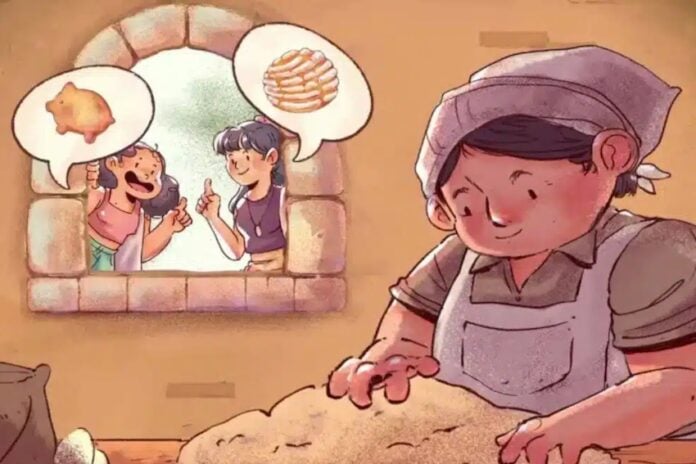
Rarely, if ever, does one utter the words: “Let’s play the Mexican panaderia game on Nintendo.” But thanks to PancitoMerge, an independent video game that was released on Nintendo Switch consoles last month, gamers — and pan dulce aficionados alike — can live out their Mexican bakery video game fantasies.
The game, an interactive ode to Mexico’s pan dulce (sweet bread), was developed by Antonio “Fáyer” Uribe — a Mexican indie game developer and cofounder of HyperBeard Games, who has long advocated for Mexican representation in the gaming industry with platforms like the “Mexican Entertainment System” — and illustrated by Jessica Álvarez, known as Vanila Ryder online, where she has a massive following on Instagram for her pan dulce-themed art.
PancitoMerge - Official Launch Trailer | Latin American Games Showcase TGA Edition 2025
A Mexican Candy Crush?
PancitoMerge offers a twist on the mega-iconic Tetris puzzle format. As the town’s panadero (baker), you are tasked with filling a bread basket full of falling pan dulce for a stream of enthusiastic customers. The catch? While you scramble to serve your customers, each type of pan dulce that drops from the top of the screen, à la the aforementioned Tetris — or, for younger generations, Candy Crush — is a different shape: conchas, bollilos, orejas, puercitos and more.
As a player, your job is to stack them in the correct order and sequence in order to gain points and avoid the bread basket from overflowing.
Nintendo’s official store, which describes the game as “whimsical” and “adorable,” invites gamers to “step into the warm, flour-dusted world where pan dulce takes center stage” and calls the game a “love letter to Mexican culture and the joy of pan dulce… inspired by real treats found in local bakeries, celebrating the warmth, tradition, and creativity of Mexican baking.”
It’s a perhaps appropriately timed ode to Mexican bread culture, on the heels of Richard Hart’s much-lambasted critique of Mexican bread — in which the British baker claimed that Mexico lacked sophisticated, high-quality breads. PancitoMerge proves otherwise — what other nation has made a Nintendo-backed video game based on its distinctive, at times iridescent, bread offerings?
The game has been celebrated by Mexican gamers and culture fanatics who have made viral videos and praised it for its highly decorative pan dulce illustrations and low-stakes, friendly gameplay. The game’s developers even wrote an original theme song for PancitoMerge, which lists off a variety of breads to the tune of a strumming mariachi guitar.
PancitoMerge is one of the few games to have an entirely Mexican theme. (PancitoMerge)
Though the game’s framework is relatively simple, a variety of thoughtful touches add to its appeal. For instance, you can switch the panaderia’s appearance and customers from a traditional look to one based on Dia de Muertos, or to a Japanese-inspired theme. As customers approach your panaderia’s window, you might encounter an anthropomorphic axolotl, a skeleton, or an old señora, each in search of the right pan dulce.
And that’s not all: You can rework your bread basket by giving it a shake, clearing off unwanted bread and creating new patterns and combos. And as you progress through the tasks, you unlock more bread types, and each bread comes with a paragraph-long explanation of the pan dulce’s characteristics and history.
What is pan de melón, one might wonder, for example?
“A popular Japanese pan dulce,” the description tells players, going on to outline the origin of the sweet bread’s name — which, it turns out, doesn’t come from the flavor resembling a melon but from its round shape and color. The game’s flavor texts are actually informative and not simply mindless filler.
As of now, the game is available in Spanish, English, and Japanese, currently is priced at US $7.99 — a bargain by today’s video game industry standards, in which the latest flagship Nintendo games cost US $79.99.
It’s certainly not the most advanced or complex game out there, but that’s part of its appeal, as is its very existence in what isn’t a very deep roster of Mexican-inspired games to begin with.
Mexican culture has been directly referenced in games like Super Mario, Pokémon and more, but rarely has Mexican culture been the centerpiece of an entire game’s design. A few exceptions include Lucha Libre AAA: Héroes del Ring (2010), Taco Master(2011), and Pato Box (2018), the latter being a beautifully rendered game in a black-and-white palette where you play a human with a duck’s head boxing his way through a corrupt organization to claim a world title. Beyond that, Mariachi Legends is slated to release later this year and has been garnering attention for its Mexicanized, action-adventure Metroidvania look and feel. More serious gamers may appreciate world builder Aztec: The Last Sun.
But none of those titles seem to fully satiate, or vividly represent, Mexico’s hunger for quirky gameplay and lighthearted storytelling as much as PancitoMerge. The fact that the game was developed by Mexican creators further gives it a taste of authenticity, care, and imaginative worldbuilding that gamers of any age or background are sure to delight in.
Alan Chazaro is the author of “This Is Not a Frank Ocean Cover Album,” “Piñata Theory” and “Notes From the Eastern Span of the Bay Bridge” (Ghost City Press, 2021). He is a graduate of June Jordan’s Poetry for the People program at UC Berkeley and a former Lawrence Ferlinghetti Fellow at the University of San Francisco. His writing can be found in GQ, NPR, The Guardian, L.A. Times and more. Originally from the San Francisco Bay Area, he is currently based in Veracruz.
Doing just about anything with a middle schooler can be a challenge. So what is it like moving to Mexico with a tween? (Shutterstock)
Moving is never easy. Moving with kids is even harder. Moving with kids to another country takes it up yet another level. But moving to another country with a middle schooler? That might just be the holy grail of moving masochism.
It is with that backdrop that we thought we would focus on this episode of Season 2 of our podcast, “Confidently wrong about raising kids in Mexico.” If it can be done with a middle schooler, anyone else should be easy, right? So we talked to the principal of the Middle School of the American School Foundation in Mexico City, as well as her husband, who also has teaching experience and is currently helping with curriculum development at the school.
They both have significant experience teaching expat kids, have taught abroad in Asia, and are now raising their own kids in Mexico. As a result, they bring an honest, unfiltered perspective on what it takes to move abroad with kids.
Check out the latest episode below, or find it on YouTube or Spotify.
CW about raising kids in Mexico: Is it crazy to move to Mexico with a middle schooler? - Episode 7
Travis Bembenek is the CEO ofMexico News Daily and has been living, working or playing in Mexico for nearly 30 years.
Can charismatic leaders like Business Advisory Council chief Altagracia Gómez guide Mexico toward a brighter future? After several high-profile meetings, CEO Travis Bembenek shares his take on the state of Mexico's business community. (Galo Cañas / Cuartoscuro.com)
It’s easy to criticize the performance of the Mexican economy. The Economist magazine did so earlier this week with an article titled “Mexico’s broken economy,” complete with a picture of a man on a horse in front of a table with local beer bottles and Coca-Cola cans. It quoted a professor from Georgetown University in Washington, D.C., who said that the “unreliable supply of electricity is also constraining growth.” I have diligently read and always respected The Economist for nearly 30 years, but found this particular article to be intellectually lazy, superficial and incomplete.
I am by no means suggesting that the Mexican economy is performing at the level it should be — in fact, it is far from it. That being said, I had the opportunity in the past week to attend two separate large business conferences in Mexico City and left feeling upbeat, excited and optimistic.
My wife and I first started meeting with foreign ambassadors and foreign chambers of commerce in Mexico two years ago. It was near the end of both the AMLO and Biden presidencies, and the mood was somber. It was clear that commerce, especially with other countries, was not a priority for AMLO. Ambassadors told us that they stopped encouraging political and business leaders from their home countries to come to Mexico as there quite simply “was no interest from the government” to meet with, listen to or collaborate with foreign leaders. AMLO was clearly focused on Mexican domestic projects like the Maya train, the AIFA airport and the Dos Bocas refinery. He didn’t want to make time for foreigners.
On the U.S. side, I remember hearing the former U.S. ambassador, Ken Salazar, speak at a business meeting. An extremely affable person, he seemingly prioritized his relationship and support for AMLO and his initiatives over what the U.S. political and business community wanted and needed. He talked about how he had recently been to Oaxaca to see the building of the new train and highway projects there. He emphasized the growth and equality that this could bring to the poorer southern areas of the country. Don’t get me wrong, the domestic projects prioritized by AMLO are most certainly game-changing investments for the people living in those parts of the country. But their impact and results will be felt over decades, not years. They are simply not the kind of investments that can “move the needle” for the country in the short or even medium term.
Which brings me back to the meetings of this past week. The first one, the American Chamber of Commerce of Mexico annual meeting, began with a presentation by the new U.S. ambassador, Ron Johnson. Ambassador Johnson started affably enough, even speaking in Spanish for a bit, but then quickly got down to business. He switched to English and while remaining charming, rattled off the areas that the U.S. government was focused on that ultimately would, in his words, even further deepen the relationship between the U.S. and Mexico. His language wasn’t threatening like his boss President Trump’s oftentimes is. Rather, he was direct and crystal clear. Reducing the levels of violence, drug trafficking, human trafficking, cartel influence and unfair trade practices ultimately would be very good for both countries and very positive for the business community.
It felt a little bit like a parent lecturing a child. It hurt a little bit to hear the message, but you knew he was right. The tough love that the U.S. was giving to Mexico, in his telling, would make Mexico a better partner of the United States, and in turn make Mexico better. Now I understand that many people will be cynical upon hearing this, but it’s impossible to suggest that the levels of violence in Mexico have not been a significant drag on the people of Mexico, the business community and the economy as a whole.
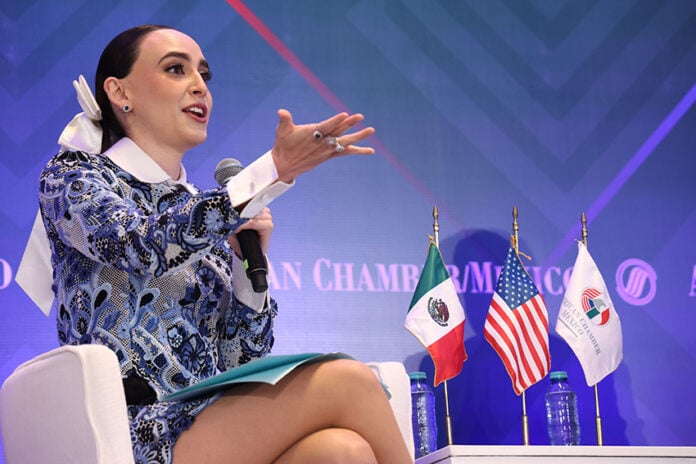
Next up was Altagracia Gómez, the 33-year-old Mexican businesswoman who leads President Sheinbaum’s Business Advisory Council, a group that provides vital input from the business community into government policy decisions. Altagracia was poised, calm and professional as she updated the audience on the progress of Sheinbaum’s ambitious Plan México initiative. She talked about roadblocks to progress and how they were going to overcome them. She talked about what the government was doing to accelerate approvals and better support the business community. As I listened to her give the update, I couldn’t help but think that I was witnessing the style and tone of a businessperson, not a politician. It was refreshing — inspiring really.
Just a few days later, I was invited to attend the first-ever Forum of Binational Trade Chambers in Mexico. Under the leadership of the Indian Embassy in Mexico and in close collaboration with Mexico’s Minister of the Economy, Marcelo Ebrard, a total of 23 chambers of commerce were brought together to form a new working group. The idea of the forum, as well as future meetings, is to work together to set common goals in support of the Plan México program. The goal is for the chambers to work in closer cooperation and collaboration to share best practices, lessons learned, and further enable growth of companies from their home countries in Mexico.
Minister Ebrard kicked off the forum with an update on the progress on the USMCA trade agreement between Mexico, the U.S., and Canada. He talked about the work done to improve trade relations with the European Union, Latin American countries and countries in the Middle East and Asia. Similar to Altagracia just days earlier, he had a calm, confident, optimistic tone. In a time of such global stress, his comments were reassuring. He emphasized and gave examples of how the government was working hard to improve the business climate in Mexico and working closely with the U.S. and other countries to do so.
Mexico has a long way to go to achieve its true economic growth potential. The per capita GDP of the United States — a measure of average economic output per person — is still an incomprehensible 6.4 times that of a person in Mexico. (For a point of reference, U.S. per capita GDP is 1.6 times larger than that of Canada). The previous administrations in both the U.S. and Mexico did not prioritize their business communities or trade between the two countries, and yet commerce still flourished. Both countries are now each other’s leading trading partners, and foreign direct investment is hitting record highs on both sides of the border. Just this week, two large multinationals committed to investing an additional US $1.5 billion in Mexico.
Government policy doesn’t move fast, but what I witnessed firsthand this past week in terms of engagement and commitment from the Mexican and U.S. governments, foreign embassies and chambers of commerce should go a long way towards helping bring some favorable animal spirits to the business community in Mexico. Let’s hope this positive momentum continues!
Travis Bembenek is the CEO ofMexico News Daily and has been living, working or playing in Mexico for nearly 30 years.