Home Blog Page 66

El Jalapeño: Simi sues Mattel, claims exclusive licensing rights over all dolls depicting Mexican people

2
There's only room for one Mexican doll in this town... and he has a moustache.

All stories in El Jalapeño are satire and not real news. Check out the original article here.

MEXICO CITY — Farmacias Similares, the pharmaceutical chain behind Dr. Simi — the beloved, rotund, mustachioed mascot whose foam effigy is hurled at concert stages with a frequency that suggests it is Mexico’s national pastime — filed suit against Mattel Inc. on Thursday, claiming the California toy giant violated its exclusive intellectual property rights by producing a Barbie doll in the likeness of Mexican NASCAR driver Regina Sirvent without first obtaining written consent from a dancing pharmacy mascot.

The 47-page complaint, filed in Mexico City civil court, argues that Farmacias Similares holds “the sole and inalienable right to manufacture, distribute, and have thrown at Billie Eilish any three-dimensional representation of a Mexican person,” a claim legal experts described as “creative,” “unprecedented,” and, from one professor at UNAM who asked not to be named, “absolutely unhinged but also somehow not obviously wrong.”

Adele Simi
See? Even the female Simi’s have facial hair. (Revista Brújula/X)

At the center of the dispute is Sirvent’s Barbie Role Model doll, produced by Mattel to honor the 23-year-old Mexico City native’s historic achievements as the first woman to win a NASCAR Mexico Truck Series race and the first Latina to win a NASCAR international race. Mattel presented the doll to Sirvent in February — a one-of-a-kind figurine wearing a racing suit, which the company said would not be sold to the public.

Dr. Simi’s legal team argues this is irrelevant.

“Whether one unit or one million, the precedent is the same,” the filing states. “A plastic Mexican woman was manufactured without our client’s knowledge or approval. Our client has been manufacturing plastic Mexican people since 1997 and considers this its core business.”

The filing further notes that the Barbie in question stands approximately 11.5 inches tall, wears a tailored racing suit, and bears no mustache, all of which Farmacias Similares’ attorneys argue constitutes an “unauthorized departure from established aesthetic norms” for Mexican dolls.

Mattel, reached for comment, said it “respectfully disagrees with the characterization that Dr. Simi owns Mexico.”

Sirvent, currently preparing for her next NASCAR event, said she was honored by the Barbie recognition and had not previously been aware that a foam mascot had standing to sue over it. Her representatives noted that she intends to keep racing regardless of the outcome.

Farmacias Similares is seeking unspecified damages, a formal apology, and the right to produce an official Dr. Simi x Regina Sirvent crossover doll, which it confirmed would absolutely be thrown at concerts.

Check out our Jalapeño archive here.

Got an idea for a Jalapeño article? Email us with your suggestions!

2 CFE-run power plants fined for polluting La Paz area

2
Termo La Paz
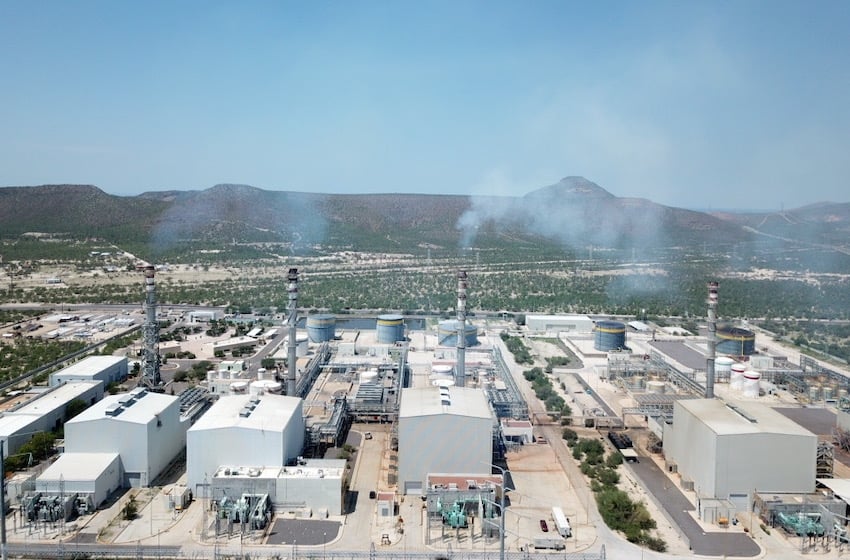
The La Paz Internal Combustion Power Plant and the Punta Prieta Thermoelectric Power Plant, both located within 15 kilometers of La Paz, were fined over US $72,000 by the Federal Attorney for Environmental Protection. (Ernesto Mendez/CEMDA)

The Federal Attorney for Environmental Protection (Profepa) detected irregularities in emissions from power plants in La Paz, Baja California Sur, resulting in fines for the offending companies.

The La Paz Internal Combustion Power Plant and the Punta Prieta Thermoelectric Power Plant — both managed by the state-owned Federal Electricity Commission (CFE) — were slapped with fines of 610,956 pesos (US $34,317) and 678,840 pesos (US $38,137), respectively.

 the Punta Prieta Thermoelectric Power Plant
The plants operated with fuel oil and without the implementation of sufficient emissions controls. (Ernesto Mendez/CEMDA)

After years of complaints about the pollution and a request for a public inquiry failed to generate a response, a federal judge ordered Profepa to carry out inspections.

Profepa said it sanctioned the two companies for failing to demonstrate compliance with the maximum pollutant emission limits established in environmental law. Both companies lacked technical information, had incomplete emissions reports and were unable to produce reliable operational records.  

The La Paz plant was also found to have deficient fuel consumption records and lacked adequate maintenance of emissions control equipment. At the Punta Prieta plant, Profepa detected similar omissions, including a lack of records on the operation of pollution reduction systems.

La Paz Mayor Milena Quiroga Romero blamed the pollution on the continued burning of fuel oil at the plants, adding that long-term solutions can be achieved by relying on renewable energy.

“The transition to cleaner energy championed by President Claudia Sheinbaum must be driven by the federal government and it will take time,” she said. 

The previous administration had promised to reduce emissions by installing filters in chimneys and transitioning to natural gas, but the plants continue to operate with fuel oil and without the implementation of sufficient controls.

Promises aside, the Mexican Center for Environmental Law (Cemda) said in a press release that although the fines exceed 1 million pesos, that alone is not enough to repair the environmental damage, guarantee the implementation of corrective measures or result in the reduction of toxic emissions.

For its part, the La Paz-based Alianza por la Calidad del Aire (Air Quality Alliance) asked local authorities to accompany the sanctions with a comprehensive strategy that promotes the proper operation of existing plants in the city, as well as a quicker transition to the use of clean energy sources.

La Paz is the main energy center of Baja California Sur. Most of the state’s electricity is produced in power plants located in the state capital.

With reports from Excelsior, BCS Noticias and Diario El Independiente

Building materials company Holcim to invest US $20M in its water conservation strategy

1
Holcim plant
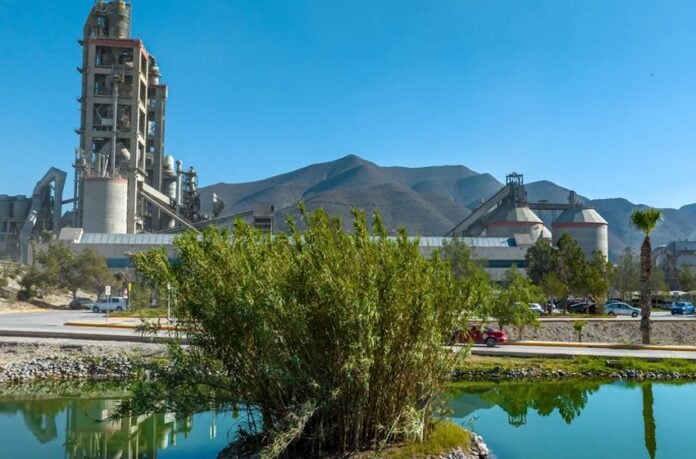
Holcim is not only seeking to reduce water use in its Mexican plants, such as this one, but also to manufacture materials that require less water use by customers after they're sold. (Holcim)

Swiss-based building materials company Holcim is investing heavily in the water conservation efforts of its Mexico operations, as the popular mood in Mexico has been turning against perceived excess corporate water use. 

The global firm plans to invest 356 million pesos (US $20 million) by 2027 to expand its infrastructure and technology for water management. The planned expenditure supports Holcim’s expressed goal of reducing water extraction across all its Mexico operations by up to 33% by 2030.

Holcim plant
The Swiss-based construction materials producer could be a trendsetter among manufacturers sensing the need to engage in water conservation and decarbonization. (Holcim)

Companies are feeling pressure to reduce their water use in Mexico as increased episodes of drought across much of the country have forced individual users to cut back on water use.

To date, Holcim has cut its water extraction volume by 58% by increasing the use of treated wastewater, recirculation technologies and predictive maintenance, which it implements at 71% of its plants.

Holcim México also conducts rainwater harvesting projects, community infrastructure projects and environmental restoration in vulnerable areas near its operations. 

In the Moctezuma basin, which helps drain the Bajío region and where Holcim conducts much of its non-Mexico City operations, the company has reduced its freshwater extraction by 47%, far higher than its 39% target.

In addition to reducing potable water use in its plants, Holcim aims to reduce the water consumption required for construction processes by customers using Holcim building materials. So far, the firm has achieved a potential reduction of 232 million liters of water in construction projects nationwide by launching several innovative products. 

For example, its self-curing concrete technology, I-dracreto, eliminates the need for subsequent watering, saving roughly 70 liters of water per square meter poured. Meanwhile, its permeable systems promote infiltration and natural aquifer recharge.

“Our vision has evolved: simply reducing consumption is no longer enough,” said Holcim México’s sustainability manager, Ibette Sosa. “We are transforming our operating model toward a circular water economy ecosystem, where systematic reuse and regeneration are the pillars of our efficiency.” 

Holcim México’s decarbonization efforts  

In November, Holcim México inaugurated its first 100% electric ready-mix concrete plant, investing 51 million pesos ($2.9 million) in the electrification of its Zapopan, Jalisco facility. 

The firm aims to contribute to the decarbonization of the construction industry and move toward a net-zero model by 2050, with plans to replicate the electrification model in other regions of Mexico, according to the firm’s director of sales and operations, Pedro Garza.

“With innovation, technology, and commitment, we are demonstrating that sustainable construction is already a reality in Mexico and that it can generate economic, environmental, and social value,” Garcia stated. 

The electrification of the facility reduces dependence on fossil fuels and reduces carbon emissions by an estimated 300 tons a year. The move is also expected to decrease internal noise pollution by 90%, eliminate traffic noise and cut energy costs by 67%. 

At present, Holcim manages over 77 ready-mix concrete plants, seven cement plants, and one grinding mill in Mexico, supporting over 5,000 direct jobs.

With reports from El Economista

229 migrants found trapped in impounded truck in Veracruz

2
impounded truck where over 200 migrants were traveling
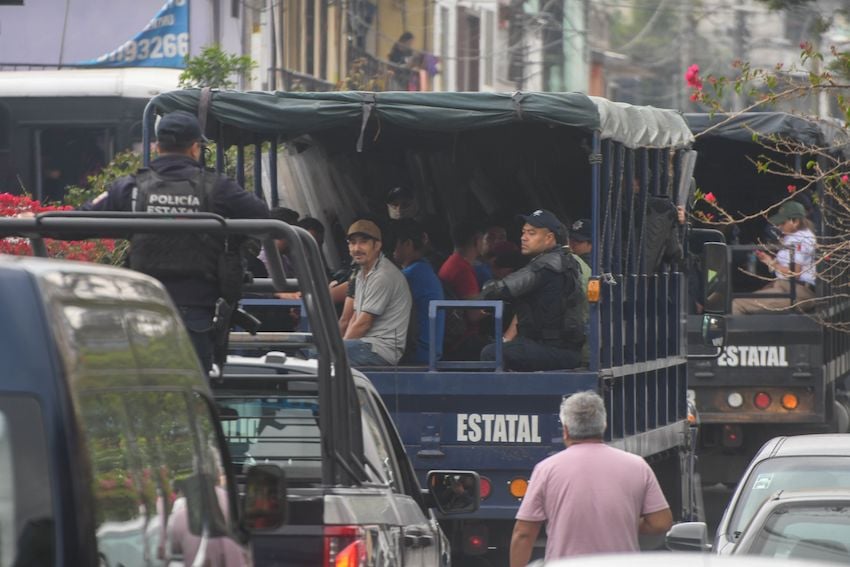
The truck — which had been reported as stolen — was intercepted by police on Monday around 45 kilometers southeast of Xalapa and subsequently taken to an impound lot in the state capital. (Tonatiuh Navarro/Cuartoscuro)

Authorities on Monday found 229 migrants crammed into an impounded truck in Xalapa, the capital of the Gulf coast state of Veracruz.

The truck — which had been reported as stolen — was intercepted by police on Monday around 45 kilometers southeast of Xalapa and subsequently taken to an impound lot in the state capital.

The discovery of the migrants only occurred after workers at the impound lot heard shouting and banging from inside the trailer.

One employee told the Associated Press (AP) that they called emergency services to open the trailer once they realized that people were trapped inside.

José Manuel Pozos, deputy governance minister in the Veracruz government, attended the scene and told reporters that most of the migrants were from Central American countries.  Among them were 17 minors.

Pozos said that the migrants, in general, were “all well,” although some of them were suffering from dehydration. The official noted that the driver of the vehicle had been detained.

XALAPA, VERACRUZ, 23MARZO2026.- Fueron hallados 229 migrantes en la caja de untrailer que esta estacionado en un deposito de vehículos. Las persoans fueron asegurdasd por autoridades estatales y federales y enviadas a un centro migratorio para deifnir sus esatus en el país. No se reportaron lesionados. FOTO: TONATIUH NAVARRO/CUARTOSCURO.COM
The migrants were reportedly taken to state police barracks in Xalapa, the capital of Veracruz. (Tonatiuh Navarro/Cuartoscuro)

The migrants were reportedly taken to state police barracks in Xalapa. Many will likely be deported to their countries of origin, including Guatemala, Honduras and El Salvador.

Veracruz is located along the shortest route to the United States from Mexico’s southern border with Guatemala, where migrants from Central America and further afield commonly enter the country. It was unclear where the 229 migrants found on Monday commenced their journey or how long they had been crammed into the trailer.

On numerous previous occasions, Mexican authorities have found migrants traveling through the country in trucks. However, the discovery on Monday was the first of its kind in months, according to AP.

The number of migrants attempting to reach the Mexico-U.S. border and subsequently enter the United States — legally or illegally — has decreased since U.S. President Donald Trump returned to office in January 2025. The Trump administration has taken various measures to secure the border and prevent the entry of migrants. AP reported on Monday that “while migration levels have taken a nose dive over the past year, migration north appears to be slowly picking up again.”

The journey to the United States from southern Mexico is notoriously dangerous for migrants. Among the risks are becoming victims of crime, being forcibly recruited by cartels and falling off northbound freight trains, collectively referred to as “La Bestia” (The Beast).

In late 2021, at least 55 migrants were killed when the truck they were traveling in overturned on a highway in the southern state of Chiapas.

Mexican authorities frequently detain migrants traveling through Mexico and hold them in detention centers until they are deported or given permission to remain in Mexico.

In March 2023, a fire in a Ciudad Juárez detention center claimed the lives of 40 migrants.

With reports from AP, DW, EFE, Reforma and La Jornada 

Camera traps spy a jaguar for the first time in Guanajuato’s Sierra Gorda Biosphere Reserve

7
jaguar in Guanajuato's Sierra Gorda Biosphere Reserve
The country’s biggest cat was caught on camera in an area of ​​continuous forest with minimal human disturbance. (Conanp)

Camera traps installed in the woods of the Sierra Gorda Biosphere Reserve of Guanajuato have recorded the first official images of a jaguar (Panthera onca) in that area, according to the National Commission of Natural Protected Areas (Conanp). 

The Conanp reported that the images were obtained via a 75-trap camera system operated by community monitors.

The country’s biggest cat was spotted in an area of ​​continuous forest with minimal human disturbance, functioning as a biological corridor that links feline populations from central to eastern Mexico. This Natural Protected Area (ANP) extends 236,882 hectares, representing 8.92% of the total territory of Guanajuato state.  

A recent study found that the jaguar’s habitat extends through 16 states, or half of Mexico: Sonora, Sinaloa, Nayarit, Jalisco, Michoacán, Guerrero, Chiapas, Quintana Roo, Yucatán, Campeche, Morelos, Hidalgo, San Luis Potosí, Nuevo León and Tamaulipas.

Thanks to these latest images, scientists have added the Guanajuato jaguar to the national distribution and conservation map of the species. The sighting also marks a milestone for the reserve itself: scientists have now confirmed the presence of all six wild cat species native to Mexico within Sierra Gorda — ocelot, margay, jaguar, jaguarundi, lynx and puma. 

According to Conanp, these apex predators are essential to the health of entire ecosystems. Their role in regulating herbivore populations curbs overgrazing, sustains biodiversity, and supports the broader environmental services on which the region depends. 

Experts note that the finding validates the functionality of the biological corridors that connect Guanajuato with Querétaro, San Luis Potosí and Hidalgo along the Sierra Madre Oriental.

Furthermore, the jaguar’s presence in Guanajuato’s reserve adds to the list of priority species for conservation that inhabit the region. These include the green macaw, the mountain axolotl, the golden eagle, the black bear and rattlesnakes.

Lastly, the Conanp recalled that the discovery of the jaguar was made possible by a research project conducted between August 2024 and May 2025, led by biologist Juan Felipe Charre-Medellín and his team. The project was funded by the Toyota Group and the Science, Humanities, Technology and Innovation Ministry (Secihti). 

Mexico News Daily

A Mexican artist could be the one to put the finishing touches on Gaudí’s Sagrada Familia

0
October 30, 2025: The Basilica i Temple Expiatori de la Sagrada Familia, aka Sagrada Familia, in Barcelona, Catalonia, Spain
The Sagrada Familia's Glory Façade — the main entrance and final section — will depict humanity’s journey from sin to salvation, including scenes of the Last Judgement, hell and glory. (Shutterstock)

More than 140 years after construction began, Barcelona’s iconic Sagrada Familia is reaching its final stage — and Mexican sculptor Javier Marín may help bring Antoni Gaudí’s unfinished vision to fruition.

Designed by Gaudí as a vast theological “Bible in stone,” the basilica is the crown jewel of Catalan Modernism and part of a UNESCO World Heritage ensemble that recognizes his experimental, highly sculptural approach to sacred architecture.

Begun in 1882, it is distinguished by three immense façades symbolizing the life of Christ: Nativity, Passion and Glory.

The Glory Façade — the main entrance and final section — will depict humanity’s journey from sin to salvation, including scenes of the Last Judgement, hell and glory.

It is the most complex and ambitious section, as Gaudí left few directions before his death in 1926, compelling today’s curators to balance tradition and innovation.

That challenge now involves Marín, a 63-year-old artist from Uruapan, Michoacán.

Javier Marín. Plastilina Cabeza de mujer sopladora grande en el Estudio Javier Marín.
Marín says artificial intelligence was an essential element of his creative process, in honor of the forward-thinking mentality exemplified by Gaudí during his time. (Javier Marín/Facebook)

He is one of three contemporary sculptors invited to propose designs for the façade, along with Spaniards Miquel Barceló and Cristina Iglesias. The board of trustees of the Sagrada Familia is expected to choose a final plan in April.

Over the past months, Marín has immersed himself in Gaudí’s world. 

“I was captivated by his boundless imagination,” Marín told the newspaper La Jornada. “After all this research, I was impressed by how you can conceive such a large work, knowing that it will have to be completed by other people in the future with new technologies.”

Marín blends classical expression and contemporary technique in monumental sculptures installed across Mexico and abroad.

His public works include “Cabeza Vainilla” in Mexico City’s Historic Center; “Retablo,” an altarpiece in the UNESCO-listed Cathedral Basilica of Zacatecas; and “Hoy es hoy,” a large bronze head now on loan to the Jacksonville Jaguars NFL team after standing in Florida’s Jacksonville International Airport from 2006 to 2023.

Internationally, his pieces have been shown at the Venice Biennale and in major European institutions such as the Palazzo delle Esposizioni in Rome.

His proposal for Barcelona combines handcrafted models with artificial intelligence and robotics.

“It has to be,” he told the newspaper El Sol de México. “It should be possible to read there that we did it at this time and with all these [new] tools.”

Coinciding with his selection, Mexican architect Mauricio Cortés Sierra recently completed Gaudí’s cross atop the Tower of Jesus Christ, now the basilica’s highest point at 172.5 meters.

The Mexico City–born architect has spent years embedded in the Sagrada Familia’s design team, overseeing the terminals of the six central towers that define the basilica’s new skyline.

His work on the cross literally crowns the same Barcelona church where Marín could soon sign the main entrance.

With reports from La Jornada, El Sol de México, La Crónica and Architectural Digest México y Latinoamérica

Headline inflation approaches 5% amid agricultural and energy price pressures

0
a watermelon salesman
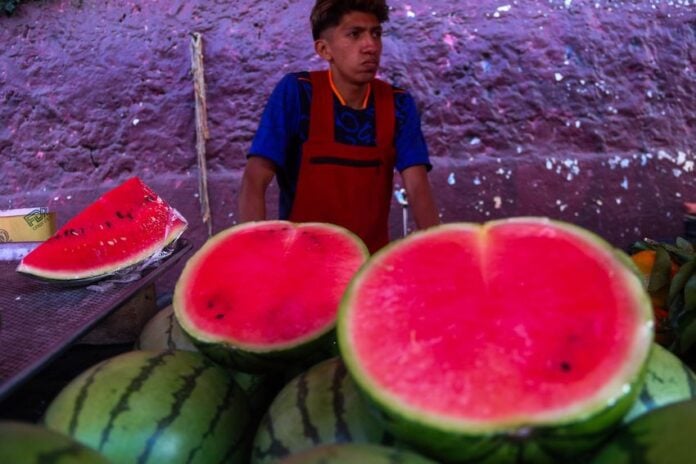
The highest inflation rate for any category monitored by INEGI between the second half of February and the first half of March was 8.34% for fruit and vegetables. (Victoria Valtierra/Cuartoscuro)

Inflation continues to rise in Mexico, with the annual headline rate approaching 5% in the first half of March.

The national statistics agency INEGI reported on Tuesday that the annual headline inflation rate was 4.63% in the first 15 days of the month, up from 4.02% across February. Compared to the second half of February, inflation was 0.62% in early March.

It appears almost certain that inflation will rise for a third consecutive month in March, after increases in both January and February.

The annual headline rate reported by INEGI on Thursday came in well above the 4.37% median forecast of analysts polled by Bloomberg.

INEGI also reported that Mexico’s annual core inflation rate in the first half of March was 4.46%, down from 4.50% across February. That reading excludes inflation for food and energy, whose prices tend to be volatile.

The publication of the inflation data for the first half of the month comes just two days before the Bank of Mexico (Banxico) board will decide whether to cut, maintain or increase the central bank’s benchmark interest rate, which is currently set at 7%. The bank targets 3% inflation with tolerance of a 2-4% range.

In a post to X on Tuesday morning, the director of economic analysis at Banco Base, Gabriela Siller, wrote that the Bank of Mexico “should be cautious” and maintain its key interest rate at 7% after its board’s monetary policy meeting this Thursday.

Cutting the interest rate “would be a serious monetary policy error,” she asserted after writing that it’s “possible” that the bank may in fact need to raise its key rate in the coming months.

What’s driving inflation in Mexico?

INEGI’s data shows that annual inflation for agricultural products (fruit, vegetables and meat) was 9.69% in the first half of March. That rate is derived from inflation of 23.91% for fruit and vegetables and 0.57% for meat.

Annual inflation was 5.91% for processed food, beverages and tobacco, 3.16% for non-food goods, 4.49% for services and 1.76% for energy, including electricity and gasoline.

Compared to the second half of February, energy prices (excluding electricity) rose 0.61% due to a rise in gasoline and diesel prices. The newspaper El Economista reported that fuel prices have gone up due to the increase in international oil prices since the start of the Iran War at the end of February. The federal government last week secured a deal with gas station owners to renew a gasoline price cap agreement for a further six months as it seeks to ease cost-of-living pressures for Mexicans.

On X, Siller wrote that inflation had shot up due to war in Iran and “public insecurity in Mexico,” but didn’t elaborate on either reason. Extortion is one crime that contributes to inflation in Mexico.

The highest inflation rate for any category monitored by INEGI between the second half of February and the first half of March was 8.34% for fruit and vegetables, whose prices can fluctuate wildly depending on climatic conditions. Growers of such produce, including avocados and limes, are among those targeted by extortionists.

Analysts divided over whether Banxico will cut or maintain 7% rate 

15 of 29 analysts polled by Bloomberg expect the Bank of Mexico board to vote in favor of maintaining Banxico’s key interest rate at 7% at this week’s monetary policy meeting, while 14 are anticipating a 25-basis-point cut to 6.75%.

On Feb. 5, the Banxico board ended a streak of interest rate cuts at 12 consecutive monetary policy meetings by deciding to maintain the 7% rate.

The Bank of Mexico said in a statement at the time that the board took into account “the need to continue evaluating the impact of the fiscal adjustments implemented at the beginning of the year, as well as the behavior of the exchange rate, the weakness of economic activity, and the level of monetary restriction [already] implemented.”

In the same statement, Banxico forecast an average annual inflation rate of 4% in the first quarter of 2026. Considering that inflation was 4.02% in February and 4.63% in the first half of March, it looks likely that the central bank’s forecast will turn out to be an underestimation.

With reports from El Economista and El Financiero 

2 teachers killed in shooting at Michoacán high school

5
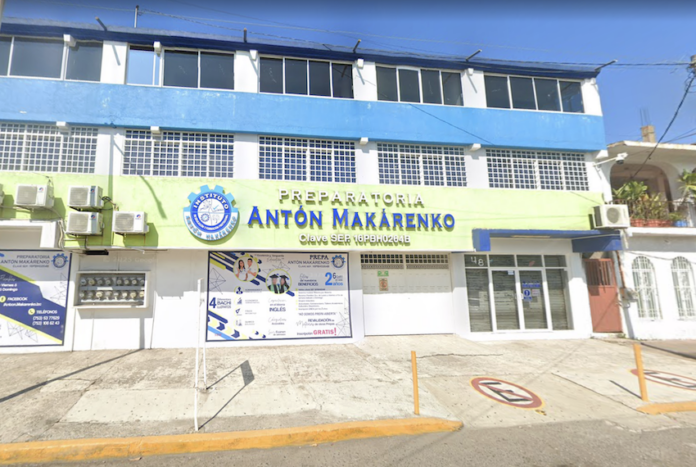
Antón Makárenko High School (Preparatoria)
The two victims of the shooting were identified as María del Rosario, 36, and Tatiana Bedolla, 37. (Google Maps)

A teenage boy allegedly shot and killed two female teachers at a high school in the Pacific coast port city of Lázaro Cárdenas, Michoacán, on Tuesday morning.

The shooting occurred at the Antón Makárenko High School (Preparatoria) in the downtown area of Lázaro Cárdenas. The alleged perpetrator — reportedly a 15-year-old student at the school — was detained.

“After a report from @C5Michoacan [command center] due to gunfire detonations at the Makárenko High School in Lázaro Cárdenas, the [Michoacán] Civil Guard along with municipal police carried out an operation resulting in the arrest of an adolescent allegedly related to the events,” the Michoacán Security Ministry (SSP) said on social media.  

The ministry said that two deceased women with bullet wounds were located inside the school. It also said security forces seized a 5.56 millimeter caliber rifle.

Video footage showed the alleged perpetrator being held by a police officer, who had apparently tied a thin rope around the youth’s waist prior to handcuffing him. According to some media reports, the adolescent opened fire after he was initially blocked from entering the school. The newspaper El Universal reported that it appears he was denied entry because he had arrived late, while the news outlet La Silla Rota said there were claims that he had been expelled from the school and was seeking revenge.

Authorities didn’t mention any possible motive for the crime.

El Universal reported that the suspect is the step-son of a member of the navy and perpetrated the double homicide with an AR-15 rifle. He was not immediately identified by name. La Silla Rota reported that the suspect had shown off his firearm in a video posted to social media.

Victims identified as teachers in their 30s 

The two victims of the shooting were identified as María del Rosario, 36, and Tatiana Bedolla, 37. Both were teachers at the high school in downtown Lázaro Cárdenas and died at the scene of the crime.

The shooting reportedly triggered panic among students and teachers at the Antón Makárenko High School, a private educational institute. According to reports, they hid in classrooms after gunshots rang out and called emergency services to request help.

Personnel from the Michoacán Attorney General’s Office reportedly went to the school to collect evidence.

School shootings are rare in Mexico, but not unheard of. Among the previous incidents are a shooting perpetrated at a primary school in Torreón, Coahuila, in 2020. In that incident, an 11-year-old boy killed his teacher and wounded five students and one teacher before taking his own life.

With reports from Aristegui Noticias, Reforma, La Silla Rota, El Universal and N+

New anti-femicide law seeks expanded definition and increased prison time: Tuesday’s mañanera recapped

1
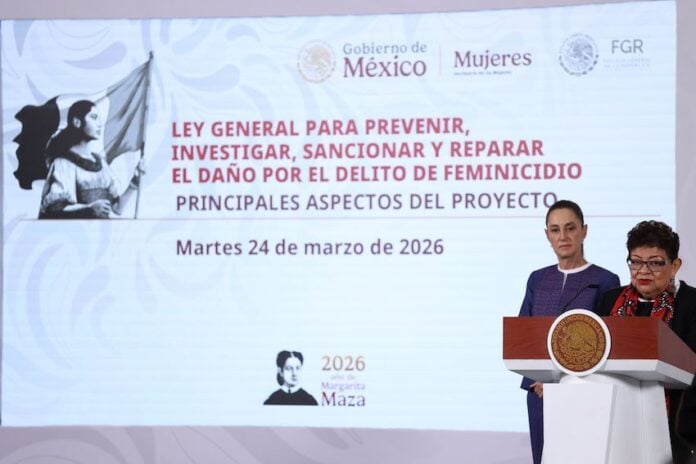
CIUDAD DE MÉXICO, 24MARZO2026.- Ernestina Godoy, fiscal general de la República, durante la conferencia Mañanera del Pueblo en la que se presentó la "Ley General para Prevenir, Investigar, Sancionar y Reparar el daño por el delito de feminicidio".
Sheinbaum said that the proposed law would be sent to the lower house of Congress on Tuesday. (Galo Cañas/Cuartoscuro)

Sheinbaum’s mañanera in 60 seconds

  • ⚖️ New anti-femicide law — Attorney General Ernestina Godoy unveiled a landmark bill to standardize femicide classifications and punishments nationwide: 40–70 years in prison for femicide, 20+ years for attempts, with 21 aggravating factors (e.g., victims who were pregnant, minors or elderly).

  • 🗂️ Uniform investigations — All Attorney General’s offices would be required to investigate every violent death of a woman or girl under the femicide hypothesis.

  • 📊 By the numbers — 6,440 femicides recorded in Mexico between January 2019 and January 2026.
  • 🗳️ “Plan B” electoral reform in doubt — Sheinbaum conceded that her “Plan B” bill may not pass Congress, as the Labor Party (PT) is resistant to the proposed law, but she remains confident that it will. Nevertheless, she didn’t rule out a “Plan C” electoral reform. 

  • 🛢️ Pemex + Petrobras? — Sheinbaum confirmed that Brazil’s President Lula da Silva proposed a joint venture between the two state oil giants to explore deepwater oil in the Gulf of Mexico. No decision yet; talks will continue in April.


Why today’s mañanera matters

Time and time again, President Claudia Sheinbaum has spoken of her commitment to improving the lives of Mexican women. That commitment has gone beyond rhetoric to the enshrinement of a range of women’s rights in the Mexican Constitution, the carrying out of a 16-day campaign “against violence toward women” and the classification of sexual harassment as a crime in federal law, among other measures.

Still, Sheinbaum acknowledged earlier this month that her government needs to do more for Mexican women.

On Tuesday, a legislative initiative that seeks to address the most serious problem Mexican women face — violence — was unveiled.

Sheinbaum’s mañanera was also significant as the president acknowledged that her “plan B” electoral reform bill might not get through Congress, and confirmed that Brazilian President Luiz Inácio Lula da Silva (Lula) had proposed a joint venture between Mexican state oil company Pemex and its Brazilian counterpart Petrobras.

AG presents new anti-femicide law 

Attorney General Ernestina Godoy presented a proposed General Law to Prevent, Investigate, Sanction and Provide Compensation for the Crime of Femicide.

The bill seeks to establish a national classification of femicide — the killing of a woman or girl due to “reasons of gender” — and uniform punishment for the crime across the country.

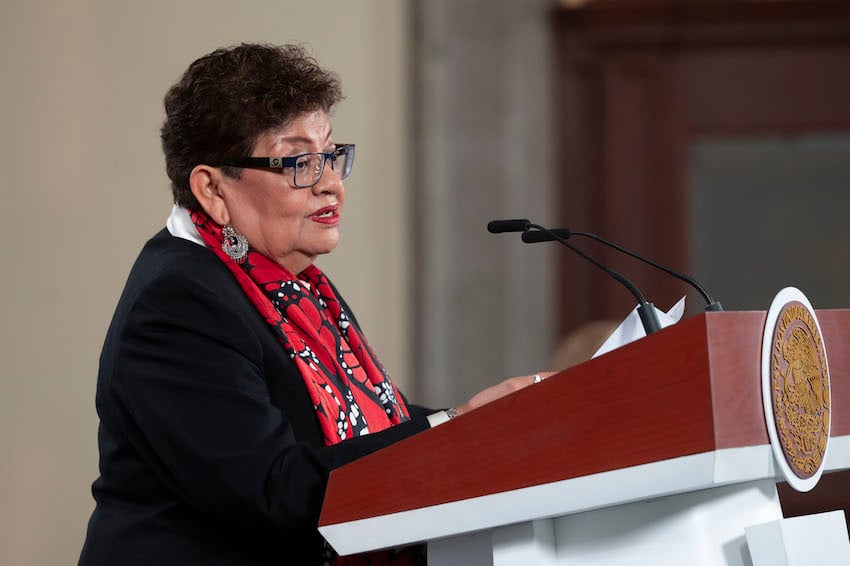
Attorney General Ernestina Godoy
Attorney General Ernestina Godoy presented a proposed General Law to Prevent, Investigate, Sanction and Provide Compensation for the Crime of Femicide at the president’s morning press conference on Tuesday. (Saúl López Escorcia/Presidencia)

Godoy explained that among nine “reasons of gender” that would result in the murder of a female being classified as a femicide are that the body of the femicide victim showed “signs of sexual violence,” and that the perpetrator had previously committed acts of violence against the victim.

The proposed law seeks to establish a punishment of 40 to 70 years imprisonment and a hefty fine for a person found guilty of committing femicide. Attempted femicide would be punished by a minimum prison sentence of 20 years.

Godoy explained that the bill proposes the establishment of 21 aggravating factors that would result in a perpetrator of femicide being given a longer prison sentence. They include that the victim was a girl, adolescent or elderly woman; that the victim was pregnant or had a disability; and that the femicide was committed in front of the victim’s children.

Godoy said that the bill seeks to standardize “investigation protocols” in cases of femicide across Mexico. If the bill is approved, all Attorney General’s offices would be required to investigate all violent deaths of women and girls “under the hypothesis of femicide.”

Sheinbaum said that the proposed law would be sent to the lower house of Congress on Tuesday.

Femicide has long been a major problem in Mexico. Between January 2019 and January 2026, there were 6,440 femicides in Mexico, according to official data cited in an El Universal newspaper report.

Could there be a ‘plan C’ electoral reform?

Asked whether she would develop a ‘plan C’ electoral reform proposal if her ‘plan B’ bill is rejected by Congress, Sheinbaum said she didn’t know, but didn’t rule out that possibility.

She subsequently expressed confidence that her ‘plan B’ proposal will, in fact, pass Congress, even though the Labor Party (PT) — an ally of the ruling Morena party — appears unlikely to support the bill in its current form.

“I don’t think [PT lawmakers] are going to vote against eliminating privileges,” Sheinbaum said.

Among a range of objectives, the president’s “plan B” proposal seeks to reduce or eliminate excessive benefits received by lawmakers at the different levels of government. Sheinbaum submitted it to Congress after her original, more ambitious, electoral reform proposal was rejected by Congress earlier this month.

The PT is not happy with an aspect of “Plan B” that could allow a presidential recall election to be held in 2027 at the same time as a federal congressional election, as the party reportedly believes such a scenario would erode its support at the ballot box and benefit Morena. The PT’s opposition to the law, combined with its rejection by opposition parties, could doom it to failure in Congress.

Sheinbaum confirms that Lula proposed Pemex-Petrobras joint venture

Sheinbaum confirmed that during her call with Lula earlier this month, the Brazilian president proposed the establishment of a joint venture between Pemex and Petrobras to explore oil in the Gulf of Mexico.

Lula revealed that he had made the proposal during an event in Brazil last Friday.

salvador, bahia, brazil - january 6, 2021: view of Petrobras' gas station in the neighborhood of Stiep, in the city of Salvador.
Founded in 1953, Petrobras already operates in the Gulf of Mexico via a joint venture with Murphy Exploration & Production, according to Reuters. (Shutterstock)

On Tuesday morning, Sheinbaum said:

“He said to me, ‘Why don’t we make an alliance?’ Petrobras has specialized a lot in deep waters, so he proposed, ‘Why don’t we make an alliance with Pemex?'”

Sheinbaum said that her government hasn’t yet decided whether Pemex will enter into a joint venture project with Petrobras, but noted that the head of the Brazilian company will come to Mexico in April to meet with the CEO of Pemex and the federal energy minister.

She said that Brazil’s proposal will be discussed during those talks. Sheinbaum said that a joint venture with Petrobras would mainly focus on deepwater exploration and drilling for oil, rather than gas.

“We’re going to see what the proposal is. We haven’t made a decision yet, but it’s true that Lula proposed [a joint venture] and [the idea] comes from the president of Petrobras,” Sheinbaum said.

By Mexico News Daily chief staff writer Peter Davies (peter.davies@mexiconewsdaily.com)

Mexican basketball star Karim López set to make NBA Draft history on June 25

0
Karim López
López represented Mexico in the 2024 FIBA Olympic Qualifying Tournament in Puerto Rico and has spent the past two seasons playing for the New Zealand Breakers in the Australian National Basketball League (NBL). (@karim_lopez21/Instagram)

The Mexican athlete Karim López is poised to make history on June 25, right in the middle of the World Cup, but it has nothing to do with soccer.

López, an 18-year-old from Hermosillo, is a highly touted basketball prospect and is expected to be the first Mexican-born player to be selected in the first round of the NBA Draft in Chicago, Illinois, this summer.

On Monday, ESPN’s senior NBA insider Shams Charania broke the news that López — who spent the past two seasons playing for the New Zealand Breakers in the Australian National Basketball League (NBL) — officially declared for the draft. 

NBA eligibility rules require international players under the age of 22 — López will turn 19 on April 12 — to formally apply in writing 60 days before the draft.

After confirming his intention to enter the upcoming draft, López spoke about his dreams of playing in the premier basketball league in the world.

“It’s been … a goal my whole life to play in the NBA,” he said. “Honestly, since I can remember. I was probably like 5 years old, making drawings of myself playing in the NBA … It’s pretty special, you know, to be in this position right now.”

Karim Lopez’s Best NBL Plays

The 6’9” forward could be selected as high as No. 11, according to ESPN’s Jeremy Woo, who says “NBA teams are optimistic about his mix of size, skill and toughness.”

In projecting López’s draft prospects, USA Today NBA staff writer Bryan Kalbrosky believes that although he still needs some development, “the physically gifted forward is widely seen as the top prospect from this class currently playing overseas.”

During the just completed NBL season, López — the son of former Mexican national team player Jesús Hiram López —  averaged 11.9 points, 6.1 rebounds and 2 assists per game, while shooting better than 50% from the field.

Former NBL players now starring in the NBA include LaMelo Ball (Charlotte Hornets), Josh Giddey (Chicago Bulls) and Alex Sarr (selected second overall in the 2024 NBA Draft by the Washington Wizards).

Only one other Mexican-born player has ever been drafted by an NBA team and that came 26 years ago when Eduardo Najera was selected in the 2nd round with the 38th overall pick.

Among the four Mexicans to have played in the NBA, Najera — a native of Meoqui, Chihuahua — had the longest career, playing 678 games (playoffs included) from 2000 to 2012.

The other three Mexicans to have worn NBA jerseys are Horacio Llamas from El Rosario, Sinaloa (28 games from 1996-1998), Gustavo Ayón from Tepic, Nayarit (135 games from 2011-2014) and Jorge Gutiérrez from Chihuahua city (47 games from 2013-2016).

With reports from ESPN, Yahoo Sports and Clutch Points