BTS, the South Korean boy band that brought K-pop into the global mainstream, could perform a free concert at Mexico City's Zócalo following sold-out stadium shows in May. (Netflix)
BTS, the South Korean boy band that transformed K-pop into a global cultural force, may be the next band to give a free show at Mexico City’s Zócalo.
To that end, Sheinbaum said that she sent a letter to South Korean President Lee Jae Myung to ask for his support to schedule more concert dates and explore the possibility of a free concert. She noted, however, that the decision to make it free depends on producers.
“We wrote to the President of Korea asking for his help,” Sheinbaum said at her Tuesday morning press conference. “They will perform at the GNP, and tickets sold out immediately because they are a group that young people like. We asked him to put us in touch with producers so they could return to Mexico.”
Sheinbaum said that the South Korean president responded positively to the request.
After a brief hiatus due to mandatory military service, BTS announced their return to the music scene with the release of their new album, “Arirang,” which is scheduled for Thursday. As part of this global comeback, the group will perform a live show from Gwanghwamun Square in Seoul, set to be streamed on Netflix this Saturday.
BTS: THE RETURN | Documentary | Official Trailer | Netflix
The group’s comeback includes a global tour, with performances in Mexico City planned for May 7, 9 and 10. This marks the group’s first performance in Mexico since 2017.
BTS, which is short for Bangtan Sonyeondan and translates as Bulletproof Boy Scouts, was formed as a group around 2010 in Seoul, South Korea, within the company BigHit (now HYBE). The band’s breakthrough, however, came between 2015 and 2017 with the single “I Need U,” which earned the group its first No. 1 ranking in Korea.
Since then, BTS has appeared several times in the Billboard Hot 100 (singles), Billboard 200 (albums), and has at least six singles that reached number 1, including the popular song “My Universe” featuring Coldplay.
Mexico. A land of opportunity, peace and pyramids. (Juliana Barquero/Unsplash)
I’ve spent a fair amount of my life leaving.
Not running, just moving. Following love, duty, curiosity, adventure or simply the call of the unknown.
Leaving is something I’ve spent a fair amount of my life doing. (Law Tigers)
I learned early that home could be packed into boxes and rebuilt somewhere else. When I was 3, my mum married my stepdad, an American Air Force pilot, and we left England for Japan. I don’t remember the logistics, only the feeling of newness. I remember the different air, the different sounds and a childhood shaped by impermanence.
From Japan, we moved to Florida, and then, when he retired, to Louisiana, his home state. It made sense that we’d root ourselves where his story had begun.
And then they divorced.
We stayed.
From Louisiana to England and back
Louisiana is where I grew up properly. It’s where adolescence unfolded in thick humidity and Friday-night lights. It’s where I learned to properly shuck a crawfish tail and where I received my undergraduate degree from Louisiana State University while spelling “Geaux Tigers” correctly. It was the first place that felt less like a posting and more like a choice.
And then, after graduation, I left again.
LSU in Baton Rouge, Louisiana, where I went to college. (LSU)
I moved back to England and stayed for 14 years. Fourteen years of building a career and relearning the rhythms of the country I’d left as a toddler. But with each year, something tugged quietly across the Atlantic.
My mum was still in Louisiana.
She never once asked me to come back. That’s the kind of mother she is: steady, selfless and determined that her children live fully wherever they land. But on visits home, I began noticing small shifts. A slower step. A deeper sigh at the end of the day. A longer nap. Time was doing what it does without asking permission.
In 2008, I stopped pretending the pull wasn’t there, and I moved back to Louisiana.
Moving to Mexico
For more than a decade, we had proximity again. Ordinary, precious proximity. Quick calls that turned into coffee. Lunches and errands that required no planning. The comfort of knowing I was close if she needed me.
And then, in 2021, I left once more. This time for Mexico.
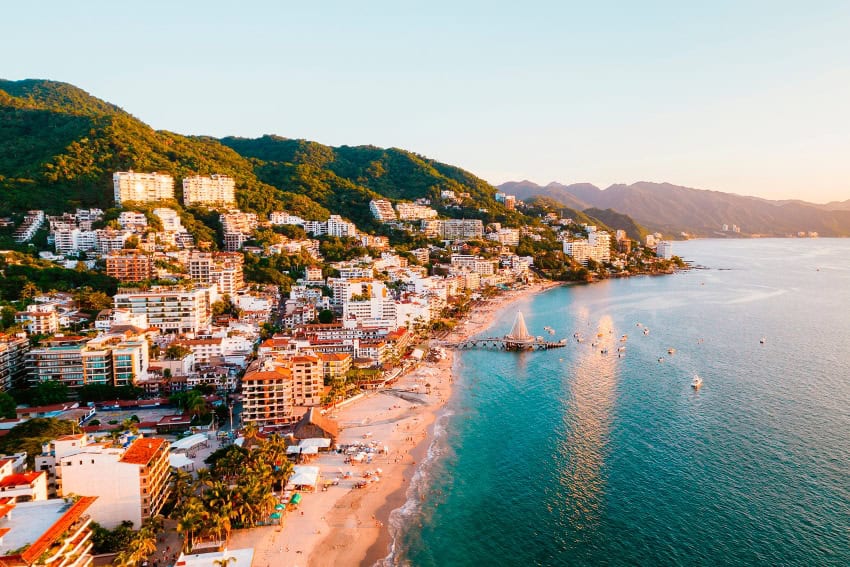
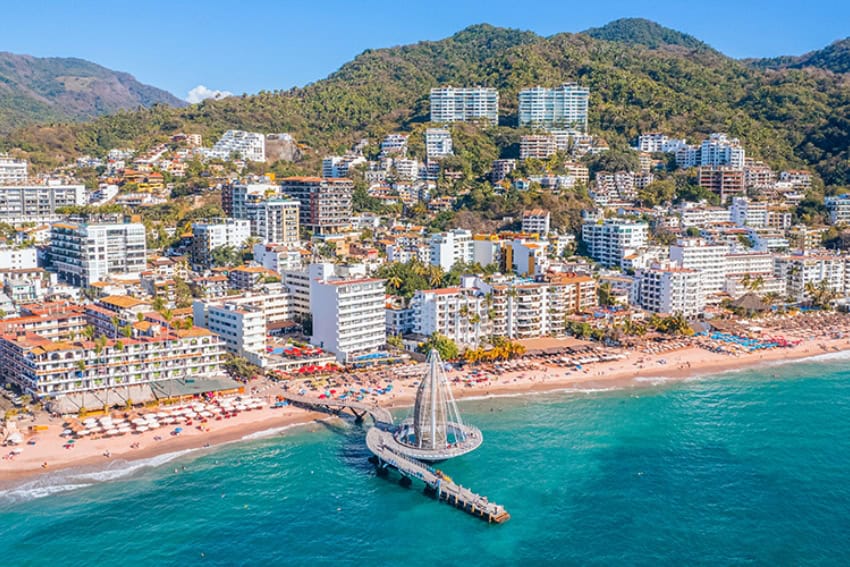
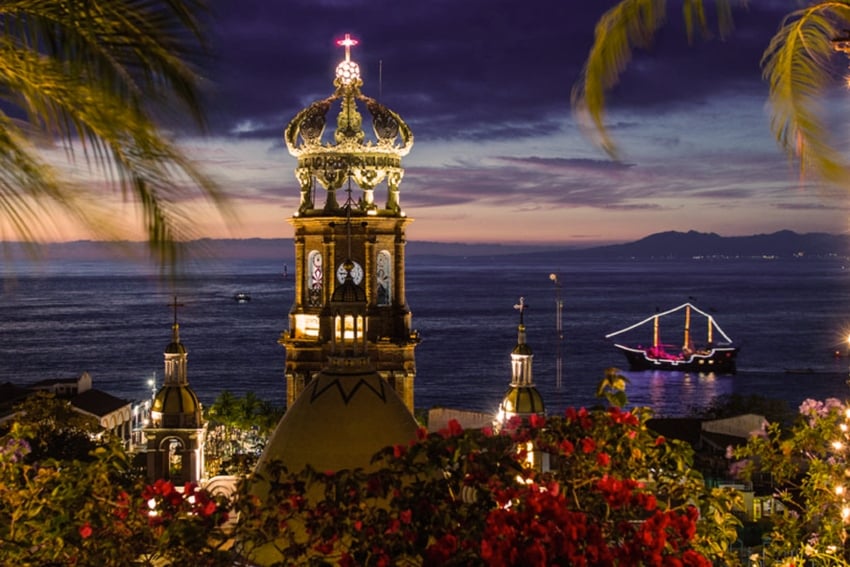
I moved to Puerto Vallarta, Mexico, in 2021. (Roman Lopez/Unsplash)
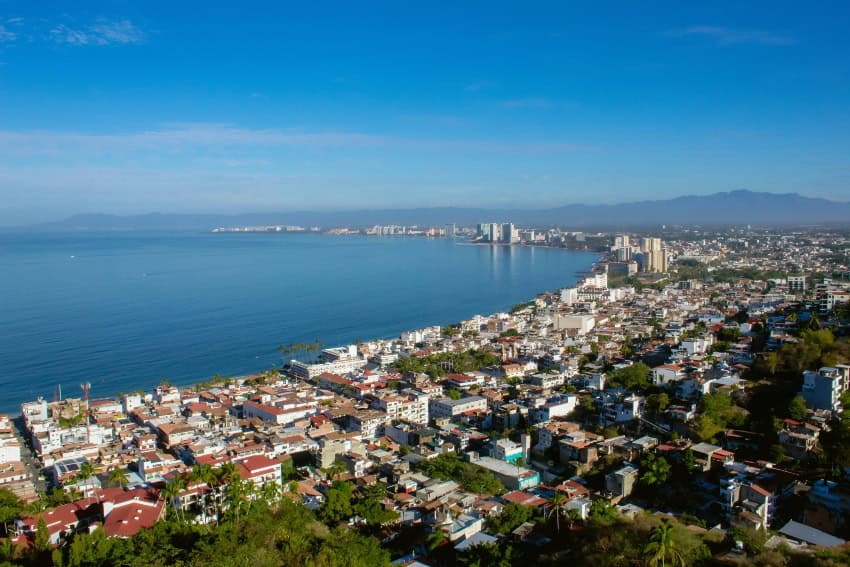
It was the boldest move yet as it wasn’t a return to familiarity but a leap toward something entirely new. I chose Puerto Vallarta for its color and its possibilities. I chose a life that felt expansive and sunlit. I met someone. And soon I was building that life deliberately with him.
When my car was all packed up in Baton Rouge to make the trip here, I told myself I knew how to do distance. I’d done it before. But this time, she was in her 80s.
A year after I moved, my mum made a decision that still humbles me. She sold her Louisiana home, the one that had held decades of memory, and moved to Portland. My brother had already built a life there, drawn by Oregon’s green expanses, softer pace and the love of a wonderful, caring woman who’d become his wife. My mum had a tiny house built in their driveway, replacing the garage.
Watching her dismantle a lifetime was quietly devastating. Sorting photographs. Letting go of furniture that had witnessed birthdays and heartbreak. Choosing which objects would accompany her into this smaller intentional space.
She didn’t call it downsizing because what she was really doing was choosing connection over square footage and proximity over permanence.
And then she began coming to us. To Mexico.
Family time in Puerto Vallarta
Every winter, mom comes to visit for a soft, golden season. (The Villas Group)
Every winter, she trades Oregon’s rain for Mexico’s sun. For three months, our spare room becomes hers. The wardrobe fills with her neatly folded summer clothes. The kettle whistles more often.
Those months are soft and golden.
We sit on the porch in the mornings before the heat presses in. She cradles her tea, and I hold my coffee. We talk about politics or neighbors or the price of avocados. Sometimes we sit in companionable silence, watching the sun spill over the wall.
I find myself studying her face without meaning to. Her lines are deeper now. Her movements are more measured. There’s the careful way she lowers herself into a chair.
Aging is subtle until it isn’t.
In February 2025, while she was here in Puerto Vallarta, she became ill. What began as discomfort escalated quickly. At 82, five days in the hospital isn’t a minor interruption; it’s a reckoning.
Going to the hospital in your 80s isn’t an interruption, but a reckoning. (Visit Puerto Vallarta)
There’s a particular amount of fear and guilt that grips you when your parent lies in a hospital bed in a country you chose. I remember standing by the window, palm trees swaying against an impossibly blue sky, thinking, “This was meant to be the joyful chapter.”
But Mexico held us.
The big question
The care she received was exceptional: The doctors were attentive, the nurses were compassionate and communication was clear. In those five days, this country shifted from being my adventure to being the place that cared for my mother.
And that matters.
When she was discharged, thinner, tired, but resolute, we sat at the dining table and had “The Conversation.”
It wasn’t dramatic or morbid, just intentionally honest.
Eventually, it’s time to have the conversation. Where do you want to rest? (Visit Puerto Vallarta)
What happens if the inevitable happens here? What are your wishes? Where are the documents? Who do we call? Do you want to be repatriated, and to which country does “home” belong now?
There were tears. There was awkward laughter. There was relief.
Living across borders means love has to be organized. It means researching medical professionals before you need them. It means keeping in touch with those doctors even when she flies back to Oregon. It means having plans in place so that if the worst happens, you’re not scrambling through grief and paperwork at the same time.
Preparation doesn’t diminish joy. It protects it.
The Pyramid of the Moon
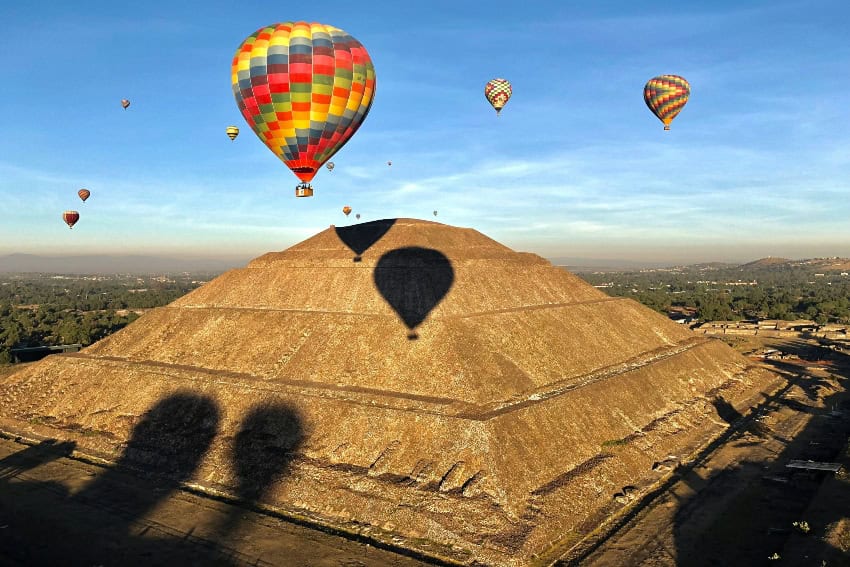
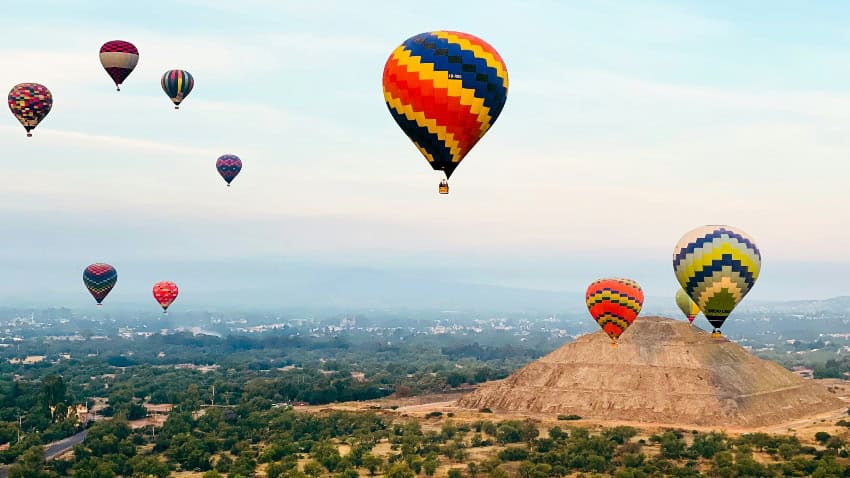
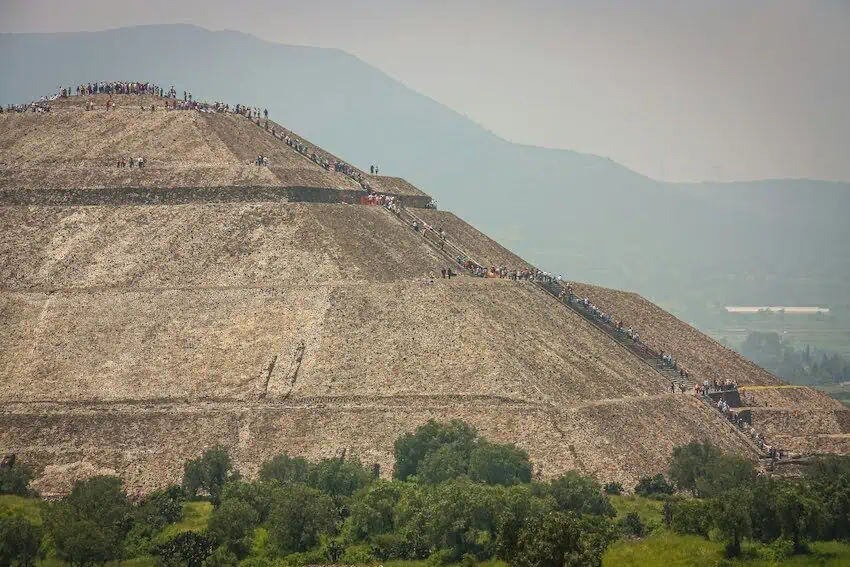
A year later, just a few weeks ago, at 83, she stood with us at Teotihuacán, just outside Mexico City, staring up at the Pyramid of the Moon.
“I think I’ll try,” she said.
My mom climbed the Temple of the Sun in Teotihuacán. (Samantha Velazquez/Unsplash)
And she did.
Slowly. Carefully. Resting often.
My boyfriend climbed with her as I videoed, and he hovered without wanting to hover. My heart was lodged somewhere in my throat.
Younger tourists passed them easily, but she climbed with quiet determination.
Halfway up, she stopped and looked out across the Avenue of the Dead stretching into the distance.
When I joined them, I asked what she was thinking when she stopped.
It’s not how fast you climb, it’s whether you get to the top. (Francisco Kemeny/Unsplash)
“I’m glad I came,” she said.
Three words that seem to hold our entire family’s history. And I knew what she meant.
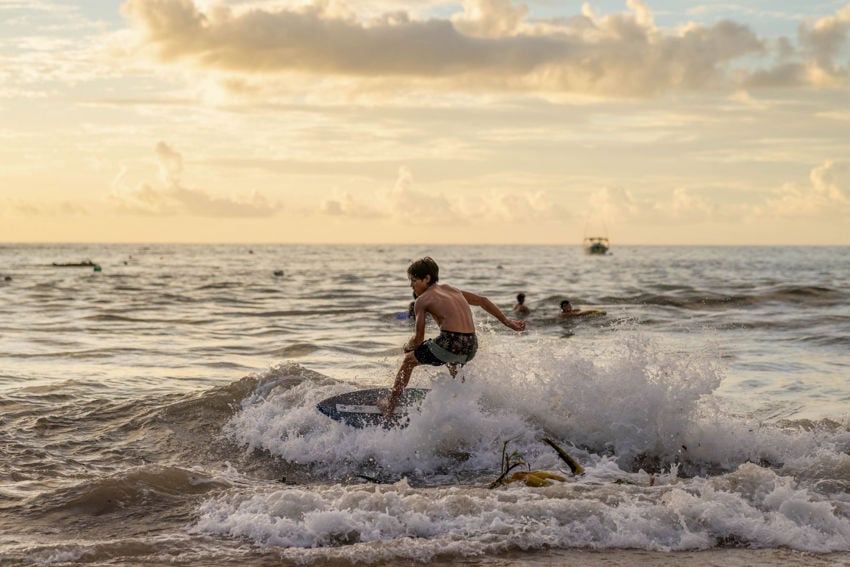
Young boy surfing in Puerto Vallarta. (Agencia Perspectiva/Cuartoscuro)
I’m glad I came to every single moment that shaped you.
Missing your mom
Our parents will age wherever we are. Staying in England wouldn’t have frozen her. Staying in Louisiana wouldn’t have slowed time. Leaving didn’t cause her to grow older; it simply meant I had to learn how to love her across more miles.
She flew back to Portland a few weeks ago, and I’ve been a bit weepy. The spare room seems so incredibly empty. The mornings are quieter, and I still glance at the empty porch chair beside mine before remembering she’s thousands of miles away.
The missing doesn’t soften just because the initial leaving was my choice. But neither does the gratitude.
Gratitude from Mexico
I’m grateful she crossed oceans when I was 3. I’m grateful she let me leave again and again. I’m grateful she chose family in Oregon. I’m grateful she chooses us for three months each year. I’m grateful she climbed a pyramid at 83.
I’m grateful we spoke honestly about endings before they arrive.
Climbing to the top of the Pyramid of the Sun when it was still allowed. (Maciej Cisowski/Pexels)
Living in Mexico while your parents age elsewhere is an exercise in holding opposites. Joy and worry. Freedom and responsibility. Sunshine and hospital corridors.
So we do what we can.
We invite them into our new worlds. We encourage their visits. We do the research. We keep the doctors’ numbers close. We have the hard conversations early. We plan, not because we expect the worst but because love deserves steadiness.
And then we embrace the ordinary.
Tea on the porch.
A slow walk around a market.
Times on the porch swing are always nostalgic. (The Porch Swing Company)
A careful climb up ancient steps.
There’s always room on the porch
One day in the not-so-distant future, there won’t be another winter flight. I know that. One day, there won’t be another climb.
But for now, there’s still a suitcase in Oregon waiting for her next visit. For now, there are still mornings warmed by Mexican light and the comfort of her presence beside me.
I’ve spent my life leaving. What I’m learning now is how to stay. In the moment, in the gratitude, in the fragile beauty of having her here at all.
No matter how far we travel, no matter how many countries shape us, there’s a simple rule I intend to keep.
I will always make room on my porch.
Charlotte Smith is a writer and journalist based in Mexico. Her work focuses on travel, politics, and community. You can follow along with her travel stories at www.salsaandserendipity.com.
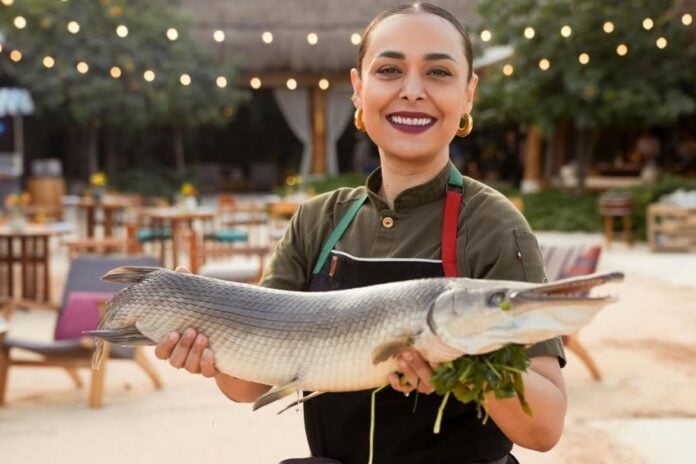
What does Chef Lupita cook when she wants to show off the cuisine of her native state of Tabasco? Pejelagarto, of course. (Instagram)
It was a cold day in Doha, Qatar’s capital — an extraordinary weather pattern for this small country. And just as extraordinary was my encounter with Mexican Chef Lupita Vidal, who was also in Doha as a guest chef for the Qatar International Food Festival (QIFF) on behalf of the 2026 Qatar Mexico and Canada Years of Culture (YoC) program.
I met up with her and her husband, photographer Jesús David, in Saasna for lunch, a Qatari restaurant in the chic Msheireb district in Downtown Doha. They both arrived carrying shopping bags of purchases they had made that morning at Souq Waqif, the city’s traditional market.
Over a date salad and a chicken, prawn and lamb majboos, she told me this was her first time in Doha.
“My work has taken me to many parts in Mexico and the United States, but this is the farthest we’ve ever been,” she said, smiling while exchanging glances with her husband.
Vidal’s journey as a chef started in Tabasco, a state in southern Mexico typically not associated with Mexican cuisine, which makes Vidal’s success even more remarkable.
“I’m here representing Mexico. But most of all, I’m here representing Tabasco,” she said, highlighting the arduous journey she undertook to bring visibility to the state’s cuisine. “I think Mexico is a mega-ultra-diverse country, and within that diversity — as someone from Tabasco — you don’t feel Mexican because nobody pays attention to your cuisine.”
An unexpected success story in Villahermosa
Vidal’s success with her first restaurant was completely unexpected. After graduating from culinary school and working two years in the kitchens of Yucatán, Vidal went back to Tabasco and opened La Cevichería Tabasco with David in the city of Villahermosa.
“We opened this little cevichería as a way to capitalize ourselves and leave Tabasco, because we both thought that we wouldn’t be successful there,” Vidal said.
Chef Lupita Vidal never dreamed her journey would take her all the way to Qatar. (Instagram)
Their “tiny” restaurant, as Vidal described it, was a family-run enterprise: Vidal’s mother was the cashier, David was a waiter and she was the chef. The menu was inspired by the cuisine of Mexico’s south, and featured six dishes.
But over time, the restaurant began to attract more clients and to expand its offerings.
“Suddenly, we had to get more chairs and tables, and, without planning it, we realized we couldn’t leave anymore because the restaurant was doing really well,” Vidal said.
Amidst this growth, Vidal began to feel the responsibility of having a team and “feeling the need to teach them something more,” she said.
Into the heart of Tabasco
Unlike other renowned chefs who have traveled the world, learning about foreign cuisines, Vidal didn’t have that opportunity. But instead of feeling limited by this, her lack of international exposure motivated her to explore the culinary world near her. So she and David took to the road and traveled throughout Tabasco.
During this time, the pair traveled to all corners of the state, exploring different cooking techniques, flavors and ingredients, realizing just how rich the state’s culinary heritage was. People welcomed them into their homes, introduced them to local ingredients and taught Vidal firsthand how they cooked their meals. The couple also began working with local producers, fishermen and artisans, featuring their products in their restaurant.
The chef has become a tireless promoter of the glories of Tabascan cuisine. (Instagram)
“Traveling through Tabasco made me realize just how little we knew about our own state, how little pride we Tabascans have in our state and how badly we speak about ourselves,” Vidal shared with raw honesty.
A Tabasco cookbook
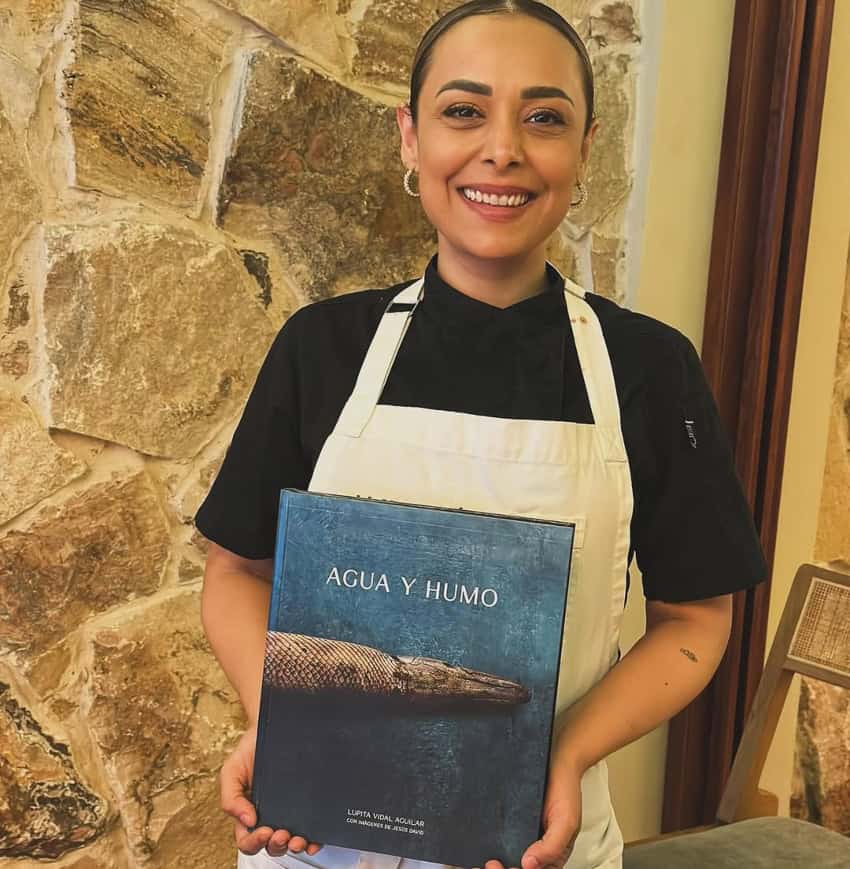
Recognizing the value of their discoveries, the couple felt compelled to document them all in a book. A decade after their journey through Tabasco began, they published Agua y Humo: Cocinas de Tabasco (Water and Smoke: Kitchens of Tabasco) in 2024, a book that covers the cuisine of all seven of Tabasco’s regions.
Offering a deep exploration of Tabasco’s culinary heritage, the book wasnominated in the Women category and the Independent Publishing category at the Gourmand World Cookbook Awards.
“We weren’t expecting it,” David told me.
“I thought it was a joke! And we never imagined it would take us all this way,” Vidal said and opened her arms, acknowledging the fact that she was in Qatar for a live cooking demonstration at QIFF’s closure ceremony.
When I asked her what she would cook at the event the following evening, on a stage before hundreds of guests, she smiled.
Chef Lupita has won awards for her book on Tabascan cuisine, “Agua y Humo.” (Instagram)
“The pejelagarto, of course!” she said, referring to the prehistoric fish found in the rivers of Tabasco. “I will season it with spices I brought from home, including momo (hoja santa), chipilín and criollo parsley.”
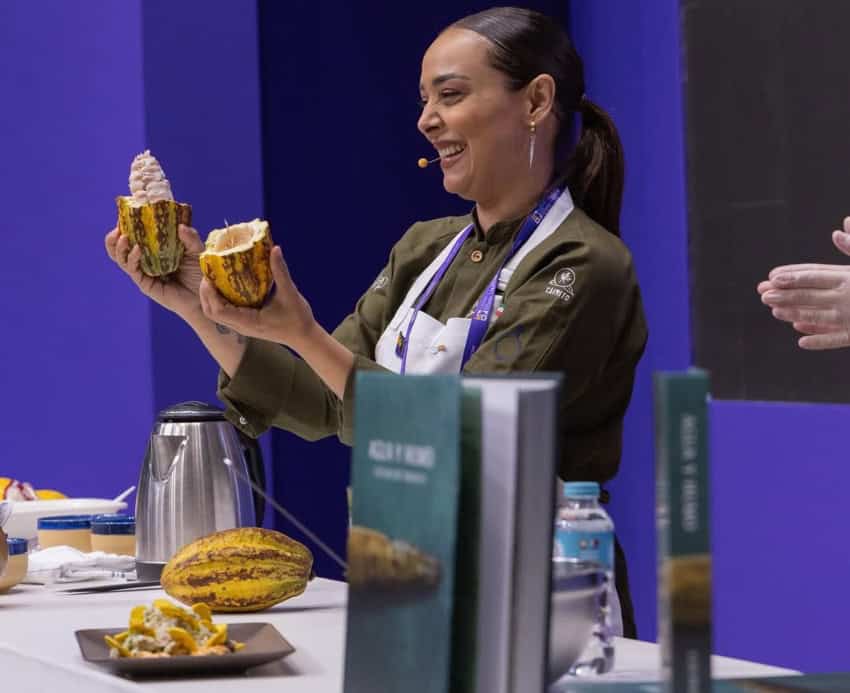
At the actual event, Vidal also prepared pozol, an ancestral drink made of nixtamalized corn and cacao.
A Tabasco culinary ambassador
Vidal’s success in the culinary world has shone an unlikely spotlight on Tabasco.
“I’ve felt so much responsibility for being a pioneer,” she said. “Of doing what no one had ever done. Just as I wanted to leave at some point, many Tabasqueños want to leave their state. They don’t stay because it’s hard to work there. But we have stayed, and we will continue to work there,” Vidal said.
Vidal’s career has been on a rising trajectory for the last several years. In 2020, she was an invited judge on the TV show “Master Chef México,” and the recognition has not stopped since. Most recently, she won Culinaria Mexicana magazine’s 2025 award for Best Mexican Chef and was acknowledged by the National Chamber of the Restaurant and Seasoned Food Industry (CANIRAC) as an Ambassador for Tabasco’s Cuisine.
A sense of pride in place
But she is not one to rest on her laurels: She and David opened a second restaurant in Tabasco in 2022 — Salón Caimito — and, most recently, a third in Valladolid, Yucatán — Caimito Refresquería at the end of 2025.
Chef Lupita has now opened three restaurants in Mexico: two of them in Tabasco and a third in Yucatán. (Instagram)
Vidal’s hope is that her work makes Tabasqueños feel proud of their home state and their food.
“Tabasco has so much to offer, and we need to feel proud of who we are and the food we eat. And if we eat pejelagarto, well — let’s eat it proudly,” she said.
Before we said goodbye, I asked Vidal what it meant to be Mexican in today’s world. Two ideas stood out — pride and potential.
“I think we are a great country and a culture loved by everyone. And I think that if we really worked together, as a team, we could achieve anything,” she said. She noted that her teamwork with David is precisely what has propelled their success.
“I believe that one of our greatest achievements is that we have done something that no one had expected, within our own state and our own country,” she said.
Gabriela Solis is a Mexican lawyer turned full-time writer. She was born and raised in Guadalajara and covers business, culture, lifestyle and travel for Mexico News Daily. You can follow her lifestyle blog Dunas y Palmeras.
Legal exportation of reptiles from the United States into Mexico by land requires expressed approval from several U.S. agencies, of which the tractor driver apparently had none. (CBP)
U.S. Customs and Border Protection (CBP) officers intercepted a tractor with 39 live pythons hiding inside on March 5 while conducting outbound operations. The driver was starting to cross the World Trade Bridge from Laredo in Texas to Nuevo Laredo in Tamaulipas.
CBP officers flagged for inspection a 2021 Peterbilt tractor traveling to Mexico and then found the snakes after the driver had provided a declaration that no prohibited goods were being transported.
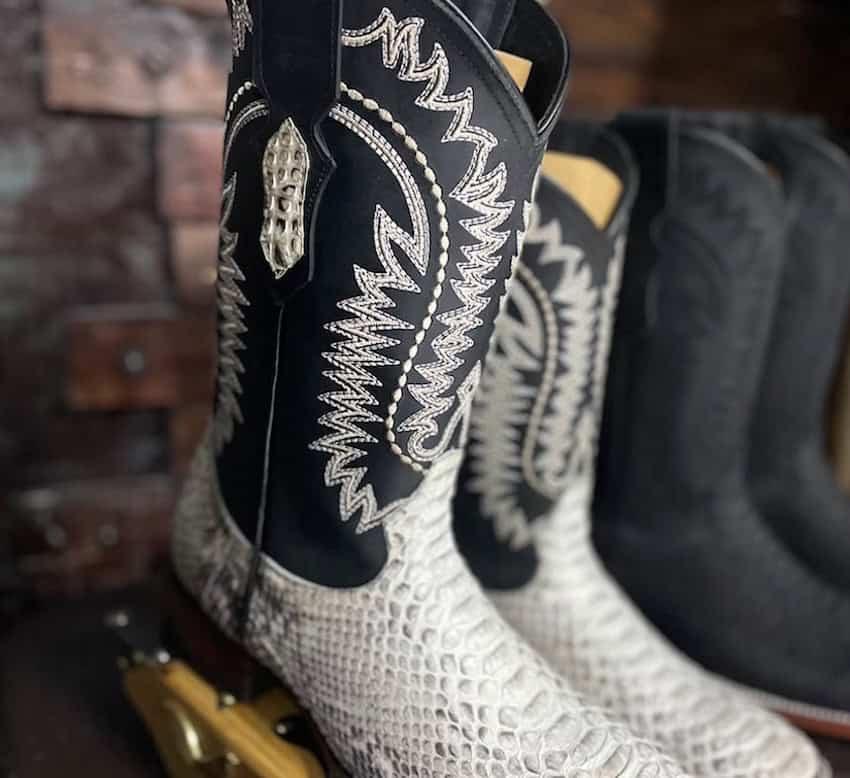
Animal smugglers know there’s a market for pythons in Mexico, either live as pets or dead as snakeskin boots. (Facebook)
Officials contacted U.S. Fish and Wildlife Service agents who took custody of the animals. The pythons were transported to a controlled environment where their condition could be monitored, according to CBP reports.
The driver was given penalties of $34,824 for export violations, while CBP seized the tractor and trailer.
Exporting live reptiles across the U.S.-Mexico border requires compliance with several U.S. and international regulations, and approval must be given from agencies such as the U.S. Fish and Wildlife Service, the U.S. Department of Agriculture and the U.S. Census Bureau.
This is not the first time this year that someone has been caught trying to smuggle wildlife across the border. In February, a U.S. citizen allegedly attempted to transport 11 parrots in a private vehicle from Mexico into the U.S., via the Córdova–Las Américas International Bridge near Ciudad Juárez, Chihuahua.
This followed an incident in November when a man was caught attempting to smuggle two Mexican orange-fronted parakeets in his pants across the border between Tijuana and San Diego.
“The interception of live pythons at the World Trade Bridge highlights the vigilance and dedication of our CBP officers in enforcing laws that protect both our borders and our environment,” said Port Director Alberto Flores, Laredo Port of Entry. “CBP remains committed to preventing the illegal importation and exportation of wildlife and ensuring compliance with all federal regulations.”
Carín León, the Sonora-born singer who recorded the official 2026 World Cup song, has soared in international popularity along with the musical genre with which he is identified. (Facebook)
When FIFA announced recently that Carín León has recorded the lead vocal on the soon-to-be-released recording of the official World Cup 2026 song “Lighter,” the tens of millions of Mexican regional music fans needed no introduction.
But they’re far from the only ones. Ever since León switched to a solo career in 2018, his popularity has soared internationally along with the musical genre he is most identified with.
That’s no coincidence. Carín León has become the rising star of regional Mexican music by injecting new life into it. What was a blend of such regional sounds as norteño, banda and sierreño, now includes touches of blues, rock and country.
“We want to come and change the game in a certain way,” León told the newspaper El País. “We come with a very different proposal and I think it’s a great opportunity to show what we are capable of and where we want to take our music.”
In a sense, León conquered Mexican regional music by adapting it to his own style. And thanks to the innovation he is largely responsible for, León, 36, has achieved several breakthroughs in his career.
Most prominent these days is his shared lead (with the American Jelly Roll) on FIFA’s World Cup song, which Billboard calls one of the tournament’s “biggest collaborations yet.”
This year, he will also become the first Latino artist to perform at the Sphere in Las Vegas, with three shows scheduled for the city’s Sept. 11-13 run-up to Mexican Independence Day.
He was born Óscar Armando Díaz de León in Hermosillo, Sonora, a city traditionally linked to banda, one of the staple sounds of Mexican regional music. He gained success as the lead vocalist of Grupo Arranke before kicking off his solo career in 2018.
The artist’s big break, however, came thanks to “Primera cita” (First Date), a song that blends norteño, blues, rock and pop. The song’s video generated millions of views on YouTube and became a trend on TikTok.
“I wasn’t happy with the music I was making, I was a little frustrated,” León told El País. “I decided to abandon the dream of wanting to be a star in the market and started making the music I wanted, regardless of the fact that all the statistics told me this wasn’t going to work […] Thank God, things worked out for us.”
It worked not only in Mexico, but abroad as well. León has become a recognized Mexican artist within the U.S. music market. He has forged innovative collaborations with country stars like Kacey Musgraves, Leon Bridges and Kane Brown.
He recently announced a collaboration with rock legend Bon Jovi on the album Forever Legendary Edition.
In addition to his successful collaborations, he has won two Grammy Awards in the Best Mexican Music Album category for “Boca chueca, Vol. 1” and “Palabra de To’s (Seca),” in addition to several Latin Grammys.
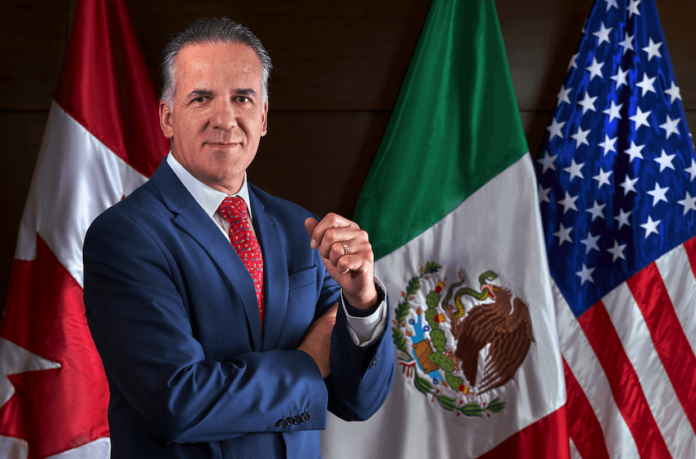
Oscar Del Cueto is president of Canadian Pacific Kansas City, which has been a member of AmCham for over a decade. (CPKC)
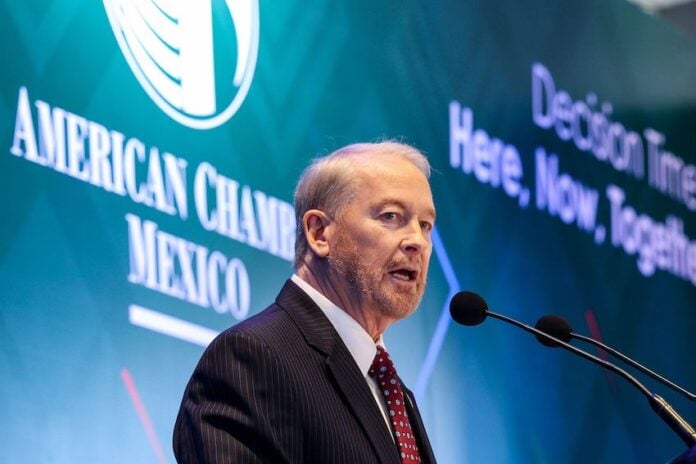
Oscar Del Cueto, president of Canadian Pacific Kansas City (CPKC) Mexico, was named the new president of the American Chamber of Commerce of Mexico (AmCham) for the 2026-2027 period, the business organization announced Wednesday.
The appointment was formalized during AmCham’s 109th General Assembly of Partners in Mexico City.
In his first address as president, Del Cueto stressed the importance of strengthening North American economic integration and consolidating coordinated efforts across the region. He highlighted AmCham’s role as a technical and constructive voice on strategic issues, including the United States-Mexico-Canada Agreement (USMCA), competitiveness and foreign investment attraction.
“We have the opportunity to strengthen our leadership, to influence the major debates and to ensure that the voice of our business community is heard, respected and considered at the highest levels of decision-making,” he said.
Del Cueto’s appointment came as Mexican and U.S. officials commenced preliminary talks on the formal USMCA review.
The incoming president recognized the outgoing AmCham board, which was led by Carlos García, general director of energy company Valero México, and Fernanda Guarro, managing director of 3M México. He thanked the outgoing AmCham president and vice president for their commitment and results.
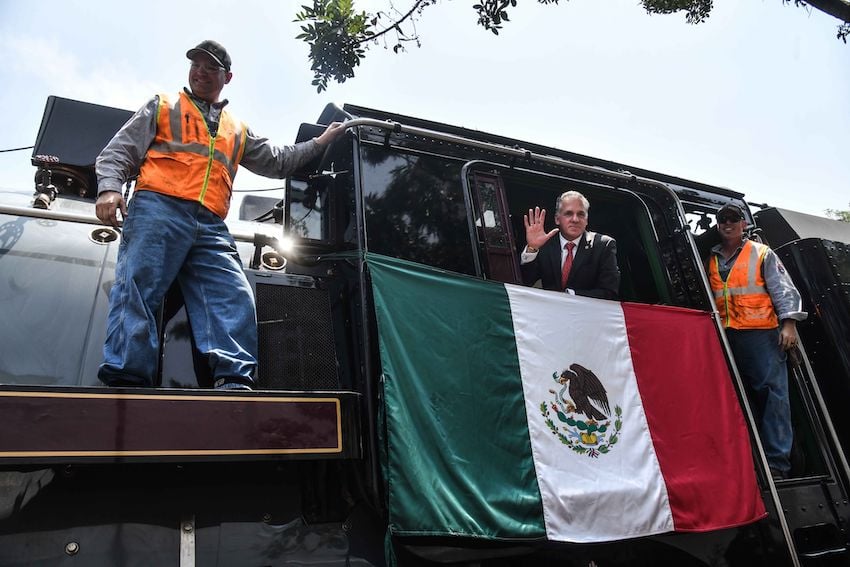
Del Cueto has been with CPKC since 2006. (Mario Jasso/Cuartoscuro)
In his address, Del Cueto also called on the chamber’s membership to anticipate challenges, forge agreements and advance toward a modern, long-term-oriented organization aimed at driving sustainable and shared economic growth.
AmCham México groups Mexican and U.S. companies with the aim of promoting bilateral trade and strengthening the economic relationship between both countries. The chamber currently has more than 1,450 affiliated companies. CPKC, one of North America’s major transnational freight rail operators, has been an AmCham member for over a decade.
According to Ambassador Johnson, "the true strength" of the U.S.-Mexico relationship "doesn't lie just in economic figures, but in the depth of our human connections." (Galo Cañas/Cuartoscuro)
U.S. Ambassador to Mexico Ronald Johnson asserted Wednesday that the upcoming review of the USMCA doesn’t represent a “risk” to the trilateral North American free trade pact, but rather an “opportunity to deepen integration” in the region.
His remarks came during an address in Mexico City at the 109th General Assembly of Partners meeting of the American Chamber of Commerce of Mexico (AmCham). Johnson is the honorary president of AmCham.
Here is an overview of the ambassador’s remarks, as reported by major Mexican newspapers.
USMCA can be ‘the envy’ of the world
Johnson said that “we” — i.e., the U.S. government — “don’t see the 2026” review of the United States-Mexico-Canada Agreement (USMCA) “as a risk, but rather as an opportunity to deepen integration and strengthen [North American] supply chains in an increasingly complex world.”
The ambassador also said that the United States, Mexico and Canada have an opportunity to establish North America as the world’s most competitive economic region and a bloc that is the “envy” of the world.
His comments came as Mexican and U.S. officials commenced formal trade talks ahead of the review of the USMCA, which replaced NAFTA in 2020.
Mexican Economy Minister Marcelo Ebrard wrote on social media on Wednesday that he and other Mexican officials held talks with U.S. Trade Representative Jamieson Greer “and his team to commence discussions with respect to the review of the USMCA.”
“The [Mexican and U.S.] technical teams will be working throughout the day today and tomorrow,” he added.
The talks are taking place in Washington, D.C. The formal trilateral USMCA review will take place later this year.
During his address, Johnson also said that the United States and Mexico will continue building a stronger, more dynamic and more competitive partnership.”
He noted that the U.S. and Mexico are each other’s largest trade partners, with two-way trade totaling close to US $1 trillion annually.
Despite that, U.S. President Donald Trump said in January that he doesn’t “care” about the USMCA, and claimed that the pact offers “no real advantage” to the United States.
“We could have [the agreement] or not, it wouldn’t matter to me,” he said.
Mexico-US relationship is like ‘a marriage’
Speaking to Mexican and U.S. businesspeople at the AmCham event at the Papalote Children’s Museum, Johnson described the U.S.-Mexico relationship as “a marriage.”
“You can love each other a lot, be partners, raise children and grow businesses [even] when you don’t agree on everything,” he said.
Johnson said that he had used the marriage analogy in a conversation with President Claudia Sheinbaum, and asserted that there is no possibility of a divorce between the two countries.
As he has asserted on social media, the ambassador said there is “historic cooperation” between the United States and Mexico under the leadership of Trump and Sheinbaum.
He also said that “when the United States and Mexico work together, we’re stronger.”
“We’re stronger economically, we’re stronger strategically and we’re stronger in the face of unfair competition from other parts of the world,” Johnson said.
He also said that “the true strength” of the U.S.-Mexico relationship “doesn’t lie just in economic figures, but in the depth of our human connections.”
‘North America, united, could be independent’
The ambassador claimed that North America could become self-sufficient at some point in the future, eliminating the need to import goods from other regions of the world.
“North America, united, could be independent,” Johnson said.
“Think about it. Mexico and the United States together could feed each other. We can provide each other the water we need. We could be independent and have everything we need for our people,” he said.
‘We have the most secure border in history’
Johnson highlighted that the U.S. and Mexican governments are “working together to stop fentanyl trafficking, seize illicit firearms, combat human trafficking and tackle illegal migration.”
“And that cooperation is delivering real results for our people and our communities,” the ambassador said.
Johnson asserted that the U.S. and Mexico currently have “the most secure border in history.”
“Illegal immigration is at record lows and there are zero releases of migrants [detained] at the border. This is important for President Trump and therefore it’s important for me,” he said.
Johnson said that fentanyl — which is made in Mexico with Chinese precursor chemicals before being smuggled into the U.S. — is still killing “too many” people in the United States, but noted that deaths related to the synthetic opioid are declining.
“We still have a lot of work to do, but [deaths] are declining and that’s very special,” he said.
‘A strong private sector needs certainty’
Johnson asserted that “a strong private sector needs certainty, fair conditions and a level playing field.”
“Guaranteeing those conditions both at home and in all of North America is a key priority for the United States,” he said.
Johnson’s predecessor as ambassador to Mexico, Ken Salazar, criticized Mexico’s judicial reform, saying in 2024 that the “direct election of judges is a major risk to the functioning of Mexico’s democracy” and that judicial elections — which were held last year — would “threaten the historic trade relationship we have built, which relies on investors’ confidence in Mexico’s legal framework.”
World Cup ‘will demonstrate the strength of our cooperation’
Johnson said that the FIFA men’s World Cup — which will be co-hosted by the United States, Mexico and Canada in June and July — “will not only show the passion of our people for the game … but also demonstrate the strength of our cooperation.”
He also said that the five-week tournament will demonstrate “our capacity to coordinate with each other across borders in order to guarantee security and offer to the world an event that is successful, memorable and safe.”
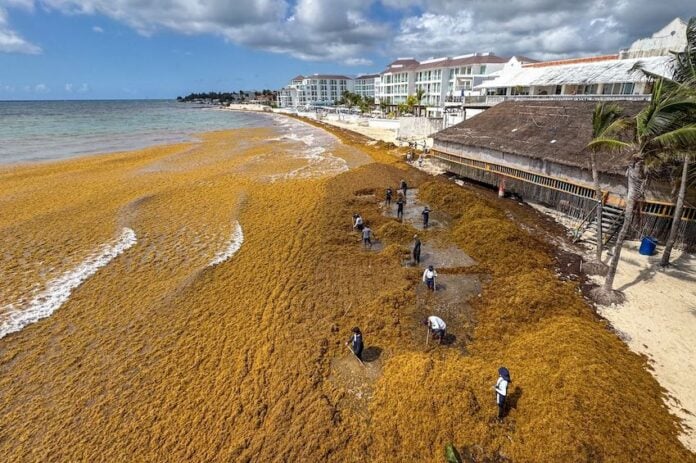
With millions of tonnes of sargassum lurking out in the Atlantic, barriers are being constructed, ships deployed and clean-up crews put to work in order to keep the seaweed off Quintana Roo's beaches during the upcoming Semana Santa. (@JuanM.Valdivia/Facebook)
March is here, and with it the typical start to sargassum season, when the noxious seaweed begins washing up on Mexico’s Caribbean coastline, darkening the sea, fouling the sand and chasing away the tourists.
This year could be worse than ever.
Local authorities are hoping to avoid the kind of sargassum invasions that turned Playa del Carmen into a slippery field of seaweed in previous years. (Elizabeth Ruiz/Cuartoscuro)
For one thing, the season started earlier than usual, with the slimy invader first washing up on Isla Mujeres in the second week of January. According to industry publication Reportur, 244 tonnes of sargassum were collected from Tulum in February, up from 59 in 2025. It has since accumulated in many other beaches along the Quintana Roo coastline, particularly near Playa del Carmen.
“This year is going to be terrible,” said Rosa Rodríguez, a researcher at the National Autonomous University of Mexico’s Institute of Limnology and Marine Sciences in Puerto Morelos.
According to Rodríguez, a record 9.5 million tonnes of sargassum was spotted out in the Atlantic Ocean during January and another 13.6 million tonnes in February, far exceeding the previous records of 7.8 and 4.3 million tonnes in 2025. Because sargassum is a floating seaweed carried by ocean currents and winds, experts expect about 10% of that accumulation to reach Mexican shores, which is more than enough to surpass last year’s quantities.
While it does not pose any direct health risk to humans, its decomposition can generate unpleasant odors and affect water quality.
Initial forecasts suggest that the most affected beaches along Mexico’s Caribbean coast will be Cancún, Playa del Carmen, Tulum, Cozumel and Mahahual. A large patch of sargassum appeared along the coast of Akumal, in the municipality of Tulum, last Thursday.
The overall increase in the volume of sargassum is attributed to climate change, the warming of the seas and ocean acidification.
Authorities activate preventive protocols
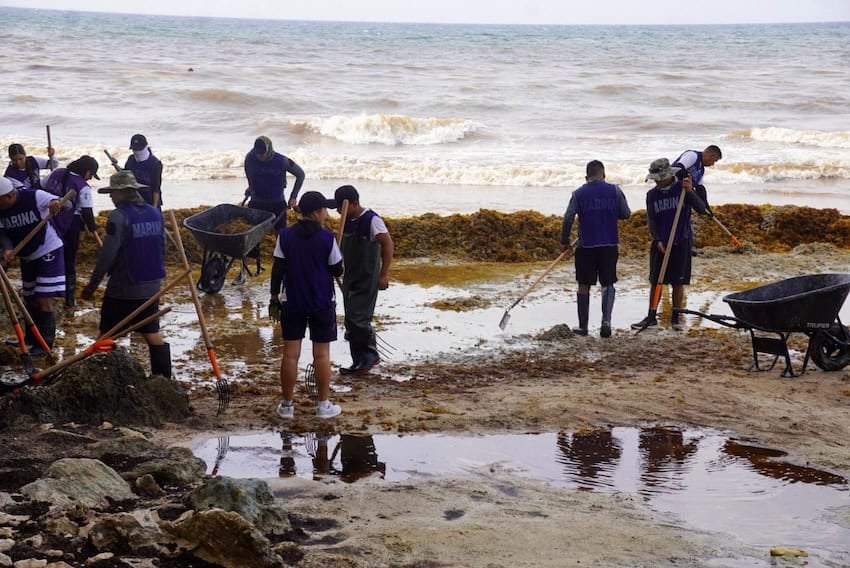
Ahead of the official start of sargassum season, officials have been making moves to prevent the seaweed from reaching the shore. In Isla Mujeres and Puerto Morelos, barriers have been placed in the sea to trap the sargassum.
Meanwhile, Playa del Carmen has launched its Sargassum Challenge 2026, which includes the use of a 5-km double barrier to contain the seaweed, as well as the deployment of cleanup personnel at 15 locations.
The Mexican Navy will use ships and an amphibious vehicle to capture and transport the seaweed.
Tourism Minister Josefina Rodríguez assured visitors that measures will be taken to contain any sargassum that washes up ahead of the busy Easter season, from March 29 to April 5.
Meanwhile, tourists can track the conditions of the beaches through the sargazo.info website. A blue or green indicator signifies that there is little to no sargassum on the beach, while a yellow, orange or red indicator suggests the presence of seaweed.
Tourism Minister Josefina Rodríguez credited the uptick to tourists using the train to explore pueblos mágicos along the route, boosting local economies. (Josefina Rodríguez Zamora/Facebook)
Sheinbaum’s mañanera in 60 seconds
🚉 Maya Train ridership up Foreign travelers on the Maya Train jumped 47% in January year-over-year — 13,166 passengers versus 8,980 in January 2025. Tourism Minister Josefina Rodríguez credited the uptick to tourists using the train to explore pueblos mágicos along the route, boosting local economies. The $28.27 billion railroad, built under AMLO and fully operational since December 2024, still runs at a net operating loss.
📱 “Discover Mexico” app for World Cup tourists The government is developing Conoce México, an app in English and Spanish to help FIFA World Cup visitors plan their trip. It’s already available for download, covers all 32 Mexican states, and allows certified tourism agencies to sell experiences directly through it. Mexico co-hosts the tournament with the U.S. and Canada; 13 matches will be played in Mexico City, Guadalajara and Monterrey, with the opener — Mexico vs. South Africa — at Estadio Azteca on June 11.
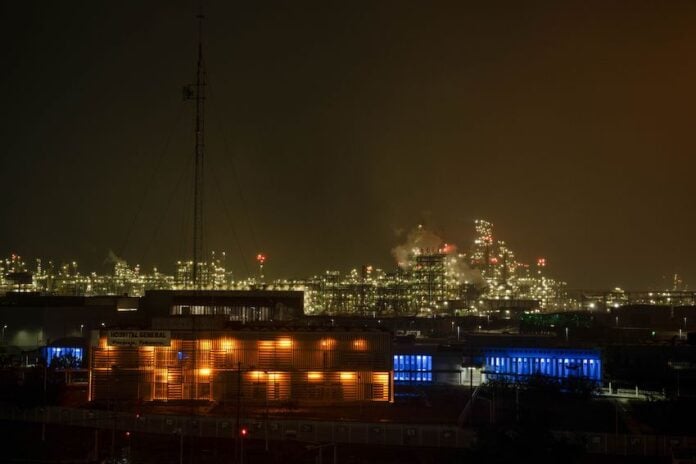
🚑 Dos Bocas refinery fire The FGR (Federal Attorney General’s Office) will investigate Tuesday’s fatal fire at the Olmeca (Dos Bocas) Refinery in Tabasco, which killed five people. Pemex blamed heavy rain for an overflow of oily water outside the perimeter fence that then ignited near a fuel storage area — though the ignition cause remains undetermined. Sheinbaum stressed the refinery itself sustained no damage and is operating at 100% capacity.
Why today’s mañanera matters
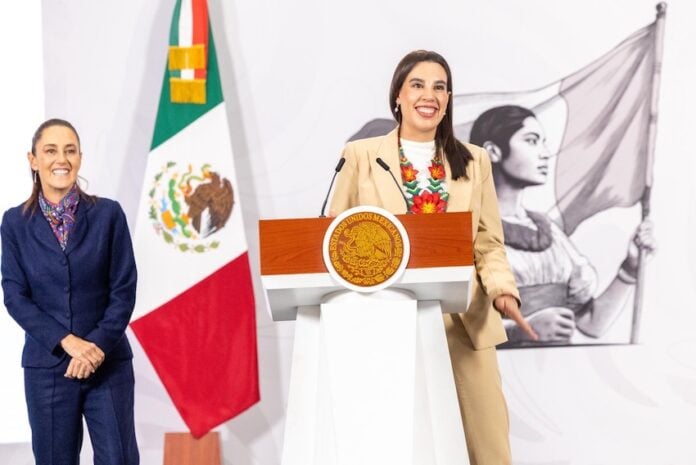
Tourism was a key focus of President Claudia Sheinbaum’s Wednesday morning press conference.
Federal Tourism Minister Josefina Rodríguez presented at the mañanera, reporting that international tourist numbers increased almost 9% annually in January to 4.29 million.
Mexico’s tourism sector is set to get a major boost this year as 13 FIFA men’s World Cup matches will be played here in June and July.
Mexican authorities hope that the influx of foreign tourists will benefit not just the three Mexican host cities, but also other parts of the country.
To that end, the government is developing a tourism-focused mobile app for World Cup tourists, which Rodríguez spoke briefly about on Wednesday morning.
Sheinbaum’s mañanera was also significant as the tourism minister presented the latest data on foreign ridership for the Maya Train and the president herself spoke about Tuesday’s fatal fire near the Olmeca Refinery in Tabasco.
More than 13,000 foreigners traveled on the Maya Train in January
During a tourism update, Rodríguez noted that the number of foreigners who traveled on the Maya Train in January increased 47% compared to the same month of last year.
The data she presented showed that 13,166 foreigners traveled on the Yucatán Peninsula railroad in January, up from 8,980 in the same month of 2025.
According to Mexico’s Tourism Ministry, tourism to pueblos mágicos connected by the Maya Train has more than doubled since the railroad’s opening. (@TrenMayaMX/X)
Rodríguez said that foreign passengers are using the train to visit pueblos mágicos (magical towns) along the route and are thus helping to stimulate local economies.
Government developing ‘Discover Mexico’ app for World Cup tourists
Rodríguez told reporters that the Tourism Ministry and the federal government’s Digital Transformation and Telecommunications Agency is developing an app called “Conoce México” (Discover Mexico) to help FIFA World Cup tourists plan their stay in the country.
Rodríguez noted that certified tourism agencies can sell trips and experiences to tourists via the app. She said that the trips promoted on the app cover all 32 federal entities of Mexico.
Mexico is co-hosting this year’s FIFA men’s World Cup with the United States and Canada. Millions of tourists are expected to visit Mexico during the five-week tournament.
In Mexico, a total of 13 matches will be played in Mexico City, Guadalajara and Monterrey. The tournament’s opening match between Mexico and South Africa will be played at the Estadio Azteca in Mexico City on June 11.
FGR to investigate refinery fire
Sheinbaum told reporters that the Federal Attorney General’s Office (FGR) will investigate the fire that occurred just outside the Olmeca (Dos Bocas) Refinery in Tabasco on Tuesday.
“[The fire] was on the outside of the Dos Bocas refinery toward the port. … As there was a loss of human lives, the Federal Attorney General’s Office comes in to do the investigation,” she said.
Pemex said that heavy rain caused an “overflow of oily water,” which accumulated outside the perimeter fence of the refinery and subsequently ignited, killing five workers, one of whom was a direct employee of the state oil company. (Isabel Mateos Hinojosa/Cuartoscuro)
The blaze — which spread to the perimeter fence of the refinery, according to state oil company Pemex — claimed five lives.
Sheinbaum said that the FGR “has to do the expert’s report” and determine what caused the fire.
Pemex, which operates the Olmeca Refinery, said on Tuesday that heavy rain caused an “overflow of oily water,” which accumulated outside the perimeter fence of the refinery and subsequently ignited. The state oil company didn’t say what caused the oily water to ignite, but noted that it was collaborating with authorities to determine the cause. The oil spill occurred near a fuel storage facility.
Sheinbaum said that the refinery is operating at 100% capacity, noting that it didn’t sustain any damage from the fire.
By Mexico News Daily chief staff writer Peter Davies (peter.davies@mexiconewsdaily.com)
The victims were in a vehicle on a federal road adjacent to the refinery when the disaster occurred on Tuesday morning. (Isabel Mateos Hinojosa/Cuartoscuro)
Five people were killed after an oil leak sparked a large fire just outside the Olmeca Refinery in the Gulf Coast state of Tabasco on Tuesday, state oil company Pemex reported.
Four of the deceased were workers for a services company not affiliated with Pemex, while the fifth victim was a woman who worked for the state oil company. The refinery is located in the municipality of Paraíso.
Pemex said in a statement that the four service company workers were in a vehicle on a federal road adjacent to the refinery when “the disaster occurred” on Tuesday morning.
According to the newspaper El Universal, the workers abandoned the vehicle and attempted to reach safety, but were unable to outrun the flames.
In addition to the five fatalities, Pemex said that people were injured in the blaze but didn’t specify how many.
Pemex: Fire started outside the refinery limits
Pemex said that heavy rain caused an “overflow of oily water,” which accumulated outside the perimeter fence of the refinery and subsequently ignited. The state oil company didn’t say what caused the oily water to ignite, but noted that it is collaborating with authorities to determine the cause. The oil spill occurred near a fuel storage facility.
Pemex said that the fire reached the perimeter fence of the refinery but didn’t damage the actual infrastructure of the facilty, which was built during the 2018-24 government led by former president Andrés Manuel López Obrador.
The blaze was extinguished, and Pemex said on Tuesday night that the refinery was operating normally.
The company expressed its “deepest condolences” to the families and friends of the five people killed in the fire. It also said it was providing “comprehensive care” to those injured.
The Olmeca Refinery, also known as the Dos Bocas refinery, is one of eight refineries operated by Pemex. Seven are in Mexico and one is in Texas.
Often referred to as Las Bocas for its location on the Gulf Coast, the Olmeca Refinery was inaugurated in 2022 and began production in 2024. (Presidencia/Cuartoscuro)
The fire outside the facility occurred one day before the 88th anniversary of the nationalization of oil reserves in Mexico. President Lázaro Cárdenas nationalized the Mexican oil industry on March 18, 1938.