Home Blog Page 75

When will the Mexican peso begin to behave rationally again? A perspective from our CEO

17
mexican pesos and a calculator with the number 2026
After a weird year for the peso, will the exchange rate come back down to earth in 2026? (Shutterstock)

I have written about the peso many times before. Other than safety, I would argue that there is no other issue that affects everyone like that of the peso. Business people making investment decisions — concerned about the peso. Low income families in Mexico depending on wire transfers in USD from family members in the U.S. — watching the peso. Expats living in Mexico and vacationers to Mexico making budgeting/planning decisions — worried about the peso. And Mexican families looking to vacation abroad or buy foreign goods — you guessed it, closely monitoring the peso.

As 2025 came to a close with the peso touching below 18, we learned that the peso appreciated more in the year against the USD than it ever has in modern history (since 1994 to be exact). Think about that for a minute. Literally no one was expecting the peso to appreciate last year — the average prediction of the “expert analysts” was a depreciation to 21 — and instead it got stronger! At the risk of getting a little wonky, think of all of the events of last year that, in theory, should have caused the peso to weaken in 2025:

1. President Trump’s constant threats against Mexico for everything from drugs, water, immigration, trade and more.

2. President Trump’s “America First” policies, threatening the value proposition of Mexican manufacturing.

3. President Trump’s tariffs against Mexico and in particular the critical automotive, steel and aluminum industries.

4. Record amounts of new investment announcements in the U.S. that, if anything, should have made the USD stronger versus emerging market economies like Mexico.

5. The (I would argue incorrect) rhetoric from the opposition that the newly elected President Sheinbaum was anti-business and had socialist policies that would turn the country into the next Venezuela.

6. Mexico’s 2025 economic growth was terrible, with GDP growing less than 1% for the year versus nearly 3% for the United States and 3% globally.

7. Mexico lowered its interest rates much faster than the U.S., making the peso less attractive compared to other countries that lowered interest rates more slowly. (It is often the rate of change that is more impactful on a currency versus the absolute rate.)

8. Mexico’s inflation rate is higher than that of the U.S.

9. Even the thought of the USMCA trade agreement not being renewed is potentially catastrophic for Mexico.

Any one of these events could have caused the peso to weaken in a typical year, and the peso historically has devalued for less impactful reasons. In fact, the peso has on average devalued against the USD around 10% annually over the past 30 years!

Pros and cons of the ‘superpeso’: A perspective from our CEO

So what is going on here? And what should we expect for 2026? Let’s start with what standard economic theory (which arguably was very wrong in 2025) would tell us about what should happen to the peso in 2026:

1. Mexico’s economy will grow slower than the US economy — downside risk for the peso.

2. Significant USMCA renewal risk (economic tensions) throughout the year — downside risk for the peso.

3. Expansion of the war on drugs to include Mexico (geopolitical tensions) — downside risk for the peso.

4. Mexico’s inflation rate remains higher than the U.S. rate — downside risk for the peso.

5. Mexico’s interest rate continues to be lowered due to slowing economy — downside risk for the peso.

In fact, I don’t see any factors in the short term that (using standard economic theory) would point to a strengthening of the peso in 2026. But of course there is often an important element to exchange rates that don’t follow standard theory.

So what could be the logic around a continued strengthening of the peso (or even maintaining the current rate) this year? Here are a few:

1. Markets and companies globally increasingly recognize that Mexico is critically important to the U.S. as China tensions increase.

2. Faith that the USMCA agreement will be renewed and potentially even strengthen economic ties between the U.S., Mexico and Canada.

3. The belief that the U.S. war on drugs could actually benefit Mexico, making it more attractive to investment.

4. Increasing confidence in President Sheinbaum’s policies being pro-growth and business-friendly.

5. The belief that Mexico might begin to open up its energy industry to foreign investment.

Mexico in the past has relied on the constant devaluing of the peso to keep the country competitive and attractive for foreign investment. Those devaluations reliably provided a short-term boost to the economy, but kept the country from making the kinds of investments resulting in long-term growth. 2026 is going to be a key year for Mexico to demonstrate if it is worthy of its strong currency, or if it will fall into the trap of a peso devaluation to juice the economy. Stay tuned … MND will be your front row seat for every tick of the peso. It is going to be fascinating to watch.

Travis Bembenek is the CEO of Mexico News Daily and has been living, working or playing in Mexico for nearly 30 years.

Mexico’s golden age of ramen

0
Three women eating noodles
Ramen, or Japanese noodles, have been popular in Mexico for decades. With so many fantastic noodle offerings throughout the country, what's sending Mexicans mad for Maruchan? (RMN Xalapa/Instagram)

On a rainy weeknight in Xalapa, I found myself huddled inside a narrow, izakaya-style eatery across from a jungly patch of tropical trees on the corner of a busy, potholed intersection. No less than 15 other patrons were either seated along the cramped, six-person counter, or eagerly awaited their turn outside to take up a stool and to order what we all came here for: delicious, soul-nourishing ramen at one of my favorite ramenerias.

RMN Xalapa is among the best I’ve found in Mexico. As someone who grew up in the San Francisco Bay Area (a region in California known for its diverse Asian offerings, and which is a West Coast hub of Japanese culture and food) and who has traveled to Tokyo more than once (where the ramen is, as expected, mindblowingly incredible and abundant), I can honestly say that in this small, misty corner of the Veracruz mountains, I’ve found ramen that is more than worthwhile. It’s totally legit. And, somehow, it’s all run by a miniscule team of three Mexican cooks.


View this post on Instagram


A post shared by RMN XALAPA (@rmn_xalapa)

 Though everyone always thinks of tacos and tortas being slung throughout Mexico’s markets and food stalls, ramen has elevated itself into one of the most popular dishes in la republica mexicana, an unavoidable staple in Mexican culinary circles that cannot be avoided if you know where to look.

Here are the facts: Mexico is the second largest consumer of ramen in Latin America — behind only Brazil, a nation that is both larger and has a significantly more visible Japanese population than Mexico. Not to be outdone, Mexico has firmly established itself as the noodly epicenter of fusion ramen, taking the noodle-and-broth classic and adding an appropriately Mexicanized flair with birria ramen, elote ramen, carnitas ramen, and more. 

It’s not simply ramen that Mexicans love about the Land of the Rising Sun; the connection between Mexico and Japan has historically been amicable, if not endearing, for generations. On the Japanese side, you’ll find entire subcommunities dedicated to Mexican and Mexican American cultural trends, from professional wrestling icons (see: the Japanese lucha libre legend in Mexico, Último Dragón) all the way down to Japan’s street culture (cholo fashion, lowriders, Chicano oldies). And you can’t walk a few blocks in any of Mexico’s biggest cities, or smallest pueblos, without seeing some vestige of sushi, ramen, anime, or other Japanese pop culture (my Mexican grandmother, rest in peace, couldn’t go a day without eating her beloved cacahuates japonés for as long as I can remember). 

These examples of intercultural permeation, and the rich flavors that have resulted from more than a century of exchange between the two, can perhaps be best understood through the ramen scene that is currently flourishing, which is more visible and accessible than ever. Make no mistake: we are living in the golden age of Japanese ramen in Mexico. And I, for one, am totally here for it.

The origins of Japanese immigrants — and their foods

The earliest Japanese-owned restaurant in Mexico, Nichiboku Kaikan, opened in 1960 in Mexico City. Inaugurated on the southern end of the capital as part of the Asociación México-Japón cultural center (which now includes Mexico’s largest Museum of Manga, as well as a Japanese garden and a language school), it served classic Japanese food and was financially supplemented by the Mexican government, which aided Japanese immigrants post-World War II.

The Mexico-Japan Association
(Mexico-Japan Association)

You have to go further back to 1888 when the two nations first established their diplomatic alliance to get to the root of this unlikely connection. Back then, Mexico was one of the first countries to recognize Japan’s sovereignty, leading to a strong relationship that has since remained. Soon after, Japanese immigrants arrived in Chiapas with the hopes of establishing a community there known as the “Enomoto Colony.”

But it wasn’t until a century after Japanese immigrants reached Mexico — much later, in the 1980s — that Mexico’s love of Japanese food became a cultural zeitgeist.

The rise of ramen throughout Mexico

Instant ramen changed everything. Specifically, Maruchan, the Toyo Suisan food company, which came to Mexico in the 80s. As reported by Japanese Mexican journalist Isami Romero, the book “Maruchan wa naze Mekishiko no kokumin-shoku ni natta no ka?” (Why Maruchan Became a National Dish of Mexico) outlines a dubious history of Maruchan’s arrival south of the border: “a Mexican man working in the United States brought the first Maruchan to Mexico when he returned to his homeland.” Though unproven, the brand undoubtedly established itself as an affordable go-to food option for Mexican families, and can be found in even the most remote parts of the country nowadays. Part of that is due to the Mexican government’s supply of Maruchan instant noodles in its Diconsa stores for rural Mexican populations.

There is no definitive record of when the first ramen shop in Mexico opened its doors, though. From memory, I don’t remember eating anything besides instant ramen noodles in Mexico as a kid visiting from California. Not until recently can I think of a time in Veracruz when one of my relatives invited me to an authentic ramen shop. It’s not until the past 15 years or so that authentic Japanese ramen has begun to spring up, with Mexican innovations abounding. In Xalapa alone, I can think of about five ramen shops off the top of my head, all within a few minutes drive of one another (and it seems that every week, another one opens).

Credited as being a pioneer in Mexico’s contemporary ramen circuit, Yamasan Ramen — which was founded by Japanese chef Shinichiro Nagata in 2012, and is now a national chain with branches in CMDX, Monterrey and Querétaro — represents the vanguard for ramen that isn’t served from a styrofoam cup with steaming water and powdered seasoning. I ate at their location in Condesa: the ramen bowls are flavorful, the venue is spacious and neon-lit, and they have an impressive variety of Japanese lagers and sake to go along with each massive portion.

In 2015, birria ramen — the drowning of Japanese ramen noodles in the rich, meaty broth of birria, an invention that has gone globally viral — was conceived by chef Antonio de Livier of Ánimo Ay Caldos! in CDMX. The concoction set the bar high for Mexican ramen lovers, which, to this day — a full decade later — has inspired other forms of ramen locuras. 


View this post on Instagram


A post shared by Ay Caldos! (@animomx)

 Down in Oaxaca City, Mexican chef Ricardo Arellano has experimented with chilacayote ramen, which Eater described as “translucent noodles made out of the Mexican pumpkin and served in a seaweed broth and topped with edible flowers.” At Mexico City’s Fideo Gordo, you can find ramen prepared with salsa verde and jalapeños. From the Los Mochis elote cart in Sinaloa, you can get ramen (albeit of the instant variety) mixed in with the all-time favorite Mexican corn snack. 

There are now plenteous forms of ramen: Hokkaido-style at Ramen Ichi in Roma Norte (an actual Hokkaido noodle house that has now branched out to Mexico), or picante tan tan ramen at Deigo Ramen, a 24/7 ramen bar with various locations in Mexico’s ramen-saturated national capital. 

If ever there was a time to slurp down a hearty serving of Japanese noodles in Mexico, this is it.

Alan Chazaro is the author of “This Is Not a Frank Ocean Cover Album,” “Piñata Theory” and “Notes From the Eastern Span of the Bay Bridge” (Ghost City Press, 2021). He is a graduate of June Jordan’s Poetry for the People program at UC Berkeley and a former Lawrence Ferlinghetti Fellow at the University of San Francisco. His writing can be found in GQ, NPR, The Guardian, L.A. Times and more. Originally from the San Francisco Bay Area, he is currently based in Veracruz.

Mexico’s longest dictatorship in history began 150 years ago today

3
A vintage black-and-white photograph from the Porfiriato era, featuring Mexican campesinos in white and with straw hats and an elderly woman carrying a large ceramic cistern in front of a Ferrocarril Central Mexicano steam locomotive at a rural station in Mexico during the nation's Porfiriato era, which followed Porfirio Díaz's rise to power under the Plan of Tuxtepec.
Mexico's longest dictatorship (1884-1910) is known as the Porfiriato, which ushered in rapid modernization but also increased social inequality. (William Henry Jackson/U.S. Library of Congress)

In the last decades of the 19th century, Porfirio Díaz dominated public life in Mexico, sometimes as the power behind the throne but usually as the country’s president. Díaz’s rule, remembered as the Porfiriato, began with the Plan of Tuxtepec, launched 150 years ago on this day in 1876.

It was during Díaz’s rule that capitalism became firmly rooted in Mexico, with railroads unfurling across the country, national products making millionaires out of Mexican businessmen on the world market and native elites fervently embracing European trends, leaving marks like the Palacio de Bellas Artes and Teatro Macedonio Alcalá on national cityscapes. But it was also the dizzying speed and unevenness of this development — which stripped rural communities of their communally-held lands and enslaved Indigenous people on henequen plantations in Yucatán — that planted the seeds of the cataclysmic Revolution of 1910.

Mexican president Porfirio Diaz
President Porfirio Díaz ruled Mexico for a total of seven terms, thanks to elections whose validity was increasingly questioned. (Wikimedia Commons)

The Tuxtepec Revolution ended what is remembered as the Restored Republic, or the nine years of republican rule following the end of the French Intervention. To make sense of Díaz’s revolt, we need to understand the politics of the Restored Republic itself. After the civil war of the 1860s, the Conservative Party was discredited for its collaboration with the French, and liberalism was in practice the only game in town, which meant that politics broke along factional lines within the Liberal Party.

Díaz had made his name fighting against the Santa Anna dictatorship and later the conservatives and their French allies, and during the Restored Republic — as the period between 1867 and 1876 is called — he was the figure most associated with the populist, mass-politics wing of the liberals. On the other side of the political spectrum was Díaz’s fellow Oaxacan and old mentor, Benito Juárez.

How do you solve a problem like Benito?

In 1867, Juárez had already served two terms as President of Mexico. Chief Justice of the Supreme Court following the Ayutla Revolution, Juárez first rose to the presidency in 1858 not by election but as constitutionally-designated successor to President Ignacio Comonfort, whose self-coup in January 1858 marked the start of the Reform War, a three-year civil war between liberals and conservatives.

Juárez led the liberals to victory and won reelection in June 1861, just in time to see the Conservatives play the ace up their sleeve, reopening the civil war by bringing in Archduke Maximilian of Austria to rule Mexico as emperor, supported by French bayonets. With Juárez and his government-in-exile — the “Nomad Republic” — leading the war effort as they wandered across the country, the liberals again beat the Conservatives and their European allies in 1867. 

An official oil painting portrait of Benito Juárez, former president of Mexico and national hero, depicted in a formal black suit and bowtie against a dark yellow-green background.
Benito Juárez, Mexico’s first Indigenous president, served four consecutive terms as the chief executive, plus the beginning of a fifth, before dying of a heart attack in office. (Mexican National Archives)

By the time he entered Mexico City in triumph in July of that year, Juárez had already been in power for nearly a decade, and he announced his intention to run for the presidency again in October. Already, he faced opposition from fellow liberals who felt that with the civil war over and the French expelled, a third term was unjustifiable.

Particularly concerning for the anti-reelectionists were Juárez’s stated plans for governing. The Constitution of 1857, which had lit the fuse of civil war years earlier and which Juárez himself had an important part in writing, established a notably weak executive branch and placed virtually all power with the national legislature.

Juárez understood that the Constitution would need to be reformed if the country was to advance according to his vision. That meant giving the executive the veto it lacked and dividing the unicameral legislature into a senate and chamber of deputies, and there was little chance Congress would vote to limit its own power. So Juárez circumvented it, calling a national plebiscite to ratify his proposed changes.

Porfirio Díaz, unable to accept this kind of change to the Constitution he had fought to establish and defend, decided to run against the man he had fought under. He gathered around himself some of the country’s leading lights, intellectuals like Ignacio Ramírez, Guillermo Prieto and Vicente Riva Palacio, not to mention broad support from the masses.

Díaz was a popular and respected war hero, but Juárez swept the election anyway, winning 72% of the vote, although the Senate ratified his victory at the price of not passing his constitutional reforms. Díaz resigned from the Army and returned home to Oaxaca, where he dedicated himself to business and to cultivating his prestige.

In 1871, Juárez decided to stand for a fourth term as president, a decision so controversial that not only Díaz but Juárez’s close ally Sebastián Lerdo de Tejada decided to run against him. In the elections that summer, Díaz came in second. Juárez won 48% of the vote; the most of the three candidates, but short of the 51% needed to win. It was up to Congress to choose a winner, and they chose Benito Juárez.

Official portrait of Sebastian Lerdo de Tejada, the President of Mexico, wearing a formal black suit and bowtie, representing a key figure in the Restored Republic era of Mexican history, which preceded the Porfiriato.
President Sebastián Lerdo de Tejada, an ally of Benito Juárez who took office after Juárez’s death six months into his fifth term. (Mexican National Museum of History)

In 1871, Juárez and Díaz ran against each other once again, and again Juárez won; this time, though, a third candidate had been in the mix, and no one had a majority of the votes. It was up to Congress to choose a winner, and they chose Juárez. Díaz and others who believed that Juárez was becoming an autocrat responded by rebelling against his government under the Plan of Noria.

The rebellion went on for half a year before Juárez’s sudden death by heart attack took the wind out of Díaz’s movement. His successor, Sebastián Lerdo de Tejada, pardoned the rebels and politically neutralized Díaz, who eventually settled across the border in Texas. Lerdo de Tejada pursued the same centralizing policies that the former president’s enemies had called autocratic. This undermined Lerdo de Tejada’s own government.

The straw that broke the camel’s back was the president’s September 1875 announcement of his intention to stand for reelection the next year. In March 1876, a group of pro-Díaz military officers and intellectuals proclaimed the Plan of Tuxtepec in the Oaxaca town of Villa de Ojitlán, declaring Lerdo de Tejada’s government illegitimate and calling for the end of reelection for the presidency and governorships. It invited Díaz to lead the rebellion.

The meaning of the Tuxtepec Revolution

Looking back a century and a half and through the lens of all the classroom days, novels and popular songs that help shape a country’s memory, it’s easy to see history as a clash of giant individuals fighting for reasons of personal ambition. We miss a great deal, however, if we read the Tuxtepec Revolution as a grasping, ambitious Díaz versus the noble Juárez — or vice-versa, as power-hungry Juárez against champion-of-the-masses Díaz. Indeed, much of the tragedy of Díaz’s struggle against Juárez, and later Lerdo de Tejada, is that the commanders on both sides had an outstanding history of patriotic service, fighting against French occupiers and the old feudal order to make Mexico a more democratic country. 

In some ways, their positions even intermingled: In 1867, it was Díaz who stood for respecting the tedious mechanisms for reforming the Constitution; Juárez wanted to submit the document to the will of the whole country. Who here was the populist? And when Díaz — the anti-reelectionist, the federalist — finally won power, he did just as Juárez and Lerdo de Tejada had done: He centralized power and perpetuated himself in it.

It would be an easy cliché to explain this turn by saying that power corrupts. Harder to wrestle with, but maybe more illuminating, would be to consider whether it was something about Mexico itself — about the reality of the country — that made these two men, with their democratic bona fides, govern as they did.

It may be more fruitful to read the Tuxtepec Revolution as a continuation of the struggle between centralism and federalism that had characterized Mexican politics since the country’s earliest days of independence. Díaz’s partisans were largely regional leaders who stayed in power by remaining closely attuned to the concerns of the communities and areas they represented.

Despite the fact that these men were military commanders, imagining them as the kind of professional military men who overturned governments in 20th-century Latin America — or indeed, who would later keep Díaz in power as his dictatorship stretched on — is a misstep too, given that they rose as the elected leaders of their hometown militias.

Diego Levin is a historian and researcher.

Sheinbaum and Brazil’s Lula compare notes on Venezuela: Friday’s mañanera recapped

0
President Sheinbaum speaks into a microphone
A conversation with Brazilian President Lula da Silva and recent comments by U.S. President Trump were among the highlights of Friday's presidential presser. (Gabriel Monroy / Presidencia)

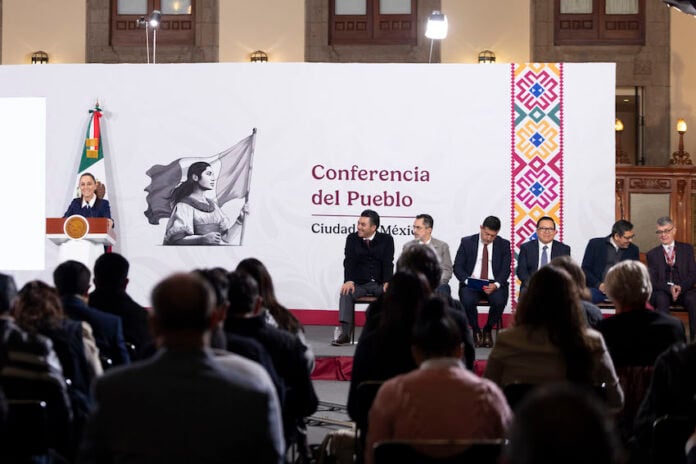
President Claudia Sheinbaum held her Friday morning press conference in Acapulco, the largest city and most popular tourism destination in the state of Guerrero.

It was the second consecutive day that Sheinbaum held her mañanera outside Mexico City as she fronted the press in Cuernavaca on Thursday morning.

“It’s warm [here], not like yesterday in Cuernavaca where the air was cold,” the president said at the start of her press conference.

After presentations by various government officials on issues pertinent to Acapulco and the state of Guerrero, Sheinbaum fielded questions from reporters.

Sheinbaum’s call with Lula

Asked about her telephone conversation on Thursday with Luiz Inácio Lula da Silva, Sheinbaum said that she and the Brazilian president spoke about “many issues.”

“We spoke about the situation in Latin America and the defense of sovereignty,” she said.

A post from Brazilian president Lula reading: I also spoke by phone this Thursday with the President of Mexico, @Claudiashein . We repudiate the attacks against Venezuelan sovereignty and reject any view that may imply the outdated division of the world into zones of influence. In this context, we reiterate the defense of multilateralism, international law, and free trade, and emphasized the interest in continuing to cooperate with Venezuela in favor of peace, dialogue, and the stability of the country and the region. I invited President Sheinbaum to make a visit to Brazil, on a date to be negotiated between the foreign ministries of the two countries, and we agreed to establish cooperation in combating violence against women.
Brazilian President Lula shared about their phone call on the social media platform X. (Screenshot/X)

In a social media post, Lula wrote that he and Sheinbaum condemned “the [U.S.] attacks against Venezuelan sovereignty” during their call, and rejected “any view that might imply a return to the outdated division of the world into spheres of influence.”

While Mexico condemned the U.S. military’s intervention in Venezuela last Saturday, Sheinbaum noted that she explained to Lula that Mexico has a security “understanding” with the United States that it is currently “strengthening.”

She also acknowledged that the Brazilian president invited her to visit Brazil in May.

“I told him that we were going to consider [the invitation],” Sheinbaum said.

“He also told me that they’re doing very significant work to attend to [the problem of] violence against women, which they also have in Brazil. And I proposed that [Women’s Minister] Citlalli [Hernández] get in touch with them so that they know what we have done [in Mexico],” she said.

Sheinbaum responds to Trump’s remarks about ‘hitting’ cartels on land

While speaking about her call with Lula, Sheinbaum turned her attention to “the statements President Trump has made in recent days.”

She was specifically referring to Trump’s remarks to Fox News on Thursday.

“We’ve knocked out 97% of the drugs coming in by water, and we are going to start now hitting land, with regard to the cartels,” the U.S. president said.

“The cartels are running Mexico; it’s very sad to watch and see what’s happened to that country,” he added.

Sheinbaum gives her daily press conference from a podium at a outdoor pavilion in Guerrero
President Sheinbaum gave her Friday presser from Acapulco, Guerrero, where she addressed recent comments by U.S. President Trump about military strikes on Mexican cartels. (Gabriel Monroy / Presidencia)

Sheinbaum played down the seriousness of Trump’s remarks, attributing them to his unique communication style.

“In short, we believe it’s part of his way of communicating, but, in any case, yesterday I asked Foreign Minister Juan Ramón de la Fuente to make direct contact with the secretary of state,” she said, referring to Marco Rubio, who has spoken in positive terms about the security cooperation between Mexico and the United States.

“And if it’s necessary, we’ll speak to President Trump to strengthen [security] coordination within the framework that we’ve already explained on several occasions,” Sheinbaum said, referring to a framework premised on respect for sovereignty and territorial integrity.

On repeated occasions, the president has asserted that a U.S. attack against Mexican cartels on Mexican soil “won’t happen,” even after Trump said in November that “strikes in Mexico to stop drugs” were “OK” with him.

In light of the United States’ audacious intervention in Venezuela — and Trump’s remarks on Thursday — the likelihood of a U.S. military attack against cartels in Mexico, six of which the U.S. government has designated as foreign terrorist organizations, certainly appears to have increased.

In what would amount to an attempt to stave off such a possibility, Sheinbaum stressed that her government is willing to “further strengthen the [security] relationship” with the United States and “strengthen coordination” on security matters.

Trump: The US will ‘now’ start hitting Mexican land targets

She didn’t specify how bilateral coordination could be strengthened, but offering one example of the current security collaboration between Mexico and the United States, Sheinbaum noted that the Mexican Navy maintains contact with the U.S. Coast Guard “in case a vessel or boat approaches [Mexican waters] so that it can be apprehended through coordinated efforts, without the need for force.”

She subsequently stressed that her government wants to maintain its security cooperation with the Trump administration, before declaring: “We don’t want to think about any other scenario.”

During the current Trump administration, the United States has flown drones over Mexico to spy on drug cartels and hunt for fentanyl labs in missions that Sheinbaum says were requested by her government.

She is steadfastly opposed to any unilateral, unrequested U.S. mission in Mexico, as such an action would violate the sovereignty of a country that hasn’t forgotten the consequences of past U.S. interventions, including the loss of vast swathes of its territory to its northern neighbor in 1848.

By Mexico News Daily chief staff writer Peter Davies (peter.davies@mexiconewsdaily.com)

Mexico’s formal jobs market struggled in 2025, but gig work saved the day

0
motorcycle delivery driver
Nearly three out of every four jobs created in 2025 were for work linked to digital platforms, such as delivery and ride-hailing drivers. (Victoria Valtierra/Cuartoscuro.com)

Mexico’s Social Security Institute (IMSS) reported that 278,697 formal jobs were created last year, a second consecutive year in which job creation failed to top 300,000.

The performance was especially disappointing for President Claudia Sheinbaum, as it was the lowest formal employment figure in a president’s first full year in office since Vicente Fox in 2001. Sheinbaum took office in October 2024.

worker
Job creation in 2025 exceeded some forecasts but was still the lowest in 15 years, except for the 2020 COVID year and last year’s dismal performance. (@ntrzacatecas/on X)

Although Mexico’s economy typically slows down in the first years of a new administration, Bloomberg News reported that “the weakness of growth was accentuated by a marked contraction of private investment, a cut in public spending to reduce an unprecedented fiscal deficit and the uncertainty due to Donald Trump’s tariffs.”

The IMSS report, published on Jan. 8, showed that formal job creation was the second-lowest observed in the past 15 years, not counting 2020, when the COVID-19 pandemic hit. The poorest performance occurred in 2024 when only 213,933 formal jobs were created.

It’s worth noting that formal job creation exceeded the central bank forecast which projected the generation of between 60,000 and 160,000 jobs for all of 2025. It also exceeded the 180,000 jobs estimated by the Mexican Institute of Finance Executives Expectations Survey.

On the other hand, between 2010 and 2019, annual formal job creation consistently exceeded 600,000 positions, even topping 800,000 in 2017.

The main engine in creating jobs in 2025 corresponded to workers linked to digital platforms, which accounted for nearly three out of every four jobs created (74.1%).

The employment situation reflects a lack of dynamism in the economy and the inability of the productive apparatus to generate formal jobs outside of digital schemes, economists say.

“If platform workers are excluded, job growth for the year was 0.3%, lower than the expected 0.5%,” Rodolfo Ostolaza, deputy director of Economic Studies at Banamex, said.

The creation of only 72,176 jobs outside of the digital sector reveals underlying stagnation, Ostaloza said.

The weight of platform employment during 2025 occurred in the context of a July-to-December pilot program for incorporation into social security for delivery drivers and app drivers which allowed them to be registered within the IMSS.

“Without this component, the labor market would have shown a significantly weaker performance, both in terms of job creation and social security affiliation,” he said. 

Even so, only 13% of the workers within the pilot test met the threshold to be considered fully insured.

At the same time, job losses in December reached 320,692 jobs, in line with the seasonal adjustment observed recurrently at the end of each year.

The monthly layoffs were lower than that recorded in December 2024 (405,259), but it was the second largest of the last decade in proportional terms, representing 53.5% of the jobs that had been generated up to November.

Of the nine sectors into which the IMSS divides the economy for the purpose of employment registration, five grew in 2025; however, manufacturing, construction, agriculture and extractive industries all lost jobs.

The sectors with the highest annual percentage growth in jobs were transportation and communications (13.7%, due primarily to railway construction), commerce (3.1%), electricity (2.1%) and services (1.6%).

With reports from Bloomberg Online and El Economista

Discover Similandia Los Angeles, Mexico’s top pharmacy’s US flagship

0
Similandia in Hollywood
Dr. Simi's first incursion into the U.S. market takes place in no less a locale than Hollywood — the real place, not the film industry symbol — right on Hollywood Blvd. (Similandia LA / Facebook)

Beloved Mexican mascot Dr. Simi is now starring in Hollywood. Farmacias Similares, Latin America’s largest pharmacy chain, has opened Similandia Los Angeles — its first flagship U.S. store.

With an area of 140 square meters (1,507 square feet), the new store — part of the pharmacy’s initial push into the United States — is not selling prescriptions and medications due to strict U.S. and FDA regulations.

Rather, it is focusing on health products and themed merchandise surrounding Dr. Simi, including the brand’s iconic Simipeluche, a plush toy that’s a cultural phenomenon in Latin America.

The shop is located at 6818 Hollywood Boulevard — within a stretch of the Hollywood Walk of Fame — and is open from 9 a.m. to 11 p.m. daily. A grand opening took place in September 2025.

The store also offers interactive experiences such as video games, dance challenges and selfie stations. One of the activities is “building” a Dr. Simi doll by choosing various outfits and accessories.

A fiberglass sculpture of Dr. Simi dressed as a charro (traditional Mexican horseman) welcomes visitors at the entrance, while murals by Israeli artist Samuel Hagai depict the popular mascot in costumes from mariachi to superhero.

Inside, displays showcase the work of the SíMiPlaneta Foundation supporting environmental causes in Mexico.

Dr. Simi is often in the news in Mexico, where there are already five Similandia-branded stores in greater Mexico City and one in Zapopan, Jalisco, according to Similandia.com.

Over the final five weeks of 2025, for example, the Dr. Simi Foundation set a Guinness World Record for constructing the largest bottle cap mosaic not long after running the second annual Simifest — an 11-hour music festival that drew more than 15,000 people and was promoted via “Simisónico,” a series of in-office concerts like NPR’s Tiny Desk concerts.

Additionally in 2025, Dr. Simi launched a line of budget-friendly veterinary clinics; debuted a Dr. Simi flight simulator and store in Aztlán amusement park; and received thousands of visitors to its four-room Dr. Simi museum and café in Mexico City.

But the store in Los Angeles is a whole new world, one recently experienced by Mexican actor-comedian Eugenio Derbez.

When visiting the shop in October, Derbez discovered a plush Dr. Simi doll dressed as his character, Ludovico P. Luche, from the old Mexican sitcom “La familia P. Luche” (2002-2012).

“It felt really nice, to be honest,” he said in the newspaper El Universal. “Especially because Dr. Simi has become an iconic figure for Mexicans, and seeing him on the street here in Los Angeles made me feel very proud.”

The plush toys sold at Similandia are handmade in Puebla by employees with disabilities through the social enterprise CINIA, which stands for capacitación (training), industria (industry) and artesanías (crafts). Factory workers craft about 1,000 dolls daily, employing more than 400 people.

Farmacias Similares began its U.S. expansion in 2025, establishing an office in Austin, Texas, and announcing plans to initially focus on locations in California and Texas, to be followed by New York, Illinois, Arizona and Florida.

For now, the chain has partnered with CVS Pharmacy to sell its products nationwide.

CVS locations in Las Vegas are the first to carry supplements, over-the-counter medicines and cosmetics, with California and Texas stores to follow.

“This collaboration with Farmacias Similares is the latest example of how we personalize our assortment for our Hispanic customers,” said Alfredo Martínez, associate vice president of Hispanic Strategy at CVS Health.

Farmacias Similares, founded in 1997, operates more than 10,500 branches in Mexico, Colombia and Chile — and, now, one in Hollywood.

With reports from KABC, El Diario Noroeste, El Universal and El Economista

Mexico City removes all street vendors from its Historic Center — for now

3
street vendors
Mexico City street vendors, such as these near the Palacio de Bellas Artes and the Alameda, will be absent from the Historic Center while the city finalizes and implements a new plan to organize and regulate the informal businesses. (Victoria Valtierra/Cuartoscuro.com)

The Mexico City government has begun establishing order in the Historic Center, beginning with the temporary removal of street vendors this week.

While the ubiquitous street merchants traditionally take a one- or two-week break after the year-end holiday season, Mayor Clara Brugada said her administration had reached agreement with the vendors to coordinate the complete reorganization of informal commerce in the city center.

pedestrians in the Historic Center of cdmx
The goal of the new regulatory regimen in the Historic Center is to encourage pedestrians to stroll pleasantly among the established businesses and attractions while allowing informal vendors to provide options and make a living. (Camila Ayala Benabib/ Cuartoscuro.com)

“Today the main streets and avenues of the Historic Center are clear,” Brugada said Wednesday, “in this first stage of the reorganization we have been preparing for.” 

“By the end of January, commerce will return, but under the terms of the reorganization program,” she said.

Government Secretary César Cravioto said new restrictions will be established in specific areas of the Historic Center.

The main streets and avenues, as well as other public areas, are currently free of street vendors, the mayor said, inviting residents and tourists to check it out first-hand.

“Go take a look around; there are no street vendors,” she said.

The newspaper Excelsior reported that some Indigenous vendors were selling goods in and around the Zócalo on Wednesday, while Indigenous vendors from Triqui, Mazahua and Otomí communities were camped out alongside City Hall and conducting a sit-in, demanding permanent spaces to operate.

Brugada said talks with the downtown street vendors, or ambulantes as they’re often called, are ongoing via the Advisory Commission for the Reorganization and Regulation of Street Vending, which was established in October. 

She said the program seeks to establish new rules while preserving freedom of movement. She said it is part of her administration’s public commitment to fully establish order by mid-year, in time for the World Cup which kicks off in Mexico City on June 11. 

Brugada acknowledged the challenge is not only operational, but also legal and social.

“Our goal is to guarantee both the right to work and the recovery of public space to allow for unfettered pedestrian mobility,” she said. “The reintegration (of the vendors) will be gradual and will be carried out according to the guidelines agreed upon.”

The city’s reorganization program began last year as informal commerce in the Historic Center grew by 25% in 2025, forcing authorities to enforce existing rules, issue sanctions and carry out permit reviews. 

The newspaper El Sol de México reported that the city removed more than 65,000 vendor stalls last year for violations of existing regulations. This included the confiscation of merchandise, including clothing, toys, accessories, gifts and food.

Some of the actions were prompted by formal complaints filed by downtown residents and, although city officials say 63% of all complaints were addressed, vendors often return and occupy the same spaces.

With reports from Proceso, Excelsior, El Sol de México and Infobae

Trump: The US will ‘now’ start hitting Mexican land targets

48
President Donald Trump Speaks During Mexican Border Defense Medal Presentation in the Oval Office of the White House, Washington, DC on December 15, 2025
The U.S. president's threat was not subtle: “We’ve knocked out 97% of the drugs coming in by water, and we are going to start now hitting land, with regard to the cartels.” (Shutterstock)

After the Jan. 3 raid on Venezuela that captured that country’s president, analysts and everyday residents worried that Mexico may be the next target. U.S. President Donald Trump has now validated those concerns, stating bluntly that the U.S. military could begin land strikes on drug cartels in Mexico.

“We’ve knocked out 97% of the drugs coming in by water, and we are going to start now hitting land, with regard to the cartels,” Trump told Fox News host Sean Hannity Thursday. “The cartels are running Mexico; it’s very sad to watch and see what’s happened to that country.” 

Mexican President Claudia Sheinbaum, who had previously condemned the U.S. military actions in Venezuela, responded on Friday by saying that defending national sovereignty is a priority in light of Trump’s statements.

At the same time, she called for stronger coordination with the U.S. on maritime security.

During her daily morning press conference, Sheinbaum highlighted the Mexican Naval Ministry’s surveillance in Mexico’s continental waters, insisting it has provided concrete results in the fight against drug trafficking.

“We are in contact with the U.S. government and the Coast Guard in case a vessel or boat approaches, so that it can be apprehended through coordinated efforts, without the need for force,” she said, adding that the Navy has seized 1.6 tons of cocaine in the past year. 

“We want to continue working as necessary to further strengthen coordination within the framework of defending our water sovereignty and the territorial integrity of Mexico,” she said.

The White House has yet to clarify Trump’s remarks, nor has it provided additional information on the timing or scope of the potential land attacks.

Since September, the U.S. has carried out strikes on approximately 30 so-called narcoboats allegedly from Venezuela, resulting in the deaths of more than 100 people. These operations were conducted without a court order or congressional mandate.

Trump also said U.S. forces recently struck a docking facility for such boats in Venezuela and, this week, U.S. forces boarded and seized a Russian-flagged oil tanker in the Atlantic Ocean.

The U.S. has accused the ship of breaking sanctions and shipping Iranian oil, although the BBC reported that it has historically transported Venezuelan crude oil. Reports suggest it is empty at the moment.

Last February, Trump designated six Mexican cartels as foreign terrorist organizations, a move Sheinbaum criticized as threatening Mexico’s sovereignty. In November, NBC News reported that the U.S. military was training for ground operations in Mexico.

Last month, the digital news outlet Código Magenta reported that U.S. operations might even target past and present Mexican politicians with alleged links to drug cartels.

Speculation about U.S. intentions with regard to Mexico has intensified since the Venezuelan operation which prompted mixed reactions — and protests — across Mexico.

There’s an economic threat as well

However, there are other concerns for Sheinbaum.

The Trump administration has announced that it would reincorporate Venezuelan oil into international markets, a move that would reshape the global energy map and economically threaten Mexico, a principal supplier to its northern neighbor.

A worker walks by gas lines at a PDVSA Venezuela oil facility
A U.S. takeover of Venezuelan oil resources could be a problem for Mexico, which is a major crude oil supplier for the U.S. (Petróleos de Venezuela)

George Baker, an energy sector analyst based in Houston and the editor of the specialized newsletter Mexico Energy Intelligence, told the digital publication Animal Político that Mexico is especially vulnerable.

Baker warned that “Mexico is at risk of losing its second-place position (Canada is the top supplier) as a source of crude oil supply to the United States, due to the likely advance of PDVSA, Venezuela’s national oil company that has been restricted for years due to financial and operational problems.”

U.S. Energy Secretary Chris Wright said on Wednesday that the U.S. is already in talks with major trading firms and banks to immediately move between 30 million and 50 million barrels of Venezuelan oil stored on floating platforms and on land.

With reports from El País, EuroNews and Milenio

Oaxacan coast wins a spot among Nat Geo’s best 2026 destinations

3
An aerial view of the Oaxacan coast in Mazunte
The town of Mazunte, located between Puerto Escondido and Huatulco on the Oaxacan coast, is one of those quiet coastal areas that made Oaxaca's Costa Chica one of Nat Geo's favorite spots. (Hersom Alexander / Pexels)

As travel guides release their must-visit destinations for the year, Mexico keeps popping up.

This time around, National Geographic included the Costa Chica region in the southern state of Oaxaca as one of the top places to travel to in 2026.

“It’s a surfer’s dream, but on a quieter coastline,” the magazine says.

Historically, Oaxaca City, the state’s capital, has gotten the spotlight due to its vibrant cultural scene, pre-Hispanic monuments, culinary heritage and Mexican traditions. But just 100 miles southwest of the colonial city lies Costa Chica, a stretch of coastline between Pinotepa Nacional and the Huatulco area.

Costa Chica has remained a “less traveled, quieter destination than Mexico’s more popular and accessible stretches of sand,” National Geographic says, adding that still, “it is every bit as enticing.”

Renowned for its world class surf, the travel publication praises the destination’s “spectacular, undeveloped beaches, endemic birds, design-centric hotels, and countercultural enclaves, such as the queer-friendly, clothing-optional community of Zipolite.”

Even though the area has increased in popularity with national and international travellers, many beaches remain underdeveloped, making them attractive to those seeking quiet places, surfing, and community projects rather than large resorts.

Places like Puerto Escondido and nearby beaches are world-renowned for surfing — the Zicatela wave, called “Mexican Pipeline,” is emblematic — and early this year, Puerto Escondido was recognized as a World Surfing Reserve, to promote the conservation of historic beaches.

In addition to long stretches of uncrowded beaches, Costa Chica stands out as one of the few places in Mexico with a strong Afro-Indigenous identity, which reveals itself in Indigenous and mestizo dances and music such as the chilenas of Pinotepa and the sones of Pochutla.

Nat Geo also highlights the area’s inclination for architecture and design, starting with Casa Wabi arts complex, designed by celebrated Japanese architect Tadao Ando. It also mentions two nearby hotels, both designed by Mexican architect Alberto Kalach: Casona Sforza, an adults-only boutique hotel consisting of 11-suites, and the 100 percent solar Grupo Habita eco-hotel Hotel Terrestre.

In 2025, Hotel Terrestre earned a Michelin Key, recognizing exceptional experience the hotel offers to guests.

Reaching this paradisiac coastline is now easier than ever following the opening of a new superhighway between Oaxaca City and Costa Chica, which turned the 10-hour drive through the mountains into a 3.5-hour drive. And in December, American Airlines began operating a nonstop service between Dallas-Fort Worth and Puerto Escondido.

Mexico News Daily

Tijuana’s CBX: The ‘impossible dream’ is now 10 years old

5
Cross Border Xpress
Once considered an "impossible dream," the Cross Border Xpress has now been open for a decade. (Cross Border Xpress)

Serious thought about a bi-national airport for San Diego and Tijuana really began after the terrorist attacks on Sept. 11, 2001. Of course, Tijuana International Airport sits immediately across the border from the U.S. The airport is so close to the border that its runway veers from southeast to northwest and pilots must take a sharp left to avoid crossing into U.S. airspace.

San Diego International Airport, just 24.7 miles north, has limited room for expansion due to its proximity to the city on one side and the bay on the other, making it the busiest single-runway airport in the country. By 2006, the U.S. Navy had also stated unequivocally that potential expansions for San Diego International Airport using Marine Corps Base Camp Pendleton, Marine Corps Air Station Miramar and Naval Air Station North Island were not acceptable. That left a bi-national airport as the only viable solution — maybe.

Supporters and early efforts

Cross Border Xpress
Supporters on both sides of the border were necessary to make this project a possibility. (Keizers/Wikimedia Commons)

Various entrepreneurs from both sides of the border had tried for years to develop plans to make airport cross-border travel work. These have included businessman Ralph Nieders, real estate magnate and civic leader Malin Burnham and Luis De La Calle, a Mexican economist and consultant, among others.

There were previous attempts to develop a cross-border airport called Twin Ports, utilizing San Diego City-owned Brown Field on the U.S. side and Tijuana International Airport in Mexico, but these failed due to financing as well as problems with land acquisition on the U.S. side. In addition, presidential permits would be required from both the U.S. and Mexican governments to make a new border crossing between Tijuana and San Diego.    

Meanwhile, there was increased interest in the project by Guadalajara-based Grupo Aeroportuario Pacifico (GAP), operators of a dozen airports in Mexico, including the one in Tijuana. Instrumental with GAP was the enthusiastic support of Enrique Valle Alvarez, Director of the Tijuana airport. Also supportive were the San Diego Regional Chamber of Commerce and the South County Economic Development Corporation.

Partners in developing the project

The key to success was the acquisition of land on the San Diego side, which was completed along with the required presidential permits in August 2010. However, an anticipated problem was the estimated US $8 million annual budget for U.S. Customs and Border Protection (CBP), which CBP insisted be paid by the developer, since, according to its reasoning, the development was a private venture.   

Led by Alan Bersin, the previous chairman of the San Diego County Regional Airport Authority and later U.S. Department of Homeland Security Secretary for International Affairs and Special Representative for Border Affairs, as well as the Commissioner of U.S. Customs and Border Protection, an agreement was reached that the operators of a cross-border terminal would fund the costs of CBP. 

GAP strategic partners Eduardo Sanchez-Navarro, Carlos Laviada Ocejo and his wife, Laura Díez Barroso Azcárraga, were joined by Sam Zell of Chicago-based Equity Group Investments to fund the project. Land was then purchased on the San Diego side for the terminal as well as for parking spaces.

The Cross Border Xpress becomes a reality

Cross Border Xpress terminal
The terminal that connects two countries. (City Captain Transportation)

There was some concern about what might happen to the cross-border terminal should Mexico ever close the border, making the planned San Diego terminal a white elephant.  Ironically, it was the U.S. that closed the border during the COVID pandemic.

With all objections overcome, construction began in June 2014. The distinctive terminal was designed by its architect, the late Ricardo Legorreta. Special arrangements had to be made to permit the primary contractor, Turner Construction, to build the bridge that would cross the border and construct the connections on the Tijuana International Airport terminal.     

After more than a decade and all real and potential issues solved, the cross-border terminal, renamed Cross Border Xpress (CBX), opened on Dec. 9, 2015. Grateful passengers began using the 390-foot secure skybridge crossing between Mexico and the U.S., eliminating long waits at the other land border crossings. The San Diego Terminal even has its own airline code designation: TJC. Access is available to 40 destinations within Mexico and two in China (Beijing and Shenzhen), as well as Phoenix in the U.S.   

10 years later

Since opening, 25 million ticketed passengers have used CBX, contributing to a 1.4% annual growth rate of Tijuana International Airport. There are 8,500 spaces available for short- and long-term parking. Uber and Lyft, as well as car rental companies, have designated pickup locations. Under the leadership of Jorge Goytortúa, Chief Executive Officer and his team, CBX and its facilities on both sides of the border continue to expand and make travel from California to Mexico seamless and easy.

Today’s air passengers take for granted the ease of accessing Tijuana International Airport from the CBX San Diego Terminal. Most have no idea how hard it was for the many players who made “the impossible dream” a reality 10 years ago.

James Clark writes for Mexico News Daily.